
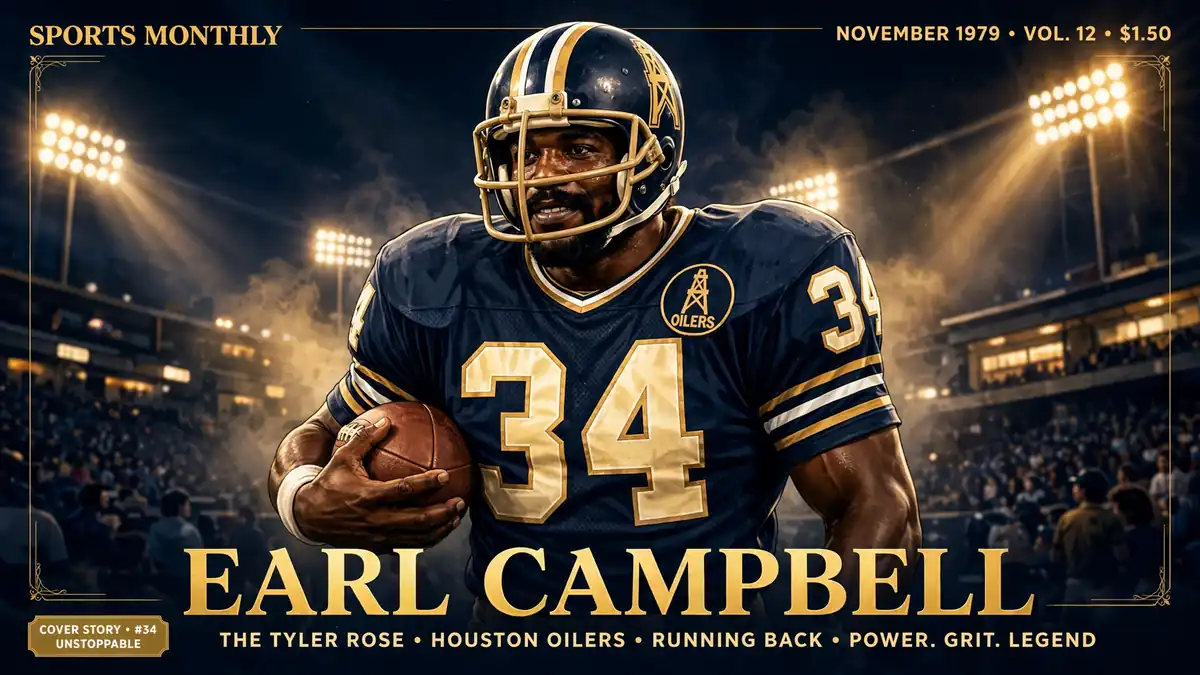
Earl Campbell‘s net worth is estimated at $20 million to $25 million as of November 2026. The Tyler Rose built that fortune the hard way: a six-year, $1.4 million rookie contract that made him one of the best-paid players of his era, three straight NFL rushing titles, and then a second career as the president of a Texas sausage company that did about $10 million in sales in 2008. Celebrity Net Worth puts him at the low end of the range at $20 million, while most other 2026 profiles settle on $25 million — and the gap between those two numbers says a lot about how wealth from a pre-free-agency NFL career gets counted.
Earl Campbell: Quick Facts
| Estimated net worth | $20 million – $25 million (range: $20M–$25M) |
|---|---|
| Profession | Former NFL running back; founder and president of Earl Campbell Meat Products |
| Nationality | American |
| Born | March 29, 1955 (age 71) |
| Height | 5 ft 11 in (1.80 m) |
| Primary income sources | NFL salaries and endorsements (1978–1985); Earl Campbell Meat Products; appearances and licensing |
| Active years | 1974–1985 (college and NFL); business career from 1990 |
| Last reviewed | November 2026 |
- Early Life and Background
- Education
- Career Journey
- Rise to Fame
- Main Sources of Income
- Salary and Earnings
- Businesses and Investments
- Brand Deals and Sponsorships
- Houses, Cars and Other Assets
- Awards and Achievements
- Net Worth Growth Over the Years
- Social Media Presence
- Personal Life
- Sources & Reporting
- Frequently Asked Questions
- Final Thoughts
Early Life and Background
Earl Christian Campbell was born on March 29, 1955, in Tyler, Texas, the heart of the East Texas region that grows the roses behind his nickname. He was one of 12 children born to B.C. and Ann Campbell, and the family lived on modest means — Campbell has said many times since that his family was never rich in money, but rich in love. That line gets repeated a lot in profiles of him, and it matters here because it explains the first thing he did with NFL money: he built his mother a new house in Tyler.
His father, B.C. Campbell, died in 1966, when Earl was 11. Ann Campbell raised the family after that, and Earl grew up doing the kind of physical work — chores, yard work, helping around the house — that later coaches would point to when they tried to explain a running back who seemed to enjoy contact more than the defenders trying to tackle him. Tyler in the 1960s and early 1970s was a football town, and Campbell was its brightest prospect from an early age.
At John Tyler High School, Campbell became a local phenomenon. He led the John Tyler Lions to the Texas Class 4A state championship in 1973, running behind a line that could not always keep defenders out of the backfield — which meant Campbell spent his teenage years breaking tackles at or behind the line of scrimmage, a skill that defined his professional career. College recruiters across the country wanted him. He stayed in Texas.
The nickname “The Tyler Rose” followed him from those high school days, a nod to Tyler’s identity as the Rose Capital of America and to a running style that was anything but delicate. It stuck for his entire career, and it still names the award given each year to college football’s best offensive player with Texas ties — an award Campbell himself presents.
Education
Campbell enrolled at the University of Texas at Austin in 1974 and played four seasons for the Longhorns under head coach Darrell Royal, finishing under Fred Akers. He arrived as a freshman and rushed for nearly 1,000 yards in his first season, an immediate signal that Texas had landed a rare talent. As a sophomore in 1975 he topped 1,100 rushing yards and earned first-team All-America honors, the first of two All-America selections in Austin.
His junior season in 1976 was cut short by a hamstring injury, and for a time it looked as if the wear on his body might cap his ceiling before his career truly started. Instead, his senior year became one of the great individual seasons in college football history. In 1977 Campbell rushed for 1,744 yards and 18 touchdowns, carried Texas to an undefeated regular season and a No. 1 ranking, and won the Heisman Trophy in December 1977 as the best player in college football. He was a unanimous All-American that season.
He finished his college career with 4,443 rushing yards and 40 rushing touchdowns in 40 games — a yardage total that still sits among the best in Longhorns history, and a touchdowns-per-game rate that tells you how central he was to everything Texas did on offense. Texas retired his No. 20 jersey, and in 1990 he entered the College Football Hall of Fame, one year before his induction into the Pro Football Hall of Fame.
Campbell never chased a degree as a public credential, and his post-football life kept him close to the university anyway: he later served as a special assistant to the athletic director at Texas, a role that kept him around the program, its players, and its donors for years. The school remained the anchor of his public life long after his playing days ended.
Career Journey
The Houston Oilers wanted Campbell so badly that owner Bud Adams traded up to get him. Houston sent tight end Jimmie Giles and draft picks to the Tampa Bay Buccaneers for the No. 1 overall selection in the 1978 NFL Draft, then used it on the Heisman winner from Texas. On May 2, 1978, in a ballroom at the Roosevelt Hotel in New York City, the Oilers made Campbell the second No. 1 overall pick in franchise history. He signed a six-year, $1.4 million contract — a figure that looks small today but was enormous in 1978, when the average NFL salary sat near $100,000.
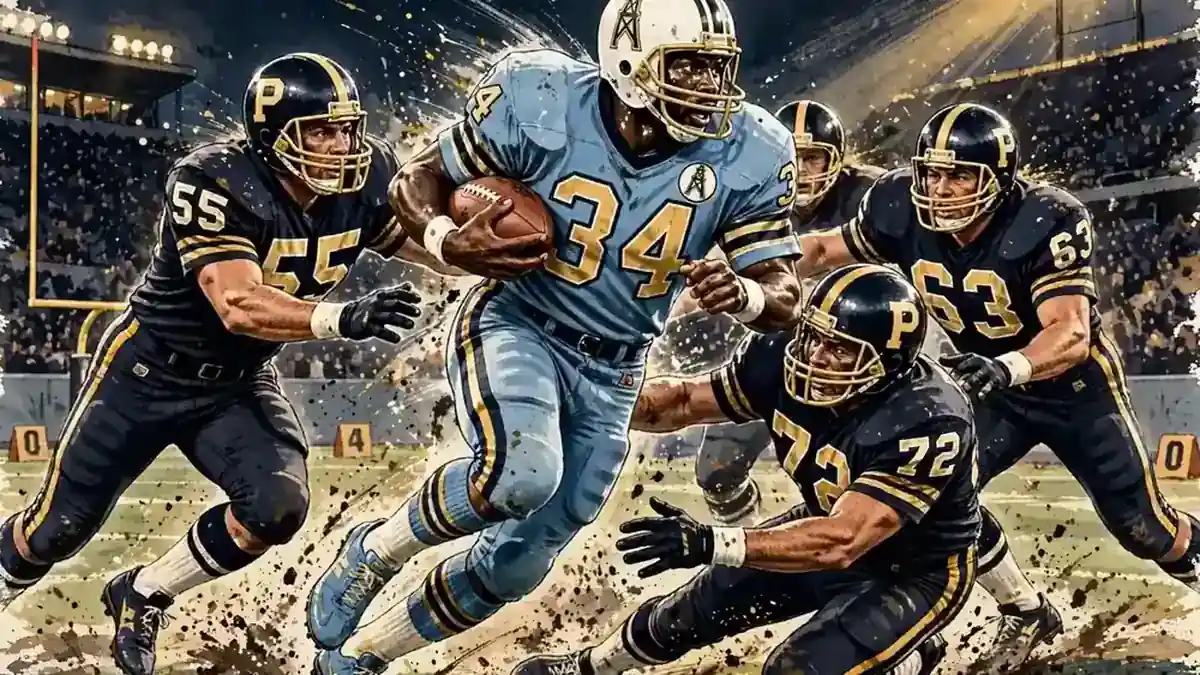
His rookie season rewrote expectations. Campbell led the NFL with 1,450 rushing yards — a rookie record at the time — and 13 touchdowns, winning Offensive Rookie of the Year and Offensive Player of the Year honors and finishing second in MVP voting. The signature night came on Monday Night Football against the Miami Dolphins, when he ran for 199 yards and four touchdowns in a 35–30 Oilers win, dragging defenders the last few yards on carry after carry while a national audience watched. Houston, a franchise that had been drifting, suddenly had an identity and a packed Astrodome.
The next two seasons made him the most feared runner alive. In 1979 he won the AP NFL Most Valuable Player Award after leading the league in rushing yards (1,697) and touchdowns (19). In 1980 he was better still: 1,934 yards, 13 touchdowns, and four separate 200-yard games, including a 206-yard afternoon against the Chicago Bears. He led the league in rushing in each of his first three seasons, 1978 through 1980, averaging nearly 1,700 yards a year over that stretch.
That run coincided with the “Luv Ya Blue” era under head coach Bum Phillips, when the Oilers reached the AFC Championship Game in both 1978 and 1979, losing both times to the Pittsburgh Steelers. Campbell was the centerpiece of those teams — the offense ran through him, the crowds chanted for him, and the team’s marketing leaned on his shoulders. He made five Pro Bowls (1978–1981 and 1983) and was first-team All-Pro in each of his first three seasons.
Injuries, though, were already taking their cut. The running style that made him famous — straight ahead, through people, never out of bounds — carried a price, and by 1982 knee problems and the accumulated punishment began to slow him. He still ran for 1,301 yards and 12 touchdowns in 1983, his fifth Pro Bowl season, but the explosiveness was fading. Six games into the 1984 season, Houston traded him to the New Orleans Saints, reuniting him with Bum Phillips, who was coaching there. Campbell spent a season and a half in New Orleans, played his final game on December 22, 1985, and announced his retirement in the preseason of 1986, saying the game had taken too much of a toll on his body.
His career numbers: 2,187 carries for 9,407 yards, a 4.3-yard average, 74 rushing touchdowns, plus 121 receptions for 806 yards. The yardage total looks modest beside the career marks of Emmitt Smith or Barry Sanders, but Campbell did his damage in eight seasons, three of them as the most productive runner in football — a peak as high as any back who ever played. The Hall of Fame agreed: he was inducted in 1991, his first year of eligibility, and Houston retired his No. 34.
Rise to Fame
Campbell’s rise was unusually fast and unusually public. The Heisman in December 1977 made him a national figure before he ever took an NFL snap; the trade up to the No. 1 pick kept him in the headlines through the spring; and then the 199-yard Monday night game against Miami in his rookie season put his running style in front of the largest television audience in the sport. By the end of 1978, sportswriters were already comparing him with the great power backs of earlier eras — and noting that none of them had arrived this quickly.
What set him apart was not speed alone, though he had plenty of it for a 232-pound back. It was the refusal to go down. Defensive players from that era still describe tackling Campbell as a two-man job with a poor success rate, and the film supports them: he ran through arm tackles, carried defenders on his back, and finished runs by falling forward. The style made him appointment viewing in an era when the NFL was becoming a television product, and it made the Oilers — a franchise with little national profile before him — a team people tuned in to see.
The 1979 MVP season sealed it. Campbell carried Houston on a five-game winning streak that ended with a 30–24 Thanksgiving Day win over the Dallas Cowboys, in which he ran for 195 yards and two touchdowns in front of a holiday audience. He finished that season with 1,697 yards and 19 touchdowns, and the MVP vote was not close. The next year, 1,934 yards and four 200-yard games made the argument moot: for a three-year stretch, Earl Campbell was the best running back on the planet, and everyone in football knew it.
Fame stuck to him after retirement, too, in a way that eludes many players of his era. The Heisman, the Hall of Fame, the retired numbers in Houston and Austin, and the Tyler Rose Award — named for him and presented by him each year — kept his name in circulation. Unlike many retired stars, he did not fade into nostalgia; he stayed visible in Texas as a businessman and a university figure, which is part of why his name still draws search traffic nearly four decades after his last game.
Main Sources of Income
Campbell’s wealth comes from three distinct chapters, and understanding the split matters because the first chapter — football — was much smaller in dollars than modern fans assume. His NFL career ran from 1978 to 1985, before free agency, before the television money explosion, and before running backs signed nine-figure deals. His rookie contract, $1.4 million over six years, was a headline number in 1978. Spread across a career, his total NFL salary earnings likely landed in the low single-digit millions — real money for the era, and a fraction of what a star back earns in a single season today.
The second chapter, and the one that did the most for his long-term wealth, was business. In 1990 he founded Earl Campbell Meat Products, Inc., which manufactures and sells Earl Campbell’s Smoked Sausage, hot links, and barbecue sauce through grocery chains across Texas and beyond. The trade publication Meat & Poultry reported the company had about $10 million in sales in 2008, and it credited Texas grocery chains H-E-B and Brookshire Grocery Co. with carrying the products from the company’s early days. Campbell has served as the company’s president for more than three decades — this was not a licensing deal with his name slapped on a package, but an operating business he ran.
The third chapter is the long tail of a Hall of Fame career: paid appearances, autograph and memorabilia work, licensing, and his role with the University of Texas, where he served as a special assistant to the athletic director. None of these is a fortune on its own, but stacked across forty years after retirement they add up — and, just as importantly, they kept his name and his brand alive while the sausage business did the heavy lifting. The Tyler Rose Award, presented each year to college football’s top offensive player with Texas ties, is both a legacy project and a visibility engine for that brand.
One thing the income picture does not include: a big second act in media. Campbell never became a television analyst in the mold of some of his contemporaries, and he never chased the broadcasting money that padded other retired stars’ fortunes. His post-career income stayed close to Texas — the university, the meat company, and the local business community — which is why his net worth sits in the $20 million to $25 million range rather than the $50 million-plus territory of players who cashed in on broadcasting or national endorsement empires.
Salary and Earnings
The most concrete salary figure in Campbell’s career is also the most famous: the six-year, $1.4 million contract he signed with the Houston Oilers in May 1978. It was, by the standards of its day, a blockbuster. The average NFL salary in 1979 sat near $100,000, which meant Campbell’s deal — about $233,000 a year on average — paid him more than twice the league average from the day he signed. Adjusted for inflation, that $1.4 million is worth roughly $6.5 million in 2026 dollars, a useful reminder of how different the economics of the sport were.
He used the first of that money the way his biography has always suggested he would: he built his mother a new house in Tyler. The draft-day story is a small detail that gets repeated because it is true and because it is characteristic — Campbell, presented with the keys to a brand-new blue Lincoln at the draft, drove it back to Tyler and gave the car back. He was not interested in the trappings.
Later contracts are harder to pin down, because NFL salaries of the early 1980s were not published the way they are today. What the record shows is a player whose bargaining power peaked in 1979 and 1980, when he was the league MVP and the rushing champion, and whose earning power then faded with his knees. The Saints years, 1984 and 1985, paid a veteran back’s salary rather than a star’s. A fair estimate of his total career NFL earnings is in the range of $2 million to $4 million — substantial for the era, and the reason his post-career business mattered so much to his wealth.
For comparison, consider the gap to the modern game. A star running back in 2026 can earn Campbell’s entire career salary in a single season, and the top of the position earns more than $15 million a year. That gap is the single biggest reason net worth profiles of players from Campbell’s era look modest beside today’s stars — and it is also why the $20 million to $25 million range for Campbell is a business story as much as a football story. The football money gave him a start; the sausage company and three decades of operating it built the fortune. His contemporary Joe Montana, who played in the same era and also earned far less on the field than modern quarterbacks, followed a similar path — the field made the name, and the decades after the field made the money.
Businesses and Investments
Earl Campbell Meat Products, Inc. is the center of Campbell’s business life, and its story is more interesting — and more honest — than the usual athlete-brand tale. He founded the company in 1990, five years after retiring from football, to manufacture and sell smoked sausage, hot links, and barbecue sauce under his own name. The products were made through a co-packing deal with J&B Sausage Co. in Waelder, Texas, and sold through Texas grocery chains, with H-E-B and Brookshire Grocery Co. taking the products on when the company was still small. By 2008, Meat & Poultry reported the company at about $10 million in annual sales.
The sausage business has a longer history than the 1990 company, and the distinction is worth making because most net worth profiles blur it. While Campbell was still at Texas, he signed an endorsement deal with Dallas-based Motts Inc. to put his name on a line of smoked sausages that debuted in Texas grocery stores in 1978. That licensed product ran through the late 1990s before Motts discontinued it as sales lagged. The 1990 company was Campbell’s own venture — his capital, his name, his presidency — and it outlasted the licensed product by decades.
The company was not a straight line upward. Campbell and his associates opened a restaurant, Earl Campbell’s Lone Star BBQ, on Sixth Street in Austin in 1999; it closed in 2001. And in the spring of 2021, his Austin food company declared bankruptcy — a fact most net worth profiles of Campbell skip entirely, but one that matters to an honest estimate. A sausage manufacturer in Flatonia, Texas, took on the company’s debts and put Campbell back on the road selling for the new partnership, and Earl Campbell Meat Products continued selling under that arrangement. The brand survived; the original corporate structure did not.
There was also a revival along the way: in 2006, an energy executive secured the rights from Campbell to bring the sausage back under the name Real Earl Campbell Sausage, a separate chapter in the brand’s tangled history. The picture that emerges is of a business that has been real, operating, and regionally significant for more than thirty years — with genuine sales, genuine setbacks, and a genuine bankruptcy — rather than a vanity brand. That is a stronger foundation for wealth than a licensing check, and it is also a more fragile one, which is exactly why the net worth range for Campbell carries a $5 million spread.
Beyond the meat company, Campbell’s investments have stayed close to home: Texas real estate, his long association with the University of Texas, and the Tyler Rose Award, which he has presented since its founding in 2013. He has never been linked to the kind of venture-capital portfolio or restaurant empire that shows up in the wealth stories of some modern athletes. His money stayed in Texas, in businesses he could walk into.
Brand Deals and Sponsorships
Campbell’s endorsement career began before his professional one. The 1978 deal with Motts Inc. — smoked sausage bearing his name in Texas grocery stores — was signed while he was still a Texas Longhorn, and it was unusual for its time: a college star’s name on a grocery product, years before name, image, and likeness deals existed. The sausage debuted in stores across Texas in 1978, the same year he was drafted first overall, and it ran for two decades.
During his playing career, Campbell’s endorsements were typical of a star of his era: regional Texas brands, sporting goods, and appearances, rather than the national campaigns that define modern athlete marketing. The NFL of the late 1970s did not yet pay its stars the endorsement fortunes of today, and running backs — even the best of them — earned less from sponsors than quarterbacks. Campbell’s biggest endorsement asset was always his name in Texas, and the Motts deal was the clearest expression of it.
After retirement, the endorsement model flipped: instead of lending his name to other companies, he built a company around his own name. Earl Campbell Meat Products was, in effect, a thirty-year endorsement of himself — his name on every package, his face at grocery-store appearances, his story in every sales pitch. That is why the company’s 2021 bankruptcy matters to his financial story and why its survival matters too: when your name is the brand, a business failure is personal in a way a failed licensing deal never is.
He has also monetized the Hall of Fame career in the usual ways — autograph signings, memorabilia, paid appearances at corporate and university events — and his role with the Tyler Rose Award keeps him in front of the college football audience every season. None of these is individually large, but together they have provided steady income across four decades, and they explain why a player whose on-field earnings were modest by modern standards still sits in the $20 million to $25 million range.

Houses, Cars and Other Assets
Campbell has lived in Austin, Texas, for decades, and his longtime home there is the centerpiece of his property holdings. Celebrity Net Worth values the estate at roughly $4 million — a substantial piece of the overall net worth, and a reminder that a meaningful share of his wealth sits in Texas real estate rather than in liquid investments. He has kept a low profile about the details of the property, and we do not publish private addresses.
His first major purchase, though, was not for himself. With his rookie-contract money in 1978, Campbell built his mother a new house in Tyler, the town where he grew up and where his mother had raised twelve children on little money. It was the purchase that defined his relationship with wealth from the start: family first, flash second.
Cars have never been a major part of the Campbell wealth story. The draft-day Lincoln — a brand-new blue car handed to him at the Roosevelt Hotel in May 1978 — is the most famous automobile attached to his name, and he gave it back. Later reports have mentioned a custom Cadillac, but Campbell has never been known as a collector, and there is no credible record of the kind of multi-car garage that shows up in the asset lists of modern stars. His money went into the meat company and into property, not into vehicles.
The other asset worth naming is the brand itself. “Earl Campbell” and “The Tyler Rose” carry commercial value in Texas that has lasted nearly fifty years — on sausage packaging, on the Tyler Rose Award, and on memorabilia. It is an intangible asset, hard to price and easy to overstate, but it is real: a name that still sells sausage in Texas grocery stores in 2026 is an asset in a way a retired jersey is not.
Awards and Achievements
Campbell’s trophy case is one of the fullest of any running back of his era, and it is worth listing in full because the awards explain both his fame and his earning power. At Texas he won the Heisman Trophy in 1977, was a unanimous All-American the same year, and earned first-team All-America honors in 1975. Texas retired his No. 20 jersey.
In the NFL he won the AP Most Valuable Player Award in 1979, was named Offensive Player of the Year in each of his first three seasons (1978–1980), was Offensive Rookie of the Year in 1978, made five Pro Bowls (1978–1981 and 1983), and was first-team All-Pro three times (1978–1980). He led the NFL in rushing yards three straight years and in rushing touchdowns twice (1979 and 1980). He was named to the NFL 1970s All-Decade Team and, decades later, to the NFL 100th Anniversary All-Time Team.
The institutional honors followed: induction into the College Football Hall of Fame in 1990 and the Pro Football Hall of Fame in 1991, in his first year of eligibility. Houston retired his No. 34, and he is a member of the Titans/Oilers Ring of Honor. The Tyler Rose Award, established in 2013 and presented each year to the top offensive player in college football with Texas ties, carries his name and his nickname — an honor that is also a living legacy, since Campbell presents the award himself.
For context, here is how Campbell’s career rushing numbers sit beside the other great backs of his era and after — the peer group his name is always measured against:
| Running back | Career rushing yards | Rushing touchdowns | Seasons |
|---|---|---|---|
| Earl Campbell | 9,407 | 74 | 8 |
| Jim Brown | 12,312 | 106 | 9 |
| Barry Sanders | 15,269 | 99 | 10 |
| Emmitt Smith | 18,355 | 164 | 15 |
| Adrian Peterson | 14,918 | 120 | 15 |
Campbell’s totals are the smallest in that group, and the reason is simple: he played eight seasons, and his body gave out at 30. His peak, though, was as high as anyone’s — three straight rushing titles and an MVP — and the Hall of Fame voters weighed the peak, not the longevity. That is the honest way to read his career: short, violent, and brilliant.
Net Worth Growth Over the Years
There is no audited record of Campbell’s wealth year by year, and any growth table for a private individual is an estimate built from the public milestones. The table below is illustrative — it shows how the fortune was assembled, not a set of bank statements — and it uses the documented anchors: the 1978 contract, the 1990 company founding, the 2008 sales figure, and the current $20 million to $25 million range.
| Year | Milestone | Estimated net worth |
|---|---|---|
| 1978 | Signs six-year, $1.4 million Oilers contract; builds mother a house in Tyler | ~$1 million |
| 1980 | Third straight rushing title; 1,934-yard season; peak earning power | ~$2 million |
| 1985 | Retires after eight NFL seasons | ~$3 million – $5 million |
| 1990 | Founds Earl Campbell Meat Products, Inc. | ~$5 million |
| 2008 | Meat company reports about $10 million in annual sales | ~$10 million – $15 million |
| 2016 | $25 million figure first widely cited by net worth profiles | ~$25 million |
| 2021 | Food company declares bankruptcy; brand continues under new partnership | ~$20 million – $25 million |
| 2026 | Range holds: Celebrity Net Worth $20 million; most 2026 profiles $25 million | $20 million – $25 million |
Two things stand out in that timeline. First, the football money was the smallest part of the story: Campbell’s wealth roughly tripled between retirement and 2008, and the growth came from the business, not the field. Second, the $25 million figure has barely moved since it first appeared around 2016 — which is a warning as much as a data point. A number that does not move for a decade is usually a number being copied, not a number being re-checked. Celebrity Net Worth’s lower $20 million figure, updated in November 2025, may reflect the 2021 bankruptcy and the thinner business since; the $25 million consensus may simply be inertia. Our range covers both, and the truth is most likely somewhere inside it.
It is also worth saying plainly what the outlier figures are and why we do not use them. A few content-farm profiles put Campbell at $45 million or even $60 million, with no sourcing, no breakdown, and in one case a claim of $2.5 million a year in licensing income that would make him richer than most active players. Those numbers do not survive contact with the documented record — a $10 million-sales sausage company and a pre-free-agency NFL career do not produce a $60 million fortune — so we leave them out. A range with a named low anchor and a named high anchor is more honest than a single big number nobody can defend.
Social Media Presence
Campbell keeps a low profile online, and that is a deliberate choice rather than an accident. He has no widely verified, actively managed personal account that functions as a public platform in the way modern athletes use social media, and he does not post training clips, endorsements, or daily life to an audience. His public presence runs through institutions instead: the University of Texas, the Pro Football Hall of Fame, and the Tyler Rose Award, which announces its winner each season and puts Campbell in front of cameras when he presents it.
That absence is a generational fact as much as a personal one. Campbell retired in 1986, two decades before social media existed, and his fame was built on television and print, not on follower counts. The trade-off is real: a modern star with his résumé would monetize an audience directly, through sponsored posts and direct-to-fan businesses, in ways Campbell never has. The upside is that his brand has never depended on an algorithm — it rests on a Heisman, a Hall of Fame bust in Canton, and a sausage brand Texans still buy.
Fans looking for him will find him most reliably at Texas football events and at the Tyler Rose Award ceremony each year, and through the Earl Campbell Meat Products brand, which maintains the commercial presence his name carries in grocery stores across Texas.
Personal Life
Campbell married his high school sweetheart, Reuna Smith, in 1980, at the height of his NFL career, and the marriage has lasted more than four decades. Reuna has been a steady presence in his public life, appearing with him at Hall of Fame events and at the Tyler Rose Award ceremonies. Their son Tyler played college football, continuing a family line that runs from John Tyler High School through the University of Texas and into the NFL.
His health after football has been a public story in its own right, and Campbell has been unusually open about it. The punishment his running style invited left him with spinal stenosis and chronic back problems; he has undergone multiple surgeries and has used a wheelchair at times in his later years. In 1999 he co-authored “The Earl Campbell Story” with John Ruane, a book that dealt frankly with his battle with panic disorder — a subject few athletes of his generation discussed in public, and one of the more candid athlete memoirs of its era.
He has lived in Austin for decades, staying close to the university and to the business he built there. The Tyler Rose Award, which he presents each year, is the most visible expression of that rootedness: a Tyler kid, a Texas Longhorn, a Houston Oiler, still handing a trophy to the next generation of Texas football talent. At 71, in November 2026, he remains a working presence in Texas football — a businessman, a university figure, and a living link to the Luv Ya Blue era.
Sources & Reporting
How this article was reported. Figures were checked against named outlets between November 2025 and November 2026. Where sources disagreed on the headline number, we published the range and named both ends. Career statistics come from the standard record books; business figures come from trade reporting and company history.
- Celebrity Net Worth — the $20 million estimate (page updated November 2025) and the roughly $4 million valuation of his Austin estate.
- Wikipedia — career statistics (9,407 rushing yards, 74 touchdowns), awards list, and the six-year, $1.4 million Oilers contract.
- GatorSports (Gainesville Sun) — February 2025 reporting on the 1978 draft, the contract, the house for his mother, and the Lincoln story.
- EBSCO Research Starters — biography and career timeline, including the 1,744-yard Heisman season and the 1990 founding of the meat company.
- Meat & Poultry — January 2010 trade reporting: about $10 million in company sales in 2008, the H-E-B and Brookshire’s relationships, and the J&B Sausage co-packing deal.
- AboutNetWorth — the $25 million consensus figure (updated February 2026).
- Urban Splatter — the $25 million figure and Austin home details (April 2026).
- CollegeNetWorth — the $25 million figure and the 1990 company founding.
- Red Table Meats — the history of the sausage brand, the 1978 Motts Inc. endorsement deal, the 2006 revival, and the spring 2021 bankruptcy.
- Pro Football Reference — season-by-season rushing statistics, used to cross-check the career totals and the peer comparison table.
Reporting window: November 2025 – November 2026. Net worth estimates for retired athletes move slowly and are revised when new business filings or reporting emerge; this article will be updated if the meat company’s position changes materially.
Frequently Asked Questions
What is Earl Campbell’s net worth in 2026?
Earl Campbell’s net worth is estimated at $20 million to $25 million as of November 2026. Celebrity Net Worth puts him at $20 million, while most other 2026 profiles settle on $25 million. The range reflects the uncertainty in valuing a private business — his sausage company — and a pre-free-agency NFL career, rather than any single audited figure.
How much did Earl Campbell make in the NFL?
His best-documented deal was the six-year, $1.4 million contract he signed with the Houston Oilers in 1978 — about $233,000 a year at a time when the average NFL salary sat near $100,000. His total career NFL earnings are estimated at $2 million to $4 million. The bulk of his wealth came after football, from his meat products company.
Is Earl Campbell still alive?
Yes. Earl Campbell is alive and living in Austin, Texas. Born on March 29, 1955, he is 71 years old as of November 2026. He remains active with the University of Texas and presents the Tyler Rose Award each year.
What teams did Earl Campbell play for?
Campbell played for the Houston Oilers from 1978 to 1984 and the New Orleans Saints from 1984 to 1985. He was the No. 1 overall pick in the 1978 NFL Draft, was traded to New Orleans six games into the 1984 season, and retired in the preseason of 1986.
How many rushing yards did Earl Campbell have?
Campbell rushed for 9,407 yards and 74 touchdowns on 2,187 carries over eight NFL seasons, averaging 4.3 yards per carry. He led the league in rushing in each of his first three seasons, including a career-best 1,934 yards in 1980. In college at Texas he added 4,443 rushing yards and 40 touchdowns.
Did Earl Campbell win the Heisman Trophy?
Yes. Campbell won the Heisman Trophy in 1977 after rushing for 1,744 yards and 18 touchdowns in his senior season at the University of Texas, leading the Longhorns to an undefeated regular season and a No. 1 ranking. He was a unanimous All-American that year.
Who is Earl Campbell’s wife?
Earl Campbell is married to Reuna Smith, his high school sweetheart. They married in 1980, during his third NFL season, and have been together for more than four decades. Their son Tyler played college football.
What is Earl Campbell doing now?
Campbell lives in Austin, Texas, where he remains president of Earl Campbell Meat Products, the sausage company he founded in 1990. He also serves in a role with the University of Texas athletics department and presents the Tyler Rose Award each year to college football’s top offensive player with Texas ties.
Final Thoughts
Earl Campbell’s $20 million to $25 million fortune is a story in two acts, and the second act is the one most profiles get wrong. The football act was brilliant and brief: three straight rushing titles, an MVP award, a $1.4 million contract that made him one of the best-paid players of his day, and a body that gave out at 30. That act alone would have left him comfortable, not wealthy — the NFL of 1978 did not pay fortunes, even to its best player.
The wealth came from the second act: a sausage company founded in 1990, run by Campbell himself for more than thirty years, carried by Texas grocery chains to about $10 million in annual sales by 2008 — and honest enough to include a bankruptcy in 2021 and a survival under a new partnership. That is a real business story, with real setbacks, and it is worth more than the tidy $25 million figure most profiles copy from each other without checking.
What endures, beyond the money, is the name. The Tyler Rose still sells sausage in Texas, still presents an award to the best offensive player with Texas ties, and still means something in Austin and Houston nearly fifty years after a kid from Tyler ran for 199 yards on Monday night. That is the fortune that does not show up in any estimate — and the reason his name still gets searched in 2026.
Published on November 14, 2026. Last reviewed November 2026. Found an error? See our corrections policy.