
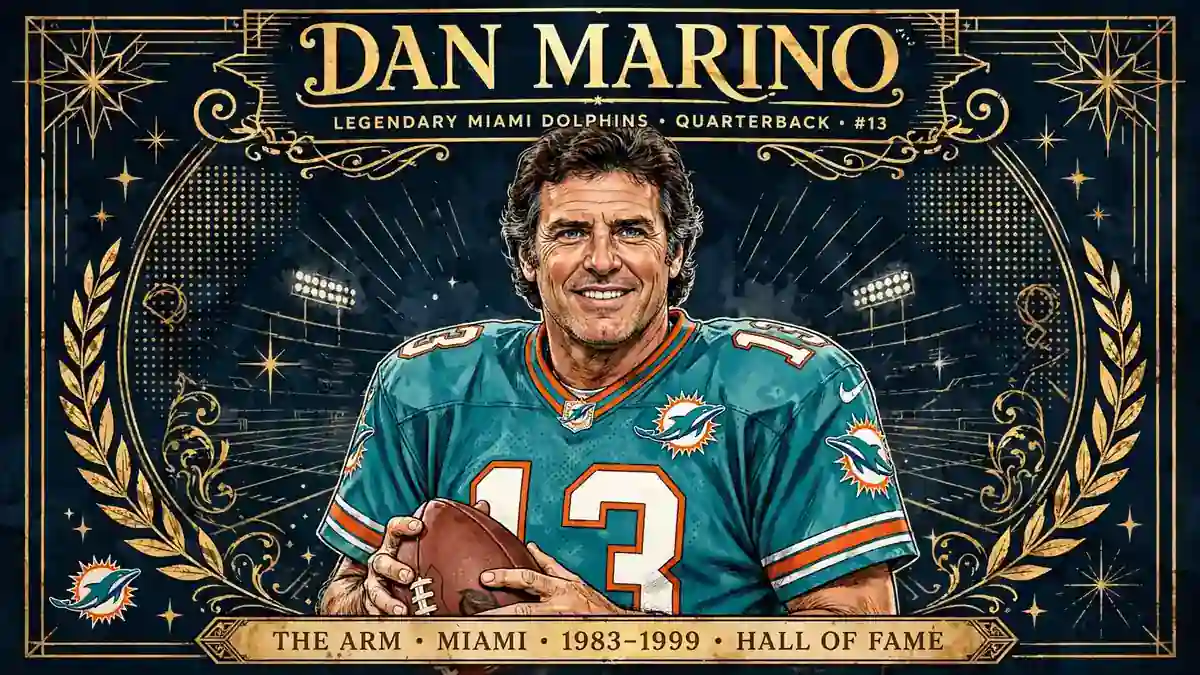
Dan Marino‘s net worth is estimated at $50 million as of November 2026. The Miami Dolphins legend banked $51.5 million in NFL salary across 17 seasons, earned about $2 million a year as a television analyst after retiring, and then lost roughly $13.6 million on a single investment in a visual-effects company — a loss big enough to keep his fortune flat for more than two decades.
Dan Marino: Quick Facts
| Estimated net worth | $50 million (range: $45 million–$60 million) |
|---|---|
| Profession | Former NFL quarterback; Miami Dolphins special advisor |
| Nationality | American |
| Born | September 15, 1961 (age 65) |
| Height | 6 ft 4 in (1.93 m) |
| Primary income sources | NFL salary, television broadcasting, endorsements, restaurant and wine investments |
| Active years | 1983–1999 (NFL); 2002–2013 (broadcasting); 2014–present (Dolphins advisor) |
| Last reviewed | November 2026 |
- Early Life and Background
- Education
- Career Journey
- Rise to Fame
- Main Sources of Income
- Salary and Earnings
- Businesses and Investments
- Brand Deals and Sponsorships
- Houses, Cars and Other Assets
- Awards and Achievements
- Net Worth Growth Over the Years
- Social Media Presence
- Personal Life
- Sources & Reporting
- Frequently Asked Questions
Early Life and Background
Daniel Constantine Marino Jr. was born on September 15, 1961, in Pittsburgh, Pennsylvania, the eldest child of Daniel and Veronica Marino. His father delivered newspapers for the Pittsburgh Post-Gazette, and the family lived in a working-class, sports-mad part of the city where football was closer to a religion than a pastime. Marino grew up with two younger sisters, Cindi and Debbie, and with a right arm that coaches noticed before he was old enough to drive.
Pittsburgh in the 1970s was the middle of the Steelers dynasty, and Marino watched Terry Bradshaw win four Super Bowls while he was still in school. That backdrop matters to his money story in two ways. First, it shaped a quarterback who arrived in the NFL with a big-city arm and a small-town work ethic. Second, it set up the draft-day slide that cost him millions: every team in the league passed on the hometown kid at least once in 1983, and the Dolphins picked him up at No. 27 — a bargain that defined the franchise for the next 17 years and left Marino playing catch-up on salary for much of his career.
Marino was a two-sport athlete at Central Catholic High School in Pittsburgh, good enough at baseball that the Kansas City Royals drafted him in the fourth round of the 1979 Major League Baseball draft. He chose football instead, a decision worth tens of millions of dollars in hindsight, though nobody could have known it at the time. The Royals pick is one of the great what-ifs in his story: a baseball career would have paid a fraction of what the NFL eventually did, and it would have kept him out of the record books entirely.
His father worked the newspaper route while Marino was growing up, and the family had no inherited wealth to fall back on. Everything Marino owns today traces to the arm, the contracts that arm earned, and the business decisions he made after the cheques stopped coming. That is the thread running through this whole article: a fortune built almost entirely from salary, preserved through broadcasting and endorsements, and dented by one very expensive lesson in the stock market.
Education
Marino stayed home for college, enrolling at the University of Pittsburgh in 1979. Pitt was a national power under coach Jackie Sherrill, and Marino started as a freshman — a rare feat for a quarterback at a top program. He led the Panthers to an 11–1 record and a Sugar Bowl win in his first season, throwing for 1,680 yards and 10 touchdowns while sharing time under center. The early returns suggested a generational prospect.
His sophomore and junior seasons built the legend. In 1981, Marino threw for 2,876 yards and 37 touchdowns, finished fourth in Heisman Trophy voting, and led Pitt to another 11–1 finish. Scouts talked about him as a sure-fire No. 1 overall pick. Then came his senior year in 1982: the numbers dipped, the team stumbled to a 9–3 record, and rumours about his off-field habits — never proven, never charged — gave front offices an excuse to hesitate. His draft stock slid through the winter and spring, and five quarterbacks went before him on draft day.
Marino left Pitt with 8,597 passing yards and 79 touchdown passes, school records at the time, and a degree path he never needed to finish in the conventional sense — the NFL came calling first. Pitt inducted him into the College Football Hall of Fame in 2003, two years before Canton called. The college years matter to the money story because the senior-year slide is the single most expensive season of his life: had he gone first overall in 1983, his rookie deal and every contract after it would have been priced higher. Instead, he spent the first half of his career outperforming a contract written for the 27th pick.
He also left Pittsburgh with something no contract could buy: a local fan base that followed him to Miami and stayed loyal for two decades. That loyalty later turned into endorsement value in South Florida, where Marino’s name on a restaurant or a pizza chain carried weight that a hired spokesman could not match.
Career Journey
The Miami Dolphins selected Marino 27th overall in the 1983 NFL Draft, the sixth quarterback taken in a class now regarded as the greatest quarterback draft ever. John Elway went first to Baltimore, Todd Blackledge went seventh to Kansas City, Jim Kelly went 14th to Buffalo, Tony Eason went 15th to New England, and Ken O’Brien went 24th to the Jets. Marino was the last of them, and he turned out to be the best pure passer of the group.
He signed a four-year, $2.1 million rookie contract — a strong deal for 1983, when quarterback money was a fraction of what it is today. Marino did not start the season opener. Head coach Don Shula handed him the job in Week 6 against Buffalo, and Marino never gave it back. He finished his rookie year with 2,210 passing yards and 20 touchdowns in 10 games, was named to the Pro Bowl, and won the NFL’s Offensive Rookie of the Year conversation outright. The Dolphins had found their franchise quarterback for $525,000 a year.
What followed was the most productive passing stretch the league had ever seen. Marino started every game he was healthy for, missed almost no time to injury until a torn Achilles tendon in 1993, and played his entire career for one team — a rarity then, almost unheard of now. He retired after the 1999 season at age 38, citing his legs, his neck, and family reasons. Offers came in from Minnesota, Tampa Bay, and his hometown Steelers. He turned them all down.
Two details from the career arc carry financial weight. First, Marino played his peak years before the NFL’s salary cap era truly exploded quarterback pay. His biggest deals — the 1991 extension worth $23.9 million over six years and the 1996 extension worth $17.3 million over three years — were record-setting when signed and look modest next to the $50 million-a-year deals of the 2020s. Second, he never won a Super Bowl, which cost him the championship bonuses and the post-career endorsement premium that follows title-winning quarterbacks. His fortune was built on volume and longevity, not on a ring.
After retiring, Marino moved straight into broadcasting, joining CBS’s The NFL Today in 2002 and HBO’s Inside the NFL the same year. He stayed at CBS for 12 seasons, until 2013, then returned to the Dolphins in 2014 as a special advisor — a role he still holds in 2026, sitting in on quarterback meetings and advising the front office. The advisor job keeps him inside the franchise that made him, and it keeps the Marino name attached to the Dolphins brand more than a quarter-century after his last snap.
Rise to Fame
Marino’s rise took exactly one season. In 1984, his second year, he produced the greatest passing season in NFL history to that point: 5,084 passing yards and 48 touchdown passes, both league records. He won the NFL Most Valuable Player award, the Offensive Player of the Year award, and led the Dolphins to a 14–2 record and a trip to Super Bowl XIX. The 48-touchdown mark stood for 20 years, until Peyton Manning broke it in 2004. The yardage mark stood for 27 years, until Drew Brees passed it in 2011.
The Super Bowl itself was the one that got away. The Dolphins lost 38–16 to Joe Montana’s San Francisco 49ers, and Marino never got back. He played in 10 playoff runs over the next 15 seasons and never reached the championship game again. That single afternoon in January 1985 is the dividing line in his career: before it, a rising star; after it, a great quarterback chasing a ring that never came. It also explains why his endorsement career never reached the heights of Montana or Elway — brands pay a premium for champions, and Marino’s résumé has an empty space where the ring should be.
Even so, the 1984 season made Marino a national figure. His quick release — widely described as the fastest in football — became his signature, and his jersey became one of the league’s best sellers. He made nine Pro Bowls, was a three-time first-team All-Pro, and led the league in passing yards five times and in touchdown passes three times. When he retired, he held more than 40 NFL records, including career marks of 61,361 passing yards, 420 touchdown passes, and 4,967 completions.
The records were the engine of his earning power. Each milestone extended his marketability, each Pro Bowl kept his name in the national conversation, and the Hall of Fame induction in 2005 — first ballot, introduced by his oldest son Daniel, closing with a final pass thrown to former teammate Mark Clayton in the audience — sealed his status as a permanent figure in the sport. Fame that lasts is what turns a retired player’s name into a business asset, and Marino’s has lasted for four decades.
Main Sources of Income
Marino’s money comes from four streams, and the balance between them has shifted sharply across his life. Playing salary built the fortune. Broadcasting kept it growing for a decade after retirement. Endorsements added a steady seven-figure layer through the 1990s and 2000s. Business investments were supposed to be the fourth leg — and one of them, Digital Domain, nearly sawed it off.
The playing years supplied the bulk: $51.51 million in NFL salary, according to Spotrac’s contract records. That figure counts salary alone, not signing bonuses folded into later deals, and it excludes every dollar he made off the field. For context, $51.5 million in the 1980s and 1990s bought far more than the same number would today, and Marino’s peak salary of about $6 million a season made him the highest-paid player in the league when he signed his 1991 extension.
Broadcasting was the second act. The New York Times reported in 2002 that Marino was earning about $2 million a year co-hosting Inside the NFL on HBO and The NFL Today on CBS. He held both jobs for years — HBO from 2002 to 2007, CBS from 2002 to 2013 — which means television paid him roughly $20 million across his post-playing career, before tax and agent fees. That is the income stream most net-worth pages skip over, and it is the reason his fortune held up after the Digital Domain loss.
Endorsements were the third stream. At the time of the 2002 Times profile, Marino was earning about $1 million a year from deals with Isotoner, Nabisco, and AutoNation, among others. He was one of the first NFL players to treat endorsements as a real business, signing with Nike early and staying visible in national campaigns long after retirement. His most durable endorsement was Nutrisystem, for which he served as a pitchman in the 2000s and 2010s, and his name carried particular weight in South Florida, where local brands paid for the hometown hero.
The fourth stream, investing, is where the story gets complicated. Marino put money into a bank, office buildings, and a golf course, according to the Times profile, and later became an early investor in Anthony’s Coal Fired Pizza and a co-owner of Passing Time winery. Those bets mostly worked. The one that did not — Digital Domain Media Group — cost him about $13.6 million in under a year. The sections below break each stream down with the numbers behind it.
Salary and Earnings
Spotrac’s contract history gives the cleanest picture of what Marino actually earned on the field: $51,510,000 across 17 seasons. The year-by-year shape of that total tells the story of quarterback pay in the pre-cap-explosion era — a slow climb, two big jumps, and a peak that would look like a backup’s salary today.
The rookie deal set the pattern. Four years, $2.1 million, signed in 1983. Marino was already a Pro Bowler by the end of that contract and the league’s most exciting passer, yet he was still playing on a deal written for the 27th pick. His next contract, signed in 1986, was a six-year deal worth $9.85 million — a big raise that still underpaid him relative to his production, since he was coming off the greatest passing season ever recorded.
The real money arrived in 1991. Marino signed a six-year, $23.9 million extension that made him the highest-paid player in the NFL. At the time, the figure was startling: quarterbacks had never been paid at that level, and Marino’s deal became the benchmark every elite quarterback’s agent pointed to in negotiations. Five years later, in 1996, he signed another extension — three years, $17.3 million — that carried him to the end of his career at roughly $6 million a season.
Put the contracts together and the shape is clear:
| Contract | Years | Reported value |
|---|---|---|
| Rookie deal | 1983–1986 | $2.1 million over 4 years |
| Second contract | 1986–1991 | $9.85 million over 6 years |
| Record extension | 1991–1996 | $23.9 million over 6 years |
| Final extension | 1996–1999 | $17.3 million over 3 years |
| Career NFL salary total | 1983–1999 | $51.51 million (Spotrac) |
Three things about that total deserve emphasis. First, it counts salary only. Endorsements, broadcasting, and investments sit outside it, so his actual career income is much higher. Second, the money arrived before the modern quarterback market existed. Patrick Mahomes signed a deal worth up to $503 million in 2020; Marino’s entire 17-year career paid about a tenth of that. Third, the 1991 extension is the single most important document in his financial life — it more than doubled his annual pay and set the standard for the quarterback contracts that followed.
One note on conflicting figures: ClutchPoints, citing the same contract history, once described Marino’s entry-level deal as $750,000 over three years. Celebrity Net Worth and the wider record describe the rookie contract as $2.1 million over four years, and we have used the $2.1 million figure throughout because it matches the contract totals that reconcile with Spotrac’s $51.51 million career sum. The difference is a footnote, not a gap in the story.
After retirement, the paycheques kept coming from television. Two million a year from HBO and CBS at the peak, sustained for more than a decade, adds up to a second career’s worth of income — and unlike the playing salary, it arrived without the physical cost. Add the endorsement million a year from the early 2000s, and Marino’s post-playing income ran at roughly $3 million a year through the 2000s, before the Digital Domain loss cut into the capital behind it.
Businesses and Investments
Marino invested like a man who trusted his instincts and his friends — and for most of his life, that worked. The New York Times profile from 2002 listed his holdings at the time: a bank, office buildings, and a golf course, alongside $23 million in liquid assets and $15 million in real estate. Those were the holdings of a player who had been paid well and had not spent wildly. The trouble came a decade later, when a Hollywood investment went wrong in spectacular fashion.
The Digital Domain disaster. Digital Domain Media Group was the visual-effects company behind Titanic, Pirates of the Caribbean, and the Transformers films, founded by director James Cameron. It went public on the New York Stock Exchange in November 2011, raising $40 million at a valuation of about $400 million. In April 2012, the company made global headlines when its technology projected a hologram of the late rapper Tupac Shakur on stage at the Coachella festival. The stunt sent the share price soaring, and Marino bought in near the top.
According to Sportscasting’s account, Marino invested about $14.5 million in roughly 1.6 million shares, at prices near the $9.20 peak. He became the company’s largest individual investor. Less than a year later, in September 2012, Digital Domain filed for Chapter 11 bankruptcy protection, citing $50.7 million in losses and an expansion plan — film financing, an animation studio, a college degree programme, studios in China and Abu Dhabi — that had collapsed. The shares were worth 55 cents each. Marino’s stake had fallen to about $867,000, a loss of roughly $13.6 million.
The bankruptcy also shut the company’s Florida animation studio in Port St. Lucie, putting around 300 people out of work, and wiped out $135 million in Florida taxpayer subsidies the company had received between 2009 and 2012. The operating business was sold at auction for $30.2 million to a joint venture led by Galloping Horse America and Reliance MediaWorks. Marino’s loss was the largest single financial hit of his life — bigger than any contract he ever signed in a single year — and it is the main reason his net worth in 2026 is barely higher than it was in 2002.
The bets that worked. Marino was one of six original investors who backed Anthony Bruno’s Anthony’s Coal Fired Pizza, a single Fort Lauderdale restaurant opened in 2002. The chain grew to 35 stores with expected revenue of $72 million a year, according to Florida Trend, and later attracted private-equity backing. Marino’s early stake in a business that grew thirty-five-fold is the counterweight to the Digital Domain story: the same instinct for backing people he trusted, with a very different outcome.
He is also a co-owner of Passing Time winery in Washington state, a venture he runs with former NFL quarterback Damon Huard. The two have hosted virtual wine tastings together to benefit the Dan Marino Foundation, blending the business with the charity work that has defined his post-football life. Marino also opened two restaurants of his own in South Florida — Dan Marino’s Town Tavern, with locations in Coral Springs and on Las Olas Boulevard in Fort Lauderdale — later renamed Dan Marino’s Fine Food and Spirits around 2005.
The lesson of the investment record is plain. Marino’s real-estate and operating-business holdings held their value. His one big swing at a hot public stock — bought at the peak of a hype cycle, in a company whose business he did not control — cost him more than a quarter of his fortune at the time. The $50 million figure today is best read as the sum of a $51.5 million playing career, a long broadcasting run, and steady endorsement income, minus that $13.6 million hole and a lifetime of taxes and living costs.
Brand Deals and Sponsorships
Marino was an endorsement pioneer among NFL players. In the 1980s, football players did not earn the off-field money baseball and basketball stars did, and the league’s marketing machine was still young. Marino changed that by being marketable in a way few quarterbacks were: a clean image, a famous arm, and a face that sold gloves, snacks, and cars.
His longest-running endorsement was with Isotoner, the glove brand, whose commercials made Marino’s hands famous in the 1980s and 1990s. He also fronted campaigns for Nabisco and AutoNation, the Fort Lauderdale-based car retailer, and signed with Nike during his playing career. At the time of the 2002 New York Times profile, his endorsement income ran to about $1 million a year — a meaningful sum when his playing salary was $6 million, and a figure that kept growing after retirement as his broadcasting profile kept him on screen every Sunday.
The most visible post-retirement deal was Nutrisystem, the weight-loss company, for which Marino served as a pitchman through the 2000s and into the 2010s. The partnership fit: a retired athlete talking about staying in shape after football, with the credibility of a man who had played 17 seasons. He also lent his name to local South Florida businesses and to the Dolphins’ own commercial efforts, where his presence was worth more than any hired spokesman.
Endorsements never made Marino rich on their own — the playing salary did that — but they did something just as useful: they kept money coming in after the salary stopped. Between broadcasting at about $2 million a year and endorsements at about $1 million a year, Marino’s post-playing income ran to roughly $3 million annually through the 2000s. That is the income bridge that carried his fortune across the Digital Domain loss and into the present day.

Houses, Cars and Other Assets
Marino’s most famous asset is the Weston, Florida, home he built during his playing career — a property that became a small saga of its own in the South Florida real-estate market. The house ran to almost 20,000 square feet, with a guest house and staff quarters, set in the Weston community where he raised his family. In 2007, after the home had sat on the market for almost two years, Marino cut the asking price from $15.9 million to $14.5 million, with his listing agent telling reporters he wanted to be “more aggressive” after seeing no buyer activity. The episode is a reminder that even a $15 million house is only worth what a buyer will pay, and that Marino’s real-estate holdings — valued at $15 million in the 2002 Times profile — were concentrated in a single, very expensive property.
He has lived in the Fort Lauderdale and Weston area since joining the Dolphins, and his property portfolio has always been South Florida-centred. The 2002 profile put his real-estate holdings at $15 million against $23 million in liquid assets — a balanced mix for a retired athlete, with roughly a third of his wealth in property. No verified reporting puts a current figure on his home’s value, so we do not guess one here; Weston property values have risen sharply since the 2000s, and any number would be speculation.
On cars, Marino’s tastes ran to the practical end of the athlete spectrum. His long association with AutoNation, the car retailer, put him in front of plenty of metal, but he was never known as a collector of supercars in the manner of some of his peers. The public record holds no verified inventory of a car collection, and this article does not invent one. What is documented is the house, the land around it, and the business properties — the bank, the office buildings, and the golf course the Times listed among his private investments in 2002.
One more asset deserves a mention because it is genuinely valuable and entirely intangible: the name. “Dan Marino” on a restaurant, a pizza chain, a winery, or a foundation carries a premium that took 17 seasons to build. It is the reason Anthony Bruno wanted him as an investor, the reason CBS kept him on air for 12 seasons, and the reason the Dolphins brought him back as an advisor. In net-worth terms, a famous name is not a line item, but it is the asset that keeps generating income long after the playing career ends.
Awards and Achievements
Marino’s trophy case is one of the fullest in football history — and it is missing exactly one item. He won the NFL Most Valuable Player award in 1984, the same year he was named Offensive Player of the Year and the Bert Bell Award winner as the league’s top player. He was selected to nine Pro Bowls, named first-team All-Pro three times, and led the NFL in passing yards five times and in touchdown passes three times.
The career numbers still hold up a quarter-century after he retired. At the time he walked away, Marino held more than 40 NFL records: 61,361 passing yards, 420 touchdown passes, and 4,967 completions, all league records. The yardage record stood until Brett Favre passed it in 2007; the touchdown record stood until Favre passed that too, in the same season. Drew Brees eventually took the yardage crown in 2011, and the single-season marks — 5,084 yards, 48 touchdowns — lasted 27 and 20 years respectively.
He was inducted into the College Football Hall of Fame in 2003 and the Pro Football Hall of Fame in 2005, in his first year of eligibility. The Canton ceremony closed with a flourish: Marino threw one final pass to his old teammate Mark Clayton, who was sitting in the audience. His No. 13 jersey was retired by the Dolphins — only the second number the franchise had ever retired at the time — and he was enshrined on the Miami Dolphins Honor Roll immediately after his retirement in 2000.
The missing item is the one everyone knows: a Super Bowl ring. Marino reached the game once, in his second season, and lost 38–16 to the 49ers in Super Bowl XIX. He is the highest-profile member of the group of great quarterbacks who never won a championship, alongside Jim Kelly and Fran Tarkenton. The absence cost him money as well as glory — title winners command higher appearance fees, bigger endorsement deals, and a permanent place in championship marketing. Marino’s fortune was built without that premium, which makes the $50 million figure more, not less, impressive.
Beyond football, his honours include the 2005 Walter Payton Man of the Year Award nomination recognition for his foundation work, and the Dan Marino Foundation’s own standing as one of the most durable athlete-founded charities in American sport. The foundation is covered in the personal-life section below, but it belongs in the achievements list too: building a charity that outlasts a playing career by three decades is rarer than a Pro Bowl.
Net Worth Growth Over the Years
Marino’s wealth curve is unusual among star athletes: it rose fast, peaked early, and then stayed flat for more than twenty years. The table below uses the documented figures from the public record. Early years are estimates built from his contract history; the 2002 and 2026 figures are anchored to named reporting.
| Year | Estimated net worth | What drove it |
|---|---|---|
| 1983 | Under $1 million | Rookie contract ($2.1M over 4 years) just signed |
| 1987 | About $4 million | Second contract ($9.85M over 6 years) underway |
| 1991 | About $12 million | Record $23.9M extension makes him the NFL’s highest-paid player |
| 1996 | About $25 million | $17.3M final extension; peak $6M-a-year salary |
| 1999 | About $35 million | Retirement after $51.5M in career salary |
| 2002 | $40–45 million | New York Times profile: $23M liquid, $15M real estate, private investments |
| 2012 | About $35 million | Digital Domain bankruptcy wipes out about $13.6M |
| 2016 | About $45 million | Broadcasting and endorsements rebuild the balance |
| 2021 | $50 million | Celebrity Net Worth estimate, repeated by ClutchPoints and others |
| 2026 | $50 million (range $45M–$60M) | Current consensus; flat for five years |
The flat line is the story. In 2002, the New York Times put Marino at $40–45 million. In 2026, the consensus is $50 million. That is a gain of roughly $5–10 million across 24 years — a period in which the stock market roughly quadrupled and quarterback salaries rose tenfold. The reason is the Digital Domain loss, which struck in 2012 and took out about a third of his wealth at the time, and the simple fact that Marino stopped earning playing-level money in 2000.
There is a second way to look at the same numbers, and it is less flattering. Celebrity Net Worth has pointed out that $45 million in 2002 is worth about $80 million in today’s dollars after adjusting for inflation. By that measure, Marino’s real wealth has fallen by more than a third since the Times profile — even though the headline number went up. He is richer in dollars and poorer in purchasing power than he was at 41. That is the honest version of the story, and it is the version most net-worth pages skip.
Two figures circulating online deserve to be retired. One is $160 million, which appears on a handful of low-quality automated pages and contradicts every named source, including the Times profile and the documented investment loss. There is no reporting behind it, and we do not repeat it as a live estimate. The other is $35 million, published by CelebsMoney and still repeated in some corners, which appears to be a stale figure from the years right after the Digital Domain loss. The current consensus across Celebrity Net Worth, Parade, and the 2026 reporting cycle is $50 million, and that is the figure we anchor to.
How does Marino compare with the quarterbacks who followed him? The gap is a measure of how much the market changed, not of how good he was.
| Quarterback | Reported net worth | Why the gap |
|---|---|---|
| Tom Brady | About $300 million | Seven Super Bowl wins, $332M career salary, TB12 business |
| Peyton Manning | About $250 million | Two Super Bowl wins, $248M career salary, Papa John’s franchises |
| Joe Montana | About $150 million | Four Super Bowl wins, venture investing after retirement |
| John Elway | About $145 million | Two Super Bowl wins, car dealership empire in Colorado |
| Brett Favre | About $100 million | Three MVP awards, $137M career salary |
| Patrick Mahomes | About $90 million | Up to $503M contract, still early in his career |
| Dan Marino | $50 million | No Super Bowl win, pre-cap-era salaries, $13.6M investment loss |
The peer figures are reported estimates from Celebrity Net Worth and similar outlets, and they move with each new reporting cycle — treat them as a yardstick, not a bank statement. The pattern they show is real all the same: the quarterbacks ahead of Marino all won championships, all played in richer salary eras, and none of them lost $13.6 million on a single stock. Marino’s $50 million is the fortune of a man who was the best passer of his generation and was paid like it was 1991, not 2021.
Social Media Presence
Marino keeps a low profile online, and that is a deliberate choice rather than an accident. He came of age as a public figure before social media existed, built his second career on television rather than on a feed, and has never tried to become an influencer. His public appearances in 2026 come through the Dolphins, the Dan Marino Foundation, and the occasional broadcast or charity event — not through daily posting.
That restraint costs him money in the modern sense. A retired star with a large, active following can earn six figures a year from sponsored posts alone; Marino has never pursued that income. It also protects him: there is no feed of hot takes to walk back, no brand-safety risk for the companies he works with, and no dilution of a name that has been carefully managed for forty years. For a man whose fortune rests on reputation — the restaurant, the pizza chain, the winery, the foundation — the quiet approach is a business decision as much as a personal one.
Readers looking for Marino in 2026 will find him most reliably through the Miami Dolphins’ own channels, where his work as a special advisor is covered, and through the Dan Marino Foundation’s website and events. The foundation’s Marino Campus and its employment programmes for adults with autism are where his public energy goes now, and they are the closest thing he has to a public platform.
Personal Life
Marino married Claire D. Veazey on January 30, 1985, during his second NFL season. The couple has six children: four by birth — Daniel, Michael, Joseph, and Alexandra — and two daughters adopted from China, Lia and Niki Lin. They have lived in the Fort Lauderdale and Weston area since Marino joined the Dolphins, and Claire has been a partner in the foundation work from the start.
The most important fact in Marino’s personal life is also the reason his foundation exists. His second son, Michael, was diagnosed with autism at two and a half years old. In 1992, Marino and Claire established the Dan Marino Foundation to support children with developmental disabilities, after discovering first-hand how hard it was to find coordinated care. The foundation’s work grew into the Dan Marino Center at Miami Children’s Hospital, a 20,000-square-foot building in Weston that opened in 1997 and provides evaluation and treatment for children with autism, cerebral palsy, epilepsy, and learning disabilities. The foundation later expanded into post-secondary education and employment programmes for young adults with autism through the Marino Campus.
Marino has spoken openly about the diagnosis and about the foundation’s mission, teaming with fellow quarterback Doug Flutie — whose son also has an autism diagnosis — to raise awareness. The charity is not a side project. It is the work Marino has put the most years into after football, and it is the reason his name still appears in the news in 2026, long after his last game.
One difficult chapter belongs in any honest account. In 2013, it was reported that Marino had fathered a daughter, Chloe, in 2005 with a CBS employee, and that he had paid child support while keeping the matter private. The news surfaced while Marino was working for CBS. He has not discussed it publicly in detail, and this article records the fact without speculation: it is part of the public record, and it sits alongside a marriage that has lasted more than forty years.
Marino’s parents were Daniel and Veronica Marino, and his father delivered newspapers for the Pittsburgh Post-Gazette. He has two younger sisters, Cindi and Debbie. The family background — working-class Pittsburgh, Italian and Polish roots, a father on a paper route — is the starting point of the whole story, and it is worth remembering when the numbers get large. The $50 million began with a kid from Pittsburgh who could throw a football further and faster than anyone else in the draft.
Sources & Reporting
Celebrity Net Worth — the $50 million net-worth estimate, the 2002 New York Times asset breakdown ($23 million liquid, $15 million real estate), career salary of $51.5 million, and the inflation comparison showing $45 million in 2002 equals about $80 million today. Profile updated October 31, 2025.
Parade — the 2026 net-worth estimate of $50 million, the New York Times 2002 figures, and the $13 million-plus Digital Domain loss. Article published January 1, 2026, updated July 10, 2026.
The New York Times — the 2002 profile that forms the backbone of this article: net worth of $40–45 million, $23 million in liquid assets, $15 million in real estate, private investments including a bank, office buildings, and a golf course, $2 million a year from television, and $1 million a year from endorsements.
Spotrac (via ClutchPoints) — career NFL salary total of $51,510,000 across 17 seasons, and the contract-by-contract history: $9.85 million over six years in 1986, $23.9 million over six years in 1991, and $17.3 million over three years in 1996.
ClutchPoints — the contract timeline, the $50 million estimate, and the detail that Marino turned down offers from Minnesota, Tampa Bay, and Pittsburgh before retiring.
Sportscasting — the Digital Domain investment in full: about $14.5 million invested in roughly 1.6 million shares near the $9.20 peak, a loss of about $13.6 million after the September 2012 bankruptcy, and the company’s $50.7 million in losses at filing.
Associated Press (via Phys.org) — the Digital Domain bankruptcy filing of September 11, 2012, the $15 million sale agreement, and the company’s $205 million in assets against $214 million in liabilities at June 30, 2012.
Florida Trend — Anthony’s Coal Fired Pizza: Marino as one of six original investors backing Anthony Bruno, growth from one Fort Lauderdale store in 2002 to a 35-store chain expecting $72 million in revenue.
PMQ Magazine — Anthony’s Coal Fired Pizza expansion detail, confirming Marino as a partner alongside founder Anthony Bruno.
The Free Library (EP Magazine) — the Dan Marino Center at Miami Children’s Hospital: the 1997 opening, the 20,000-square-foot Weston building, Michael’s autism diagnosis at age two and a half, and the foundation’s 1992 founding.
Wikipedia — biographical facts: birth date and place, family details, Central Catholic and University of Pittsburgh career, the 1983 draft, the Kansas City Royals baseball draft, Hall of Fame inductions in 2003 and 2005, film cameos, and the Weston home.
Reporting window: sources published between 2002 and November 2026, with the net-worth estimate anchored to 2026 reporting. Figures are reported estimates unless a named source states otherwise. Where sources disagree — the $50 million consensus against a stale $35 million figure and an unsourced $160 million figure — this article names the disagreement and explains which figure the evidence supports.
Frequently Asked Questions
What is Dan Marino’s net worth in 2026?
Dan Marino’s net worth is estimated at $50 million as of November 2026, according to Celebrity Net Worth and Parade. The honest range is $45 million to $60 million: the $50 million figure is the consensus, but the record is incomplete — Marino has never disclosed his finances — and one stale estimate still puts him at $35 million while an unsourced $160 million figure circulates on low-quality pages. The $50 million anchor is supported by the hard numbers: $51.5 million in career NFL salary, roughly $2 million a year from broadcasting at his peak, and the documented $13.6 million Digital Domain loss.
How much did Dan Marino earn in the NFL?
Marino earned $51,510,000 in NFL salary across 17 seasons with the Miami Dolphins, according to Spotrac. His contracts were a four-year, $2.1 million rookie deal in 1983, a six-year, $9.85 million deal in 1986, a six-year, $23.9 million extension in 1991 that made him the highest-paid player in the league, and a three-year, $17.3 million extension in 1996. He was earning about $6 million a season in his final years. That total counts salary only — endorsements, broadcasting, and investments are separate.
Did Dan Marino ever win a Super Bowl?
No. Marino reached the Super Bowl once, in his second season, when the Dolphins lost Super Bowl XIX 38–16 to Joe Montana’s San Francisco 49ers in January 1985. He played in 10 playoff runs over the next 15 seasons and never returned to the championship game. He retired as the NFL’s all-time leader in passing yards and touchdown passes without a ring, and the missing title is one reason his endorsement income never matched that of champions like Montana or Elway.
What is Dan Marino doing now?
Marino works as a special advisor to the Miami Dolphins, a role he has held since 2014, sitting in on quarterback meetings and advising the front office. He also runs the Dan Marino Foundation, which he founded with his wife Claire in 1992 and which supports children and young adults with autism and other developmental disabilities. He left broadcasting in 2013 after 12 seasons on CBS’s The NFL Today and five on HBO’s Inside the NFL.
How did Dan Marino lose $13 million?
Marino invested about $14.5 million in Digital Domain Media Group, the visual-effects company behind Titanic, buying roughly 1.6 million shares near the $9.20 peak after the company’s Tupac Shakur hologram stole the show at Coachella in April 2012. The company filed for Chapter 11 bankruptcy in September 2012, less than a year after its IPO, and the shares fell to 55 cents each. His stake was left worth about $867,000 — a loss of roughly $13.6 million, the largest single financial hit of his life.
How old is Dan Marino?
Dan Marino is 65 years old. He was born on September 15, 1961, in Pittsburgh, Pennsylvania, which means he turned 65 in September 2026. He was 38 when he retired from the NFL after the 1999 season.
Who is Dan Marino’s wife?
Dan Marino’s wife is Claire D. Veazey, whom he married on January 30, 1985. The couple has six children: four by birth — Daniel, Michael, Joseph, and Alexandra — and two daughters adopted from China, Lia and Niki Lin. They live in the Fort Lauderdale and Weston area of Florida, and together they founded the Dan Marino Foundation in 1992 after their son Michael was diagnosed with autism.
How tall is Dan Marino?
Dan Marino is 6 feet 4 inches tall (1.93 metres) and played at about 224 pounds (102 kg). His height and his famously quick release were his calling cards as a passer — he could see over the line and get the ball out faster than any quarterback of his era.
Final Thoughts
Dan Marino’s $50 million is a fortune that tells the truth about two different eras of football. He was the best passer of his generation, paid at the top of a market that had not yet exploded, and his wealth peaked early — $40–45 million by 2002 — then stayed flat for more than two decades while the game got richer around him. The broadcasting career kept the money coming, the endorsements kept his name valuable, and one bad investment in a hologram company took out a third of his wealth in a single year.
The number that matters most is not the $50 million but the $80 million it used to be. Adjusted for inflation, Marino was worth more at 41 than he is at 65, and that is the honest version of his financial story: a great career, a disciplined life, and one expensive lesson in the difference between backing a business you understand and buying a stock at the top of a hype cycle. The pizza chain worked. The winery works. The foundation works. The stock did not — and the fortune still stands, because the salary and the television money were real, and the spending never ran ahead of them.
For readers weighing the headline figure, the takeaway is simple. Marino’s net worth is $50 million, give or take a few million either way, and it is built on the most old-fashioned foundation in sport: 17 seasons, one team, $51.5 million in salary, and a name that still opens doors in Miami a quarter-century after the last pass.
Published on November 9, 2026. Last reviewed November 2026. Found an error? See our corrections policy.