
Dario Franchitti‘s net worth is estimated at $50 million to $72 million as of November 2026. The Scottish driver banked more than $17 million in reported career salary across CART and IndyCar, collected three Indianapolis 500 winner’s purses worth over $6.8 million combined, and spent a decade as the face of Target Chip Ganassi Racing — then, at 52, climbed back into a race car in February 2026 for a NASCAR Truck Series return nobody saw coming.
Dario Franchitti: Quick Facts
| Estimated net worth | $50 million – $72 million (range: $50M–$72M) |
|---|---|
| Profession | Retired IndyCar and CART racing driver; motorsport commentator and driver coach |
| Nationality | Scottish (British) |
| Born | 19 May 1973 (age 53) |
| Height | 1.75 m (5 ft 9 in) |
| Primary income sources | IndyCar and CART race salary, Indianapolis 500 prize money, Target and Honda sponsorships, post-retirement coaching and broadcasting |
| Active years | 1991–2013 (professional racing); 2026 NASCAR Truck Series one-off |
| Last reviewed | November 2026 |
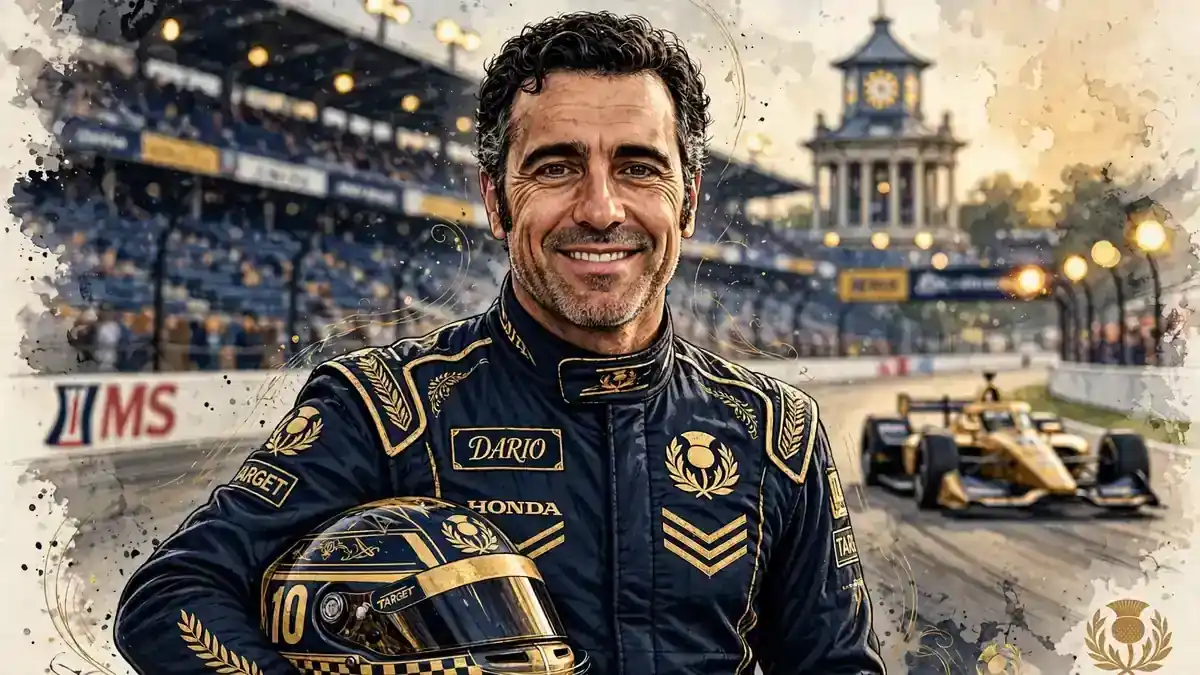
Early Life and Background
George Dario Marino Franchitti was born on 19 May 1973 in Bathgate, West Lothian, Scotland, a former mining town between Edinburgh and Glasgow. His mother Marina, born in Inverness, worked for the tourist board. His father George ran an ice-cream parlour and raced karts and Formula Ford as an amateur on weekends. Three of Franchitti’s four grandparents came from Cassino, Italy, which explains a Scottish childhood with an Italian surname and a family that treated motorsport as a birthright rather than a hobby.
The racing started almost before he could walk. At three years old he was given a Honda-powered go-kart. His father took him to the West of Scotland Kart Club and to tracks across the north of Scotland, and the boy who had grown up reading racing magazines decided, with no backup plan, that driving was what he would do. When the family moved to nearby Whitburn, Franchitti was eight. The move changed his address, not his direction.
He started kart racing at ten. His first race ended after two laps with an engine failure — a small humiliation that did not slow him down. By eleven he was Scottish Junior Champion, winning the title in 1984. He took the British Junior Karting Championship in 1985 and again in 1986, added the Scottish senior title in 1988, and was racing in world championship events by fourteen. The family paid for it the hard way: his father remortgaged the family home to keep the karting programme going, a gamble that only looks sensible in hindsight.
Two details from those years still shape how Franchitti talks about his career. The first is the clan around him. His father George and Louis di Resta — father of future Formula 1 driver Paul di Resta — were second cousins, and the Franchitti and di Resta families were close enough that George helped a young Louis into karting. The second is the company he kept. Allan McNish, David Coulthard and Franchitti all came through the same Scottish karting scene, and McNish later credited David Leslie senior and junior with giving all three their start in the sport. Franchitti’s path to Indianapolis began on cold Scottish kart tracks, not in a racing academy.
His junior single-seater career followed the classic ladder. He won the Formula Vauxhall Junior Championship in 1991 and the Formula Vauxhall Lotus Championship in 1993, and collected the McLaren Autosport BRDC Award in 1992 — the prize that marks a young British driver as one to watch. By 1995 he was racing in Formula 3, and by 1997 he had crossed the Atlantic. The ice-cream parlour in Bathgate had produced a driver America would soon know by first name.
Education
Franchitti was educated at Stewart’s Melville College, a private school in Edinburgh, and he has never romanticised the experience. He has said he did not feel at ease there, put off by its traditionalism, and the classroom never competed with the kart track for his attention. School was something to get through; racing was the curriculum that mattered.
His real education came from the paddock. Around the time he was leaving school in 1990, David Leslie’s father suggested he go to the races with Leslie’s team, polish the cars, do odd jobs and watch and learn. Franchitti took the offer. He spent his late teens around professional race teams, learning how cars were prepared, how engineers thought and how drivers carried themselves — lessons no school in Edinburgh was teaching.
That apprenticeship explains a trait that followed him through his whole career: Franchitti was always a driver’s driver, fluent in the technical side of the car. Engineers at Andretti Green and later Chip Ganassi Racing valued him as much for feedback as for speed, and that reputation is part of why Ganassi kept him on as an advisor and driver coach after his driving career ended. The schooling he remembers is the one he got holding a polishing cloth in a race garage at seventeen.
Career Journey
Franchitti’s American career began in 1997, when he joined Hogan Racing in CART, the top open-wheel series in the United States at the time. He was 24, quick, and largely unknown to American audiences. Six seasons in CART followed, most of them with Team Green, and the record he built there was strong enough to make his later IndyCar dominance look inevitable: 10 wins and 11 poles in 114 starts, with a best championship finish of second in 1999.
That 1999 season still stings in the telling. Franchitti finished tied on points with Juan Pablo Montoya and lost the championship on a tie-breaker — Montoya had more wins. It was the closest Franchitti ever came to a CART title, and the defeat taught him something his later career kept proving: in American open-wheel racing, winning races matters more than collecting points. He won again in CART in 2000 and 2001, but the championship never came, and by 2002 the series itself was fading.
He moved to the IndyCar Series in 2003 with Andretti Green Racing, the successor to Team Green. The first years were steady rather than spectacular: a first IndyCar win came in 2004 at Milwaukee, and he finished fourth in the championship in 2005. Then came a cruel interruption. A back injury — he had broken his back in a crash earlier in his career and carried the damage with him — cost him races and momentum, and at thirty years old he had no championship and a repaired spine. Plenty of drivers with that record fade into midfield. Franchitti did the opposite.
The 2007 season changed everything. Driving for Andretti Green, he won four races including his first Indianapolis 500, and took the IndyCar championship in a final-race decider, beating Scott Dixon by 13 points. It was the breakout year his whole career had been building toward, and it arrived in his tenth season of American open-wheel racing.
Success sent him sideways for a year. In 2008 he tried NASCAR with Chip Ganassi Racing, running stock cars in the Nationwide Series and a handful of Cup races. The experiment did not take. He quit mid-season and returned to IndyCar with Ganassi’s team in 2009 — a move that looks, in hindsight, like the best decision of his career. What followed was the most dominant three-year stretch by any driver of his era: three consecutive IndyCar championships in 2009, 2010 and 2011, with twelve more race wins including the 2010 Indianapolis 500. His total reached four IndyCar titles, tying him for second all-time behind A.J. Foyt.
The 2012 season showed the first cracks. Franchitti struggled to adapt to the new Dallara DW12 chassis, won only once all year — but that one win was his third Indianapolis 500, a dramatic victory that put him in the ten-driver club of three-time winners at the Brickyard. He finished seventh in the championship. In 2013 the slide continued: five pole positions but no wins, tenth in the standings, and then the crash that ended it all.
On 6 October 2013, on the last lap of the Grand Prix of Houston, Franchitti’s car touched Takuma Sato’s, launched into the catchfence and came down in pieces. He suffered a concussion, two fractured vertebrae and a broken right ankle. Thirteen fans were hurt by flying debris. Doctors told him another heavy crash could leave him permanently paralysed, and on 14 November 2013 he announced his immediate retirement from motor racing on medical advice. He retired with 31 victories from 265 starts in American open-wheel racing, 92 podium finishes and 34 pole positions — tied at the time with Paul Tracy for ninth on IndyCar’s all-time wins list.
Retirement did not mean leaving the sport. Franchitti stayed with Chip Ganassi Racing as an advisor and driver coach, and became a co-commentator and pundit on Formula E’s television world feed. Then, in February 2026, came the twist no competitor profile written before that date contains: at 52, he strapped into a NASCAR Craftsman Truck Series entry for the first time since 2008 and raced at St. Petersburg. The comeback is covered in full below, because it is the freshest chapter in a career most writers had already closed.
Rise to Fame
Franchitti’s fame arrived late and then all at once. For most of his CART years he was respected inside the paddock and little known outside it. The 2007 Indianapolis 500 changed that in a single afternoon. The 500 is the race that defines American open-wheel drivers, and winning it — then backing it up with a championship in the same season — turned a solid journeyman into a star. The 2007 title decider, settled by 13 points over Dixon, gave the story a rival and a finish line.
The Ganassi years made him the defining IndyCar driver of the 2007–2012 stretch. Three straight championships from 2009 to 2011 put him in company no active driver could match, and the second and third Indianapolis 500 wins in 2010 and 2012 made him only the tenth driver ever to win the race three times. He did it without ever starting an Indy 500 from pole — a quirk that says something about how he won. Franchitti was a racer, not a qualifier: he won by reading races, saving fuel, picking his moment and being there at the end.
His marriage to actress Ashley Judd, from 2001 to 2013, put him in front of audiences that had never watched a motor race. The couple married at Skibo Castle in the Scottish Highlands in December 2001, and for a decade Franchitti was as likely to appear in celebrity coverage as in the sports pages. The attention cut both ways — it raised his profile well beyond motorsport, and it meant his divorce in 2013 played out in public — but the racing record is what lasted. Judd’s fame opened doors; Franchitti’s four championships are why anyone still writes about him.
The 2026 NASCAR Truck Series return gave his fame a second act. When TRICON Garage announced in February 2026 that the 52-year-old would drive its No. 1 Toyota Tundra at St. Petersburg, the story ran everywhere from NASCAR’s own site to the racing press — a four-time IndyCar champion, thirteen years after a career-ending crash, back in a race car. He ran in the top ten for most of the day before a faulty helmet cooling system and an unscheduled pit stop dropped him to 27th. The result mattered less than the sight of him there. Franchitti had never really left the sport’s consciousness; the truck race reminded everyone why.
Main Sources of Income
Franchitti’s money came from four places, in roughly this order: race salary, prize money, sponsorship, and post-retirement work in coaching and broadcasting. There was no side business empire, no clothing line, no restaurant chain. His wealth is a racing fortune, built lap by lap over seventeen professional seasons, and that narrowness is exactly what makes the estimate range so wide — almost all of it sits inside contracts and prize purses that were never published in full.
Race salary was the foundation. Celebrity Net Worth reports that between CART and IndyCar he brought in over $17 million in salary alone — the single most concrete figure attached to his career earnings. IndyCar salaries are private, and top drivers in his era earned anywhere from $200,000 to $2 million a year according to Sporting News reporting cited by eBiographyPost, with champions at the top teams commanding the upper end. Franchitti spent his peak years at the two best-funded teams of his era, Andretti Green and Target Chip Ganassi Racing, which is where the big salaries in IndyCar lived.
Prize money was the second pillar, and it is the best documented. The Indianapolis 500 pays its winner a purse that runs into seven figures, and Franchitti collected three of them. TheRichest’s earnings table lists his Indy 500 winner’s payouts as $1,645,000 for 2007, $2,752,000 for 2010 and $2,474,000 for 2012 — $6,871,000 from three afternoons at the Brickyard, before team shares and taxes. Championship bonuses, race-win purses across 31 victories and appearance money added to the total across a seventeen-year career.
Sponsorship was the third pillar, and the hardest to put a number on. As the lead driver for Target Chip Ganassi Racing, Franchitti was the face of one of American motorsport’s longest and richest sponsorships — Target’s backing of Ganassi’s IndyCar programme ran for more than two decades. He also carried Honda as an engine partner and Firestone as a series supplier through his championship years. None of those deals paid the driver directly in published figures, but a driver in Franchitti’s seat was paid, in part, because sponsors wanted him in the car. TheRichest has claimed his combined earnings and sponsorship deals were worth about $10 million a year at his peak; that figure is the site’s own estimate, not a documented salary, and we treat it as an upper-bound claim rather than a fact.
Post-retirement income is smaller but steady. Since 2014 Franchitti has worked as an advisor and driver coach for Chip Ganassi Racing, and as a Formula E television pundit and commentator — both paid roles that keep him in the sport’s payroll more than a decade after his last full season. The 2026 Truck Series drive, sponsored by Dollar Tree, was a one-off arranged through his friendship with Jimmie Johnson rather than a paid comeback, but it kept his name in front of sponsors and broadcasters. His fortune today is a mix of money banked during his driving years and the lower, steadier income of a coach and broadcaster.
Salary and Earnings
The honest answer about Dario Franchitti’s salary is that the exact numbers were never published. IndyCar teams do not disclose driver contracts, and Franchitti never discussed his pay in public. What exists is a set of documented anchors, and they are enough to explain a fortune in the tens of millions without inventing a payslip.
The strongest anchor is the career salary total. Celebrity Net Worth, which puts his net worth at $50 million, reports that he earned over $17 million in salary between CART and IndyCar. That figure covers base pay only — it excludes prize money, bonuses and endorsements — and it is the closest thing to a verified career-earnings number in the public record. Seventeen seasons at the top of American open-wheel racing, most of them with front-running teams, produced a salary total that alone would make most athletes wealthy.
The Indianapolis 500 purses are the second anchor, and they are exact. TheRichest’s earnings table, drawn from published purse figures, records $1,645,000 for his 2007 win, $2,752,000 for 2010 and $2,474,000 for 2012. The 2010 purse was the largest of the three, reflecting the race’s growing prize fund. These are gross figures — the team takes a share, and taxes take another — but three wins at the Brickyard paid Franchitti several million dollars in prize money on top of his salary. Add 28 other race victories, each with its own purse, plus championship bonuses for four titles, and the prize-money column of his career runs deep into eight figures.
Context helps. Sporting News reporting, cited by eBiographyPost, put the range for top IndyCar drivers at roughly $200,000 to $2 million a year in salary during Franchitti’s era, with the Indianapolis 500 winner’s team collecting $10–$15 million in total prize money. Franchitti sat at the top of that range during his Ganassi years — four championships and three Indy 500 wins is the record of a driver a team pays to keep. TheRichest’s claim of roughly $10 million a year in combined earnings and sponsorships at his peak sits above the documented salary range and should be read as that site’s estimate, not a verified figure.
The 2008 NASCAR detour likely cost him money rather than making it. He left a championship-winning IndyCar seat for a stock-car programme that he abandoned mid-season, and the return to IndyCar in 2009 came with a new contract at Ganassi — the team that then paid him through the most successful three years of his life. The lesson of his earnings history is timing: his biggest paydays came between 2007 and 2012, when he was winning championships and Indy 500s in the same seasons, and the money compounded because he stayed at the top for six straight years.
One more earnings detail belongs here because competitors skip it: the 2026 Truck Series drive. TRICON Garage announced the St. Petersburg entry as a partnership with Jimmie Johnson and Legacy Motor Club, with Dollar Tree as primary sponsor. No salary was reported, and Franchitti described the deal as the product of a wine-fuelled conversation with Johnson rather than a negotiation. It was a one-off appearance, not a contract, and it added nothing material to his net worth — but it did add something to his earning power, by putting a 52-year-old former champion back on television in front of sponsors.
Businesses and Investments
Franchitti never built a business empire, and that is a fact worth stating plainly. Search his record for the ventures that fill other drivers’ profiles — a team ownership stake, a car dealership group, a merchandise brand, a property portfolio — and almost nothing turns up. His investments were his career and his house, and the money he made stayed close to racing.
That is not the same as having no business sense. Franchitti’s career decisions were commercial decisions, and he made them well. He left Andretti Green at the top of his game and joined Ganassi for 2009, the team with the Target money and the Honda engines, and won three straight titles there. He stayed with Ganassi after retirement as an advisor and driver coach, converting a driving relationship into a salaried post-driving role — the move that keeps ex-drivers earning when the helmet comes off. He took the Formula E punditry job early, when the series was new and needed credible voices, and held it for years.
On investments specifically, the public record is thin. No property portfolio beyond the one documented house sale is on record, no startup investments have been reported, and no company directorships are listed against his name. TheRichest and other net-worth sites credit him with business ventures in general terms, but none names a specific company, deal or holding. We do not repeat those claims as facts. What can be said is that a driver who earned $17 million-plus in salary, collected $6.87 million in Indy 500 purses and sold a Scottish country house for $5.08 million had the means to invest, and that the absence of public records says more about his privacy than about his portfolio.
The one documented asset transaction is the house sale, covered in the assets section below. Beyond that, the sensible reading of Franchitti’s finances is that he is a wealthy retired athlete whose money came from driving, not from deal-making — and that his post-retirement income from Ganassi and Formula E is the closest thing he has to a business. For a net-worth profile, that matters: the $50 million to $72 million range reflects career earnings and prize money, not a hidden portfolio, and the lower end of the range is the more conservative read.
Brand Deals and Sponsorships
Franchitti’s sponsorship story is the story of two long relationships: Target and Honda. For most of his championship years he drove the No. 10 Target Honda for Chip Ganassi Racing, and the red Target branding became as much a part of his image as the car itself. Target’s sponsorship of Ganassi’s IndyCar programme was one of the longest partnerships in American motorsport, running for more than twenty years, and Franchitti was its lead driver through the most successful stretch of that deal. Sponsors pay for winners, and for six seasons he gave Target exactly that.
Honda was the other constant. His Ganassi cars ran Honda engines, and Honda’s backing of the team was part of the package that made the 2009–2011 title run possible. Firestone, the series tyre supplier, was a third name on the car through those years. Earlier, in CART, he drove for Team Green under the Kool cigarette branding — the famous Kool Green cars of the late 1990s — a reminder that motorsport sponsorship looked very different before tobacco advertising left the sport.
What Franchitti did not do is also notable. He never became a personal-endorsement star in the style of a Formula 1 driver with a watch deal and a clothing line. His endorsements were team deals, not personal ones: the money flowed to the team, and the driver was paid from it. That is normal in IndyCar, where the economics run through the team rather than the driver’s image rights, and it is one reason his sponsorship income is impossible to itemise. The value to Franchitti was indirect but real — the best-funded seat in the series, the best engineers, and a salary that reflected the sponsors’ willingness to pay for him specifically.
The 2026 Truck Series drive added a final sponsor name to the list. Dollar Tree joined as primary sponsor of the No. 1 TRICON Garage Toyota for St. Petersburg, a deal put together through Jimmie Johnson and Legacy Motor Club. It was a one-off, but it showed that Franchitti’s name still carried commercial weight thirteen years after his last full season — sponsors will still put their brand on a car with him in it.

Houses, Cars and Other Assets
The best-documented asset in Dario Franchitti’s life is a house in Scotland that he no longer owns. Rednock House, his country home in Port of Menteith, was sold in 2015 for $5.08 million, according to Featured Biography. The house had a room dedicated to Jim Clark, the Scottish Formula 1 legend Franchitti idolised — a detail that tells you what kind of collector he was. It was not a trophy property bought for show; it was a racing fan’s house, built around the sport’s history.
Before that sale, Franchitti’s living arrangements tracked his marriages. During his marriage to Ashley Judd he lived for a time in Nashville, Tennessee, where Judd was based. After the divorce and his 2015 marriage to Eleanor Robb, the couple settled in Hobart, Tasmania — Eleanor’s adopted home, where she has worked in digital roles including at the Museum of Old and New Art (MONA) — and are raising their two daughters there. Scottish reporting has also placed him living in England at various points, and the honest picture is that of a man with homes and ties on three continents, not a single fixed address.
On cars, the record is thinner than fans might expect. Franchitti’s working cars were race cars owned by his teams, not his personal collection, and no verified list of his private cars exists in the public record. What is documented is his taste: he is a known enthusiast of historic racing machinery, a regular at the Goodwood Revival, and a collector of racing history — the Jim Clark room at Rednock House was the evidence. He has also kept a close relationship with classic cars through his broadcasting and coaching work. We do not invent a garage inventory. The $5.08 million house sale is the one asset transaction with a published price, and it anchors the property side of his net worth.
Other assets are harder to pin down. His championship trophies, race-worn helmets and memorabilia have value to collectors, but no auction records are published. His MBE, awarded in 2014 for services to motor racing, is an honour rather than an asset. The picture that emerges is of a man whose wealth sits in money earned and banked, plus one significant property sale — not in a portfolio of houses and cars that can be listed and priced.
Awards and Achievements
Franchitti’s trophy case is the reason his net worth reads the way it does. Four IndyCar Series championships — 2007, 2009, 2010 and 2011 — put him second on the all-time list behind A.J. Foyt’s seven, and his three consecutive titles from 2009 to 2011 are a feat only the greats have matched. Three Indianapolis 500 wins — 2007, 2010 and 2012 — make him one of ten drivers in history to win the race at least three times. He also won the 2008 Rolex 24 at Daytona and the 2010 IndyCar Series oval championship.
The numbers underneath the titles are just as strong. Across CART and IndyCar he made 265 starts, won 31 races, stood on the podium 92 times and took 34 pole positions. Split by series, that is 10 wins in CART and 21 in the IndyCar Series, with 59 IndyCar podiums and 23 IndyCar poles. He finished second in the 1999 CART championship, losing on a tie-breaker to Juan Pablo Montoya, and his best CART result remains one of the narrowest title defeats in the series’ history.
The honours kept coming after he stopped driving. In 2014 he was appointed a Member of the Order of the British Empire (MBE) for services to motor racing. In 2017 he was inducted into the Indianapolis Motor Speedway Hall of Fame, and in 2019 into the Motorsports Hall of Fame of America. The Hall of Fame citation, written by Gordon Kirby, calls him IndyCar’s biggest star of the 2007–2012 era — a fair summary of a driver who won four championships and three Indy 500s in six seasons and then had his career cut short by a crash.
How does that record stack up against the drivers fans usually compare him with? The table below uses titles and Indianapolis 500 wins — the two measures that define American open-wheel greatness — and it shows why Franchitti belongs in the conversation with the sport’s all-time names.
| Driver | IndyCar / USAC titles | Indianapolis 500 wins |
|---|---|---|
| Dario Franchitti | 4 | 3 |
| A.J. Foyt | 7 | 4 |
| Scott Dixon | 6 | 1 |
| Al Unser | 3 | 4 |
| Rick Mears | 3 | 4 |
Two names from the wider racing world also belong in any Franchitti profile. Lewis Hamilton’s net worth profile covers a driver whose seven Formula 1 titles make him the benchmark for modern racing wealth, while Michael Schumacher’s net worth profile traces the fortune of the driver Franchitti grew up watching — the seven-time Formula 1 champion whose records Hamilton eventually chased. Franchitti never raced in Formula 1, and his fortune is smaller than either man’s, but his four IndyCar titles and three Indy 500 wins put him in the same tier of achievement in his own series.
Net Worth Growth Over the Years
Franchitti’s fortune was not built in a single deal. It accumulated across seventeen seasons, with the steepest growth coming between 2007 and 2012, when he won four championships and three Indianapolis 500s. The table below tracks the documented money — not invented yearly net-worth figures — so readers can see how the fortune was assembled.
| Year / period | Documented money event | Amount |
|---|---|---|
| 1997–2002 | CART career: 10 wins, 114 starts, salary plus race purses with Team Green | Part of $17M+ career salary |
| 2007 | First Indianapolis 500 win; first IndyCar championship | $1,645,000 Indy 500 purse |
| 2009–2011 | Three consecutive IndyCar championships with Target Chip Ganassi Racing | Championship bonuses + purses |
| 2010 | Second Indianapolis 500 win | $2,752,000 Indy 500 purse |
| 2012 | Third Indianapolis 500 win | $2,474,000 Indy 500 purse |
| 2013 | Retirement after Houston crash; coaching and broadcasting income begins | Career salary total $17M+ reported |
| 2015 | Rednock House, Port of Menteith, sold | $5,080,000 |
| 2025 | Celebrity Net Worth updates its estimate | $50,000,000 |
| 2026 | TheRichest’s long-standing estimate; NASCAR Truck Series one-off at St. Petersburg | $72,000,000 |
The gap between the two published estimates — $50 million and $72 million — is the most important fact in this section. Celebrity Net Worth, updated in April 2025, is the fresher figure and the more conservative one. TheRichest’s $72 million has sat largely unchanged for years and rests on older reporting. Neither site publishes its workings, so we cannot reconcile them, and we do not pick a single number and pretend the disagreement does not exist. Our range is the honest answer: Franchitti is worth tens of millions, built on $17 million-plus in salary and $6.87 million in Indy 500 purses alone, with the true figure sitting somewhere between the two published estimates.
One more factor pushes the range rather than narrowing it. Franchitti retired in 2013, so his fortune has had thirteen years to grow through investment returns — or to shrink through spending, taxes and the costs of a life split between Tasmania, Britain and the racing world. No public filings exist either way. A retired athlete’s net worth thirteen years after his last paycheque is genuinely uncertain, which is why the range, not a single figure, is the right way to report it.
Social Media Presence
Franchitti keeps a lower social media profile than most retired champions, and what he posts is mostly racing, family and historic motorsport. His Instagram account, @dario_franchitti, is his main public channel, where he shares photos from race weekends, the Goodwood Revival, family life in Tasmania and the occasional look at his racing memorabilia. He is also present on X, where he comments on IndyCar and Formula 1, usually with the authority of a man who has won the races he is talking about.
He does not run his accounts like an influencer. There are no sponsored-post deals of note, no merchandise pushes, no daily content schedule — and that is consistent with everything else about his post-retirement career. Franchitti monetises his expertise through coaching and broadcasting, not through his following. His social media functions as a window into his life rather than a business, which is why it contributes nothing material to his net worth and why we do not attach follower counts or earnings estimates to it: the numbers change weekly, and the money attached to them is negligible either way.
What his accounts are good for is freshness. The 2026 Truck Series drive was announced and documented across his channels, and his posts from St. Petersburg — the helmet cooling problems, the top-ten running, the 27th-place finish — gave fans a direct line to a comeback that most of the racing press had to report second-hand. For a driver whose career ended before social media mattered, he has adapted to it on his own terms: present, personal, and uninterested in turning himself into a brand.
Personal Life
Franchitti’s personal life has been public for most of his adult life, first through his marriage to Ashley Judd and then through his second marriage and family in Tasmania. He married Judd, the American actress, in December 2001 at Skibo Castle in the Scottish Highlands, after two years of dating. Featured Biography reports the wedding cost around $1.8 million. The couple were married for eleven years and announced their separation in January 2013, releasing a joint statement to People magazine that the decision was mutual and that they would always be family. They had no children together, and the divorce was finalised in 2013. Judd has spoken warmly about him since, telling Us Magazine in July 2023 that she still loves him and considers him a loved one.
His second marriage began through the racing world. Fellow IndyCar driver Pippa Mann introduced him to Eleanor Robb, a British marketing and digital strategist who had built a career in finance — including a senior role at hedge fund Caxton Associates — before moving into digital leadership at the Museum of Old and New Art (MONA) in Tasmania. They married in a small private ceremony in 2015, and have two daughters: Sofia, born on 2 November 2015, and Valentina, born in February 2019. Ashley Judd is Sofia’s godmother, a detail that says something about how amicably the first marriage ended. The family lives in Hobart, Tasmania, where Eleanor’s work is based.
His wider family is motorsport through and through. His younger brother Marino Franchitti is also a racing driver, with a career in sports cars including the 24 Hours of Le Mans. His cousin is Paul di Resta, the former Formula 1 driver, and the two families — Franchitti and di Resta — have been close for generations, their fathers second cousins. Franchitti’s own father George, the ice-cream parlour owner who remortgaged the family home to fund his son’s karting, lived to see that gamble pay off many times over.
Away from racing, Franchitti is a Celtic Football Club supporter and a committed volunteer: he has driven a van for the Bethany Christian Trust in Edinburgh, delivering food and drink to people in need. He is also a familiar face at historic racing events, particularly the Goodwood Revival, where his love of the sport’s history — the same instinct that put a Jim Clark room in his Scottish house — is on full display. Retirement, for Franchitti, has meant a quieter life in Tasmania, a coaching role with Ganassi, a broadcasting chair at Formula E, and, as 2026 proved, the occasional itch to climb back into a race car.
Sources & Reporting
Celebrity Net Worth — net worth estimate of $50 million (updated 14 April 2025) and the report that Franchitti earned over $17 million in salary between CART and IndyCar. TheRichest — net worth estimate of $72 million, the Indy 500 winner’s purse figures ($1,645,000 for 2007, $2,752,000 for 2010, $2,474,000 for 2012) and the claim of roughly $10 million a year in combined earnings and sponsorships at his peak. Wikipedia — full name, birth date and place, career statistics (265 starts, 31 wins, 92 podiums, 34 poles), family background, education at Stewart’s Melville College, karting titles and the Houston crash and retirement dates. NASCAR — the 2026 St. Petersburg Truck Series race report (28 February 2026): Franchitti’s top-ten running, helmet cooling failure, 27th-place finish and the Jimmie Johnson connection. Motor Sport Magazine — retirement coverage and the family background, including the ice-cream business, the di Resta connection and the remortgaged family home. Motorsports Hall of Fame of America — Hall of Fame citation and career summary, including the 2007 title decider and the 2009–2011 title run. Scottish Sports Hall of Fame — career record, McLaren Autosport BRDC Award 1992 and retirement details. Reporting window: November 2026, with the freshest sources being the February–October 2026 coverage of the NASCAR Truck Series comeback. Where sources disagree on the net worth figure, this article publishes the range and names who says what.
Frequently Asked Questions
What is Dario Franchitti’s net worth in 2026?
Dario Franchitti’s net worth is estimated at $50 million to $72 million as of November 2026. Celebrity Net Worth lists $50 million (updated April 2025), while TheRichest lists $72 million. The range reflects that disagreement. His fortune is anchored to documented money: over $17 million in reported career salary across CART and IndyCar, $6.87 million in published Indianapolis 500 winner’s purses, and a $5.08 million house sale in 2015.
How many Indianapolis 500 races did Dario Franchitti win?
Three — in 2007, 2010 and 2012. He won the first with Andretti Green Racing and the other two with Target Chip Ganassi Racing, making him only the tenth driver ever to win the race at least three times. He never started an Indy 500 from pole, winning all three from further back on the grid.
Why did Dario Franchitti retire from racing?
He retired on medical advice after a serious crash at the Grand Prix of Houston on 6 October 2013. His car hit Takuma Sato’s, flew into the catchfence and came down in pieces, leaving him with a concussion, two fractured vertebrae and a broken right ankle. Doctors warned that another heavy crash could leave him permanently paralysed, and he announced his retirement on 14 November 2013.
Who is Dario Franchitti’s wife?
He is married to Eleanor Robb, a British marketing and digital strategist. Fellow IndyCar driver Pippa Mann introduced them, and they married in a private ceremony in 2015. They have two daughters, Sofia (born 2015) and Valentina (born 2019), and live in Hobart, Tasmania. Franchitti was previously married to actress Ashley Judd from 2001 to 2013.
How old is Dario Franchitti?
He was born on 19 May 1973 in Bathgate, West Lothian, Scotland, which makes him 53 years old as of November 2026. He is 1.75 m (5 ft 9 in) tall.
What was Dario Franchitti’s salary as a racing driver?
Exact IndyCar salaries were never published, but Celebrity Net Worth reports he earned over $17 million in salary between CART and IndyCar. His three Indianapolis 500 winner’s purses added $1,645,000 (2007), $2,752,000 (2010) and $2,474,000 (2012). Sporting News reporting put top IndyCar driver pay in his era at roughly $200,000 to $2 million a year, with champions at top teams at the upper end.
Did Dario Franchitti race in NASCAR in 2026?
Yes. On 28 February 2026, at 52, he drove the No. 1 TRICON Garage Toyota Tundra in the NASCAR Craftsman Truck Series race on the streets of St. Petersburg, Florida — his first NASCAR start since 2008. The deal came from a conversation with his friend Jimmie Johnson, who acted as his mentor on the pit box, and Dollar Tree sponsored the entry. He ran in the top ten for most of the day before a faulty helmet cooling system forced an unscheduled pit stop, and he finished 27th.
Is Dario Franchitti related to Paul di Resta?
Yes — they are cousins. Franchitti’s father George and Paul di Resta’s father Louis were second cousins, and the two families have been close for generations. His younger brother Marino Franchitti is also a racing driver. Franchitti’s Italian heritage comes from his grandparents, three of whom came from Cassino, Italy.
Final Thoughts
Dario Franchitti’s fortune is a racing fortune in the purest sense: no empire, no side hustles, no celebrity brand — just seventeen seasons at the top of American open-wheel racing, four championships, three Indianapolis 500s and more than $17 million in reported salary. The honest estimate is a range, $50 million to $72 million, because the two most-cited sources disagree and neither shows its workings. The lower figure is fresher and more conservative; the higher figure has sat unchanged for years.
What makes his story worth more than the number is the shape of it. A boy from Bathgate whose father remortgaged the family home to fund his karting; a driver who lost a championship on a tie-breaker, broke his back, and still became the defining IndyCar driver of his era; a champion whose career ended in a Houston catchfence and who, thirteen years later, climbed into a NASCAR truck at 52 because a friend asked him to. The money is real. The comeback is the part nobody will forget.
Published on 18 November 2026. Last reviewed November 2026. Found an error? See our corrections policy.