
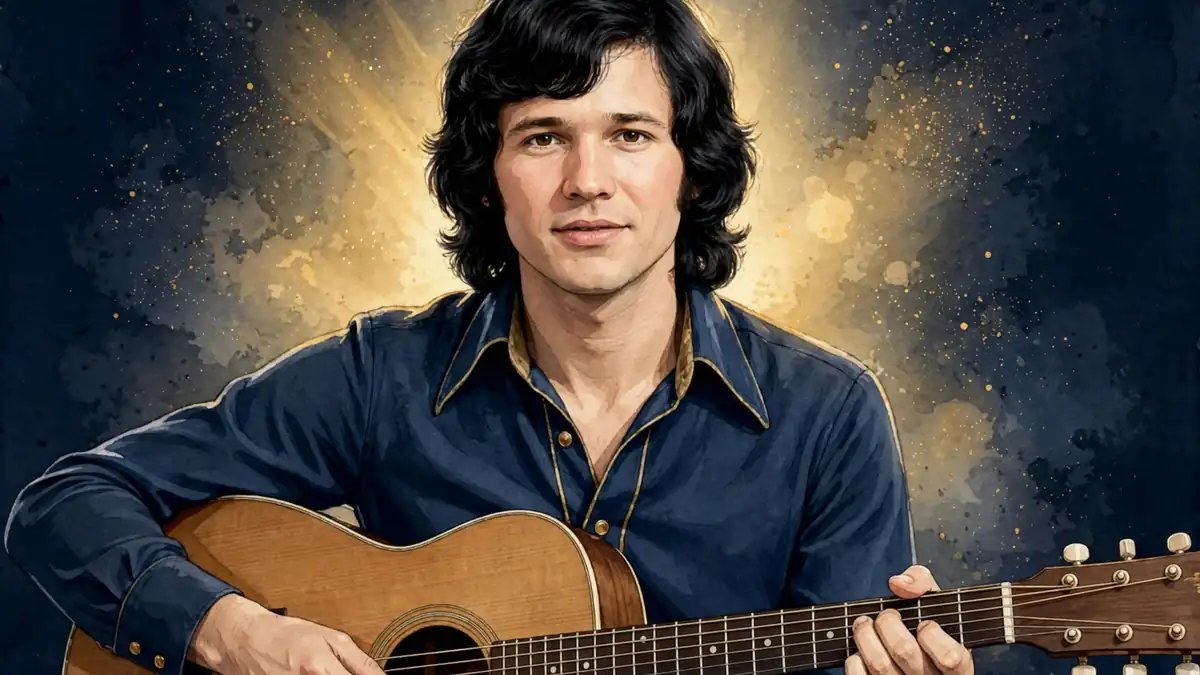
David Gates‘s net worth is estimated at $3 million to $4 million as of October 2026. The number reflects a career built the old-fashioned way: Gates wrote and sang nearly every hit the soft-rock band Bread ever had — eleven Billboard Hot 100 singles between 1970 and 1973, including the No. 1 “Make It with You” — then kept collecting publishing royalties when his songs found second lives through other singers. His ballad “Everything I Own,” written as a tribute to his late father, topped the UK chart twice in other artists’ hands (Ken Boothe in 1974, Boy George in 1987). A solo career added the No. 15 film theme “The Goodbye Girl,” five RIAA gold studio albums kept the catalog valuable, and in 2026 the 85-year-old songwriter is retired on a 1,400-acre cattle ranch in Washington state with Jo Rita, the high-school sweetheart he married in 1959.
David Gates: Quick Facts
| Estimated net worth | $3–4 million (range: $3 million to $4 million) |
|---|---|
| Profession | Singer-songwriter, producer, frontman of Bread |
| Nationality | American |
| Born | December 11, 1940 (age 85) |
| Height | ~5 ft 8 in (1.78 m), as reported by biographical outlets |
| Primary income sources | Songwriting/publishing royalties, Bread record royalties, solo career, session and production work |
| Active years | 1957–2007 (retired) |
| Last reviewed | October 2026 |
- Quick Facts
- Early Life and Background
- Education
- Career Journey
- Rise to Fame
- Main Sources of Income
- Salary and Earnings
- Businesses and Investments
- Brand Deals and Sponsorships
- Houses, Cars and Other Assets
- Awards and Achievements
- Net Worth Growth Over the Years
- Social Media Presence
- Personal Life
- Sources & Reporting
- Frequently Asked Questions
- Final Thoughts
Early Life and Background
David Ashworth Gates was born on December 11, 1940, in Tulsa, Oklahoma, into a household where music was the family trade. His father, Clarence Gates, was a band director; his mother, Wanda Gates (née Rollins), taught piano. The Oklahoma Historical Society’s encyclopedia entry notes that Gates was surrounded by music from birth, and by the time he enrolled at Will Rogers High School in Tulsa he could already play piano, violin, bass and guitar.
High school is where the professional story starts. Gates formed his first group, The Accents, with fellow Tulsa musicians — including the piano player Claude Russell Bridges, who would later change his name to Leon Russell. In 1957, when Gates was sixteen, The Accents backed Chuck Berry at a concert in Tulsa, and the band released the single “Jo-Baby”/”Lovin’ at Night” on Robbins’ label. The A-side was written for Gates’ sweetheart, Jo Rita — the high-school girlfriend he would marry in 1959.
Gates’ father struck a deal with his son after high school: David had two years to make something of himself in the music business, or he would have to return to his studies as a music major at the University of Oklahoma. He did not need the full two years. By 1961, Gates, his wife and their growing family had moved to Los Angeles, where the session-music economy of the early 1960s would turn the Tulsa teenager into one of the most dependable behind-the-scenes players in pop.
Education
Gates’ formal education ran on two tracks — the classroom and the bandstand — and the bandstand won. He attended Will Rogers High School in Tulsa, where he played in the school band and formed The Accents. At the University of Oklahoma, where he enrolled to study law and pre-med after the two-year deal with his father, he joined the Delta Tau Delta fraternity and married Jo Rita in 1959. The move to Los Angeles in 1961 effectively ended his academic path; his education from that point was the recording studio, where he learned arranging, engineering and production alongside veteran session players. Biographical sources, including the Oklahoma Historical Society, treat his early mastery of four instruments — piano, violin, bass and guitar — as the credential that mattered: it is what made him employable as a session musician at nineteen and a producer by his mid-twenties.
Career Journey
The 1960s Los Angeles chapter of Gates’ life is the part most net-worth profiles skip, and it is where his earning power was quietly built. Arriving in 1961, Gates worked as a studio musician, music copyist, songwriter and producer. The Oklahoma Historical Society records session work for Duane Eddy, Pat Boone, Glenn Campbell, Bobby Darin and Ann-Margret; the Bread retrospective published by Album Liner Notes adds engineering and production assignments with Merle Haggard, Buck Owens, Rod McKuen and others, plus an unlikely avant-garde detour producing two singles for Captain Beefheart on A&M Records in 1966.
His first significant songwriting payday came in early 1964, when the girl group The Murmaids took his song “Popsicles and Icicles” to No. 3 on the Billboard Hot 100. That single established Gates as a writer whose work could chart without his name on the sleeve. He was twenty-three, and the hit bought him credibility in an industry that ran on them.
Gates also kept trying to be a recording artist himself long before Bread existed — and mostly failing at it, which makes the later success more instructive than the usual overnight-sensation story. Biographical accounts record at least eight singles released under his own name (and pseudonyms, including a 1965 Vee-Jay release as “The Manchesters”) through the mid-1960s, none of which charted nationally. The failures taught him the studio from every chair: singer, writer, arranger, engineer. By the time he stood in front of Bread, he had already spent a decade learning why records work.
Through the rest of the decade he placed songs with The Monkees, Johnny Burnette, Shelly Fabares and Connie Stevens, and produced Glenn Yarbrough’s 1965 hit “Baby the Rain Must Fall.” In 1968 he scored the motion picture Journey to Shiloh, based on the Will Henry novel — an early film-composing credit that foreshadowed “The Goodbye Girl” a decade later.
Gates also tried the business side early: he founded Planetary Records, a short-lived R&B label, and in 1967 produced the debut album of the pop-psych group The Pleasure Fair. That production job introduced him to two musicians who would change his life — Robb Royer, a member of the band, and Royer’s songwriting partner James Griffin. In 1968 the three decided to try a collaboration of their own. They named it Bread.
Rise to Fame
Bread’s path to a record deal had a touch of industry legend about it. As recounted in band histories, music attorney Al Schlesinger brought the trio’s demo to Jac Holzman at Elektra Records — an unusual home for a pop act, since Elektra was known for folk and rock — and Holzman signed them, reportedly allowing the band to produce itself with engineer Bruce Botnick. The group name, by Gates’ own account, came to him while stuck in traffic behind a Wonder Bread delivery truck.
The 1969 self-titled debut, cut with session drummers Jim Gordon and Ron Edgar, peaked at No. 127 on the Billboard 200 — a modest start. Later that year Mike Botts joined as permanent drummer, completing the quartet. The second album, On the Waters (1970), changed everything: it reached No. 12 in the U.S., driven by the ballad “Make It with You,” which topped the Billboard Hot 100 in the summer of 1970 and was certified gold by the RIAA on August 6, 1970. Bread was suddenly a major act.
What followed was one of the most concentrated hit runs in soft-rock history. Robb Royer left after three albums and was replaced by session veteran Larry Knechtel (whose credits included Elvis Presley, The Beach Boys and Simon & Garfunkel). From 1970 to 1973, Bread placed eleven singles on the Billboard Hot 100 — all written and sung by Gates — including six Top 10 hits: “Make It with You” (No. 1, 1970), “If” (No. 4, 1971), “Baby I’m-a Want You” (No. 5, 1972), “Everything I Own” (No. 5, 1972), “The Guitar Man” (No. 11, 1972), “Aubrey” (No. 15, 1973), “It Don’t Matter to Me” (No. 10, 1969) and “Lost Without Your Love” (No. 9, 1976–77). The parent albums kept pace commercially: Manna (1971) hit No. 21, Baby I’m-a Want You (1972) hit No. 3, Guitar Man (1972) hit No. 18, and the RIAA would later certify every one of the five studio albums gold.
The dominance of Gates-penned A-sides created friction — co-lead singer James Griffin, a capable songwriter himself, wanted more of his own songs released as singles, and Elektra kept choosing Gates’ material. In 1973 the band called it a day rather than coast. Their final concert was May 19, 1973, at the Salt Palace in Salt Lake City, Utah. Gates later explained the split simply: “We just couldn’t write anything that was worthy of the ‘Bread’ name, so instead of tarnishing our reputation, I felt it was time to call it a day” (as quoted by FamousPeopleToday).
The story did not end there. Bread reunited in 1976 for Lost Without Your Love, whose Gates-written title track reached No. 9 on the Hot 100 — the band’s last Top 10. The reunion years carried one more legal footnote: when Gates toured with former bandmates billed as “David Gates & Bread,” James Griffin sued, winning an injunction against the use of the Bread name. The resulting litigation retired the name altogether by late 1978 and was not settled until 1984 — a reminder that the band’s internal tensions outlived its chart run by a decade.
A 1996–97 “25th Anniversary” tour took Gates, Griffin, Botts and Knechtel across the United States, South Africa, Europe and Asia; band histories record it as the last time the members ever performed together. Bread was inducted into the Vocal Group Hall of Fame in 2006, and in March 2014 Helter Skelter Publishing (UK) issued the band’s first full biography, Bread: A Sweet Surrender, built on exclusive interviews with founding member Robb Royer. Griffin and Botts both died of cancer in 2005; Knechtel died in 2009, leaving Gates and Royer the surviving members — and, per a June 2026 Parade report, Gates the sole surviving member of the original lineup.
Main Sources of Income
Gates’ wealth rests on four pillars, and publishing royalties are the load-bearing one. First, record royalties from Bread: five RIAA-gold studio albums, a gold comeback single, the five-times-platinum Best of Bread (1973), a platinum Anthology of Bread (1985) and a gold second volume. Compilation sales are the quiet engine of legacy acts — The Best of Bread has been in print for more than fifty years, and every pressing pays the songwriter.
Second, songwriting and publishing royalties. Gates wrote virtually all of Bread’s hits, which means he collects the writer’s share on every sale, stream, radio spin and sync license. The crown jewel is “Everything I Own”: Ken Boothe’s reggae cover topped the UK Singles Chart for three weeks starting October 26, 1974, and Boy George’s version spent two weeks at No. 1 in March 1987, also reaching No. 1 in Canada, Ireland, Italy, Norway and South Africa. Each of those chart-toppers sent mechanical and performance royalties back to Gates as the song’s sole composer. The song has since been recorded by NSYNC, Olivia Newton-John, Rod Stewart, Shirley Bassey, Crystal Gayle, Vanessa Hudgens and Chrissie Hynde, among others — a catalog asset that compounds across generations.
The cover pipeline extended beyond pop. Nashville acts The Kendalls and Joe Stampley cut country versions of “Everything I Own,” and Julio Iglesias — one of the best-selling Latin artists in history — recorded Gates’ material, opening the catalog to the Latin and country markets where publishing royalties are collected through entirely separate societies and licensing channels. Each new genre a Gates song enters is a new royalty stream the original writer never has to tour for.
Third, his solo career: eight albums between 1973 and 1994, with “The Goodbye Girl” (No. 15 Hot 100, No. 3 Adult Contemporary, 1978) as the commercial peak, plus “Never Let Her Go” (No. 29, 1975) and “Took the Last Train” (No. 30, 1978). Fourth, session and production work from the 1960s, and later reported production credits for artists such as David Pomeranz and Jennifer Warnes — fees earned long before Bread existed, and a skill set that let Gates produce his own records rather than pay outside producers.

Salary and Earnings
No verified per-album advance, per-show fee or annual salary figure for David Gates exists in public reporting, and this article will not invent one. What the record does provide is a precise map of the commercial peaks that generated his income. On the album side, the RIAA’s Gold & Platinum database logs gold certifications for On the Waters and Manna (both certified December 21, 1972), Baby I’m-A Want You (March 9, 1972), Guitar Man (November 21, 1972) and Lost Without Your Love (February 17, 1977) — each representing at least 500,000 U.S. units shipped at the time. The Best of Bread went further: certified five-times platinum, with the multi-platinum award logged December 12, 1997.
The singles tell the same story in miniature. “Make It with You” was certified gold as a single in August 1970, at the height of its No. 1 run. The Adult Contemporary chart — where Gates was a fixture — delivered additional royalty-bearing airplay: “Clouds” (No. 3 AC, 1973), “Sail Around the World” (No. 11 AC, 1974), “Never Let Her Go” (No. 3 AC, 1975) and “The Goodbye Girl” (No. 3 AC, 1978) all reached the top tier of that format. His solo albums charted more modestly — First at No. 107, Never Let Her Go at No. 102, Falling in Love Again at No. 46 and Take Me Now at No. 62 on the Billboard 200 — which is why the honest accounting of Gates’ wealth puts catalog royalties, not solo record sales, at the center.
The economics that matter most are the least visible. As the sole writer of “Make It with You,” “If,” “Baby I’m-a Want You,” “Everything I Own,” “The Guitar Man,” “Aubrey,” “It Don’t Matter to Me” and “Lost Without Your Love,” Gates earns the songwriter’s share on every use of those recordings: original Bread pressings, the endlessly reissued compilations, oldies and adult-contemporary radio, film and television placements, and the cover versions that keep arriving. A song that produces two separate UK No. 1 records thirteen years apart — as “Everything I Own” did — is the textbook definition of a durable publishing asset.
The 1978 “Goodbye Girl” commission shows how a single placement could out-earn months of touring. Written to order for Neil Simon’s film, the song was released as a single in December 1977, peaked at No. 15 on the Hot 100 and No. 3 on Adult Contemporary in 1978, and rode the film’s Oscar-season visibility — Richard Dreyfuss won Best Actor — into the year-end charts (No. 47 on Billboard’s 1978 year-end Hot 100). Gates wrote it, produced it and performed it, collecting the writer’s, producer’s and artist’s shares on a record that sold on the strength of a hit movie. It remains his biggest solo hit and the clearest example of his 1960s session craft converting directly into 1970s income.
Businesses and Investments
Gates’ business ventures were music-industry plays rather than the restaurant chains and clothing lines that pad other celebrity portfolios. The earliest was Planetary Records, the short-lived R&B label he founded in Los Angeles in the 1960s — an ambitious move for a twenty-something session player, and one that taught him the production and label mechanics he later used to self-produce Bread with engineer Bruce Botnick. His production résumé became a revenue line in its own right: beyond the 1960s session work, he is reported to have produced albums for singer-songwriters David Pomeranz and Jennifer Warnes, keeping the producer’s chair — and the producer’s fee — through the 1970s and beyond.
The most significant non-music investment attributed to Gates is land. While touring with Bread, he purchased a 1,400-acre cattle ranch near Mount Vernon, Washington. In a 1997 Los Angeles Times interview recounted by FamousPeopleToday, Gates said the ranch became his full-time home in 1987, once his children were grown: “I began to pull away from the business a little bit in the mid-80s… I moved up here full-time in 1987.” Rural Washington acreage bought in the 1970s–80s and held for half a century represents meaningful asset appreciation, though no public record discloses the purchase price or current valuation, so this article treats it as a real but unquantified asset rather than a dollar figure.
Brand Deals and Sponsorships
There is no public record of David Gates signing endorsement deals, sponsorships or advertising campaigns — not in the 1970s, when such deals were rare for soft-rock acts, and not later. That absence is itself informative: Gates’ income model never depended on his image being licensed. The commercial exploitation of his work happened through music licensing instead — the film theme “The Goodbye Girl,” written for Neil Simon’s 1977 romantic comedy, being the clearest example. The film won Richard Dreyfuss the Academy Award for Best Actor, and Gates’ piano-led ballad played over the closing credits, tying his name to an Oscar-winning picture without a single endorsement contract.
Houses, Cars and Other Assets
The documented asset in Gates’ life is the Washington ranch: 1,400 acres of cattle country near Mount Vernon, bought during the Bread touring years and occupied full-time since 1987. Gates described the pull of the place in plain terms — the seasons, the distance from Los Angeles, the space to step back from the industry once his four children were grown. Before the move, he lived in Los Angeles through the 1960s, 70s and mid-80s, the decades when the money was being made.
Beyond the ranch, the public record is quiet. No verified reporting documents Gates’ car collection, additional properties or investment accounts, and aggregator sites that claim “real estate investments” or “business ventures” as wealth drivers cite no transactions, addresses or filings. This article leaves those boxes unchecked rather than filling them with guesses: the known assets are the ranch, the music catalog and whatever royalties and savings five decades of hits produced.
Awards and Achievements
Gates’ trophy case is measured in certifications and chart positions rather than Grammy statuettes. The RIAA record stands as follows: five gold studio albums (On the Waters, Manna, Baby I’m-A Want You, Guitar Man, Lost Without Your Love), one gold single (“Make It with You,” 1970), the five-times-platinum Best of Bread, a platinum Anthology of Bread and a gold Best of Bread, Volume 2. On the charts: one Billboard Hot 100 No. 1, six Top 10 singles with Bread, and a solo Top 15 in “The Goodbye Girl.”
Institutional recognition arrived in 2006, when Bread was inducted into the Vocal Group Hall of Fame. The songwriting achievement that outlasts all of it may be “Everything I Own” — a song Gates wrote as a tribute to his father, Clarence, that became a standard. As Gates told The Guardian (recounted by Parade in June 2026), his father had once written, after Gates sent his mother an orchid he could barely afford, that he could have had “anything she owned” in return. Gates wrote the lyric — “I would give everything I own just to have you back again” — so it could be heard as a love song; when he played it for his wife Jo Rita, she recognized immediately that it was about his father, and cried.
Net Worth Growth Over the Years
| Period | Estimate | Note |
|---|---|---|
| 1970–73 (Bread peak) | Not publicly estimated | Eleven Hot 100 singles, five gold albums, No. 1 single — the earning peak, but no contemporary figure was published |
| 1978 (“Goodbye Girl” era) | Not publicly estimated | Solo Top 15 plus Oscar-film theme; catalog royalties compounding |
| 2021 | $4 million | Reported by Pinoria (August 2021 biographical profile) |
| 2024 | $3 million | Reported by Celeb Observers, MediaCoverage, NetWorthHub, Namso-gen and RichestRapper |
| 2025 | $4 million | FamousPeopleToday, page updated October 2025 — the freshest outlet figure |
| October 2026 | $3–4 million | NetWorthCraft estimate: the credible published range, carried forward with 2026 review |
A note on the numbers you may see elsewhere: a handful of low-quality aggregator sites publish far larger figures — $20–50 million on one, $25 million on another, and a “growth table” climbing to $65 million in 2026 on a third. None of them cites a source, a filing, an interview or a methodology; the $65 million table in particular invents year-by-year “primary income sources” (including “charitable foundations”) with no reporting behind them. This article excludes those figures as unreliable. The credible, sourced record — six outlets, the most recent updated in October 2025 — sits at $3–4 million, and that is the range we publish.
Why has the estimate barely moved in five years? Because Gates’ income is now almost entirely passive. He has not toured or released an album in roughly two decades, so there are no new paydays to spike the number — but the catalog does not need him to work. Bread’s gold records keep selling in compilation form, “Everything I Own” keeps getting covered, and oldies radio keeps spinning the hits. Against that steady base, the range’s stability is the story: a songwriter’s fortune built on publishing is one of the few celebrity balance sheets that barely moves, up or down, in retirement.
Social Media Presence
David Gates has no verified public social media presence that this article could confirm. No official accounts appear under his name on the major platforms, and given his long-standing withdrawal from public life — he has been retired from performing for roughly two decades and lives on a rural Washington ranch — the absence is consistent with the man. Fan pages and Bread tribute accounts exist, but none is operated by Gates. For a figure of his generation, the catalog is the presence: Bread’s hits stream in the tens of millions annually on the major platforms, generating the performance royalties that underpin the net-worth estimate above, whether or not the songwriter ever logs in.
Personal Life
Gates’ personal life is notable mostly for its stability — a rarity in the industry that made him famous. He married his high-school sweetheart, Jo Rita, in 1959; by 2025 the couple had been married 66 years, a milestone fewer than one percent of married couples reach. They have four children together. The “Jo-Baby” single he cut as a teenager in 1957 was written for her, and she was the first listener who understood that “Everything I Own” was about his father, not a lover.
Since 1987 the couple has lived year-round on their 1,400-acre ranch near Mount Vernon, Washington, where Gates stepped back from the music business as his children grew. He did not vanish overnight: press photography documents a concert at Vicar Street in Dublin in March 2003, and reference works list his active years as 1957–2007. A June 2026 Parade report described the 85-year-old as retired from the stage and the sole surviving member of Bread’s original lineup, following the deaths of James Griffin and Mike Botts in 2005 and Larry Knechtel in 2009. He has granted only occasional interviews in recent decades, and — in his own words from an earlier interview — prefers it that way: “Sometimes it’s better to be grateful and stay the heck out of the limelight when your best work is behind you.”
Sources & Reporting
Parade — June 2026 features on “The Goodbye Girl” and “Everything I Own”: the freshest reporting used here, including Gates’ Guardian interview account of the song’s origin, his age (85), retirement, and Mount Vernon, Washington residence.
The Guardian — original “How we made” interview with Gates and Ken Boothe on “Everything I Own” (recounted via Parade): the father’s-orchid story behind the lyric.
Best Classic Bands — career overview: six Top 10 singles, 1959 marriage, the Murmaids’ “Popsicles and Icicles” breakthrough, Elektra signing, and 1960s collaborations with Elvis Presley and Bobby Darin.
FamousPeopleToday — $4 million net-worth estimate (page updated October 2025, the freshest outlet figure), solo discography chart positions, the 1,400-acre ranch, and the 2014 band biography.
Celeb Observers — $3 million net-worth estimate (2024), full name, Mount Vernon residence, Vocal Group Hall of Fame induction.
RIAA — Gold & Platinum database: certification dates for all five gold studio albums, the gold “Make It with You” single, and the multi-platinum Best of Bread.
Oklahoma Historical Society — encyclopedia entry on Gates: Tulsa birth, musician parents, session work for Duane Eddy, Pat Boone, Glenn Campbell, Bobby Darin and Ann-Margret, and seven gold records.
Album Liner Notes — Bread retrospective: 1960s production and engineering credits (Captain Beefheart, Glenn Yarbrough, Merle Haggard, Buck Owens), Planetary Records, and the Pleasure Fair connection.
WealthyPersons and HealthyTon — height reported at 1.78 m (5 ft 8 in); both are secondary aggregators, so the figure is labeled as reported rather than confirmed.
Reporting window: career coverage 1957–2026; net-worth estimates cited from 2021–2025 outlet publications, reviewed October 2026. Figures the record does not support — per-show fees, private investment values, and the unsourced $20–65 million aggregator claims — were excluded or labeled as estimates.
Frequently Asked Questions
What is David Gates’ net worth in 2026?
David Gates’ net worth is estimated at $3 million to $4 million as of October 2026. The most recent outlet figures are $4 million (FamousPeopleToday, updated October 2025) and $3 million (five biographical outlets, 2024). Larger figures published by some aggregator sites ($20–65 million) cite no sources and are not considered credible.
Is David Gates still alive?
Yes. As of a June 2026 Parade report, David Gates is 85 years old, retired from performing, and living with his wife Jo Rita on their property in Mount Vernon, Washington. He is the sole surviving member of Bread’s original lineup.
How old is David Gates?
David Gates was born on December 11, 1940, in Tulsa, Oklahoma, which makes him 85 years old as of October 2026.
Who is David Gates’ wife?
David Gates married his high-school sweetheart, Jo Rita, in 1959. The couple has four children and, by 2025, had been married 66 years. She was the dedicatee of his teenage single “Jo-Baby” and the first person to recognize that “Everything I Own” was written about his father.
What was David Gates’ biggest hit with Bread?
“Make It with You” (1970) was Bread’s biggest hit — it reached No. 1 on the Billboard Hot 100 and was certified gold by the RIAA. Gates also wrote and sang the band’s other Top 10 hits: “If” (No. 4), “Baby I’m-a Want You” (No. 5), “Everything I Own” (No. 5) and “Lost Without Your Love” (No. 9).
Did David Gates write “Everything I Own”?
Yes — Gates is the sole songwriter of “Everything I Own.” He wrote it as a tribute to his late father, band director Clarence Gates, though the lyric is often mistaken for a love song. The song later topped the UK chart twice in other artists’ hands: Ken Boothe’s reggae version (1974) and Boy George’s version (1987), both generating publishing royalties for Gates.
Why did Bread break up?
Bread split in 1973, after their final concert on May 19 at the Salt Palace in Salt Lake City. Gates later said the band simply felt it could no longer write material worthy of the Bread name. Tensions had also grown over Elektra’s habit of choosing Gates’ songs — rather than co-singer James Griffin’s — for the A-sides of singles. The band reunited in 1976 for “Lost Without Your Love” and again for a 1996–97 world tour.
Where does David Gates live now?
David Gates lives on a 1,400-acre cattle ranch near Mount Vernon, Washington, which he bought while touring with Bread and moved to full-time in 1987. He lives there with his wife Jo Rita and has been retired from performing for roughly two decades.
Final Thoughts
David Gates built a three-to-four million dollar fortune the way songwriters are supposed to: by writing songs people never stop playing. Eleven Hot 100 singles with Bread, a No. 1 record, five gold albums and a five-times-platinum compilation gave him the catalog; the covers — two UK chart-toppers for “Everything I Own” thirteen years apart — gave that catalog a second and third life. He never chased endorsements, never sold a lifestyle brand, and walked away from the stage while the songs kept working for him. At 85, retired on a Washington ranch with the wife he married in 1959, Gates is the rare hitmaker whose money story needs no embellishment: the royalties arrive because the melodies never left.
Published on 2026-10-19. Last reviewed October 2026. Found an error? See our corrections policy.