
Mel Fisher‘s net worth is estimated at $50 million–$100 million as of October 2026. The range describes his wealth at the end of his life — Fisher died in 1998, and no audited estate record or primary-source fortune figure was ever published, so the commonly repeated “$100 million” traces back to a single thinly sourced claim that keeps getting recycled. The truth is more interesting: his 1985 discovery of the Nuestra Señora de Atocha mother lode pulled roughly $450 million in gold, silver and emeralds off the ocean floor, but most of it flowed to investors who bankrolled the 16-year search, to lawyers in an eight-year Supreme Court fight, and to Florida’s museums — a classic case of a headline treasure number that was never one man’s bank balance.
Mel Fisher: Quick Facts
| Estimated net worth | ~$100 million (range: $50M–$100M) |
|---|---|
| Profession | Treasure hunter, salvage entrepreneur |
| Nationality | American |
| Born | August 21, 1922, Hobart, Indiana (died December 19, 1998, aged 76) |
| Height | Not publicly documented |
| Primary income sources | Shipwreck salvage shares, sale of recovered coins and artifacts, Mel Fisher’s Treasures retail, museums |
| Active years | 1950s–1998 |
| Last reviewed | October 2026 |
- Early Life and Background
- Education
- Career Journey
- Rise to Fame: the Sixteen-Year Hunt
- Main Sources of Income
- Salary and Earnings
- Businesses and Investments
- Brand Deals and Sponsorships
- Houses, Cars and Other Assets
- Awards and Achievements
- Net Worth Growth Over the Years
- Social Media Presence
- Personal Life
- Sources & Reporting
- Frequently Asked Questions
Early Life and Background
Mel Fisher was born August 21, 1922, in Hobart, Indiana, and the treasure bug bit early: as a boy he read Robert Louis Stevenson’s Treasure Island and, at age 11, built his own diving helmet out of a bucket, a garden hose and a bicycle pump (per the Clio history of the Mel Fisher Maritime Museum). He grew up working on the family chicken farm — the detail nearly every obituary leads with, because the contrast with what followed is the whole story.
Fisher served with the U.S. Army Engineers in Europe during World War II, then studied engineering at Purdue University (Clio also records time at the University of Alabama). Around 1950 he moved to California with his parents, where the family opened a chicken ranch. California is where two things happened that set his course: he opened “See Da Sea,” described by Wikipedia as the first diving shop in the state, and in 1953 he married Dolores “Deo” Horton. Deo was one of the first women to learn scuba diving and set a women’s record by staying underwater for 50 hours; she became his business partner in every sense. The couple had five children: Dirk, Kane, Kim, Julie and Taffi.
The dive shop became an education business as much as a retail one. Florida Weekly‘s Key West history of the Atocha quest reports the Fishers taught an estimated 65,000 people to dive, made underwater films for television, and spent their 1953 honeymoon exploring shipwrecks in Florida — financing the early years partly by selling lobsters. The treasure obsession, sparked by a Mexico vacation, kept growing until Fisher assembled a crew — a welder, an electronics specialist, a diesel mechanic, a cartographer, and Deo, an accomplished skin diver — and moved to Florida.
Education
Fisher studied engineering at Purdue University in Indiana, and the Clio entry on the Mel Fisher Maritime Museum adds engineering coursework at the University of Alabama. The engineering training shows up everywhere in his salvage career: Fisher’s crew designed its own magnetometers to sense magnetic-field variations on the ocean floor and built the famous “mailbox” — a deflector fitted over a boat’s propeller to blast clear water down to the silty bottom, the sand-blowing system that made the 1964 gold finds possible (Indian River Magazine). His formal schooling was brief relative to his diving education, but the Army Engineers service in World War II and the Purdue engineering background gave him the two skills that mattered: he could read the seabed and he could build the tools to work it.
Career Journey
Fisher’s first big break came through partnership, not solo discovery. In 1963, Kip Wagner and the Real Eight Corporation — salvors working the 1715 Spanish Plate Fleet wrecks off Florida’s east coast — contracted Fisher to investigate a new wreck site, per Indian River Magazine. Florida Weekly describes the deal’s terms: the Fishers agreed to work for free for a full year, splitting whatever they salvaged equally with Wagner’s outfit. One day before the unpaid year expired, using Fisher’s mailbox system, his crew dove onto a now-legendary “carpet of gold” — 2,500 gold coins in one spot, according to Indian River Magazine. Medical Economics puts the numbers even more colorfully: 1,033 gold coins in a single day and 2,700 within a week, a find then valued at $20 million.
The Fisher crew and Real Eight together located several more wreck sites through the late 1960s and into the 1970s, pulling up millions in artifacts; Florida took its cut — usually around 25 percent — for the state museum, per TreasureNet’s history of the fleet. Fisher’s own account, preserved by Mel Fisher’s Treasures, says his team located at least two of the 1715 wrecks and kept working them through 1970, when he left the Treasure Coast to hunt the Atocha full time in the Florida Keys. He came back in 1983 with part of his team to renew the 1715 effort, making a 20 percent annual “donation” to Florida’s museums, and opened a conservation laboratory in Sebastian in 1990.
The Atocha hunt, begun in earnest in 1969, was the career-defining grind. Fisher sent historian Eugene Lyon, PhD, to Seville’s Archive of the Indies to dig through Spanish records; mistranslated directions and renamed islands led the crew on futile searches costing hundreds of thousands of dollars (Florida Weekly). In 1973 they recovered three silver bars unmistakably matched to the Atocha‘s manifest (Heritage Auctions’ Intelligent Collector). In 1975 Fisher’s eldest son Dirk found five bronze cannons whose markings proved to be the Atocha‘s — and days later, on July 20, 1975, Dirk, his wife Angel, and diver Rick Gage died when their boat sank from a bilge pump failure (Wikipedia). The New York Times headline that week read “3 Drown on Mission to Salvage $100-Million in Sunken Treasure” — note the figure; it would echo decades later as Fisher’s supposed net worth.
Rise to Fame: the Sixteen-Year Hunt
The 1980s were the payoff decade. In 1980 Fisher’s crew found the wreck of the Santa Margarita, the Atocha‘s sister galleon, and brought up over $20 million in gold and other treasure (Interesting Engineering) — real money, but the Fishers still called it a warmup. The legal war ran in parallel: Florida had forced Treasure Salvors, Inc. into a contract granting the state 25 percent of found treasure, and Fisher spent eight years in court arguing the find should belong to his company outright. On July 1, 1982, the U.S. Supreme Court ruled in an 8–1 decision for Treasure Salvors, awarding it rights to all found treasure from the vessel (Wikipedia; Dave Does History). Medical Economics reports the fight consumed 108 lawyer hours and cost $1.6 million — an early, painful lesson in what percentage of a treasure a treasure hunter actually keeps.
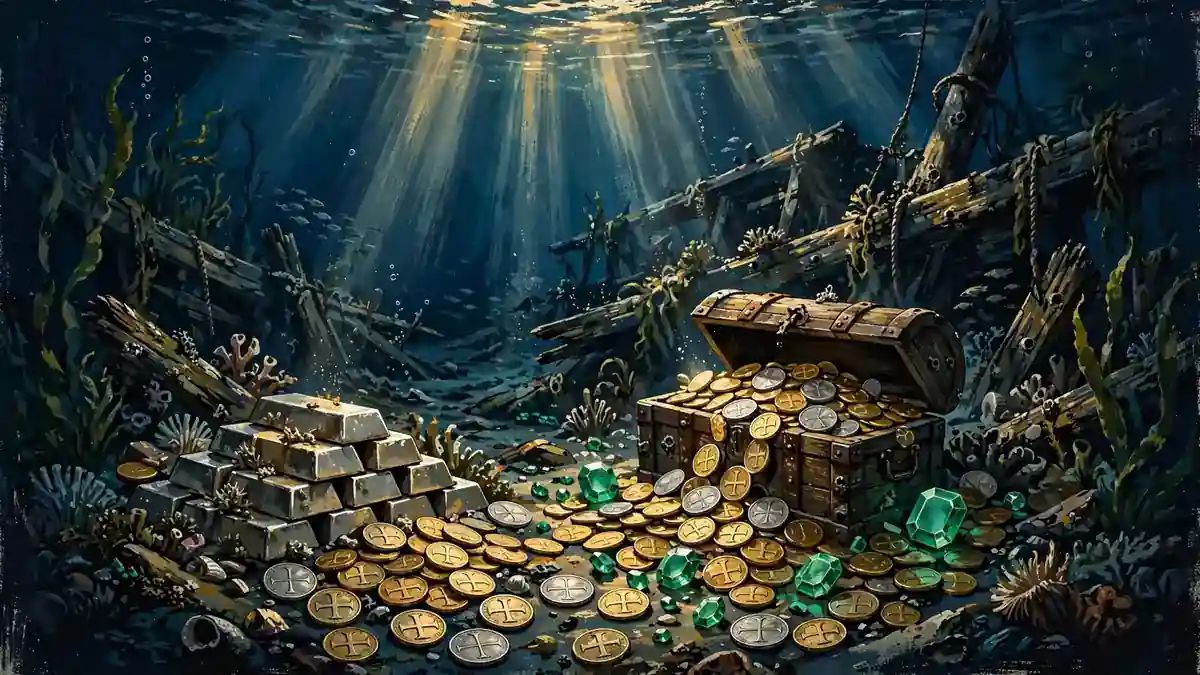
Then, on July 20, 1985 — exactly ten years to the day after Dirk’s death — Fisher’s son Kane radioed from the salvage boat Dauntless: “Put away the charts; we’ve found the main pile!” Divers Andy Matroci and Greg Wareham had located a virtual reef of chests: silver bars stacked like cordwood, chests of silver coins, copper ingots, stone ballast and artifacts, 55 feet down (Miami Herald, via OceanTreasures). Aboard the boat that day, Jimmy Buffett reportedly sang atop a stack of silver bars while Fisher and the “golden crew” drank champagne. The haul — 40 tons of gold and silver, some 114,000 Spanish silver coins (“pieces of eight”), gold coins, 1,000 silver ingots, 125 gold bars and discs, and 71 pounds (32 kg) of Colombian emeralds from the famed Muzo mine — was valued at roughly $450 million and entered the Guinness Book of World Records as the most valuable shipwreck recovery ever (Wikipedia; Intelligent Collector).
Fisher became a national figure overnight: the beaming, “Today’s the day!”-chanting captain on every talk show, the subject of the 1986 CBS television movie Dreams of Gold: The Mel Fisher Story starring Cliff Robertson and Loretta Swit, and a National Geographic Explorer episode that same year (Wikipedia). The discovery also rewrote maritime law and, by Fisher’s own boast recorded by the New York Times in a 2025 retrospective quoted by gCaptain, he had by his death “found more than $1 billion worth of treasure” across his career — a career total, not a personal fortune, but a measure of the scale he operated at.
Main Sources of Income
Fisher’s money came from four streams, and the order matters because the first one is where most of the fortune never reached his own pocket.
1. Salvage shares. Treasure Salvors, Inc. was financed by outside investors who bought in to fund the search; when treasure came up, they shared in the proceeds. A BikeHike history of the find puts it plainly: the Atocha treasure — “an estimated worth of some $400 million” — “made Fisher, his family members and other investors millionaires.” That plural matters. The $450 million was a gross recovery figure, not a personal balance sheet.
2. Direct retail of recovered treasure. Fisher’s company Mel Fisher’s Treasures sold authenticated coins, emeralds and artifacts directly to collectors and the public from stores in Key West and on the Florida mainland (ClassX profile) — capturing retail margins instead of wholesaling everything to dealers. Every coin carried Fisher’s own certification, which commanded a premium right up until it became a liability: in 1998 his retail subsidiary Crystals of Delaware pled no contest to fraud charges over counterfeit coins bearing a 1733 fleet insignia, agreeing to pay more than $67,000 to identified claimants and to maintain a $50,000 fund for additional customers during a three-year probation (New York Times, November 27, 1998).
3. The museum business. The nonprofit Mel Fisher Maritime Museum in Key West’s 1910 Naval Storehouse displays Atocha artifacts and runs educational programs; a second Mel Fisher’s Treasure Museum exhibits 1715 Fleet discoveries (melfisher.com tribute; Clio). Museums don’t pay dividends, but they anchored the family brand — and in November 2024 the Key West museum opened a new exhibit on the transatlantic slave trade centered on artifacts from the Henrietta Marie, the 1700 slave ship Fisher’s company found in 1972, keeping the institution newsworthy 26 years after his death (WLRN).
4. Ongoing salvage rights. Salvage didn’t stop in 1985. The wreck site known as “The Bank of Spain” — a sandy area 22 feet deep within 200 yards of the anchor location — was still being worked as of Wikipedia’s latest review, with the stern castle, some 300 silver bars and 8 bronze cannons still unfound. Meanwhile, Fisher’s company sold the rights to the 1715 Treasure Fleet wrecks to Queens Jewels, LLC (Wikipedia), converting a worked-over asset into whatever the sale fetched. The family still dives the Atocha trail each salvage season; in June 2016 grandson Josh Fisher Abt recovered his first 1715 Fleet gold coin — a Bogotá two escudo — from the Douglass Beach wreck (Indian River Magazine).

Salary and Earnings
Fisher never drew a salary in the conventional sense — his “paychecks” were shares of recoveries, and each came with a haircut.
The 1964 carpet of gold. The 2,500-coin 1715 Fleet find valued at $20 million at the time (Medical Economics) was split with Kip Wagner’s Real Eight under the handshake deal, then reduced again by Florida’s ~25 percent state-museum share (TreasureNet). A career-launching windfall, not a fortune.
The Santa Margarita, 1980. Over $20 million in gold and treasure recovered (Interesting Engineering) — again gross, again shared with the investor pool, again before costs.
The Atocha mother lode, 1985. Roughly $450 million gross (Heritage/Intelligent Collector, Miami Herald, Wikipedia; BikeHike reports ~$400 million — hence our $400M–$450M range). Out of that came the investor pool’s share, the 1982-settlement artifacts for Florida’s museums (the aggregator accounts at NetWorthPost and NetWorthRanker describe a 20 percent artifact donation to the state), years of operating costs for boats and crews, and the $1.6 million legal bill. Fisher sold a large portion of his share through retail channels over the following decade-plus rather than banking it as a lump sum.
The 1986 company sale. The Associated Press reported on December 5, 1986 that Fisher agreed to sell Treasure Salvors to four Atlanta businessmen; the business continued as Mel Fisher’s Treasures (Wikipedia). No sale price was disclosed in the sources we found — but a founder selling a salvage company one year after the mother lode suggests a liquidity event, not a man hoarding every doubloon.
Put together, the earnings picture is: several large gross recoveries across 1964–1985, each divided among investors, the state, and operating costs, with Fisher monetizing his share largely through coin and artifact retail. That is the arithmetic behind our $50M–$100M range — and behind the skepticism any honest profile should apply to the flat “$100 million” every aggregator repeats without a source.
Businesses and Investments
Treasure Salvors, Inc. — the search-and-salvage company behind the Atocha hunt, founded in the early 1970s (CineNetWorth dates its formation to 1973), financed by investors, employer of chief archaeologist Duncan Mathewson and the crews that pioneered magnetometer-and-mailbox salvage. Sold in 1986 to four Atlanta businessmen (AP); remained active as of 2009 (Wikipedia).
Mel Fisher’s Treasures — the successor retail and salvage business, selling authenticated Atocha and 1715 Fleet coins, emeralds and jewelry from stores in Key West and Sebastian, Florida, and online. Still family-run today. It sold the 1715 Fleet salvage rights to Queens Jewels, LLC (Wikipedia) — a quiet divestiture most profiles miss.
Crystals of Delaware — the retail subsidiary behind the 1998 fraud plea: counterfeit coins with a 1733 fleet insignia, bought from associate Walter J. Kruse and sold with Fisher’s signed certificate claiming he had found them himself (NYT, Nov. 27, 1998). The plea cost the company $67,000-plus in restitution and a $50,000 reserve fund — a small sum next to the treasure, but a real stain on the authentication business that underpinned his retail margins.
The museums — the nonprofit Mel Fisher Maritime Museum (Key West) and the Treasure Museum focused on the 1715 Fleet (melfisher.com). Fisher also opened a conservation laboratory in Sebastian in 1990 (Mel Fisher’s Treasures history). These were legacy and education plays, but they also functioned as permanent showrooms for the brand his family still monetizes.
On the investment side, Fisher’s real “portfolio” was the ocean floor: the still-unrecovered stern castle of the Atocha — with its church gold, taxes, and smuggled emeralds that never made the manifest — remains the family’s outstanding lottery ticket. Grandson Sean Fisher told the Miami Herald the crews keep working the 10-mile Atocha trail looking for “another 400 silver bars and over 130,000 silver coins,” plus some 60 pounds of Muzo emeralds believed smuggled aboard in a 70-pound keg to dodge the Spanish king’s 20 percent tax.
Brand Deals and Sponsorships
Honesty first: Mel Fisher was not a brand-endorser in any modern sense — his “brand deals” were pop-culture appearances and the merchandising of the treasure itself. He appeared on the game show To Tell the Truth on January 2, 1974 (Wikipedia), headlined the National Geographic Explorer episode “Quest for the Atocha” in 1986, and was portrayed by Cliff Robertson in the 1986 CBS television movie Dreams of Gold: The Mel Fisher Story (with Loretta Swit as Deo). Travel Channel’s Expedition Unknown revisited him in Season 3, Episode 17. The commercial engine was the certification business: coins and artifacts sold with Fisher’s signature carried a documented-provenance premium — a model that worked brilliantly until the 1998 counterfeit-coin plea showed what happened when the signature outran the verification.
Houses, Cars and Other Assets
Public records of Fisher’s personal assets are thin — treasure hunters don’t file like public companies — so this section stays inside what the sources support. Fisher lived and died at his home in Key West, Florida, the town that became his base after the 1968–69 move to the Keys (Wikipedia; RedOrbit). His working assets were boats: the Dauntless (Kane’s boat on mother-lode day), the J.B. Magruder and the Dare, whose crews still work the Atocha trail under the family operation (Miami Herald). He also held a personal collection of recovered artifacts — the museum displays and the family stores suggest much of the finest material stayed in Fisher hands rather than being sold, functioning as both inventory and heirloom. No credible source documents a real-estate portfolio, car collection, or private holdings beyond the Key West home and the business assets, so we report none.
Awards and Achievements
Fisher’s trophy case is measured in precedents, not statuettes. The Atocha recovery entered the Guinness Book of World Records as the most valuable shipwreck ever recovered — a record it held until the 2015 discovery of the San José (Dave Does History; Intelligent Collector). The 8–1 Supreme Court victory of July 1, 1982, in Florida v. Treasure Salvors set the landmark precedent affirming private salvors’ rights to historic wrecks in federal waters. His company’s identification of the Henrietta Marie — the 1700 English slave ship found in 1972, reburied when the crew realized what it was, then excavated in 1983–85 after a bronze bell inscribed “The Henrietta Marie 1699” confirmed it — produced the most complete collection of slaving-ship artifacts in North America (Wikipedia), honored with a 1993 memorial plaque by the National Association of Black Scuba Divers. NetWorthPost credits Fisher’s leadership with helping drive UNESCO’s 2001 Convention on the Protection of the Underwater Cultural Heritage, adopted three years after his death. And Key West, never a town to under-celebrate, honored its adopted captain with ceremonial treasure-hunter titles — crown and scepter included (ClassX).
Net Worth Growth Over the Years
No audited figures exist for any year of Fisher’s life; the table below reconstructs the trajectory from documented recoveries and business events. Figures are gross recovery values where stated — Fisher’s personal share was always smaller.
| Year | Milestone | Estimated standing |
|---|---|---|
| 1950s–62 | Dive shop “See Da Sea,” dive instruction, underwater films | Modest — small-business income |
| 1964 | “Carpet of gold”: ~2,500 gold coins from the 1715 Fleet, then valued at $20M gross | First real wealth — shared with Real Eight, ~25% to Florida |
| 1969–79 | Atocha search burns cash; lean years, debts mount | Strained — search costs ran to hundreds of thousands |
| 1980 | Santa Margarita recovery: $20M+ gross | Recovering — shared with investor pool |
| 1982 | Supreme Court 8–1 win secures title; $1.6M legal bill | Asset-rich, cash-constrained |
| 1985 | Atocha mother lode: ~$450M gross | Tens of millions — the wealth years begin |
| 1986 | Sells Treasure Salvors (AP); retail monetization accelerates | Rising — liquidity event, terms undisclosed |
| 1998 | Death, December 19; family business continues | ~$100M commonly reported; our assessed range $50M–$100M |
Social Media Presence
Fisher died in 1998, a decade before the social-media era, so there are no personal accounts to audit — and any “Mel Fisher” profile claiming otherwise is fan-run. The legacy lives on through the family business channels: Mel Fisher’s Treasures maintains the brand’s web and social presence around new recoveries, the Key West museum promotes exhibits (like the November 2024 Henrietta Marie installation covered by WLRN), and the “Today’s the day!” motto still circulates as the signature sign-off on the company’s public communications. For a man whose fame peaked on network television and the cover of National Geographic, the afterlife is appropriately analog: museums, stores, and boats, not feeds.
Personal Life
Fisher married Dolores “Deo” Horton in 1953, and the marriage was the business partnership’s foundation: she dove, kept the books of the early expeditions, and raised five children — Dirk, Kane, Kim, Julie and Taffi — inside what the Miami Herald later called the “golden crew.” The family’s defining tragedy came on July 20, 1975, when Dirk, his wife Angel and diver Rick Gage drowned after their boat’s bilge pump failed; Fisher kept searching, and exactly ten years later Kane made the mother-lode call. Fisher died at his Key West home on December 19, 1998, at 76, after a long battle with cancer — reported as bladder cancer by RedOrbit, with chemotherapy in his final months (doms2cents). He was cremated and his ashes scattered at sea over the Atocha wreck site. The business passed to the family: sons Kane and Kim, daughter Taffi Fisher Abt, and grandchildren including Sean Fisher and Josh Fisher Abt, who still dive the family sites. In a 2005 Miami Herald retrospective, son Kim summed up the family’s relationship with the money: “I never used to worry about money. It really hasn’t made any difference. It’s an incredible thrill to find gold and emeralds. It’s too much fun to quit.”
Sources & Reporting
Wikipedia — biographical backbone: birth/death dates, Purdue, “See Da Sea,” 1953 marriage, five children; the Atocha timeline (1973 silver bars, 1975 cannons, July 20 1975 deaths, July 1 1982 8–1 Supreme Court ruling, $450M mother-lode inventory); the Henrietta Marie history; the 1998 Crystals of Delaware fraud plea; the 1986 company sale; pop-culture credits. Reporting window: article last updated ~96 days before research.
The New York Times — July 21, 1975 headline “3 Drown on Mission to Salvage $100-Million in Sunken Treasure” (via Wikipedia citation); November 27, 1998 report “Hunter Admits Sale of Fake Gold Coins” ($67,000+ restitution, $50,000 fund, 3-year probation); 2025 “more than $1 billion worth of treasure” career-total quote (via gCaptain). Reporting window: 1975–2025.
The Miami Herald — Cammy Clark’s account of mother-lode day (divers Matroci and Wareham, Jimmy Buffett, champagne); the family’s continuing search with grandson Sean Fisher’s quotes on the unfound stern castle, 400 silver bars, 130,000 coins and smuggled emeralds (via OceanTreasures). Reporting window: retrospective coverage.
Intelligent Collector (Heritage Auctions) — “Deep Value”: the 1973 silver-bar identification, the 16.5-year search, the $450M valuation, 40 tons of gold and silver, 114,000 pieces of eight, 71 lbs of Muzo emeralds; the 2015 San José comparison. Reporting window: current.
Florida Weekly (Key West) — “The quest for the Atocha”: the 65,000 dive students, underwater TV films, lobster-selling early years, the crew’s composition, the handshake year with Real Eight, the magnetometer and mailbox inventions, the Seville archive research with Eugene Lyon, and the costly mistranslated searches. Reporting window: retrospective.
Indian River Magazine — the 1963 Kip Wagner contract, the May 1964 “carpet of gold” (2,500 coins), and grandson Josh Fisher Abt’s 2016 two-escudo find on the Douglass Beach wreck. Reporting window: 2016–2022.
Medical Economics — the 1,033-coins-in-a-day / 2,700-in-a-week account ($20M then-valuation), Army Engineers service, the 108 lawyer hours and $1.6M Florida legal bill, and the Muzo emerald ring detail. Reporting window: retrospective.
TreasureNet — “Gold on the Bottom”: the mid-1960s Fisher–Real Eight partnership, the ~25% Florida share on 1715 Fleet finds, and the post-1975 permit history. Reporting window: 2026.
Dave Does History — the July 1, 1982 8–1 Supreme Court ruling narrative and the Guinness record context. Reporting window: 2025.
Interesting Engineering — the $20M+ Santa Margarita recovery, Kane Fisher’s “Put away the charts” call, and the mother-lode inventory. Reporting window: retrospective.
WLRN — November 2024 report on the Mel Fisher Maritime Museum’s new Henrietta Marie transatlantic-slave-trade exhibit. Reporting window: November 2024.
RedOrbit — 2005 retrospective: death from bladder cancer at 76, the “Uncle Dad” nickname, son Kim Fisher’s quotes. Reporting window: 2005.
gCaptain — 2025 “Gold Fever” piece quoting the NYT on the $1B+ career treasure total. Reporting window: 2025.
NetWorthPost, NetWorthRanker, Gemtracks, MediaCoverage — the net-worth aggregator consensus (~$100M), none with primary sourcing; the 20% artifact-donation-to-the-state detail appears in these accounts. Reporting window: 2023–2026.
CineNetWorth — the $400M outlier figure (2025), flagged in this article as an apparent conflation of the treasure’s gross value with personal net worth.
Mel Fisher’s Treasures / Clio — the family company’s 1715 Fleet history (20% annual state donation, 1990 Sebastian conservation lab); Clio’s museum history (bucket-diving-helmet childhood, Purdue/Alabama engineering, Army Engineers, 1950 California move). Reporting window: current.
Frequently Asked Questions
What is Mel Fisher’s net worth in 2026?
Mel Fisher’s net worth is estimated at $50 million–$100 million, with ~$100 million the figure most net-worth sites repeat. Fisher died in 1998, so this describes his wealth at the end of his life; no audited estate figure was ever published. One site (CineNetWorth) claims $400 million, but that appears to confuse the Atocha treasure’s gross value with his personal fortune.
How much treasure did Mel Fisher actually find?
The New York Times reported (via a 2025 gCaptain retrospective) that Fisher had “found more than $1 billion worth of treasure” before his death. The headline find was the 1985 Atocha mother lode, valued at roughly $450 million, plus over $20 million from the Santa Margarita in 1980 and the 1964 “carpet of gold” from the 1715 Fleet. These are gross recovery values — investors, the state, and operating costs all took shares.
Did Mel Fisher get to keep the Atocha treasure?
Mostly, but not all of it. Florida forced his company into a contract giving the state 25 percent, then fought him for eight years; on July 1, 1982, the U.S. Supreme Court ruled 8–1 for Treasure Salvors, awarding it rights to all found treasure. Even so, the $450 million gross was divided among the investors who funded the 16-year search, Florida’s museums received artifacts, and legal bills topped $1.6 million.
What happened to Mel Fisher’s son Dirk?
On July 20, 1975, Fisher’s eldest son Dirk, Dirk’s wife Angel, and diver Rick Gage drowned when their salvage boat sank after a bilge pump failure. It happened just days after Dirk had found five bronze cannons that proved to be from the Atocha. Exactly ten years later — July 20, 1985 — Fisher’s son Kane made the radio call announcing the mother lode.
How long did it take Mel Fisher to find the Atocha?
Sixteen years of focused searching, from 1969 to July 20, 1985. Fisher’s crew invented purpose-built tools for the hunt — magnetometers to sense the seabed and the “mailbox,” a propeller-fitted deflector that blasted sand off the bottom. Historian Eugene Lyon researched Spanish archives in Seville, though mistranslated directions sent the crew on costly wrong searches before they corrected course.
What was the Atocha treasure worth?
The recovered mother lode is valued at roughly $400–$450 million: 40 tons of gold and silver, about 114,000 Spanish silver coins, 1,000 silver ingots, 125 gold bars and discs, and 71 pounds of Colombian emeralds from the Muzo mine. It entered the Guinness Book of World Records as the most valuable shipwreck recovery ever — a record that stood until the San José was found in 2015.
Is anyone still looking for the Atocha treasure?
Yes. The wreck site called “The Bank of Spain” is still being worked by Fisher’s family, and the richest part — the stern castle, with an estimated 300 silver bars, 8 bronze cannons, the church’s gold, and smuggled emeralds — has never been found. Fisher’s grandson Sean told the Miami Herald the crews keep working the 10-mile Atocha trail, while his grandson Josh recovered a 1715 Fleet gold coin in 2016.
Who runs Mel Fisher’s business today?
The family. After Fisher sold Treasure Salvors in 1986, the business continued as Mel Fisher’s Treasures, run after his 1998 death by his children (Kane, Kim, and Taffi Fisher Abt) and grandchildren. The company still sells authenticated Atocha coins and jewelry from stores in Key West and Sebastian, Florida, and operates the treasure museums.
Final Thoughts
Mel Fisher’s fortune is the purest example in our files of a number everyone quotes and nobody sourced: ~$100 million, repeated across the net-worth web without a single primary document behind it. The documented facts are better than the myth. A chicken farmer’s son read Treasure Island, built a diving helmet from a bucket, taught 65,000 people to dive, and spent 16 years and a son’s life chasing a ship that sank in 1622 — then won an 8–1 Supreme Court case before he even found it. The $450 million mother lode made him, his family and his investors millionaires, and the $1 billion-plus career total the Times credited him with remains one of the great tallies in American enterprise. Was he worth $100 million? Probably, roughly, at the peak — our range of $50M–$100M says so with the honesty the record demands. The $400 million figure one site floats is fantasy, the treasure’s gross wearing a man’s name. Fisher’s real net worth was the operation: the boats, the crews, the museums, the family still diving the Bank of Spain. “Today’s the day,” he said every morning. For sixteen years it wasn’t — until the one morning it was.
Published on October 19, 2026. Last reviewed October 2026. Found an error? See our corrections policy.