
Dennis Collins‘s net worth is estimated at $30 million to $40 million as of October 2026. Celebrity Net Worth, the most frequently cited estimator, puts the figure at $30 million (updated August 2024), while several 2025–26 profiles land at $40 million — and one outlier pushes the number far higher with thin sourcing. The range reflects a fortune that is genuinely hard to pin down: most of it sits in a private Jeep business, a manufacturing arm, and a rotating collection of rare cars that is bought, restored, and sold rather than held still. Three money stories explain the bulk of it: a Jeep restoration business he has owned for more than four decades, a personal car collection that produced six world-record auction sales in a single 2017 weekend, and a YouTube series, Coffee Walk, that now reaches millions of viewers every Friday morning.
Dennis Collins: Quick Facts
| Estimated net worth | $30–$40 million (Celebrity Net Worth: $30M; several 2025–26 profiles: $40M) |
|---|---|
| Profession | Entrepreneur; classic-car collector and restorer; TV personality |
| Nationality | American |
| Born | January 28, 1965 (age 61) |
| Height | 6 ft 1 in (185 cm) |
| Primary income sources | Collins Brothers Jeep restoration business; Black Mountain (BLKMTN) Jeep parts manufacturing; classic-car buying and selling; Coffee Walk YouTube series |
| Active years | 1984–present |
| Last reviewed | October 2026 |
- Early Life and Background
- Education
- Career Journey
- Rise to Fame
- Main Sources of Income
- Salary and Earnings
- Businesses and Investments
- Brand Deals and Sponsorships
- Houses, Cars and Other Assets
- Awards and Achievements
- Net Worth Growth Over the Years
- Social Media Presence
- Personal Life
- The Collector Playbook
- Sources & Reporting
- Frequently Asked Questions
Early Life and Background
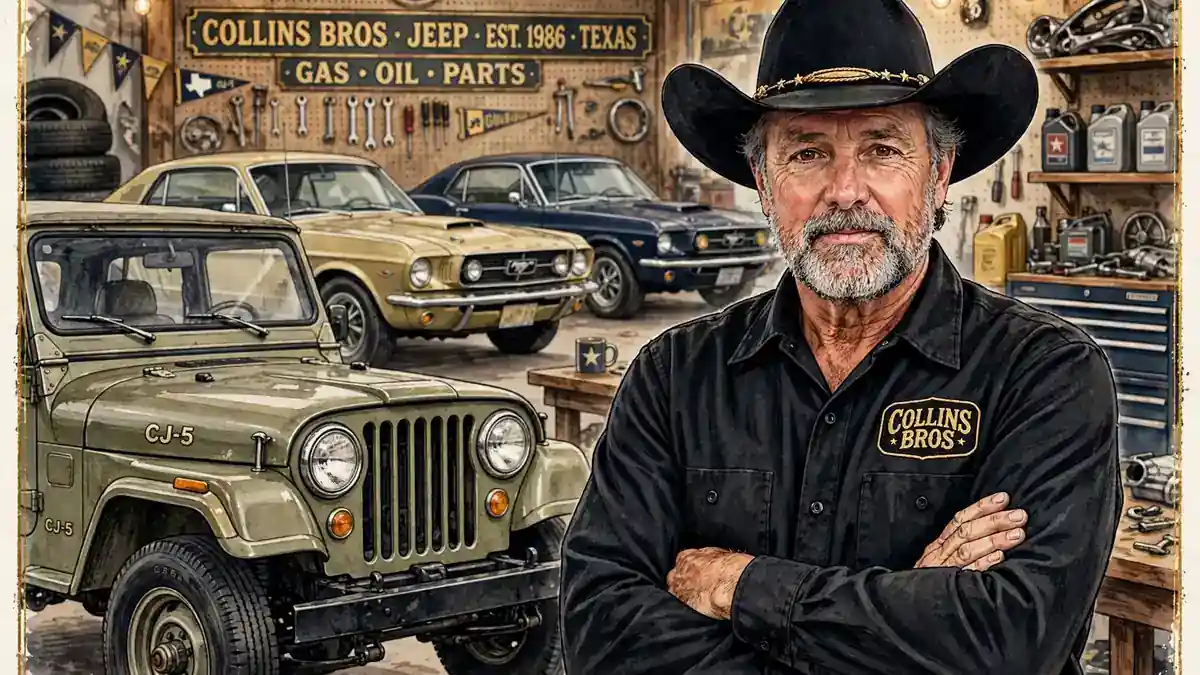
Dennis Collins was born on January 28, 1965, in Wylie, Texas, to Jim and Patra Collins, and raised there alongside his younger brother Jaime. The car obsession started about as early as an obsession can: as a child, Collins staged cops-and-robbers chases across his bedroom rug with Matchbox and Hot Wheels cars. It was not a passing phase. In high school he drove a blue 1966 Ford Mustang, and by his own later telling he has been restoring, buying, and selling cars since he was 13 years old — a detail that surfaces in a 2026 Restoration Revival event listing, “Dennis Collins has been restoring, buying and selling cars since he was 13 years old.”
What separates Collins’ origin story from the usual gearhead biography is that the hobby ran parallel to genuinely strong schooling. He did not wash out of business life into the garage; he chose the garage after studying business. That choice — a college graduate in economics and finance deciding that outfitting Jeeps was a smarter career than a finance desk — is the hinge the whole fortune turns on.
Education
Collins earned degrees in economics and finance from the University of Texas at Dallas, per Celebrity Net Worth, whose biography of him has been maintained since 2020. A few secondary profiles shorten this to “the University of Texas,” but the Dallas campus is the specific, better-attributed version. The education shows up everywhere in how he talks about the business: inventory management, risk tolerance, and the economics of holding versus selling rare inventory are the subjects he returns to in interviews. On a 2026 episode of the Inside the C-Suite podcast, host Christy Honeycutt pressed him on the hardest part of entrepreneurship, and his answer was characteristically blunt: the money is the stressful part — spending your own capital on inventory, carrying the risk yourself.
Career Journey
Right after college, Collins opened his own shop instead of taking a job. Collins Brothers Jeep was founded in 1984 with his brother Jaime, and Collins received his dealer’s license that same year — a date he confirmed in the Inside the C-Suite interview, and one that puts him at 42 consecutive years in the business as of 2026. The shop’s home base is 3101 W FM 544, Wylie, Texas, where it operates today as a family-owned and operated business offering service, paint, customization, and conversions across CJ, YJ, TJ, LJ, JK, JL, and JT Jeep models (1976 to current).
The model was deliberately narrow. Where most dealers chase breadth, Collins Brothers Jeep specialized in Jeep restoration and Jeep conversion projects — specifically the Wrangler and CJ series — and became what Collins’ own team now describes as the largest classic Jeep restoration shop in the world. Narrow focus, repeated for four decades, built the reputation that made everything else possible: the parts brand, the television visibility, and the credibility that lets a buyer trust Collins’ eye for rare cars.
In 2000, Collins added a second revenue engine: Black Mountain Jeep Parts and Accessories, a manufacturing arm that grew into a globally distributed Jeep parts brand. It trades today under the BLKMTN badge (blkmtnjeep.com), selling parts, accessories, conversions, and upgrades for Jeep JK and JL models, and it commissions full custom builds through a “BLKMTN Built” program. Crunchbase lists the parent entity as Collins Bros., Inc., headquartered in Wylie, Texas. The parts business matters to the net-worth story for a simple reason: unlike car flipping, it produces recurring revenue independent of whatever Collins happens to have in his personal garage.
Rise to Fame
Collins built a serious fortune before most of America knew his name. The fame arrived through a friendship forged on two wheels: in 1996, Collins met Richard Rawlings on a Harley-Davidson invitational ride from Dallas to Daytona. The two became close — and then, in 2007, they became briefly famous together for something that had nothing to do with television. During the 2007 Bullrun rally in Montreal, Rawlings and Collins bet fellow rally regular Jay Riecke $50,000 that they could break the longstanding Cannonball Run record for the fastest cross-country drive from New York City to Los Angeles. They left the rally, fitted a black 1999 Ferrari 550 Maranello with extra fuel cells and video equipment, and made the run in 31 hours and 59 minutes — beating the 32-hour-51-minute mark set by Dave Heinz and Dave Yarborough in a Jaguar XJS back in 1979. Autoblog and Jalopnik both covered the attempt in May 2007, and the record stood until 2013.
By the time Discovery Channel’s Fast N’ Loud premiered in 2012, Collins was a natural fit: a genuine buyer with real money, a 30-year restoration business, and a pre-existing friendship with the star. He became a recurring figure on the show between 2012 and 2017 — Net Worth Post counts 12 episodes across those years — typically appearing as a knowledgeable buyer snapping up Rawlings’ finds. He also appeared alongside Rawlings on Garage Rehab, the Fast N’ Loud spin-off. Television never became his business — the shop did — but it converted four decades of credibility into national recognition, and that recognition eventually became the engine of Coffee Walk.
One caveat that honest reporting requires: the 2007 Cannonball time was claimed rather than certified. Autoblog described the 31-hour-59-minute mark as “unofficial,” Jalopnik wrote that it had “yet to be independently verified,” and later reporting notes the record was never formally ratified amid disputes over the route and timing. Collins and Rawlings held the mark in the popular record books for six years regardless — but unlike an auction price, it is a claimed time, not a certified one.
Main Sources of Income
Collins’ wealth comes from four interlocking income streams, which is why the estimate resists a single clean number. The base is the Collins Brothers Jeep restoration and service business — full restorations, custom builds, service, and vehicle sales out of the Wylie shop. The second is parts manufacturing through BLKMTN, which sells to Jeep owners worldwide and is the closest thing in the portfolio to a scalable product business. The third is classic-car buying and selling: Collins’ stated formula is finding rare, low-mileage classics and matching them with buyers who have been searching for them — “for every Jeep sold or serviced in his shop, a classic car finds a new home,” as Celebrity Net Worth puts it. The fourth is media and digital content: Coffee Walk ad revenue, sponsorships, and branded merchandise. Information Cradle also reports involvement in real estate development, commercial property leasing, and investments in companies across industries — worth noting as a reported fifth stream, though we could not independently verify deal-level detail.
The structure is unusual among television-adjacent entrepreneurs: the screen came last and monetizes the other three streams rather than replacing them. A Coffee Walk episode that walks through a barn-find collection is simultaneously entertainment, advertising for the shop, and a direct funnel into vehicle sales.
Salary and Earnings
Collins has never publicly disclosed a salary, a draw from his businesses, or deal-level figures for the shop — and no credible reporting has surfaced them. What can be measured is the digital business, which is unusually transparent for a personality-driven channel. His YouTube channel, Dennis Collins Car World (@denniscollinscarworld, live since June 2016), holds roughly 650,000 subscribers, more than 200 million total views, and over 565 videos, per independent trackers SpeakRJ and SocialCounts (checked October 2026). Third-party estimators put the channel’s ad earnings in the low thousands of dollars per month — FindAChannel estimated about $2,700 a month on an older snapshot, while youtubers.me’s rolling 30-day band sits between roughly $800 and $4,900. The ad money is real but modest; it is the smallest of his income streams.
What the view counts miss is the flywheel. In his 2026 Inside the C-Suite appearance, Collins’ team described Coffee Walk as a long-form automotive series with 400 consecutive weekly episodes and more than 2.3 million organic followers across platforms — a publishing streak few automotive shows anywhere can match. Weekly episodes drop every Friday at noon Central, and the channel has extended into a Spanish-language version (Coffee Walk en Español). Sponsors buy into the trust directly: workwear brand Brunt runs a standing COFFEEWALK10 discount code, the vehicle-buying service GiveMeTheVin promotes a $500 bonus offer through Collins’ link, and Blue Island Coffee sells “The Holy Grail Blend” and “The Outstanding Blend” as Coffee Walk tie-ins. None of this is a salary — it is better described as a media business where the content, the sponsors, and the vehicle deals all feed the same customer.
Stacked against his Fast N’ Loud circle, Collins sits at the top of the money table — and the gap explains the business-first story. Celebrity Net Worth’s own comparison tool places Aaron Kaufman $22 million below Collins, and 2026 profiles put Richard Rawlings at roughly half of Collins’ figure:
| Personality | Reported net worth | What drives it |
|---|---|---|
| Dennis Collins | $30–$40 million | Collins Brothers Jeep, BLKMTN parts brand, car dealing |
| Richard Rawlings | ~$18 million | Gas Monkey Garage, Fast N’ Loud, Dodge endorsements |
| Aaron Kaufman | ~$8 million | Arclight Fabrication, Fast N’ Loud, Shifting Gears |
Sources: Celebrity Net Worth (Collins $30M; comparison tool implies ~$8M for Kaufman); a 2026 profile citing Celebrity Net Worth for Rawlings’ $18M.
Businesses and Investments
The operating core is Collins Bros., Inc.: the Wylie restoration shop, the parts manufacturing line, and the retail side selling restored Jeeps, customs, and parts from the Black Mountain/BLKMTN brand. The shop’s published scope covers full service, paint, customization, and conversions for every Jeep generation from 1976 to current, and customer reviews consistently single out the parts operation’s speed and pricing. Beyond the counter, the businesses form a closed loop that competitors in the Jeep world rarely replicate: the shop feeds the parts line real-world fitment data, the parts line feeds the shop margin on every build, and Coffee Walk feeds both of them customers.
On investments beyond the automotive world, the record is thinner. Information Cradle reports real estate development and commercial property leasing among his activities, and the 2017 sale of his own North Texas estate (detailed below) suggests genuine familiarity with the property market. We found no public record of outside equity investments, startup stakes, or securities portfolios, so we treat his investment profile as concentrated: cars, Jeeps, parts inventory, and real estate. That concentration is also the honest explanation for the estimate’s spread — a $40 million figure likely assumes fuller valuation of the personal car collection, while the $30 million figure stays conservative on inventory that turns over constantly.
Brand Deals and Sponsorships
Collins does not do celebrity endorsement deals in the conventional sense; he monetizes the audience the way a shop owner would — through branded merchandise and in-show sponsor integrations built around Coffee Walk. The merchandise line — Coffee Walk shirts, hats, and gear — turns viewers into walking billboards for the Wylie shop, and sponsor segments are sold on trust rather than reach: a buyer’s trust in Collins’ eye is the product being monetized. These deals are modest earners individually; their real value is compounding credibility with an audience that later spends far more on restorations and vehicles.
Houses, Cars and Other Assets
The car collection is the most analyzed asset Collins holds, because it periodically converts to public prices. The centerpiece stories: Collins purchased the Law Man Mustang, a Super Boss 429-powered machine, for less than $100,000. Reporting on what happened next splits — Celebrity Net Worth notes that the same model has sold for more than $2 million, while other outlets report that the car itself changed hands for over $2 million. We present both attributions because the sources genuinely disagree on whether Collins personally realized the seven-figure number. Either way, the purchase was one of the sharpest documented buys in modern Mustang collecting.
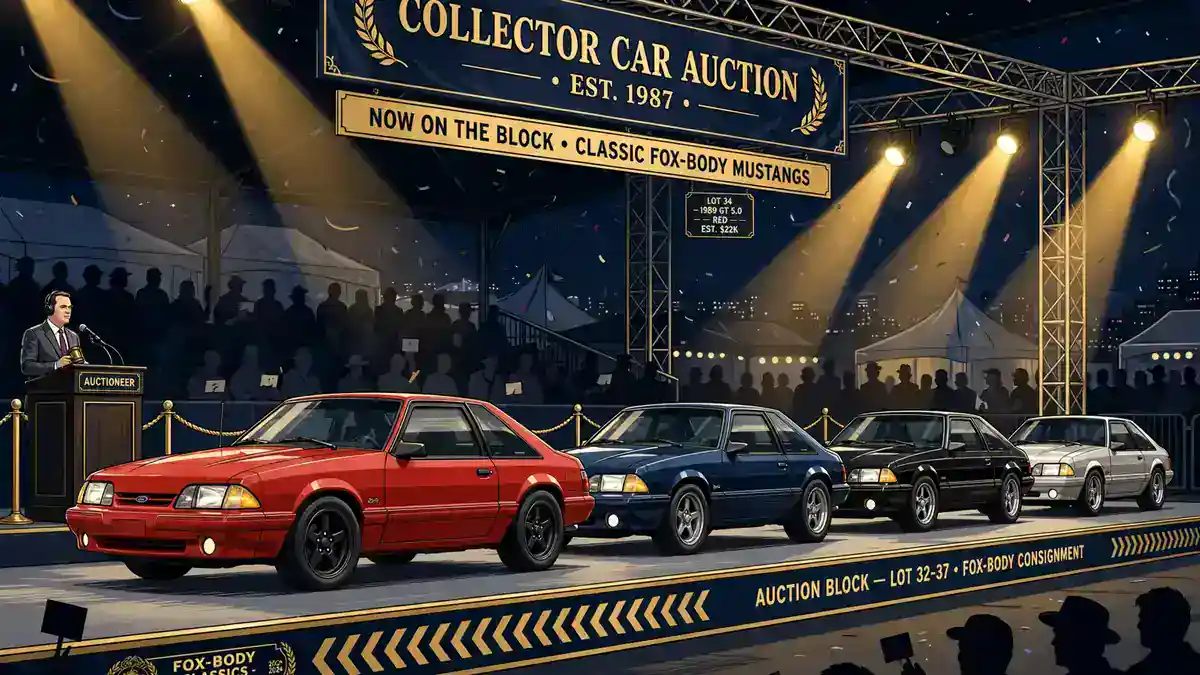
Then came the weekend that made the collection famous. At Barrett-Jackson’s 2017 Scottsdale auction, Collins sold six of his Mustangs — drawn from a one-of-every-year 5.0L Fox-body collection that MotorTrend covered as it headed to the block — and the results were extraordinary: a 1994 Mustang GT Convertible for $44,000; a 1989 Mustang LX Hatchback 5.0 for $71,500; a 1999 Mustang 35th Anniversary Convertible Limited Edition for $55,000; a 1990 Mustang Convertible 7UP Limited Edition for $82,500; a 1993 Triple White LX Convertible for $44,000; and a 1985 Mustang SVO Hatchback for $63,800. That is $360,800 across six cars, with Celebrity Net Worth reporting that each set a world record for its model. Before the sale, Collins had become a social-media phenomenon simply for owning the Fox-body lineup, with preview videos drawing millions of views.
More recently, Collins has used Bring a Trailer as a public shop window. In one documented 2024 run, he rescued and restored six Corvettes with his shop mechanic and listed them all through the online auction platform — models ranging from 1958 to 1989, two of them described by Collins as “extremely rare.” The results were instructive about how his inventory turns over: a 1970 Corvette Coupe LT-1 sold for $66,000, a custom 1958 Pro-Street Vette brought $41,000, and a four-speed 1971 Coupe LS6 — one of only 188 built with the 454ci LS6 V8 — drew a $55,454 high bid that did not meet reserve. Restoration, documentation, and Collins’ own audience are the marketing budget; the margin is the profit.
The keepers are arguably more interesting than the sales. Collins has owned or worked on more than 200 Healeys, including Goldie, the celebrated 100-6 show car, and he is reported to own the first production Nash-Healey, built in 1950 — a car often described as America’s first true sports car, though historians debate the title. Over his career he has bought and sold more than 500 restored vehicles in total. These are not garage trophies; they are working inventory in a lifelong arbitrage between what a rare car costs and what the right buyer will pay.
Real estate is the quieter asset line. In 2017, Collins listed the family estate in Murphy, Texas — about 30 miles from downtown Dallas and 38 from DFW Airport — for $1.988 million, with Dallas News covering the listing that July. The property told you everything about the man: two acres, a 7,964-square-foot ranch-style home, and a freestanding, climate-controlled two-building garage complex big enough to store more than 20 cars plus a large workshop. Add a private baseball diamond that doubles as a helicopter pad, a fenced dog run, a double-sized V-shaped pool, a fire pit and double-sided fireplace, a fountain that converts into a hot tub for 16, three bedrooms plus a guest wing, three fireplaces, a wine cooler, a wet bar — and a 600-square-foot boutique closet in the master suite reached by its own private staircase. Collins and his wife planned to build a new contemporary home on a golf course elsewhere in Texas, per the Dallas Business Journal via Neighborhoods.com. The sale is a matter of public record; the current home’s value is not, so we count the real estate contribution conservatively.
Awards and Achievements
Collins’ trophy case holds no acting awards — his honors are the kind the automotive world respects more. The six world-record Mustang sales at Barrett-Jackson 2017 stand as the single most decorated weekend of his collecting career. The 2007 Cannonball Run record — 31 hours, 59 minutes from New York to Los Angeles in a modified Ferrari 550 Maranello, a mark that had stood since 1979 — put him in the record books alongside Richard Rawlings, and it stood until 2013. His business achievements are measured in longevity: a dealer’s license held since 1984, a shop that has run for 42 years, a parts brand launched in 2000 that sells globally, and a YouTube series that has shipped 400 consecutive weekly episodes. In the Jeep restoration trade, where most shops are measured in years rather than decades, that continuity is the achievement competitors cannot buy.
Net Worth Growth Over the Years
Public net-worth tracking for Collins begins late — Celebrity Net Worth’s profile was published in 2020 at $30 million — so the earlier years below are reconstructed from business milestones, not from published estimates, and should be read as illustrative trajectory rather than documented figures.
| Year | Estimated net worth | What drove it |
|---|---|---|
| 1984 | Under $1 million | Opens Collins Brothers Jeep with brother Jaime; receives dealer’s license |
| 2000 | Low single millions | Launches Black Mountain Jeep Parts and Accessories; adds manufacturing margin to restoration revenue |
| 2007 | High single millions | Cannonball Run record with Richard Rawlings; growing national profile in car culture |
| 2012 | ~$10–$15 million | Recurring role on Discovery’s Fast N’ Loud begins; shop demand and collector credibility compound |
| 2017 | ~$20–$25 million | Six world-record Mustang sales ($360,800) at Barrett-Jackson Scottsdale; lists Murphy estate at $1.988M |
| 2024 | $30 million | Celebrity Net Worth updates profile, holds $30M; Coffee Walk passes 300 weekly episodes |
| 2026 | $30–$40 million | Coffee Walk at 400+ weekly episodes and 200M+ views; multiple 2025–26 profiles land at $40M |
The shape of the curve is the story: no inheritance event, no single payday, no exit. Four decades of a profitable trade, layered with manufacturing, media, and a collection that appreciates as it turns over.
The Collector Playbook: How Collins Actually Makes Money on Cars
Watch enough Coffee Walk episodes and a repeatable business model emerges — one that explains why the car collection is an asset rather than a hobby. Collins buys in private, where prices are soft and sellers are motivated: barn finds, estate collections, and tip-offs from the network he has built since his teens. He restores in-house, where the shop’s labor costs him far less than it would a buyer, and he sells in public, where auctions and his own audience create competitive bidding. The margin sits in the gap between private purchase price and public sale price, multiplied by volume — more than 500 vehicles bought and sold across his career.
The Law Man Mustang is the textbook case. Buying a Super Boss 429-powered machine for less than $100,000 required knowing what it was when the seller did not fully price it — and holding it until the market caught up. The 2017 Barrett-Jackson sale shows the public end of the same machine: six cars, each positioned as the definitive example of its model year or trim, sold at no-reserve-style public auction where rarity plus documentation plus Collins’ own reputation as a collector pulled record prices. Preview content for the sale drew millions of views, which meant the audience was pre-sold before the gavel fell.
Restoration Revival, the 2026 live event listing that bills Collins as a headliner, captures the model’s current state: four decades in, he is simultaneously the inventory source (his own collection), the service provider (the shop), the media channel (Coffee Walk), and the auction draw (his name on the consignment). Competitors who try to value his net worth from YouTube ad revenue alone miss the point entirely — the channel is the cheapest customer-acquisition tool in the classic-car business, and the cars are the product. That is also why the estimates spread so wide: value the inventory at wholesale and you get $30 million; value it at what his audience will pay at auction, and $40 million is not aggressive.
Social Media Presence
Collins runs his digital presence the way he runs the shop: steady, product-focused, and in-house. The hub is YouTube — Dennis Collins Car World (@denniscollinscarworld), home of Coffee Walk, with roughly 650,000 subscribers and more than 200 million total views as of October 2026. His personal accounts include Instagram at @thedenniscollins, where he posts to a mid-six-figure following. His team’s 2026 podcast bio claims more than 2.3 million organic followers across all platforms — a number we attribute rather than audit, since platform-by-platform counts do not publicly sum to it. His daughter Kelsey, who shares the family’s automotive fascination, appears in the Coffee Walk world. The tone is consistent everywhere: cars, shop life, and deals, with no lifestyle-posturing filler.
The 2026 season of the show gave competitors nothing they could copy. In one standout Coffee Walk installment, Collins unveiled what the muscle-car press called a “top secret” muscle car collection — a running documentary of what a working dealer actually keeps for himself versus what goes back out the door, narration and all. The format is the insight: viewers get Collins explaining why a car caught his attention, what shape it was in when it arrived, and whether it is headed for private sale, full restoration, or a permanent place in his own rotation.
Personal Life
Collins has been married to Kimberly “Kim” Collins since 1993. The couple has two children, now adults and living on their own, per Celebrity Net Worth. His daughter Kelsey is visibly involved in the family business, appearing as part of the Coffee Walk crew — one of the few family details the public record confirms. Beyond that, Collins keeps his family life private; there are no public reports of divorce proceedings, controversies, or legal disputes attached to his name, which is itself notable for a public figure with four decades in a transaction-heavy business.
Sources & Reporting
Celebrity Net Worth — the $30 million estimate; UT Dallas economics and finance degrees; the blue 1966 Mustang in high school; Collins Brothers Jeep’s 1984 founding; the Law Man Mustang Super Boss 429 purchase under $100K; the six world-record Mustang sales at Barrett-Jackson Scottsdale 2017 with per-car prices; the 200+ Healeys, Goldie, and the first 1950 Nash-Healey; the Cannonball Run record details (31h59m, 2,811 miles); the Murphy, Texas estate listing at $1.988M and its full specifications; wife Kim, married since 1993, two adult children; profile published 2020, updated August 2024.
OnAllCylinders (Summit Racing’s media outlet) — coverage of the 2017 Barrett-Jackson Scottsdale sale: eight Collins Mustangs went across the block, six set records for their respective years and models, with lot-by-lot results.
Mustang Fan Club — the eight-car $391,050 auction total at Barrett-Jackson Scottsdale 2017; six of the eight Mustangs broke world records, with per-car results matching the record prices.
Autoblog — the May 2007 Cannonball Run attempt: the $50,000 bet with Jay Riecke during the Bullrun rally in Montreal, the black Ferrari 550 modified with extra fuel cells, and the 31h59m unofficial time beating the 1979 record.
Jalopnik — corroborating May 2007 coverage of the Cannonball attempt and the claimed 31h59m time, noting it had yet to be independently verified at the time.
Dallas News — July 2017 reporting on Collins listing the North Texas family estate (minus the cars), with plans to build a new home elsewhere in Texas.
Inside the C-Suite with Christy Honeycutt — 2026 podcast episode: dealer’s license received in 1984; Collins Brothers Jeep described as the largest classic Jeep restoration shop in the world; Coffee Walk described as a long-form series with 400 consecutive weekly episodes and over 2.3 million organic followers; Collins on the financial stress of entrepreneurship.
YouTube — channel analytics context via independent trackers: SpeakRJ (~649K subscribers, 565 videos, 200.4M views), SocialCounts (live count), youtubers.me (30-day earnings band ~$800–$4,900), and FindAChannel (older ~$2,700/month estimate); Coffee Walk episode descriptions documenting sponsors and the Spanish-language channel.
Crunchbase — Collins Bros., Inc. company profile: Wylie, Texas headquarters, active status, Jeep parts/accessories/restoration scope.
Information Cradle — the $40 million estimate cluster’s company (with other 2025–26 profiles); reported real-estate development, commercial property leasing, and cross-industry investments.
Scintillating Stars — the $40 million 2026 estimate; background details on the Collins biography.
Muscle Cars and Classics — the six-Corvette Bring a Trailer auction run (1958–1989 models), including the $66,000 sale of the 1970 LT-1 and the $41,000 sale of the 1958 Pro-Street car.
Muscle Car and Corvette Nationals — Collins’ appearances at the MCACN show, including his 2023 first-time visit with his own film crew.
Frequently Asked Questions
What is Dennis Collins’ net worth in 2026?
Dennis Collins’ net worth is estimated at $30 million to $40 million as of October 2026. Celebrity Net Worth puts the figure at $30 million (updated August 2024), while several 2025–26 profiles estimate $40 million. The range reflects a fortune concentrated in a private Jeep business, a parts manufacturing line, and a rotating classic-car collection that is hard to value precisely.
How did Dennis Collins get rich?
Collins got rich the slow way: he founded Collins Brothers Jeep with his brother Jaime in 1984 and ran it for more than four decades, added the Black Mountain Jeep parts manufacturing brand in 2000, and compounded the profits by buying, restoring, and selling rare classic cars — including six Mustangs that set world records at Barrett-Jackson in 2017 for a combined $360,800. His Coffee Walk YouTube series now adds ad revenue, sponsorships, and merchandise income on top.
What does Dennis Collins do for a living?
Collins owns and runs Collins Brothers Jeep in Wylie, Texas — a Jeep restoration, customization, and conversion business he founded in 1984 — along with the BLKMTN (Black Mountain) Jeep parts and accessories brand. He is also a classic-car collector and dealer and the host of Coffee Walk, a weekly automotive YouTube series, and a recurring television personality from Discovery’s Fast N’ Loud.
Is Dennis Collins related to Richard Rawlings?
No — they are close friends, not relatives. They met in 1996 on a Harley-Davidson invitational ride from Dallas to Daytona, and in 2007 they jointly held the Cannonball Run cross-country speed record (31 hours, 59 minutes in a Ferrari 550 Maranello) until it fell in 2013. Collins later became a recurring buyer on Rawlings’ Discovery show Fast N’ Loud.
How much did Dennis Collins make selling his Mustangs?
At Barrett-Jackson’s 2017 Scottsdale auction, Collins sold six Mustangs for a combined $360,800, with each car reportedly setting a world record for its model: $71,500 (1989 LX Hatchback 5.0), $82,500 (1990 Convertible 7UP Limited Edition), $63,800 (1985 SVO Hatchback), $55,000 (1999 35th Anniversary Convertible), and $44,000 each for the 1994 GT Convertible and 1993 Triple White LX Convertible.
What is Dennis Collins’ most famous car?
The Law Man Mustang — a Super Boss 429-powered machine Collins bought for less than $100,000. Sources disagree on its later history: Celebrity Net Worth notes the same model has sold for more than $2 million, while other outlets report the car itself changed hands for over $2 million. His collection also includes the first production Nash-Healey (built 1950) and Goldie, the celebrated 100-6 show car, among more than 200 Healeys he has owned or worked on.
Is Dennis Collins married?
Yes. Collins has been married to his wife Kimberly “Kim” Collins since 1993. The couple has two adult children, and their daughter Kelsey works with him on the Coffee Walk crew.
What is Coffee Walk?
Coffee Walk is Dennis Collins’ weekly automotive YouTube series, with new episodes every Friday at noon Central on the Dennis Collins Car World channel (@denniscollinscarworld). It follows Collins through barn finds, restorations, auctions, and shop life, has run for more than 400 consecutive weekly episodes, and has accumulated over 200 million total views. The show also has a Spanish-language version, Coffee Walk en Español.
Final Thoughts
Dennis Collins’ $30–$40 million fortune is the product of the least glamorous formula in the celebrity wealth business: pick one trade, stay in it for 42 years, and let every adjacent opportunity — parts manufacturing, television, a YouTube audience of hundreds of thousands — compound the core. There was no single windfall here. The 2017 Barrett-Jackson weekend produced $360,800 in world-record sales, and the Cannonball run produced a footnote in motorsport history, but neither explains the number. The Jeep shop explains it: four decades of restorations, a parts line that sells worldwide, and a collector’s eye that turns rust into record prices. Coffee Walk is simply the latest, most public expression of a business model that has worked since 1984 — know your lane, and dominate it. For anyone trying to understand how a car guy from Wylie, Texas built a tens-of-millions fortune without ever selling his company, the answer is in the streak: 400 consecutive weekly episodes, and a dealer’s license that has been active longer than most of his competitors have been alive.
Published on October 16, 2026. Last reviewed October 2026. Found an error? See our corrections policy.