
Dick Cavett‘s net worth is estimated at $60 million as of November 2026. The figure comes from Celebrity Net Worth, updated in February 2026, and it rests on an unusual foundation: the talk-show host’s fortune was built less by television salaries than by a single piece of Long Island land he held for more than fifty years, a property that produced $41.6 million in documented sales alone.
Dick Cavett: Quick Facts
| Estimated net worth | $60 million (range: $20 million to $60 million) |
|---|---|
| Profession | Television talk show host, comedian, writer, actor |
| Nationality | American |
| Born | November 19, 1936 (age 89) |
| Height | 5 ft 6½ in (1.69 m) |
| Primary income sources | Television hosting, writing, books, real estate sales |
| Active years | 1956–present |
| Last reviewed | November 2026 |

- Early Life and Background
- Education
- Career Journey
- Rise to Fame
- Main Sources of Income
- Salary and Earnings
- Businesses and Investments
- Brand Deals and Sponsorships
- Houses, Cars and Other Assets
- Awards and Achievements
- Net Worth Growth Over the Years
- Social Media Presence
- Personal Life
- Sources & Reporting
- Frequently Asked Questions
Early Life and Background
Richard Alva Cavett was born on November 19, 1936, in Buffalo County, Nebraska. His family lived in Gibbon, a small town in the county, and the nearest hospital stood in Kearney — a detail that has produced two birthplaces in the record. Cavett himself has said his birth certificate gives Kearney, while also describing Gibbon as his birthplace. For a man whose career ran on precision with words, the blur is a fitting start: both towns sit in the same Nebraska county, and both appear in reputable biographies.
His parents, Alva and Erabel Cavett, were teachers. The household ran on books, school discipline and performance. Young Dick performed magic shows for $35 a night under the guidance of a local mentor, Gene Gloye, and he took gymnastics seriously enough to become a star gymnast at Lincoln High School in Lincoln, Nebraska, where his father taught English. He started kindergarten at Wasmer Elementary School in Grand Island and moved through Capitol, Prescott and Irving schools before Lincoln High.
Loss arrived early. His mother died of cancer when he was ten years old, at the age of 36. His father later married Dorcas Deland, also a teacher. The death shaped Cavett in ways he has discussed across a lifetime of interviews: a bright, funny boy in a quiet Nebraska town, suddenly aware that life could turn without warning. After high school he worked as a caddie and as a magician, small jobs that kept him close to audiences while he decided what came next.
Nebraska gave him two things that paid for the rest of his life. The first was a performer’s nerve — the magic shows, the gymnastics, the willingness to stand in front of strangers. The second was a reader’s mind. Teachers’ children in small towns either rebel against books or absorb them; Cavett absorbed them. That combination, a showman’s timing and a bookish frame of reference, became the exact skill set that network television would pay for in the late 1960s.
Education
Cavett enrolled at Yale University and graduated in 1958 with a degree in drama. Yale mattered to his career in three concrete ways. He worked heavily with the campus radio station, WYBC, learning to talk into a microphone without a script in front of him. He acted in school plays, building stage craft that later let him hold a live studio audience. And he met Carrie Nye, a fellow drama student from Greenwood, Mississippi, who became his first wife in 1964.
While still at Yale, Cavett spent summers with the Oregon Shakespeare Festival, then in its 16th season. He performed in productions of Richard III, Love’s Labor’s Lost, Romeo and Juliet and Titus Andronicus. Shakespeare in an Oregon summer sounds far from late-night television, yet the training shows up directly in his hosting: the unhurried diction, the comfort with long sentences, the habit of letting a guest finish a thought. Most talk hosts interrupt; Cavett listened, and the listening was a trained skill.
After Yale he took a string of odd jobs in New York, the standard path for a drama graduate with no money and no connections. At 23, in 1960, he lived in a three-room, fifth-floor walk-up apartment on West 89th Street in Manhattan for $51 a month. The rent figure survives in his own accounts because it marks the distance he travelled: from $51 a month in a walk-up to a Montauk estate that would one day sell for $23.6 million.
Career Journey
Cavett’s break came through a hallway and an envelope. Working as a copyboy — a gofer — at Time magazine, he read a newspaper item about Jack Paar, then host of The Tonight Show, and decided to write jokes for him. He put the jokes in a Time envelope and handed them to Paar in person. Paar used them, kept asking for more, and eventually hired Cavett as a talent coordinator for the show. It was the cheapest possible entry into network television, and it worked because the material was good.
When Johnny Carson took over The Tonight Show in 1962, Cavett stayed on as a writer. He left not long after, then wrote for Jerry Lewis’s short-lived talk show in 1963 — for three times the money he had been earning, according to his biographical record — before returning to Carson’s orbit. He also wrote for The Merv Griffin Show; IMDb’s salary listings record $460 a week for that writing work, a figure we report as listed rather than verified, since no primary source confirms it. The pattern of these years is a writer selling jokes and monologues to the biggest names in late night, learning the machinery of the format from inside.
In 1964 he tried the other side of the desk. He launched a short-lived stand-up career, playing the Bitter End in New York, Mr. Kelly’s in Chicago and the hungry i in San Francisco. Stand-up paid less than staff writing and exposed him to live audiences night after night, which turned out to be the point: the clubs taught him timing that a writers’ room never could. He also appeared on television game shows of the era, including What’s My Line?, To Tell the Truth, Password and The $25,000 Pyramid, and guested on The Merv Griffin Show and The Ed Sullivan Show.
Television kept finding uses for him while he waited for a show of his own. He appeared as an extra in the late 1950s and early 1960s, took small acting parts, and built a reputation in New York media circles as the funny, literate writer who could also perform. That reputation is what ABC bought in 1968.
Rise to Fame
In 1968 ABC hired Cavett to host a morning programme, This Morning. Executives quickly decided the show was too sophisticated for a morning audience, so the network moved it to primetime and then to a late-night slot opposite The Tonight Show. The programme evolved into The Dick Cavett Show, and the accident of scheduling became the defining fact of his career: for the first time, Johnny Carson had a late-night rival who was not trying to out-joke him but to out-think him.
The ABC run lasted from 1968 to 1974. Ratings placed Cavett third behind Carson and Merv Griffin in 1969–72, yet critics and guests treated him as the most respected of the challengers. His format broke the rules of the genre. Most episodes carried several guests, but he regularly gave a whole programme to one person — Groucho Marx, Katharine Hepburn, Jerry Lewis, Woody Allen, Ray Charles, David Bowie and Alfred Hitchcock all received the full-hour treatment. He booked guests other hosts could not get: reclusive film stars, poets, politicians and intellectuals who distrusted television. Marlon Brando, famously reluctant with interviewers, praised Cavett as the best.
The guest list reads like a syllabus of twentieth-century culture. John Lennon and George Harrison, Jimi Hendrix, Judy Garland, Salvador Dalí, Orson Welles, Ingmar Bergman, Jean-Luc Godard, Richard Burton, Sophia Loren and Marcello Mastroianni all sat across from him. Political guests included the segregationist Georgia governor Lester Maddox, John Kerry and John O’Neill. The show’s archive, now licensed and replayed on Turner Classic Movies and streaming platforms, is the asset that keeps earning: every clip of Lennon or Hendrix talking at length carries licensing value decades after the broadcast.
After ABC, the show kept finding new homes, which is rare for a talk format and says something about its durability. It aired on CBS in 1975, on PBS from 1977 to 1982, on the USA Network and on Olympia Broadcasting radio, back on ABC from 1986 to 1987, on CNBC from 1989 to 1996, and finally on Turner Classic Movies from 2006 to 2007. Cavett appeared regularly on nationally broadcast television in five consecutive decades, from the 1960s through the 2000s. The 1981 Swedish special Dick Cavett Meets ABBA showed the format travelling internationally, and his narration of the HBO documentary series Time Was in 1979 added a prestige credit outside the talk-show desk.
Fame, for Cavett, never looked like Carson’s fame. Carson drew the biggest audience; Cavett drew the audience other famous people watched. That distinction explains both his cultural standing and his money: he was never the highest-paid host of his era, but his interviews became a permanent library, and libraries pay residuals.
Main Sources of Income
Cavett’s income breaks into four streams, and their order surprises people who assume television paid for everything. Real estate produced the largest single sums of his life. Television salaries and residuals produced the steadiest income across five decades. Books and newspaper columns produced smaller but durable royalties. Acting appearances and narration added fees across the same span.
Real estate sits first because the numbers are documented. In 2008 he sold 77 acres of his Montauk land for $18 million to a government consortium — New York State, Suffolk County and the Town of East Hampton each paying $6 million — and in October 2021 he sold the remaining Tick Hall estate for $23.6 million. Those two transactions total $41.6 million in gross proceeds before taxes, commissions and the cost of rebuilding the house after the 1997 fire. No television contract in his career approached either figure.
Television paid in a different way: salary during each run of the show, then residuals and licensing fees as the archive kept selling. The show’s long afterlife matters here. Interviews with John Lennon, Jimi Hendrix and Groucho Marx are licensed to Turner Classic Movies, DVD collections and streaming services, and Cavett has promoted DVD editions of his old shows himself. A talk show that ran in some form from 1968 to 2007 generates a long tail of small payments that add up across decades.
Writing formed the third stream. Cavett wrote an online column for The New York Times in his later years, published a book of those columns, and authored or co-authored several books: Cavett (1974), his autobiography written with Christopher Porterfield; Eye on Cavett (1983), also with Porterfield; Talk Show (2010); and Brief Encounters (2010). Book advances and royalties for a literary talk-show host were never enormous, but the Times column kept his name in front of the exact audience that buys books.
Acting rounded out the picture. He played himself in Woody Allen’s Annie Hall in 1977 and in the political thriller Power Play in 1978, appeared in a dream sequence in A Nightmare on Elm Street 3: Dream Warriors in 1987, and played Delia’s agent Bernard in Tim Burton’s Beetlejuice in 1988. Later credits include a rare non-self role, Reverend Pilatus in the 2012 romantic comedy Excuse Me for Living, and the off-Broadway play Hellman v. McCarthy in 2014. He also guested on sitcoms including Kate & Allie and Cheers. These were fees, not fortunes — but they kept cash coming in during years when no talk show was on the air.
One income claim deserves a warning label. A blog-style profile asserts Cavett earned $150,000 a year at his peak and $50,000 to $100,000 per speaking appearance, citing a “media historian and former PBS executive” from 2023. We could not verify either figure against a primary source, so we report them as unverified claims from that profile, not as facts. The same caution applies to NetWorthSpot’s $5 million to $10 million estimate: it describes television and writing income only, with no mention of the Montauk property sales, which is why we treat it as an incomplete count rather than a competing valuation of the same assets.
Salary and Earnings
No verified contract figure for Cavett’s peak ABC salary exists in the public record, and this article will not invent one. What the record does show is a career of steadily rising pay across distinct eras, each with its own economics. The early years paid little: $51 a month in rent in 1960, copyboy wages at Time, and staff-writing money from Paar, Carson and Griffin. The Jerry Lewis writing job in 1963 paid three times his previous rate, his first real jump.
The ABC years, 1968 to 1974, were the first period in which Cavett earned a network host’s salary rather than a writer’s wage. He was the network’s late-night answer to Carson, and ABC paid accordingly — though never at Carson’s level, since Carson’s ratings dwarfed his. Contemporary reporting does not preserve the number, and later profiles that quote a figure do so without a source. The honest statement is that his ABC salary, adjusted for inflation, would sit in the low millions per year in today’s money, based on what network late-night hosts of that era earned; the exact figure is not public.
Later runs paid differently. PBS (1977–82) and CNBC (1989–96) were smaller stages with smaller budgets, but they came with something ABC did not offer in the same way: archive value. Every interview recorded for PBS or CNBC joined a library that could be re-licensed. The TCM run of 2006–07 was built entirely on that library, with Cavett hosting replays of his classic interviews — a format that pays a host to curate work he had already done.
The earnings picture that matters most is the property ledger, because it is the only part with hard numbers. The 2008 land sale brought $18 million gross. The 2021 Tick Hall sale brought $23.6 million gross. Against those figures sit real costs: the 1997 fire destroyed a house that had to be rebuilt almost exactly to its original specifications, a three-year project; the estate carried taxes and upkeep across five decades; and the listing history shows the market did not give him his asking price. Tick Hall was listed at $62 million in June 2017, cut to $48.5 million in 2018, cut again to $33.95 million in 2019, and listed at $28.5 million before selling for $23.6 million — roughly 38 percent of the original ask. Gross proceeds are not profit, and any estimate that treats $41.6 million as pure gain overstates the case.
His Manhattan apartment tells a smaller version of the same story. He bought the three-bedroom co-op at the Kenilworth, 151 Central Park West, in 2009 for $4.2 million, listed it in February 2018 at $5,995,000, and it went into contract in May 2018. A gain of roughly $1.8 million before costs, on a nine-year hold, in a building that also housed neighbours such as Michael Douglas. Solid, not spectacular — the same pattern as the rest of his money: patient holds, modest borrowing, no speculation.
Businesses and Investments
Cavett never built a production company, never launched a product line and never took a startup stake that the record shows. His investment life was almost entirely one asset: land in Montauk, bought in the late 1960s and held for more than half a century. That concentration is the whole story of his wealth, and it was not a strategy so much as a purchase that turned out to be one.
He and his first wife, Carrie Nye, first rented Tick Hall for a summer — one account puts the rent at $1,000 for the season — and later bought the property. Tick Hall was one of the “Seven Sisters,” a cluster of shingle-style houses built by the firm McKim, Mead & White for the Montauk Association in the 1880s; the house itself, designed by Stanford White, was built in 1882 for Alexander E. Orr, a businessman who had served as president of New York’s Transit Commission. In the 1920s an owner named Harrison Tweed bought up the surrounding land down to the ocean. Cavett ended up owning around 100 acres of it.
The holding worked because the land around it became protected. The estate borders nearly 200 acres of oceanfront preserve, and the 77 acres he sold in 2008 became a nature preserve under government ownership. Scarcity did the compounding: oceanfront land on the eastern tip of Long Island, next to protected parkland, with 900 feet of private beachfront — known locally as Cavett’s Cove — does not get made again. He did not flip it, develop it or subdivide it. He lived in it, rebuilt it after it burned, and sold pieces of it twice, 13 years apart.
The 1997 fire deserves attention as an investment event as well as a personal disaster. On March 18, 1997, the original house burned completely to the ground while the couple were in New York. With the original blueprints long gone, the house was reconstructed from memory and architectural forensic evidence, replicating the original almost exactly, down to the smallest details. The rebuild took three years. A documentary, From the Ashes: The Life and Times of Tick Hall (2003), recorded the process. The rebuilt house measured about 6,500 to 7,000 square feet, with six or seven bedrooms, on roughly 19 to 20 acres. The cost of that rebuild is not public, but it plainly ran into the millions, and it sits on the other side of the ledger from the $23.6 million sale.
Outside Montauk, his holdings were conventional: the Kenilworth co-op, and later a home in Ridgefield, Connecticut, where he lives with his second wife, Martha Rogers. No business ventures, endorsements or investment portfolios appear in any credible reporting, and we will not invent them. The absence is itself informative. Cavett’s fortune is a two-transaction fortune plus a long television career — not a diversified empire.
Brand Deals and Sponsorships
There is no record of Cavett fronting a major brand campaign, endorsing a product line or taking a sponsorship deal of the kind modern talk hosts sign. His era of television did not work that way for a host of his type: the money came from the network, not from the host’s personal brand deals, and his image — erudite, dry, slightly aloof — was not the kind advertisers bought for mass products.
What he did sell was his archive and his name as an author. DVD collections of his interviews, the Times column and its book edition, and the TCM replay hosting all monetised his reputation rather than his face. Voiceover and narration work, including the HBO series Time Was, paid fees in the same lane: a distinctive voice and a trusted manner, hired by the hour rather than by the campaign.
Modern readers sometimes ask whether he earns from YouTube, where clips of his interviews draw large audiences. The clips do circulate widely, and the underlying rights generate licensing income for the rights holders, but no public reporting breaks out what Cavett himself receives from digital licensing. We do not estimate a figure for it. Claims in low-quality profiles about “digital licensing, educational partnerships and archival deals” growing his wealth are unsourced, and we treat them as speculation.
Houses, Cars and Other Assets
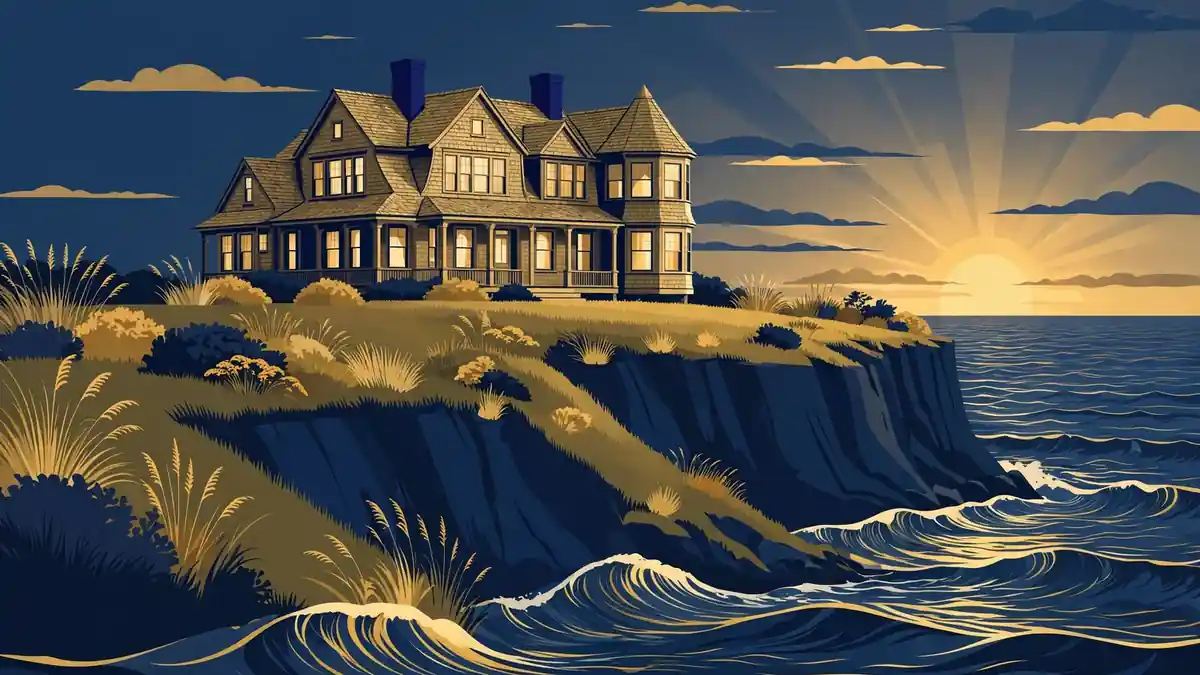
Tick Hall dominates the asset list, so it is worth setting out in full. The estate at 176 Deforest Road, Montauk, sat on 19.8 acres with about 900 feet of private beachfront, bordered by nearly 200 acres of preserve. The rebuilt house ran to roughly 6,500 square feet with six bedrooms and four bathrooms. Listed at $62 million in 2017, it sold in October 2021 for $23.6 million through Compass agent Chris Coleman, with Krae Van Sickle of Saunders & Associates representing the buyer. It was the most expensive sale in Montauk that year. One correction to the record: Celebrity Net Worth’s profile states he “accepted $26 million” for the property; the property press — The Real Deal, Behind the Hedges and Hamptons Real Estate Showcase — all report $23.6 million, and we use that figure.
The Kenilworth apartment was the city counterpart: a three-bedroom, three-bathroom pre-war co-op at 151 Central Park West, apartment 5W, bought for $4.2 million in 2009 and listed at $5,995,000 in 2018. The listing described leaded glass windows and doors, an oak-panelled dining room, floor-to-ceiling built-ins and decorative fireplaces. It went into contract in May 2018. The building, constructed in 1908, sits on the stretch of Central Park West that includes the Dakota and the Museum of Natural History.
His current home is in Ridgefield, Connecticut, where he has lived with Martha Rogers since around 2019. No purchase price or valuation for the Ridgefield house appears in public reporting, and we do not guess at one. No car collection, art collection or other luxury asset appears in credible reporting either. The man who owned one of the most storied houses in the Hamptons has never been a collector in the public sense; the house was the collection.
The other asset is the archive: hundreds of hours of interviews with the most famous people of the twentieth century, recorded when those people were alive and talking freely. Its value is real but impossible to price from outside. It generates licensing fees, it anchors his reputation, and it is the reason his name still circulates among young viewers who were not born when the show aired. An archive is not a bank balance, though, and our estimate does not assign it a dollar value.
Awards and Achievements
Cavett was nominated for at least ten Emmy Awards and won three. The nominations span his hosting career, and the wins recognise the show rather than any single interview — a reminder that the industry judged him on the body of work, not on one night. For a host who spent his career in third place in the ratings, three Emmys are a meaningful counterweight: the people who made television thought he was doing the best work in it.
The achievements that matter more than trophies are the interviews themselves. He was the host other hosts studied. Johnny Carson, the king of the format, kept Cavett’s show in his sights; Merv Griffin competed with him for the same second-place audience. Decades later, the interviews remain in circulation because they captured people at their most unguarded: Groucho Marx in old age, Katharine Hepburn refusing to perform, John Lennon talking politics, Jimi Hendrix talking music, Marlon Brando talking at all. No award measures that, but it is the reason the archive still earns.
His books add a literary line to the record. Cavett (1974) told his own story at the height of the ABC run; Eye on Cavett (1983) followed; Talk Show and Brief Encounters, both published in 2010, collected the interviews and the backstage stories for a new generation. The New York Times column extended the same voice into print, and its book edition closed the loop between the newspaper and the television archive.
He also holds a quieter distinction: longevity. Appearing regularly on nationally broadcast television across five consecutive decades, from the 1960s through the 2000s, puts him in a small group of broadcasters whose careers outlasted the formats they started in. He began as a copyboy handing jokes to Jack Paar and ended as the host of his own archive on Turner Classic Movies — the same jokes, the same desk, the same curiosity, fifty years apart.
Net Worth Growth Over the Years
Cavett’s wealth did not grow in a straight line, and any table that assigns him a precise net worth for every year would be fiction. The honest version tracks the events that moved the number, with hard figures where the record provides them and ranges where it does not.
| Year | Event | Financial note |
|---|---|---|
| 1960 | Copyboy at Time; $51-a-month walk-up on West 89th Street | Near zero; living on entry-level wages |
| 1962–63 | Writer for The Tonight Show, then Jerry Lewis’s show at triple pay | First real professional income; staff-writer scale |
| 1968–74 | The Dick Cavett Show on ABC opposite Carson | First network host salary; peak television earnings begin |
| 1974 | Autobiography Cavett published | Book advance and royalties; modest addition |
| 1977–82 | PBS run of the show | Smaller salary; archive value accumulates |
| 1989–96 | CNBC run | Steady hosting income through the 1990s |
| 1997 | Tick Hall burns down; three-year rebuild begins | Major unquantified cost; insurance and savings absorbed it |
| 2008 | 77 acres of Montauk land sold to government consortium | $18 million gross proceeds |
| 2009 | Kenilworth co-op bought for $4.2 million | City asset added at a cyclical low |
| 2018 | Kenilworth listed at $5,995,000; Tick Hall cut to $48.5 million | Paper gains visible on both properties |
| 2021 | Tick Hall sells | $23.6 million gross proceeds |
| 2026 | Current estimate | $20 million to $60 million; $60 million per Celebrity Net Worth |
The shape of that table is the point. For thirty years his wealth grew slowly, through salaries and a house that appreciated quietly. Then, in two transactions thirteen years apart, the land delivered $41.6 million. The lesson other profiles miss is that Cavett’s fortune is not a television fortune at all. Television gave him the income to hold the land; the land gave him the fortune.
Peer comparison puts the scale in context. The figures below are reported estimates from Celebrity Net Worth and Forbes, not audited wealth, and they show how far a prestige host sits from the format’s biggest earners.
| Host | Reported net worth | How it was built |
|---|---|---|
| Dick Cavett | $60 million | Talk-show salaries plus $41.6 million in Montauk property sales |
| Jimmy Fallon | $60 million | Tonight Show salary, production and endorsements |
| Ellen DeGeneres | $500 million | Daytime syndication, production company, real estate flipping |
| Howard Stern | $650 million | SiriusXM contracts and radio syndication |
| Oprah Winfrey | $2.9 billion | OWN, Harpo productions and brand empire (Forbes) |
| Ryan Seacrest | $450 million | American Idol, radio syndication and production |
Two things stand out. First, Cavett sits level with Jimmy Fallon on the reported figures, despite Fallon hosting the flagship late-night show of the current era — a sign of how much the Montauk land did for Cavett. Second, the gap to Oprah Winfrey and Howard Stern is a gap of business model, not talent: both turned hosting into ownership of networks, production companies and contracts worth hundreds of millions. Cavett owned a house, not a network. Ellen DeGeneres and Ryan Seacrest sit between the two poles, having paired hosting with production and property dealing at a scale Cavett never attempted.
Social Media Presence
Cavett keeps no large verified social media presence of the kind younger celebrities maintain, and this article will not invent follower counts for him. At 89, his public presence runs through the archive: clips of his interviews circulate on YouTube and streaming services, Turner Classic Movies replays his classic programmes, and his New York Times columns remain available in the paper’s archive. That is a different kind of reach from a social following — slower, but attached to material that does not age.
The clips are the distribution system now. A young viewer is more likely to meet Cavett through a John Lennon interview shared online than through a broadcast schedule, and the interviews reward that discovery because they run long and unhurried. No official account drives the traffic; the material does. For a net-worth profile this matters because it explains the residual income: the archive earns precisely because it keeps being watched, shared and licensed without any promotion from its host.
Personal Life
Cavett married his Yale classmate Carrie Nye on June 4, 1964, in New York. Nye, born Carolyn Nye McGeoy in Greenwood, Mississippi, was an actress who had shared his summer-theatre years in Williamstown, Massachusetts, after graduation. They had no children together and remained married for 42 years, until Nye’s death from lung cancer on July 14, 2006.
Four years later, in 2010, Cavett married author Martha Rogers in New Orleans, Louisiana. Through that marriage he gained two stepchildren. Rogers and Cavett lived in Montauk for years before moving to Ridgefield, Connecticut, where they have resided since around 2019. He turned 89 on November 19, 2025, and remains alive and living in Connecticut as of this review — a fact worth stating plainly, since death hoaxes and stale obituaries circulate around figures of his age.
He has spoken openly about depression, including periods of hospitalisation, and about his agnosticism. The candour fits the rest of his public life: a host who asked guests direct questions has generally answered them directly himself. Friends in the business have included Bob Costas, whom Cavett has jokingly called his “illegitimate son,” and Muhammad Ali, whom he once hosted overnight at Tick Hall in the early 1980s — a story Cavett tells with the punchline that his wife later placed a plaque over the bed reading “Ali slept here.”
His height is listed at 5 feet 6½ inches (1.69 m), with some profiles rounding it to 5 feet 7 inches. He has no biological children; his family is his wife, his two stepchildren, and a circle of friends built across sixty years in New York media.
Sources & Reporting
Celebrity Net Worth — the $60 million estimate, updated February 14, 2026; the full career and Tick Hall history, including the 77-acre sale, the 2017 listing and the Emmy record. The anchor source for the headline figure.
Celebrity Net Worth (Homes) — Tick Hall listing history, the $62 million ask, the Stanford White provenance and the 7,000-square-foot rebuild.
The Real Deal — the October 2021 Tick Hall sale at $23.6 million, the most expensive Montauk sale of that year; the 6,500-square-foot house, six bedrooms, and the Compass representation.
Behind the Hedges — the $23.6 million Tick Hall sale, the 19.8-acre parcel at 176 Deforest Road, the price-cut sequence from $62 million to $48.5 million to $33.95 million to $28.5 million, and the 2003 From the Ashes documentary.
27east — the 2008 government purchase of 76.8 acres for $18 million, split equally between New York State, Suffolk County and the Town of East Hampton.
6sqft — the Kenilworth co-op: bought 2009 for $4.2 million, listed February 2018 at $5,995,000, three bedrooms at 151 Central Park West.
Wikipedia — birth details and the Gibbon/Kearney question, Yale and the Oregon Shakespeare Festival, the Tonight Show writing years, the full run of networks carrying his show, the three Emmy wins from ten-plus nominations, the two marriages, and the Ridgefield move; the 2021 sale figure of $23.6 million.
IMDb — height of 5 feet 6½ inches, birth name Richard Alva Cavett, the $460-a-week Merv Griffin Show writing credit as listed, and the film and television appearance record.
NetWorthSpot — the competing $5 million to $10 million estimate, updated October 1, 2026, cited here to show the low end of the published range and its television-only basis.
Remind Magazine — Cavett at 89, living in Ridgefield, Connecticut, with Martha Rogers, and the Montauk sale summary.
Reporting window: sources published or updated between 2017 and November 2026, with the headline estimate current as of February 2026 and the property sales verified against 2008 and 2021 reporting. Figures that could not be verified against a named source are labelled as unverified in the text.
Frequently Asked Questions
What is Dick Cavett’s net worth in 2026?
Dick Cavett’s net worth is estimated at $60 million as of November 2026, according to Celebrity Net Worth, which updated its figure in February 2026. Because other outlets publish far lower numbers, we report a range of $20 million to $60 million. The $60 million figure is the best supported: his two documented Montauk property sales alone totalled $41.6 million.
How old is Dick Cavett?
Dick Cavett was born on November 19, 1936, which makes him 89 years old as of November 2026. He turns 90 on November 19, 2026. His birthplace is given as Gibbon, Nebraska, where his family lived, though his birth certificate names nearby Kearney, the location of the nearest hospital.
Is Dick Cavett still alive?
Yes. As of November 2026, Dick Cavett is alive and living in Ridgefield, Connecticut, with his wife, author Martha Rogers. He turned 89 in November 2025.
Who is Dick Cavett’s wife?
Dick Cavett has been married twice. His first wife was actress Carrie Nye, whom he married on June 4, 1964; they stayed together until her death from lung cancer in 2006. In 2010 he married author Martha Rogers in New Orleans. He has two stepchildren from his second marriage and no biological children.
Did Dick Cavett sell Tick Hall, and for how much?
Yes. Tick Hall, his Montauk estate, sold in October 2021 for $23.6 million, the most expensive sale in Montauk that year. It had been listed at $62 million in 2017 and cut several times — to $48.5 million, then $33.95 million, then $28.5 million — before selling. He had owned the property since the late 1960s.
How did Dick Cavett make his money?
Mostly from real estate, not television. He sold 77 acres of his Montauk land for $18 million in 2008 and the Tick Hall estate for $23.6 million in 2021 — $41.6 million in documented property proceeds. Television salaries, residuals and licensing from The Dick Cavett Show, plus books and a New York Times column, provided his steady income across five decades.
What happened to Dick Cavett’s house in Montauk?
The original Tick Hall, built in 1882 to a Stanford White design, burned completely to the ground in a fire on March 18, 1997. Cavett rebuilt it almost exactly to its original specifications over three years, working from memory and architectural forensic evidence because the blueprints were gone. The rebuild was documented in the 2003 film From the Ashes: The Life and Times of Tick Hall.
Where does Dick Cavett live now?
Dick Cavett lives in Ridgefield, Connecticut, with his wife Martha Rogers. He previously lived in Montauk, New York, at Tick Hall, and kept a co-op apartment at the Kenilworth on Central Park West in Manhattan, which he bought for $4.2 million in 2009 and listed for $5,995,000 in 2018.
Final Thoughts
Dick Cavett’s fortune is a reminder that wealth is not always made where the cameras point. He spent fifty years asking the best questions on television and earned a good living doing it, yet the money that defines his net worth came from a house he bought in the 1960s and refused to sell until the moment was right — twice. The $18 million land sale in 2008 and the $23.6 million house sale in 2021 are documented, dated and priced in the public record, which is more than can be said for most celebrity fortunes. That is why we anchor on $60 million and still print the range: the television income is real but unpriced, the property income is priced but partly spent, and the honest answer sits between $20 million and $60 million. What is not in doubt is the work. Three Emmys, ten nominations, five decades on the air, and an archive of conversations — with Lennon, Hepburn, Brando, Hendrix and Groucho Marx — that still earns its keep. The land paid him. The interviews are what last.
Published on November 16, 2026. Last reviewed November 2026. Found an error? See our corrections policy.