
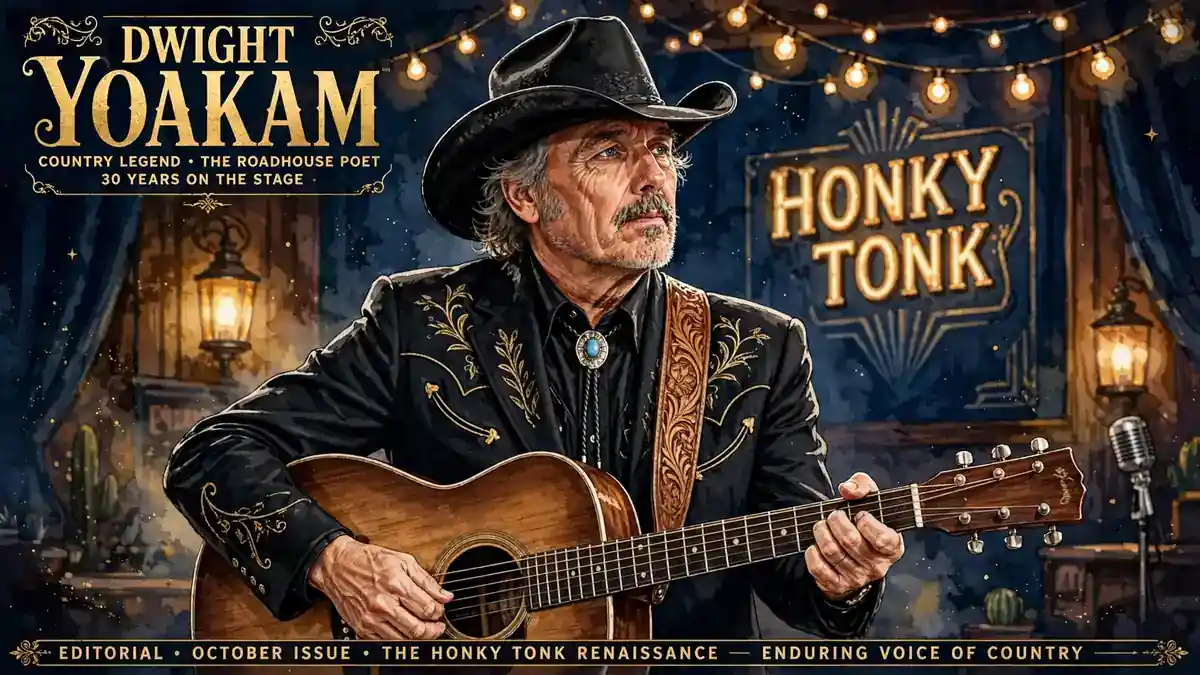
Dwight Yoakam‘s net worth is estimated at $45–$50 million as of November 2026. The Kentucky-born honky-tonk singer built that fortune across four decades: more than 25 million records sold, a run of platinum albums that carried the Bakersfield sound back to the top of the charts, a second career as one of Hollywood’s most in-demand character actors, and a food brand that put his name on grocery shelves. In 2026 he is still adding to it — a new album, Brighter Days, released in November 2024, and a co-headlining arena tour with ZZ Top that ran through the spring.
Dwight Yoakam: Quick Facts
| Estimated net worth | $45–$50 million (range: $45–$50 million) |
|---|---|
| Profession | Singer-songwriter, actor, film director |
| Nationality | American |
| Born | October 23, 1956 (age 70) |
| Height | 6 ft 0 in (183 cm) |
| Primary income sources | Record sales and royalties, touring, acting, publishing, Bakersfield Biscuits food brand |
| Active years | 1984–present |
| Last reviewed | November 2026 |
- Early Life and Background
- Education
- Career Journey
- Rise to Fame
- Main Sources of Income
- Salary and Earnings
- Businesses and Investments
- Brand Deals and Sponsorships
- Houses, Cars and Other Assets
- Awards and Achievements
- Net Worth Growth Over the Years
- Social Media Presence
- Personal Life
- Sources & Reporting
- Frequently Asked Questions
Early Life and Background
Dwight David Yoakam was born on October 23, 1956, in Pikeville, Kentucky, a coal-mining town in the eastern part of the state. He was the son of David Dwight Yoakam and Ruth Ann Tibbs. The family moved to Columbus, Ohio, while Dwight was still a boy, and Columbus — not Pikeville — is where he grew up, went to school and first picked up a guitar. The Kentucky birthplace and the Ohio upbringing both show up in his music: the mountain twang of his father’s home state and the working-class plainspokenness of the industrial Midwest.
Music was in the house from the start. Yoakam has talked in interviews about listening to his parents’ records and about the records that shaped him — the hard country of Buck Owens and Merle Haggard, the Bakersfield sound that came out of California in the 1960s, and the rockabilly records his older relatives played. He started playing guitar as a teenager and was writing songs before he left school. Columbus gave him his first stages: school talent shows, local bars and the kind of small rooms where a young singer learns whether a crowd will stay or walk out.
The move that made his career came in 1977, when Yoakam was 20. He left Ohio for Los Angeles with the aim of becoming a recording artist. Nashville was the obvious destination for a country singer, but Nashville in the late 1970s had little room for a singer who wanted to sound like Buck Owens in 1965. Los Angeles, by contrast, had a live circuit that tolerated — and sometimes celebrated — old-style country played loud. Yoakam’s beacon, as Grantland later put it, was Emmylou Harris, one of the surviving links to the Los Angeles country-rock heritage through her association with Gram Parsons. He settled in Los Angeles and never really left; nearly fifty years later he still lives in the Los Angeles area.
Los Angeles in the late 1970s and early 1980s was not a country town. Yoakam found work opening for punk and alternative rock acts — X and The Blasters among them — and playing the Palomino Club in North Hollywood, the room that had been the West Coast home of the Bakersfield sound. The Palomino was where Nashville’s exiles and California’s country-rock crowd mixed, and it was where Yoakam built the following that would carry him to a record deal. He was turned down in Nashville more than once; the story, retold in almost every profile of him, is that Music Row executives told him his sound was too old-fashioned, too country, at a moment when country radio was chasing pop crossover. That rejection became the foundation of his commercial identity: the singer Nashville would not sign became the singer who revived the very sound Nashville had abandoned.
What set Yoakam apart in those Los Angeles club years was the repertoire and the performance around it. He sang with a sharp, keening tenor that owed as much to the Bakersfield records as to rockabilly, and he performed with a tight, almost theatrical physical style — the low-pulled cowboy hat, the skin-tight jeans, the hip-swivelling stage moves borrowed from Elvis Presley. The look was as deliberate as the sound. Yoakam understood early that a country singer in Los Angeles needed to be a show, and he built one.
Education
Yoakam attended school in Columbus, Ohio, where the family had settled after leaving Kentucky. Public records of his schooling are thin — he has never made his education a talking point, and no university degree or college career is part of his public biography. What is documented is that he was playing guitar and performing while still a schoolboy in Columbus, and that by the time he left Ohio for Los Angeles at 20, music had already replaced any other plan.
His real education was the Los Angeles club circuit. Between 1977 and the mid-1980s he learned the trade the slow way: nightly sets at the Palomino Club, opening slots for rock bands whose audiences had never heard a steel guitar, and a self-financed recording project that he paid for himself because no label would. That apprenticeship — seven or eight years of live work before a major-label album — is part of why his debut sounded so finished when it arrived. He had already played the songs hundreds of times.
The other strand of his education was film. Yoakam has been a serious film student since his early years in Los Angeles, and the knowledge shows in his later directing work and in the care he takes with his own music videos, which he began directing himself in the late 1990s. Grantland’s 2015 profile found him working out of an office in the Directors Guild of America building on Sunset Boulevard, surrounded by books on Jean-Michel Basquiat, Leonardo da Vinci and James McNeill Whistler — a long way from the honky-tonk image, and a reminder that the cowboy hat was always a choice rather than a limitation.
Career Journey
Yoakam’s recording career began with his own money. In 1984 he financed and produced a six-song EP, Guitars, Cadillacs, Etc., Etc., and released it on his own Oak Records label. The EP sold well enough in Los Angeles and on the independent circuit to get him noticed, and in 1985 he signed with Reprise Records, the Warner Music imprint. Reprise took the six EP tracks, added four new songs, and released the result as his debut album, Guitars, Cadillacs, Etc., Etc., in March 1986.
The debut went to number one on Billboard’s Top Country Albums chart and was certified double platinum by the RIAA for more than two million units sold in the United States. Its singles — a cover of Johnny Horton’s “Honky Tonk Man,” the title track “Guitars, Cadillacs” and “It Won’t Hurt” — put Yoakam on country radio at a moment when the format was dominated by the smooth “urban cowboy” sound. He was 29, a decade into his Los Angeles apprenticeship, and suddenly the most talked-about new voice in country music.
The follow-up albums confirmed it was not a one-record moment. Hillbilly Deluxe (1987) also reached number one on the country albums chart and went platinum, powered by “Little Sister” and “Please, Please Baby.” Buenas Noches from a Lonely Room (1988) made it three straight number-one country albums and went platinum, with “Streets of Bakersfield” — a duet with Buck Owens himself — reaching number one on the Hot Country Songs chart. Owens, the architect of the Bakersfield sound Yoakam had spent his career channelling, became a mentor and collaborator; the duet was a passing of the torch in public, and it remains one of the most famous pairings in country music history.
Through the late 1980s and early 1990s Yoakam released an album almost every year: If There Was a Way (1990), which passed a million in sales, and This Time (1993), his most commercially successful record. This Time was certified triple platinum by the RIAA and produced his biggest singles of the decade — “Ain’t That Lonely Yet,” which won him a Grammy, and “A Thousand Miles from Nowhere” and “Fast as You.” By the mid-1990s he had ten studio albums for Reprise, more than 30 singles on the Billboard country chart and two number-one singles.
Acting arrived in parallel and soon became a second career rather than a sideline. His first film role was in Red Rock West (1993), the neo-noir thriller starring Nicolas Cage. The role that changed how Hollywood saw him came in 1996, when Billy Bob Thornton cast him as Doyle Hargraves — the abusive, alcoholic boyfriend — in Sling Blade. Yoakam has said the part was the first acting role he believed would last, and it did: the film was a critical hit, and Yoakam and the rest of the cast were nominated for a Screen Actors Guild Award for Outstanding Performance by a Cast in a Motion Picture. From there the film work never stopped — The Newton Boys (1998), Panic Room (2002) with Jodie Foster, Hollywood Homicide (2003), Wedding Crashers (2005), The Three Burials of Melquiades Estrada (2005), Bandidas (2006), Logan Lucky (2017) and Clint Eastwood’s Cry Macho (2021).
He also stepped behind the camera. Yoakam wrote, directed and starred in the western South of Heaven, West of Hell (2000), a film that became the most expensive lesson of his career: it was a financial failure, his production company filed for bankruptcy shortly after its release, and Yoakam had borrowed $500,000 against his Malibu ranch to help fund it. He has directed his own music videos since the late 1990s, and the experience — he once called music-video directing “a poor man’s film school” — shaped the visual style of his later records.
The 2000s and 2010s brought fewer albums but no slowdown. He released records on his own terms, toured steadily, and kept the acting work coming. In 2015 he released Second Hand Heart, his first album of new material in three years, to strong reviews. Then came a nine-year gap before Brighter Days, released on November 15, 2024, through his own Via Records and Thirty Tigers — his 21st studio album, and his first collection of new music in eight years. The record included the single “I’ll Pay the Price” and a duet with Post Malone, and its title track was co-written with his four-year-old son.
2026 has been a working year, not a retirement lap. In November 2025 Yoakam and ZZ Top announced the Dos Amigos Tour, a co-headlining run across the United States that opened on March 26, 2026, in Brookings, South Dakota, and ran through May 23 in Huntington, West Virginia, with 15 dates across the Midwest, South and East Coast. His own headline dates continued through the autumn, with shows booked into December 2026 — a 70-year-old singer still playing the rooms he has played since the Palomino Club, still in the hat.
Rise to Fame
Yoakam’s rise had three ingredients, and all three are still visible in his fortune. The first was timing. When Guitars, Cadillacs, Etc., Etc. arrived in 1986, country radio was full of pop-leaning production and drum machines. A record built on Telecaster twang, steel guitar and a singer who sounded like he had walked out of a Bakersfield roadhouse in 1965 was the opposite of what Nashville was selling — and that was exactly why it worked. Country fans who missed the old sound had somewhere to go, and critics who had written country off as a spent force had a new champion. Yoakam won the Academy of Country Music’s Top New Male Vocalist award in 1986, the first of his career honours.
The second ingredient was the Bakersfield connection itself. Buck Owens was far more than an influence on Yoakam; he became a collaborator and a public endorser. Their 1988 duet on “Streets of Bakersfield” — a song Owens had first recorded in 1973 — went to number one and gave Yoakam a direct line to the audience that had bought Owens’ records for twenty years. For a singer Nashville had rejected as too old-fashioned, a number-one record with the man who invented the sound was the best possible answer. Owens’ imprimatur also opened doors with older country fans who might otherwise have dismissed a Los Angeles singer in tight jeans.
The third ingredient was television and film. Sling Blade in 1996 did for Yoakam’s acting what the debut album had done for his music: it proved he could do serious work in a second field, and it put his face in front of audiences who had never bought a country record. The film grossed $34.2 million worldwide on a tiny budget, according to TheRichest’s box-office records, and the SAG cast nomination put Yoakam in the same conversation as the film’s stars. After Sling Blade, directors stopped casting him as “the country singer” and started casting him as the menacing character actor — the abusive boyfriend, the corrupt sheriff, the warden. That range kept the acting cheques coming for thirty years.
What the rise did not include was a tabloid celebrity phase. Yoakam has never been a gossip-column regular, never had a reality show, and never chased a crossover pop hit. The fortune he built is the product of a long career rather than a single windfall: platinum records in the 1980s and 1990s, steady touring income for forty years, and a film career that paid in six figures a picture for decades. It is a quieter kind of wealth than the stadium-country fortunes of his peers, and it is also a more durable one — built on a catalogue that still sells and streams, rather than on a moment.
Main Sources of Income
Record sales and royalties. This is the foundation. Yoakam has sold more than 25 million records worldwide, with some tallies — including Lovemoney’s 2026 ranking of country music’s richest stars, which draws on Celebrity Net Worth — putting the figure above 30 million. His catalogue includes nine platinum albums, according to BounceMojo, and three number-one country albums in a row at the start of his career. This Time alone was certified triple platinum, and the debut was double platinum. Those records still earn: mechanical royalties from physical sales and downloads, publishing royalties every time a song is played on radio, television or film, and streaming royalties from a catalogue that never left the services — except for one painful year, when the debut album itself vanished during the Warner dispute described below.
Touring. Yoakam has toured almost without a break since the mid-1980s. The economics of a legacy country headliner are straightforward: ticket sales, merchandise and VIP packages, with fees that industry reporting puts in the tens to hundreds of thousands of dollars per show depending on the venue. His 2026 schedule shows the model still working — the 15-date Dos Amigos co-headline run with ZZ Top across arenas and theatres in the spring, his own headline dates through the summer and autumn, and shows booked into December 2026, including Las Vegas, Long Beach and Reno. A singer who can still fill theatres at 70 does not need a radio hit to keep earning.
Acting. More than 50 film and television productions, according to TrafficTail’s career survey, spread across thirty years. The paycheques for individual roles have never been made public, but the volume tells the story: Sling Blade, Panic Room (which grossed heavily worldwide), Wedding Crashers and The Three Burials of Melquiades Estrada — the last two together grossed $298.6 million worldwide at the box office, per TheRichest — plus Logan Lucky ($48.5 million worldwide) and Cry Macho. Screen Actors Guild minimums alone put even modest film roles into five figures, and Yoakam’s steady supporting roles across three decades, with residuals on rebroadcast and streaming, amount to several million dollars of career acting income by any reasonable estimate.
Publishing and songwriting. Yoakam wrote or co-wrote most of his catalogue, which means he earns as a songwriter as well as a performer. The Warner lawsuit of 2021 was, at its heart, a fight about exactly this: the value of the songs he wrote as a young man, and who controls them once the 35-year copyright clock runs out. Winning back control of his debut album’s copyrights — the settlement in February 2022 left the album copyrighted to his own Via Records, licensed to Rhino — turned a publishing asset he had signed away in 1985 into an asset he owns in 2026.
Bakersfield Biscuits. The food brand Yoakam founded in 1996, built around a buttermilk biscuit recipe he first tasted at a Bakersfield roadside stand run by a cook known as Biscuit Boy. The frozen-food line — biscuits with gravy, then chicken fingers, ribs and cheeseburgers — was distributed in thousands of supermarkets across the United States, including Walmart, Kroger and Safeway. It was never a restaurant empire on the scale of some celebrity food brands, and Yoakam has been more cautious than many peers about overextending his name, but it gave him a consumer-goods income stream outside music and film, and it tied his brand to the same Kentucky comfort-food roots his songs come from.
Licensing and sync. Yoakam’s songs turn up in films, television and advertising, and his own acting roles often arrive with soundtrack placements attached. The Bakersfield sound — twangy, unmistakable, instantly evocative of a particular America — is a useful thing for a music supervisor to license, and a forty-year catalogue gives supervisors a deep bench to draw from.
Salary and Earnings
There is no public record of Dwight Yoakam’s salary for any single project. He has never disclosed a per-album advance, a per-show fee or a film paycheque, and the record companies and studios that paid him have not either. Any article that prints an exact figure for his concert fee or his Sling Blade salary is guessing. What can be stated honestly is the shape of the earnings, and the industry benchmarks that frame them.
On tour, legacy country headliners of Yoakam’s standing typically command fees in the tens to hundreds of thousands of dollars per show, according to industry reporting summarised by TrafficTail, with the number rising for co-headline arena dates like the Dos Amigos run and falling for smaller theatre dates. A 15-date arena and theatre run, plus a full year of headline dates, puts a single year’s touring gross comfortably into seven figures before costs — and Yoakam has run a version of that schedule for most of the last forty years, with a touring band led for many years by his longtime guitarist and producer Pete Anderson, whom he parted with in 2002.
On screen, the numbers are smaller per job but steadier. Yoakam’s film roles have mostly been supporting parts, which in studio films typically pay in the low-to-mid six figures for an established character actor, plus residuals when the film is rebroadcast or streamed. Over fifty-plus productions, that adds up. The two films most often cited in his box-office record — Wedding Crashers and The Three Burials of Melquiades Estrada, both 2005 — grossed $298.6 million worldwide between them, and Panic Room was a major commercial hit in 2002. Yoakam’s share of those grosses was a salary, not a percentage, but the films kept his quote healthy for the next job.
The recording side of the ledger is the hardest to price and the most important. A triple-platinum album in 1993, when albums sold for fifteen dollars or more, generated far more artist income than the same number of streams would today — and Yoakam’s prime years were the last great years of the CD economy. His debut’s two million-plus US sales, This Time‘s three million-plus, and a string of platinum and gold records through the 1990s were earned in the most lucrative era in recorded-music history. The catalogue still earns, but the bulk of the recording fortune was made when people still bought the record.
One earnings event deserves its own line because it shows the downside of the business. South of Heaven, West of Hell, the western Yoakam wrote, directed and starred in, lost money on release in 2000. He had borrowed $500,000 against his Malibu ranch to help finance it, his production company filed for bankruptcy shortly afterwards, and the ranch itself was sold in 2000 for $825,000. It is the one documented moment when a Yoakam project cost him real money — and a useful corrective to any account that treats a forty-year career as forty years of uninterrupted profit.
Businesses and Investments
Bakersfield Biscuits is the business most often attached to Yoakam’s name, and the only one he has talked about at length. He founded the brand in 1996, according to Grantland, after tasting the biscuits at a Bakersfield stand and going into business with the cook behind them. The line began with buttermilk biscuits and gravy and expanded into frozen chicken fingers, ribs, chicken and dumplings and cheeseburgers, distributed through major grocery chains including Walmart, Kroger and Safeway. The brand has been sold on and off since 2002, and its current status is not publicly documented in detail — Yoakam has never published sales figures for it, and the company has kept a low profile in recent years. What is clear is that it was a genuine operating business, not a licensing deal: Yoakam’s name, his Kentucky food memories and a real product in real freezers.
Via Records is the second business, and in 2026 it may be the more valuable one. Yoakam’s own label released Brighter Days in November 2024 in partnership with Thirty Tigers, and — following the settlement of the Warner lawsuit — the debut album Guitars, Cadillacs, Etc., Etc. is now copyrighted to Via Records under exclusive license to Rhino Entertainment. Owning the label that owns the masters changes the economics of the catalogue: instead of a royalty rate set in 1985, Yoakam’s company controls the recordings and licenses them out. For a singer with twenty-one studio albums, that control is worth more than any single year’s touring.
The Warner Music fight is the business story that defines Yoakam’s recent career. On February 8, 2021, he sued Warner Music Group, Warner Records and Rhino Entertainment in the United States District Court for the Central District of California (case 2:21-cv-01165), seeking the return of the copyrights to “Honky Tonk Man” and “Miner’s Prayer” under Section 203 of the Copyright Act of 1976, which lets authors reclaim copyrights 35 years after signing them away. Yoakam had first notified Warner of his intention to terminate in February 2019, and his complaint said the company had “refused to acknowledge and accept” his termination notices while continuing to profit from the songs — “having profited and benefitted off of Mr. Yoakam for 35 years,” the filing said, Warner did “not want their gravy train to end.” Warner pulled the two songs from streaming services in February 2021, then the whole debut album on March 3, 2021, saying it did not want to earn further royalties on disputed works. The album stayed off streaming for more than a year. In February 2022 the parties told the court they had reached an agreement in principle to settle, and on April 15, 2022, Guitars, Cadillacs, Etc., Etc. reappeared on Spotify, Apple Music and Amazon Music — copyrighted to Via Records, licensed to Rhino. The settlement terms were never made public, but the practical outcome is visible in the credits: Yoakam appears to have won back his copyrights and chosen to keep working with Warner as licensee.
Other investments. Beyond music, food and his label, Yoakam’s investment portfolio is private. Public reporting links him to long-term California real estate — the subject of the assets section below — and to the kind of conservative, low-profile wealth management that fits a singer who has spent forty years avoiding the spotlight off stage. He has never been reported as an investor in a startup, a restaurant chain or a fashion line, and there is no record of endorsement deals beyond the food brand and the occasional western-wear or instrument partnership tied to his image.
Brand Deals and Sponsorships
Yoakam has never been a serial endorser. His commercial life has been built on his own products — records, films, biscuits — rather than on lending his face to other people’s. The brand associations that do exist fit the image tightly: western wear and musical instruments, the two product categories a honky-tonk singer can endorse without looking like he is selling out.
The Bakersfield Biscuits venture is itself the biggest brand deal of his career, except that he was the brand rather than the endorser. The biscuits put his name on packaging in Walmart, Kroger and Safeway freezers across the country, and the story behind them — a Kentucky boy who grew up on his grandmother’s biscuits, tasting a roadside version in Bakersfield and deciding to sell it — was the marketing. It worked because it was true, and because the product matched the persona exactly.
There are no reported multi-million-dollar endorsement contracts in Yoakam’s history — no car deal, no watch deal, no fragrance — and that absence is itself a fact about how his fortune was built. Where other country stars of his generation monetised fame through sponsorships, Yoakam monetised it through ownership: his songs, his masters, his label and his food brand. The Warner lawsuit is the clearest expression of that instinct. He spent a year with his debut album off streaming, and the legal fees that implies, rather than accept a deal that left his copyrights with someone else.
Houses, Cars and Other Assets
The Malibu ranch. The best-documented property in Yoakam’s history is the 12.6-acre ranch in Malibu, California, which he bought in 1989 for $550,000 and sold in 2000 for $825,000, according to Celebrity Net Worth’s property reporting. The spread — on Yerba Buena Road, near the Boney Ridge mountains, which gave it the nickname the Bony Pony ranch — had a three-bedroom main house of about 2,500 square feet, a two-bedroom guesthouse, a six-stall horse stable and a garage with a workshop. Yoakam liked the place enough to rebuild structures destroyed in a 1993 firestorm. Nicki Swift, drawing on Realtor.com, reported that the same ranch was later worth more than $4.3 million — a reminder that the 2000 sale, forced in part by the costs of South of Heaven, West of Hell, gave up decades of appreciation. The $275,000 paper gain on the 1989–2000 holding looks modest against what the land became.
The Los Angeles home. After the Malibu sale, Yoakam based himself in Los Angeles, where he has lived ever since with his wife Emily Joyce and their son Dalton. Grantland’s 2015 profile described a 5,900-square-foot Spanish colonial mansion in the Hollywood Hills that Yoakam designed himself. Nicki Swift, citing Virtual Globetrotting, described a 5,830-square-foot Los Angeles house with six bedrooms and four bathrooms, bought in 1994 for $1.24 million. The two accounts are consistent on the essentials: a large, self-designed Spanish-style home in the hills, owned since the mid-1990s, and held through three decades of Los Angeles price growth. No current valuation is publicly documented, and Yoakam has never listed the house or discussed its value.
Cars and other assets. Yoakam has never cultivated a public car collection, and no verified reporting attaches a fleet of luxury vehicles to him. The vintage pickup in the imagery of his career is a stage prop and an album-cover motif rather than a documented asset. What is documented is the working equipment of a touring musician — guitars, including the Telecaster-style instruments associated with the Bakersfield sound, and a touring operation that has run for forty years — and a catalogue of twenty-one studio albums whose masters he increasingly owns through Via Records. In wealth terms, the catalogue is the asset that matters: it earns every day, it does not depreciate, and since the Warner settlement he controls more of it than at any point since 1985.
Awards and Achievements
Yoakam’s trophy record is strong without being the headline of his career — the respect he commands in Nashville and Hollywood has always rested more on the work than on the hardware. The headline numbers: two Grammy Awards from a career total of eighteen nominations, according to Digital Music News’ reporting on the Warner filing, and one Academy of Country Music award, with the ACM’s Top New Male Vocalist honour in 1986 as his first major prize.
The first Grammy came in 1994, for Best Country Vocal Performance, Male, for “Ain’t That Lonely Yet” — the lead single from This Time and the biggest radio hit of his career. The second came in 1999, for Best Country Collaboration with Vocals, for “Same Old Train,” the all-star collaboration that also featured Clint Black, Joe Diffie, Merle Haggard, Emmylou Harris, Alison Krauss, Patty Loveless, Earl Scruggs, Ricky Skaggs, Marty Stuart, Pam Tillis, Randy Travis and Travis Tritt. That second Grammy is a useful summary of where Yoakam sits in country music: the singer other singers want on their records.
The chart record is the achievement that pays the bills. His first three albums — Guitars, Cadillacs, Etc., Etc., Hillbilly Deluxe and Buenas Noches from a Lonely Room — all reached number one on Billboard’s Top Country Albums chart. He has two number-one singles on the Hot Country Songs chart, “Streets of Bakersfield” with Buck Owens and “I Sang Dixie,” and more than thirty singles on the Billboard country chart across his career. His albums have been certified platinum nine times over, with This Time triple platinum and the debut double platinum.
The film honours are thinner but real: a Screen Actors Guild Award nomination in 1997 for Outstanding Performance by a Cast in a Motion Picture, shared with the Sling Blade ensemble. And the less formal honours matter too — the 2026 Dos Amigos Tour with ZZ Top, a band that does not co-headline with singers it does not respect, and a 2024 album that put a 68-year-old singer back on the new-music pages with a duet partner thirty years his junior in Post Malone.
One achievement that belongs in any honest account of his career is the Warner settlement itself. Reclaiming the copyrights to the songs that made him, after a public legal fight and a year with his debut album pulled from streaming, is a business achievement as much as a legal one — and it is one very few artists of his generation have managed.
Net Worth Growth Over the Years
Yoakam’s reported net worth has been strikingly stable for a decade, which is itself informative: the figure has sat at $45 million in Celebrity Net Worth’s reporting for years, with some 2026 trackers publishing $50 million. That stability reflects a career whose big paydays came in the 1980s and 1990s and whose income since has been steady rather than explosive — catalogue royalties, touring and acting, without a stadium tour, a catalogue sale or a viral moment to spike the number. The table below uses the figures published by the trackers named, and the range where they disagree.
| Year | Reported estimate | What drove it |
|---|---|---|
| 1986 | Under $1 million | Debut album goes double platinum; first major-label income after a decade of club work |
| 1993 | $5–$10 million (estimated) | This Time goes triple platinum; “Ain’t That Lonely Yet” wins a Grammy |
| 2000 | $15–$20 million (estimated) | Film career established after Sling Blade; Malibu ranch sold for $825,000 |
| 2010 | $30–$40 million (estimated) | Catalogue, touring and two decades of film roles compounding |
| 2020 | $45 million | Celebrity Net Worth figure; BounceMojo also lists $45 million for 2020 |
| 2021 | $50 million | BounceMojo lists $50 million for 2021; Warner lawsuit filed in February |
| 2022 | $45 million | Celebrity Net Worth holds $45 million; Warner settlement restores catalogue control |
| 2024 | $45 million | Brighter Days released; first new album in eight years |
| 2026 | $45–$50 million | Celebrity Net Worth $45 million; other 2026 trackers $50 million; Dos Amigos Tour with ZZ Top |
The early-year rows are our estimates, built from the documented record — the certifications, the film grosses and the property sales — and labelled as such. The 2020–2026 rows are the published tracker figures. The honest summary is that Yoakam’s wealth grew fast in the late 1980s and early 1990s, levelled into a long plateau, and has been maintained rather than multiplied since — which is what a catalogue-and-touring fortune looks like when its owner never sells the catalogue.
For comparison, Celebrity Net Worth’s estimates for Yoakam’s peers put his fortune in context: a working honky-tonk legend’s wealth, far above the journeyman level but well below the stadium-country and crossover fortunes of the biggest names in the genre. His contemporary Blake Shelton, whose television career added a second income stream Yoakam never pursued, is reported far higher — a reminder that in modern country music, the television money often exceeds the touring money. Yoakam’s fortune is the touring-and-catalogue kind, and it has lasted longer than most.
Social Media Presence
Yoakam keeps a working social media presence rather than a personal one. His official accounts — Instagram, Facebook, X and YouTube under his name, with his official site at dwightyoakam.com — are used the way a touring musician uses them: tour dates, new music, photographs of the band and the road, and the occasional family photograph taken by his wife Emily Joyce, a professional photographer whose credit line has appeared under his official portraits for years. The accounts are verified and active, with the 2024 Brighter Days release and the 2026 Dos Amigos Tour both promoted heavily through them.
He is not a social media personality in the modern sense. There are no viral moments, no brand-partnership posts and no daily content stream; the accounts go quiet between tours and albums, and the content is promotional rather than confessional. That restraint is consistent with everything else about his public life — the decade he kept his relationship with Emily Joyce out of the press, the two months he waited before announcing his marriage in 2020, and the refusal to discuss his finances. For a net worth estimate, the social following is a minor income factor: it sells concert tickets and records, but it is not itself a revenue line the way it is for younger stars.
What the social accounts do show, and what matters for a 2026 valuation, is that the audience is still there. Tour announcements for the Dos Amigos run and the autumn headline dates drew the engagement of a fanbase that has followed him since the 1980s, and the Brighter Days posts — including the story of four-year-old Dalton’s co-writing credit on the title track — were among his most shared content in years. A 70-year-old singer with a live audience and a new record is a going concern, not a nostalgia act.
Personal Life
For most of his career, Dwight Yoakam was one of country music’s most famous bachelors. Through the 1990s and 2000s he was linked in the press to high-profile relationships — including with actresses Sharon Stone and Bridget Fonda and singer Wynonna Judd — but he never married, and he guarded his private life behind the low brim of the cowboy hat. That changed quietly in 2010, when he began dating Emily Joyce, a photographer, graphic designer and former indie musician twenty-seven years his junior, raised in Omaha, Nebraska, and trained at the Rhode Island School of Design. The couple kept the relationship almost entirely out of the press for a decade; Joyce’s name appeared in small print under his official portraits as “Photo credit: Emily Joyce” long before the public knew they were together.
They married in March 2020, in a ceremony that could hardly have been more private: fewer than ten people at St. Monica Catholic Church in Santa Monica, guests spaced six feet apart in the pews, hours before California’s statewide pandemic lockdown took effect. Yoakam was 63 and marrying for the first time. The couple waited two months to announce it, confirming the marriage on May 4, 2020, with two understated photographs — Yoakam in a dark suit, Joyce holding a small bouquet of white flowers with a face mask resting in her lap — and a statement saying the news had been held out of respect for people on the front lines of the pandemic.
Five months later, on August 16, 2020, at 9:19 a.m., Joyce gave birth to their first child, a son named Dalton Loren Yoakam, at a hospital in the Los Angeles area. The middle name honours Yoakam’s late father, David Loren Yoakam. Yoakam became a first-time father two months before his 64th birthday. The family lives in Los Angeles, in the Spanish colonial home Yoakam designed in the Hollywood Hills.
Fatherhood has changed the work in visible ways. The title track of Brighter Days was born in the family living room, when four-year-old Dalton walked in wearing a miniature Fender Telecaster-shaped ukulele and told his father, “Get your guitar.” Yoakam improvised the melody with his son across the room, gave Dalton an official co-writing credit, and kept the boy’s voice at the close of the master recording. Joyce shot the album photography, her brother Bryan Joyce co-wrote the album’s seventh track, “A Dream That Never Ends,” and the sleeve carries the line that has accompanied Yoakam’s work for years: “Photography By Emily Joyce.” At 68, releasing his first album of new material in eight years, Yoakam no longer separated the recording studio from the life waiting for him at home.
He is, by all public accounts, a private man who spends his money privately. No verified reporting describes extravagant purchases, and the two big-ticket items in his documented history — the Malibu ranch and the Hollywood Hills house — were both long-held homes rather than trophy acquisitions. The fortune, like the man, is low-profile.
Sources & Reporting
Celebrity Net Worth — the $45 million net worth figure; the Malibu ranch purchase ($550,000 in 1989) and sale ($825,000 in 2000); the $500,000 loan against the ranch to fund South of Heaven, West of Hell; Bakersfield Biscuits’ availability at Walmart. Reporting window: profile updated November 2024.
TheRichest — the $45 million figure; box-office totals for Sling Blade ($34.18 million), Logan Lucky ($48.45 million) and the 2005 films ($298.63 million combined).
Wikipedia — birth date and place, career chronology, the three consecutive number-one country albums, two number-one singles, two Grammy wins, the Sling Blade SAG cast nomination, and the South of Heaven, West of Hell bankruptcy. Accessed November 2026.
BounceMojo — the $50 million figure and the 2020–2021 year-by-year estimates; nine platinum albums; the February 2021 Warner filing. Published 2026.
News Anyway — the $45 million 2026 estimate and the career snapshot, including album royalties, touring, licensing and production income. Published February 2026.
Digital Music News — the Warner Music lawsuit filing in full detail, including case number, the eighteen Grammy nominations, twenty studio albums at the time of filing, and the Section 203 termination dates. Published February 2021.
Saving Country Music — the Warner dispute timeline: the February 2021 takedowns, the March 2021 album removal, the February 2022 settlement in principle, and the April 15, 2022 return to streaming under Via Records’ copyright. Published February 2021 and April 2022.
Grantland — the 2015 profile: the Directors Guild office, the Bakersfield Biscuits founding in 1996, the self-designed 5,900-square-foot Spanish colonial home, and the Los Angeles apprenticeship. Published 2015.
Nicki Swift — the Bony Pony ranch’s later $4.3 million valuation via Realtor.com, the Los Angeles home details via Virtual Globetrotting, and the Bakersfield Biscuits history. Published 2022.
Remind Magazine — the Brighter Days release, the Post Malone duet, and the Dos Amigos Tour dates (March 26 to May 23, 2026). Published 2025.
Bored Panda and TVOverMind — the $45 million 2026 estimate, birth date, height of 6 ft 0 in and career highlights. Published October 2026.
Reporting window for this article: February 2021 to November 2026. Where sources disagreed on the net worth figure ($45 million versus $50 million), this article publishes the range and names the outlets behind each figure. Where no public record exists — per-show fees, film salaries, the Bakersfield Biscuits sales figures — this article says so rather than inventing a number.
Frequently Asked Questions
What is Dwight Yoakam’s net worth in 2026?
Dwight Yoakam’s net worth is estimated at $45–$50 million as of November 2026. Celebrity Net Worth and TheRichest put the figure at $45 million, while other 2026 trackers publish $50 million. The range reflects the disagreement between outlets; Yoakam has never disclosed his finances, and no audited figure exists.
How did Dwight Yoakam make his money?
Mostly from music: more than 25 million records sold, including nine platinum albums, with This Time (1993) certified triple platinum. Touring has paid steadily for forty years, including the 2026 Dos Amigos Tour with ZZ Top. A second career as a film actor — Sling Blade, Panic Room, Wedding Crashers, Logan Lucky — added decades of film salaries and residuals, and his Bakersfield Biscuits food brand put his name on grocery shelves nationwide.
Who is Dwight Yoakam’s wife?
Dwight Yoakam is married to Emily Joyce, a photographer, graphic designer and former indie musician. They began dating in 2010, kept the relationship private for a decade, and married in March 2020 at St. Monica Catholic Church in Santa Monica, with fewer than ten guests, hours before California’s pandemic lockdown. Their son, Dalton Loren Yoakam, was born on August 16, 2020.
How old is Dwight Yoakam?
Dwight Yoakam was born on October 23, 1956, in Pikeville, Kentucky. He turned 70 on October 23, 2026. He is still touring at 70, with the Dos Amigos Tour with ZZ Top and headline dates booked through December 2026.
How tall is Dwight Yoakam?
Dwight Yoakam is 6 feet 0 inches tall (183 cm), according to multiple 2026 biographical profiles.
Is Dwight Yoakam still touring in 2026?
Yes. In 2026 he co-headlined the Dos Amigos Tour with ZZ Top, a 15-date run from March 26 in Brookings, South Dakota, to May 23 in Huntington, West Virginia. His own headline dates continued through the autumn, with shows booked into December 2026 in Las Vegas, Long Beach and Reno.
What happened between Dwight Yoakam and Warner Music?
In February 2021 Yoakam sued Warner Music Group, seeking the return of the copyrights to “Honky Tonk Man” and “Miner’s Prayer” under Section 203 of the Copyright Act, which lets authors reclaim rights after 35 years. Warner pulled the songs — and then the whole debut album — from streaming. The parties settled in February 2022, and on April 15, 2022, the album returned to streaming, copyrighted to Yoakam’s own Via Records under license to Rhino.
How many albums has Dwight Yoakam sold?
More than 25 million records worldwide, with some tallies putting the figure above 30 million. He has released 21 studio albums, including three consecutive number-one country albums — Guitars, Cadillacs, Etc., Etc. (1986), Hillbilly Deluxe (1987) and Buenas Noches from a Lonely Room (1988) — and more than 30 singles on the Billboard country chart.
Final Thoughts
Dwight Yoakam’s $45–$50 million fortune is the most old-fashioned kind of money in modern country music: earned slowly, from records people bought, rooms he played and films he acted in, over forty years. He was rejected by Nashville for sounding too country, so he went to Los Angeles and made the sound Nashville had abandoned into a platinum career. He turned a film career that began as a sideline into a second income stream that lasted three decades. He put his name on a biscuit brand instead of a sponsorship deal, and when his record company would not give back the songs he wrote as a young man, he sued them — and won the copyrights back.
The 2026 picture is a working musician at 70, not a retired one: a new album in 2024, a co-headline arena tour with ZZ Top in 2026, a four-year-old son with a songwriting credit, and a catalogue he finally controls through his own label. The number has barely moved in a decade, and that is the point. Yoakam never sold the catalogue, never cashed out, never chased the windfall. He kept the songs, kept touring, and kept the money that came with them.
Published on November 19, 2026. Last reviewed November 2026. Found an error? See our corrections policy.