
G-Eazy‘s net worth is estimated at $12 million as of October 2026. The Oakland rapper turned a string of multi-platinum singles — “Me, Myself & I” and “No Limit” among them — into arena-touring money, then made his most interesting financial move outside the studio: an equity stake in whiskey brand Stillhouse Spirits that got absorbed by Bacardi in a 2019 buyout. His Hollywood Hills villa “Gerryland,” bought for roughly $1.8 million in 2016, hit the market at $3.7 million in 2025 before a price cut and a May 2026 delisting. With recent albums underperforming on the charts, the fortune now rests more on catalog royalties and business bets than new-release revenue.
G-Eazy: Quick Facts
| Estimated net worth | $12 million (range: $10–15 million) |
|---|---|
| Profession | Rapper, singer-songwriter, record producer |
| Nationality | American |
| Born | May 24, 1989 (age 37) |
| Height | 6 ft 4 in (1.93 m) |
| Primary income sources | Music royalties, touring, songwriting/publishing, spirits investment, acting cameos |
| Active years | 2006–present |
| Last reviewed | October 2026 |
- Quick Facts
- Early Life and Background
- Education
- Career Journey
- Rise to Fame
- Main Sources of Income
- Salary and Earnings
- Businesses and Investments
- Brand Deals and Sponsorships
- Houses, Cars and Other Assets
- Awards and Achievements
- Net Worth Growth Over the Years
- Social Media Presence
- Personal Life
- Sources & Reporting
- Frequently Asked Questions
- Final Thoughts
- Related Profiles
Early Life and Background
G-Eazy was born Gerald Earl Gillum on May 24, 1989, in Oakland, California. His parents separated when he was in the first grade; he moved with his mother, Suzanne Olmsted, an art teacher, first to live with his grandparents in Berkeley and later to North Oakland, while his father, Edward Gillum, an associate professor of art at California State University, Fresno, remained in Fresno. His younger brother, James Gillum, also became a musician.
The stage name is a compression of his own name: he has said it combines his first initial and his middle name, Earl, shortened to the phonetic “Eazy” — a play that let him dodge comparisons to N.W.A’s Eazy-E while keeping the hip-hop cadence. The slicked-back hair and James Dean styling that later became his visual trademark were still years off; as a kid in Berkeley and Oakland, Gillum was simply a boy with a drummer’s restlessness who gravitated toward music early.
Oakland shaped his sound. He came up adjacent to the Bay Area’s internet-native hip-hop wave — Lil B, the Cataracs, and a constellation of producers and rappers trading tracks online when the industry still lived on radio and MTV. That early proximity to artists who built audiences without labels would define his entire business model: G-Eazy spent his twenties treating the internet as his label before a major label ever touched him.
Education
Gillum attended Berkeley High School, where he started out as a record producer rather than a rapper. He began producing his own tracks as a teenager and joined a local hip-hop group called the Bay Boyz, who released songs through their MySpace page in the late 2000s — the tail end of the platform’s music era.
In 2007 he enrolled at Loyola University in New Orleans, a school with a serious music industry program. He made the city his second home and graduated in 2011 with a degree in Music Industry Studies. While at Loyola he worked closely with fellow student producer Christoph Andersson, and the pair ground out singles and mixtapes in campus dorm rooms. His first mixtape, The Tipping Point, arrived in 2008. The Loyola years taught him the business mechanics he would lean on for a decade — publishing splits, tour routing, how a master recording actually earns — at an age when most rappers were still figuring out punch-ins.
New Orleans left a second mark on his money story. When he later became an investing partner in Stillhouse Spirits, he pushed the brand into Louisiana first, calling it his old stomping grounds — the Loyola network became the distribution beachhead for his spirits bet.
Career Journey
G-Eazy’s professional clock starts in 2006, when he began releasing music as an independent artist. He self-released his debut studio album, The Epidemic LP, in 2009, and a second independent record, Must Be Nice, in 2012 — the title doubled as an inside joke about his own upward mobility. The independent years were slow money: he opened for Lil Wayne and Snoop Dogg in 2010 and spent summers grinding through Warped Tour dates, building a live following one regional crowd at a time.
The breakthrough arrived on June 23, 2014, when RCA Records released These Things Happen, his major-label debut. The album landed at number 3 on the Billboard 200 — a striking debut for a rapper with no prior Hot 100 entry. Its single “I Mean It,” featuring Remo, became his first Billboard Hot 100 appearance and eventually earned triple-platinum certification from the RIAA. The album’s title proved prophetic twice over; he would revisit it seven years later with the sequel These Things Happen Too.
When It’s Dark Out followed on December 4, 2015, debuting at number 5 on the Billboard 200 with roughly 63,000 first-week equivalent copies, according to contemporary reporting. The album’s engine was “Me, Myself & I,” a duet with Bebe Rexha that climbed to number 7 on the Hot 100 and became his first genuine mainstream hit. Then came the peak years: The Beautiful & Damned (December 15, 2017) debuted at number 3 on the Billboard 200 and carried “No Limit,” featuring Cardi B and A$AP Rocky, to number 4 on the Hot 100 — the highest-charting song of his career.
The 2020s were less kind to the discography. Everything’s Strange Here (2020) was a detour into alt-pop that split his fanbase. These Things Happen Too (2021) reached number 19 on the Billboard 200 — respectable, but a step down. Around this point his major-label chapter ended; he moved his releases to Empire for distribution, trading the RCA machine for an independent-minded model closer to his roots. Freak Show (2024) and Helium (2025) both failed to chart in any territory, per Wikipedia’s chart tracking — a blunt signal that the streaming-era audience had cooled. He stayed busy on the road anyway, taking the Helium Tour across North America and continuing to play live through 2026.
Rise to Fame
Two records made G-Eazy a mainstream name, and they did it eighteen months apart. “Me, Myself & I” arrived in late 2015 as a duet with Bebe Rexha — a hook-driven pop-rap single that radio programmers could place anywhere, and it became his first top-10 Hot 100 hit. “No Limit,” released in late 2017 off The Beautiful & Damned, did something more impressive: it put an Oakland rapper alongside Cardi B and A$AP Rocky at the exact moment both were at their cultural peaks, and it peaked at number 4. Together the two singles account for the bulk of his streaming catalog wealth.
The middle of that run included a pop-culture cameo few of his peers could claim: a featured verse on Britney Spears’ 2016 single “Make Me…”, which he performed with Spears at the MTV Video Music Awards that year. In 2017, Forbes named him to its “30 Under 30” music list — the kind of industry validation that tends to arrive just before the business deals do. For G-Eazy, that sequence held: within months of the Forbes nod he was announced as an investing partner and co-creative director of Stillhouse Spirits, the first equity deal of his career.
It is worth noting what fame didn’t bring. Despite multi-platinum records, G-Eazy never won a Grammy and was never nominated for one; his trophy case is built from genre and video awards instead. His peak fame window — roughly 2015 to 2019 — was shorter than many of his peers’, which is exactly why his net worth sits in the low tens of millions rather than the hundreds of millions commanded by rappers with longer arena cycles.
Main Sources of Income
G-Eazy’s money comes from four buckets, and their proportions have shifted over time. Recorded music royalties — album sales, streaming, and licensing — form the foundation. His catalog’s earning power concentrates in a handful of multi-platinum singles: “Me, Myself & I,” “No Limit,” and “I Mean It” have collectively generated hundreds of millions of streams, and because he writes his own material, publishing income compounds on top of recording royalties. Songwriter credits on your own hits are the difference between a paycheck and an annuity, and G-Eazy has held onto them.
Touring was his second pillar during the peak years. He headlined the Endless Summer Tour in 2017 and the Beautiful & Damned Tour in 2018 — the nine-month run he later described as grueling in a 2018 interview — and played nearly every major American festival circuit stop from Bonnaroo to Outside Lands to Lollapalooza, where headliner-adjacent fees run deep into six figures. The Helium Tour (2025) kept him on stage through the chart-cooling years, but the days of his largest grosses sit behind him, a fact the net worth trajectory reflects.
The third bucket is sync and licensing, a quiet moneymaker most net-worth pages skip. His tracks appear across EA Sports franchises: “Me, Myself & I” landed in NBA 2K17, “No Limit” in EA Sports UFC 3, his Dillon Francis collaboration “Say Less” in Madden NFL 18 and The Crew 2, and an A Boogie wit da Hoodie feature in NBA 2K25. Video-game placements pay sync fees and introduce the catalog to new listeners — a licensing stream that keeps earning long after a single falls off the Hot 100.
The fourth bucket is his spirits equity — the Stillhouse Spirits investment that made him an actual owner rather than a paid face. That deal, plus acting cameos and merchandise, rounds out the portfolio. It is a narrower set of income streams than peers who stacked fashion lines, tech investments, or restaurant empires on top of music. G-Eazy bet his non-music capital on one company, and that bet’s outcome is documented below.
Salary and Earnings
There is no public record of G-Eazy’s per-show fee or a salaried figure anywhere in his career — rappers of his tier don’t publish them, and no leaked contract has ever surfaced. What exists is a mosaic of reported data points. His 2015 album When It’s Dark Out moved about 63,000 album-equivalent units in its first week; its follow-up hit number 3 on the Billboard 200. One competitor outlet claims he has sold over 8 million albums worldwide since 2012, but that figure comes from a single weak source and doesn’t line up with his chart certifications — we treat it as unverified and exclude it from the estimate.
The honest read on his earning power: at his 2016–2019 peak, he was pulling in the high seven figures annually from the combination of touring, streaming, and publishing. One low-credibility outlet cited a $10 million pre-tax earnings figure attributed to Forbes for 2020, but no corresponding Forbes list has surfaced, so we don’t repeat it as fact. What’s verifiable is the shape of the curve — a sharp climb from 2014 to 2018, a plateau through the pandemic years, and a tapering as new releases stopped charting. The $12 million net worth estimate reflects a career that banked most of its money in a five-year window and has been managing that capital since.
What that means for 2026: the current revenue mix leans heavily on catalog — his multi-platinum singles still stream, and his songwriter’s share of them doesn’t expire. Touring continues but at lower billing than the 2018 peak. The estimate’s $10–15 million range accounts for the unknowns: private investment performance, whether the New York move came with new real estate, and the actual terms of his Empire distribution deal, none of which are public.
Businesses and Investments
The Stillhouse Spirits deal is the most substantial business move of G-Eazy’s career, and it reads like a case study in how a musician can play the spirits game as an investor instead of a pitchman. In June 2017, Stillhouse — a whiskey and vodka company packaging its products in stainless-steel flask-shaped cans — announced that Gillum had joined as an investing partner and co-creative director alongside founder and CEO Brad Beckerman. He put his own money in, which closed a significant funding round, and he said publicly that he had turned down standard spirits endorsement deals to do it: the equity structure was the point.
His creative-director work was real, not decorative. He recorded the exclusive track “My Next Fix” for the launch of Stillhouse Black Bourbon — a bourbon rested in roasted small-batch coffee beans — and fronted the brand’s first creative campaign, a series of video shorts that ran across tour cities during his 2017 Endless Summer Tour. He pushed the brand into Louisiana first, treating his Loyola years as a distribution beachhead.
Then the story took a corporate turn. Spirits giant Bacardi, which had first invested in Stillhouse in 2014, agreed in November 2019 to fully acquire the company for an undisclosed sum — after Beckerman filed a $100 million lawsuit against Bacardi in March 2019 accusing it of scheming to buy the brand below market value. The suit was dismissed with no settlement or concession, Beckerman stepped away, and Bacardi folded Stillhouse into its portfolio. Shanken News Daily reported the brand was shipping about 50,000 cases a year and on pace for 70,000 at the time of the deal. Whether G-Eazy’s equity paid out, how much, and on what terms has never been disclosed — but as an early-round investor in a brand acquired by a global spirits giant, the structure of the deal is the strongest candidate for a seven-figure payday outside his music income.
Beyond Stillhouse, his business footprint is deliberately light. He operates his own label imprint — Everything Is G, per NextBiography — inside his Empire distribution arrangement, giving him control of his masters going forward. And he founded the Endless Summer Fund, a nonprofit aimed at helping young people in the Bay Area. In 2018 he headlined a Bay Area Fire Relief concert that reportedly raised $15 million for wildfire victims, and he donated $100,000 of his own money to the cause, per Celebrity Net Worth.
Brand Deals and Sponsorships
G-Eazy’s endorsement portfolio is thinner than his fame level would suggest — and that appears to be by design. The most revealing quote of his business career is the one he gave when the Stillhouse partnership was announced: spirits companies had approached him with endorsement deals, but “that was just money.” He chose equity. That philosophy explains the rest of his commercial record: no national fast-food campaign, no sneaker line, no fragrance with his face on the bottle. He monetized his image through ownership stakes and tour-stage branding rather than licensing it out.
His one major consumer-brand move outside spirits is hard to find in the reporting, which itself is the data: G-Eazy never built the endorsement machine that peers like Cardi B or A$AP Rocky assembled. His fashion profile — the James Dean styling, the leather jackets, the grooming-level attention to image — made him a magazine favorite, but magazine covers don’t pay. For net worth purposes, this is a material drag relative to peers: endorsements that never happened are income that never compounded. The Stillhouse equity was supposed to be the counterweight — one concentrated bet instead of a dozen small checks.
Houses, Cars and Other Assets
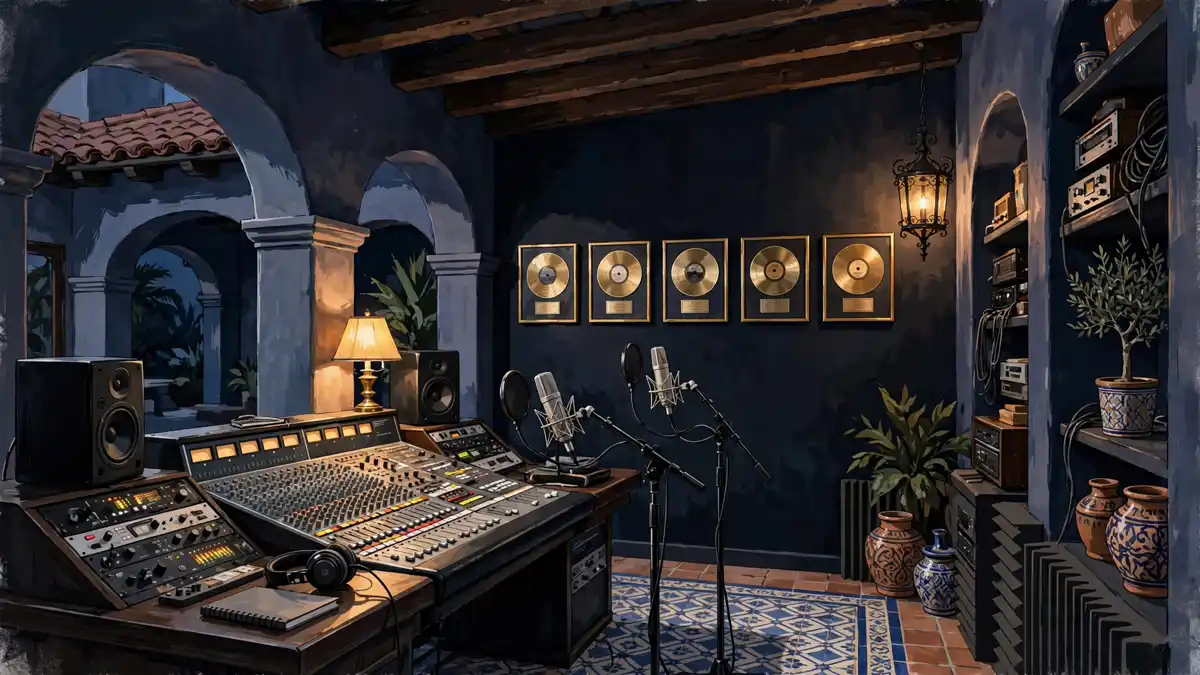
The property story is unusually well documented, thanks to a 2025 listing that made the whole timeline public. In 2016, fresh off the multi-platinum run of When It’s Dark Out, Gillum bought a Spanish Colonial villa in Hollywood’s Beachwood Canyon from ER and Salem actor Shane West for roughly $1.758–1.8 million, depending on the report. He nicknamed it “Gerryland” and, with designer Melody Jimenez of MA Creative, rebuilt it around his work life — including a professional-grade recording studio and isolation booth where, according to his listing agent Raul Sanchez Jr. of Christie’s International Real Estate Southern California, he wrote many of his biggest hits. Architectural Digest described it as a “low-key hideaway in which to work and collaborate with fellow artists.”
The numbers on the property: about 3,642 square feet, four bedrooms, five bathrooms, rustic hardwood floors, custom Italian and Moroccan tile, a saltwater pool, and views stretching to the Hollywood Sign. In March 2025 — by which point he had been living primarily in New York for roughly three years, per TMZ reporting — he listed it at $3.7 million, nearly double the purchase price before counting the extensive renovation costs. The price was later cut to $2.85 million, and in May 2026 he took the property off the market entirely, per HomesOfCelebs. As of October 2026, the villa appears to still be in his hands — a $2–3 million illiquid asset rather than a realized gain.
On cars and other physical assets, the public record is quiet: no verified collection, no reported supercar fleet, no second property on file. That silence is itself informative — unlike rappers who convert touring income into depreciating machinery, G-Eazy’s visible assets are his catalog, his spirits equity, and one California villa.
Awards and Achievements
G-Eazy’s awards cabinet is solid but tells a clear story about his ceiling: dominant in fan-voted and genre categories, absent from the Grammy rolls. His biggest win was the Billboard Music Award for Top Rap Song in 2016 for “Me, Myself & I” — a trophy that measures actual chart performance. The following year he won the MTV Video Music Award for Best Collaboration (2017), also for the Bebe Rexha duet. Nominations that didn’t convert include the MTV Europe Music Award for Best US Act and the BET Hip Hop Award for Best Album, per Celebrity Net Worth.
The non-trophy achievements carry their own weight. Three albums in the Billboard 200’s top five (These Things Happen at No. 3, When It’s Dark Out at No. 5, The Beautiful & Damned at No. 3). A triple-platinum single in “I Mean It.” The Forbes 30 Under 30 music nod in 2017. A Britney Spears collaboration and a VMA stage performance in 2016. For a rapper who built his first audience on MySpace, the distance traveled is real — even if the trophy shelf stopped growing when the chart hits did.
Net Worth Growth Over the Years
The figures below are our estimates, reconstructed from the career timeline and the reporting available at each stage. They are not audited numbers — treat them as the trajectory, not a balance sheet.
| Year | Estimated net worth | What was happening |
|---|---|---|
| 2014 | $1–2 million | RCA debut These Things Happen hits No. 3 on the Billboard 200; “I Mean It” goes triple platinum |
| 2016 | $4–6 million | “Me, Myself & I” peaks at No. 7 on the Hot 100; VMA performance with Britney Spears; Billboard Music Award win |
| 2018 | $8–10 million | “No Limit” peaks at No. 4 — his highest-charting song; The Beautiful & Damned Tour; Stillhouse investment |
| 2020 | $10–12 million | Alt-pop detour Everything’s Strange Here; catalog streaming compounds |
| 2022 | $11–12 million | These Things Happen Too reaches No. 19; move from RCA to Empire distribution |
| 2024 | $11–12 million | Freak Show fails to chart; income shifts to catalog and touring |
| 2026 | $10–15 million | Helium Tour; “Gerryland” listed then delisted; Celebrity Net Worth anchors at $12M |
Two notes on the table. First, the 2026 dip in precision reflects genuinely mixed signals: new releases no longer chart, but the back catalog keeps streaming and the real-estate position stayed intact after the delisting. Second, the commonly cited $12 million figure from Celebrity Net Worth has barely moved for years — suggesting the estimate is a trailing indicator of the 2018 peak rather than a live reflection of 2026 cash flow.
Social Media Presence
G-Eazy’s audience is large but no longer growing the way it once did. His Instagram account, @g_eazy, carries about 8.7 million followers as of October 2026, per NetWorthSpot’s tracking. He posts under @G_Eazy on X, and his site g-eazy.com functions as the tour-and-merch hub.
The social-media story that matters for his net worth is the origin, not the current count: he was a MySpace and SoundCloud-era builder. The Bay Boyz tracks, the early mixtapes, the direct-to-fan releases — G-Eazy learned audience economics on platforms that paid nothing, which is why his later business decisions (own imprint, equity over endorsements) read the way they do. An artist who spent his early twenties operating without a label tends to negotiate like one when the labels come calling.
Personal Life
G-Eazy keeps his private life guarded, but his relationships have been tabloid fixtures. He dated singer Halsey from 2017 to 2018 — a pairing that produced the duet “Him & I” and dominated music-press coverage of both artists. Subsequent reported relationships include model Yasmin Wijnaldum, singer Lana Del Rey, and actress Ashley Benson. As of mid-2026, his relationship status is not publicly confirmed, and he is not married and has no children.
His mother, Suzanne Olmsted, died in 2021, a loss he has spoken about publicly and that informed the introspective tone of his early-2020s work. His younger brother James remains involved in music. In September 2021 he was arrested in New York City in connection with an alleged physical altercation outside the Standard Hotel’s Boom Boom Room; he was issued a desk appearance ticket and was not held in custody.
Offstage, his public identity is philanthropic as much as musical. Beyond the Endless Summer Fund, he donated $100,000 to the 2017 Northern California wildfire relief and headlined the 2018 Bay Area Fire Relief concert that raised a reported $15 million. The throughline is consistent: Bay Area first, celebrity second.
Sources & Reporting
- Celebrity Net Worth — the $12 million baseline estimate; biographical sketch, the $100,000 wildfire donation, the Endless Summer Fund, film/TV appearances, and the award nominations list. Reporting window: career-spanning, page current through 2026.
- Wikipedia — career chronology: birth date and place, 2006 start, label history (RCA → Empire, BPG, RVG imprints), full discography with Billboard 200 chart positions, RIAA certifications for “I Mean It,” “Me, Myself & I,” and “No Limit,” and the non-charting Freak Show/Helium entries. Cross-checked against primary chart reporting where money was involved.
- Billboard — chart reporting behind the Wikipedia-certified positions: These Things Happen (No. 3), When It’s Dark Out (No. 5), The Beautiful & Damned (No. 3), and the Hot 100 peaks for “Me, Myself & I” (No. 7) and “No Limit” (No. 4).
- Recording Industry Association of America (RIAA) — certification data: triple platinum for “I Mean It”; multi-platinum status for “Me, Myself & I” and “No Limit.”
- Forbes — the 2017 “30 Under 30” music honoree listing, per the Stillhouse announcement’s contemporaneous press coverage.
- BevNET (June 2017, PRNewswire release) — the Stillhouse Spirits announcement: G-Eazy’s investing-partner and co-creative-director roles, his investment closing a funding round, the Black Bourbon launch, and his on-record statement about choosing equity over endorsement deals.
- Shanken News Daily (Nov 15, 2019) — Bacardi’s full acquisition of Stillhouse Spirits for an undisclosed sum; the $100 million Beckerman lawsuit and its dismissal with no settlement.
- The Spirits Business (2018–2019) — the Black Bourbon launch with G-Eazy’s “My Next Fix” track; the 2019 acquisition terms and lawsuit background.
- Mixonline (March 4, 2025) — the “Gerryland” Hollywood Hills listing: $3.7 million ask, 3,642 sq ft, the 2016 purchase from Shane West for ~$1.8 million, the in-home studio, and agent Raul Sanchez Jr.’s comments.
- The Source (March 2025) — the New York relocation context and the $1.758 million purchase price.
- HomesOfCelebs (2026) — the price cut to $2.85 million and the May 2026 off-market removal.
- Bustle (2016) — the “Make Me…” Britney Spears collaboration and VMA performance context.
- ScreenDollars — early biography: Berkeley upbringing, father at CSU Fresno, Loyola University New Orleans (graduated 2011), Bay Boyz and MySpace beginnings, 2010 opening slots for Lil Wayne and Snoop Dogg.
- CelebsMoney — height (6’4″/1.93 m); its stale $3 million net worth estimate is noted and excluded from the range.
- NetWorthSpot (Oct 2026) — the 8.7 million Instagram follower count; its $39.8 million “net worth” figure is an influencer-revenue estimate and is excluded from the range.
Reporting window: career records through October 2026. Net worth figures are estimates compiled from public reporting, not audited financials; where outlets disagreed, we published the range and named who said what.
Frequently Asked Questions
What is G-Eazy’s net worth in 2026?
G-Eazy’s net worth is estimated at $12 million as of October 2026, with a realistic range of $10–15 million. Celebrity Net Worth anchors the $12 million figure, and most recent outlets land between $11 and $13 million. Two widely-cited outliers — a stale $3 million figure and an influencer algorithm’s $39.8 million — come from weak methodology and are excluded from the range.
What is G-Eazy’s real name?
His birth name is Gerald Earl Gillum, born May 24, 1989, in Oakland, California. His stage name compresses his first initial and his middle name, Earl, into the phonetic “Eazy” — a play he used to avoid comparisons with N.W.A’s Eazy-E.
How old is G-Eazy?
G-Eazy is 37 years old in 2026, born on May 24, 1989. He started his music career in 2006 as a teenager and graduated from Loyola University New Orleans in 2011.
What is G-Eazy’s biggest song?
Commercially, “No Limit” (2017) featuring Cardi B and A$AP Rocky is his biggest: it peaked at No. 4 on the Billboard Hot 100, his highest chart position ever. His most-streamed and most-awarded single is “Me, Myself & I” with Bebe Rexha (2015), which reached No. 7 and won a Billboard Music Award for Top Rap Song plus a VMA for Best Collaboration.
How did G-Eazy get famous?
After a decade of independent mixtapes and MySpace releases, his 2014 RCA debut album These Things Happen debuted at No. 3 on the Billboard 200. The real breakout came with the singles “Me, Myself & I” (2015) and “No Limit” (2017), which made him a mainstream rap name and a festival headliner.
What happened to G-Eazy’s Hollywood Hills house?
He bought the Spanish Colonial villa he calls “Gerryland” in 2016 from actor Shane West for roughly $1.8 million, remodeled it with a professional recording studio, and listed it for $3.7 million in March 2025 after relocating to New York. The price was later cut to $2.85 million, and in May 2026 he took it off the market — so as of October 2026 he appears to still own it.
What business does G-Eazy own?
His main business bet is Stillhouse Spirits, the whiskey-and-vodka company where he became an investing partner and co-creative director in 2017. Bacardi fully acquired Stillhouse in November 2019 for an undisclosed sum; the payout terms of his equity were never made public. He also runs his own label imprint, Everything Is G, and founded the Endless Summer Fund nonprofit for Bay Area youth.
Who is G-Eazy dating?
As of 2026, his relationship status is not publicly confirmed. His most famous relationship was with singer Halsey (2017–2018), with whom he recorded “Him & I.” He has also been linked to model Yasmin Wijnaldum, singer Lana Del Rey, and actress Ashley Benson. He is not married and has no children.
Final Thoughts
G-Eazy’s $12 million fortune is a portrait of a specific kind of rap career: a compressed, five-year commercial peak banked smartly enough to last. The 2014–2019 run produced the only assets that matter on his balance sheet — a catalog of multi-platinum singles he wrote himself, a touring résumé at the festival-headliner level, and the Stillhouse equity that converted a brand partnership into actual ownership. The Forbes 30 Under 30 nod, the VMA stage with Britney Spears, the No. 4 Hot 100 peak: these were the years when everything compounded.
What makes his case interesting rather than just successful is how he used that advantage. Most rappers at his level licensed their faces; he bought into a whiskey company and closed a funding round. He spent his early twenties learning the music business at Loyola and grinding MySpace-era DIY releases, and he negotiated the rest of his career like someone who had read the contracts. The Stillhouse-to-Bacardi arc — including the founder’s $100 million lawsuit — is the kind of business drama most celebrity net worth profiles skip; it’s also the single most important non-music event in his financial life.
The honest caveats close the story: the $12 million anchor is a trailing estimate of a 2018 peak, his recent albums haven’t charted, and the Gerryland listing suggests a man recalibrating rather than expanding. But the catalog doesn’t expire, the publishing checks keep coming, and a decade of owning his masters-through-imprint puts him ahead of most rappers who peaked when he did. For an Oakland kid who started producing in his teens, the bottom line is exactly what the number says: a twelve-million-dollar career built the long way, one owned asset at a time.
Published on October 15, 2026. Last reviewed October 2026. Found an error? See our corrections policy.