
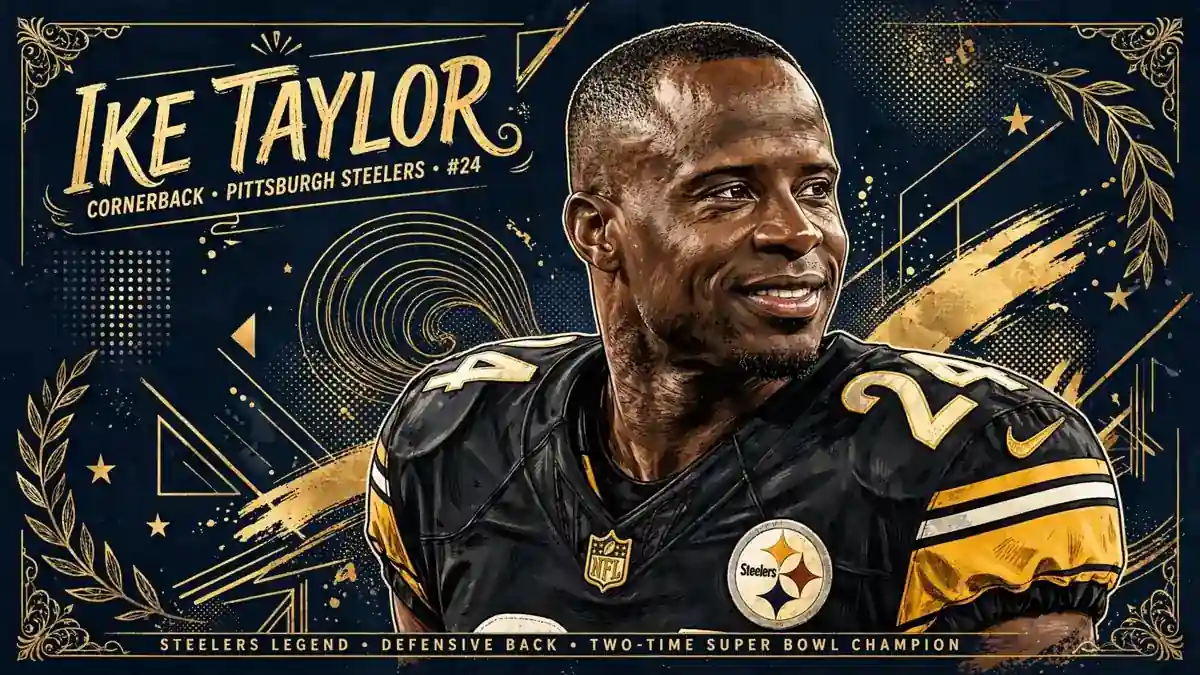
Ike Taylor‘s net worth is estimated at $10 million to $20 million as of November 2026. The former Pittsburgh Steelers cornerback banked $47.4 million in career NFL earnings across 12 seasons with one team, won two Super Bowls, then added media pay at NFL Network and, in 2024, a return to the Steelers as a college scout.
Ike Taylor: Quick Facts
| Estimated net worth | $10 million–$20 million (range: $10 million to $20 million) |
|---|---|
| Profession | Former NFL cornerback; former NFL Network analyst; Steelers college scout |
| Nationality | American |
| Born | May 5, 1980 (age 46) |
| Height | 6 ft 2 in (1.88 m) — listed; some sources list 6 ft 1 in |
| Primary income sources | NFL salaries and bonuses, NFL Network analyst work, Steelers scouting, football camps and appearances |
| Active years | 2003–2014 (NFL); 2015–2017 (NFL Network); 2024–present (Steelers scouting) |
| Last reviewed | November 2026 |
- Early Life and Background
- Education
- Career Journey
- Rise to Fame
- Main Sources of Income
- Salary and Earnings
- Businesses and Investments
- Brand Deals and Sponsorships
- Houses, Cars and Other Assets
- Awards and Achievements
- Net Worth Growth Over the Years
- Social Media Presence
- Personal Life
- Sources & Reporting
- Frequently Asked Questions
Early Life and Background
Ivan Taylor was born on May 5, 1980, in Gretna, Louisiana, a town across the Mississippi River from New Orleans. He grew up as Ike, the name that stuck for his whole career, raised by his mother, Cora. Childhood took him away from Louisiana for a stretch — the family moved to Raleigh, North Carolina — before he returned as a seventh-grader to live with his uncle and aunt, Herman and Judy Francois, in Harvey, Louisiana.
That move back put him in New Orleans football. He attended Marion Abramson Senior High School in New Orleans, where he played football and basketball. Abramson used him everywhere: running back, defensive end, cornerback and placekicker. The versatility said something about his athleticism, but it also hid him. He was a gifted athlete without a settled position, and college recruiters had no clear picture of what he would become. That uncertainty followed him into college and nearly kept him out of the game entirely.
Money was not part of the story at this stage. Taylor came from a working family in the New Orleans area, moved between households as a child, and reached college as a walk-on — the opposite of the blue-chip path that most future NFL starters travel. The financial story of his life starts with that fact: nothing was handed to him, and his first professional contract, worth $1.18 million over three years, was modest by NFL standards even in 2003.
Education
Taylor attended the University of Louisiana at Lafayette, where he majored in psychology. His first two years there were spent academically ineligible to play football. He joined the team as a walk-on in 2001 and earned a scholarship before the season started — a detail that matters because it shows how late his football career actually began. He was not a recruited star. He was a student who talked his way onto the roster and then played his way into a scholarship.
In his first season he played tailback and special teams and returned kicks. The position switch that made his career came before his senior season, when he asked to be moved to cornerback. He started at right cornerback and recorded 46 tackles, eight passes defensed and two forced fumbles. In four games that season, no opponent caught a ball against him. One of his college teammates was Charles Tillman, who went on to a long NFL career of his own with the Chicago Bears.
The college record is short — two real seasons, one at a new position — and that thin record is exactly why the 2003 draft treated him as a gamble. Scouts saw size and speed in a player with almost no tape at cornerback. The Steelers bet on the traits. Taylor’s psychology degree never became a career path, but the late start explains the shape of his earnings: his rookie deal paid like a fourth-round pick, and his real money arrived only after he proved himself as a starter in 2005 and 2006.
Career Journey
Pittsburgh selected Taylor in the fourth round of the 2003 NFL draft, 125th overall. The pick was made on size and speed — he was timed as fast as 4.18 seconds in the 40-yard dash at his pro day, a figure reported with the caveat “allegedly” because it sat well ahead of his other timed runs — despite his inexperience at the position. Pittsburgh Post-Gazette writer Mark Madden called it the worst pick in history at the time. Taylor spent the next 12 years making that judgement look foolish.
On May 28, 2003, the Steelers signed him to a three-year, $1.18 million contract that included a $275,000 signing bonus. Head coach Bill Cowher named him the fourth cornerback to start the season, behind Chad Scott, Dewayne Washington and Deshea Townsend, and gave him kick-return duties. He made his regular-season debut in the opener against the Baltimore Ravens, recording two tackles and returning two kicks for 29 yards. In Week 8 he returned six kicks for a season-high 145 yards against the St. Louis Rams. On November 23, 2003, he earned his first career start at nickelback against Cleveland and held the role for the rest of the season after Scott went on injured reserve. He finished his rookie year with 32 combined tackles and three pass deflections in 16 games, plus 37 kick returns for 831 yards.
The second season brought his first interceptions. On October 3, 2004, he picked off Carson Palmer in a 28–17 win over Cincinnati. The following month he intercepted Tom Brady in a 34–20 win over New England. He finished 2004 with 16 combined tackles, four pass deflections and an interception in 13 games and one start, and the Steelers finished 15–1 behind rookie quarterback Ben Roethlisberger. Taylor appeared in his first playoff game in January 2005, a 20–17 win over the New York Jets.
The breakthrough came in 2005. Taylor won the starting cornerback job in training camp against Chad Scott, Willie Williams, Ricardo Colclough and Bryant McFadden, and defensive coordinator Dick LeBeau named him a starter alongside Deshea Townsend. He started 15 games, set a career high with 91 combined tackles, and led the team with 23 pass deflections. In the playoffs he started his first postseason game in the wild-card win at Cincinnati, intercepted a pass in the AFC Championship Game at Denver, and then started Super Bowl XL on February 5, 2006, leading the Steelers with seven tackles and intercepting Matt Hasselbeck in the red zone as Pittsburgh beat Seattle 21–10.
That Super Bowl changed his pay. Before the 2006 season, Pittsburgh signed him to a four-year, $22.5 million extension with a $6.4 million signing bonus, making him the highest-paid cornerback in franchise history and tying him to the club through 2010. The deal also set up the hardest stretch of his career. In Week 9 of 2006 he gave up six receptions for 134 yards and two touchdowns to Denver’s Javon Walker in a 31–20 loss, was benched for Bryant McFadden, and was demoted to third on the depth chart by Week 12. He finished the season with 69 tackles and two interceptions in 16 games, but the demotion was public and sharp.
He won the job back. Under new head coach Mike Tomlin in 2007, Taylor started all 16 games, recorded 80 tackles, 16 pass deflections and three interceptions, and scored his only career touchdown on a 51-yard interception return against the St. Louis Rams in Week 16. On October 7, 2007, he was voted NFL Defensive Player of the Week for his performance in a 21–0 win over Seattle — five tackles, four pass deflections and an interception. In the 2007 wild-card loss to Jacksonville, his interception marked his third straight playoff game with a pick.
The 2008 season showed his value as a shadow corner. LeBeau used him in one-on-one man coverage against the opponent’s top receiver, and the results were stark. On October 26, 2008, he held the New York Giants’ Plaxico Burress to three receptions for 15 yards. The next week he held Washington’s Santana Moss to two catches for 14 yards. He finished the year with 65 tackles and an interception in 16 starts, and on February 1, 2009, he started in Super Bowl XLIII, recording eight tackles as the Steelers beat the Arizona Cardinals 27–23 for his second ring.
From 2009 onward he was a fixture: 16 starts in 2009, 2010 and 2012, the team’s No. 1 cornerback for most of that stretch. The 2010 draft also brought Antonio Brown to Pittsburgh, and the defence around Taylor in those years included James Harrison, the Steelers linebacker who anchored the same championship core. His third career sack came against Joe Flacco in a 13–10 win at Baltimore in December 2010. He started all 16 games in 2012 and 2013, recording 66 tackles in 2013 at age 33. The end arrived fast. On September 21, 2014, he broke his right forearm against the Carolina Panthers and missed 11 of the Steelers’ 16 games. He had taken a pay cut that March to stay in Pittsburgh — a one-year, $2.75 million deal after a scheduled $7 million base salary — and the injury closed his final season at 16 tackles in five games. On April 14, 2015, he announced his retirement, a one-team player after 12 seasons.
Rise to Fame
Taylor’s rise did not follow the usual script. He was not a college star, not a first-round pick, and not a player the draft press liked. His rise happened in public, in two stages: the 2005 season that made him a starter on a Super Bowl team, and the 2007–2008 stretch that made him the corner the Steelers trusted against the best receiver on the field.
The first stage was the Super Bowl XL run. A fourth-round pick starting at cornerback for a championship team is rare, and Taylor’s red-zone interception of Hasselbeck in the Super Bowl itself gave him a signature play. The second stage was quieter but more telling. Coaches do not assign a corner to shadow Plaxico Burress and Santana Moss in consecutive weeks unless they trust him completely, and the yardage totals — 15 yards, then 14 — were the proof. Steelers.com later noted that Bill Cowher often assigned Taylor to follow the opponent’s best receiver all over the field, and that for a while he was a legitimate shutdown cornerback.
The same story explains his reputation for dropped interceptions. He finished with 14 career interceptions against 134 pass deflections — a wide gap that says he was in position far more often than he finished the play. Steelers.com’s Labriola put it plainly: “If only he could catch. Those five words are arguably what stood between Ike Taylor and a career worth of Hall of Fame discussion.” The hands kept him out of the Hall of Fame conversation. They never cost him his job.
By retirement his career line read 636 total tackles, 134 pass deflections, 14 interceptions, one defensive touchdown, five fumble recoveries, two forced fumbles and three sacks across 174 regular-season games and 14 playoff games, with 140 starts. The numbers that matter most for this article are the ones that paid him: two Super Bowl rings, 12 seasons with one franchise, and $47.4 million in career cash earnings.
Main Sources of Income
Taylor’s money came from one place above all: the Steelers’ payroll. His NFL contracts account for essentially all of the fortune he built, and the shape of those contracts explains the shape of his net worth — slow early years, a sharp rise after the 2006 extension, a peak in 2011, and a hard landing in the 2014 pay cut. Everything after football — television, coaching, scouting, camps — added income at a much smaller scale.
The salary stream breaks into four deals. The rookie contract (2003, three years, $1.18 million) paid a fourth-round wage. The 2006 extension (four years, $22.5 million) made him the highest-paid cornerback in franchise history. The 2011 deal (four years, $28 million) was the biggest of his career and produced his single best cash year. The 2014 renegotiation (one year, $2.75 million) was a pay cut that let him finish as a Steeler. Over The Cap records $47,435,500 in total career cash earnings; Steelers.com rounds the same career to $47.7 million. The small gap between the two figures is a rounding and categorisation difference, not a dispute about the scale.
Media work was the second stream. In August 2015, four months after retiring, Taylor joined NFL Network as an analyst, appearing mainly on NFL Now and on shows such as The Top 100 Players. He stayed in that role until December 2017, when the network suspended him alongside Marshall Faulk and Heath Evans after sexual harassment claims were reported by The Washington Post. The suspension ended his run at the network. His analyst pay was never reported publicly, and no figure should be attached to it — it was a working television salary for roughly two and a half years, not a star anchor contract.
Coaching and scouting form the third stream, and the most recent one. In June 2015, weeks after retiring, Taylor spent OTAs and minicamp working with the Steelers’ coaching staff, sitting in staff meetings with Mike Tomlin and learning the coaching side of the game. He described the coaching window as a short one he wanted to take while it was open, and said the broadcasting window would still be there later. The coaching tryout did not turn into a staff job at the time. In 2024 he returned to the organisation in a different role: college scouting. Steelers general manager Omar Khan brought him into the scouting department, and Taylor worked the pro-day circuit that spring — Alabama, Miami and LSU — putting defensive backs through drills and writing evaluations. He told the “All Things Covered” podcast, hosted by Bryant McFadden and Patrick Peterson, that he had always thought he had an eye for talent and that scouting “don’t even feel like work.” He also said his goal was to win rings from the front-office side.
Football camps are the fourth stream, and the longest-running. Taylor has run the FaceMeIke Football Camp in New Orleans for local youth every summer since 2005. Camps of this kind are usually community work first and income second, and no revenue figure for his camp has been published. It belongs in the income picture as a steady, modest activity tied to his name in Louisiana, not as a business empire.
That leaves the question of what did not pay him. Taylor never signed a second NFL contract with another team, never took a front-office salary before 2024, and never built a public business portfolio. His income story is unusually clean for a modern athlete: one team, four contracts, a television stint, and a scouting return. The range in his net worth comes from how much of the $47.4 million survived taxes, fees and living costs — not from hidden ventures.
Salary and Earnings
Over The Cap’s contract record is the best single source on Taylor’s pay, because it lists cash actually paid each season rather than the headline value of each deal. The headline numbers flatter players; the cash column is what landed in the bank. Here is the record, season by season.
| Season | Cash paid | What drove it |
|---|---|---|
| 2003 | $500,500 | Rookie deal: $225,000 base plus signing-bonus money |
| 2004 | $305,000 | Second year of rookie deal |
| 2005 | $380,000 | Final rookie year; breakout starter season |
| 2006 | $5,585,000 | First year of $22.5M extension; $6.4M signing bonus |
| 2007 | $4,000,000 | Extension year two |
| 2008 | $4,500,000 | Extension year three |
| 2009 | $4,000,000 | Extension year four |
| 2010 | $4,500,000 | Extension year five (option year) |
| 2011 | $9,250,000 | First year of $28M deal; largest cash year of his career |
| 2012 | $5,750,000 | $825,000 base plus $4.975M signing bonus after restructure |
| 2013 | $6,000,000 | $3.02M base plus prorated bonus; cap number $7.97M |
| 2014 | $2,750,000 | Pay-cut deal after scheduled $7M base was cut |
| Career total | $47,435,500 | All 12 seasons with Pittsburgh |
Three seasons explain most of the money. The 2006 extension delivered $5.59 million in cash in its first year and $22.5 million across five seasons. The 2011 deal delivered $21 million of its $28 million value before the final year was renegotiated away — the contract was listed at four years and $28 million with $8 million guaranteed, and Taylor earned 75 percent of it. And 2011 alone, his best cash year at $9.25 million, paid more than his first four seasons combined.
The 2014 pay cut deserves a close look because it shows how quickly NFL money can shrink. Taylor was scheduled to earn a $7 million base salary in 2014 with a cap number of $11.94 million. The Steelers needed cap room, and Taylor agreed to a one-year, $2.75 million deal that freed $4.25 million of cap space. He announced it himself on Twitter that March: “The INK is about to dry on this paper… im a LIFER… will retire as a ROONEY and a LEBEAU.” ESPN confirmed the terms the same day. He took the cut to finish where he started, and the forearm injury in September meant the season — and the career — ended on that reduced number.
The restructure a year earlier tells the same story from the team’s side. In February 2012 the Steelers converted the maximum amount of his $5.75 million base salary into a signing bonus, dropping his base to the $825,000 veteran minimum and paying him $4.925 million at once. In 2013 they restructured again, dropping his base to $940,000 and rolling the rest into bonus money. These moves are routine cap management, but they show Taylor’s pay was repeatedly reshaped by the team’s cap position as much as by his play.
Set against the $47.4 million gross, the net-worth range of $10 million to $20 million reflects the usual deductions. Federal and state tax on $47.4 million earned mostly in Pennsylvania, agent fees at the standard 3 percent, and 12 years of living costs for a professional athlete with a family all take a large share before any investment return. The low-end published estimate of $5 million, from Celebrity Birthdays’ December 2023 update, looks too low against $47.4 million of documented earnings unless the money was spent or lost at an extreme rate. The $20 million figure published by TheMost10 for 2026 sits at the top of the range and implies strong post-career preservation. A 2021 estimate of $10 million sits in the middle. Our $10 million–$20 million range holds the 2021 figure as its floor and the 2026 figure as its ceiling, and treats the $5 million figure as stale and understated.
Businesses and Investments
There is no public record of Ike Taylor running a business, holding a large property portfolio, or investing in a startup. That sentence matters more than it looks, because several low-quality net-worth pages credit him with “investment properties,” “tech investments” and “commercial properties in tech hubs.” None of those pages names a property, a company, a deal or a source. We checked the reporting and found nothing behind the claims, so this article does not repeat them as fact.
What the record does show is smaller and more believable. The FaceMeIke Football Camp, run every summer in New Orleans since 2005, is his longest-running venture outside playing. It is a youth camp built on his name and his local ties, and it has run for two decades. No financial statements for the camp exist in public, and it should be read as community work with modest income rather than a business line.
His post-playing work has been employment, not entrepreneurship. NFL Network paid him as an analyst from 2015 to 2017. The Steelers pay him as a college scout in his current role, which began in 2024. Neither role has a published salary, and neither involves equity, ownership or a business he founded. The “All Things Covered” podcast appearance in March 2024, where he discussed the scouting move with Bryant McFadden and Patrick Peterson, is the fullest public account of the job: college-side scouting, pro-day work, written evaluations, and a stated goal of winning rings from the front office.
That leaves the honest position on investments: unknown. Taylor has never spoken publicly about a portfolio, a property, or a business deal in any interview this research found, and no filing or rich list covers him. A net-worth estimate for a retired player in this position rests on career earnings minus the costs of a career, plus modest post-career pay — not on a hidden portfolio. Readers should treat any site that lists specific Taylor properties or tech holdings as guessing, because the underlying reporting does not exist.
Brand Deals and Sponsorships
Taylor never carried a major national endorsement portfolio. No shoe deal, no beverage deal, no national campaign with his name on it appears in the reporting. That is normal for a cornerback, even a good one on a championship team — the endorsement money in the NFL flows to quarterbacks, and to corners only when they become cultural figures. Taylor was a respected starter, not a marketing star.
His media presence during his playing years was local. He hosted a radio show in Pittsburgh on the Tribune-Review radio and podcast network while still with the Steelers, and he appeared on NFL Network shows such as the Dave Dameshek Football Program after retirement. Those are working media gigs: regular appearances, a host’s fee, and a profile in Pittsburgh sports media. They are not endorsement deals, and they should not be priced as if they were.
One marketplace listing does exist — an Opendorse profile offering bookings with Taylor — but a booking page is not evidence of endorsement income, and no deal value is published there. We do not count it as a revenue line. The fair summary is that endorsements contributed little to Taylor’s fortune. His $47.4 million came from contracts, and the gap between that figure and his net worth is explained by tax and time, not by a missing endorsement fortune.

Houses, Cars and Other Assets
The verifiable facts about Taylor’s homes and cars fit in a short paragraph, and the rest of this section is an honest account of what is not known. He makes his off-season home in his native New Orleans, a fact recorded in his biographical profiles, and he has trained in Orlando, Florida, at Disney’s Wide World of Sports complex under Tom Shaw’s SPARQ programme. No address, purchase price, or property record for a Taylor home has been published, and no car collection has ever been documented.
That gap is worth stating plainly because the net-worth pages that rank for his name fill it with invention. TheMost10’s 2026 page lists “investment properties” as a notable asset. The Stanislas blog’s 2026 article claims “commercial properties in tech hubs” and “residential assets in affluent neighbourhoods.” Neither page names a single property, city, price or record. A property claim with no address is not reporting. It is decoration, and this article does not repeat it.
The assets that can be documented are the ones tied to his career. Two Super Bowl rings — XL and XLIII — are the most valuable objects he owns in sporting terms, and championship rings for a two-time winner carry real resale value, though Taylor has given no sign of selling them. His NFL pension and benefits, earned across 12 credited seasons, pay a steady post-career income under the league’s retirement plan; the exact monthly figure depends on when he began drawing it and is not public. His name and likeness, including the FaceMeIke camp brand he has run since 2005, are working assets in the sense that they produce camp and appearance income.
Readers looking for a house tour or a garage list will not find one here, because none exists in the public record. Taylor has kept his private property private, and the right response to that is to say so rather than invent a portfolio. The $10 million–$20 million estimate does not depend on any property claim. It depends on $47.4 million of documented earnings, the tax and fees on those earnings, and a decade of modest post-career income.
Awards and Achievements
Taylor’s honours list is short, and its shortness is part of the story. He was never selected for a Pro Bowl and never made an All-Pro team. The recognition he did earn came from team success and single-game performances rather than season awards, which fits a player whose value was coverage — the part of defence that leaves the least trace in a box score.
- Super Bowl champion, XL (February 5, 2006): started at cornerback, led the Steelers with seven tackles, intercepted Matt Hasselbeck in the red zone in a 21–10 win over Seattle.
- Super Bowl champion, XLIII (February 1, 2009): started at cornerback, recorded eight tackles in a 27–23 win over the Arizona Cardinals.
- NFL Defensive Player of the Week, Week 5, 2007: five tackles, four pass deflections and an interception in a 21–0 win over Seattle.
- 140 career starts for the Steelers, the mark of a player trusted as a starter for most of a 12-year career.
- 174 regular-season games and 14 playoff games across 12 seasons, all with Pittsburgh — durability that few corners match.
- Career totals: 636 tackles, 134 pass deflections, 14 interceptions, one defensive touchdown, five fumble recoveries, two forced fumbles, three sacks.
- Highest-paid cornerback in Steelers history at the time of his 2006 extension — a four-year, $22.5 million deal with a $6.4 million signing bonus.
- One-team career: drafted by Pittsburgh in 2003, retired as a Steeler in 2015, and returned to the organisation as a scout in 2024.
The absence of a Pro Bowl is the honest context for the awards list. Taylor’s 2005 season — 91 tackles, 23 pass deflections, a Super Bowl start — was the kind of year that earns Pro Bowl votes for corners who finish plays, and his 14 career interceptions against 134 deflections show why the votes never came. He broke up passes at an elite rate and caught them at an ordinary one. The Steelers kept starting him for a decade anyway, which is the judgement that counted for his pay.
Net Worth Growth Over the Years
No audited record of Taylor’s wealth exists for any year, so the table below is a modelled estimate built from his cash earnings by season, less the tax, agent fees and living costs that apply to an NFL player, and checked against the published estimates that do exist. It is labelled as a model, not a fact, and the published anchors are named where they fall.
| Year | Estimated net worth | Why |
|---|---|---|
| 2003 | $300,000–$500,000 | Rookie deal cash of $500,500; first year of earnings |
| 2006 | $3 million–$5 million | $22.5M extension signed; $5.59M cash in 2006 alone |
| 2009 | $7 million–$10 million | Second Super Bowl; extension paying $4M–$4.5M a year |
| 2011 | $10 million–$14 million | Best cash year, $9.25M; $28M deal signed |
| 2014 | $12 million–$18 million | Career earnings near $47.4M; pay cut in final season |
| 2021 | About $10 million | Published estimate for 2021; post-retirement years without NFL pay |
| 2026 | $10 million–$20 million | Our current range; $20M is the top published 2026 figure |
The shape of the table is the point. Wealth rose steeply from 2006 to 2011, when Taylor’s cash earnings ran at $4 million to $9.25 million a year, then levelled off after retirement in 2015. The 2021 published estimate of $10 million sits below the 2014 peak of the model, which is what you would expect: eleven years without an NFL salary, with media and scouting pay at a far lower level, will draw a fortune down unless investments replace the salary. The $20 million top end for 2026 implies the opposite — that investments or savings held up well. Our range covers both readings because the evidence does not settle it.
One comparison puts the scale in context. Taylor’s $47.4 million in career earnings is a large fortune for a cornerback drafted in the fourth round, and it sits well above what most players at his draft position ever earn. The cornerback market has moved a long way since his $28 million deal — the modern pay scale is visible in Jalen Ramsey’s net worth and in Richard Sherman’s fortune, the next era’s shutdown corner — and Taylor’s earnings sit well below the quarterbacks and star receivers of his era, which is why his net worth sits in the tens of millions rather than the hundreds.
Social Media Presence
Taylor has kept a public voice since retirement, mostly on X (formerly Twitter), where he posted as @Ike_SwagginU during his playing years and used the account to announce his 2014 pay-cut deal himself — “The INK is about to dry on this paper… im a LIFER” — before the news outlets confirmed it. That post is a good guide to how he uses social media: direct, in his own voice, and tied to Steelers news rather than to brand promotion.
Since retiring he has stayed visible through football media rather than through his own channels: appearances on NFL Network during his analyst years, the “All Things Covered” podcast with Bryant McFadden and Patrick Peterson in 2024, and Steelers coverage around his son Ivan’s recruiting journey. No verified follower count or engagement figure for his accounts is published in a form this article can cite, so none is given here. The honest summary is that his post-career profile runs through Steelers media and podcast appearances, not through a large personal social following.
His son’s recruiting story played out in public in a way his own career never did. Ivan Taylor’s commitment flips — Notre Dame in December 2023, Michigan in July 2024, Alabama in November 2024 — were covered as recruiting news by On3, Sports Illustrated and Larry Brown Sports, with Ike’s name in every story. The coverage kept the Taylor name in football news a decade after his retirement, and it is the reason many younger fans know the name at all.
Personal Life
Taylor is married to Danielle Taylor. The two met in 2001 at the University of Louisiana at Lafayette, where Taylor had just walked onto the football team, and they were together for well over a decade before marrying. Danielle keeps a low public profile and stays off social media, so little about her life outside the marriage is on the record. Their son is Ivan Taylor.
Ivan followed his father into football and became a story in his own right. A four-star safety from West Orange High School in Winter Garden, Florida, he committed to Notre Dame on December 1, 2023, as the highest-rated defensive commit in the Irish’s 2025 class at the time. Seven months later he flipped to Michigan, becoming the highest-rated member of the Wolverines’ 2025 class, and in November 2024 he flipped again and signed with Alabama, choosing the Crimson Tide over Notre Dame and Michigan. He was ranked No. 54 overall in the 247Sports Composite for his class. The three-commitment journey was covered widely, and Ike appeared alongside fellow former Steelers Jerome Bettis and Plaxico Burress in a Notre Dame recruiting photo with their sons in early 2024, before Ivan’s flips.
The family story connects back to Taylor’s own beginnings. He grew up between Gretna, Raleigh and Harvey, Louisiana, raised by his mother Cora and later by his uncle and aunt. His son’s path — a Florida high school, national recruiting attention, a signing with Alabama — is the version of the football journey that Taylor himself never had. He arrived as a walk-on with no position; his son arrived as a top-100 recruit with his pick of programmes.
Outside football, Taylor’s steady commitment has been the FaceMeIke Football Camp in New Orleans, running every summer since 2005. It is the longest-running thread in his post-playing life outside the Steelers organisation, and it ties his public work to the city where he grew up.
Sources & Reporting
Over The Cap — the contract and cash-earnings record for the whole article: $47,435,500 in career earnings, the four deals ($1.18M rookie, $22.5M extension, $28M deal, $2.75M final year), season-by-season cash, and the 2011 peak of $9,250,000. Reporting window: contract data current to the 2014 season, checked November 2026.
Pro Football Reference — career statistics: 636 tackles, 134 pass deflections, 14 interceptions, and the 6 ft 2 in listed height used in the facts table. Reporting window: career statistics through the 2014 season, checked November 2026.
Wikipedia — biographical spine: born May 5, 1980 in Gretna, Louisiana; mother Cora; the move to Raleigh and return to Harvey; Abramson High School; the walk-on year at Louisiana–Lafayette; the move to cornerback; the 2003 draft; season-by-season game logs; the 2006 extension terms; the 2017 NFL Network suspension; and the NFL Network analyst role from August 2015. Cross-checked against the primary sources below wherever money or dates were involved. Checked November 2026.
Steelers.com — the team’s own account of Taylor’s post-retirement coaching tryout in June 2015, his NFL Network analyst work, and the Labriola assessment of his career ($47.7 million in career earnings, 140 starts, the “if only he could catch” judgement). Reporting window: 2015–2016 team coverage, checked November 2026.
ESPN — confirmation of the March 2014 pay-cut deal: one year, $2.75 million, freeing $4.25 million of cap space, with Taylor’s own Twitter announcement quoted. Reporting window: March 2014, checked November 2026.
Sports Illustrated — the July 2014 interview on the pay cut, in which Taylor said he took the cut because he could not see himself playing anywhere else, and the Michigan recruiting coverage of his son Ivan’s flip from Notre Dame. Reporting window: 2014 and 2024, checked November 2026.
Steelers Depot — the March 2024 account of Taylor’s move into Steelers college scouting under general manager Omar Khan, including the Alabama and Miami pro days and his “All Things Covered” podcast interview. Checked November 2026.
PlayersBio — Taylor’s marriage to Danielle Taylor and the account of their relationship beginning at Louisiana–Lafayette in 2001. Checked November 2026.
Larry Brown Sports and On3 — Ivan Taylor’s recruiting timeline: the Notre Dame commitment of December 1, 2023, the flip to Michigan in July 2024, and the signing with Alabama in December 2024. Checked November 2026.
Celebrity Birthdays — the low-end net-worth estimate of $5 million, last updated December 11, 2023, treated here as stale and understated against the earnings record. TheMost10 — the high-end 2026 estimate of $20 million, and the source of the unverified “investment properties” claim this article declines to repeat. Both checked November 2026.
How we estimated: the $10 million–$20 million range starts from Over The Cap’s $47,435,500 in documented career cash, applies the standard deductions for tax, agent fees and living costs across a 12-year career and a decade of retirement, and is bounded by the published estimates — $10 million in 2021 at the floor and $20 million in 2026 at the ceiling. Where the published estimates conflict, this article names the outlet and the figure instead of picking one silently. No property, business or endorsement figure is published here without a named source, because none exists in the reporting.
Frequently Asked Questions
What is Ike Taylor’s net worth in 2026?
Ike Taylor’s net worth is estimated at $10 million to $20 million as of November 2026. Published estimates disagree widely — from $5 million at the low end to $20 million at the high end — so we publish a range. The anchor is his documented career NFL earnings of $47,435,500, recorded by Over The Cap, less tax, agent fees and living costs across his career and retirement.
How much did Ike Taylor earn in the NFL?
Over The Cap records $47,435,500 in career cash earnings across 12 seasons, all with the Pittsburgh Steelers. His best year was 2011, when he took home $9,250,000 in the first year of a four-year, $28 million deal. His 2006 extension was worth $22.5 million over four years, and his final season in 2014 paid $2,750,000 after he accepted a pay cut from a scheduled $7 million base salary.
How many Super Bowls did Ike Taylor win?
Two. He started at cornerback in Super Bowl XL on February 5, 2006, leading the Steelers with seven tackles and intercepting Matt Hasselbeck in the red zone in a 21–10 win over Seattle. He started again in Super Bowl XLIII on February 1, 2009, recording eight tackles in a 27–23 win over the Arizona Cardinals.
Is Ike Taylor still playing in the NFL?
No. Taylor retired on April 14, 2015, after 12 seasons, all with the Pittsburgh Steelers. He then worked as an NFL Network analyst from 2015 to 2017, and in 2024 he returned to the Steelers organisation as a college scout, working the pro-day circuit and evaluating defensive back prospects for general manager Omar Khan.
How tall is Ike Taylor?
He is listed at 6 ft 2 in (1.88 m) by Pro Football Reference, while Wikipedia lists him at 6 ft 1 in (1.85 m) and his pro-day measurement was 6 ft 0⅜ in. His playing weight was 195 lb (88 kg). The one-inch gap between the two main listings is a routine difference between sources, not a dispute.
Who is Ike Taylor’s wife?
His wife is Danielle Taylor. The two met in 2001 at the University of Louisiana at Lafayette, where Taylor had just walked onto the football team, and were together for well over a decade before marrying. Danielle keeps a low public profile and stays off social media.
What is Ike Taylor’s son doing now?
His son Ivan Taylor is a four-star safety who signed with Alabama in December 2024. He first committed to Notre Dame on December 1, 2023, flipped to Michigan in July 2024, and then flipped again to Alabama that November. He was ranked No. 54 overall in the 247Sports Composite for the 2025 class.
What does Ike Taylor do now?
He works as a college scout for the Pittsburgh Steelers, a role he began in 2024. He evaluates defensive back prospects, works pro days — Alabama, Miami and LSU in his first spring on the job — and has said he wants to win Super Bowl rings from the front-office side. He also continues to run the FaceMeIke Football Camp in New Orleans, which he has held every summer since 2005.
Final Thoughts
Ike Taylor’s fortune is a story about a player who made the most of a late start. A walk-on with one season at cornerback in college became a fourth-round pick, then a Super Bowl starter, then the highest-paid cornerback in Steelers history, and he banked $47.4 million without ever playing for another team. The $10 million–$20 million net worth range reflects what survives of that money after tax, fees and a decade of retirement — and it is honest about the uncertainty, because the published estimates run from $5 million to $20 million and no audit exists.
What is certain is the career behind the number: 174 games, 140 starts, two rings, and a return to the organisation as a scout in 2024. Taylor never had the hands to be a Hall of Fame corner, and he never had the marketing profile to earn a fortune off the field. He had coverage skills, durability and loyalty to one franchise, and those three things paid him. The scouting job is the fitting next chapter — the man who was once called the worst pick in the draft now decides which defensive backs are worth drafting.
Published on November 24, 2026. Last reviewed November 2026. Found an error? See our corrections policy.