
Jamie Mazur‘s net worth is estimated at $10 million to $30 million as of November 2026. The Los Angeles denim entrepreneur built that fortune twice: first by hauling discounted designer jeans to college campuses in a van, then by co-founding RE/DONE, the label that turned discarded vintage Levi’s into jeans selling for just under $300 a pair — and became the first brand Levi’s ever licensed its name to.
Jamie Mazur: Quick Facts
| Estimated net worth | $10 million – $30 million (range: $10 million to $30 million) |
|---|---|
| Profession | Entrepreneur, denim brand co-founder |
| Nationality | American |
| Born | April 11, 1981 (age 45) |
| Height | Not publicly reported |
| Primary income sources | RE/DONE equity, Underground Denim, fashion investments, real estate |
| Active years | Late 1990s – present |
| Last reviewed | November 2026 |
- Early Life and Background
- Education
- Career Journey
- Rise to Fame
- Main Sources of Income
- Salary and Earnings
- Businesses and Investments
- Brand Deals and Sponsorships
- Houses, Cars and Other Assets
- Awards and Achievements
- Net Worth Growth Over the Years
- Social Media Presence
- Personal Life
- Sources & Reporting
- Frequently Asked Questions
Early Life and Background
Jamie Mazur was born on April 11, 1981, in California, and grew up in Los Angeles. The birth date is one of the few hard facts about his early years that multiple outlets agree on — JustRichest and Famous Birthdays both give April 11, 1981, and his age works out to 45 in November 2026. Beyond that, the public record thins out fast, and this article says so plainly rather than filling the gaps with guesswork.
What Mazur has said himself is more useful than any biography-site profile. In a 2019 interview with Julia von Boehm, he said: “Growing up in Los Angeles, many of my friends’ dads worked in denim. In their presence, I became obsessed with denim and all things vintage.” That single sentence explains the whole career that followed. Los Angeles in the 1980s and 1990s was the centre of the American premium-denim trade, and Mazur grew up around the factories, wash houses and sample rooms of that industry. He has also said he loves “all kinds of design” and that fashion was “the most encompassing of all of my interests” — a remark that reads as a mission statement for a man who later built a brand out of other people’s discarded jeans.
JustRichest reports that Mazur was raised in California alongside his sister Jennifer Mazur, in a Jewish household. That detail comes from a single outlet and has not been confirmed by Mazur himself in any interview we could find, so we repeat it only with that caution attached. One low-quality biography site, LuxLux, claims he was born in Yonkers, New York — a claim that conflicts with every other source, including Mazur’s own account of growing up in Los Angeles, and we treat it as unreliable. No credible reporting names his parents, gives a childhood address, or describes his family’s financial position. The honest picture is a Los Angeles kid who absorbed the denim trade by proximity, then turned that familiarity into a business before he turned 20.
That proximity mattered. Premium denim in the late 1990s was a strange market: jeans from labels such as True Religion, Seven for All Mankind, AG and Rock & Republic retailed for several hundred dollars, yet the brands had excess stock, samples and overruns with nowhere to go. A teenager who knew the Los Angeles denim scene could buy that stock cheap and find buyers who could not afford retail prices. Mazur saw the gap before almost anyone else in his generation, and the gap became Underground Denim.
Education
No reliable source documents Jamie Mazur’s schooling. JustRichest states directly that there is no information about his elementary, high school or higher-level education, and no interview, profile or company biography we reviewed names a school, college or degree. Famous Birthdays lists no education details either. We do not invent a school to fill the space.
What the record does show is a practical education in the denim trade itself. By the late 1990s Mazur was already buying excess inventory from Los Angeles denim labels and reselling it — work that teaches pricing, sourcing, logistics and customer reading faster than any classroom. His later interviews show a founder who talks about sourcing in concrete terms: buying 10,000 pairs of vintage jeans at a time, running a factory and headquarters from the same Los Angeles building so quality control stays close, and building a brand online before opening stores. That is the education that shows up in his balance sheet, and it is the only one the public record supports.
Readers searching for a university name should treat any site that supplies one with suspicion. None of the five leading profiles of Mazur names an institution, and the absence is itself a data point: Mazur’s career was built on trade knowledge picked up in Los Angeles, not on a credential he has ever chosen to publicise.
Career Journey
Mazur’s working life divides cleanly into two businesses, with a short stretch of desk jobs in between that he walked away from. JustRichest reports that he held several office jobs early on and quit after deciding a 9-to-5 salary could not meet his ambitions. The desk-job phase left no paper trail — no employer names, no dates — but the exit from it is the hinge of his story: he chose to sell jeans himself rather than keep earning someone else’s wage.
Underground Denim came first, founded in the late 1990s. The model was simple and, at the time, original. Mazur bought excess inventory and samples from premium Los Angeles denim labels — True Religion, AG, Blue Cult, Rock & Republic, Seven for All Mankind — and sold them at pop-up sample sales on university campuses across the United States. Celebrity Net Worth reports the company visited more than 60 college campuses in 40 states every year, selling jeans that retailed for as much as $600 a pair at 40 to 70 percent below retail. Students got labels they could not otherwise afford; brands cleared stock that would otherwise sit in warehouses; Mazur kept the margin in the middle.
Sean Barron, who later became his RE/DONE partner, described the operation to Coveteur in blunt terms: Mazur “had Underground Denim, which was pre-digital-age. He would buy all the jeans off the LA guys, like Seven and True Religion, all that stuff, and would sell them all over college campuses all over the place.” Mazur himself has called it “basically a mobile sample sale of vintage denim.” The word mobile is doing real work there — the business was a travelling roadshow, loading stock, driving to a campus, selling out, and moving on. It needed no stores, no advertising budget and no website. It needed a van, supplier relationships and a read on what 19-year-olds wanted to wear.
The campus trade also taught Mazur the lesson that built his second fortune: scarcity and story sell jeans better than fabric does. A pair of jeans that cost $600 in a store felt like a find at a campus sale, and the students who bought them became walking advertisements on campuses Mazur had not yet visited. Celebrity Net Worth credits Underground Denim with helping popularise premium denim among younger consumers, and the claim holds up — the company spent the early 2000s putting labels that had been boutique-only into the hands of the exact age group that would later drive the premium-denim boom.
By the early 2010s the campus model was running up against its own limits. It was labour-heavy, seasonal and tied to a single channel. Mazur needed a brand of his own, one that owned the product instead of reselling other labels’ surplus. The answer arrived through Barron, a fashion veteran who had already founded the contemporary labels Joie and Katayone Adeli. The two men launched RE/DONE in July 2014, and Mazur’s career changed from reseller to brand owner in a single move.
RE/DONE’s idea was to take vintage Levi’s 501 jeans, sourced from rag houses and vintage suppliers across the United States, cut them apart and rebuild them into modern fits. Each pair was one of a kind because the source material was one of a kind. The launch numbers, reported by Glossy in a 2017 interview with Barron, show how fast the idea caught on: the brand put its site live at midnight in July 2014, sold out of all 150 pairs in 22 minutes, and woke to a waitlist of 2,200 people. A second small run sold out just as fast. Barron told Glossy the team first thought it was a fluke. It was not.
Rise to Fame
Strictly speaking, Jamie Mazur became famous twice, and only the second time had anything to do with his work. His first brush with public attention came through his relationship with Brazilian supermodel Alessandra Ambrosio, whom he met in the summer of 2005 at a mutual friend’s wedding in Rio de Janeiro, according to Celebrity Net Worth. Ambrosio was already one of the highest-paid models in the world and a Victoria’s Secret Angel. Mazur was a denim salesman with a campus roadshow. The pairing put his name in gossip columns that would never have covered a jeans wholesaler, and JustRichest is blunt about the effect: before 2005 Mazur was “just a successful California businessman who wouldn’t consider himself a celebrity,” and the relationship changed that overnight.
The fame that mattered to his fortune arrived nine years later, with RE/DONE. Glossy’s 2017 profile of the brand credits it with paving the way for Vetements, the Paris label that made reworked vintage jeans a runway statement at its autumn 2015 show — jeans that sold out on Net-a-Porter at $1,450 a pair. Barron’s line to Glossy was pointed: “We did it first.” RE/DONE had been reconstructing vintage Levi’s since the summer of 2014, a full year before Vetements put the idea on a catwalk, and the fashion press noticed the sequence. Coverage in Glossy, Coveteur, California Apparel News and Haute Living through 2014 to 2017 gave Mazur a second identity: not a model’s partner, but a founder with a genuine first in the industry.
The Levi’s relationship sealed that identity. RE/DONE is the first brand Levi’s has ever licensed its name to, a fact reported by Glossy and repeated in the brand’s own materials. For a two-man Los Angeles label to hold a licence from the company that invented the blue jean is the kind of credential that opens department-store doors — and Barneys New York stocked RE/DONE early, giving the brand a physical presence beside labels many times its size. Mazur’s public profile stayed low through all of this; he gave few interviews and let Barron do most of the talking. The 2019 Julia von Boehm interview, conducted jointly with Barron, remains one of the rare occasions Mazur spoke at length about the business in his own words.
There is a third, smaller wave of attention worth recording because it shows up in search data: in June 2024, Us Weekly confirmed Mazur was in a relationship with actress Bijou Phillips, the former wife of actor Danny Masterson. The news put Mazur’s name back in celebrity coverage six years after his split from Ambrosio, and it is the reason many 2024 and 2025 searches for his name exist at all. It changed nothing about his business, but it is part of why the “Jamie Mazur net worth” query keeps drawing traffic in 2026.
Main Sources of Income
Mazur’s money comes from equity in private fashion businesses, not from a salary, a television contract or a social-media following. The split below reflects what the public record actually supports, with the honest gaps left visible.
RE/DONE equity. This is the largest single piece of the fortune under any estimate. Mazur co-founded the brand with Sean Barron in 2014 and, according to his LinkedIn profile as reported by Us Weekly, remains a founder. The brand’s value sits in the Levi’s licence, the upcycling method, the direct-to-consumer site at shopredone.com, wholesale accounts and a small chain of stores. No public valuation exists. A third-party data site, Prospeo, lists annual revenue of about $1.29 million and an estimated valuation near $4.2 million, but those figures are model-generated guesses from a thin data set, and they sit oddly beside the brand’s store count and press profile — we cite them only to show how unreliable the low-end guesses are, not as facts. Crunchbase records no outside funding rounds for RE/DONE, which means Mazur and Barron kept the equity rather than diluting it to investors. For a founder, that matters: a modest revenue line with no dilution can still be worth far more to its owners than a larger venture carved up among funds.
Underground Denim. The campus business ran for well over a decade and threw off cash the whole time. Its economics were straightforward: buy surplus premium stock at deep wholesale discounts, sell at 40 to 70 percent below retail, keep the spread, repeat on the next campus. With 60-plus campuses a year and jeans retailing up to $600, even modest per-stop volumes add up across a decade of touring. Mazur has described himself as previously owning the brand, and reporting from 2024 still lists it as his earlier venture; whether it still trades today is not documented in any source we found, so we do not claim current income from it. The cash it generated in the 2000s and early 2010s, however, is the seed capital story of this fortune — it is what let Mazur fund RE/DONE without outside money.
Fashion and business investments. Celebrity Net Worth reports that Mazur diversified after Underground Denim into investments across fashion, technology and real estate, while keeping most of his current ventures private and working behind the scenes. No filing, portfolio company or deal size is named in any source we reviewed, so this line stays a labelled estimate rather than a number. The pattern fits a founder who made his money in one trade and spread it: small stakes, private deals, no press releases.
Real estate. One low-quality source, DiffSense, claims California property holdings “likely worth $10M+” without naming a single address, deed or transaction. No property record, listing or credible report ties Mazur to a specific home, so we do not repeat that figure as fact. What is documented is that Mazur and Ambrosio split their time between Los Angeles and Brazil during their relationship, according to Celebrity Net Worth — a lifestyle fact, not an asset valuation.
No endorsement or media income of note. Mazur has no acting credits, no television deal, no book and no paid social-media career. His Instagram following, reported at more than 30,000 by Famous Birthdays, is small by celebrity standards and has never been a revenue line in any reporting. The fortune is a business fortune, and the article says so because readers searching for a salary or a pay cheque will not find one.

Salary and Earnings
Jamie Mazur has no public salary, and any site that quotes one is inventing it. He is a private-company founder, not an employee, and founders in his position are paid through distributions, dividends and, eventually, a sale or partial sale of equity — none of which is disclosed for RE/DONE or Underground Denim. This section therefore works from the price points and unit economics that are on the record, rather than from a fabricated pay figure.
The price points tell the story. RE/DONE’s Levi’s jeans typically sold for just under $300, according to Glossy, with co-branded Levi’s rivets and a one-of-a-kind vintage source for every pair. The first drop was 150 pairs, sold out in 22 minutes; within months the brand was buying 10,000 pairs of vintage jeans at a time and Barron said it could produce 10,000 pieces a month. Even at conservative sell-through, that volume at roughly $300 a pair implies a revenue line far above a boutique hobby — while saying nothing certain about profit, because the cost of sourcing, deconstructing, rebuilding and quality-checking 10,000 vintage pairs is high, and the brand has never published margins. Glossy reported in 2017 that the company declined to share revenue numbers while Barron said business was growing rapidly.
Underground Denim’s unit economics were cleaner. Buying surplus stock at deep discounts and selling at 40 to 70 percent below a retail price that could reach $600 a pair leaves a wide gross margin even after travel and staffing costs for a campus tour. Celebrity Net Worth’s account of 60-plus campuses in 40 states a year, sustained over more than a decade, points to a business that generated steady cash rather than a single windfall. That cash is the most plausible source of Mazur’s early wealth and of the capital that seeded RE/DONE.
For readers who want a single earnings number: there is not one, and the $10 million to $30 million range in this article is a net-worth estimate, not an annual income. The low end of the range, $10 million from Celebrity Net Worth, is consistent with a founder whose main asset is a profitable but small private label. The high end, $30 million from JustRichest, LuxLux and DiffSense, assumes a larger equity value for RE/DONE plus property and investments. Neither side publishes a workings sheet, which is why this article keeps the range instead of picking a side.
Businesses and Investments
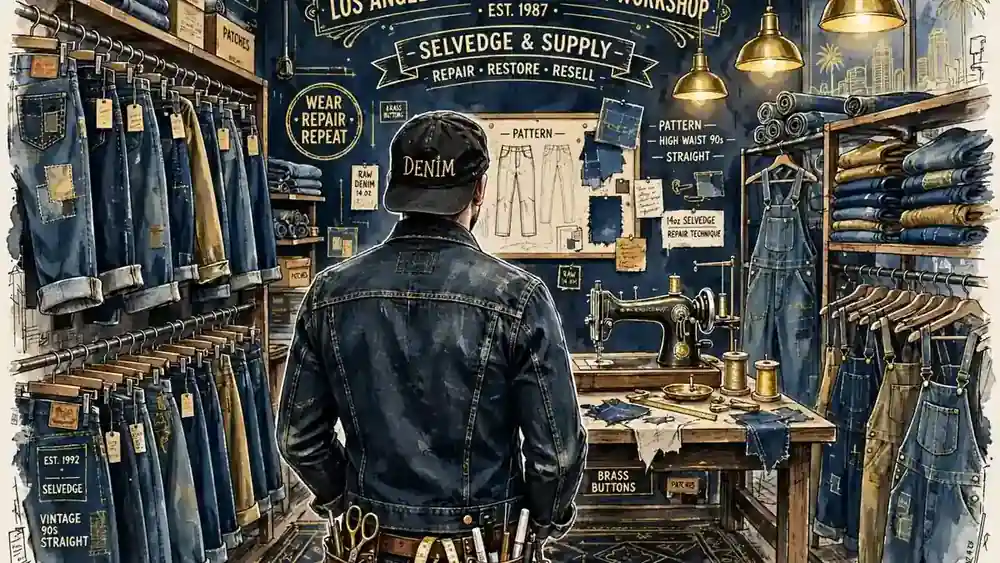
RE/DONE, founded July 2014. The brand is Mazur’s main business and the most documented part of his career. Launched in downtown Los Angeles by Sean Barron and Jamie Mazur, it began with a single idea: take old Levi’s 501 jeans, sourced from vintage suppliers across the country, and rebuild them into modern fits. California Apparel News, reporting in September 2015, noted the founders’ combined experience — Barron with Katayone Adeli and Joie, Mazur with Underground Denim — and that the factory and headquarters shared one Los Angeles building, keeping quality control close to production. The brand was born online at shopredone.com, a fact Mazur stressed in his 2019 interview: “Unlike most other luxury brands, we were born online. Social media has been huge for us, but it has been super organic.”
The Levi’s licence is the asset that separates RE/DONE from the many vintage-rework labels that followed it. Glossy reports it as the first licence Levi’s ever granted to another brand, and the jeans carry Levi’s rivets and co-branding. The relationship has held for more than a decade, and Mazur told Julia von Boehm in 2019 that “our relationship with Levi’s is great and mutually beneficial. We are the only brand that is officially partnered with them.” That exclusivity is a commercial moat: no rival can sell a Levi’s-licensed reworked jean, whatever it charges.
Growth after launch followed a clear sequence. A men’s collection arrived for autumn 2016, preserving the women’s fit logic in men’s cuts. The brand expanded from denim into full ready-to-wear collections through 2024 and 2025, according to DiffSense’s profile of the company, and added footwear collaborations to its plans. Stores followed the online success: Us Weekly’s 2024 profile of Mazur lists outposts in Los Angeles, East Hampton, New York, Paris and Seoul, alongside the original downtown Los Angeles location. The wholesale picture is selective rather than mass — Barneys New York was an early stockist, and Barron told Glossy in 2017 that about 70 percent of wholesale went to international retailers, with the brand’s own site and a small set of American retailers driving the domestic business.
Underground Denim, founded late 1990s. The campus sample-sale business remains Mazur’s second business and the one that taught him the trade. It bought excess inventory from premium labels and sold it directly to students, a model that needed no stores and no advertising. Its scale — hundreds of campus locations over its life, according to Celebrity Net Worth — made it a genuine national operation rather than a side project. Mazur’s own description of it as a “mobile sample sale” is the most accurate summary in print.
Other ventures. Beyond the two denim businesses, the record goes quiet. Celebrity Net Worth mentions diversification into fashion, technology and real estate without naming a single holding. No startup investment, no property purchase and no second brand carries Mazur’s name in any credible reporting we reviewed. Readers should treat any article that lists specific Mazur investments with named companies as unsourced unless it links to a filing or an interview. The honest statement is that his public business identity is denim, twice over, and everything else is private.
Brand Deals and Sponsorships
RE/DONE’s deal sheet reads like a list of heritage American brands, and it is one of the strongest parts of Mazur’s business story. The Levi’s licence, covered above, is the anchor: first licence Levi’s ever granted, co-branded product, a relationship still running more than a decade after launch. It is a licensing deal rather than a sponsorship, and it is worth more than any endorsement Mazur could have signed personally, because it sits inside the product itself.
Us Weekly’s 2024 profile of Mazur reports partnerships with Disney and Hanes alongside Levi’s, covering signature denim apparel. The Disney work put RE/DONE’s rework method onto licensed character product, and the Hanes link tied the brand to an American basics giant — both deals that signal a label trusted by large licensors with their marks. A further collaboration, reported by Julia von Boehm in 2019, paired RE/DONE with The Attico, the Milan label founded by Giorgia Tordini and Gilda Ambrosio. Mazur said he met the pair at a party in Paris, took them to Los Angeles rag houses, and the two sides decided to collaborate on reconstructing pieces found there. That is a founder-level deal, struck on relationships rather than through an agency.
There is no record of Mazur signing personal endorsement deals, fronting advertising campaigns or taking paid social-media sponsorships. His name does not appear on a brand ambassador roster anywhere we could find, and that fits the pattern of his career: the deals sit inside RE/DONE, not on Mazur himself. For a founder, that is the better place for them — a brand deal that ends when a contract ends is worth less than a licence that makes every product more valuable.
Fashion entrepreneurs who build the way Mazur did — a single trade, deep supplier relationships, a licensing moat — tend to be compared with model-founders who turned fame into labels. The comparison only goes so far: Kylie Jenner and Kendall Jenner built beauty and drinks brands on audiences of hundreds of millions, while Mazur built a denim label on 2,200 people on a waitlist and 150 pairs of jeans. The smaller start is the point. RE/DONE’s growth came from product and scarcity, not from a founder’s follower count, and that is why its economics have held up where influencer-led labels often fade.
Houses, Cars and Other Assets
This is the thinnest section of the article, and we say so rather than dressing it up. No property record, vehicle registration, watch listing or asset filing ties Jamie Mazur to a specific house, car or collection in any credible source we reviewed. Celebrity net worth profiles often fill this section with a named mansion and a garage list; for Mazur, that material does not exist in the public record, and inventing it would be fabrication.
What can be said with sourcing is limited to lifestyle facts. During his relationship with Alessandra Ambrosio, the couple split their time between Los Angeles and Brazil, according to Celebrity Net Worth — Los Angeles as the business base, Brazil as Ambrosio’s home country and the family’s second centre. Mazur’s business base has been Los Angeles throughout: Underground Denim bought from Los Angeles labels, RE/DONE’s factory and headquarters sit in a single Los Angeles building, and the brand’s first store was in downtown Los Angeles. A Los Angeles home base is a reasonable inference from a decade of Los Angeles operations, but it is an inference, not a documented address, and we label it as one.
The DiffSense claim of California real estate “likely worth $10M+” deserves a direct note because it is the kind of figure that gets copied from site to site until it looks sourced. It names no property, no county record and no transaction, and it appears only on that one low-quality page. We do not count it in the net-worth range, and readers should not either. If Mazur owns Los Angeles property — and a founder of his standing very likely owns his home — the value is not public, and the honest estimate treats it as unknown rather than as ten million dollars.
The same caution applies to cars, watches and art. Mazur keeps a low public profile, rarely appears in street-style coverage, and has never been photographed for a “what’s in my garage” feature. The assets that matter to his net worth are business assets: his RE/DONE equity, whatever remains of Underground Denim, and private investments. Those are the assets the range in this article is built on.
Awards and Achievements
Jamie Mazur has no major industry award on the public record — no CFDA nomination, no fashion prize, no entrepreneur-of-the-year trophy that any credible source reports. That absence is worth stating plainly, because it is part of what makes his story different from the celebrity founders who collect honours. His achievements are commercial and structural, not ceremonial, and they are stronger for being verifiable.
The first achievement is the Levi’s licence itself. Being the first brand Levi’s ever licensed its name to is a fact reported by Glossy and confirmed by the founders in interview, and it is a distinction no award committee confers — it is a commercial decision by the most protective brand in denim. The second is the launch: 150 pairs sold out in 22 minutes, a 2,200-person waitlist overnight, and a second run that sold out just as fast. The third is longevity. RE/DONE launched in July 2014 and was still trading, expanding into ready-to-wear and opening stores on three continents, more than a decade later — a survival record that most fashion labels, which fold within five years, do not match.
The fourth achievement is the one the fashion press keeps returning to: precedence. Glossy’s 2017 headline — “We did it first” — records Barron’s claim that RE/DONE pioneered the reworked-vintage-jean idea that Vetements later took to the runway. Being first matters in fashion because the first mover sets the price and the story; everyone after is a follower. Mazur’s fifth achievement is quieter: he built a second business without outside funding. Crunchbase records no funding rounds for RE/DONE, and the brand grew from a midnight website launch to an international store network on its own cash flow. For a founder, keeping the equity is the achievement that shows up in net worth.
Net Worth Growth Over the Years
The table below uses only figures that a named outlet actually published, with the source beside each one. The pattern it shows is not smooth growth but a disagreement between outlets — and that disagreement is the reason this article reports a range.
| Year | Reported estimate | Source | What drove it |
|---|---|---|---|
| 2017 | $20 million | Elite Daily | RE/DONE’s early growth; Mazur still engaged to Ambrosio |
| 2023 | $30 million | LuxLux | RE/DONE expansion into ready-to-wear and new stores |
| January 2025 | $10 million | Celebrity Net Worth | Conservative re-rating of the private label’s value |
| Early 2026 | $30 million | DiffSense; JustRichest (updated October 2026) | Continued RE/DONE trading; property and investment claims |
| November 2026 | $10 million – $30 million | NetWorthCraft estimate | Full published range, no single figure chosen |
Three things stand out. First, no outlet has ever published a figure above $30 million with sourcing — the $100 million figure on TheMost10’s page is an outlier with no workings, no source and a growth table that rises by exactly $10 million a year, and we reject it outright. Second, the spread between $10 million and $30 million has stayed stable for years, which suggests the disagreement is about how to value a private label, not about a sudden change in Mazur’s affairs. Third, the low end comes from the most established outlet in this niche: Celebrity Net Worth, updated in January 2025, is the only source that revisits its figures with dated updates. The high end comes from outlets that repeat a $30 million figure without showing how they reached it.
Our judgement is that the truth sits inside the range rather than at either end. A founder who owns a meaningful stake in a profitable, licensed, internationally stocked label, plus a decade of cash from a national campus business, is plausibly worth more than $10 million — and a founder whose label has never disclosed revenue, raised no outside money and never been valued in a transaction is hard to place at $30 million with confidence. Readers who want a single number can take the midpoint, around $20 million — the same figure Elite Daily reported in 2017 — but the range is the honest answer, and the range is what we publish.
For scale, the people around Mazur show how different kinds of fame convert into money. Alessandra Ambrosio, his former partner and the mother of his children, is reported at $30 million by Celebrity Net Worth — a modelling fortune built on two decades at the top of the industry. Danny Masterson, the former husband of Mazur’s current partner Bijou Phillips, is reported at $4 million by Celebrity Net Worth, with other outlets giving a combined $8 million figure for the former couple — a fortune cut down by legal fees and the end of his acting career. Mazur’s $10 million to $30 million sits between them: a business fortune, smaller than a supermodel’s peak earnings, larger than an actor’s after a career-ending conviction, and built without either kind of fame.
Social Media Presence
Jamie Mazur keeps a far lower social-media profile than the celebrities his name is usually printed next to, and the numbers show it. Famous Birthdays reports his Instagram account at more than 30,000 followers — a figure that dates from the site’s profile of him and has not been refreshed in any source we could find for 2026. By comparison, Ambrosio’s following runs into the tens of millions, and even a modest celebrity account clears a million without effort. Mazur’s 30,000 is the following of a businessman, not a public figure, and it has never been a source of income in any reporting.
That low profile is a choice, and it matches everything else about how he runs his businesses. RE/DONE itself was “born online,” as Mazur put it in 2019, and the brand’s social media grew organically rather than through paid promotion — but the brand’s accounts are the brand’s, not Mazur’s personal shop window. He gives interviews rarely, posts rarely, and lets Barron handle most of the public-facing work for the label. Celebrity Net Worth’s summary of his later career makes the same point from the other side: Mazur has kept a much lower profile than during his Underground Denim years, working behind the scenes in business development and investment.
Readers should be careful with accounts that claim to be Mazur. No verified follower count for 2026 is published by any credible outlet, and any page quoting a precise current figure without a source is guessing. The safe statement is the dated one: more than 30,000 Instagram followers as reported by Famous Birthdays, with a deliberately low public profile since.
Personal Life
Mazur’s personal life is better documented than his business, because for thirteen years it involved one of the most photographed women in the world. He met Alessandra Ambrosio in the summer of 2005 at a mutual friend’s wedding in Rio de Janeiro, according to Celebrity Net Worth, and the two began dating that year. Ambrosio was already a Victoria’s Secret Angel; Mazur was running his campus denim business. The relationship lasted thirteen years, produced two children, and never produced a wedding — a fact that became a running story in itself.
Their daughter, Anja Louise, was born in August 2008, and the couple became engaged a few months later, according to JustRichest’s timeline. Their son, Noah Phoenix, was born in May 2012. Through those years the family split its time between Los Angeles and Brazil, and Ambrosio spoke in interviews about time apart — driven by her travel schedule — helping to keep the relationship strong. Engagement rumours and wedding-date speculation followed the couple for a decade, and they answered it by ignoring it. Ambrosio said more than once that marriage was not her priority, a position JustRichest cites as a possible reason the wedding never happened — though neither party has ever given a reason, and this article does not guess at one.
On March 17, 2018, Ambrosio announced that she and Mazur had ended their ten-year engagement. W Magazine reported the split that day, citing Us Weekly, which said the couple had been separated for a while and had tried to keep the news quiet. The announcement ended a thirteen-year relationship and a ten-year engagement. Both parents have remained present in their children’s lives, and neither has spoken publicly about the reasons for the split.
In June 2024, Us Weekly confirmed Mazur was in a relationship with actress Bijou Phillips, reporting that the pair had been quietly seeing each other for a few months after meeting earlier that year. Phillips is the former wife of actor Danny Masterson, from whom she filed for divorce after his 2023 conviction. The Mazur–Phillips relationship was still being reported as current in coverage through 2026. Mazur has never married, and he has two children, Anja and Noah, with Ambrosio.
Sources & Reporting
Celebrity Net Worth — the $10 million estimate (updated January 4, 2025); Underground Denim’s campus model, 60-plus campuses in 40 states, 40–70 percent below retail; the 2005 meeting with Ambrosio in Rio, the 2008 and 2012 births, the March 2018 split; diversification into fashion, technology and real estate. Reporting window: profile first published December 2010, updated January 2025.
Glossy — the 2017 founder interview with Sean Barron: the July 2014 launch, 150 pairs sold out in 22 minutes, 2,200-person waitlist, 10,000 vintage pairs bought at a time, 10,000 pieces a month, jeans just under $300, the first-ever Levi’s licence, 70 percent of wholesale international, Barneys New York stocking, revenue undisclosed. Reporting window: March 2017.
JustRichest — the $30 million estimate; birth date April 11, 1981; the desk-job exit; the engagement and children timeline; the October 2026 update. Reporting window: first published April 2019, updated October 27, 2026.
W Magazine — the March 17, 2018 split announcement, citing Us Weekly. Reporting window: March 2018.
Us Weekly — the June 2024 confirmation of the Bijou Phillips relationship; RE/DONE’s Disney, Hanes and Levi’s partnerships and its stores in Los Angeles, East Hampton, New York, Paris and Seoul. Reporting window: June 2024.
Coveteur — Barron’s account of Underground Denim as a pre-digital campus business and the RE/DONE founding story. Reporting window: October 2016.
Julia von Boehm — the 2019 joint interview with Mazur and Barron: growing up in Los Angeles around denim, the Levi’s partnership, The Attico collaboration, the online-first launch. Reporting window: June 2019.
California Apparel News — the September 2015 RE/DONE profile: shared Los Angeles factory and headquarters, vintage Levi’s 501 sourcing, the autumn 2016 men’s collection. Reporting window: September 2015.
Elite Daily — the 2017 $20 million estimate and the account of the long engagement. Reporting window: November 2017.
Famous Birthdays — birth and California upbringing, Underground Denim and RE/DONE founding, Instagram following above 30,000.
Crunchbase — RE/DONE company profile: founded 2014 by Barron and Mazur, Los Angeles headquarters, 11–50 employees, no funding rounds recorded.
Reporting note: RE/DONE and Underground Denim are private companies. No revenue, profit, valuation or ownership split is published by either company, and no filing exists. Figures that depend on those numbers are labelled estimates throughout, and single-source claims from low-quality biography sites are flagged rather than repeated as fact. This article was researched and written in November 2026.
Frequently Asked Questions
What is Jamie Mazur’s net worth in 2026?
Jamie Mazur’s net worth is estimated at $10 million to $30 million as of November 2026. Celebrity Net Worth puts him at $10 million, while JustRichest, LuxLux and DiffSense put him at $30 million. The range reflects the honest disagreement between outlets, because RE/DONE is private and has never disclosed revenue or valuation.
How did Jamie Mazur make his money?
He made it in denim, twice. First with Underground Denim, founded in the late 1990s, which bought surplus premium jeans and sold them at pop-up sales on more than 60 college campuses in 40 states a year, at 40 to 70 percent below retail. Then with RE/DONE, co-founded with Sean Barron in 2014, which rebuilds vintage Levi’s jeans into luxury pairs selling for just under $300.
What is RE/DONE?
RE/DONE is a Los Angeles luxury denim label launched in July 2014 by Sean Barron and Jamie Mazur. It takes vintage Levi’s 501 jeans, cuts them apart and rebuilds them into modern fits, so every pair is one of a kind. It is the first brand Levi’s has ever licensed its name to, and it has since expanded into full ready-to-wear collections and stores in Los Angeles, New York, Paris and Seoul.
Who founded RE/DONE?
RE/DONE was founded by Sean Barron and Jamie Mazur in Los Angeles in July 2014. Barron had previously founded the labels Joie and Katayone Adeli; Mazur had run Underground Denim. The brand launched online at shopredone.com and sold out its first 150 pairs in 22 minutes.
Is Jamie Mazur still with Alessandra Ambrosio?
No. Mazur and Ambrosio dated from 2005, became engaged in 2008 and announced their split on March 17, 2018, ending a thirteen-year relationship and a ten-year engagement. They never married. They share two children, daughter Anja Louise, born in August 2008, and son Noah Phoenix, born in May 2012.
How old is Jamie Mazur?
Jamie Mazur was born on April 11, 1981, in California, which makes him 45 years old as of November 2026. He grew up in Los Angeles, where many of his friends’ fathers worked in the denim trade.
Who is Jamie Mazur dating now?
Us Weekly confirmed in June 2024 that Mazur was in a relationship with actress Bijou Phillips, the former wife of actor Danny Masterson. The pair had been quietly seeing each other for a few months before the news broke, and the relationship was still being reported as current through 2026.
What is Underground Denim?
Underground Denim is the campus denim business Mazur founded in the late 1990s. It bought excess inventory from premium labels such as True Religion, AG, Blue Cult and Rock & Republic and sold it at travelling pop-up sales on university campuses across the United States. Mazur has described it as “basically a mobile sample sale of vintage denim.” It was the business that funded his later move into RE/DONE.
Final Thoughts
Jamie Mazur’s fortune is a useful corrective to the usual celebrity net worth story. There is no television contract behind it, no record deal, no viral moment and no inherited wealth on the record. There is a Los Angeles kid who knew the denim trade, a van full of discounted jeans, sixty campuses a year, and then a second business that took the oldest idea in fashion — an old pair of Levi’s — and rebuilt it into something people would pay just under $300 for. The $10 million to $30 million range in this article is wide because the evidence is thin at the top: RE/DONE is private, its revenue is undisclosed, and no outlet shows its workings. The bottom of the range is the cautious, sourced figure; the top is what the brand’s longevity, its Levi’s licence and its international stores suggest it could be worth. Either way, the shape of the fortune is clear, and it was built the slow way — one campus, one vintage pair, one customer at a time.
Published on November 17, 2026. Last reviewed November 2026. Found an error? See our corrections policy.