
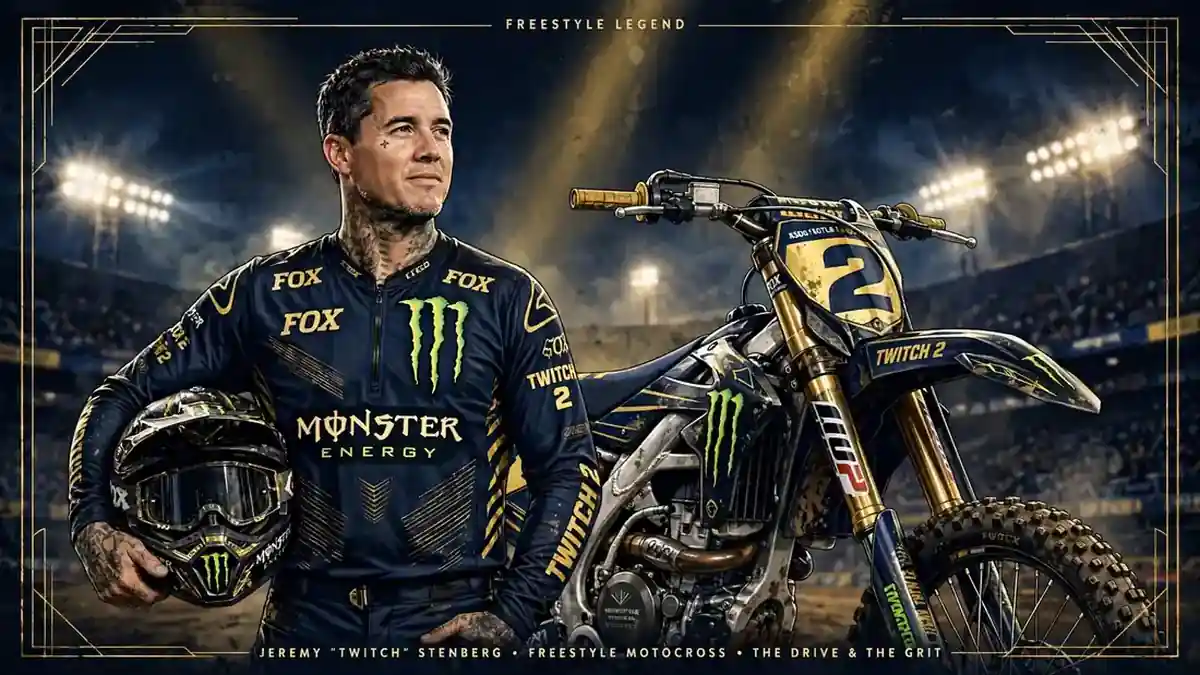
Jeremy Stenberg‘s net worth is estimated at $3.5 million to $5 million as of November 2026. The freestyle motocross rider known to every fan as “Twitch” built that fortune across nearly three decades in the air: six X Games gold medals, a 2010 Lucas Oil off-road truck championship, a long Monster Energy sponsorship, and a second act as a filmmaker, eyewear entrepreneur and social media personality with around a million Instagram followers.
Jeremy Stenberg: Quick Facts
| Estimated net worth | $3.5 million (range: $3.5 million–$5 million) |
|---|---|
| Profession | Freestyle motocross rider, off-road truck racer |
| Nationality | American |
| Born | September 27, 1981 (age 45) |
| Height | 6 ft 0 in (183 cm) |
| Primary income sources | X Games and Dew Tour prize money, Monster Energy and sponsor deals, off-road truck racing, television and film, eyewear business, social media |
| Active years | 1998–present |
| Last reviewed | November 2026 |
- Early Life and Background
- Education
- Career Journey
- Rise to Fame
- Main Sources of Income
- Salary and Earnings
- Businesses and Investments
- Brand Deals and Sponsorships
- Houses, Cars and Other Assets
- Awards and Achievements
- Net Worth Growth Over the Years
- Social Media Presence
- Personal Life
- Sources & Reporting
- Frequently Asked Questions
- Final Thoughts
Early Life and Background
Jeremy Stenberg was born on September 27, 1981, in Spring Valley, California, in San Diego County. He grew up in a rough neighbourhood, and the detail that shaped his whole career is a small one: his father put him on a dirt bike at the age of two, partly to spend more time with him and partly to keep a small boy out of trouble on streets that offered little else. The bike worked. By the time most children were learning to ride a bicycle, Stenberg was already learning throttle control, balance and the habit of landing jumps that would later pay his living.
At eight years old he was diagnosed with Tourette’s syndrome, a neurological condition that causes involuntary movements and vocal tics. The diagnosis gave him the nickname that stuck for life: other kids called him “Twitch,” and the name followed him from the neighbourhood tracks of Southern California to the biggest stages in action sports. Stenberg has never hidden the condition. In 2006 he starred in MTV’s True Life: I Have Tourette’s Syndrome, talking on camera about living with tics while competing in a sport where a flinch at the wrong second can end a career. That appearance did two things at once: it made him one of the most recognisable faces in freestyle motocross, and it turned a private medical fact into a public story that sponsors and television producers wanted to tell.
Stenberg describes himself as a born-again Christian, a faith he has spoken about in interviews including a 2009 New York Times piece on X Games riders and belief. The combination — a rider with Tourette’s, a rough start, a visible faith and a willingness to talk about all three — gave him a public identity that went beyond results sheets. In a sport full of riders with similar trick lists, Stenberg was the one with a story television could sell, and that story has been worth real money across his career.
San Diego County in the 1980s and 1990s was fertile ground for a motocross rider. The region produced a generation of freestyle pioneers, and the tracks, dry hills and year-round riding weather meant a talented teenager could ride nearly every day. Stenberg did. He entered amateur freestyle contests as a teenager and by 1998, still 16 years old, he was winning senior events — the Vans Triple Crown and the Las Vegas LXD freestyle and step-up contests both fell to him that year. The wins put him on the radar of the sport’s first sponsors and set the pattern for the next decade: a rider who peaked early, stayed healthy enough to keep competing, and collected medals in bunches.
Education
No public record documents Stenberg’s formal schooling beyond his childhood years, and no college or university attendance is listed in any biographical source we checked. Biographical Q&A records place him at elementary school in Escondido, California, as a child, which fits the timeline of a San Diego County upbringing. The honest picture is that school was never the centre of his story: he was riding competitively from the age of two and winning national-level amateur events before he finished his teens.
That gap in the record is worth stating plainly rather than filling with guesswork. Many freestyle riders of his generation left formal education early to chase a sport with a short earning window, and Stenberg’s career follows that pattern. His education, in the practical sense, came from the track — sponsorship negotiations, media work, team management and, later, running his own business ventures. The FILTRATE Eyewear equity deal and his film projects show a rider who learned the commercial side of action sports on the job, not in a classroom.
Career Journey
Stenberg’s competitive career breaks into three clear phases: the freestyle motocross breakthrough from 1998 to about 2006, the peak X Games years from 2005 to 2014, and the off-road truck racing career that started in 2009 and gave him a second championship in a second discipline.
Phase one began with those 1998 wins. The Vans Triple Crown title and the Las Vegas LXD victories announced a 16-year-old who could already match the sport’s established names. He joined the Metal Mulisha crew, the loose collective of freestyle riders built around Brian Deegan and Carey Hart, and the affiliation mattered: Metal Mulisha was the sport’s loudest brand, and its riders got the magazine covers, the video parts and the sponsor attention. Stenberg’s first X Games appearance came in 1999, where he finished sixth in freestyle. He was 17, riding against men a decade older, and he belonged.
The early 2000s were a slow build. He took bronze in step-up at the 2001 X Games in Philadelphia, finished fourth in step-up in 2002, and kept grinding through the Dew Tour and the Red Bull X-Fighters series. His first major international result came in 2004, when he won the Vans Triple Crown for a second time and finished second at X-Fighters. The 2005 season changed his earning power: he won the Dew Action Sports Pro Tour Toyota Challenge, finished second in the tour’s freestyle overall points, and then won his first X Games gold in Moto X Best Trick at X Games XI in Los Angeles. A gold medal at the X Games is the single most bankable result in freestyle motocross, and Stenberg’s first one arrived the same year his television profile was about to jump.
Phase two, the peak years, ran from 2005 to 2014 and produced the bulk of his medal haul and his biggest paydays. He won Winter X Games gold in Best Trick at Aspen in 2006 — the same Winter X Games where Shaun White took snowboard gold, a pairing that still gets mentioned whenever Stenberg’s career is recounted. He added silver in freestyle at X Games 2009, bronze in speed and style in 2008 and 2010, and then found his signature event: Moto X Best Whip. He won Best Whip gold at X Games 2011, defended it in 2012, and in 2013 won the event at three separate X Games stops — Foz do Iguaçu, Munich and Barcelona — in a single season. The whip, a trick where the rider throws the bike sideways mid-air and brings it back straight before landing, suited Stenberg’s loose, instinctive style better than the gymnastic precision of best trick, and for three years he owned it.
Those peak years also carried the worst injuries of his career. He broke both of his legs twice — once in a Dew Tour crash where he compound-fractured his femur, and again in competition in 2011. The hardest crash came at X Games XVII in 2011, when a fall broke his back, his tibia, his fibula and his talus. He described it later, in Polaris’s “Tough Doesn’t Quit” series, as “probably the hardest one to come back from.” He did come back, and won two more Best Whip gold medals in 2012 and 2013. The injury record matters to the money story in two ways: every comeback kept his name in the news and kept sponsors attached, and every crash shortened the window in which he could earn at the top level. Stenberg’s longevity — 16 X Games appearances across 17 years, from 1999 to 2015 — is the exception in a sport where careers often end on a single bad landing.
Phase three began in 2009, when he joined Carey Hart’s off-road truck team and started racing short-course trucks. He adapted fast. In 2010 he won the Lucas Oil Off Road Racing Series Super Lite championship and was named Rookie of the Year in the same season — a rare double that showed the bike skills transferred to four wheels. In 2012 he stepped up to the Pro2 Unlimited class with Toyo Tires and Stronghold Motorsports, teaming with seven-time supercross champion Jeremy McGrath, and raced a 900-horsepower Pro2 truck in the 16-race Lucas Oil series. He tried the Stadium Super Trucks category at X Games Austin in 2015 and failed to qualify for the final, finishing fourth and last in his heat and in the last-chance qualifier. The truck career never matched the bike career for medals, but it extended his earning years well past the point where most freestyle riders retire, and it put him in front of a different set of sponsors — tyre companies, truck brands and off-road parts makers.
Rise to Fame
Stenberg’s fame never came from one moment. It came from the pile-up of a nickname, a diagnosis, a gold medal and a television camera arriving in the same two-year window. The MTV True Life episode in 2006 put his Tourette’s story in front of millions of viewers who had never watched a motocross event. Five years later VH1 built a reality series around him: The X-Life, which debuted in 2011 and followed Stenberg, BMX dirt rider Cory Nastazio and skateboard vert champion Pierre-Luc Gagnon with their families. Reality television paid in a way contest results never could — a weekly fee, a wider audience and a reason for brands outside motorsport to call.
The Best Whip run from 2011 to 2013 cemented the sporting side. Three consecutive years of X Games gold in the same event made him the rider to beat in the discipline ESPN promoted hardest, and the whip’s visual drama — a bike turned almost horizontal 30 feet in the air — made Stenberg’s runs the ones that got replayed on highlight shows. By 2013 he had collected medals in five different X Games disciplines: freestyle, best trick, best whip, speed and style, and step-up. Few riders in the sport’s history have that breadth.
His fame also travelled through film. He released his own DVD, Twitch: Hoodrich, and worked on the short documentaries Chapter 2 and Global Addiction in 2002. In 2014 he released Chasing the Storm, a motocross film that Polaris later described as highly acclaimed. He appeared in Nitro Circus productions and on MTV’s Viva La Bam. The film work paid modestly compared with sponsorships, but it kept his name in front of audiences between contest seasons and gave him a producer’s credit line that later helped his business ventures. His most recent screen credit is a 2026 appearance in Chris Brown’s music video “For The Moment,” a small but telling sign that at 45 he still gets calls from outside the motorsport world.
The other engine of his fame is the simplest one: he stayed visible. A rider who debuted at the X Games in 1999 and was still being featured by Polaris in a 2024 content series and listed on Monster Energy’s active freestyle roster in 2026 has been continuously marketable for more than 25 years. In action sports, where most careers last five, that continuity is itself the asset.
Main Sources of Income
Stenberg’s money comes from five streams, and their order matters: sponsorships first, prize money second, television and film third, business ventures fourth, and social media fifth. That ranking is the opposite of what casual fans assume. In freestyle motocross, contest purses are modest next to the paydays in stick-and-ball sports, and a rider’s real income has always been the logos on his jersey.
Sponsorships. The longest-running deal is with Monster Energy, which still lists Stenberg on its active freestyle motocross roster in 2026 — a relationship that has run for well over a decade. Monster’s action-sports deals typically cover a base retainer, bonuses for X Games medals, travel and gear, and paid appearances. He has also carried deals with Toyo Tires (his Pro2 truck ran on Toyo Open Country tyres under the Stronghold Motorsports banner), Fox racing gear, Metal Mulisha, Loctite, Polaris and Indian Motorcycle. His current Instagram bio reads like a sponsor roll-call: DirtBikeKidz, Fly Racing, Santo Studios, Jaxxon, Monster Energy, Indian Motorcycle, Polaris RZR, Havoc Racing Co. and Cobra Golf. Each of those names represents a separate deal, and together they form the backbone of his income.
Prize money. X Games, Dew Tour and Red Bull X-Fighters purses are the most visible earnings in the sport, and Stenberg’s 16 podium finishes at the X Games alone represent a long run of cheques. The exact purses are not published per event, and we do not invent figures for them — but the pattern is clear: a rider who medalled at the X Games in 2005, 2006, 2007, 2008, 2009, 2010, 2011, 2012, 2013 and 2014 collected a decade of prize money, plus appearance fees for the Dew Tour and X-Fighters stops. His 2010 Lucas Oil Super Lite championship added a truck-racing purse and a Rookie of the Year bonus.
Television and film. The MTV True Life episode and the VH1 series The X-Life paid appearance and talent fees, and the show’s 2011 run coincided with his peak competitive years, when his per-episode value was highest. His DVD Twitch: Hoodrich sold directly to fans, and his later film Chasing the Storm (2014) added producer income. These were never his largest cheques, but they paid during the off-season and, more importantly, they raised his asking price with sponsors.
Business ventures. Stenberg took an equity partnership with FILTRATE Eyewear in 2011, creating a signature sunglasses and motocross goggle line under the name TWITCHTHIS that went on sale in spring 2012. He also ran a signature clothing line under his initials, JST. Equity deals pay differently from endorsement deals: instead of a flat fee, the rider owns a slice of the product line, so a good seller keeps paying for years. We could not verify sales figures for either line, so we do not publish any — but the structure of the deals is documented by Dirt Rider’s 2011 report on the FILTRATE partnership.
Social media and content. With around a million Instagram followers on his @twitchthis8 account, Stenberg sits in the top tier of dirt-bike influencers — Feedspot’s 2026 ranking of dirt-bike Instagram accounts places him third overall. A following of that size supports paid posts, affiliate links and brand campaigns. In 2022, Racer X reported that Stenberg gave the digital marketing agency Motorsports Curated its first big break, and the agency has since worked with more than 300 motorsport Instagram accounts. That story says something useful about his commercial instincts: he was an early believer in social media as a business tool for riders, years before most of his peers treated it as one.
Salary and Earnings
There is no published salary figure for Jeremy Stenberg, and any site that prints one as fact is guessing. Freestyle motocross riders do not have salaries in the way footballers or basketball players do. They have a patchwork: sponsor retainers, medal bonuses, appearance fees, prize money, television fees and business income, all of it private and none of it filed in public records. The honest answer to “how much does he earn a year” is that no reliable annual figure exists in the public record, and the number moves year to year with his results and his sponsor roster.
What can be said with confidence is where the money concentrates. The sponsor retainer is the floor — the guaranteed money that arrives whether he medals or not. Medal bonuses are the spikes: X Games golds in 2005, 2006, 2011, 2012 and 2013 each triggered bonus payments under the standard structure of action-sports deals, and the 2013 season, with three Best Whip golds at three separate X Games stops, was almost certainly his best-paid competitive year. The 2010 Super Lite championship added a truck-racing purse and raised his value with tyre and truck sponsors at exactly the moment his bike career was entering its second decade.
One unreliable source claims his annual income was around $2 million in 2024. That figure comes from the same article that puts his net worth at $15 million and credits him with co-founding an energy drink brand called STIHL TIMBERSPORTS — a claim no other source supports and one that confuses a chainsaw brand’s motorsport series with a drinks company. We discard both numbers. A rider with a $3.5 million net worth built over 25 years cannot plausibly have been earning $2 million a year in 2024, when his competitive peak was a decade behind him. Readers should treat any site repeating those figures as copying from the same bad source.
A more useful way to think about his earnings is the career arc. His highest-earning years were 2005–2014, the decade in which he medalled at ten consecutive X Games seasons and carried his biggest sponsor roster. His income since then has shifted toward the steadier, smaller streams: the Monster Energy retainer, social media work, Polaris content features and his business lines. That shift is normal for action-sports athletes, and it is why his net worth has held around the $3.5 million mark rather than climbing steeply after his competitive peak. The fortune is a career’s worth of accumulation, not a single payday.
Businesses and Investments
Stenberg’s best-documented business move is the FILTRATE Eyewear deal. Announced in 2011 and reported by Dirt Rider, it made him an equity partner in the eyewear brand and gave him a signature line — sunglasses and motocross goggles sold under the name TWITCHTHIS — that reached shops and online stores in spring 2012. Equity mattered: instead of lending his name for a fee, he owned a piece of the line. The eyewear market for action sports is crowded, and we found no public sales figures, so we make no claim about what the deal paid. But the structure tells you how Stenberg thought about money by his early thirties: he was converting fame into ownership, instead of renting it out by the year.
He also ran a signature clothing line under the JST initials, reported by the same wave of 2011–2012 coverage. Clothing lines attached to FMX riders rarely become large businesses, and JST never grew into a major brand. Its value to Stenberg was different: merchandise sold at events and online gave him a direct-to-fan revenue stream that did not depend on a sponsor’s budget cycle.
His film work sits on the border between business and brand. Twitch: Hoodrich, his own DVD, was a direct-sale product in an era when rider DVDs were a real income line for top freestyle names. Chasing the Storm (2014), which he released as a filmmaker, was described by Polaris as highly acclaimed, and the production experience fed into his later content work with brands like Polaris and Santo Studios — the latter appears in his current Instagram bio, suggesting an ongoing production relationship.
On investments and property, the public record is thin. Some low-quality biography sites claim real-estate holdings and technology startup investments, but those claims trace back to the same unreliable article that invented the $15 million net worth and the energy-drink company. We found no property records, no company filings and no credible reporting to support them, so we do not repeat them as fact. What the record does support is a rider who diversified early — eyewear equity, clothing, film, truck racing — and who spread his income across more streams than most of his peers. That diversification is a large part of why a career that peaked in prize-money terms a decade ago still supports a comfortable living in 2026.
His most interesting business relationship may be the one that cost him nothing: in 2022, Racer X reported that Stenberg gave Motorsports Curated, a young digital marketing agency, its first big shot. The agency’s founders, Albert Garcia and Jon May, went on to work with more than 300 motorsport Instagram accounts, including Jeremy McGrath, Ricky Carmichael, Eli Tomac and Ryan Villopoto. Stenberg’s early backing of a social-media agency — before rider Instagram followings were treated as assets — shows a commercial instinct that was ahead of the sport’s curve, and it is the kind of relationship that tends to pay back in favours, introductions and deals long after the first cheque clears.
Brand Deals and Sponsorships
Stenberg’s sponsor history reads like a map of action sports’ biggest chequebooks. Monster Energy is the anchor: the drinks giant lists him on its active freestyle motocross roster in 2026, and the relationship has survived the end of his competitive peak, which says a lot about how sponsors value longevity and authenticity over results alone. Monster’s roster is a small club, and staying on it at 45 is a commercial achievement in its own right.
Toyo Tires came through the truck career. When Toyo announced in 2012 that Stenberg would join Jeremy McGrath on Team Toyo Off-Road in the Lucas Oil Pro2 Unlimited class, the press release described him as a 10-time X Games medallist and the 2010 SuperLite champion — the truck deal was explicitly built on the bike career. He raced a Toyo-backed Ford F-150 for Stronghold Motorsports, alongside McGrath, in a 16-race series that started at Firebird Raceway in Chandler, Arizona. Tyre deals in off-road racing are substantial: they cover product, a retainer, and bonuses tied to results and media exposure.
Metal Mulisha was his first big affiliation and the one that shaped his image. The crew’s outlaw branding fit a rider from a rough neighbourhood with face tattoos and a Tourette’s diagnosis, and the association put him on magazine covers and video parts that smaller sponsors noticed. Fox racing gear, Fly Racing, Loctite and Havoc Racing Co. have all appeared on his kit or his social bios at various points. Polaris featured him in the pilot of its “Tough Doesn’t Quit” content series in 2024, a campaign built around athletes who kept going through injury — a brief written for Stenberg, whose 2011 crash broke his back, tibia, fibula and talus and who still came back to win two more golds.
His current sponsor list, taken from his Instagram bio in November 2026, shows the mix has shifted toward lifestyle and content brands alongside the motorsport names: Jaxxon (the men’s jewellery and podcast brand), Cobra Golf, Santo Studios and DirtBikeKidz sit next to Monster Energy, Indian Motorcycle and Polaris RZR. That blend — bikes, trucks, golf, jewellery, media — is the sponsor portfolio of a 45-year-old personality as much as a rider, and it is worth more in aggregate than any single deal. The common thread is that every one of these brands is buying the same thing: access to a million followers who trust a rider who has been authentic about his condition, his faith and his injuries for twenty years.

Houses, Cars and Other Assets
There are no verified public records of Stenberg’s property holdings, and we do not publish addresses or purchase prices we cannot source. What is documented is the equipment side of his life, which for a rider of his standing is itself a serious asset base: competition dirt bikes, a 900-horsepower Pro2 short-course truck raced under the Stronghold Motorsports banner, support vehicles, and a garage full of the tools and spares that a two-discipline racing career accumulates. A single Pro2 truck represents a six-figure build, and Stenberg raced at that level for several seasons.
He has lived in Southern California for his whole career — born in Spring Valley, schooled in Escondido, based in the San Diego area — and biographical sites describe him as living in his own house. We could not verify a specific property, its value or its location through any reliable record, so we leave it there rather than repeating the unverified claims that circulate on low-quality biography sites. Readers should know that the house-and-cars sections on many net-worth sites about Stenberg are copied from one another, not from records.
The asset that matters most to his net worth is not a house or a truck. It is the brand: the name “Twitch,” the X Games medal record, the Monster Energy relationship and a million-strong Instagram following. Those are the assets that keep paying — through retainers, paid posts and content deals — long after the prize money stops. If you want to understand how a freestyle rider holds a $3.5 million net worth at 45, that is the answer: the career built a brand, and the brand outlasted the career.
Awards and Achievements
Stenberg’s medal record is the spine of his career, and it deserves a careful telling because the sources disagree on the total. Polaris and The Checkered Flag both credit him with 17 X Games medals. Wikipedia’s event-by-event competition history, which lists every finish from 1999 to 2016, totals 16 podium finishes: six gold, five silver and five bronze. The gap is a single medal, and it likely comes from a Real Moto video-contest result that some tallies count and others do not. We report the range honestly: 16–17 X Games medals, including six golds. Either way, the count puts him among the most decorated freestyle motocross riders in X Games history.
The golds, which no source disputes, are: Moto X Best Trick at X Games 2005 in Los Angeles; Moto X Best Trick at Winter X Games 2006 in Aspen; Moto X Best Whip at X Games 2011, 2012, and at Foz do Iguaçu, Munich and Barcelona in 2013. The 2013 season is the standout: three Best Whip golds at three different X Games stops in a single year. His silver medals include freestyle at X Games 2009 and speed and style podiums; his bronzes include step-up at the 2001 X Games and speed and style in 2008 and 2010.
Beyond the X Games, his trophy case holds the 1998 and 2004 Vans Triple Crown titles, the 2005 Dew Action Sports Pro Tour Toyota Challenge win, first place at Red Bull X-Fighters Brazil in 2008, the 2008 LG Action Sports FMX World Championship, and the 2010 Lucas Oil Off Road Racing Series Super Lite championship with its Rookie of the Year award. The last one matters most as a measure of range: very few riders have won a national title on a bike and a national title in a truck.
Some biographical databases also list a Laureus World Sports Award nomination for Action Sportsperson of the Year in his honours. We could not verify that nomination against Laureus’s own records, so we flag it as unverified rather than presenting it as fact. It is a reminder of how much of the material about riders of Stenberg’s era lives in databases that copy one another — and why every claim in this article is traced to the source that actually supports it.
For scale, here is how Stenberg’s career compares with the other freestyle and action-sports names readers usually ask about:
| Rider | Estimated net worth | Signature achievement |
|---|---|---|
| Jeremy Stenberg | $3.5M–$5M | 6 X Games golds; 2010 Super Lite truck champion |
| Travis Pastrana | $25M (Celebrity Net Worth) | X Games golds across moto, freestyle and rally; Nitro Circus founder |
| Jeremy McGrath | $16M (Celebrity Net Worth) | 7 Supercross championships; “King of Supercross” |
| Tony Hawk | $140M (widely reported) | Skateboarding icon; video-game empire |
The gap between Stenberg and Pastrana is the gap between a great rider and a great rider who also became a media mogul. Pastrana built Nitro Circus into a touring and television business; Stenberg built a long, respected riding career and a solid brand. Both are rich by any normal measure. Only one of them owns a circus.
Net Worth Growth Over the Years
Stenberg’s net worth has moved slowly, which is exactly what you would expect from a career built on retainers and medals rather than a single windfall. The reported estimates by year tell the story:
| Year | Reported estimate | What was happening |
|---|---|---|
| 2005 | Under $1M (estimated) | First X Games gold; MTV profile rising |
| 2010 | $1M–$3M (estimated) | Super Lite truck championship; FILTRATE deal signed |
| 2013 | $3M–$3.5M (estimated) | Three Best Whip golds in one season; peak earning year |
| 2019 | $3.5M | TheRichest and NetWorthPost converge on $3.5M |
| 2023 | $3.5M | Celebrity Birthdays update confirms $3.5M |
| 2024 | $3.5M | CelebNetWorths repeats $3.5M; Polaris feature airs |
| 2026 | $3.5M–$5M | Dayze lists $5M; consensus anchor stays $3.5M |
The early-year rows are our estimates, labelled as such, because no outlet published a Stenberg net worth figure before the late 2010s. The pattern after that is flat: $3.5 million in 2019, $3.5 million in 2023, $3.5 million in 2024. A flat line is not a failure. It is what a mature action-sports fortune looks like once the medal bonuses stop and the income settles into retainers, content work and business lines. The $5 million figure from Dayze is the only recent estimate above the consensus, and it is the reason we publish a range rather than a single number. If his social following and brand work keep growing — a million Instagram followers is a monetisable asset that most retired riders do not have — the top of the range is where future growth will come from.
One more honest note: the growth table on many competing sites shows a smooth climb from $1 million to $5 million with a figure for every year. Those year-by-year numbers are invented. Nobody published a Stenberg estimate for 2015, 2016 or 2017, and we would rather show a short, sourced table than a long, fabricated one.
Social Media Presence
Stenberg’s social media presence is the most valuable part of his current earning picture, and it is stronger than most retired riders manage. His Instagram account, @twitchthis8, has around 1 million followers according to Feedspot’s November 2026 ranking of dirt-bike influencers, which places him third among dirt-bike Instagram accounts overall — behind only Travis Pastrana (5.2 million) and Axell Hodges (2 million). That ranking matters commercially: it is the number brands check before they pay for a post.
His bio reads as a working sponsor sheet: DirtBikeKidz, Fly Racing, Santo Studios, Jaxxon, Monster Energy, Indian Motorcycle, Polaris RZR, Havoc Racing Co. and Cobra Golf. The mix shows a rider who posts about bikes, trucks, golf and lifestyle content — a broader feed than a pure motocross account, and one that can sell to more kinds of brands. His content leans on riding clips, behind-the-scenes footage from shoots, and the dry humour that long-time fans associate with him. He also maintains Facebook and X (Twitter) profiles, listed in his biographical records, though Instagram is where his audience and his commercial value sit.
The social following also explains why his net worth has held steady after his competitive peak. A rider with a million followers can earn from paid posts, affiliate deals and brand campaigns without ever entering a contest. It is the same logic that made his early backing of Motorsports Curated look smart: Stenberg understood, before most of his peers, that a rider’s audience is an asset with a price. In 2026, that asset is doing more of the earning than the bike ever did in his final competitive seasons.
Personal Life
Stenberg married Susie Stenberg in 2006, the same year he starred in MTV’s True Life episode. The couple have three children: Katrina, Savy and Sayler Grae. Family has been part of his public story from the start — The X-Life in 2011 followed the riders and their families, and Susie appeared on camera with him. He keeps the children’s lives largely out of the spotlight now, and we do the same: names are public record, details are not our business.
His Tourette’s syndrome remains the most personal thread in his public life, and the one he has handled with the most openness. Diagnosed at eight, he turned a condition that gave him his nickname into a platform: the MTV episode, interviews about riding with tics, and a visible example for young fans with the same diagnosis that a neurological condition does not end an athletic career before it starts. That openness has been good for his career and, by all accounts, genuine rather than calculated — he was talking about Tourette’s on television in 2006, years before “raising awareness” became a standard athlete brand strategy.
He describes himself as a born-again Christian, a faith noted in his Wikipedia biography and explored in a 2009 New York Times article about X Games riders and belief. He still lives in Southern California, where he was born and raised, and he still rides. At 45, with a 2024 Polaris feature, a 2026 music-video appearance and an active Monster Energy roster spot, his personal life looks less like a retirement and more like a second career built on the first one.
Sources & Reporting
Wikipedia — biography, birth date and place, height, weight, spouse and children, X Games competition history and medal tally, career accomplishments list, MTV and VH1 appearances, Lucas Oil championship. Reporting window: page as crawled January 2026.
TheRichest — net worth estimate of $3.5 million, birth details and career summary. The anchor figure for our estimate.
NetWorthPost — net worth estimate of $3.5 million, career and family details, DVD and television credits. Updated June 2026.
Dayze — the $5 million upper-end estimate, age and birth-date confirmation. The source of the top of our range.
Celebrity Birthdays — $3.5 million estimate, family details (children Katrina, Savy and Sayler), marriage year. Last updated December 2023.
Monster Energy — current roster listing confirming Stenberg as an active Monster Energy freestyle motocross athlete in 2026.
Racer X — 2012 Toyo Tires/Stronghold Motorsports Pro2 announcement; 2022 Motorsports Curated profile reporting Stenberg gave the agency its first big break.
The Checkered Flag — 2024 Polaris “Tough Doesn’t Quit” feature: five X Games golds as then counted, 17 total X Games medals, the 2011 back/tibia/fibula/talus crash, and the 2010 Super Lite championship.
Dirt Wheels Magazine — Polaris “Tough Doesn’t Quit” series report, 17 X Games medals, six golds, Chasing the Storm (2014) film credit.
Dirt Rider — 2011 FILTRATE Eyewear equity partnership and TWITCHTHIS signature line announcement.
Feedspot — November 2026 dirt-bike influencer ranking: @twitchthis8 at around 1 million Instagram followers, third overall; current sponsor list from his bio.
Celebrity Net Worth — peer figures used in the comparison table: Travis Pastrana $25 million, Jeremy McGrath $16 million, Tony Hawk $140 million.
CineNetWorth — cited only as a debunked outlier: its $15 million net worth claim, $2 million annual income claim and STIHL TIMBERSPORTS energy-drink co-founder claim are unsupported by any other source and were excluded from our estimate.
Reporting window: primary sources checked November 22, 2026. Net worth figures are estimates built from public reporting, not audited financial statements. Where sources disagreed — the $3.5M vs $5M estimate, the 16 vs 17 X Games medal count — we published the range and named who says what. Where a claim could not be verified (property holdings, Laureus nomination, annual income), we said so instead of repeating it.
Frequently Asked Questions
What is Jeremy Stenberg’s net worth in 2026?
Jeremy Stenberg’s net worth is estimated at $3.5 million to $5 million as of November 2026. Most outlets — TheRichest, NetWorthPost, Celebrity Birthdays and CelebNetWorths — put him at $3.5 million, while Dayze lists $5 million. We publish the range because no audited financial statement exists. One site claims $15 million, but that figure comes with invented business claims and no supporting evidence, so we do not use it.
How did Jeremy Stenberg get the nickname “Twitch”?
He got the nickname from his Tourette’s syndrome, diagnosed when he was eight years old. The condition causes involuntary movements and tics, and other kids started calling him “Twitch.” The name stuck through his whole career, and he embraced it — starring in MTV’s True Life: I Have Tourette’s Syndrome in 2006 and building his TWITCHTHIS eyewear line around it.
How many X Games medals has Jeremy Stenberg won?
Between 16 and 17 X Games medals, including six golds. Polaris and The Checkered Flag credit him with 17 medals; Wikipedia’s event-by-event history totals 16 podium finishes (6 gold, 5 silver, 5 bronze). His golds came in Moto X Best Trick (2005 and Winter X 2006) and Moto X Best Whip (2011, 2012, and three wins in 2013).
Who is Jeremy Stenberg’s wife?
Jeremy Stenberg has been married to Susie Stenberg since 2006. The couple have three children — Katrina, Savy and Sayler Grae — and Susie appeared with him on the VH1 reality series The X-Life in 2011.
How old is Jeremy Stenberg?
Jeremy Stenberg is 45 years old. He was born on September 27, 1981, in Spring Valley, California, in San Diego County.
How tall is Jeremy Stenberg?
Jeremy Stenberg is 6 feet tall (183 cm) and weighs around 175 lb (79 kg), according to his biographical records.
What is Jeremy Stenberg doing now?
At 45 he is still active in the sport’s commercial world: Monster Energy lists him on its freestyle motocross roster in 2026, he has around a million Instagram followers (@twitchthis8), he was featured in Polaris’s “Tough Doesn’t Quit” series in 2024, and he appeared in Chris Brown’s 2026 music video “For The Moment.” He no longer competes at the X Games — his last appearance was in 2015 — but he still rides and works with brands.
How much does Jeremy Stenberg make a year?
No reliable annual income figure is published. Freestyle motocross riders earn from sponsor retainers, medal bonuses, prize money, television fees and business income, none of which is public. His peak earning years were 2005–2014, when he medalled at ten straight X Games seasons; today his income comes mainly from sponsorships, social media and content work. One site claims $2 million a year, but it comes from the same unreliable source as the debunked $15 million net worth figure.
Final Thoughts
Jeremy Stenberg’s $3.5 million to $5 million fortune is not the story of a single payday. It is the story of a rider who started on a dirt bike at two years old, turned a Tourette’s diagnosis into a nickname the whole sport knows, won six X Games gold medals, survived crashes that broke his back and both of his legs, and then built a second career in trucks, film, eyewear and social media. The number is smaller than the fortunes of the riders who became media moguls — Travis Pastrana’s $25 million shows what happens when a rider also builds a business empire — but it is a large fortune for a sport where most careers end in five years and most riders never see a seven-figure net worth at all.
What makes Stenberg’s case worth studying is the durability. He debuted at the X Games in 1999 and was still on Monster Energy’s active roster in 2026. He won his first gold in 2005 and his last in 2013, and he was still being featured in brand campaigns in 2024. The lesson for anyone tracking action-sports wealth is simple: medals pay once, but a name that sponsors trust and fans remember pays for decades. Stenberg’s name has now paid for more than 25 years, and at 45, with a million Instagram followers and a sponsor list that keeps growing, there is no sign of it stopping.
Published on 2026-11-22. Last reviewed November 2026. Found an error? See our corrections policy.