
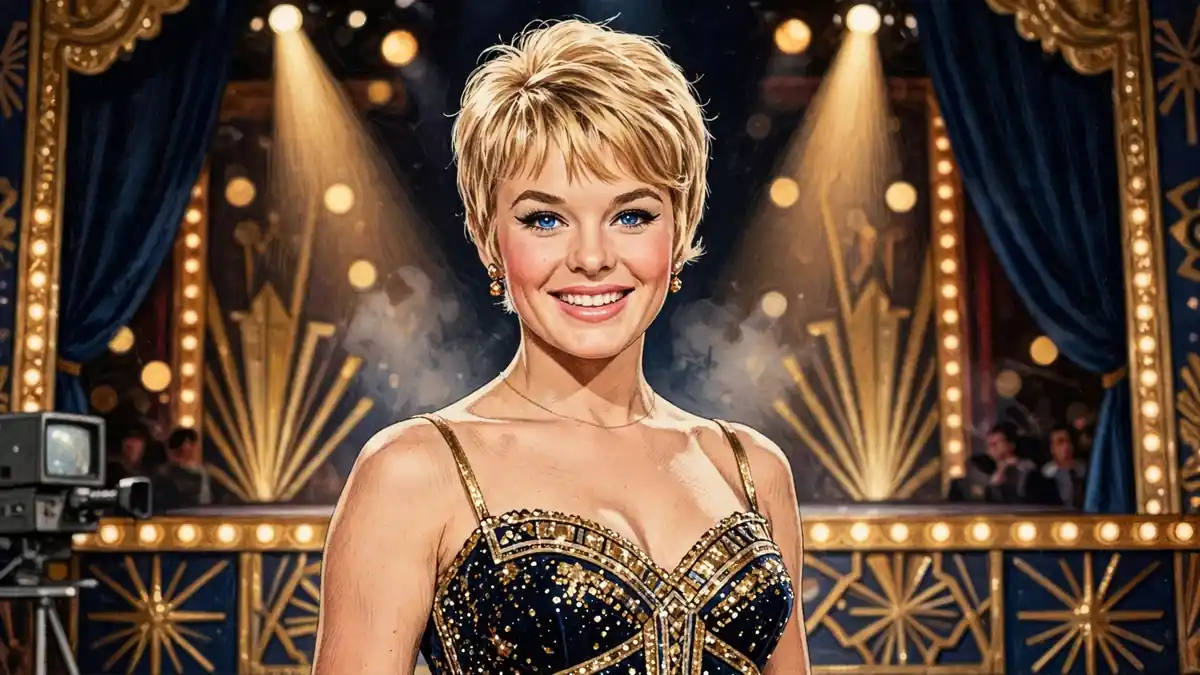
Joey Heatherton‘s net worth is estimated at $3 million to $6 million as of November 2026. The blonde variety-show star who danced her way through the 1960s — from the original Broadway cast of The Sound of Music to a decade of Bob Hope USO tours and a Billboard Top 40 hit with her cover of “Gone” — earned her money in an era before eight-figure television deals existed, then stepped away from public life so completely that the most recent estimates of her fortune now disagree by a factor of two.
Joey Heatherton: Quick Facts
| Estimated net worth | $3 million – $6 million (range: $3 million to $6 million) |
|---|---|
| Profession | Actress, singer, dancer |
| Nationality | American |
| Born | September 14, 1944 (age 82) |
| Height | 5 feet 5 inches (1.65 m) |
| Primary income sources | Television variety appearances, USO tours, film roles, recording royalties, Las Vegas performances, television advertising |
| Active years | 1959–present |
| Last reviewed | November 2026 |
- Early Life and Background
- Education
- Career Journey
- Rise to Fame
- Main Sources of Income
- Salary and Earnings
- Businesses and Investments
- Brand Deals and Sponsorships
- Houses, Cars and Other Assets
- Awards and Achievements
- Net Worth Growth Over the Years
- Social Media Presence
- Personal Life
- Sources & Reporting
- Frequently Asked Questions
Early Life and Background
Davenie Johanna Heatherton was born in New York City on September 14, 1944, and raised in Rockville Centre, a town in Nassau County on Long Island. She was nicknamed “Joey” as a child, a blend of her first name Davenie and her middle name Johanna, and the nickname stuck so firmly that most of America never learned her given names at all. She grew up inside show business rather than beside it. Her father, Ray Heatherton, was a Broadway star who had appeared in Babes in Arms and went on to become a television pioneer in the New York market, best known in the region as the star of the long-running children’s show The Merry Mailman. Her mother, also named Davenie, was a dancer who had met Ray while both were performing in Babes in Arms. Her older brother Dick, born October 19, 1943, later became a disc jockey.
That upbringing shaped the economics of her whole career. Heatherton did not arrive in Hollywood as an outsider chasing a break; she was a second-generation performer who had been on television sets since childhood, and her first screen appearance came on her father’s own children’s show. The advantage was real — access, training, and a famous surname in New York entertainment — and so was the trap. When the work dried up in the 1970s, she had no second profession to fall back on, no business empire, and no brand to sell. The money she made in her twenties had to last, because almost nothing new came in after her early forties.
Rockville Centre mattered to her in a way it rarely matters to a celebrity biography. She was raised there, she was schooled there, and after the fame faded she went back there. Reporting from 2023 onward places her living a quiet life at her home in Rockville Centre, the same town where she grew up. A rare public sighting in early 2026, reported by the Daily Mail and covered by EntertainmentNow, caught her on a grocery run in Los Angeles at 81, applying lip gloss while driving — a small, human detail that made news precisely because she had been out of sight for so long.
Her father’s career also explains the shape of her talent. Ray Heatherton was a song-and-dance man of the old school, and Joey was trained as a triple threat from childhood: ballet, jazz dance, voice, and dramatics. In the variety-show economy of the 1960s, that combination was the whole job description. A guest who could sing a number, dance a routine, and hold a comedy sketch was worth far more to a producer than a dramatic actress who could only do one of those things, and Heatherton’s booking rate across the decade reflects it.
Education
Heatherton attended Saint Agnes Academy, a Catholic grade and high school in Rockville Centre. She did not attend college, and by the time she finished school in 1963 her professional career was already four years old. The classroom that counted was the dance studio. She began studying ballet at age six at the Dixon McAfee School of Dance, then spent four years studying under George Balanchine, the choreographer who founded New York City Ballet and reshaped American dance. After Balanchine she studied modern jazz dance, voice, and dramatics — the exact toolkit a variety performer needed.
That training is the honest answer to a question the net-worth numbers raise on their own: how does a teenager with no film career become one of the most-booked women on American television? The answer is that she could do, live, in front of a studio audience, things almost nobody else on the booking lists could do. Balanchine training gave her dance credibility; the voice lessons gave her a recording career; the dramatics gave her the film roles. Each skill opened a separate income stream, and the streams overlapped through the whole of the 1960s.
It is worth saying plainly that there was no business education in that curriculum, and the record shows it. Heatherton never built a production company, never launched a product line, never turned her name into a brand while the name still carried weight. The contrast with modern celebrities is sharp: a star of her visibility today would leave a variety-show peak with endorsement contracts, a beauty line, and a production deal. Heatherton left it with residuals, a record contract, and a Las Vegas act. That difference sits at the center of why her fortune is measured in single-digit millions rather than the nine-figure sums attached to later television stars.
Career Journey
Heatherton began as a child actress, first appearing on television on her father’s show The Merry Mailman. The real launch came in 1959, when she was 15. That year she joined the ensemble of the original Broadway production of The Sound of Music as a member of the cast and an understudy, and she also became a semi-regular on The Perry Como Show — later Perry Como’s Kraft Music Hall — playing an exuberant teenager with a perpetual crush on Como. Some sources put her age at 13 when she joined The Sound of Music; given her sourced birth date and the premiere date, 15 is the figure that fits. The same year she released her first single, “That’s How It Goes” backed with “I’ll Be Seeing You”. It did not chart, and neither did the three singles that followed over the next few years.
Broadway gave her a second credit in 1960, co-starring in the short-lived There Was a Little Girl opposite Jane Fonda. Her first dramatic television role came the same year, playing a wealthy, spoiled teenager in an early episode of Route 66 (“Three Sides”). Through the early 1960s she was cast again and again as the troubled teenager, a type the trade press of the time attributed to what one profile called her “sexy-kid look”. The typecasting was a double-edged deal: it kept her working, and it boxed her into roles built around her appearance rather than her range.
Her film career began with Twilight of Honor in 1963, in which she played Laura Mae Brown, the young wife of an accused murderer played by Oscar nominee Nick Adams. The film itself earned two Academy Award nominations, for art direction and for Adams as supporting actor, and Heatherton earned a Golden Globe nomination as Most Promising Newcomer. She followed it with Where Love Has Gone in 1964 — a big-budget melodrama based on Harold Robbins’ novel, with Susan Hayward playing the Lana Turner-inspired lead and Heatherton as her daughter — and with My Blood Runs Cold in 1965, her first leading film role, opposite Troy Donahue in a William Conrad thriller. She also played Curley’s Wife in a 1968 television movie of Of Mice and Men and starred as Lisa in the 1969 Vietnam-veteran drama The Ballad of Andy Crocker, alongside Lee Majors and Jimmy Dean.
Television drama filled the gaps between films all through the decade: Mr. Novak, The Virginian (as Gloria Blaine in the 1963 episode “A Distant Fury”), The Nurses, two episodes of I Spy in 1966, and It Takes a Thief. The sheer volume of credits is the point. Heatherton appeared in 28 movies and television series before retiring from acting in 1990, according to a career count published by The Legit, and most of those credits were earned in a single decade. She was not a star who made one big film; she was a working performer who stacked dozens of paid appearances, and her fortune was assembled the same way — booking by booking.
The 1970s slowed everything down. She performed in Las Vegas, did a run of television commercials, and took film roles when they came: Bluebeard in 1972, with Richard Burton in the title role, in which she did her only onscreen nude scene; the starring role of Xaviera Hollander in the Watergate-era comedy The Happy Hooker Goes to Washington in 1977; and a single 1980s film, The Perils of P.K. in 1986. A brief high point arrived in July 1975, when she headlined Joey & Dad, a four-week Sunday-night summer replacement series for Cher’s variety show, performing alongside her father while he reminisced through the family attic. Her last substantial screen role was as Mrs. Hackett, a religious fanatic, in John Waters’ 1990 musical comedy Cry-Baby, starring Johnny Depp and Ricki Lake. A 2002 credit as a Serta spokeswoman in the fantasy comedy Reflections of Evil used archival footage. She posed nude for Playboy in 1997, at 52 — a late-career appearance that underlined how completely the mainstream work had stopped.
Rise to Fame
Heatherton’s rise was a television phenomenon, and it happened fast. Beginning in the mid-1960s she drew attention for sensual dancing on variety shows — routines some viewers found shocking and some critics dismissed as “sleazy eroticism”, in the words of a contemporary profile. The notoriety was the engine. In 1964 she appeared on The Tonight Show coaching Johnny Carson in the finer points of dancing “The Frug”. In January 1965 she was a featured guest on the premiere episode of the teen dance show Hullabaloo, and she returned for several more episodes, releasing “Hullabaloo”, a song she had performed on the show, on Coral Records.
The booking that certified her status came at the invitation of Dean Martin. She appeared extensively on The Dean Martin Show starting with its premiere episode on September 16, 1965, and from June to September 1968 she co-hosted Martin’s summer-substitute musical comedy hour, Dean Martin Presents the Golddiggers, alongside Frank Sinatra Jr. Around the same run she appeared on The Andy Williams Show, The Hollywood Palace, The Ed Sullivan Show, and This Is Tom Jones. She was a mystery guest on What’s My Line? on November 7, 1965 — the last live telecast on which the panelist Dorothy Kilgallen appeared, a piece of television history that has nothing to do with money and everything to do with how central Heatherton was to the medium at that moment.
She belonged to a specific class of 1960s star: the variety-show headliner whose fame was measured in bookings rather than box office. Grace Slick, another defining female face of the decade, built a fortune of a different shape — a recording catalog that kept paying — while Heatherton’s fame was tied to live performance, which pays only while you are on stage. That distinction explains the gap between their fortunes today. Heatherton’s peak earning years were also her peak visibility years, and the two ended together.
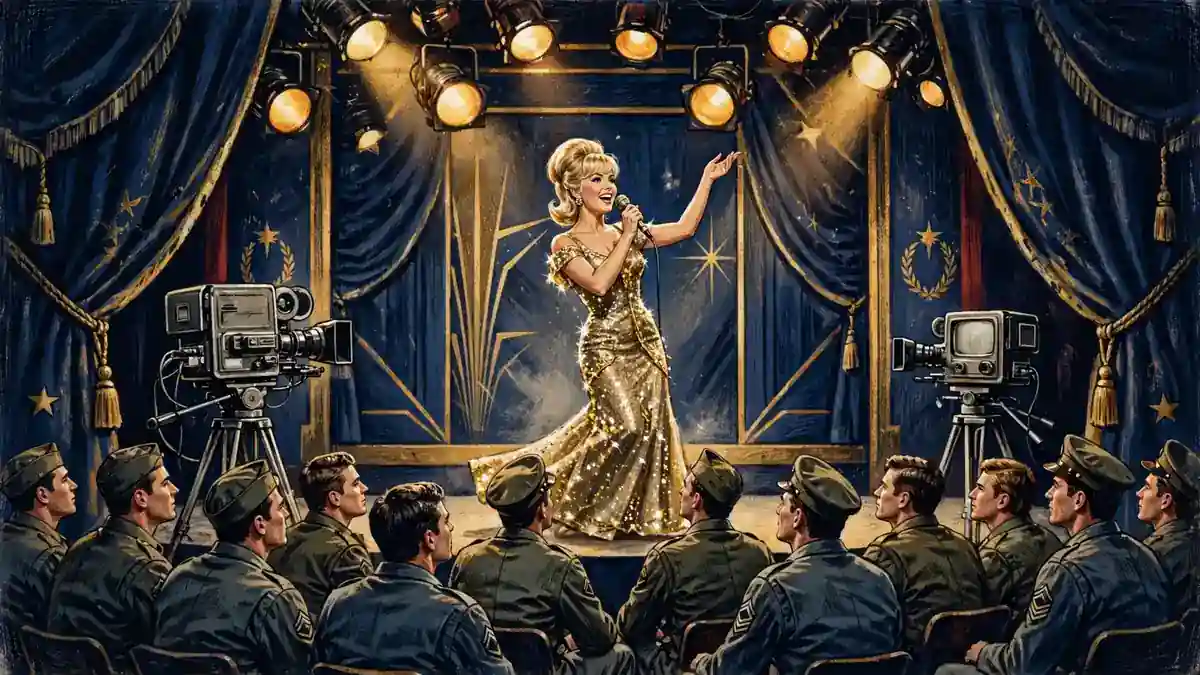
The longest-running engagement of her career was the one that paid the least in cash and the most in reputation. From 1965 to 1977 she performed live with Bob Hope’s touring USO troupe, entertaining American troops with singing, dancing, and provocative stage outfits. Excerpts from the tours were televised as part of Hope’s long-running NBC monthly specials, including the top-rated Christmas shows, where her segments were regularly featured. Twelve years of USO touring put her in front of audiences no film or record could reach, and it fixed her image in the public mind as the girl-next-door who showed up for the troops. It also consumed the years when a performer of her profile might otherwise have been building a film career or a business.
Main Sources of Income
Heatherton’s income came from six streams, and their relative weight changed sharply across her career. In the 1960s the largest was television variety work: guest spots and semi-regular slots on The Perry Como Show, The Dean Martin Show, Hullabaloo, The Ed Sullivan Show, and the rest of the variety circuit. Variety pay in that era was solid working money — a featured guest could earn a comfortable fee per appearance — but it was not the kind of money that compounds. A guest spot pays once. There were no syndication windfalls for a variety guest, and the residuals system that later enriched sitcom stars did not work the same way for variety performers.
Film was the second stream, and it was thinner than her fame suggested. She had a leading role in My Blood Runs Cold and a starring role in The Happy Hooker Goes to Washington, but her filmography is mostly supporting parts in modestly budgeted pictures. Where Love Has Gone was the big-budget exception, and she was not its star. No backend points, no profit participation, and no franchise money appear anywhere in her record. The honest reading is that film paid her a salary and added to her visibility, which fed back into the variety bookings. It did not build wealth on its own.
The third stream was music, and it was the one with the longest tail. Her 1972 album The Joey Heatherton Album, released on Mercury Records, produced a genuine hit: her cover of Ferlin Husky’s 1957 song “Gone” spent 15 weeks on the Billboard Hot 100 and peaked at number 24, while also reaching number 38 in Australia. The follow-up single, “I’m Sorry”, peaked at number 87. A Top 40 single in 1972 generated royalties — mechanical royalties on sales, performance royalties on radio play — and those royalties, small as they were, kept arriving long after the variety bookings stopped. The album was re-released in 2004 with a nude cover photograph by Harry Langdon Jr., taken while she was filming Bluebeard, which put the record back in front of collectors and added a small new round of sales. Linda Ronstadt, who turned the same era’s recording industry into a fortune estimated at $130 million, shows what the music stream could become when the catalog was deep and the career kept going; Heatherton’s catalog was one album and a handful of singles, so the stream stayed a trickle.
The fourth stream was live performance, above all Las Vegas. In the 1970s she performed in Vegas, where a headliner with her name recognition could command real nightly money, and she toured with the USO for twelve years. The USO work was goodwill rather than a payday — the tours ran on patriotism and exposure, not fees — but the Vegas dates were commercial, and the television commercials were too. The fifth stream was advertising: a series of television ads for RC Cola and for Serta mattresses in the 1970s. A national commercial campaign was one of the best-paying jobs in show business at the time, and the Serta association lasted so long that archival footage of her as a Serta spokeswoman was still being used in 2002.
The sixth stream is the quiet one: residuals, reissues, and licensing. Her variety appearances are re-run in clip packages, her single “Gone” still streams, her album was reissued, and her image still sells in nostalgia markets. None of this is large money. Added together, though, these small streams are the reason a woman who last had a substantial screen role in 1990 still has a fortune to estimate in 2026. She did not get rich from one deal. She accumulated a working performer’s earnings across three decades and then, by most accounts, lived quietly on what remained.
Salary and Earnings
No per-episode salary, no film fee, and no Las Vegas guarantee for Heatherton has ever been published. That absence is itself a finding, and it is one of the reasons the estimates of her fortune disagree so widely. The $3 million figure from Celebrity Net Worth and Urban Splatter is built from public reporting on her career volume, not from any disclosed paycheck, and the $6 million figure that circulated in 2023 comes from the same kind of modeling with more generous assumptions about what a decade of variety bookings and a hit single were worth. Neither number can be checked against a filing, because there is no filing. She was never a studio executive, never a public-company founder, and never the subject of a divorce settlement that put numbers on the record. Her 1972 divorce from Lance Rentzel produced no published financial disclosure.
What can be said with confidence is where the money was concentrated. Her peak earning years were 1964 to 1972: the Dean Martin Show run, the Hullabaloo appearances, the USO tours, the film roles, the RC Cola and Serta campaigns, and the Mercury Records deal that produced “Gone”. A performer working at that pace in that era — a featured variety guest several times a month, a film or two a year, a national commercial campaign, a charting single — was earning well into six figures a year in 1960s and early-1970s dollars. That is a strong income for the time, and it is also an income that stops the moment the bookings stop.
The bookings did stop, or nearly so. After The Happy Hooker Goes to Washington in 1977, her screen work fell to almost nothing: one film in 1986, one in 1990, and archival footage in 2002. The 1975 Joey & Dad series ran four weeks. The 1997 Playboy pictorial was a one-off fee, not a career. From the early 1980s onward, her new income was essentially limited to royalties, residuals, and the occasional licensing deal. That shape — a sharp peak, a long flat tail — is the shape of her fortune. The $3 million to $6 million range reflects disagreement about how much of the peak survived the tail: how much she saved, how much the legal troubles of the 1980s cost her, and how much the quiet decades since have drawn down.
Two details from the record sharpen the picture. In July 1986 she was arrested and charged with theft of services for refusing to pay a $4,906 bill from a Long Island hotel and spa where she had stayed in 1984. A $4,906 unpaid hotel bill is not the behavior of a woman with unlimited cash, and it sits in the record alongside the 1985 passport-office arrest and the 1986 assault arrest as evidence that the late 1980s were financially and personally strained. The counterweight is that she kept her home in Rockville Centre, stayed out of bankruptcy proceedings that would have become public, and never appeared in the kind of distressed-sale property reporting that follows broke celebrities. The fortune, in other words, shrank but did not collapse.
For readers comparing her with her peers, the honest frame is this: Heatherton earned like a top variety star of the 1960s and saved like a working performer, not like a mogul. The variety-show economy paid for the present, not the future. Her peer Robert Wagner, who kept working in film and television for decades after the 1960s and built a fortune estimated at $20 million, shows the difference a long second act makes. Heatherton did not get one.
Businesses and Investments
Heatherton never founded a company, never launched a product line, and never took an equity stake that made the public record. That is a notable absence in a net-worth story, because business income is where most celebrity fortunes of her scale are built or lost. Her career was a labor career: she sold performances, not products. The investments she is reported to have made were the quiet, private kind — savings and property rather than ventures — and no outlet has ever documented a portfolio, a business partner, or a deal.
The reporting that does exist points in the same direction. Achievers, in its 2026 assessment, describes her fortune as “largely preserved from her heyday and various smart investments made during her peak years”, without naming any investment. That phrasing is honest about its own limits: the preservation is inferred from the fact that she still has an estimated fortune at all, not from any disclosed holding. The same outlet notes that she never chased reality-television checks, never wrote a memoir, and never cashed in on nostalgia in the way many former stars do — decisions that protected her privacy and also closed off the income streams other retired celebrities live on.
The practical consequence is that her net worth is best understood as accumulated earnings minus five decades of living costs, rather than as a portfolio. The peak earnings of the 1960s and early 1970s, invested conservatively, would compound into a modest fortune over fifty years even without new income. The same earnings, spent at a celebrity pace through the 1970s and 1980s, would be gone. The $3 million to $6 million range is, in effect, a disagreement about which of those two stories is closer to the truth, and the newest reporting leans toward the lower end.
One more angle belongs here, because competitors skip it: the value of what she did not sell. Heatherton never sold a tell-all, never licensed her name to a product, and never turned her legal troubles into a reality-show arc. In the modern celebrity economy, a 1960s sex symbol with her story could monetize a memoir, a documentary, and a podcast tour. She chose not to, and that choice is part of why the fortune is small and part of why the reputation survived. The money she left on the table is invisible in the net-worth figure, but it is real, and it is the clearest evidence that her priorities after 1990 were privacy rather than profit.
Brand Deals and Sponsorships
Heatherton’s endorsement career was a 1970s story, and it was built on two national campaigns. The first was for RC Cola, a series of television advertisements in which she appeared as the brand’s glamorous face. The second, longer association was with Serta mattresses, for which she appeared in television commercials through the 1970s. A national commercial campaign in that era was one of the most lucrative jobs available to a television personality: a single campaign could pay more than a season of guest spots, and it put the performer’s face in front of audiences who never watched variety shows.
The Serta association outlasted the decade. Archival footage of Heatherton as a Serta spokeswoman was still being used in the 2002 film Reflections of Evil, which credited her in that role — a small detail that shows how durable a commercial image can be. The RC Cola campaign is less documented, and no figures for either deal have been published. What is documented is the pattern: she was hired because her face and name still sold products in the 1970s, and the work stopped when the cultural moment moved on.
There were no modern-style sponsorships. No social-media deals, because she has no social media. No fashion line, no fragrance, no fitness brand. Her endorsement career belongs to the era when a celebrity sold a product by appearing in its commercial, and it ended with that era. That is another reason the fortune stayed modest: the endorsement economy that makes modern celebrities rich did not exist when Heatherton was famous, and by the time it did exist, she had left public life.

Houses, Cars and Other Assets
Heatherton’s known property footprint is small and rooted in one place: Rockville Centre, New York. Reporting from 2023 onward places her living a quiet life at her home there, the town where she was raised and schooled. No property record for the house has been published in the celebrity-real-estate press, no purchase price or sale has been reported, and no second home has ever been documented. That is consistent with a performer whose wealth was earned in New York and kept in New York, rather than a Hollywood star who traded up through Los Angeles real estate.
The absence of a property portfolio is itself informative. Many celebrity fortunes are built as much on real estate appreciation as on earnings, and Heatherton’s does not appear to be one of them. She is not reported to own investment properties, and no car collection, art collection, or jewelry portfolio has ever been documented. The assets that can be named with confidence are the intangible ones: the recording catalog (one album, a handful of singles, and the “Gone” royalties), the residual rights from her television and film appearances, and the value of her name and likeness in nostalgia markets.
One caution belongs here. The 1986 theft-of-services charge, tied to a $4,906 hotel and spa bill from a 1984 stay in Long Island, is sometimes read as evidence of financial distress. It is evidence of a dispute over a bill, and of a difficult period in her life, but it is not evidence of insolvency. She was not reported to have lost a home, and no bankruptcy filing exists in the public record. The fair reading is narrower: the mid-1980s were a period when money was tight enough that a five-thousand-dollar bill became a legal matter, and that is a useful data point for anyone weighing the $3 million figure against the $6 million one.
Awards and Achievements
Heatherton’s awards record is modest in size and specific in what it rewards: she was recognized as a newcomer and as a variety star, not as a dramatic actress. In 1964 she was nominated for a Golden Globe as Most Promising Newcomer – Female for her performance in Twilight of Honor, her film debut. The same year she won a Golden Laurel Award as Top Female New Face, and she won a second Golden Laurel as New Faces, Female in 1966. The Legit, which counts six award nominations across her career, adds three Photoplay Awards for Favorite Variety Star, won in 1976, 1977, and 1978 — a late run of recognition that arrived after her film career had slowed and her variety work was winding down.
The Photoplay wins deserve a second look, because they say something about how she was valued. Photoplay was a fan magazine, and Favorite Variety Star was a popularity award, voted by readers. Winning it three years running, from 1976 to 1978, meant that audiences still loved her even as the industry stopped hiring her. That is a different kind of achievement from a critics’ prize, and for a net-worth story it matters: popularity is what sells commercials, fills Las Vegas rooms, and moves records. The awards trace the same arc as the money — early promise, a mid-decade peak, and a long, affectionate afterglow.
Beyond the formal awards, her achievements include the ones that do not come with trophies. She was a member of the original Broadway cast of The Sound of Music. She co-hosted a network summer series. She performed for American troops for twelve years. Her single “Gone” reached the Billboard Top 40 and stayed on the Hot 100 for 15 weeks. And she is still being written about in 2026, more than three decades after her last substantial role — a kind of durability that no award measures and that explains why a keyword like “Joey Heatherton net worth” still draws searches at all.
The cultural afterlife is part of that durability. Jill Sobule’s 2004 song “Joey” is about her. She is mentioned in three episodes of the television series Monk — “Mr. Monk and the Badge”, “Mr. Monk Joins a Cult”, and “Mr. Monk and the Panic Room”. Her favorite actress, by her own account, was Marilyn Monroe, and her favorite films included Gentlemen Prefer Blondes, Some Like It Hot, and The Seven Year Itch — a taste that places her squarely in the tradition of the blonde comedy star she was often compared with. Donna Douglas, another 1960s television actress whose fame came from a single iconic role, followed a similar arc from weekly television to a quiet life away from Hollywood, and her fortune — estimated at $500,000 — shows how thin the tail can get when the work stops early.
Net Worth Growth Over the Years
The table below is an estimated trajectory, not a set of audited figures. No year-by-year fortune for Heatherton has ever been published, and the numbers here are our reconstruction from her career arc and the published estimates that exist. Treat them as a shape — rise, peak, long decline — rather than as a ledger.
| Period | Estimated net worth | What drove it |
|---|---|---|
| Late 1950s | Under $100,000 | Broadway ensemble work, Perry Como Show appearances, early singles that did not chart |
| Mid-1960s | $500,000 – $1 million | Dean Martin Show run, Hullabaloo, Tonight Show, film roles, USO tours |
| Early 1970s | $2 million – $4 million | Peak earning years: variety, Las Vegas, RC Cola and Serta campaigns, “Gone” royalties |
| Late 1970s | $3 million – $5 million | Happy Hooker starring role, Vegas dates, Photoplay-era popularity, royalties accumulating |
| 1980s | $2 million – $4 million | Work nearly stops; legal troubles and living costs draw the fortune down |
| 1990s – 2000s | $3 million – $5 million | Cry-Baby cameo, Playboy pictorial, 2004 album reissue, residuals and royalties |
| 2026 | $3 million – $6 million | Recent estimates cluster at $3 million; older figures say $6 million |
The shape is the story. The fortune was built between 1964 and 1977, and everything after that was management of what had been built. The range widens in the later rows because the evidence thins: nobody publishes a retired performer’s bank balance, and the outlets that estimate these numbers are modeling, not measuring.
Peer comparison puts the range in context. Jerry Lee Lewis, a music contemporary whose catalog kept selling for decades, built a fortune estimated at $10 million. Grace Slick, a fellow 1960s icon with a deep recording catalog, is estimated at $20 million. Linda Ronstadt, who turned the same era into a far deeper catalog, is estimated at $130 million. Heatherton sits below all three, and the reason is the same in each case: her fame was live performance, and live performance does not compound. Readers who want the fullest picture of how 1960s stardom translated into money can compare these profiles against our richest actors in the world ranking, where the top of the list is occupied by stars whose fortunes came from business empires, not bookings.
Social Media Presence
Heatherton has no verified social media presence. There is no official Instagram, X, Facebook, or TikTok account in her name, and the fan-run pages that use her name and photographs are not hers. She belongs to a generation of performers who left public life before social media existed, and she has shown no interest in joining it since. That absence is total: no interviews on YouTube channels, no podcast appearances, no verified statements of any kind in recent years.
The absence has a direct effect on her net worth. A retired celebrity with a social media following can monetize nostalgia — sponsored posts, Cameo videos, paid appearances, a memoir launch. Heatherton monetizes none of it. The February 2026 Daily Mail sighting, in which she was photographed on a grocery run in Los Angeles, is the closest thing to a public appearance she has made in years, and it was not arranged by her. For a net-worth estimate, the point is simple: there is no social-media income stream to add, and there is no public statement from her about her finances to weigh against the published estimates.
Personal Life
Heatherton married once. On April 12, 1969, she married Thomas Lance Rentzel, a wide receiver for the Dallas Cowboys, in a private ceremony in New York City attended by no more than 150 people. The marriage lasted three years and ended in circumstances that damaged her career as much as her personal life. In November 1970, Rentzel was arrested for exposing himself to a 10-year-old girl. He pleaded guilty, was given a suspended sentence, and promised to undergo psychiatric treatment. Heatherton filed for divorce in September 1971, and the divorce became final in 1972. She never remarried, and no children have been reported.
Contemporary accounts, including the reporting summarized on Wikipedia, say that some observers believed she never recovered from the psychological shock of Rentzel’s offense, and that her career lost its luster after the divorce. The timeline supports the association, even if the causation is a matter of interpretation: her busiest years were 1964 to 1971, and the work thinned sharply after 1972. She dated Jerry Fischer in the 1980s, when he was also her manager, and that relationship ended in the August 30, 1986 incident in which she stabbed him in the hand with a steak knife during an argument in Hillcrest, Rockland County. Fischer later dropped the assault charge.
The legal troubles of the 1980s came in a cluster. On July 8, 1985, she was arrested at the U.S. Passport Agency office in Manhattan after she allegedly slapped and pulled the hair of a clerk; she was charged with interfering with a government agent’s duties and disturbing the peace, and acquitted of both charges in September 1986. In July 1986 she was arrested and charged with theft of services over the unpaid $4,906 hotel and spa bill. In the August 1986 arrest, police searching her purse found a foil packet containing less than a gram of cocaine, and she was charged with misdemeanor drug possession alongside the assault charge. In October 1987 a court ruled that the purse search was unconstitutional, because she had not been advised that she could refuse it, and the drug possession charge was dropped.
Since the 1990s she has lived privately, and the reporting since then is thin by design. She is reported to be unattached, living at her home in Rockville Centre, and staying away from media attention. The February 2026 sighting in Los Angeles, at 81, is the most recent public trace. She has not given an interview in years, has not appeared at retrospectives or conventions, and has not commented on any of the net-worth estimates published about her. The privacy is complete, and it is clearly a choice.
Sources & Reporting
Wikipedia — the biographical backbone: birth date and place, family background, Broadway and television credits, USO tours, filmography, the Rentzel marriage and divorce, the 1985–1986 arrests and their outcomes, and the Billboard chart data for “Gone”. Reporting window: page as reviewed October–November 2026.
Celebrity Net Worth — the $3 million estimate, updated March 27, 2025, the most widely cited figure for Heatherton and the anchor of the low end of our range.
Urban Splatter — the $3 million estimate, published October 22, 2026, the freshest of the current estimates, plus the Mercury Records detail on “Gone”.
The Legit — the $6 million figure as of May 2023, the career count of 28 movies and television series, the six-award breakdown including the three Photoplay wins, and the cultural details (Jill Sobule’s “Joey”, the Monk mentions, her favorite films).
EntertainmentNow — the February 2026 rare public sighting in Los Angeles, drawing on Daily Mail reporting, confirming she was seen at 81 looking well.
Billboard — chart history for “Gone”: 15 weeks on the Hot 100, peak number 24, with “I’m Sorry” peaking at number 87, as cited in the Wikipedia chart record.
IMDb — credits cross-check: Perry Como Show, Route 66, The Virginian, I Spy, Cry-Baby, and the marriage dates.
Where outlets disagreed on the fortune — $3 million from the newest reporting, $4 million from WikiBioStar, $5 million to $6 million from older pages — we published the full $3 million to $6 million range and said which figure came from where, rather than picking the number that made the best headline. Where no source exists, notably for per-episode salaries and film fees, we said so instead of inventing one. Figures were reviewed in November 2026.
Frequently Asked Questions
What is Joey Heatherton’s net worth in 2026?
Joey Heatherton’s net worth is estimated at $3 million to $6 million as of November 2026. The newest estimates — Celebrity Net Worth and Urban Splatter, both current for 2025–2026 — put her at $3 million, while older pages from 2023 estimated $6 million. No audited figure exists, so the range reflects that disagreement.
Is Joey Heatherton still alive?
Yes. Joey Heatherton is alive and living a private life, reported to be at her home in Rockville Centre, New York. She was photographed on a rare public outing in Los Angeles in February 2026, at 81, and looked well. She has not given interviews or made public appearances in years.
How old is Joey Heatherton?
Joey Heatherton is 82 years old. She was born Davenie Johanna Heatherton on September 14, 1944, in New York City, and turned 82 on September 14, 2026.
Who was Joey Heatherton married to?
Joey Heatherton was married once, to Dallas Cowboys wide receiver Lance Rentzel. They married in a private ceremony in New York City on April 12, 1969, and divorced in 1972, after Rentzel pleaded guilty to exposing himself to a 10-year-old girl in November 1970. She never remarried and has no reported children.
What happened to Joey Heatherton, and why did she disappear?
Her career slowed sharply after her 1971–1972 divorce from Lance Rentzel, and the work never came back at the same level. Legal troubles in 1985 and 1986, including arrests at a passport office and an assault charge involving her then-boyfriend and manager Jerry Fischer, added to the damage. Her last substantial film role was in Cry-Baby in 1990, and she has lived privately in Rockville Centre ever since, turning down the reality-TV and memoir money other retired stars chase.
What was Joey Heatherton’s biggest song?
Her biggest song was her 1972 cover of Ferlin Husky’s “Gone”, released on Mercury Records. It spent 15 weeks on the Billboard Hot 100 and peaked at number 24, and it also reached number 38 in Australia. Her follow-up single, “I’m Sorry”, peaked at number 87.
What movies was Joey Heatherton in?
Her best-known films are Twilight of Honor (1963), Where Love Has Gone (1964), My Blood Runs Cold (1965), Bluebeard (1972), The Happy Hooker Goes to Washington (1977), and Cry-Baby (1990), in which she played Mrs. Hackett. She also appeared in Of Mice and Men (1968) and The Ballad of Andy Crocker (1969).
How tall is Joey Heatherton?
Joey Heatherton is 5 feet 5 inches tall (1.65 m). She has blonde hair and blue eyes, and was reported to weigh around 135 pounds (61 kg).
Final Thoughts
Joey Heatherton’s fortune — $3 million to $6 million, with the freshest reporting at the lower end — is the honest size of a variety-show career. She earned it the hard way, one booking at a time, across a decade when she was among the most in-demand women on American television, and she kept it by living quietly for the thirty years after the bookings stopped. The range exists because the record is incomplete: no salary was ever published, no business was ever built, and no fortune was ever audited. What the record does show is a performer who could sing, dance, and act at a level few of her contemporaries matched, who gave twelve years to entertaining American troops, who had a genuine Billboard hit, and who walked away from fame on her own terms and stayed away. The money is modest by modern celebrity standards. The career was not.
Published on November 16, 2026. Last reviewed November 2026. Found an error? See our corrections policy.