
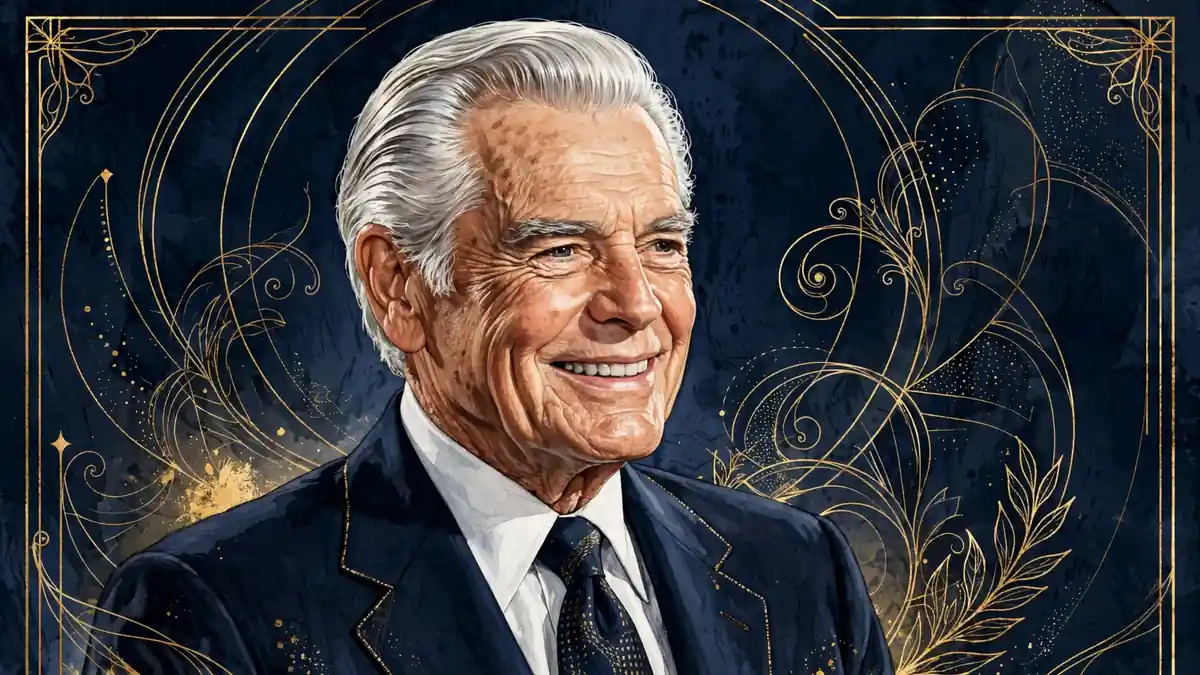
Robert Wagner‘s net worth is estimated at $15 million to $20 million as of November 2026. The headline number needs one fact most profiles skip: the best-sourced estimate, from Celebrity Net Worth, is a combined figure shared with his wife of 36 years, actress Jill St. John. Wagner, 96, built that fortune across 75 years in front of the camera — a $75-a-week studio contract at Twentieth Century Fox, three hit television series, an ownership stake in the show that defined him, three bestselling memoirs, and a Brentwood house bought for $220,000 and sold for $14 million.
Robert Wagner: Quick Facts
| Estimated net worth | $15 million – $20 million (range: $15 million – $20 million; Celebrity Net Worth lists $20 million combined with wife Jill St. John) |
|---|---|
| Profession | Actor, television producer, author |
| Nationality | American |
| Born | February 10, 1930 (age 96) |
| Height | 5 feet 11 inches (1.80 m) |
| Primary income sources | Television and film acting, Hart to Hart residuals and ownership, producing, book royalties, real estate |
| Active years | 1950–present |
| Last reviewed | November 2026 |
- Early Life and Background
- Education
- Career Journey
- Rise to Fame
- Main Sources of Income
- Salary and Earnings
- Businesses and Investments
- Brand Deals and Sponsorships
- Houses, Cars and Other Assets
- Awards and Achievements
- Net Worth Growth Over the Years
- Social Media Presence
- Personal Life
- Sources & Reporting
- Frequently Asked Questions
Early Life and Background
Robert John Wagner Jr. was born on February 10, 1930, in Detroit, Michigan. His mother, Hazel, worked as a telephone operator. His father, Robert Sr., was a traveling salesman who built a small fortune selling paint to the automotive industry and lacquer to Ford, where it was used on car dashboards. The family money came from salesmanship, not show business, and Wagner grew up watching his father work the road — a detail that matters, because the son would spend his own working life selling himself as a product, first to a studio and later to television audiences.
When Wagner was seven, the family moved to Los Angeles. His father had earned enough to retire in Southern California, and the family built a custom home in Bel Air overlooking the Bel Air Country Club, a project that took more than a year to finish. Wagner was sent ahead of the rest of the family by train to attend the Hollywood Military Academy. Growing up beside a golf course put him within sight of the movie business every day: he watched Cary Grant, Fred Astaire, and Clark Gable play golf at the club near his home. Those sightings gave a Bel Air schoolboy a fixed idea of what he wanted to be.
Detroit gave Wagner his start and Los Angeles gave him his stage. The move at age seven placed him inside the industry’s geography before he had any idea how to enter it, and the Bel Air address gave him a front-row view of stardom as a daily routine rather than a distant dream. He has said in interviews over the years that the golfers he watched as a boy made fame look like a job — something a person showed up for, day after day.
Education
Wagner attended four different military schools in Southern California, where many of his classmates were the children of famous actors. He graduated from Saint Monica Catholic School in 1949. He never attended college and never trained formally as an actor in the classroom sense. His schooling was the studio system itself: he learned camera work, diction, and screen presence on the Fox lot, starting as an extra and working his way into speaking parts.
The military-school background shows up in the way Wagner has talked about his career across seven decades — punctual, disciplined, and willing to take the work that was offered. In an era when contract players were assigned roles rather than choosing them, that attitude was a financial asset. He said yes to westerns, war films, swashbucklers, and thrillers, and each assignment kept the weekly paycheck coming while his name climbed the cast list.
Career Journey
Wagner’s film debut was an uncredited part in 1950’s The Happy Years. He signed with Twentieth Century Fox at 20, and his first film for the studio was the 1951 World War II drama Halls of Montezuma, starring Richard Widmark. He played a supporting role beside Widmark again that year in The Frogmen. The pay was modest — his first Fox contract paid $75 a week, of which he took home $55, a figure he recalled in a 1999 interview with the Los Angeles Times. At that rate, a year of steady work came to roughly $3,900 before tax, and the number is worth keeping in mind: Wagner’s fortune was not made in a single deal but in 75 years of never leaving the business.
His first real attention came in 1952, in With a Song in My Heart, starring Susan Hayward. Wagner played a shell-shocked soldier in a scene that lasted less than a minute, yet the performance drew enough notice that Fox executives started giving him larger parts. By 1953 he was carrying leading roles in Beneath the 12-Mile Reef and Titanic. In 1954 he starred in Prince Valiant and the western Broken Lance, the latter opposite Spencer Tracy, who was impressed enough to request Wagner for another film. In 1956 Wagner starred in the psychological thriller A Kiss Before Dying, playing a calculating young man who commits murder for money, and appeared opposite Tracy again in The Mountain. Back at Fox he starred in Between Heaven and Hell and played the title role in Nicholas Ray’s The True Story of Jesse James (1957). Both films were box-office disappointments, and the setbacks pushed Wagner to rethink where his career was headed.
In January 1961, Wagner and his then-wife Natalie Wood formed their own production company, Rona Productions — the name taken from the first two letters of their first names. The company arranged a three-picture deal with Columbia Pictures for Wagner’s services, an early sign of the producer’s instinct that would matter far more to his wealth than any single acting fee. Wagner then worked in England, starring in The War Lover (1962) alongside Steve McQueen, and spent several years based in Europe, appearing in The Longest Day (1962), The Condemned of Altona (1962), and Blake Edwards’ The Pink Panther (1963), where he played George Lytton opposite David Niven and Peter Sellers. The Pink Panther became a substantial international hit, yet Wagner struggled to recover his earlier leading-man standing. He appeared through the rest of the decade in films including Harper (1966), starring Paul Newman, and Banning (1967). The move into television, when it came, changed his earning power for good.
The 1970s kept him visible on the big screen — the disaster blockbuster The Towering Inferno (1974) and the war film Midway (1976) — and he worked with Laurence Olivier and Natalie Wood in a television adaptation of Cat on a Hot Tin Roof. But television was where the steady money lived, and Wagner’s three series runs there form the spine of his fortune. It Takes a Thief (1968–1970) cast him as Alexander Mundy, a sophisticated cat burglar recruited by the American government, with Fred Astaire playing Mundy’s father. The show ran on ABC and earned Wagner a Primetime Emmy nomination for Outstanding Lead Actor in a Drama Series in 1970, along with a Golden Globe nomination. Switch (1975–1978) cast him as Pete Ryan, a former con artist turned private detective, opposite Eddie Albert and Sharon Gless, and ran for three seasons on CBS. Then came the role that still defines him.
Rise to Fame
In 1979, Wagner began starring as Jonathan Hart, a wealthy businessman and amateur detective, in ABC’s Hart to Hart. The series co-starred Stefanie Powers as his wife Jennifer and Lionel Stander as their butler, Max. Created by novelist Sidney Sheldon and developed for television by Tom Mankiewicz, the show followed the glamorous couple as they traveled the world, solved murders, and lived the jet-set life. It ran for five seasons and 111 episodes, from August 25, 1979, to May 22, 1984, and became one of the most popular television dramas of its era.
The part fit Wagner in a way his film roles never had. Jonathan Hart was rich, charming, and slightly dangerous — a character who let Wagner play the Bel Air boy he had been, now grown into the leading man he had spent 30 years becoming. The show earned Wagner four Golden Globe nominations for Best Actor in a Television Drama, in 1980, 1981, 1983, and 1984. Powers was nominated alongside him, and Stander won a Golden Globe in 1983 for his supporting role. The chemistry between Wagner and Powers carried the series, and the two stayed close friends long after it ended; Powers was at Wagner’s side for his 96th birthday in February 2026.
The financial importance of Hart to Hart goes beyond salary. Wagner held an ownership and production role through Rona II Productions, which participated in the original series, and he later served as executive producer on eight Hart to Hart television movies released between 1993 and 1996, reuniting him with Powers. Ownership meant a share of the show’s long life in syndication and home video, and the reunion movies kept the property earning a decade after the series ended. For a performer who started at $75 a week, the shift from hired hand to part-owner was the single most important financial move of his career. The series has now been paying, in one form or another, for more than 45 years.
Fame came back a third time in the 1990s, when Wagner was cast as Number Two, the eye-patch-wearing associate of Dr. Evil, in Austin Powers: International Man of Mystery (1997). He reprised the role in Austin Powers: The Spy Who Shagged Me (1999) and Austin Powers in Goldmember (2002), introducing himself to a generation that had never seen Hart to Hart. The films were commercial hits, and the part — played with a straight face against Mike Myers’ broad comedy — gave Wagner a late-career signature as recognizable as Jonathan Hart. Fellow Austin Powers star Seth Green built his own long career out of the same franchise, and the two films sit at the center of a very different kind of Hollywood money: franchise comedy, where a supporting turn in a hit can pay for years through residuals and revivals.
His later work included film roles in Dragon: The Bruce Lee Story (1993), Crazy in Alabama (1999), and Hollywood Homicide (2003), plus guest appearances on Seinfeld, Boston Legal, Two and a Half Men — where he played Teddy Leopold in 2007 and 2008 — and Hustle. One of his most durable late roles was Anthony DiNozzo Sr., the charming and sometimes troublesome father of Michael Weatherly’s character on NCIS. Wagner appeared periodically on the series between 2010 and 2019, making 12 guest appearances across nine years — a remarkable run of steady network work for an actor in his eighties. Chris O’Donnell, who led NCIS: Los Angeles, comes from the same network-crime-drama world that kept Wagner employed into his late eighties. By the mid-2020s, Wagner had largely stepped away from acting and was living a private life in Aspen with Jill St. John, surfacing mainly for family milestones and the occasional interview.
Main Sources of Income
Wagner’s income has never come from one tap. It has come from six streams that opened at different points in his life and overlapped for decades, which is why his wealth survived the end of his film career, the end of his television stardom, and the slow fade of the studio system that raised him.
Television acting. Three starring series — It Takes a Thief, Switch, and Hart to Hart — plus the eight reunion movies and the NCIS guest run. Network television in the 1970s and 1980s paid its stars well, and a five-season hit with 111 episodes generates residuals every time it is re-aired, streamed, or licensed. Hart to Hart has cycled through syndication, cable, and streaming for four decades.
Film acting. more than 50 films, from the Fox contract years through The Pink Panther, The Towering Inferno, and the Austin Powers trilogy. Film pay in the contract era was modest, and his two documented film paychecks — $75,000 for All the Fine Young Cannibals (1960) and $60,000 for The Towering Inferno (1974) — show a working actor’s wages rather than a superstar’s. The film money mattered most as a platform: it kept his name current between television jobs.
Producing and ownership. Rona Productions in 1961, then the Rona II Productions stake in Hart to Hart and the executive-producer credit on the reunion movies. This is the stream that separates Wagner from other contract-era actors who earned similar salaries and ended up with far less. A salary stops when the job stops. An ownership stake keeps paying.
Books. Wagner wrote three books about his life and Hollywood, all with author Scott Eyman. His first memoir, Pieces of My Heart: A Life, was published in 2008 and became a New York Times bestseller. You Must Remember This: Life and Style in Hollywood’s Golden Age followed in 2014, and I Loved Her in the Movies: Memories of Hollywood’s Legendary Actresses in 2016. A bestselling memoir by a star of his vintage earns an advance, royalties, and — for a book as candid as Pieces of My Heart — years of paperback and foreign sales.
Real estate. The Brentwood compound, bought for $220,000 in 1983 and sold for $14 million in 2007, is the single largest documented gain of Wagner’s financial life. The couple’s Aspen home, owned since 1995, sits in one of America’s most expensive mountain markets.
Residuals and licensing. The long tail: reruns, streaming licenses, home video, and the licensing of the Hart to Hart characters for the reunion movies. Wagner’s ownership stake means this stream is larger for him than for a hired actor on the same show.
Salary and Earnings
The honest answer about Wagner’s pay is that the public record holds a few exact numbers and a long stretch of silence — and the silence is itself informative. Studio-era contracts and television deals of the 1970s were rarely disclosed, so any article that prints a precise per-episode Hart to Hart salary is guessing. Here is what is documented.
His first Fox contract paid $75 a week, with $55 reaching his pocket after deductions, according to Wagner’s own account in a 1999 Los Angeles Times interview. Published salary records list a $75,000 paycheck for All the Fine Young Cannibals (1960) and $60,000 for The Towering Inferno (1974). Those two figures, 14 years apart, tell the story of a contract-era leading man: a good living, never a fortune, from acting fees alone. The $60,000 for Towering Inferno is striking in context — the film was one of the biggest hits of 1974, yet Wagner’s fee was a working actor’s wage, not a star’s percentage of the gross.
Television changed the scale. It Takes a Thief and Switch paid network-star money for their day, and Hart to Hart — five seasons, 111 episodes, a top-rated ABC drama — would have paid substantially more per episode as the show’s ratings held. The exact per-episode figure was never published, and we do not print an invented one. What is documented is the ownership: Wagner’s stake through Rona II Productions gave him a share of the show’s profits beyond his acting fee, and his executive-producer role on the eight reunion movies (1993–1996) added producer fees on top. In television economics, that structure is worth far more over 40 years than a higher weekly salary would have been.
The Austin Powers films added a third pay era. A supporting role in a hit comedy franchise pays an upfront fee plus residuals tied to box office, video, and later streaming — and the three films, released between 1997 and 2002, kept Wagner’s face in front of a young audience that had never watched a 1980s detective show. His NCIS guest appearances from 2010 to 2019 added a fourth: steady network guest-star fees across nine years, work that most actors his age simply do not get offered.
Put together, the earnings picture is a staircase, not a spike: $75 a week in 1950, five-figure film fees in the 1960s and 1970s, network-star television money in the late 1970s and early 1980s, ownership income from Hart to Hart from the mid-1980s onward, franchise residuals from 1997, book advances and royalties from 2008, and the $14 million Brentwood sale in 2007 as the single biggest cash event. No one step made him rich. The staircase did.

Businesses and Investments
Wagner’s business record is short, specific, and unusually successful for an actor of his generation — because he invested in the one asset he understood best: his own work.
Rona Productions (1961). Founded with Natalie Wood in January 1961 and named from the first two letters of their first names, Rona Productions secured a three-picture deal with Columbia Pictures for Wagner’s services. Forming a production company was rare for a young contract actor in 1961, and it set a pattern: Wagner kept returning to the producer’s chair, and the habit paid off 18 years later with Hart to Hart.
Rona II Productions and Hart to Hart. Wagner’s ownership and production role in the series is the centerpiece of his business life. He did not simply collect a salary for playing Jonathan Hart; his company participated in the show itself. That participation is the reason Hart to Hart still matters to his net worth in 2026, more than 40 years after the final episode aired. Few of his contemporaries held a comparable stake in their signature show, and the difference shows in the wealth estimates: steady residuals plus ownership beats a higher salary with no backend, every time, over a long enough horizon.
Books as a business. The three memoirs written with Scott Eyman functioned as a late-career business in their own right. Pieces of My Heart reached the New York Times bestseller list in 2008, and a bestseller by a Hollywood survivor with Wagner’s story — the marriages, the friendships with Grant and Tracy, the loss of Natalie Wood — had a long commercial tail in paperback, audio, and foreign editions. The two follow-up books, You Must Remember This (2014) and I Loved Her in the Movies (2016), kept the author income going into his mid-eighties.
Real estate as investment. The Brentwood purchase and the Aspen home are covered in detail in the assets section below. The pattern is conservative and consistent: buy quality property in a strong market, hold it for decades, improve it, sell once. There is no record of Wagner chasing speculative ventures, restaurants, product lines, or the kind of celebrity businesses that lose money quietly. His investment record is, in that sense, the opposite of the modern celebrity portfolio — narrow, patient, and tied to things he could see and touch.
What Wagner did not do is also part of the story. He never owned a studio, never launched a production empire, and never turned his fame into a consumer brand. The fortune is modest by modern Hollywood standards precisely because it was built the old way: wages, ownership in one great show, books, and one very good house.
Brand Deals and Sponsorships
There is no public record of Wagner signing the kind of endorsement deals that fill modern celebrity income reports — no watch contract, no fragrance, no paid social-media campaign. That absence is a fact about his era as much as about him. In the studio-contract years, an actor’s image belonged largely to the studio, and endorsement work was limited and tightly controlled. In the television years, the show itself was the brand: Jonathan Hart sold the fantasy of wealth far more effectively than any single product deal could have.
Wagner’s commercial value instead flowed through his roles. Playing a millionaire detective on prime-time television for five years made him the face of a particular kind of aspirational living — tailored suits, classic cars, grand houses — and that image kept him employable for guest spots and revivals for decades. The Austin Powers films used the same asset: the joke only works because the audience already knows Wagner as the suave leading man. His most valuable brand, in the end, was himself, maintained over 75 years without a scandal-driven rebrand or a product line attached.

Houses, Cars and Other Assets
The Brentwood property is the best-documented asset Wagner has ever owned, and the numbers are unusually clean for a celebrity real-estate story. In 1983, Wagner paid $220,000 for a house in the Brentwood neighborhood of Los Angeles designed by pioneering California architect Cliff May. The house had been built in the late 1930s as one of May’s earliest examples of the California ranch style and was used as a model home for his Riviera Ranch development.
Wagner later acquired the property next door, creating a 1.6-acre compound with a large main house, guesthouse, tennis courts, and horse stables. He contacted May himself and hired the architect to oversee a major renovation and expansion in the mid-1980s. In August 2007, Wagner and St. John sold the property for a reported $14 million — roughly 64 times the 1983 purchase price, before renovation costs. The buyer was Rita Kogan, daughter of Michael Kogan, the founder of the Japanese video-game company Taito, creator of Space Invaders.
The house’s later history underlines how much of that gain was timing and land, not just the building. Kogan acquired several neighboring properties and the former Wagner estate reportedly sat largely unused for more than a decade. After her death in 2019, her estate began selling the holdings, and the historic Cliff May property was marketed for just under $10 million before selling in December 2021 for $7.2 million. Wagner and St. John had already banked their gain 14 years earlier; the later sale at half the price shows the risk they avoided by selling in 2007, near the top of the market.
After the Brentwood sale, the couple relocated full-time to Aspen, Colorado, where they had owned a home since 1995. The Aspen house was built on seven and a half acres with mountain views, and the couple had split their time between Los Angeles and Aspen for years before making the mountain town their full-time home in 2007. They also kept a condominium in Los Angeles for several years before selling it in 2015. Aspen real estate is among the most expensive in the United States, and a home held there since 1995 represents a substantial asset on its own — though no public valuation of the property has been published, and we do not invent one.
On cars, the record is thin. Wagner has never been known as a collector, and no verified list of a luxury-car collection exists, despite claims on low-quality net-worth sites. His screen image — the Jonathan Hart lifestyle of classic cars and grand houses — was a character, not a garage inventory. What can be said with confidence is that his wealth sits in the two places the record supports: the long tail of a television hit he partly owned, and property bought early and held for decades.
Awards and Achievements
Wagner’s awards shelf is modest next to his longevity, and the contrast is part of his story: he was a popular leading man and a reliable television star rather than an awards-circuit favorite. The honors that matter are these.
He earned four Golden Globe nominations for Best Actor in a Television Drama for Hart to Hart, in 1980, 1981, 1983, and 1984 — a nomination in four of the show’s five seasons, which is a measure of how consistently the Hollywood Foreign Press Association rated his work. He earned a Primetime Emmy nomination for Outstanding Lead Actor in a Drama Series in 1970 for It Takes a Thief, plus a Golden Globe nomination for the same role. His co-star Lionel Stander won a Golden Globe in 1983 for his supporting role on Hart to Hart, and Stefanie Powers was nominated alongside Wagner in 1984.
The achievements that carry more weight for his wealth are not trophies. They are the 111 episodes of Hart to Hart; the eight reunion movies he executive-produced; the New York Times bestseller status of Pieces of My Heart in 2008; the three-picture Columbia deal his own company secured in 1961; and the simple fact of a career that has run, without a long break, from 1950 to the present. At 96, Wagner is one of the last working links to the studio-contract era — a living span of Hollywood history that no award can measure.
Net Worth Growth Over the Years
No private financial records exist for Wagner, so a year-by-year balance sheet would be fiction. The table below tracks the published record instead: the documented paydays, deals, and sales that moved his wealth, with the estimate at each stage labeled as what it is — an estimate built from public reporting.
| Year | Milestone | Published estimate / documented figure |
|---|---|---|
| 1951 | Signs with Twentieth Century Fox; first film roles | $75 a week on his first contract — under $10,000 a year (estimate) |
| 1960 | All the Fine Young Cannibals; Rona Productions follows in 1961 | $75,000 film paycheck (documented); low six figures (estimate) |
| 1970 | It Takes a Thief ends; Emmy nomination | Network television star; mid six figures (estimate) |
| 1974 | The Towering Inferno | $60,000 film paycheck (documented) |
| 1979–1984 | Hart to Hart: 5 seasons, 111 episodes, ownership stake | Low millions by the series end (estimate) |
| 1993–1996 | Eight Hart to Hart reunion movies as executive producer | Producer fees plus ongoing residuals (estimate) |
| 1997–2002 | Number Two in three Austin Powers films | Franchise fees and residuals (estimate) |
| 2007 | Brentwood estate sold for $14 million | Single largest documented cash event |
| 2008 | Pieces of My Heart becomes a New York Times bestseller | Advance and royalties (estimate) |
| 2026 | Age 96; 36th wedding anniversary; October interview with Entertainment Weekly | $15–$20 million published range |
The shape of that table is the point. There is no sudden spike, no franchise payday that multiplied his wealth overnight, and no business exit. The line climbs in steps — contract wages, television stardom, ownership, a property sale — and the $14 million Brentwood sale in 2007 is the one event that looks like a windfall. Everything else is compounding: a long career, a show he partly owned, and a house he held for 24 years.
Social Media Presence
Wagner keeps a low profile online, and that is consistent with a 96-year-old who built his fame before the internet existed. He does not run a large verified social-media operation, and there is no public record of endorsement income from his accounts. What reaches the public comes mainly through family: his stepdaughter Natasha Gregson Wagner has posted tributes, including a birthday message for his 96th birthday in February 2026, and Wagner himself has shared personal notes, such as the anniversary photograph of himself kissing St. John that he posted in May 2026.
The absence of a social-media business is worth stating plainly, because many net-worth profiles invent one. Wagner’s income does not depend on followers, sponsorships, or a personal brand operation. It depends on work done decades ago that still pays — reruns, residuals, royalties, and property. In 2026, that makes him an outlier among celebrities of any age: a fortune with no social-media component at all.
Personal Life
Wagner’s personal life has drawn almost as much attention as his acting, and the facts are a matter of public record. He married actress Natalie Wood in December 1957, when she was 19 and he was 27. The couple divorced in 1962. Wagner married actress Marion Marshall in July 1963, and they had a daughter, Katie, born in 1964. That marriage ended in divorce in 1971. Wagner was engaged to Tina Sinatra, daughter of Frank Sinatra, between 1970 and 1972.
After the engagement ended, he rekindled his relationship with Wood, and the two remarried on July 16, 1972. They welcomed their daughter Courtney in March 1974. Wood died on November 29, 1981, after drowning in the waters near Catalina Island, California. She had been spending the Thanksgiving weekend aboard the yacht Splendour with Wagner, actor Christopher Walken, and the vessel’s captain, Dennis Davern. Wagner has acknowledged that he and Wood argued that evening, and accounts of what happened before she disappeared have differed over the years.
The coroner first ruled Wood’s death an accidental drowning. The case was reopened in November 2011 after Davern publicly changed his account, and in 2012 the coroner amended Wood’s death certificate, changing the manner of death from accidental to undetermined and listing the cause as “drowning and other undetermined factors.” In February 2018, Los Angeles County sheriff’s investigators publicly identified Wagner as a person of interest, saying they wanted to question him further. By 2022, authorities had exhausted the available investigative leads and Wagner was no longer considered a person of interest. No criminal charges were ever filed, and the circumstances of Wood’s death remain unresolved. Wagner discussed the events in his 2008 memoir Pieces of My Heart and has consistently denied any involvement in her death.
Following Wood’s death, Wagner continued raising Courtney and became the guardian of Wood’s daughter Natasha Gregson Wagner, whose biological father was producer Richard Gregson. Natasha has stayed close to Wagner throughout her life and considers him one of her two fathers. In October 2026, the Australian magazine New Idea reported that Wagner, then 96, was preparing his will with a promise to provide for Wood’s daughters and grandchildren, and put his fortune at $28 million — a figure higher than the $15–$20 million range in the rest of the published record. No confirmed estate document has been made public, so the $28 million figure is treated here as an outlier tied to that single report, not as a competing estimate.
In 1982, Wagner began dating Jill St. John, whom he had known since their early years as young contract players at Twentieth Century Fox — the two first met in 1959. After eight years together, they married on May 26, 1990, in a private ceremony at Wagner’s home in Pacific Palisades. They celebrated their 36th wedding anniversary in May 2026, and in an interview with Entertainment Weekly published on October 18, 2026, Wagner was asked what has kept the marriage going. His answer, reported by Parade and Hello! Magazine: “Being interested in life and in your relationship.” St. John, 86, is best known for playing Tiffany Case opposite Sean Connery in the 1971 James Bond film Diamonds Are Forever. The couple built their Aspen home in 1995 and made the town their full-time home in 2007. A small detail ties the family story together: Wood, St. John, and Stefanie Powers all took ballet lessons together as girls — three women who would each, decades later, share a part of Wagner’s life.
Sources & Reporting
Celebrity Net Worth — the $20 million combined net worth figure (with Jill St. John), the career narrative, the $75-a-week first contract from the 1999 Los Angeles Times interview, the $75,000 and $60,000 film paychecks, the Brentwood purchase and $14 million sale, and the Natalie Wood case timeline. Page updated November 2, 2026.
NetWorthPost — the $15 million estimate, the lower end of our range.
Insights Journal — the estimate of roughly $16 million and the analysis of royalty and real-estate components. Updated August 17, 2026.
Limerick Time — the analysis showing the $20 million figure is combined with Jill St. John, and the warning against treating older $15 million and $20 million figures as measurements of Wagner alone. Updated August 24, 2026.
Entertainment Weekly — the October 18, 2026 interview in which Wagner, 96, discussed his 36-year marriage to Jill St. John.
Parade — coverage of the October 18, 2026 Entertainment Weekly interview, including Wagner’s answer on what sustains the marriage.
Hello! Magazine — the September 3, 2026 report on the couple’s Aspen life, the 7.5-acre property, and Natasha Gregson Wagner’s 96th-birthday tribute; and the October 19, 2026 report on the marriage.
New Idea — the October 24, 2026 report on Wagner’s will preparations and the $28 million figure, treated in this article as a single-report outlier.
DoYouRemember — the October 20, 2026 report on the marriage and the November 2, 2026 report on Wood, St. John, and Powers taking ballet together as girls.
IMDb — birth date and place, height of 5 feet 11 inches, and career credits.
Wikipedia — Hart to Hart series facts: five seasons, 111 episodes, August 25, 1979 to May 22, 1984, and the eight reunion movies.
Metacritic — Golden Globe nomination years for Hart to Hart (1980, 1981, 1983, 1984).
Reporting window: October–November 2026. Figures are estimates built from the public record, not audited financial statements. Where sources disagree, this article publishes the range and names who says what. TheMost10’s figures of $50 million, $65 million, and $100 million appear on different pages of the same site and are not supported by any named source; they are not used in our estimate.
Frequently Asked Questions
What is Robert Wagner’s net worth in 2026?
Robert Wagner’s net worth is estimated at $15 million to $20 million as of November 2026. Celebrity Net Worth lists $20 million, but that is a combined figure shared with his wife of 36 years, actress Jill St. John. Other published estimates put the figure at $15 million (NetWorthPost) and around $16 million (Insights Journal). A single October 2026 report in New Idea put the figure at $28 million in connection with his will preparations; no confirmed estate document supports that higher number.
How old is Robert Wagner?
Robert Wagner was born on February 10, 1930, in Detroit, Michigan. He turned 96 in February 2026. He is one of the last living links to Hollywood’s studio-contract era, having signed with Twentieth Century Fox at age 20 in 1950.
Is Robert Wagner still alive?
Yes. As of November 2026, Robert Wagner is alive at 96 and living in Aspen, Colorado, with his wife Jill St. John. He celebrated his 96th birthday in February 2026 with his Hart to Hart co-star Stefanie Powers at his side, and gave an interview to Entertainment Weekly in October 2026 about his 36-year marriage.
Who is Robert Wagner married to?
Robert Wagner has been married to actress Jill St. John since May 26, 1990. They first met in 1959 as young contract players at Twentieth Century Fox, reconnected in 1982, and celebrated their 36th wedding anniversary in May 2026. St. John, 86, is best known as the Bond girl Tiffany Case in Diamonds Are Forever (1971). Wagner was previously married twice to Natalie Wood and once to Marion Marshall.
How tall is Robert Wagner?
Robert Wagner is 5 feet 11 inches tall (1.80 m), according to IMDb. He is often listed at 6 feet on lower-quality profile sites, but the 5-foot-11 figure is the one his own biography sources support.
What happened to Natalie Wood?
Natalie Wood drowned on November 29, 1981, near Catalina Island, California, while spending Thanksgiving weekend aboard the yacht Splendour with her husband Robert Wagner, actor Christopher Walken, and the captain, Dennis Davern. The coroner first ruled it an accidental drowning, then amended the manner of death to “undetermined” in 2012 after the case was reopened in 2011. Wagner was named a person of interest in February 2018; by 2022 he was no longer considered one. No criminal charges were ever filed, and the circumstances remain unresolved.
What was Robert Wagner’s salary on Hart to Hart?
The exact per-episode salary was never published, and any article printing a precise figure is guessing. What is documented is more valuable: Wagner held an ownership and production stake in the show through Rona II Productions, which gave him a share of its profits beyond his acting fee, and he executive-produced eight Hart to Hart reunion movies between 1993 and 1996. His documented early pay shows the scale of his rise — $75 a week on his first Fox contract, $75,000 for All the Fine Young Cannibals (1960), and $60,000 for The Towering Inferno (1974).
How did Robert Wagner make his money?
Wagner made his money across 75 years in Hollywood: television starring roles in It Takes a Thief, Switch, and Hart to Hart; more than 50 films including The Pink Panther and the Austin Powers trilogy; an ownership stake in Hart to Hart that paid residuals for decades; three bestselling memoirs, led by Pieces of My Heart (2008); and real estate — above all a Brentwood house bought for $220,000 in 1983 and sold for $14 million in 2007.
Final Thoughts
Robert Wagner’s $15–$20 million fortune is a study in patience. He never had a franchise payday, never sold a company, and never turned his name into a product line. He worked — for 75 years, through the studio system, three television series, a film revival, and three books — and he owned a piece of the one show that defined him. The $220,000 house that sold for $14 million did the rest. The headline number belongs to two people, not one: it is a combined figure with Jill St. John, his wife of 36 years, and the most honest way to read it is as the shared wealth of a couple who have been together longer than most Hollywood careers last. At 96, Wagner’s money story is finished in the way that matters — the work is done, the house is sold, the residuals keep coming — and what remains is the record: a contract player who became a television star, a star who became an owner, and an owner who held on long enough for time to do the heavy lifting.
Published on November 14, 2026. Last reviewed November 2026. Found an error? See our corrections policy.