
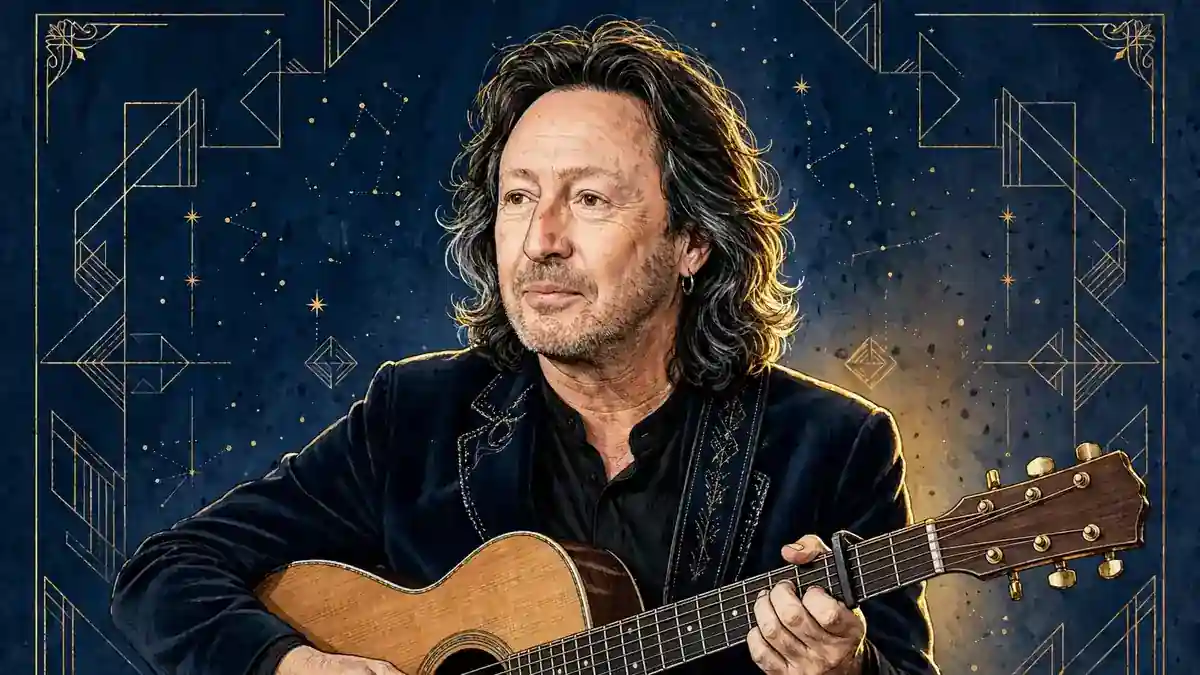
Julian Lennon‘s net worth is estimated at $50 million as of November 2026. The figure sits at the centre of a wide spread of published estimates, from $40 million to $55 million, and it rests on three very different pillars: a platinum-selling music career that began with Valotte in 1984, a fine-art photography career that has filled galleries from New York to Venice, and a mid-1990s out-of-court settlement with Yoko Ono over his late father John Lennon’s estate, a sum that was never publicly disclosed. Julian Lennon has spent four decades building an income of his own while carrying the most famous surname in popular music, and the money story that emerges is far more interesting than a single inheritance cheque.
Julian Lennon: Quick Facts
| Estimated net worth | $50 million (range: $40 million–$55 million) |
|---|---|
| Profession | Musician, singer-songwriter, photographer, author, filmmaker, philanthropist |
| Nationality | British |
| Born | 8 April 1963 (age 63) |
| Height | 5 feet 8 inches (1.73 m) — reports vary between 5 ft 8 in and 5 ft 9 in |
| Primary income sources | Music royalties and catalogue, fine-art photography sales and exhibitions, books, film production, estate settlement |
| Active years | 1984–present |
| Last reviewed | November 2026 |
- Early Life and Background
- Education
- Career Journey
- Rise to Fame
- Main Sources of Income
- Salary and Earnings
- Businesses and Investments
- Brand Deals and Sponsorships
- Houses, Cars and Other Assets
- Awards and Achievements
- Net Worth Growth Over the Years
- Social Media Presence
- Personal Life
- Sources & Reporting
- Frequently Asked Questions
- Final Thoughts
Early Life and Background
Julian Lennon was born John Charles Julian Lennon on 8 April 1963 at Sefton General Hospital in Liverpool, England, the only child of John Lennon and his first wife, Cynthia Powell. He arrived at the exact moment Beatlemania was turning his father into a global figure, and that timing shaped everything that followed: the boy grew up famous before he had done anything at all, and the adults around him were managing a phenomenon rather than a family. In 2020 he legally reordered his names to Julian Charles John Lennon, a small administrative change that carried a large personal meaning — the name the world knew him by finally came first.
His parents’ marriage ended when Julian was five. John Lennon left Cynthia in 1968, and his relationship with Yoko Ono became one of the most reported love stories of the decade. Julian stayed with his mother, and for long stretches father and son had little contact. He told The Guardian in a January 2025 interview that after his father left, “it was just mum and me, and we had nothing to do with the Beatles or Dad,” adding that he visited on odd occasions but “we were very much on the outside.” That distance is the key to his whole financial story: unlike his half-brother Sean, born to John and Yoko in 1975, Julian was not raised inside the Beatles machine, and he was not provided for in his father’s will.
Music reached him early anyway. At eleven he played drums on his father’s 1974 album Walls and Bridges, a session credit that still appears on his biography and still surprises people who assume his career began in 1984. Paul McCartney wrote “Hey Jude” for the five-year-old Julian, to comfort him through his parents’ divorce — a song that became the Beatles’ biggest-selling single in the United States, moving five million copies in its first six months. Julian has said the song has “driven him up the wall” over the years, a wry admission from a man who has spent a lifetime being introduced through other people’s work. The song’s history matters to his wealth in a roundabout way: it made him a permanent character in the Beatles story, and that story has kept his name, his catalogue and his memorabilia commercially alive for sixty years.
Cynthia Lennon raised her son largely away from the Beatles’ day-to-day world, and friends and biographers credit her handling of the divorce years with Julian’s later steadiness. He has spoken warmly about learning from the way she dealt with what life handed her, “with love and grace and positivity,” as he put it to The Guardian. His mother died in 2015, and Julian marked her memory the same year by launching the Cynthia Lennon Scholarship for Girls, a project that has since awarded 87 scholarships to underprivileged girls across Africa, Asia, the UK and the US. The scholarship is a clue to how he spends money as well as how he earns it: philanthropy is a running cost in his life, not a late-career flourish.
Education
Julian Lennon was educated at Ruthin School in North Wales, a boarding school a long way — in every sense — from the Liverpool of his birth and the London of his father’s fame. The school years gave him a measure of normality that the Lennon name rarely allowed elsewhere, and they also gave him his first serious musical training. He learned guitar and piano young, and by his late teens he was writing songs and playing in bands, working out whether he wanted a public career at all. The decision took years: he was offered his first record deal in 1983, at twenty, after sending a demo tape to Charisma Records label head Tony Stratton Smith in September of that year. The tape did its job, and the label signed him.
Nothing in his schooling pointed toward photography or film, the two fields that would later rival music as income sources. Those came later, learned on the job: photography during a 2007 tour with his half-brother Sean, film through the environmental documentaries he began producing in the 2010s. His education, in the formal sense, ended at Ruthin; his working education has run for forty years since, and it shows in the range of the income streams below.
Career Journey
Julian Lennon’s recording career began with a debut that most artists would trade a decade for. Valotte, released in October 1984 on Charisma in the UK and Atlantic in the US, was produced by Phil Ramone, the fourteen-time Grammy winner whose credits ran from Billy Joel to Paul Simon. Ramone recorded the album between February and August 1984 at Muscle Shoals Sound Studio in Alabama, Bear Tracks in Suffern, New York, and three New York City studios — A&R Recording, Clinton Recording and the Hit Factory, where his father had recorded shortly before his death four years earlier. The album peaked at No. 17 on the US Billboard 200 and No. 20 in the UK, and the Recording Industry Association of America certified it gold on 9 January 1985 and platinum on 13 March 1985, marking one million copies shipped in the United States. Film director Sam Peckinpah, of The Wild Bunch fame, directed the videos for the two hit singles.
The follow-up albums traced a familiar arc for a debut that big: solid work, smaller numbers. The Secret Value of Daydreaming (1986) reached No. 32 in the US and earned a gold certification from the RIAA. Mr. Jordan (1989) peaked at No. 87 in the US but reached No. 18 in Australia. Help Yourself (1991) went gold in Australia, where its single “Saltwater” spent four weeks at No. 1 and reached No. 6 in the UK — his biggest international hit after the debut singles. After Photograph Smile (1998) he stepped away from recording for seven years, returning with Everything Changes in 2011 and then, after another long gap, Jude in 2022 on BMG, his first commercial release in more than a decade. Across the catalogue he has released seven studio albums and thirty-eight singles as of August 2025, according to his discography record.
Photography changed the shape of his career in 2007, when he began documenting Sean Lennon’s tour and found a second calling behind the camera. His first major exhibition, Timeless, opened at the Morrison Hotel Gallery in New York in 2010. Since then his work has been shown in more than forty exhibitions across the US, Europe, Asia and elsewhere, including Belgium, Brazil, France, Germany, Greece, Italy, Japan, Monaco, Portugal, Turkey and the United Arab Emirates. In 2020 he became the first fine-art photographer featured at the Aston Martin Residences in Miami; in 2021 he partnered with Portia de Rossi’s General Public and Restoration Hardware to sell a collection. His largest exhibition to date, the retrospective Whispers, ran at Le Stanze della Fotografia in Venice through November 2024. A 2025 show, Reminiscence, ran at the Fremin Gallery in Chelsea, New York, from 6 March to 6 April 2025, and a further exhibition, Mosaic, opened at Leica Gallery Prague drawing on his photo book. Few musicians of his generation have built a second career with its own exhibition record, price list and collector base — and that second career is a real, if hard to quantify, part of the $50 million.
Books added a third strand. His Touch the Earth children’s trilogy became a New York Times bestseller, using the White Feather Flier — a small plane that recurs through the books — to teach young readers about the environment. A follow-up for middle-grade readers, The Morning Tribe, arrived in autumn 2021. In 2024 he published his first fine-art photography book, Life’s Fragile Moments, with teNeues: more than 200 photographs gathered over seventeen years, now in its second printing. The book and the Venice retrospective were planned to land together, and Julian has described the rush to finish the book in time for the exhibition opening as one of the hardest deadlines of his working life.
Film came next. As founder of White Feather Films he was executive producer of the Netflix documentary Kiss the Ground (2020), about regenerative agriculture, and its sequel Common Ground (2023), as well as Ai Weiwei’s Turandot (2025). Documentary producing pays differently from record sales — fees and backend participation rather than royalties — but it put him in rooms with streaming money at a point when his recording income had settled into catalogue earnings.
Rise to Fame
Julian Lennon’s fame arrived in two waves. The first was inherited: he was a famous child, the subject of a Beatles song, photographed from birth. The second was earned in eighteen months between late 1984 and early 1985. “Valotte,” the title track of his debut, entered the Billboard Hot 100 at No. 64 on 20 October 1984, climbed into the top forty by early November, and peaked at No. 9 in the week of 12 January 1985 after a nineteen-week chart run. “Too Late for Goodbyes” did better still: No. 6 in the UK, No. 5 on the Billboard Hot 100, and No. 1 on the US Adult Contemporary chart, where it spent two weeks at the top. Both singles were US Billboard Top 10 hits, both had videos by Sam Peckinpah, and the album’s platinum certification followed within five months of release. The Grammy nomination for Best New Artist in 1985 sealed the debut as a genuine commercial event rather than a curiosity about a famous surname.
What followed was the harder part of the story. No later album matched Valotte, and the press comparisons to his father — his voice, his phrasing, his piano-led ballads — never stopped. Julian has said the comparisons were never a conscious choice: “It’s not a conscious effort to sing like that. When you sing, you sing,” he told Creem in 1986. The 1991 single “Saltwater” gave him a second international moment, topping the Australian chart for four weeks, but by the late 1990s his public profile had shifted from chart singer to working artist with several disciplines. The 2022 album Jude — named for the song written for him as a child — was a deliberate piece of reclamation, and the four-track EP because…, released on 24 October 2025 with the songs “because…,” “I hope,” “Keep on searching” and “I won’t give up,” showed he was still recording into his sixties. In 2025 he told interviewers he was putting together a band and rehearsing new material, a sign that music remains a live income line rather than a closed chapter.
His fame has always carried a financial paradox. The Lennon name opens doors — exhibitions, documentaries, auctions — that a working photographer or mid-level recording artist would struggle to open. It also caps what he can earn from the biggest pot of money attached to that name: the Beatles and John Lennon catalogues, in which he holds no major stake. That tension explains why his net worth is $50 million rather than $500 million, and why the settlement, the photography and the catalogue he does own matter so much to the total.
Main Sources of Income
Julian Lennon’s income comes from five streams, and their balance has shifted sharply across his career. In the 1980s, record sales dominated. Today, the mix is closer to even: catalogue royalties, photography sales and exhibition fees, book advances and royalties, film production fees, and the long tail of the estate settlement, which was received as a lump sum in the 1990s and has been invested since. None of the streams is large on its own by superstar standards, and that is the point: the $50 million is a composite, built slowly across four decades rather than won in a single deal.
Music royalties and catalogue. The Valotte album’s platinum certification in the US means at least one million copies shipped, and “Too Late for Goodbyes” and “Valotte” remain his most-streamed and most-licensed songs. Catalogue income for a 1980s artist arrives in small, steady amounts: streaming pennies, radio play, sync licences for film and television, and compilation appearances. The 2022 album Jude and the 2025 EP because… refreshed the catalogue and gave streaming services new material to surface. He also earns as a songwriter on his own compositions, a separate royalty stream from his earnings as a performer. Crucially, he is not a primary beneficiary of the Beatles songwriting catalogue, as Wikipedia’s entry on him notes — the Lennon–McCartney royalties flow elsewhere, and his own catalogue is the one that pays him.
Fine-art photography. This is the income stream competitors most often underplay, and it is the one that has grown fastest since 2010. A photographer with exhibitions at the Morrison Hotel Gallery, Fotografiska New York, Le Stanze della Fotografia in Venice and Leica Gallery Prague sells limited-edition prints at gallery prices, and the 2021 partnership with General Public and Restoration Hardware put his work in front of furniture buyers as well as collectors. His first photo book, Life’s Fragile Moments, reached a second printing, which means the publisher paid for a second run — a concrete commercial signal in a business where most photography books never earn out. Exhibition fees, print sales, book royalties and the occasional brand-adjacent commission together make photography a serious second career rather than a hobby with a gallery habit.
Books. The Touch the Earth trilogy’s New York Times bestseller status is the headline, but the backlist matters too: children’s books sell steadily for years, and the environmental-education angle keeps the trilogy in school and library circulation. The Morning Tribe (2021) extended the series to older readers. Book income is modest next to a platinum album, yet it is regular, and it supports the photography and foundation work that share the same environmental themes.
Film and documentary production. Executive-producer credits on Kiss the Ground (2020) and Common Ground (2023) put Julian in the streaming documentary economy, where Netflix-scale distribution pays producer fees and, where deals allow, a share of downstream revenue. Turandot (2025), Ai Weiwei’s film, added an art-house credit. These are project fees rather than annuities, and they cluster in busy years rather than arriving monthly.
The estate settlement. The settlement with Yoko Ono, reached out of court in the mid-1990s after a legal battle reported to have run for sixteen years, is the single largest sum Julian has ever received. Its exact size was never disclosed, and published guesses run from a few million dollars to more than $20 million, with several outlets reporting a figure around £20 million, roughly $25 million at the exchange rates of the time. Even at the low end of that range, a lump sum received in the 1990s and invested for thirty years is a large share of a $50 million net worth today. It is also the least transparent part of the fortune, which is why this article publishes a range rather than a single confident number.

Salary and Earnings
Julian Lennon has never drawn a salary in the conventional sense, and there is no public record of an annual pay figure. His earnings arrive as royalties, print sales, advances, fees and investment returns, which makes year-by-year salary tables guesswork — and this article will not invent one. What the public record does support is a clear shape: a large early peak, a long middle period of steady catalogue and touring income, and a second act built on photography, books and film from 2010 onward.
The early peak is measurable. A platinum album in 1985, two US Top 10 singles, a world tour across the United States, Australia and Japan between March and June 1985, and a Grammy nomination: that eighteen-month run was the highest-earning period of his music career, and the royalties from it still pay today. The gold certification of The Secret Value of Daydreaming in 1986 and the Australian gold for Help Yourself in 1991 added smaller peaks. “Saltwater” spending four weeks at No. 1 in Australia in 1991 was a meaningful royalty event in a market where the single was a genuine hit rather than a curiosity.
The middle years are quieter in the record, and honest reporting says so. Touring, session work, voice acting and smaller releases kept income coming in, but no second platinum album arrived. The 1998 album Photograph Smile and the 2011 comeback Everything Changes sold modestly. What changed the earnings picture was not a hit record but the settlement money working as capital, plus the photography career’s arrival in 2010. A working photographer with Julian’s exhibition record earns from print editions, and limited editions of a well-known artist’s photographs command four-figure prices per print; across dozens of exhibitions, that is a real revenue line, even though no gallery publishes his sales figures.
Two one-off earnings events deserve their own mention because they are documented with exact numbers. In February 2022, the “Lennon Connection: The NFT Collection” — six NFTs of items from his private collection of Beatles and John Lennon memorabilia, sold through Julien’s Auctions and the YellowHeart marketplace — brought in $158,720 in total. The top lot, the NFT of Paul McCartney’s handwritten notes for “Hey Jude,” sold for $76,800, a record price for a Beatles NFT at auction. Other lots included an Afghan coat from Magical Mystery Tour ($22,400), a Gibson guitar gifted by his father ($22,400), and a black cape from the film Help! ($12,800). Julian kept the physical items; buyers received the NFT, narrated by Julian with a personal memory. A portion of proceeds went to the White Feather Foundation. Then, in a 2025 Julien’s Auctions sale, items from his collection carried published estimates that show the underlying value of the memorabilia he still holds: a typed sheet of his father’s “Yer Blues” lyrics carried a top estimate of $80,000, and US gold discs for “Hey Jude” and Revolver were estimated at $5,000 and $4,000. These are estimates, not sale prices, but they put a number on a collection that most net-worth roundups ignore entirely.
For comparison, the catalogue-sale market gives a sense of scale for what his own songbook is worth. Bob Dylan’s own catalogue fortune was built on a nine-figure sale of a vastly larger body of work, and Julian’s catalogue — seven studio albums, two Top 10 singles, one platinum record — is a fraction of that size. His music earns steadily rather than spectacularly, which is why the photography and settlement matter so much to the total. A second useful comparison is John Fogerty’s long fight to reclaim his own songs, a reminder that for artists of Julian’s generation, owning the work is often worth more than the original hit.
Businesses and Investments
Julian Lennon runs his working life through a small group of ventures rather than a single company. The White Feather Foundation, founded in 2007, is a nonprofit, not a business — but it is the organisational centre of his public life, and it shapes where his time and money go. The foundation began after elders of the Mirning people in Australia asked for help preserving their Indigenous culture, and it has since widened to education, health, clean water, environmental protection and support for Indigenous communities. It also functions as a platform: foundation trips generate the photographs that become exhibitions and books, and the books fund the foundation’s visibility. The loop is deliberate, and it is how a mid-size fortune sustains a global philanthropic footprint.
White Feather Films is the production arm, behind Kiss the Ground, Common Ground and Turandot. Documentary production is a project business: money is raised per film, fees are paid per film, and the upside sits in distribution deals. The Netflix placement of Kiss the Ground in 2020 was the commercial high point of this strand.
On investments, the record is thin, and this article will not pad it. Julian has not given interviews detailing a property portfolio, a stock book or startup stakes, and no filing lists them. What can be said with confidence is that a settlement received in the 1990s, plus thirty years of royalties and print sales, had to be invested somewhere to still be worth $50 million in 2026 — money left idle does not survive three decades of living costs, philanthropy and Monaco rents. Some roundups credit him with $10 million to $12 million in investments and real estate; that figure is an analyst’s allocation, not a documented holding, and we carry it as an estimate rather than a fact. The one property transaction that is on the record is his 1988 purchase of land in the Santa Monica Mountains for a reported $1 million to $2 million: a former Second World War bunker of 2,400 square feet on a mountaintop site, later renovated and expanded to around 4,000 square feet, with thick concrete walls, a pool and panoramic views. Whether he still holds it is not publicly confirmed, and we do not count it at a current value.
His most distinctive asset is not a company at all: it is the collection of his father’s papers, guitars, clothing and memorabilia that he has kept since childhood, including the Gibson Les Paul copy his father gave him as a Christmas gift and the handwritten “Hey Jude” notes. The 2022 NFT sale proved the collection can be monetised without selling the objects themselves — $158,720 for digital editions of six items, with the physical pieces staying in his hands. That model, selling the story and the scarcity while keeping the object, is a neat summary of how Julian has handled the Lennon legacy as a financial asset: he mines it carefully, in small amounts, and he does not sell the family silver.
Brand Deals and Sponsorships
Julian Lennon has never been a brand ambassador in the usual celebrity sense, and there is no record of a sneaker deal, a watch contract or a fragrance line. The partnerships he does have sit inside his photography and philanthropy, and they pay in access and distribution rather than endorsement fees. The 2020 Aston Martin Residences Miami placement made him the first fine-art photographer featured in the development’s gallery — a prestige association that put his prints in front of luxury property buyers. The 2021 partnership with Portia de Rossi’s General Public and Restoration Hardware brought a collection of his photography to the retailer’s customers, a distribution deal with a commercial edge. Leica’s Prague gallery hosted his Mosaic exhibition, a relationship with a camera maker that fits a photographer far more naturally than a paid advertisement would.
His foundation work has attracted institutional partners rather than consumer brands: UNESCO named him a Peace Laureate in 2020, and the CC Forum honoured him with a Philanthropy Award in Monaco in September 2020. These are honours, not pay cheques, but they carry the kind of credibility that keeps exhibition invitations and documentary commissions coming. The honest summary is that brand income is a small slice of his fortune — the money sits in royalties, print sales and the settlement, not in sponsorships.

Houses, Cars and Other Assets
Julian Lennon has made his home in Monaco for many years, telling Monaco Life in 2024 that he considers the principality home. Monaco is a choice with financial logic as well as personal appeal: it is the base from which he travels to exhibitions, foundation projects and recording sessions, and it is a long way from the attention that follows the Lennon name in London or Los Angeles. No public record gives the value of his Monaco residence, and this article does not guess one. What is documented is the earlier Santa Monica Mountains property, bought in 1988 for a reported $1 million to $2 million — a converted wartime bunker expanded to about 4,000 square feet — and his long-standing connection to New York, where his first photography exhibition opened and where he has kept a working base for gallery and publishing work.
Cars do not feature in his public story. Unlike many musicians of his generation, Julian has never been photographed with a collection, never fronted a motoring brand, and never discussed vehicles in interviews. The absence is worth noting because net-worth roundups often invent a car collection to fill a section; there is nothing to fill it with here, and we leave it empty rather than invent one.
The assets that matter are paper and canvas rather than bricks and metal: the music catalogue, the photography archive, the book backlist, the film credits, and the memorabilia collection. The photography archive alone — seventeen years of work distilled into Life’s Fragile Moments, plus the exhibition prints — is an appreciating asset in the literal sense: limited-edition prints by an artist with a growing exhibition record tend to rise in value, and Julian’s record has grown every year since 2010. The memorabilia collection’s value is proven by the market rather than asserted by us: the 2022 NFT sale’s $158,720 total and the 2025 auction estimates, led by the $80,000 top estimate for the “Yer Blues” lyric sheet, give outside parties’ numbers for objects he still owns.
Awards and Achievements
Julian Lennon’s awards shelf is modest next to his father’s, and that is part of the story: his career has been a working artist’s career, not a trophy hunt. The headline honour is the Grammy nomination for Best New Artist in 1985, earned on the strength of Valotte. The album’s platinum certification in the US and gold certifications for The Secret Value of Daydreaming and, in Australia, Help Yourself are the commercial markers that sit alongside it. “Too Late for Goodbyes” reaching No. 1 on the US Adult Contemporary chart and “Saltwater” spending four weeks at No. 1 in Australia are the chart achievements that still anchor his live set and his streaming numbers.
The second half of his career has brought a different kind of recognition. In September 2020 he received the CC Forum Philanthropy Award in Monaco, and the same month UNESCO’s Center for Peace named him a 2020 Cross-Cultural and Peace Crafter Award Laureate — its Peace Laureate honour. The Touch the Earth trilogy’s New York Times bestseller status is a publishing achievement that few musicians manage. The photography honours are institutional rather than competitive: first photographer featured at Aston Martin Residences Miami, a Venice retrospective at Le Stanze della Fotografia, a book in second printing, exhibitions at Leica Gallery Prague and Fotografiska New York. None of these carries a cash prize, and all of them carry the credibility that keeps a photography career earning into a seventh decade.
Net Worth Growth Over the Years
Tracking Julian Lennon’s net worth year by year is an exercise in reading estimates, not accounts, and the table below is labelled as such. The pattern it shows is consistent across sources: a fortune that was built in the 1980s, transformed by the settlement in the 1990s, and then held roughly steady, growing slowly through photography, books and investment returns rather than through new hits. The $50 million figure has been the consensus since at least 2021, which tells its own story — this is a stable fortune, not a rising one, and the stability is the achievement.
| Year | Estimated net worth | What changed |
|---|---|---|
| 1985 | $2 million–$5 million | Valotte goes platinum; two US Top 10 singles; first world tour |
| 1990 | $5 million–$8 million | Four albums released; “Saltwater” tops the Australian chart |
| 1996 | $25 million–$35 million | Out-of-court settlement with Yoko Ono reported at around £20 million |
| 2005 | $30 million–$40 million | Catalogue royalties compound; photography career begins in 2007 |
| 2015 | $40 million–$50 million | First photography decade; Touch the Earth bestseller; foundation work widens |
| 2021 | $50 million | Consensus figure settles; Jude recording under way |
| 2023 | $50 million | Common Ground released; Life’s Fragile Moments published 2024 |
| 2025 | $50 million | Whispers retrospective; Reminiscence in New York; because… EP |
| 2026 | $50 million | Mosaic at Leica Gallery Prague; memoir in progress |
The table’s early rows are the least certain and are labelled as ranges for that reason. The 1996 jump is the one structural break: whatever the settlement’s exact size, it multiplied his wealth in a single stroke, and every estimate since has been built on top of it. The flat line from 2021 to 2026 is not a failure to grow but a sign of a mature portfolio: catalogue royalties, print sales and investment returns roughly matching living costs, philanthropy and the expense of mounting exhibitions on three continents. A fortune that holds its value for five years while its owner gives large amounts of time and money away is doing its job.
Peer comparison puts the number in context. His father John Lennon’s net worth at his death in 1980 was about $200 million, worth more than $800 million in today’s dollars according to Celebrity Net Worth — and Julian received almost none of it directly. His half-brother Sean, born into the estate, is generally reported in a higher bracket. Among his own generation of singer-songwriters, Julian’s $50 million sits in the solid middle: far below the nine-figure catalogue fortunes of the biggest sellers, and far above the one-album artists whose royalties dried up in the 1990s. The streaming era has been kind to him in a quiet way — Taylor Swift’s streaming-era earnings show what a current chart-topper can make, and Julian’s catalogue earns a small, steady share of the same system every month without a tour or a new release to support it.
Social Media Presence
Julian Lennon uses social media the way a working photographer does: as a gallery wall and a noticeboard, not as a reality show. His Instagram account, @julespicturepalace, is where he shares his photography, and roundups published in 2025 put its following at roughly 359,000. His Facebook page, Julian Lennon Official, is his largest audience at about 1.4 million followers. On X he posts as @JulianLennon to around 324,000 followers, his TikTok account @julianlennonofficial has roughly 78,000 followers, and his YouTube channel @JulianLennon has about 135,000 subscribers. These are approximate figures from 2025 roundups, and they move month to month; the ordering is stable, with Facebook first and TikTok last.
The commercial value of that audience is modest next to his other income streams. He does not run a merchandise empire through his accounts, and his posts promote exhibitions, books, foundation projects and new music rather than paid partnerships. The accounts matter to the net-worth story in a subtler way: they are the distribution channel for the photography and the foundation, and they keep his name current with an audience that buys prints and books. His 2022 announcement of the NFT collection went out on X, and the $158,720 the sale raised was, in part, a social-media conversion event — a following turned into buyers in a single week.
Personal Life
Julian Lennon has never married, and he keeps his romantic life private; no long-term partner is publicly documented, and this article does not speculate about one. He has no children. His closest public family relationship is with his half-brother Sean Lennon, and it is a warm one: the two speak daily, according to Julian’s 2021 remarks to People, and he told The Guardian in 2025 that they “get on like a house on fire” and are “best buddies,” adding that Sean tells him what he can about Beatles matters, “but things are pretty secret on the Beatles front.” In 2023 he told Esquire that the brothers have “never had a fight in our life.”
His relationship with Paul McCartney is cordial but distant, a fact he stated plainly in the 2025 Guardian interview: he is often one of the last to hear Beatles news, and he is “just as curious about them as anybody else.” He has described himself as a fan of his father’s band rather than an insider in it, and the distance does not appear to trouble him — he called it “extraordinarily strange but I’m not upset about it.” The same interview revealed that he is working on a memoir with a difference: “something based more on art and emotions” rather than a standard autobiography. A memoir from Julian Lennon, told in his own voice after sixty years of being written about by other people, is the one future project that could move both his profile and his earnings in a visible way, and it is the reason this article’s 2026 estimate carries a note to watch the publishing announcements.
He lives in Monaco, travels constantly for exhibitions and foundation work, and describes his working life as a balance between music, photography, writing and philanthropy. The through-line is the one he set for himself in the 2025 interview: building “a body of work, a foundation that I can stand on, that nobody can take away from me.” It was not, he said, about showing off — it was about proving to himself that he could do the work. Four decades in, the work is the fortune’s foundation as much as the settlement is.
Sources & Reporting
Reporting window: November 2026, with sources checked against publications dated 2022–2026 and chart records from the RIAA and Billboard via Wikipedia’s discography and album pages. Net worth estimates are drawn from entertainment-finance reporting, not from any disclosure by Julian Lennon, who has never publicly stated his net worth.
Celebrity Net Worth — the $50 million headline estimate, and the $200 million valuation of John Lennon at his death. The Guardian — the January 2025 Observer interview: “not part of the Beatles inner circle,” the memoir plans, the relationship with Sean and with Paul McCartney. Wikipedia — discography and Valotte chart positions, RIAA certification dates, the note that Julian is not a primary beneficiary of the Beatles songwriting catalogue, and the 2025 EP release date. NME and American Songwriter — coverage of the 2025 Guardian interview. Leica Gallery Prague and Fotografiska New York — exhibition records, the Life’s Fragile Moments book details, the Cynthia Lennon Scholarship’s 87 scholarships, the UNESCO Peace Laureate honour and the Kiss the Ground / Common Ground credits. Art Daily and Decrypt — the February 2022 “Lennon Connection” NFT auction total of $158,720 and the $76,800 record for the “Hey Jude” notes NFT. Just Collecting — the 2025 Julien’s Auctions sale estimates, including the $80,000 top estimate for the “Yer Blues” lyric sheet. People — Julian and Sean speaking daily, 2021. Marca and Yahoo Finance UK, via competitor reporting — the $50 million consensus figure. Outlier estimates of $10 million and $55 million–$60 million from lower-authority roundups were noted and discounted in the text, with reasons given.
Frequently Asked Questions
How much is Julian Lennon worth?
Julian Lennon’s net worth is estimated at $50 million as of November 2026, with a published range of $40 million to $55 million. Celebrity Net Worth puts the figure at $50 million, and Marca and Yahoo Finance UK report the same number. Lower estimates of $40 million and higher ones of $55 million to $60 million circulate, but $50 million is the consensus across the most-cited sources.
Did Julian Lennon inherit money from John Lennon?
Almost nothing directly. John Lennon’s 1979 will left the bulk of his estate, worth about $200 million at his death in 1980, to Yoko Ono, and Julian was not named in it. Julian later reached an out-of-court settlement with Yoko Ono in the mid-1990s after a legal battle reported to have lasted sixteen years. The settlement amount was never disclosed, with reports putting it around £20 million, roughly $25 million at the time.
How much did Julian Lennon get from Yoko Ono in the settlement?
The exact figure was never publicly confirmed. The most commonly reported estimate is around £20 million, about $25 million at 1990s exchange rates, though some reports suggest the amount he actually received was significantly less. Other guesses range from a few million dollars to more than $20 million. Because the figure is undisclosed, this article publishes a net-worth range rather than treating any single settlement number as fact.
What is Julian Lennon’s most famous song?
“Too Late for Goodbyes” is his biggest hit: No. 6 in the UK, No. 5 on the Billboard Hot 100 and No. 1 on the US Adult Contemporary chart in 1985. The title track “Valotte” also reached the US Top 10, peaking at No. 9. His later single “Saltwater” (1991) spent four weeks at No. 1 in Australia and reached No. 6 in the UK.
Is Julian Lennon still making music?
Yes. His most recent studio album, Jude, was released in 2022 on BMG, and he released the four-track EP because… on 24 October 2025. In 2025 he said he was putting together a band and rehearsing new material. He has released seven studio albums and thirty-eight singles in total.
What does Julian Lennon do now?
He works across music, fine-art photography, books and film. His photography has been exhibited worldwide since 2010, including a Venice retrospective in 2024 and shows at Leica Gallery Prague and in New York in 2025. He published the photo book Life’s Fragile Moments in 2024, runs the White Feather Foundation, which he founded in 2007, and produces documentaries through White Feather Films.
How old is Julian Lennon?
Julian Lennon is 63 years old. He was born John Charles Julian Lennon on 8 April 1963 in Liverpool, England, and in 2020 he legally reordered his names to Julian Charles John Lennon.
Are Julian and Sean Lennon close?
Yes, they are close. Julian has said they speak daily and that they “get on like a house on fire,” calling Sean his best buddy. He told Esquire in 2023 that the brothers have “never had a fight in our life.” Sean keeps Julian informed about Beatles matters where he can, though Julian says he is not part of the Beatles’ inner circle.
Final Thoughts
Julian Lennon’s $50 million is a fortune built the hard way: a platinum debut at twenty-one, a sixteen-year legal fight for a share of his father’s estate, and then thirty years of steady work across music, photography, books and film. The settlement gave him capital; the work gave him a career that could stand without it. His photography exhibitions now run on three continents, his books sell in second printings, and his 2025 EP and the memoir in progress show an artist still adding to the catalogue rather than living off it. The number itself has barely moved since 2021, and that steadiness is the real story — a fortune that holds its value while its owner gives his time to clean water, Indigenous communities and girls’ education is a fortune doing more than sitting in a bank. Watch the memoir: if it lands as planned, it will be the first time Julian Lennon tells his own story at length, and the first time the market gets a new reason to reassess the name.
Published on 21 November 2026. Last reviewed November 2026. Found an error? See our corrections policy.