
Mario Andretti‘s net worth is estimated at $80 million–$130 million as of November 2026. The most-cited figure is $130 million, published by Celebrity Net Worth and repeated in Alux’s October 2026 ranking of the richest racing drivers in history, while other public estimates run as low as $80 million. Andretti built the fortune across five decades of racing — 111 official wins on major circuits, a Formula 1 world title, an Indianapolis 500 and a Daytona 500 — then kept it growing for 30 years after retirement with a Napa Valley winery, a West Coast petroleum chain, car washes, dealerships and one of the longest endorsement runs in motorsport. In 2026, at 86, he added a new line to the story: a seat on the board of the Cadillac Formula 1 team, the American outfit his family spent years trying to bring to the grid.
Mario Andretti: Quick Facts
| Estimated net worth | $80 million–$130 million (range: $80 million–$130 million) |
|---|---|
| Profession | Retired racing driver; businessman; Cadillac Formula 1 board director |
| Nationality | Italian-American |
| Born | February 28, 1940 (age 86) |
| Height | 5 ft 7 in (1.70 m) |
| Primary income sources | Racing prize money and salaries; endorsements; Andretti Winery; Andretti Petroleum; car washes; licensing and media |
| Active years | 1959–1994 (racing); 1995–present (business) |
| Last reviewed | November 2026 |
- Early Life and Background
- Education
- Career Journey
- Rise to Fame
- Main Sources of Income
- Salary and Earnings
- Businesses and Investments
- Brand Deals and Sponsorships
- Houses, Cars and Other Assets
- Awards and Achievements
- Net Worth Growth Over the Years
- Social Media Presence
- Personal Life
- Sources & Reporting
- Frequently Asked Questions
Early Life and Background
Mario Gabriele Andretti was born on February 28, 1940, in Montona, Istria — then part of the Kingdom of Italy, today the Croatian town of Motovun — six hours before his twin brother Aldo. His father Alvise, known as Gigi, administered a 2,100-acre family farm; his mother Rina raised Mario, Aldo and their older sister Anna Maria. The family owned land and standing in their community. War took both.
After the Second World War, the 1947 Treaty of Paris handed Istria to Yugoslavia. The Andrettis joined the Istrian–Dalmatian exodus in 1948, losing the farm and leaving with a single truckload of possessions. They spent seven years in a refugee camp in Lucca, living in an abandoned college dormitory without running water. The twins raced hand-made wooden cars through the streets at five years old and later parked cars at a local garage, where the owners took them to watch the 1954 Mille Miglia. Alberto Ascari won that race and became Mario’s idol; a trip to Monza for the Italian Grand Prix, where he watched Ascari race Juan Manuel Fangio, fixed the ambition for good.
In 1955, after a three-year wait for United States visas, the family sailed on the SS Conte Biancamano and arrived in New York Harbor on June 16, 1955 — Anna Maria’s birthday — with $125 in cash between them. They settled in Nazareth, Pennsylvania, where Alvise’s brother-in-law lived. Mario was 15, spoke no English, and was placed in seventh grade. The $125-to-$130-million arc that defines his financial story starts on that dock.
Nazareth turned out to host a half-mile dirt track, Nazareth Speedway, and the twins found work at their uncle’s Sunoco station to fund a race car. They bought a 1948 Hudson, fitted it with a stolen beer barrel as a fuel tank, and were ready to race at 19 — two years under the minimum age. A newspaper editor falsified their driver’s licenses so they could compete. The forgery surfaced only after Aldo fractured his skull in a crash and spent 62 days in a coma; the local police chief spotted it and looked the other way to protect Aldo’s health insurance. Their father, who had opposed racing as too dangerous, nearly disowned Mario when he insisted on continuing. He relented. Aldo’s own driving career ended after serious crashes in 1959 and 1969, but he stayed close to his brother’s career for the rest of his life.
The twins won two races each in their first four sportsman events. In their first two weeks of racing they collected $300 in winnings — against $45 a week at the gas station. From 1960 to 1961, Mario won 21 of 46 modified stock car races. To unsettle rivals, the brothers bought Italian racing suits and invented a story about racing in junior formulae back in Italy, a fiction Mario kept up for years before admitting in 2016 that it had been designed to psych opponents out.
Education
Andretti never attended college and holds no degree. His formal schooling was interrupted twice: first by the refugee years in Italy, then by emigration at 15 into an American classroom where he could not speak the language. He caught up through correspondence courses, the same route that put him in contact with Dee Ann Hoch, the English tutor he married in 1961. He once planned to become a welder, a trade that would have kept him near cars without ever putting him in one at speed.
What he learned instead came from the garage and the track. Working at his uncle’s Sunoco station taught him engines, fuel and customer business before he could legally drive. Midget and sprint car racing in the early 1960s taught him chassis setup, tire management and racecraft — skills that later made him unusually valuable to teams and sponsors, because he could develop a car as well as drive it. That technical grounding became a second career asset: Firestone kept him as a test driver and ambassador from 1964 onward, a relationship that lasted six decades and paid long after his last race.
Career Journey
Andretti’s climb ran through every rung of American racing. He raced midget cars in the American Racing Drivers Club from 1961 to 1963, winning his first race of consequence in March 1962 and finishing third in the 1963 ARDC standings after more than 100 events that year. Sprint cars followed, first with the United Racing Club and then USAC, where team owner Rufus Gray gave him a full-time drive for 1964. To cover expenses he worked as a foreman at a golf cart factory.
His IndyCar debut came on April 19, 1964, in the Trenton 100 for Doug Stearly’s team: 16th on the grid, 11th at the flag. Dean Van Lines Racing Division soon signed him, and the results arrived fast. He won his first championship-car race in 1965 at the Hoosier Grand Prix, finished third at Indianapolis and took Rookie of the Year, then won the USAC National Championship in 1965 and again in 1966. In 1967 he added two trophies no American open-wheel driver had combined before: the Daytona 500 with Holman-Moody in NASCAR, and the 12 Hours of Sebring with Ford.
Formula 1 entered the picture in 1968, when he qualified on pole for his debut at the United States Grand Prix with Lotus — a debut pole that remains one of the great first impressions in the sport’s history. He raced part-time in F1 through the early 1970s while his American career peaked: a third USAC title and the Indianapolis 500 in 1969, his first Grand Prix victory at the 1971 South African Grand Prix on debut for Ferrari, and Sebring wins in 1970 and 1972 plus the 24 Hours of Daytona in 1972.
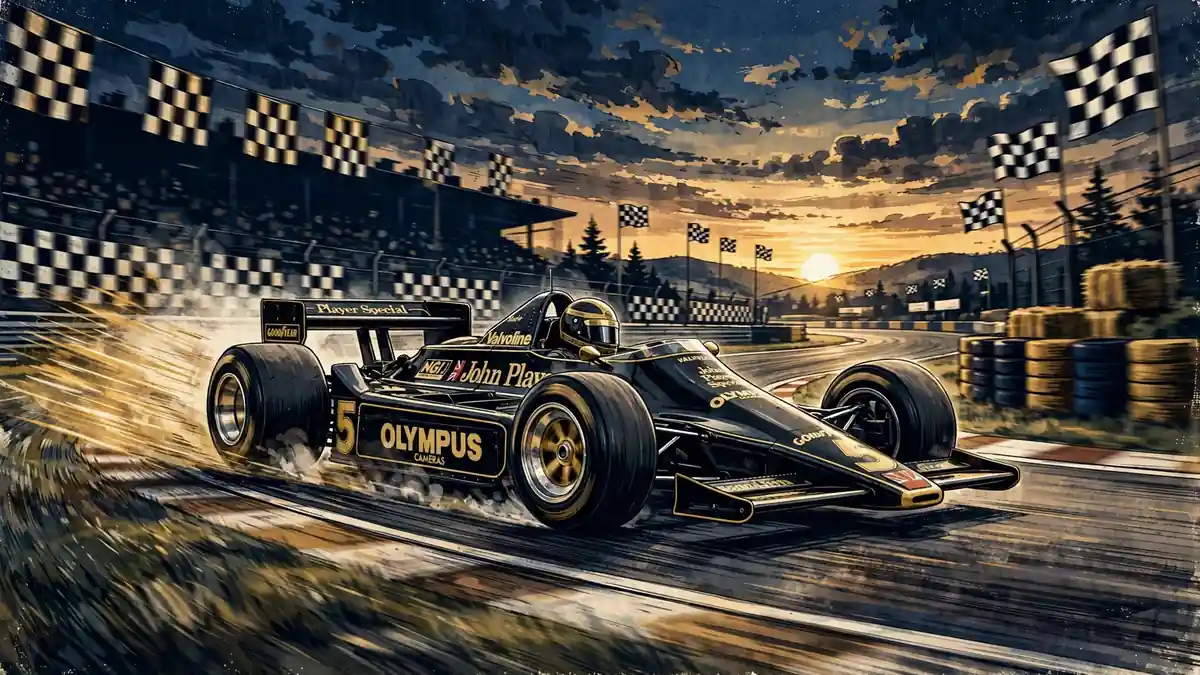
The Lotus years delivered the summit. Rejoining the team in 1976, he won the season-ending Japanese Grand Prix and helped develop the ground-effect Lotus 78. In 1977 he won four Grands Prix and finished third in the championship. In 1978, driving the Lotus 79 — the car that perfected ground-effect aerodynamics — he won six races and nine pole positions and clinched the Formula 1 World Drivers’ Championship, becoming only the second American to do so. His last Grand Prix victory came at the 1978 Dutch Grand Prix. After winless seasons with Lotus, a move to Alfa Romeo in 1981 and fill-in drives for Williams and Ferrari in 1982, he retired from F1 with 12 wins, 18 poles, 19 podiums and 180 points from 128 starts.
He was far from finished. Back full-time in IndyCar with Patrick Racing and then Newman/Haas, he won the Michigan 500 in 1982 and his fourth national championship in 1984 — 15 years after his third, and his first under CART sanction — at 44 years old, with six wins and eight poles that season. He won the Pocono 500 in 1986 and stayed with Newman/Haas until 1994. His final victory, at Phoenix in 1993, made him the oldest winner in IndyCar history at 53 and the first driver to win a race in four different decades. He retired after the 1994 Monterey Grand Prix at Laguna Seca with 52 IndyCar wins, 65 pole positions and 141 podiums from 407 starts.
Rise to Fame
Three seasons made Andretti a household name. The back-to-back USAC titles of 1965 and 1966 announced a 25-year-old who had arrived in America a decade earlier with $125. The 1969 season made him a legend: nine IndyCar wins, five poles, a third national title and victory in the Indianapolis 500 on May 30, 1969, leading 116 of 200 laps. The 1978 Formula 1 title completed a combination no driver before or since has matched — Indianapolis 500 winner, Daytona 500 winner and Formula 1 world champion — and it made him, in Wikipedia’s words, a name synonymous with speed in American popular culture.
The numbers behind the fame hold up against any driver in history. His 111 official victories on major circuits span Formula 1, IndyCar, NASCAR, sports cars and endurance racing. He is one of only two drivers to win races in Formula One, IndyCar, the World Sportscar Championship and NASCAR. He was named driver of the year in three different decades and, in 2000, the Associated Press named him Driver of the Century. The same year he entered the International Motorsports Hall of Fame. Italy honored him with the Order of Merit of the Italian Republic.
Fame in Andretti’s case also carried a commercial afterlife most champions never get. Because he won in so many series, his name stayed valuable to sponsors across categories — tires, fuel, cars, tools, toys — for decades after retirement. His most-quoted line, “If everything seems under control, you’re not going fast enough,” still circulates on team radio clips and motivational posters, keeping the brand alive for audiences too young to have seen him race.
Main Sources of Income
Andretti’s wealth rests on four legs, built in sequence: racing earnings, endorsements, operating businesses and licensing. The racing leg came first and smallest in today’s money. Prize money in the 1960s and 1970s was modest by modern standards — his record 1969 season paid $365,165 in IndyCar prize money, then the largest single-season haul in American sports — and Formula 1 salaries of the era were never publicly disclosed. The real money in driving came from the sponsorship and appearance fees that a champion’s name commanded, and from the relationships that outlived the driving.
Endorsements form the second leg. Firestone has paid him as a test driver, spokesman and ambassador since 1964, a 60-year commercial relationship with few parallels in sport. MagnaFlow, Honda, GoDaddy, Phillips Van Heusen, Chevron and Texaco all carried his name at various points, and Mattel’s Hot Wheels put his likeness on toys. These deals paid in retainers and appearance fees rather than one-off checks: a 2012 Business Observer profile found him spending about 20 days a month on the road for the brands he represented at 72 years old.
The third leg, operating businesses, is where the fortune compounded. Andretti Winery in Napa Valley, Andretti Petroleum’s gas stations and car washes in Northern California, auto dealerships, go-kart tracks, a racing experience business and a merchandise line all convert his name into recurring revenue rather than one-time prize money. The fourth leg is licensing and media: his voice role as himself in Pixar’s Cars (2006), books, video games, replica cars and an IMAX film, plus speaking engagements and the Andretti Signature Line of apparel and collectibles.
A point worth stating plainly: Mario Andretti never owned Andretti Global, the race team. His son Michael built and owned that operation; Mario’s connection to it is as father, adviser and, since 2024, board director of the Cadillac Formula 1 project that grew out of it. The distinction matters because team ownership — the route by which Toto Wolff reached $2.7 billion — was never part of Mario’s balance sheet.
Salary and Earnings
Andretti raced in an era when drivers’ pay was private and prize money was the public record. That makes his earnings history a story of two scales: the modest purses of the 1960s and 1970s, and the business income that followed. The documented figures are specific enough to sketch the arc.
His first paydays were tiny. In dirt-track racing in 1959 and 1960, he and Aldo split winnings race by race; $300 across their first two weeks of racing beat the $45 a week they earned at the gas station, and that comparison decided his career. By 1965 he was a USAC champion; by 1969, his prize money for the season reached $365,165, reported at the time as the largest single-season haul in American sports. The Indianapolis 500 victory that year carried the biggest single purse of his career to that point, and the nine-win season behind it made him the highest-paid American open-wheel driver of his generation — though no contract figure was ever published.
Formula 1 pay in the 1970s stayed behind closed doors. Lotus, Ferrari, Parnelli and Alfa Romeo never disclosed his retainers, and Andretti has never published them. What is public is the shape of the era: even world champions of the late 1970s earned a fraction of what a modern star commands. Alux’s October 2026 ranking notes that Lewis Hamilton’s move to Ferrari in 2025 was reported at as much as $100 million a year — a single season of Hamilton’s pay exceeds Andretti’s entire documented racing prize money many times over. The comparison cuts both ways: Andretti’s fortune was built after racing, not during it, which is why the business sections of this article carry more weight than the prize-money table.
His post-racing earnings are steadier and better documented in kind, if not in dollars. The winery, petroleum chain and car washes generate operating income; the endorsement retainers from Firestone, MagnaFlow and others paid year after year; and the Andretti Racing Experience in Charlotte sells drives in real Indy-style cars to the public. None of these businesses publishes revenue, so no honest article can put a precise annual income on them. What can be said is that the portfolio survived and grew for 30 years after his retirement, through recessions and a pandemic, while he continued to work it personally — a durability that single-season prize money never offers.
One more earnings line deserves a mention because it is genuinely unusual: the Cadillac Formula 1 board seat. Mario serves as a non-executive director on the team’s board, a role he took when TWG Global restructured the project in November 2024. Board fees for such a role are not public, and the value to him is better measured in the Andretti name returning to the Formula 1 grid — the team’s 2026 car, the MAC-26, carries his initials — than in any single paycheck.
Businesses and Investments
Andretti’s business career began before his racing career ended, and it followed a simple rule: sell what he understood. The first venture, Andretti Winery, started in 1995 when he and Joe Antonini — the former chairman and chief executive of Kmart — rescued a struggling Napa Valley vineyard and renamed it. The winery launched in 1996 on 53 acres, with Andretti as vice chairman, and it still operates today, selling estate wines under a label that trades directly on a world champion’s name. Wine is a slow business, but it is also a durable one: the brand has now outlived his racing career by three decades.
Andretti Petroleum followed in 1997. The company owns a chain of gasoline stations and car washes in Northern California, operating under the Texaco and Shell banners, and it grew into one of the largest parts of his portfolio. In a 2012 interview with the Business Observer, Andretti called hiring the petroleum business’s leader away from corporate America the best business decision of his life, saying the business had grown tremendously under that manager. He has described the chain as a partnership with his children, and it remains the clearest example of his shift from athlete to operator.
Auto dealerships were the third leg, and the one he walked away from. At various points he owned Andretti Toyota in Moon Township, Pennsylvania, plus Ford, Chrysler, Nissan and Mitsubishi franchises. He exited the business after concluding that scale was everything — in his own words to the Business Observer, he realized he needed 50 stores, not 12, to compete. The discipline of selling a business that worked but could not win is rarer in athlete portfolios than the purchase, and it says more about his judgment than the dealerships themselves.
The remaining ventures are smaller but true to the same pattern. Car washes and go-kart tracks monetize the Andretti name with the public. The Andretti Racing Experience, based in Charlotte, sells passenger and driving experiences in Indy-style cars. The Andretti Signature Line sells apparel, books and collectibles. He has also been involved in an IMAX film, video games carrying his name and replica cars. None of these individually explains a $130 million estimate; together, held for decades, they do. The common thread is that every one of them is a business he could walk into, understand and promote personally — and for 30 years after retirement, he did, spending most of each month on the road for them.
On investments beyond his operating companies, the public record is thin, and this article will not fill the gap with guesses. He told TheStreet in 2018 that he held partnerships with his children across several businesses, and he has been linked as an early backer or adviser to MagnaFlow, the exhaust company he joined about 11 years before his 2012 interview and which he said had since grown past $1 billion in value. No filing or registry ties a specific equity stake to him, so no investment figure is claimed here. The honest summary is that his wealth is operating wealth — businesses he runs and a name he rents — rather than portfolio wealth.
Brand Deals and Sponsorships
Few athletes in any sport have held a single sponsor for 60 years. Firestone hired Andretti as a test driver in 1964, and the relationship never ended: he has served as spokesman, ambassador and development driver for the brand across six decades, appearing at dealer events and tire launches into his eighties. The deal’s value was never just the fee; Firestone tires were on his winning cars, and the association gave the brand a living link to American racing’s golden era.
MagnaFlow, the performance exhaust maker, is the second-longest thread. Andretti joined the family-owned company about 11 years before his 2012 Business Observer interview, as it moved into the aftermarket exhaust business, and he watched it grow past $1 billion in value. His role combined endorsement with advice, the same pattern as Firestone: a driver who understood the product, not a face on a poster.
Honda, GoDaddy, Phillips Van Heusen and Chevron/Texaco all used him as a spokesman at various points, and Mattel’s Hot Wheels put his cars and likeness in toy aisles. Media coverage of his career has also listed Tommy Hilfiger, Puma, Sony and Bose among his brand associations. Those four are reported by secondary outlets rather than confirmed in interviews, so they are noted here as reported associations rather than verified deals.
The commercial logic of these deals is worth spelling out, because it explains the net worth range. A retired champion’s endorsement income depends on staying visible and credible, and Andretti protected both by working the circuit personally — dealer mornings, trade shows, fan events — rather than lending his name from a distance. That work ethic is also why the deals lasted: sponsors renew people who show up. At 72 he was still spending about 20 days a month traveling for his brands, a schedule most active athletes would find heavy.

Houses, Cars and Other Assets
Andretti has lived in Nazareth, Pennsylvania, since his family settled there in 1955. The town is where he grew up, where he married, where he raised his children and where he still keeps his home. No public property record puts a value on the residence, and this article does not invent one. Unlike many modern athletes, he never built a public real-estate portfolio of headline purchases, and no reporting ties him to additional homes. His most valuable physical assets are his businesses, not his houses.
Cars are a different matter, and here the record is richer. A 2002 profile photographed him with his Lamborghini alongside his winery, and his collection has long included classic and historic race machinery as well as road cars. The exact inventory and value are private — collectors of his standing rarely publish lists — so no figure is attached. What can be said is that a driver who won in Formula 1, IndyCar, NASCAR and sports cars, and who kept relationships with the manufacturers involved, accumulated cars that most collectors can only bid on.
Two cautions belong in this section because other net-worth pages skip them. First, the winery’s 53 acres in Napa Valley are valuable land, but the business is a partnership, not a sole holding, and its value cannot be read off a land price. Second, the petroleum stations and car washes are operating businesses whose value depends on earnings, not on the real estate beneath the pumps. Any estimate that prices Andretti’s wealth by adding up property guesses is guessing twice. The $80 million–$130 million range in this article reflects that uncertainty rather than hiding it.
Awards and Achievements
Andretti’s trophy record is the foundation of everything else in this article, and it is worth listing in full because no single series captures it. In Formula 1: world champion 1978, 12 Grand Prix wins, 18 pole positions, 19 podiums. In American open-wheel racing: national champion 1965, 1966, 1969 and 1984; Indianapolis 500 winner 1969; 52 race wins; 65 poles; 141 podiums. In stock cars: Daytona 500 winner 1967. In endurance racing: 12 Hours of Sebring winner 1967, 1970 and 1972; 24 Hours of Daytona winner 1972; Pikes Peak Hill Climb winner 1969; Michigan 500 winner 1984; Pocono 500 winner 1986; IROC champion 1979; USAC Silver Crown champion 1974.
The honors followed. The Associated Press named him Driver of the Century in 2000, the year he entered the International Motorsports Hall of Fame. He was named driver of the year in three separate decades — the 1960s, 1970s and 1980s — a span no other driver in the sport’s history can claim. Italy awarded him the Order of Merit of the Italian Republic. His final competitive distinction may be the most telling: his 1993 Phoenix victory made him the oldest winner in IndyCar history and the first driver to win races in four different decades.
Measured against his peers, the scale of the fortune comes into focus. Alux’s October 2026 ranking of the richest racing drivers puts Michael Schumacher at $800 million and Lewis Hamilton at $550 million — both men earned modern salaries Andretti never saw, with Hamilton’s Ferrari deal alone reported at up to $100 million a year. Andretti sits 14th on that list at $130 million, ahead of drivers with far bigger paychecks, because his money came from businesses held for decades rather than contracts. The full peer table is below, and the site’s profiles of Lewis Hamilton’s net worth and Michael Schumacher’s net worth carry the detail behind their figures.
| Driver | Reported net worth (2026) | Main wealth engine |
|---|---|---|
| Mario Andretti | $80M–$130M | Winery, petroleum, endorsements |
| Lewis Hamilton | $350M–$550M | F1 salaries, endorsements, investments |
| Michael Schumacher | $600M–$800M | F1 salaries, Ferrari deals, endorsements |
| Tiger Woods | $1.5B (Forbes, 2026) | Golf earnings, endorsements, course design |
The Tiger Woods line is included because it frames the era gap honestly: Woods, whose net worth profile this site carries, built a billion-dollar fortune in a sport with modern prize money and global endorsements, while Andretti built his in an era when a record season paid $365,165. Different eras, different math — and Andretti’s achievement is that he closed much of the gap after retirement, through businesses rather than paydays. Figures in the table are ranges from Alux’s October 2026 ranking and BounceMojo’s 2026 list, with Woods at Forbes’ 2026 estimate of $1.5 billion; the ranges are the point.
Net Worth Growth Over the Years
No year-by-year balance sheet exists for Andretti, so the table below traces the milestones that moved the number, using documented figures where they exist and estimates where they do not. The pattern is a slow build, a long flat period of operating income, and a late rise as the businesses matured and the estimates caught up.
| Year | Milestone | Financial picture |
|---|---|---|
| 1955 | Family arrives in the United States | $125 in cash |
| 1959–1961 | Dirt-track racing begins; 21 wins in 46 modified races | Hundreds of dollars in prize money; $45/week gas station wage left behind |
| 1965–1966 | Back-to-back USAC championships | First championship-level pay; sponsorship begins |
| 1969 | Indianapolis 500 win; third USAC title; nine wins | $365,165 season prize money — then a record in American sports |
| 1978 | Formula 1 world championship with Lotus | Peak racing earnings; global endorsement value established |
| 1994 | Retirement from IndyCar | Wealth shifts from prize money to business and endorsement income |
| 1995–1997 | Andretti Winery rescued; Andretti Petroleum founded | Operating businesses become the main wealth engine |
| 2006 | Voice role as himself in Pixar’s Cars | Licensing and media income; brand reaches a new generation |
| 2012 | MagnaFlow past $1B in value; petroleum chain grown | Portfolio described by Andretti as grown “tremendously” |
| 2024–2026 | Cadillac F1 board seat; team debuts 2026 | Estimated $80M–$130M (2026 public estimates) |
Two things stand out in that timeline. First, the fortune is back-loaded: most of it was made after 1994, not before. Second, the range widened as the estimates multiplied — $80 million at the low end, $130 million at the high end, with $100 million in the middle — which is what happens when private businesses are valued by outsiders. A reader who wants a single number should use $130 million as the most-cited figure and $80 million–$130 million as the honest range.
Social Media Presence
Andretti is active on social media in his eighties, and his accounts read like a working diary of the Cadillac project rather than a nostalgia feed. On X he posts as @MarioAndretti, and on Instagram as @andrettimario, where a 2026 follower tracker put his audience at roughly 90,000. He also keeps a Facebook page under his name, and his official site, marioandretti.com, carries his biography and career highlights.
The content is mostly racing: Cadillac Formula 1 updates, Indianapolis 500 appearances, tributes to fellow drivers and the occasional archival photo from the Lotus years. He posts personally and replies to fans, which is unusual for a figure of his standing and age — and it is commercially useful, because a living, posting champion keeps the endorsement and licensing value alive. His following is modest next to active stars (Hamilton counts his in the tens of millions), but it is large for a retired driver, and it is engaged: his posts about the Cadillac entry in 2024 and 2025 drew heavy coverage in the racing press, with his own words — “My first love was Formula 1, and 70 years later, the F1 paddock is still my happy place” — carried verbatim by outlets announcing the team.
Personal Life
Andretti married Dee Ann Hoch on November 25, 1961. They had met years earlier through the correspondence courses he took to catch up at school after arriving in America; she was his English tutor. The marriage lasted more than 56 years, until Dee Ann died of a heart attack on July 2, 2018. They had three children: Michael, born in 1962; Jeff, born in 1964; and Barbara Dee, born in 1969.
Racing runs through the whole family. Michael won the CART championship in 1991, became one of the most successful drivers in IndyCar history and later built Andretti Global into a major team operation. Jeff raced professionally as well. Grandson Marco followed them into IndyCar, and nephew John Andretti raced in both IndyCar and NASCAR. In 1990, Mario, Michael and Jeff raced together at Milwaukee; in 1991, four Andrettis — Mario, Michael, Jeff and John — competed in the same Indianapolis 500. The family still centers on Nazareth, Pennsylvania, where Mario has lived since 1955.
Off the track, wine is the passion that became a business — he is a noted connoisseur as well as the winery’s vice chairman — and he has stayed close to the sport as an ambassador, appearing at the Indianapolis 500 and Formula 1 events most years. His twin brother Aldo, whose driving career ended with crashes in 1959 and 1969, remained part of that world until his death; the brothers’ story, from a refugee camp to the top of world motorsport, is the human core of the fortune this article measures. Andretti has also spoken openly about the costs of the sport he loves, including the dangers his family lived through, and about the discipline of working into old age: in a 2018 interview with TheStreet he said his plate stayed full by design, and that as long as he could walk he would stay active in something.
Sources & Reporting
Figures in this article were checked against the sources below in November 2026. Where sources disagree on the net worth, the article publishes the range and names who says what, rather than picking a favorite number.
- Celebrity Net Worth — the $130 million estimate, the most-cited figure in this article, plus career summary and the note that the family arrived with $125.
- Alux — October 2026 ranking of the richest racing drivers in history: Andretti at $130 million, Schumacher at $800 million, Hamilton at $550 million, and Hamilton’s Ferrari deal reported at up to $100 million a year.
- Sportscasting — business portfolio summary and the earlier Celebrity Net Worth figure.
- Hotcars — 111 wins across disciplines and the winery and petroleum businesses.
- Encyclopedia.com — biography: refugee years, Nazareth, marriage and children.
- GreenyCars and Paddock Magazine — Cadillac Formula 1 entry: March 7, 2025 approval, Mario’s board seat, the MAC-26 car name and the $450 million entry fee.
Reporting window: November 2026. No private financial disclosure exists for Andretti; all wealth figures are third-party estimates and are labeled as such. Business details come from interviews Andretti gave himself, which are treated as primary statements.
Frequently Asked Questions
What is Mario Andretti’s net worth in 2026?
Mario Andretti’s net worth is estimated at $80 million–$130 million as of November 2026. Celebrity Net Worth, Alux and Sportskeeda put him at $130 million, TheCityCeleb and NetWorthPost at about $100 million, NetWorthList at $85 million and BounceMojo at $80 million. No audited figure exists, so the honest answer is the range, with $130 million the most-cited single number.
How did Mario Andretti make his money?
Racing came first: prize money, salaries and appearance fees across a 35-year driving career, including a record $365,165 season in 1969. The larger share was built after retirement through businesses — Andretti Winery in Napa Valley, the Andretti Petroleum chain of gas stations and car washes, former auto dealerships — plus decades of endorsements from Firestone, MagnaFlow, Honda and others, and licensing income from books, games and his voice role in Pixar’s Cars.
How old is Mario Andretti?
Mario Andretti was born on February 28, 1940, which makes him 86 years old as of November 2026. He retired from racing in 1994 at 54 and remains active in business and motorsport, including his board seat with the Cadillac Formula 1 team.
Is Mario Andretti still alive?
Yes. Mario Andretti is alive and active at 86. In 2026 he serves as a director on the board of the Cadillac Formula 1 team, which debuted on the Formula 1 grid that year, and he continues to appear at the Indianapolis 500 and other racing events.
How many races did Mario Andretti win?
Andretti won 111 official races on major circuits across all motorsport disciplines. The breakdown includes 52 IndyCar wins, 12 Formula 1 Grand Prix wins, the 1969 Indianapolis 500, the 1967 Daytona 500, three 12 Hours of Sebring victories and the 1972 24 Hours of Daytona. He also won four IndyCar national championships and the 1978 Formula 1 world title.
Who was Mario Andretti’s wife?
Mario Andretti was married to Dee Ann Hoch from November 25, 1961 until her death on July 2, 2018 — a marriage of more than 56 years. They met through the correspondence courses he took after arriving in America; she was his English tutor. They had three children: Michael, Jeff and Barbara Dee. Michael won the 1991 CART championship and later owned Andretti Global.
What businesses does Mario Andretti own?
His main holdings are Andretti Winery in Napa Valley, which he rescued with Joe Antonini in 1995 and launched in 1996, and Andretti Petroleum, founded in 1997, which runs gas stations and car washes in Northern California. He has also owned auto dealerships, car washes, go-kart tracks and the Andretti Racing Experience, and he sells merchandise through the Andretti Signature Line. He does not own Andretti Global, the race team — that was his son Michael’s operation.
Is Mario Andretti involved with Cadillac F1 in 2026?
Yes. Mario Andretti serves as a non-executive director on the board of the Cadillac Formula 1 team, a role he took when TWG Global restructured the project in November 2024. The team was approved as Formula 1’s 11th entry on March 7, 2025 and debuted at the 2026 Australian Grand Prix with drivers Sergio Pérez and Valtteri Bottas. Its 2026 car, the MAC-26, carries his initials.
Final Thoughts
Mario Andretti’s fortune is the least typical in this site’s racing coverage, and the most instructive. He never earned a modern superstar salary — his record season paid $365,165, and his Formula 1 pay was never even disclosed — yet he retires into the richest-drivers lists anyway, because he spent 30 years after racing building businesses instead of spending a fortune. The winery, the gas stations, the car washes and the Firestone relationship that has now lasted 60 years did what prize money could not: they compounded.
The $80 million–$130 million range is wide, and that width is honest. Private businesses valued by outsiders always produce a spread, and Andretti has never published a balance sheet. What is not in doubt is the arc: a boy who arrived in New York Harbor with $125, spent seven years in a refugee camp, and became the only driver to win the Indianapolis 500, the Daytona 500 and the Formula 1 world championship — then turned that name into a portfolio that still pays at 86, with a seat on a Formula 1 board to show for it. If the number moves in future estimates, the story behind it will not.
Published on 2026-11-25. Last reviewed November 2026. Found an error? See our corrections policy.