
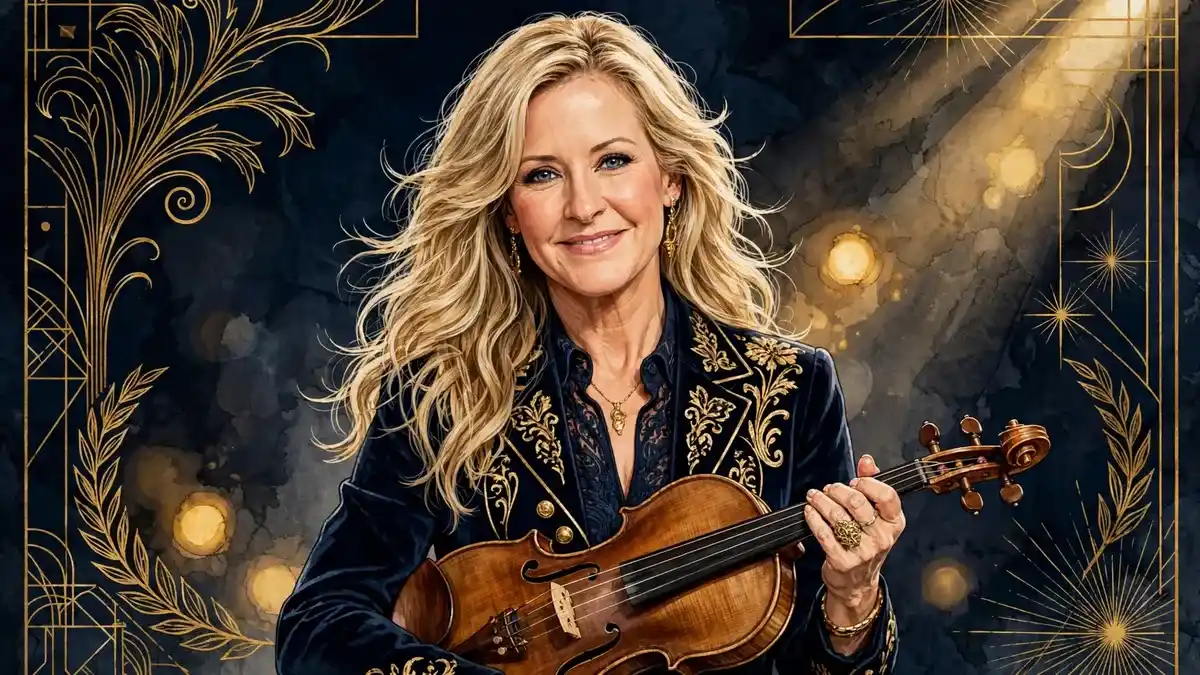
Martie Maguire‘s net worth is estimated at $40 million to $50 million as of November 2026. The fiddle player who co-founded The Chicks has spent 37 years turning a bluegrass busking act into one of the richest catalogues in country music — more than 30.5 million albums sold in the United States, 13 Grammy Awards, a 2016 world tour that took in $26.6 million in ticket sales, and a 2026 anniversary tour that put the band back on arena stages twenty years after its biggest album.
Martie Maguire: Quick Facts
| Estimated net worth | $40 million – $50 million (range: $40M–$50M; midpoint $45M) |
|---|---|
| Profession | Musician, songwriter, fiddle player — founding member of The Chicks |
| Nationality | American |
| Born | October 12, 1969 (age 57) |
| Height | 5 ft 7 in (172 cm) |
| Primary income sources | Album sales and royalties, concert touring, songwriting and publishing, Court Yard Hounds, session work |
| Active years | 1989–present |
| Last reviewed | November 2026 |
- Early Life and Background
- Education
- Career Journey
- Rise to Fame
- Main Sources of Income
- Salary and Earnings
- Businesses and Investments
- Brand Deals and Sponsorships
- Houses, Cars and Other Assets
- Awards and Achievements
- Net Worth Growth Over the Years
- Social Media Presence
- Personal Life
- Sources & Reporting
- Frequently Asked Questions
Early Life and Background
Martha Elenor Erwin was born on October 12, 1969, in York, Pennsylvania, and grew up in Addison, Texas, a Dallas suburb where her parents, Paul Erwin and Barbara Trask, both worked as educators at private schools. She was the middle of three daughters: older sister Julia and younger sister Emily, who would become her bandmate for life. The Erwin household ran on music lessons and school orchestras rather than show business. Martie picked up the violin at five years old, and by twelve she had started playing it fiddle-style — the rhythmic, dance-driven Texas swing approach that later became the signature sound of The Chicks.
As a teenager she was already competing. In 1987, at seventeen, she took second place in the fiddle division at the Walnut Valley National Fiddle Championships in Winfield, Kansas, one of the most respected contests in American bluegrass, and she placed third in another year at the same festival. Those wins mattered in a practical sense: they put a teenager from Addison on the radar of working bluegrass musicians across Texas and Oklahoma. She has said in interviews that she bought her first professional fiddle with money earned babysitting and working at a Braum’s ice cream shop — a small detail that says a lot about how self-funded her start was.
While still in high school she formed a touring bluegrass quartet with Emily and two schoolmates, brother-and-sister duo Troy and Sharon Gilchrist. The four of them played street corners and small stages around Dallas for more than five years. “We’d drive down to the west end of Dallas and open our cases, and that was our job,” Martie later recalled of those busking years. “That’s how we made money in high school.” It was a working education in the economics of live music: no label, no manager, just a case open on the pavement and a crowd deciding whether the playing was worth paying for. That instinct — earn it live, night after night — still shapes how she makes money today, with touring as the largest single income stream in her career.
The sisters’ musical partnership was the constant through those years. Emily learned banjo and guitar while Martie mastered the fiddle, and the two harmonised the way only siblings can, their voices locking into the close intervals that would later define the sound of the Dixie Chicks. By the late 1980s they were ready to build something bigger than a busking quartet, and the bluegrass scene around Dallas gave them the other two pieces they needed.
Education
Maguire attended Greenhill School in Addison, Texas, where she played in the school orchestra and kept competing in national fiddle championships through her teens. Greenhill, a private college-preparatory school, gave her the classical grounding that shows up in her string arrangements — she reads music, writes charts and orchestrates the string parts for the band, skills that go well past what most pop fiddlers ever learn.
There is no record of a university degree, and that is worth stating plainly rather than papering over. Her education was the contest circuit, the school orchestra and five years of paid bluegrass work before she turned twenty. By the time most of her peers were choosing college majors, she was already a working musician with a national fiddle title and a band of her own. The gap shows up in her career in a useful way: she is one of the few arena-level country stars whose authority rests on instrumental mastery and arranging rather than on a vocal spotlight, and the publishing income that follows from that — songwriter credits, arranging credits, session work — is income a singer alone would never see.
Career Journey
In 1989, Martie and Emily joined guitarist Robin Lynn Macy and double bassist Laura Lynch to form the Dixie Chicks, taking the name from the Lowell George song “Dixie Chicken.” The early band played predominantly bluegrass and country standards, working the Texas circuit in cowboy boots and fringe, and the four women shared everything — driving, harmonies, bookings. Their first three albums came out on independent labels: Thank Heavens for Dale Evans in 1990, Little Ol’ Cowgirl in 1992 and Shouldn’t a Told You That in 1993. Those records sold modestly, but they built a live following and taught the sisters how a band actually runs.
The lineup changed twice in the mid-1990s. Macy left in 1992 and Lynch departed in 1995, and the Erwin sisters rebuilt the group around a new lead singer: Natalie Maines, a powerhouse vocalist from Lubbock whose father, Lloyd Maines, was a respected Texas producer. The trio of Maines, Martie and Emily signed to Monument Records and then Columbia, and the machine behind them was suddenly major-label scale. Martie’s role settled into place: fiddle, mandolin, viola, guitar, double bass, backing vocals and string arrangements, plus a growing share of the songwriting.
The first album of the trio era, Wide Open Spaces, arrived on January 27, 1998, and it changed the band’s finances permanently. The record sold more than 13 million copies in the United States — the most ever by a country duo or group — and produced four hit singles, including the title track, “There’s Your Trouble” and “You Were Mine.” Martie co-wrote songs across the catalogue that followed, and in 2000 BMI named her Songwriter of the Year for writing or co-writing a string of hits, an individual honour that matters for her net worth because songwriting royalties pay the writer directly, separate from the three-way split of band income.
Her writing credits include some of the band’s most durable songs. She co-wrote “Cowboy Take Me Away” with Marcus Hummon, a number-one country hit that still earns radio and streaming royalties more than twenty-five years later, and she shared writing credits on “Ready to Run” and “You Were Mine.” Those three songs alone have generated decades of performance royalties, and they are the reason her income did not stop when the band stopped recording. A singer’s voice is tied to the stage; a writer’s catalogue pays while she sleeps.
The years after Wide Open Spaces were a run of escalating scale: Fly in 1999, Home in 2002, and Taking the Long Way in 2006, which debuted at number one on the Billboard 200 and won five Grammy Awards, including Album of the Year. Then came the long pause. After 2006 the trio barely recorded together for fourteen years, filling the gap with touring and side projects, until Gaslighter arrived in July 2020, co-produced by Jack Antonoff and released under the band’s new name, The Chicks — the word “Dixie” dropped in June 2020. The album debuted in the top five and proved the audience had waited, not wandered off.
Rise to Fame
Maguire’s rise was not a solo breakthrough but a group detonation, and her share of it was built on being unmistakable inside the sound. On record after record, the fiddle is the first thing a listener hears: the opening figure of “Wide Open Spaces,” the driving lines under “Ready to Run,” the aching solo on “Landslide,” the band’s 2002 cover of the Fleetwood Mac classic that became one of their signature performances. In a genre where fiddle players are usually hired hands, she was a founder, a writer and the arranger — three income streams where most sidemen have one.
The numbers behind the rise are unusually concrete for a net-worth profile, because the RIAA keeps count. The Chicks have sold more than 30.5 million albums in the United States, making them the biggest-selling American female band of all time, and they are the only female group ever to hold multiple diamond albums — records certified for ten million copies each. Wide Open Spaces alone has sold more than 13 million copies in the US, and the albumism retrospective of 2023 noted that in 1998 its sales exceeded those of every other country group album combined. Fly passed ten million; Home passed six million. Those are catalogue assets that pay royalties every year, in every format, in every territory where the records stream.
The band’s fame also survived a near-fatal blow, and the way it survived matters to the money story. In March 2003, days before the invasion of Iraq, Natalie Maines told a London audience the trio was ashamed to share a home state with President George W. Bush. Country radio stations pulled the band’s records, organised CD-crushing events, and the group’s airplay collapsed almost overnight. The 2003 Top of the World Tour still sold, and the 2006 album answered the boycott with “Not Ready to Make Nice,” a number-four Hot 100 hit that won Record of the Year and Song of the Year at the 2007 Grammys. The episode is now taught in music-business courses as a case study in how a catalogue and a live audience can outlast a radio ban — and it is also why the band’s touring income matters so much to Maguire’s wealth. When radio stopped paying, the stage kept paying.
The name change in June 2020, from Dixie Chicks to The Chicks, was the last big public turning point. It cost the band a brand built over thirty years and gained them a name they could carry into a new era without the historical baggage of the word “Dixie.” The comeback album Gaslighter followed within weeks, and the 2022–2023 world tour — 37 dates across North America and Europe, with Maren Morris supporting the European and Canadian headline shows — confirmed the audience had followed them through the rename. In 2026 the band is on the road again, celebrating the twentieth anniversary of Taking the Long Way with a tour that opened in the autumn and a reissue carrying two previously unreleased tracks, “Thin Line” and “Live Wire.”
Main Sources of Income
Maguire’s income comes from five streams, and their order matters: touring first, then album and streaming royalties, then songwriting and publishing, then the Court Yard Hounds side project, and finally session work. No single stream explains a $40–$50 million fortune on its own. The fortune is the sum of thirty-seven years of all five, with the catalogue compounding the way a savings account compounds — slowly at first, then all at once.
Touring is the engine. The Chicks are an arena band, and arena bands earn their money on the road, where a single night can gross more than a year of streaming. TheRichest’s earnings data puts ticket sales from the 2016 DCX MMXVI World Tour at $26.6 million, and that was one tour in a career of them: the Top of the World Tour in 2003, the Accidents & Accusations Tour in 2006, the DCX MMXVI run in 2016–2017, the 2022–2023 world tour, and the Taking the Long Way 20th Anniversary Tour running through 2026. Merchandise rides on top of ticket income — tour-exclusive shirts, posters and vinyl sold at the venue, where the band keeps a far larger share than it ever sees from a record store or a stream. Even after the split three ways, after the promoter, the crew and the venue take their cuts, a successful arena tour leaves each member with seven figures. Do that five or six times across a career and the touring line alone accounts for a large share of the estimate.
Album sales and streaming royalties are the second stream, and the scale is what sets Maguire apart from most country musicians. More than 30.5 million albums sold in the United States means royalty statements that arrive every six months whether or not the band is working. Streaming has replaced the CD, but the catalogue is so large — two diamond albums, two more multi-platinum records, a live album and a comeback record — that the monthly stream counts stay high. The band’s biggest songs (“Wide Open Spaces,” “Cowboy Take Me Away,” “Landslide,” “Goodbye Earl,” “Not Ready to Make Nice”) are permanent fixtures on country playlists, and each play pays the rights holders. Maguire’s share flows through the band’s royalty arrangements and through her own songwriter’s share where she holds a writing credit.
Songwriting and publishing is the stream most profiles of her skip, and it is the one that most separates her from a hired fiddle player. BMI named her Songwriter of the Year in 2000, and her co-writes on “Cowboy Take Me Away,” “Ready to Run” and “You Were Mine” have been earning performance royalties since the late 1990s. Publishing income behaves differently from touring income: it does not depend on her health, her schedule or the band’s touring calendar. It also survives disputes — the 2003 radio boycott hurt airplay royalties in the short term, but the songs kept earning from television, film licensing and, later, streaming. A writer with three number-one co-writes owns a small annuity, and Maguire has been collecting on hers for a quarter of a century.
Court Yard Hounds, the duo she formed with Emily in 2009, is the fourth stream. The project produced two studio albums — the self-titled debut in 2010 and Amelita in 2013 — and toured smaller rooms while The Chicks were on hiatus. The money was smaller than the main band’s, but it was money the sisters controlled directly, without a third member’s share and without major-label overhead on the touring side. The debut’s single “The Coast” got real radio play, and the duo’s shows kept both sisters’ live income flowing through years when The Chicks were not recording.
Session work is the fifth stream, and the best-known example is her fiddle on Taylor Swift’s “Lover,” the title track of Swift’s 2019 album. Session fees for a player of Maguire’s standing run into five figures per track, and the credit also pays in reputation: when the biggest pop star in the world wants your fiddle on her record, every other artist with a budget knows your number. She has also contributed arrangements and playing to other artists’ records across her career, though the Lover credit is the one that shows up in the record books.
What she does not have, and what honest reporting should say, is a visible endorsement portfolio or a business empire outside music. There are no public records of a fashion line, a spirits brand or a venture-capital portfolio, and no credible source attributes one to her. The fortune is a musician’s fortune: records, stages, songs and a second band, accumulated over nearly four decades.

Salary and Earnings
Maguire has never had a salary in the ordinary sense, and any profile that prints a single annual pay figure for her is guessing. What exists instead is a documented earnings record built from album sales and tour grosses, and it is unusually detailed because TheRichest has published the band’s per-album sales figures. The table below uses those figures, which are the best public data available for the band’s recorded-music income.
| Album / event | Year | Reported sales / gross |
|---|---|---|
| Wide Open Spaces | 1998 | ~12.57 million copies; ~$16.34 million in record sales value |
| Fly | 1999 | ~10.43 million copies; ~$13.56 million in record sales value |
| Home | 2002 | ~6.61 million copies; ~$8.59 million in record sales value |
| Taking the Long Way | 2006 | ~3.66 million copies; ~$4.75 million in record sales value |
| Top of the World Tour: Live | 2003 | ~1 million copies; ~$1.3 million in record sales value |
| DCX MMXVI World Tour | 2016 | $26.6 million in ticket sales |
| Essential Dixie Chicks | 2010 | ~70,000 copies; ~$91,000 in record sales value |
Read those numbers the right way. The “record sales value” column is the retail value of the records sold, not the band’s profit — the label, the distributor, the retailer and the songwriter all take their shares before the artist sees a royalty, and the artist’s royalty is a fraction of the retail price. Even so, the shape of the table tells the story: the late-1990s peak was enormous, with Wide Open Spaces and Fly together accounting for roughly 23 million copies, and the catalogue has kept selling ever since. The 2016 tour figure is the more telling number for her current wealth, because tour income arrives in cash, in the year it is earned, and a $26.6 million gross on a single tour — split three ways after costs — is the kind of money that moves a net worth by millions in a single year.
Annual income in a quiet year looks very different from annual income in a touring year, and that is the honest answer to the question fans ask most. In a year with no tour and no new album, Maguire’s income is mostly royalties: catalogue streams, radio play, licensing and publishing, likely in the low seven figures. In a touring year, the same royalties continue and the tour adds several million more. The 2022–2023 world tour and the 2026 anniversary tour are the recent examples. No outlet has published a verified per-show fee for the band, and this profile will not invent one. What can be said with confidence is that the pattern — big tour years, steady royalty years — is exactly how a $40–$50 million fortune is built by a musician who never had a solo pop career and never sold a product line.
The split matters too. Everything The Chicks earn as a band is divided three ways, so Maguire’s share of a $26.6 million tour gross is not $26.6 million — it is a third of the net after the promoter, the crew, the staging, the transport and the tax bill. That is why the published estimates cluster where they do: her band share of the biggest-selling female catalogue in American history, plus her own songwriting royalties, plus Court Yard Hounds, plus a house sale, adds up to the mid-eight figures rather than the nine. A solo star with the same catalogue would be worth far more. A sideman with the same gigs would be worth far less. Maguire sits in between because she is a founder and a writer, not an employee.
Businesses and Investments
Maguire’s business life is her music business, and it is organised around two entities: The Chicks and Court Yard Hounds. Neither is a startup, and neither has outside investors. Both are working bands that own their catalogues in partnership with their labels, and both generate the kind of recurring income that makes a musician’s balance sheet look more like a small publishing company’s than a performer’s.
Court Yard Hounds deserves more attention than it usually gets in net-worth coverage. Formed in 2009 with Emily while The Chicks were on hiatus, the duo released its debut album in 2010 on Columbia and followed it with Amelita in 2013. Martie sang lead for the first time in her career, which meant a second set of performance royalties and a second touring act. The duo played theatres and festivals rather than arenas, and the economics were modest next to The Chicks, but the project served a purpose beyond money: it kept the sisters working, writing and visible during a fourteen-year gap between Chicks albums, and it kept their names on royalty statements in years when the main band was silent. The 2010 debut’s single “The Coast” and the duo’s touring through the early 2010s are the documented record; there is no public record of a third album, and the project has been quiet since Amelita.
Her publishing catalogue is the other business asset. Songwriting royalties are an investment in the literal sense: a song is an asset that pays for decades, and Maguire’s co-writes from 1998–2002 are still paying in 2026. The BMI Songwriter of the Year award in 2000 is the public marker of how valuable that catalogue was at its peak. Unlike a stock portfolio, a song catalogue cannot be Googled for a current price, which is one reason the published estimates disagree by ten million dollars. Celebrity Net Worth’s $40 million and TheRichest’s $50 million are both attempts to value the same unlisted assets — the catalogue, the future touring income, the real estate — and they land in different places because the inputs are private.
On investments outside music, the public record is thin, and this profile says so rather than filling the gap with guesses. There are no filings, interviews or credible reports showing a venture portfolio, a restaurant group or a product company in her name. The one documented property transaction is the 2013 sale of her Austin home near Lake Travis for $5.4 million, reported by TheRichest, which suggests a comfortable Texas real-estate position built over the years when the band’s album income was at its peak. Some lower-quality profiles describe a Texas ranch property as well; that claim traces to thin sources and has not been verified against a property record, so it is noted here as unverified rather than stated as fact.
Brand Deals and Sponsorships
If you are looking for the sneaker deal or the beauty line, you will not find one, and that absence is itself informative. Maguire has never been an endorsement-first celebrity. The Chicks’ brand partnerships across their career have been tour sponsorships and festival placements rather than personal product deals, and there is no public record of Maguire fronting a consumer brand in her own name.
The comparison with her peers is useful. Miranda Lambert has built retail and lifestyle lines alongside her music, and Carrie Underwood has a fitness and clothing business. Maguire’s career took the other path: the money comes from the stage, the catalogue and the writing room, not from a logo. That is a narrower income base than some of her contemporaries, and it is one reason her net worth sits below the nine-figure fortunes of country stars with large endorsement portfolios. It is also a more durable base in one respect — endorsement deals end when the campaign ends, while a song catalogue pays for life plus seventy years under US copyright law.
Merchandise is the one brand-adjacent stream that does show up in the record. Tour merch — shirts, posters, hats and vinyl sold at the venue — is a real revenue line on every Chicks tour, and the band has sold tour-exclusive items at every major run from 2003 onward. The margins on venue merch are far better than on a record sale, and the income lands in the year of the tour. Streaming-era artists also earn from sync licensing — songs placed in films, television and adverts — and the Chicks’ catalogue, with its mix of defiant anthems and harmony ballads, is licensed regularly. Those cheques are not itemised in any public source, but they are part of the royalty income that keeps the estimate in the eight figures.

Houses, Cars and Other Assets
The most concrete asset in Maguire’s public record is a house, not a car or a watch. In 2013 she sold her Austin, Texas home near Lake Travis for $5.4 million, according to TheRichest’s earnings data. The sale price tells two stories at once: the scale of the property a working musician could buy at the peak of the CD era, and the fact that she held Texas real estate through the years when the band’s income was highest. Austin property bought in the 2000s and sold in 2013 would have appreciated substantially, and the sale is the single largest documented asset transaction in her name.
Beyond that sale, the record goes quiet, and the quiet is deliberate. Maguire has never been a tabloid figure, and she does not publicise her homes, her cars or her possessions. No credible source lists a car collection, a jewellery portfolio or a second home in her name, and this profile will not invent one. What can be said is that her working assets are her instruments. A professional fiddle of the quality she plays — she has owned fine instruments since the one she bought with babysitting money as a teenager — is worth five figures on its own, and her collection across fiddle, mandolin, viola, guitar and double bass is a working musician’s toolkit rather than a display case. The instruments earn their keep on stage and in the studio, which is more than can be said for most celebrity assets.
The catalogue is the asset that matters most and the one that never appears in a photograph. Her share of The Chicks’ recorded catalogue — two diamond albums, two more multi-platinum records, a live album and the 2020 comeback — plus her own songwriting publishing, is the asset that generates income every month of every year. Catalogues of this size have been bought and sold in recent years for multiples of their annual royalty income, and while there is no record of Maguire selling any part of hers, the existence of that market is part of why the published estimates hold up at $40–$50 million. A catalogue that earns seven figures a year is worth eight figures on its own.
Awards and Achievements
The awards list is the strongest evidence for the net worth, because awards track the catalogue that earns the money. As a member of The Chicks, Maguire has won 13 Grammy Awards, including five for Taking the Long Way at the 2007 ceremony — Album of the Year, Record of the Year and Song of the Year for “Not Ready to Make Nice,” along with Best Country Album and Best Country Performance by a Duo or Group. The band also holds six Billboard Music Awards and four American Music Awards, plus a shelf of Country Music Association awards. The Grammy count puts The Chicks among the most decorated groups in country history, and every one of those wins lifted the value of the catalogue behind it.
Her individual honour is the one that belongs on her own line: BMI Songwriter of the Year in 2000, awarded for writing or co-writing a run of hits that included songs from the Fly era. Songwriting awards are not handed out for fame; they are handed out for airplay, and airplay is money. The award is the industry’s own confirmation that her writing was generating real performance-royalty volume at the turn of the millennium.
The sales records are achievements in their own right. The Chicks are the biggest-selling US female band of all time, with more than 30.5 million albums sold in the United States, and the only female group to hold multiple diamond albums. Wide Open Spaces is the fourth best-selling country studio album of all time, behind only Shania Twain’s Come On Over and two Garth Brooks records — company that puts the scale of the achievement in perspective. In 1998 the album’s sales exceeded those of every other country group album combined. Those are not the kind of records a band sets once and forgets; they are the reason the royalty cheques still arrive.
There is also the achievement that does not come with a trophy: survival. The band lost its radio audience in 2003, lost fourteen years to a recording hiatus, changed its name in 2020 and came back to arena tours in 2022 and 2026. Most groups with that history would be a nostalgia act. The Chicks are still selling out theatres and arenas in 2026, with a twentieth-anniversary tour and a reissue carrying unreleased tracks. Longevity is the asset that underwrites the whole estimate.
Net Worth Growth Over the Years
The honest way to show growth is to show what outlets reported, when they reported it, and to say plainly that the differences between outlets are differences in method, not necessarily differences in her bank balance. No year-by-year audited figures exist, and the table below is a record of published estimates rather than a ledger.
| Year | Published estimate | What was driving it |
|---|---|---|
| 2010 | ~$25 million (reported range) | Four studio albums, touring, early Court Yard Hounds income |
| 2013 | ~$30 million (reported range) | Austin house sale of $5.4 million; Amelita release |
| 2016–2017 | ~$40 million | DCX MMXVI World Tour, $26.6 million in ticket sales |
| 2020 | $45 million | Gaslighter comeback; name change to The Chicks |
| 2023 | $50 million | 2022–2023 world tour; catalogue streaming growth |
| 2024 | $40 million (Celebrity Net Worth) | Updated estimate; conservative catalogue valuation |
| 2026 | $40 million – $50 million | Anniversary tour; range reflects outlet disagreement |
The pattern in that table is the pattern of a touring musician’s wealth: flat years when the band is quiet, jumps when it tours. The 2016 tour and the 2022–2023 tour are the two visible step-changes, and the 2026 anniversary tour is the next one. Between tours, the line moves slowly, driven by catalogue royalties and the occasional property sale. The $10 million gap between the two leading estimates is not a rounding error; it is a disagreement about how to value a song catalogue and future touring income, and this profile publishes the range rather than picking a side. One outlet’s $50 million is the optimistic read — full value for the catalogue, full credit for future tours. The other outlet’s $40 million is the cautious read. The truth, as far as the public record allows, sits somewhere between them, and the midpoint of $45 million is the fairest single number to carry.
One stale figure deserves a correction. A handful of low-quality profiles put her net worth at $12 million, a number that appears to confuse her solo income with the band’s shared earnings and to ignore the catalogue entirely. It is not supported by any named source with a methodology, and it sits far below both leading estimates. Readers who find that figure should treat it as an error, not a competing estimate.
Social Media Presence
Maguire keeps a far lower profile online than most stars with her sales record. She does not run a prominent personal account, and she has never been a social-media personality. Announcements, tour dates and new music come through The Chicks’ official channels, and her own public presence is mostly limited to band appearances, interviews and the occasional post tied to a tour or a release. That restraint is consistent with everything else about her career: she is a musician who lets the playing and the writing do the talking, and she has never needed a personal brand to sell records.
The low profile has a financial side too. Social media is a revenue stream for many artists — sponsored posts, affiliate deals, direct-to-fan sales — and Maguire appears to earn little or nothing from it. That is a choice with a cost, measured in the endorsement income she does not collect, and a benefit, measured in the privacy she keeps. Her wealth comes from the stage and the catalogue, not from the feed, and the 2026 anniversary tour sold without a personal influencer campaign behind it.
Personal Life
Maguire has been married three times, and the public record of those marriages is unusually well documented because she has spoken about them herself. She married pharmaceutical representative Ted Seidel on June 17, 1995, and took his surname; she was stepmother to his son Carter. The marriage ended in divorce in 1999. At bandmate Natalie Maines’ sister Kim’s wedding she met Gareth Maguire, a Roman Catholic teacher and actor from Carnlough, Northern Ireland. They became engaged in June 2001 and married on August 10, 2001, in a civil ceremony in Hawaii — the occasion, the band has said, behind the Dixie Chicks song “White Trash Wedding.” She took his surname, which is why her career has carried three surnames: Erwin, Seidel and Maguire.
Maguire and Gareth had three daughters, all conceived through in vitro fertilisation, a subject she has discussed frankly in interviews, including with People magazine. Fraternal twins Eva Ruth and Kathleen “Katie” Emilie were born on April 27, 2004 — Katie named for Gareth’s late sister Kathleen — and third daughter Harper Rosie Maguire was born on July 25, 2008. The couple divorced in 2013. In February 2022 it was revealed that Martie had married Clem Moore, her third husband. She has kept the details of that marriage private, in keeping with a career-long preference for letting the music carry the public story.
Her family remains her closest professional circle. Younger sister Emily Strayer is her bandmate in both The Chicks and Court Yard Hounds, and the two have played together since childhood — first in the school orchestra, then in the high-school bluegrass quartet, then in the biggest-selling female band in American history. Older sister Julia has stayed out of the music business. Her parents, both educators, encouraged the music lessons that started all of it, and the violin she picked up at five years old is still, in a sense, paying the bills.
Sources & Reporting
Reporting window: October–November 2026. Figures were checked against the sources below; where they disagreed, the range is published and the disagreement is named in the text.
- Celebrity Net Worth — $40 million estimate, last updated March 1, 2024; the low end of the published range.
- TheRichest — $50 million estimate; per-album sales figures and the $5.4 million Austin house sale and $26.6 million DCX MMXVI ticket sales.
- Wikipedia — birth name and date, family, marriages and children, fiddle championship results, BMI Songwriter of the Year 2000, band history and discography.
- AllMusic — biography, instruments, Court Yard Hounds discography, session credit on Taylor Swift’s “Lover” (2019).
- Ticketmaster — 2023 world tour details, 37 dates, 30.5 million albums sold, 13 Grammy Awards, Gaslighter production credits.
- BroadwayWorld — Taking the Long Way 20th Anniversary Tour announcement, May 27, 2026; reissue details and unreleased tracks.
- Albumism — Wide Open Spaces 25th-anniversary retrospective; 13 million US copies, fourth best-selling country studio album of all time.
- Country Thang Daily — biographical facts, Court Yard Hounds founding, family details; updated October 15, 2026.
- The Famous People — biography, parents’ names, marriage dates, children and IVF.
Frequently Asked Questions
What is Martie Maguire’s net worth in 2026?
Martie Maguire’s net worth is estimated at $40 million to $50 million as of November 2026. Celebrity Net Worth puts the figure at $40 million, while TheRichest puts it at $50 million; the range reflects different ways of valuing her share of The Chicks’ catalogue and future touring income. The midpoint of $45 million is the fairest single number. The fortune comes from more than 30.5 million albums sold, arena touring, songwriting royalties and her Court Yard Hounds side project.
How old is Martie Maguire?
Martie Maguire is 57 years old. She was born Martha Elenor Erwin on October 12, 1969, in York, Pennsylvania, and grew up in Addison, Texas. She co-founded the Dixie Chicks in 1989 at nineteen and has been performing professionally for 37 years.
Who is Martie Maguire’s husband?
Martie Maguire’s husband is Clem Moore, whom she married in 2022; the marriage was revealed publicly in February of that year. She was previously married to Gareth Maguire, a teacher and actor from Northern Ireland, from 2001 to 2013, and to pharmaceutical representative Ted Seidel from 1995 to 1999.
How many children does Martie Maguire have?
Martie Maguire has three daughters with her second husband, Gareth Maguire: fraternal twins Eva Ruth and Kathleen “Katie” Emilie, born April 27, 2004, and Harper Rosie Maguire, born July 25, 2008. She has spoken openly about conceiving all three through in vitro fertilisation.
What instruments does Martie Maguire play?
Martie Maguire’s main instrument is the fiddle, which she has played since she was five years old, and she also plays violin, mandolin, viola, guitar and double bass, as well as singing backing vocals and harmonies. She arranges the string parts for The Chicks and won BMI Songwriter of the Year in 2000. She took second place in the fiddle division at the Walnut Valley National Fiddle Championships in 1987.
Is Martie Maguire still in The Chicks?
Yes. Martie Maguire is still a member of The Chicks and is touring with the band in 2026 on the Taking the Long Way 20th Anniversary Tour, which celebrates the twentieth anniversary of the band’s 2006 album. The band released its most recent album, Gaslighter, in July 2020, and the 2026 tour follows the 2022–2023 world tour.
What is Martie Maguire’s real name?
Martie Maguire’s birth name is Martha Elenor Erwin. “Martie” is the nickname she has used since childhood. She performed as Martie Seidel during her first marriage and took the surname Maguire from her second husband, Gareth Maguire, in 2001; she has kept the Maguire name professionally ever since.
How did Martie Maguire make her money?
Maguire made her money as a founding member of The Chicks, the biggest-selling American female band of all time with more than 30.5 million albums sold in the US. Her income comes from album sales and streaming royalties, arena touring (including a 2016 tour that took in $26.6 million in ticket sales), songwriting and publishing royalties on hits such as “Cowboy Take Me Away,” her Court Yard Hounds duo with her sister Emily, and session work including fiddle on Taylor Swift’s “Lover.”
Final Thoughts
Martie Maguire’s $40–$50 million fortune is the quiet kind. There was no solo pop career, no product empire and no endorsement machine behind it — just a fiddle picked up at five years old, a sister to harmonise with, and a band that sold more records than any other female group in American history. The money arrived the old-fashioned way: 30.5 million albums, 13 Grammys, arena tours that grossed tens of millions, and a songwriting catalogue that has paid royalties since 1998. The two leading estimates disagree by ten million dollars because a private catalogue and future tours cannot be priced to the dollar, and the honest answer is the range, not a single figure. What is not in doubt is the foundation underneath it. In 2026, thirty-seven years after she co-founded the band on the Dallas bluegrass circuit, she is still on stage with it, still playing the fiddle that built the fortune, and still adding to it one sold-out room at a time.
Published on November 18, 2026. Last reviewed November 2026. Found an error? See our corrections policy.