
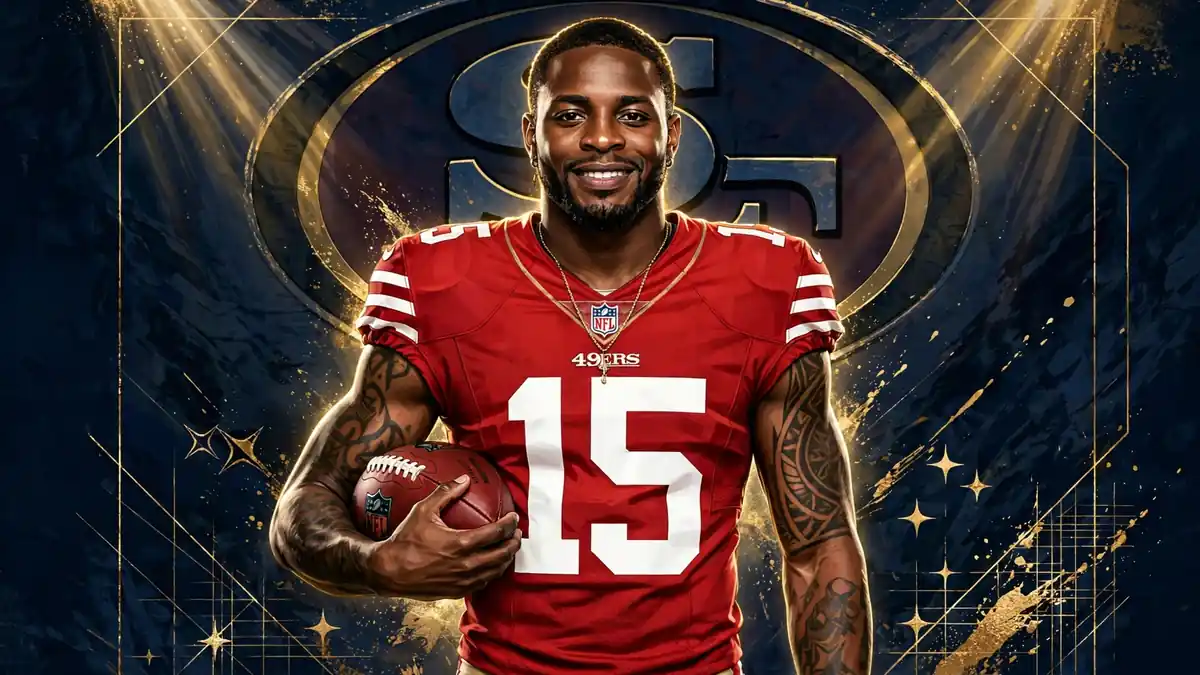
Michael Crabtree‘s net worth is estimated at $14 million to $18 million as of November 2026, with a central estimate of $16 million. The former NFL wide receiver banked $64.6 million in career salary across 11 seasons with the San Francisco 49ers, Oakland Raiders, Baltimore Ravens and Arizona Cardinals, then walked away from football at 32 with a College Football Hall of Fame plaque already on the way and a foundation carrying his name back in Texas.
Michael Crabtree: Quick Facts
| Estimated net worth | $16 million (range: $14 million to $18 million) |
|---|---|
| Profession | Former NFL wide receiver |
| Nationality | American |
| Born | September 14, 1987 (age 39) |
| Height | 6 ft 1 in (1.85 m) |
| Primary income sources | NFL salaries and bonuses, endorsements, appearances |
| Active years | 2009–2019 (NFL); 2007–2008 (college) |
| Last reviewed | November 2026 |
- Early Life and Background
- Education
- Career Journey
- Rise to Fame
- Main Sources of Income
- Salary and Earnings
- Businesses and Investments
- Brand Deals and Sponsorships
- Houses, Cars and Other Assets
- Awards and Achievements
- Net Worth Growth Over the Years
- Social Media Presence
- Personal Life
- Sources & Reporting
- Frequently Asked Questions
Early Life and Background
Michael Alex Crabtree Jr. was born on September 14, 1987, in Dallas, Texas. He grew up in Dallas and attended David W. Carter High School, the same school that produced a long line of Texas football talent. His parents, Michael Crabtree Sr. and Katrina Morgan, separated when he was six years old, and he was raised largely by his mother and grandmother, Bessie Turner. That part of his story matters to the money story that follows: Crabtree did not come from wealth, and the $64.6 million he later earned in the NFL arrived after a childhood in which his family worked hard to provide for him and his siblings.
At Carter High School, Crabtree played quarterback as well as wide receiver, and his athleticism showed early. Recruiters listed him at 6 ft 1 in and around 190 lb with a 4.51-second 40-yard dash, and Rivals rated him as an athlete rather than a pure receiver — a sign of how raw his route-running still was. He committed to Texas Tech on July 8, 2004. The choice shaped everything that came next. Texas Tech under head coach Mike Leach ran the Air Raid, an offense that threw the ball on nearly every down, and a receiver with Crabtree’s size and hands was built for it. He redshirted the 2006 season, then spent two seasons on the field in Lubbock that still rank among the most productive any college receiver has ever put together.
Dallas stayed home for Crabtree after football. Reporting from CollegeNetWorth and the National Football Foundation places him back in Texas after retirement, close to family, and his post-playing public appearances have centred on Texas Tech events and youth work in his home state. He has kept his private life out of the spotlight since his playing days, and that discretion extends to his finances: there are no public property portfolios, no business filings under his name that reporters have surfaced, and no verified interviews in which he discusses his wealth. The estimate in this article rests on the contract record, which is unusually complete for a player of his era.
Education
Crabtree attended David W. Carter High School in Dallas, where he played football and basketball. His high-school production earned him a scholarship to Texas Tech University, where he enrolled in 2006 and played for the Red Raiders from 2006 to 2008, redshirting his first year. He left school after his redshirt-sophomore season to enter the 2009 NFL Draft, so he never completed a degree at Texas Tech — a common path for a player who had just put together two of the best receiving seasons in college football history.
What he did finish at Texas Tech was a record book rewrite. In 2007, his redshirt-freshman season, Crabtree caught 134 passes for 1,962 yards and 22 touchdowns, leading the NCAA in receptions, receiving yards and receiving touchdowns in the same season. He followed that in 2008 with 97 catches for 1,165 yards and 19 touchdowns. Across just two seasons on the field he totalled 231 receptions for 3,127 yards and 41 touchdowns — numbers that still sit near the top of the school record book nearly two decades later. ESPN college football analyst Bill Connelly ranked Crabtree No. 7 among the 60 greatest college wide receivers of the last 50 years in a 2026 ranking, placing a two-season college career alongside players who played three and four years.
The university kept honouring him long after he left. Crabtree is a member of the Texas Tech Ring of Honor, and in 2019 he fully endowed a scholarship at Texas Tech, according to the National Football Foundation — a financial commitment that says something about where his money went after football, and about the value he places on the school that made him. Texas Tech is also the school that produced Patrick Mahomes, whose own rise from Lubbock to NFL stardom followed Crabtree’s by a decade, and the two Red Raiders are now linked in the school’s football lore as its two most famous modern offensive stars.
Career Journey
Crabtree entered the 2009 NFL Draft as the top receiver available and the San Francisco 49ers selected him 10th overall. The pick came with an immediate standoff. Crabtree and his agent, Eugene Parker, held out for a contract closer to the five-year, $38.25 million deal the Raiders had given Darrius Heyward-Bey, the seventh overall pick. The 49ers held firm, Crabtree missed the first five games of the 2009 season, and the two sides finally agreed on October 7, 2009, on a six-year deal worth $32 million in base value with $17 million guaranteed, plus incentives that could have pushed the total to $40 million. NBC Sports reported at the time that the deal could void to five years on performance triggers, and that the per-year guarantee of about $2.83 million was modest for a top-10 pick. The holdout cost him games, but the contract still made him a millionaire at 22.
He debuted in Week 7 of 2009 and caught 48 passes for 625 yards and two touchdowns in 11 games. The numbers climbed each year: 55 catches for 741 yards in 2010, 72 for 874 in 2011, then the breakout — 85 catches for 1,105 yards and nine touchdowns in 2012, his only 1,000-yard season in San Francisco. That 2012 season carried the 49ers to Super Bowl XLVII, where Crabtree caught five passes for 109 yards and a touchdown in the 34–31 loss to the Baltimore Ravens. The final play of that game, a fourth-and-goal pass to Crabtree in the end zone that drew no flag, remains one of the most argued non-calls in Super Bowl history.
May 2013 brought the low point of his career: a torn Achilles tendon in training camp. He missed most of the 2013 season, returned in December, and the 49ers went 7–0 after his return, a run that ended in the NFC Championship Game against Seattle. In that game, Seahawks cornerback Richard Sherman held Crabtree to a single four-yard catch when matched up against him, according to Pro Football Focus charting cited by Bleacher Report — a duel that defined the rivalry that winter. Crabtree played one more full season in San Francisco in 2014, catching 68 passes for 698 yards, and then left in free agency.
Oakland revived his career. The Raiders signed him to a one-year, $3.2 million prove-it deal in April 2015, and he responded with 85 catches for 922 yards and nine touchdowns. That December the Raiders gave him a four-year, $34 million extension. His 2016 season — 89 catches, 1,003 yards, eight touchdowns — was his second 1,000-yard year and his best-paid single season: $11 million in cash in 2016, the largest cap number of his career at $11 million. He played three seasons in Oakland, catching 232 passes for 2,543 yards and 25 touchdowns, before the Raiders released him in March 2018 after signing Jordy Nelson.
Baltimore signed him days later to a three-year, $21 million contract with $8 million guaranteed. He played all 16 games in 2018, catching 54 passes for 607 yards and three touchdowns, and the Ravens released him on February 25, 2019, after one season. His final stop was Arizona: a one-year, $3.25 million deal with the Cardinals on August 21, 2019. He played two games, caught four passes for 22 yards, and was released on September 23, 2019. He never signed with another team. His career totals: 143 games, 637 receptions, 7,499 receiving yards and 54 touchdowns over 11 seasons with four franchises.
Rise to Fame
Crabtree’s fame arrived in college, not the NFL, and it arrived all at once. His 2007 freshman season at Texas Tech was one of the great debut seasons in college football history: 134 catches, 1,962 yards, 22 touchdowns, the NCAA triple crown of receiving categories, the Biletnikoff Award as the nation’s best receiver, the Paul Warfield Trophy, unanimous All-American honours and the AT&T All-America Player of the Year award. He was the first freshman ever to win the Biletnikoff. Then he won it again in 2008, becoming the first player in history to win the award twice, and the first to win the Paul Warfield Trophy twice as well.
The single play that fixed him in college football memory came on November 1, 2008, against No. 1 Texas. With Texas Tech trailing and one second on the clock, quarterback Graham Harrell found Crabtree on the sideline; Crabtree broke a tackle and scored the game-winning touchdown as Jones AT&T Stadium erupted. The catch beat the top-ranked team in the country and sent Texas Tech to No. 2 in the polls. It is still shown in every Texas Tech highlight package, and it is the play most often cited when his College Football Hall of Fame case is made.
That case was settled in 2022, when Crabtree was selected for the College Football Hall of Fame class of 2022 and formally inducted at the National Football Foundation’s annual awards dinner in Las Vegas. He became the sixth Red Raider player enshrined, and the first from the Big 12 era, joining E.J. Holub, Donny Anderson, Dave Parks, Gabe Rivera and Zach Thomas. He remains the only two-time unanimous All-American in Texas Tech history. His NFL fame never quite matched his college fame — he never made a Pro Bowl and never made an All-Pro team — but the 2012 Super Bowl run and the $64.6 million in career earnings gave him a long, well-paid professional career that most college stars never get.
Main Sources of Income
Salary was the engine of Crabtree’s wealth, and it was nearly the whole story. Over The Cap puts his career NFL earnings at $64,607,930 — base salaries, signing and roster bonuses, workout bonuses and dead-money payments from four teams over 11 seasons. Endorsements added a smaller layer on top, and post-retirement income has come from appearances and community work rather than any public business empire. The table below shows how the money split across his career.
| Income source | Career total (approx.) | Notes |
|---|---|---|
| NFL salary and bonuses | $64.6 million | Over The Cap career earnings, 2009–2019 |
| Endorsements | Not publicly disclosed | Subway, EA Sports, Nike Air Jordan reported during career |
| Appearances and speaking | Not publicly disclosed | Texas Tech events, youth clinics, alumni work |
| Investments and business | Not publicly disclosed | No verified public holdings |
The shape of that income matters. Crabtree’s earnings were front-loaded in the middle of his career: his two biggest cash years were 2010, when the 49ers paid him $12,795,000, and 2016, when the Raiders paid him $11 million. Only twice in his career — his rookie year of 2009 and his final year of 2019 — did he earn below $3 million in a season, according to a Texas Tech alumni-site analysis of his contract history. That steadiness is the difference between a player who earns a lot and a player who keeps a lot: Crabtree collected a pay cheque in every one of his 11 seasons, and his contracts carried $25,365,000 in total guarantees, per Over The Cap.
Two things kept his net worth well below his gross earnings. First, taxes: California taxed his 49ers years at the state’s top rates, and his agent’s fee and NFLPA dues took their share. Second, the headline value of his contracts overstated what he collected. The Raiders extension was announced as four years and $34 million; he actually earned $21,669,853 across three Oakland seasons before being released. The Ravens deal was announced as three years and $21 million; he earned $8 million in one season. The Cardinals deal was $3.25 million on paper; he collected $2,375,000 in dead money after playing two games. Any honest estimate of his wealth has to start from the cash actually paid, not the numbers in the press releases.
Salary and Earnings
Over The Cap’s contract record gives the most complete picture of what Crabtree earned, season by season and team by team. The headline figures below are the announced contract values; the “actually earned” column is the cash Over The Cap records him collecting. The gap between the two columns is the single most useful fact in this article, because most net-worth pages on the internet quote the headline numbers as though he banked all of them.
| Contract | Announced value | Actually earned |
|---|---|---|
| 49ers rookie deal (2009) | 6 years, $32 million ($17M guaranteed) | $32,563,077 over 6 seasons |
| Raiders prove-it deal (2015) | 1 year, $3.2 million | $4,100,000 in 2015 (incl. bonuses) |
| Raiders extension (2015) | 4 years, $34 million | $21,669,853 over 3 seasons |
| Ravens deal (2018) | 3 years, $21 million ($8M guaranteed) | $8,000,000 in 1 season |
| Cardinals deal (2019) | 1 year, $3.25 million | $2,375,000 (dead money) |
| Career total | — | $64,607,930 |
By team, the split was $32,563,077 from San Francisco over six seasons, $21,669,853 from Oakland over three, $8,000,000 from Baltimore in one season and $2,375,000 from Arizona without playing a full season. His largest single cash payment came in 2010, when a $5,605,000 roster bonus and a $3,713,240 prorated bonus stacked on top of his base salary for a $12,795,000 year. His largest cap number, $11,000,000, came in 2016 with the Raiders. Spotrac’s career-earnings figure matches Over The Cap’s at just over $64 million, and Sports Illustrated’s Big 12 retrospective also cites the $64 million-plus total — two independent contract databases agreeing is the strongest verification available for an NFL player’s earnings.
Year by year, the cash trail ran like this: $2,393,077 in his shortened rookie season of 2009; $12,795,000 in 2010; then steady seven-figure seasons through the 49ers years; $4,100,000 in his 2015 Oakland reboot; $11,000,000 in 2016; a further $6.57 million across his final two Raiders seasons; $8,000,000 in Baltimore in 2018; and $2,375,000 from Arizona in 2019. The career average annual pay, $6,460,793 per Over The Cap, sits well above the career average for a wide receiver of his era, and it reflects the value of being a top-10 pick with a second act in Oakland after San Francisco moved on.
One more number belongs here because it explains the gap between gross earnings and net worth. A player who earns $64.6 million over 11 years does not keep $64.6 million. Federal tax, California state tax on his 49ers seasons, agent commission (typically around 3 percent on NFL contracts), NFLPA dues, and 11 years of living costs all come out first. If Crabtree kept roughly a quarter of his gross earnings after tax and expenses — a reasonable planning assumption for a player in his tax brackets — that lands almost exactly on the $16 million central estimate. The range of $14 million to $18 million allows for better or worse investment returns and spending after retirement, neither of which is publicly documented.
Businesses and Investments
This is the thinnest part of Crabtree’s public financial record, and honesty requires saying so plainly. No verified reporting ties him to a company he founded, a startup he funded, a restaurant chain, a clothing line or a real-estate portfolio of any scale. Some low-quality aggregator pages claim he invested in real estate, restaurants and a clothing line, but none of them names a property, a business, a partner or a filing, and we do not repeat claims that cannot be traced. The same pages carry the stale $25 million net-worth figure, which appears to be an old estimate copied from site to site rather than a fresh calculation.
What is documented is philanthropy. Crabtree established the Crab5 Foundation, which hosts events each year for underprivileged youth, according to the National Football Foundation. In 2019 he fully endowed a scholarship at Texas Tech, a commitment that runs into six figures at most major universities and that he made in the final year of his playing career. Endowing a scholarship is not a business investment, but it is a real use of money, and it fits the pattern of a player whose public post-career activity has been community work in Texas rather than deal-making.
Two other points belong in this section. First, Crabtree’s college fame has kept earning him invitations — Hall of Fame events, Texas Tech alumni appearances, youth clinics — and appearance fees are a normal income stream for a retired player with his resume, even if no fee is publicly reported. Second, his name still carries commercial value in college football: the 2026 ESPN ranking that placed him seventh among the 60 greatest college receivers of the last 50 years keeps his highlights in circulation, and that visibility is the raw material for endorsement and appearance work. None of this is a business empire, and this article does not present it as one.
Brand Deals and Sponsorships
Crabtree’s best-documented endorsement came before he ever played an NFL down: he signed a national deal with Subway ahead of the 2009 NFL Draft, when he was the most talked-about receiver in the draft class. Celebrity Net Worth notes the Subway deal in its profile of him, and it was the kind of national fast-food contract that went to high-profile rookies in that era. A Celebily profile also names EA Sports, Ubisoft, the Subway franchise and Nike’s Air Jordan brand among his sponsors, but that profile does not date the deals or put dollar figures on them, so we list them as reported rather than verified.
Two things limited his endorsement income relative to his peers. He played most of his prime in San Francisco and Oakland, not in the largest media markets, and his public profile was always quieter than his production — he never made a Pro Bowl, never led the league in a receiving category as a pro, and never chased the spotlight off the field. The receivers who earn eight figures from endorsements tend to be the ones with national campaigns and weekly television exposure; Crabtree’s deals were real but modest, and his wealth was built on salary, not sponsorships.
That split is worth stating because many net-worth pages imply the opposite. For Crabtree, the honest breakdown is roughly $64.6 million in documented team pay, an undisclosed but clearly smaller sum from endorsements, and no verified business income. Anyone who tells you his endorsement earnings in a precise dollar figure is guessing. The central estimate of $16 million already accounts for a modest endorsement layer on top of his salary; it does not need a large one to work.
Houses, Cars and Other Assets
Public records on Crabtree’s property are thin, and one claim needs a flag. A low-quality aggregator page reports that he bought a mansion in Prosper, Texas, in 2016 for $3.5 million. No property record, listing or reputable outlet confirms that purchase, so we report it as an unverified claim rather than a fact. What is confirmed is that he lives in Texas after retirement, according to CollegeNetWorth, and that his public life centres on the Dallas area where he grew up.
No verified reporting covers his car collection, and this article does not invent one. NFL players of his earnings level commonly own high-end vehicles, but “commonly” is not evidence about a specific person, and Crabtree has never posted a garage tour or discussed his cars in an interview that reporters have surfaced. The same restraint applies to watches, jewellery and other luxury assets: absent a source, they stay out of the estimate.
What can be said with confidence is that his asset base is dominated by whatever he retained from $64.6 million in career earnings, minus tax and spending, plus any property he holds in Texas. The $14 million to $18 million range is built on that arithmetic rather than on a list of houses and cars. Readers who want a property-by-property inventory will not find a sourced one anywhere, because Crabtree has kept that part of his life private — and a net-worth site that fills the gap with guesses would be doing its readers a disservice.
Awards and Achievements
Crabtree’s trophy case splits into two halves: a college half that has almost no equal, and a professional half that reflects a solid, durable career rather than a decorated one. The college half is the reason he is in a Hall of Fame. He won the Biletnikoff Award in 2007 and 2008 — the first player ever to win it twice, and still the only two-time winner — along with the Paul Warfield Trophy in both years, another first. He was a unanimous All-American in 2007 and 2008, the only two-time unanimous All-American in Texas Tech history, a two-time first-team All-Big 12 selection, the Big 12 Co-Offensive Freshman of the Year in 2007, and the NCAA leader in receptions, receiving yards and receiving touchdowns in 2007.
The honours kept coming after he left Lubbock. Texas Tech put him in its Ring of Honor, and in 2022 he was selected for the College Football Hall of Fame, formally inducted at the National Football Foundation’s ceremony in Las Vegas. He was the sixth Red Raider player enshrined and the first from the Big 12 era. In 2026, ESPN’s Bill Connelly ranked him seventh among the 60 greatest college wide receivers of the last 50 years.
As a professional, the honours were thinner: no Pro Bowl, no All-Pro selection, no NFL receiving title. His professional achievements are measured in durability and production instead — 637 receptions, 7,499 yards and 54 touchdowns across 143 games; two 1,000-yard seasons, in 2012 with San Francisco and 2016 with Oakland; at least 600 receiving yards in nine different seasons; and a Super Bowl appearance in his fourth season. The contrast between the two halves is the honest shape of his career: one of the greatest college receivers ever, and a very good, well-paid NFL receiver for a decade.
Net Worth Growth Over the Years
Crabtree’s wealth grew in step with his contracts. The table below is a NetWorthCraft modelled estimate, built from his cumulative career earnings at each point and the standard tax-and-spending haircut described in the salary section. The 2026 figure is anchored to Celebrity Net Worth’s $16 million estimate, updated November 19, 2026. Earlier years are estimates, not reported figures, and they are labelled as such.
| Year | Career earnings to date | Estimated net worth | What moved it |
|---|---|---|---|
| 2009 | $2.4 million | $1 million – $2 million | Rookie deal signed after holdout; 11 games |
| 2010 | $15.2 million | $5 million – $7 million | Largest cash year: $12.8 million |
| 2012 | $28 million (approx.) | $8 million – $10 million | Breakout 1,105-yard season; Super Bowl run |
| 2015 | $37 million (approx.) | $10 million – $12 million | Oakland reboot; $3.2M prove-it deal, then extension |
| 2016 | $48 million (approx.) | $12 million – $14 million | $11 million cash year; second 1,000-yard season |
| 2019 | $64.6 million | $14 million – $16 million | Final contracts; career earnings complete |
| 2026 | $64.6 million | $14 million – $18 million | No new salary; estimate held by investments and spending |
Two features of that curve deserve attention. First, the 2010 jump: a single $12.8 million cash year moved his wealth more than any other season, which is why the rookie-deal bonus structure mattered so much to his long-term position. Second, the flat line after 2019: with no new salary coming in, his net worth since retirement depends on investment returns minus spending, which is why the 2026 range is wider than the 2019 range. A retired player with no public business income does not compound wealth quickly, and the $16 million central estimate reflects that reality rather than assuming growth.
How does he compare with the receivers around him? The table below uses Celebrity Net Worth estimates for his peers, so the numbers are third-party estimates on the same basis as Crabtree’s $16 million, not our own calculations.
| Receiver | Estimated net worth (Celebrity Net Worth) |
|---|---|
| Jerry Rice | $50 million |
| Randy Moss | $25 million |
| Aaron Rodgers | $200 million |
| Michael Crabtree | $16 million |
The comparison cuts both ways. Crabtree’s $64.6 million in documented salary is a large career haul for an 11-season receiver, yet his $16 million net worth sits below Moss’s $25 million — a reminder that earnings and wealth are different things, and that post-career income, endorsements and investment choices move the final number as much as the pay cheques do. Against Jerry Rice, the gap is a matter of longevity and era: Rice played 20 seasons and built a brand that kept paying after retirement. Crabtree’s $16 million is a strong outcome for an 11-season career, and it sits comfortably in the middle of the pack for receivers of his generation.
Social Media Presence
Crabtree keeps a low profile online, in keeping with a career in which he rarely sought the spotlight. He has no large, verified, actively managed public social-media presence of the kind that drives endorsement deals for current stars, and his post-retirement public appearances have come through Texas Tech channels — Hall of Fame ceremonies, on-campus salutes and alumni events — rather than through his own accounts. The National Football Foundation and Texas Tech’s own outlets are the most reliable places to find current news about him, and his 2022 Hall of Fame induction and the 2026 ESPN all-time receiver ranking both generated coverage through those channels rather than through a personal announcement.
That low profile is itself a financial fact. A retired player with a large, engaged following can earn meaningful money from sponsored posts and appearances; a player who stays private cannot, or chooses not to. Crabtree’s income since 2019 has come from the quieter end of the retired-athlete economy — appearances, clinics and alumni work — rather than from a personal brand built on social media. Readers looking for his latest activity should check Texas Tech athletics coverage and National Football Foundation announcements, which have carried every major Crabtree story since his retirement.
Personal Life
Crabtree has kept his personal life private throughout his career, and the public record reflects that choice. He was raised in Dallas by his mother, Katrina Morgan, and his grandmother, Bessie Turner, after his parents separated when he was six. He has a son, Michael Crabtree III, according to some lower-tier profiles — but the detail is not confirmed by any reputable outlet, and other profiles state plainly that no confirmed reports exist about whether he is married or has children. This article does not present the unverified claims as fact. What can be said is that no reputable outlet has reported a marriage, and Crabtree has never discussed a partner publicly.
His family life after football is centred on Texas. CollegeNetWorth reports that he lives in Texas after retirement, close to family and friends, and his public appearances since 2019 have been in Texas — Lubbock for Texas Tech events, Dallas for community work. The Crab5 Foundation, which he established, hosts events each year for underprivileged youth, and his endowed scholarship at Texas Tech connects his name to the university in a lasting way. Those are the personal facts the record supports. Anything beyond them — relationships, children, daily life — stays private because Crabtree has chosen to keep it that way, and this article respects that boundary rather than filling it with aggregator gossip.
Sources & Reporting
Celebrity Net Worth — the $16 million net-worth estimate, in a profile updated November 19, 2026; also the $64.6 million career-earnings figure and the Subway endorsement, with contract-by-contract cash detail drawn from Over The Cap.
Over The Cap — career earnings of $64,607,930, total guarantees of $25,365,000, largest cash payment of $12,795,000 in 2010, and the full contract history and season-by-season cash breakdown used in the salary section.
Pro Football Reference — career statistics (637 receptions, 7,499 yards, 54 touchdowns, 143 games) and season-by-season receiving lines, including the 2012 and 2016 thousand-yard seasons.
Wikipedia — biographical facts (born September 14, 1987, Dallas; David W. Carter High School; Texas Tech 2006–2008), the October 7, 2009 contract agreement, and the Super Bowl XLVII line of five catches for 109 yards and a touchdown.
National Football Foundation — College Football Hall of Fame induction (class of 2022, sixth Red Raider enshrined), the Crab5 Foundation, and the fully endowed Texas Tech scholarship in 2019.
NBC Sports — the 2009 rookie contract terms (six years, $32 million base, $17 million guaranteed, incentives to $40 million) and the holdout context reported from a league source.
Sports Illustrated — the Big 12 retrospective citing career earnings above $64 million, and the Texas Tech Hall of Fame on-campus salute coverage.
ESPN — via Bill Connelly’s 2026 ranking placing Crabtree seventh among the 60 greatest college wide receivers of the last 50 years, and the October 2009 reporting of the rookie-deal agreement.
Bleacher Report — the 2013 NFC Championship Game duel with Richard Sherman, including the Pro Football Focus charting of one four-yard catch on their matchups.
CollegeNetWorth — the $16 million estimate, Texas Tech career totals, and the report that Crabtree lives in Texas after retirement; used with care, as its personal-life claims conflict with other sources and are flagged in the article.
Wreck ‘Em Red — the Texas Tech alumni-site analysis of his career earnings ($64,638,581 on its count) and the observation that only his rookie and final seasons paid below $3 million.
Reporting window: contract and statistics data checked November 2026; net-worth estimate current to Celebrity Net Worth’s November 19, 2026 update. Figures marked as estimates are NetWorthCraft’s own calculations from the cited contract data, not reported figures.
Frequently Asked Questions
What is Michael Crabtree’s net worth in 2026?
Michael Crabtree’s net worth is estimated at $16 million as of November 2026, within a range of $14 million to $18 million. Celebrity Net Worth lists him at $16 million in a profile updated November 19, 2026. The range reflects taxes, agent fees and living costs across his 11-season NFL career, plus the absence of any public record of his investments.
How much did Michael Crabtree earn in the NFL?
Over The Cap records his career NFL earnings at $64,607,930 across 11 seasons from 2009 to 2019. That covers base salaries, signing and roster bonuses, workout bonuses and dead-money payments. By team he earned $32,563,077 from San Francisco, $21,669,853 from Oakland, $8,000,000 from Baltimore and $2,375,000 from Arizona. His biggest single cash year was 2010, when the 49ers paid him $12,795,000.
What teams did Michael Crabtree play for?
Crabtree played for four NFL teams: the San Francisco 49ers (2009–2014), the Oakland Raiders (2015–2017), the Baltimore Ravens (2018) and the Arizona Cardinals (2019). He was drafted 10th overall by the 49ers in 2009, played 143 career games, and finished with 637 receptions for 7,499 yards and 54 touchdowns.
What college did Michael Crabtree go to?
Michael Crabtree played college football at Texas Tech University, where he played for the Red Raiders in 2007 and 2008 under head coach Mike Leach. In two seasons he caught 231 passes for 3,127 yards and 41 touchdowns, won the Biletnikoff Award twice — the first player ever to do so — and was a two-time unanimous All-American. He was inducted into the College Football Hall of Fame as part of the class of 2022.
How tall is Michael Crabtree?
Michael Crabtree is listed at 6 ft 1 in (1.85 m) and 215 lb (98 kg). He played wide receiver, wore No. 15 for most of his career, and was known for his size, strong hands and ability to win contested catches rather than pure speed.
Did Michael Crabtree win a Super Bowl?
No. Crabtree reached Super Bowl XLVII with the San Francisco 49ers after the 2012 season, catching five passes for 109 yards and a touchdown, but the 49ers lost 34–31 to the Baltimore Ravens. The final play — a fourth-and-goal pass to Crabtree in the end zone that drew no penalty flag — remains one of the most debated non-calls in Super Bowl history.
Is Michael Crabtree married?
No reputable outlet has reported that Michael Crabtree is married, and he has never discussed a partner publicly. Some low-quality profile sites claim he has been in a long-term relationship and has children, but those claims are not confirmed by any reliable source, and other profiles state plainly that no confirmed reports exist. He keeps his personal life private.
Where is Michael Crabtree now?
Michael Crabtree lives in Texas after retiring from the NFL in 2019, according to CollegeNetWorth. He stays connected to football through Texas Tech events and his Crab5 Foundation, which hosts events for underprivileged youth, and he endowed a scholarship at Texas Tech in 2019. He has not taken a coaching role in the NFL and keeps a low public profile.
Final Thoughts
Michael Crabtree’s $16 million net worth is the record of a player who was paid like a star for most of his career without ever becoming a star in the way the NFL usually measures it. He never made a Pro Bowl. He never led the league in anything as a professional. What he did was catch 637 passes over 11 seasons, collect $64.6 million in salary from four teams, and walk away at 32 with his health, his college legacy intact and a Hall of Fame plaque waiting for him.
The honest lesson of his finances is the gap between the headline and the cash. His contracts were announced at $32 million, $34 million and $21 million; he actually collected $32.6 million, $21.7 million and $8 million from those deals. The $16 million estimate respects that gap, and it respects the other gap in the story — the one between what the internet claims about his businesses, houses and relationships and what any reliable source can actually confirm. Crabtree’s college career was one of the greatest ever played. His professional career was long, well-paid and durable. His wealth, at $14 million to $18 million, fits both halves of that story.
Published on November 23, 2026. Last reviewed November 2026. Found an error? See our corrections policy.