
Paul Ellering‘s net worth is estimated at $1 million–$5 million as of November 2026, with a central estimate of $2 million. The man known as “Precious” Paul Ellering spent four decades turning other wrestlers into stars — first as the voice and business brain behind the Road Warriors, the most feared tag team of the 1980s, then as the manager who relaunched the Authors of Pain in NXT, and finally as a member of The Final Testament before WWE released him in February 2025. His money came from wrestling contracts across four decades, a legends deal, convention and signing appearances, a Minnesota lakeside tavern he has run since 2002, and a book about racing the Iditarod — a second career almost no other wrestling manager can claim.
Paul Ellering: Quick Facts
| Estimated net worth | $2 million (range: $1 million–$5 million) |
|---|---|
| Profession | Professional wrestling manager, retired professional wrestler, dog musher |
| Nationality | American |
| Born | August 22, 1953 (age 73) |
| Height | 5 ft 11 in (180 cm) |
| Primary income sources | WWE contracts and legends deal, managing fees, convention and signing appearances, Rock Tavern ownership, book sales |
| Active years | 1977–2025 |
| Last reviewed | November 2026 |
- Early Life and Background
- Education
- Career Journey
- Rise to Fame
- Main Sources of Income
- Salary and Earnings
- Businesses and Investments
- Brand Deals and Sponsorships
- Houses, Cars and Other Assets
- Awards and Achievements
- Net Worth Growth Over the Years
- Social Media Presence
- Personal Life
- Sources & Reporting
- Frequently Asked Questions
Early Life and Background
Paul Ellering was born on August 22, 1953, in Melrose, Minnesota, a small farming town in Stearns County, and raised there. He turns 73 in August 2026. Melrose sits in the middle of Minnesota, a long way from the arenas Ellering would later work, and his first claim to fame had nothing to do with wrestling at all: he was a powerlifter. Before he ever took a bump, Ellering set a world record in the deadlift with a lift of 745 pounds (338 kg), a number that still appears in every serious profile of him, from Wikipedia to The Richest. The record has since been beaten, but it explains a lot about the man — he arrived in wrestling as a genuine strongman, not a performer pretending to be one.
That strength shaped his whole career. In the mid-1970s, Ellering entered the training camp run by American Wrestling Association owner and promoter Verne Gagne and trainer Eddie Sharkey in Minneapolis. Gagne’s camp had a reputation for breaking trainees down — the workouts were brutal, and plenty of hopefuls quit. Ellering survived it, and the camp gave him two things that mattered more than any single match: a grounding in the fundamentals of the business, and a connection to the Minnesota wrestling scene that would run through his entire working life. He made his professional wrestling debut in 1977, working the territories as a singles wrestler and tag competitor.
Ellering’s early in-ring years took him through the American Wrestling Association and on to Japan, where he wrestled for International Wrestling Enterprise in 1981. On that tour, he and Terry Latham beat Mighty Inoue and Rusher Kimura in a two-out-of-three falls match to win the IWA World Tag Team Championship — a real title, and the only championship of his in-ring career that the record books still list. It was a solid start for a working wrestler, and nothing about it suggested the career that was coming. The injury that changed everything arrived in 1982, during a match against Robert Gibson of The Rock ‘n’ Roll Express. Ellering hurt his knee, and the damage kept recurring. Within a year, his days as a full-time wrestler were over. He was 29, with a bad knee and a powerlifting record, and the business had one more door open for him: talking.
Georgia Championship Wrestling booker Ole Anderson had noticed something about Ellering that the injury made obvious — he could talk. Anderson gave him a job as a manager, and in 1982 Ellering formed a stable called the Legion of Doom. The first version was a big group: The Spoiler, Jake Roberts, King Kong Bundy, Matt Borne, and the Road Warriors, Hawk and Animal. The stable shrank fast, and what was left was the pairing that defined the rest of Ellering’s life: two huge, face-painted brawlers and the sharp-dressed man in the suit who spoke for them.
Education
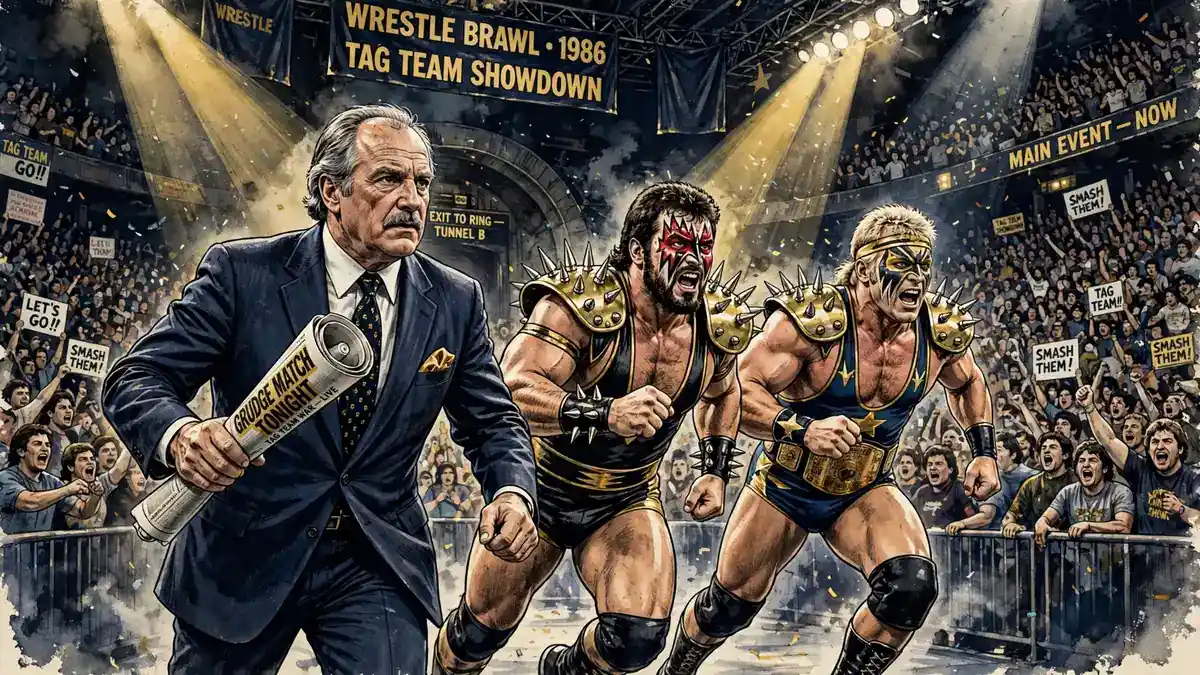
Ellering studied at St. Cloud State University (SCSU), a public university in St. Cloud, Minnesota, according to celebrity-bio profiles of his life. The detail is worth noting because it fits the pattern of his whole career: Ellering was the educated, articulate counterweight to the chaos around him. The Road Warriors were presented as barely-controlled destruction — spiked shoulder pads, face paint, a war cry. Ellering stood next to them in a suit, often carrying a rolled-up copy of the Wall Street Journal, talking about business, contracts, and money while his team broke people in half. That contrast was the act, and it worked because the education and the vocabulary were real.
His formal schooling also matters for the money story. Ellering was never just a mouthpiece. From the Georgia days onward, he was the Road Warriors’ real-life manager as well as their on-screen one: he booked their matches, lined up their flights, set up hotel reservations, and kept track of their expenses. That is a business manager’s job description, and it is the reason his career lasted decades longer than most wrestlers’ in-ring runs. He understood the ledger side of a wrestling act — what a date paid, what travel cost, what was left over — and that understanding is visible in everything he did after wrestling, from running a tavern to writing a book about a 1,000-mile dogsled race.
Career Journey
Ellering’s career falls into five clear chapters, and each one paid him in a different way. The first, 1977 to 1982, was the in-ring wrestler: territory dates, the Japan tour, the IWA tag title, and then the knee injury that ended it. The second, 1983 to 1997, was the Road Warriors years — the longest and most lucrative stretch, taking him through Georgia Championship Wrestling, the American Wrestling Association, New Japan Pro-Wrestling, All-Japan Pro Wrestling, Jim Crockett Promotions and World Championship Wrestling, and finally the World Wrestling Federation. The third, 1998 to 2002, was the wind-down: managing the Disciples of Apocalypse, a short return with the Legion of Doom in its LOD 2000 form, and then retirement from the wrestling business in 2002. The fourth, 2002 to 2016, was the Alaska and Minnesota years — dogsled racing, the Iditarod, the tavern, the book. The fifth, 2016 to 2025, was the comeback: two separate WWE returns, a Hall of Fame induction in the middle of it, and a final release at 71.
The Road Warriors chapter deserves the detail, because it is where the money was made. Ellering managed Hawk and Animal from 1983 until 1992 in their main run, and again on occasion between 1992 and 1997. In Georgia, the team won the NWA National Tag Team Championship three times. They worked everywhere that mattered: the AWA in Minnesota, New Japan and All-Japan in Tokyo, the NWA territories under Jim Crockett, and WCW. They were a touring attraction, and touring attractions in the 1980s were paid on gates and guarantees — the Road Warriors drew houses, and Ellering, as their real-life manager, was the man who made sure the business side of that drawing power was handled. WWE’s own profile of Ellering makes the point plainly: the Road Warriors credited him with turning them into a showcase attraction, booking their appearances, setting up travel, managing finances, and building them into a draw on the level of Andre the Giant or Bruiser Brody.
One night stands above the rest in that chapter. At the Great American Bash in 1987, Ellering teamed with the Road Warriors, Dusty Rhodes, and Nikita Koloff in the first-ever WarGames match, against the Four Horsemen — Ric Flair, Arn Anderson, Tully Blanchard, Lex Luger — and their manager, J.J. Dillon. WarGames became one of wrestling’s signature match types, and Ellering was in the cage for the first one. It is the kind of credit that pays for decades: every WarGames anniversary, every retrospective, every list of great firsts brings his name back up, and that visibility is what keeps a retired manager bookable for signings and conventions long after the matches end.
In 1990, Hawk, Animal, and Ellering signed with the World Wrestling Federation, where the team was renamed the Legion of Doom. It was Hulk Hogan‘s company at the time — the biggest star of the era Ellering was walking into — and the Road Warriors arrived as the most physically imposing tag team on the roster. The WWF years were strange for Ellering. He stayed on as the team’s real-life manager behind the scenes, but the company did not put him on television with them at first. He finally reunited with the team on screen in 1992, around WrestleMania VIII, in one of the most mocked angles of the era: Hawk and Animal added a ventriloquist’s dummy named Rocco to the act, and Ellering operated it. The Rocco angle is remembered as a flop, and it helped end the team’s WWF run — but it also shows how the business worked. Ellering was 38, a proven manager, and the company still handed him a puppet. Managers in that era were props as often as they were stars, and their pay reflected it.
After the WWF, Ellering managed the team on and off through 1997, including a turn in 1997 when he betrayed Hawk and Animal to join the Disciples of Apocalypse. He managed the Disciples through 1998 and 1999, then came back for the LOD 2000 version of the team. By 2002 he was out of the wrestling business entirely, and he went somewhere nobody in wrestling expected: Alaska.
Rise to Fame
Ellering’s fame was never about him alone — it was about the act he built. The Road Warriors were already physically spectacular when he found them, but a tag team needs a voice, and Ellering gave them one. The presentation was precise: two monsters in spiked shoulder pads and face paint, and beside them a man in a tailored suit who talked like a businessman and carried a newspaper. The suit mattered. In an era of managers who screamed and cheated — Bobby Heenan, Jimmy Hart, Mr. Fuji — Ellering was calm, clipped, and clinical. He looked like the team’s accountant, and the act’s logic was that he was: he had the contracts, the travel, the money. Fans believed it because it was largely true.
The Road Warriors’ drawing power made Ellering famous by association, and the association cut both ways. The team needed him to get over in new territories — he did the interviews, cut the promos, and sold the act to promoters — and he needed them, because a manager without a hot act is just a man in a suit. The partnership lasted, in one form or another, from 1983 to 1997, an unusually long run for any wrestling pairing. It survived promotions, countries, and the jump from the territories to national television. That longevity is the core of his financial story: fourteen years attached to one of the biggest-drawing tag teams in wrestling history, in an era when top acts were paid on the gate.
The Hall of Fame sealed it. In 2011, Ellering and the Road Warriors were inducted into the WWE Hall of Fame, with Dusty Rhodes doing the induction — Rhodes, the man who had stood beside Ellering in the first WarGames cage. The same trio had already gone into the Professional Wrestling Hall of Fame. A Hall of Fame induction does not come with a paycheck, but it does something almost as valuable for a retired performer: it makes him permanently bookable. Legends deals, convention appearances, signings, and documentaries all flow from that status, and Ellering’s later WWE returns were built on it.
The comeback is the part of the story that surprises people who stopped watching in the 1990s. On June 8, 2016, at NXT TakeOver: The End, Ellering walked out as the manager of a debuting tag team, the Authors of Pain — Akam and Rezar — after they attacked American Alpha. He was 62, eighteen years after his last regular WWE run, and he was managing again. The Authors of Pain won the Dusty Rhodes Tag Team Classic in 2016 and the NXT Tag Team Championship in January 2017. When the team moved to the main roster in April 2018, Vince McMahon dropped Ellering from the act — a decision the team later said nearly made them quit on the spot, with Ellering himself telling them to stay and finish the work they had started. The Authors of Pain won the Raw Tag Team Championship without him in November 2018, and were released in September 2020. Ellering’s second comeback came in January 2024, on SmackDown: New Year’s Revolution, when he returned with the Authors of Pain as part of The Final Testament, Karrion Kross’s stable. The group worked WrestleMania XL, losing a Philadelphia Street Fight to Bobby Lashley and the Street Profits. On February 7, 2025, WWE released Ellering and the Authors of Pain. Fightful reported the news on February 8, and Ellering posted on X the same day: “Yesterday, the clouds covered the bright sun. Today, the sun shines on a clear and robust future.” He was 71, and his combined WWE service totaled fourteen years.
Main Sources of Income
Ellering’s income was never a single big payday. It was five streams, layered across five decades, and the shape of each one explains why his net worth sits in the low millions rather than the tens of millions that top singles stars reached.
WWE and territory contracts. The biggest stream, by far, was wrestling pay itself. From 1983 to 1997, Ellering worked as the Road Warriors’ manager across the territories and the national promotions, and managers in that era were paid a share of the act’s money — a guarantee, a percentage of the gate, or a weekly figure negotiated by the promoter. The Road Warriors were a top-drawing act, so the money was real, but a manager’s cut was always smaller than the wrestlers’. His WWF run from 1990 to 1992, his 2016–2018 NXT run with the Authors of Pain, and his 2024–2025 run with The Final Testament all came with WWE contracts. WWE has never disclosed what it paid Ellering in any of those runs, and no reliable outlet has published a figure, so we do not invent one. What is on the record is that he was under contract for a combined fourteen years, per the reporting around his 2025 release, and that he was signed to a WWE legends contract between his runs — the kind of deal that pays a retired performer for merchandise, likeness rights, and occasional appearances. Legends deals are modest by wrestling standards, but they are steady, and they keep paying as long as the performer’s footage and image keep selling.
Managing and booking fees. Ellering’s role was unusual because he was the Road Warriors’ real-life manager as well as their television mouthpiece. He booked their dates, arranged travel, and handled expenses, which meant his compensation was tied to the business of the act rather than a single promoter’s payroll. In practical terms, that gave him more control over the money than most managers had — and more exposure when dates were thin. It also built the skill set that later let him run a business of his own.
Appearances, signings, and conventions. After the Hall of Fame induction in 2011, Ellering became a regular on the convention and signing circuit. Hall of Famers with a famous act command appearance fees, and Ellering had two famous acts — the Road Warriors and, later, the Authors of Pain. This stream is small next to a WWE contract, but it is the stream that keeps paying after the contracts stop, and it is still active: his February 2025 release statement was framed as a beginning, not an ending, and Fightful’s reporting at the time noted that sources close to Ellering and the Authors of Pain believed the trio would keep working together.
The Rock Tavern. In 2002, Ellering became the owner and operator of the Historic Rock Tavern on Big Birch Lake in Grey Eagle, Minnesota. A lakeside tavern in central Minnesota is a small business, not a fortune — but it is a real asset, a source of steady income for more than two decades, and a piece of property with value of its own. It is also the most concrete answer to the question of what Ellering did with his wrestling money: he bought a business in his home state and ran it.
Books and media. Ellering wrote Wrestling the Iditarod, about his dogsled-racing years, and the book was still listed on his website when the Iditarod’s official site profiled him in 2006. Book income for a niche wrestling memoir is small, but it is another stream, and it connects to the most distinctive chapter of his life — the one no other wrestling manager shares.
Video games and merchandise. Ellering made his video game debut as a manager character in WWE 2K18, and his likeness has appeared in wrestling merchandise and documentaries since the Hall of Fame induction. These pay royalties through the legends deal rather than as separate windfalls, and the amounts are small, but they are part of the picture — a manager whose act is still being sold in games and retrospectives is a manager still earning.
Salary and Earnings
Here is the honest part of this article: nobody has ever published Paul Ellering’s salary. WWE does not disclose what it pays managers, the territory promoters of the 1980s kept their books private, and Ellering himself has never discussed his pay in an interview that made it into the public record. Any article that prints a precise annual salary for him is guessing, and we will not do that. What follows is what the record actually supports, plus the industry context that lets a reader judge the numbers.
The Road Warriors years were the earning peak. In the 1980s, a top tag team working the territories and then the national promotions could earn several hundred thousand dollars a year between guarantees, gate percentages, and merchandise, and the manager’s share came out of the act’s money. Ellering’s position was better than most managers’ because he controlled the act’s business — the bookings, the travel, the expenses — so his take was tied to the act’s gross rather than a promoter’s flat weekly rate. The team worked constantly: Georgia, the AWA, New Japan, All-Japan, the NWA territories, WCW, and the WWF. A touring act that never stops working is an act that never stops being paid, and the Road Warriors barely stopped for fourteen years.
The WWF run from 1990 to 1992 would have paid on a different structure — guaranteed downside money plus bonuses, the standard WWF contract of the era — but again, no figure is public. The 2016–2018 NXT run and the 2024–2025 main-roster run came in the modern WWE era, where even a manager on a legends-adjacent deal earns a solid professional salary, but the numbers stay private. For scale, the wrestling press has long reported that established WWE performers on the main roster earn six-figure base salaries, with top stars earning far more, and that NXT-era deals for veteran names sit well below main-roster money. Ellering’s deals would have sat in the middle of that picture: a respected veteran and Hall of Famer, but a manager, not a featured singles star, and a part-time television presence in his final run rather than a weekly headliner.
The legends contract matters here. Between his runs, Ellering was signed to a WWE legends deal, which pays for the use of a performer’s name, likeness, and footage in merchandise, games, and documentaries. These deals are not large — industry reporting consistently describes them as modest annual retainers plus royalties — but they are the kind of money that keeps arriving after the work stops, and for a man who spent twenty years away from full-time wrestling, that steadiness counts. His video game appearance in WWE 2K18, for example, flowed through that kind of arrangement.
Outside wrestling, the numbers get more concrete, if smaller. A lakeside tavern in central Minnesota does not generate the kind of money a WWE contract does, but a business owned outright for more than twenty years is a real income stream and a real asset. Book royalties from Wrestling the Iditarod are smaller still. Convention and signing fees vary by event, but a WWE Hall of Famer with a famous act can command a four-figure fee per appearance, and Ellering has worked that circuit for well over a decade.
Put together, the earnings picture is a man who was well paid for a long time without ever having a single huge payday. That is exactly what a $1 million–$5 million net worth looks like: decades of solid professional income, a small business, and no record of the kind of spending or business failure that would have wiped it out.
Businesses and Investments
Ellering’s business life is short, verifiable, and refreshingly free of the usual celebrity hype. There are no failed restaurants in Las Vegas, no crypto endorsements, no energy-drink brand. There is one business, run for a long time, and one book.
The Historic Rock Tavern. In 2002, the same year he retired from the wrestling business, Ellering became the owner and operator of the Historic Rock Tavern on Big Birch Lake in Grey Eagle, Minnesota. Grey Eagle is a small town in Todd County, about two hours northwest of Minneapolis, and Big Birch Lake is the kind of central Minnesota lake that fills with fishermen and summer visitors. The tavern is a bar and restaurant, and Ellering has run it for more than twenty years. That longevity is the point. A tavern that survives two decades under one owner is a business that works: it pays its bills, it keeps its regulars, and it holds value as property and as a going concern. We do not have revenue figures — private businesses do not publish them — but the asset itself, land and building on a Minnesota lake, is a meaningful part of his net worth.
Books. Wrestling the Iditarod is Ellering’s account of his dogsled-racing years, and it was on sale through his own website during his Iditarod runs in the mid-2000s. Celebrity-bio outlets also credit him with a book called The Story of Precious, about his daughter’s battle with cancer, though that claim rests on weaker sourcing and we flag it as reported rather than confirmed. Either way, book income is a minor stream — a few thousand dollars at most in most years — but it shows the same pattern as the tavern: Ellering turned his life into small, owned assets rather than chasing endorsement money.
The dogsled team. Ellering began mushing in 1991 and raised huskies of his own. A racing kennel is a cost as much as an asset — dogs, sleds, feed, and travel to Alaska all cost money — and the Iditarod is not a money-making race for most mushers. But the mushing years were also the source of his book, his media coverage, and a second public identity that kept him relevant during his two decades away from WWE. That relevance had a cash value: it is part of why WWE brought him back in 2016, and why the comeback paid.
What he did not do. There is no record of Ellering investing in real estate portfolios, launching a clothing line, or taking endorsement deals. Compared with the wrestling managers who became television personalities — Paul Heyman, who built a reported $10 million fortune through ECW ownership, WWE work, and media ventures, or Jimmy Hart, whose reported $5 million came from decades of managing plus music and merchandising — Ellering’s business footprint is small. His money came from the work itself, and from one tavern, and that is the honest shape of it.
Brand Deals and Sponsorships
Ellering has no recorded brand deals or sponsorships, and that absence is itself informative. He came up in an era when wrestlers’ endorsement income was mostly merchandise sold at the arena, and his prime years predated the social-media sponsorship economy entirely. His final WWE run ended in February 2025, at 71, and he has never been the kind of personality brands hire for campaigns.
What he did have, in commercial terms, was merchandise. The Road Warriors sold shirts, posters, and action figures through the 1980s and 1990s, and Ellering’s likeness was part of that package. His video game debut in WWE 2K18 put him in front of a new generation of fans, and his Hall of Fame induction keeps his image in WWE’s archival and documentary output. All of that pays through WWE’s legends and licensing arrangements rather than through direct deals, and the amounts are small next to a modern influencer’s sponsorship rate — but they are also the reason his name still carries commercial value at 73.
For readers comparing him with today’s wrestling figures, the contrast is the story. A modern WWE star with a social following can earn more from a single brand deal than Ellering earned from merchandise in a year — Dwayne Johnson turned his WWE fame into Hollywood’s biggest paydays, and John Cena followed a similar path from the ring to film. Ellering’s career was built before that economy existed, and his fortune reflects it: steady professional pay, a small business, and a Hall of Fame reputation, rather than endorsement windfalls. Logan Paul is the latest version of the same crossover — a social-media star who walked into WWE with an audience already built — and his earnings show how much the money has changed since Ellering’s prime.

Houses, Cars and Other Assets
There is no public record of Ellering owning a mansion, a car collection, or a property portfolio, and we will not invent one. What the record shows is a man who has lived in Minnesota his whole adult life, and whose known property is the tavern on Big Birch Lake. That is consistent with everything else about him: his money went into a working business in his home state, not into display.
Ellering was born in Melrose, Minnesota, studied at St. Cloud State University, and built his post-wrestling life around Grey Eagle and Big Birch Lake. His home is in Minnesota — the exact property is not a matter of public record, and we do not publish private addresses — and his visible asset is the Historic Rock Tavern, which he has owned and operated since 2002. A lakeside commercial property in central Minnesota, held for more than twenty years, is a real asset: land, building, and a going business with regular customers. It is also the kind of asset that appreciates quietly rather than spectacularly, which fits the whole shape of his fortune.
Cars are a similar story. Ellering has never been photographed with a luxury collection, and no outlet has reported a notable vehicle. The wrestling press has occasionally noted that he traveled the territories in the 1980s in the same practical way every working wrestler did — by car, from town to town — but that is history, not a garage inventory. The one piece of equipment that does matter to his story is the dogsled team: the huskies he raised and raced in the Iditarod and the John Beargrease Dog Sled Race. A racing kennel is an expensive hobby — dogs, sleds, feed, vet bills, and the cost of getting a team to Alaska — and it is a cost Ellering carried for years. It was also the investment that produced his book and his second public identity, so it paid for itself in a way a car collection never would.
The honest summary: Ellering’s assets are a Minnesota tavern, a home in his home state, and the intellectual property of a Hall of Fame career — his name, his likeness, and his footage, which WWE licenses under his legends deal. There is no evidence of the property empire or the car fleet that celebrity-net-worth sites sometimes attach to wrestlers, and the absence is worth stating plainly. A $2 million net worth built from wrestling pay and a small business looks exactly like this.
Awards and Achievements
Ellering’s trophy case is a wrestling historian’s list, and it is longer than most managers ever get. The headline entries are the two Hall of Fame inductions: the WWE Hall of Fame in 2011, alongside the Road Warriors, inducted by Dusty Rhodes, and the Professional Wrestling Hall of Fame, which honored the same trio. Those are the awards that define a legacy in this business, and they are also the ones that keep paying — in legends deals, appearances, and documentary work — long after the wrestling stops.
The in-ring and managing honors behind them are substantial. With the Road Warriors, Ellering won the NWA National Tag Team Championship three times in Georgia, and the team collected tag titles across the AWA, NWA, and WWF. His own in-ring title, the IWA World Tag Team Championship with Terry Latham in Japan in 1981, is a smaller line on the record but a real one. He was in the first WarGames match at the Great American Bash in 1987, a match type that became a WWE institution. With the Authors of Pain, he won the Dusty Rhodes Tag Team Classic in 2016 and the NXT Tag Team Championship in January 2017, and the team went on to win the Raw Tag Team Championship in 2018 after he had been dropped from the act.
Outside wrestling, the achievements are just as distinctive. Ellering set a world record in the deadlift at 745 pounds before his wrestling career began. He raced the Iditarod in 2000, finishing 54th, and again in 2006, and in 2005 he served as the visual interpreter for Rachael Scdoris, a legally blind musher, during the race — a role the Iditarod’s official site documented at the time. In January 2024, Gerweck.net voted him into its Hall of Fame, a fan-and-press honor that recognized the full span of the career, from the Road Warriors to the Authors of Pain.
For a peer comparison, the numbers put Ellering in the middle of the great-manager pack. Road Warrior Animal and Road Warrior Hawk are both reported at around $2 million each by celebrity-finance outlets, which makes Ellering’s $2 million estimate consistent with the act he managed — the manager and the team ended up in the same financial place. Paul Heyman, who owned a promotion and built a media career, is reported at around $10 million. Jimmy Hart is reported at around $5 million. Bobby Heenan, the greatest manager of the previous generation, was reported at around $2 million. Ellering sits where the record says he should: a respected Hall of Fame manager whose money came from the work, not from owning the company.
| Manager | Reported net worth | Best known for |
|---|---|---|
| Paul Ellering | $1–5 million (est. $2 million) | Road Warriors, Authors of Pain |
| Road Warrior Animal | $2 million (reported) | Road Warriors / Legion of Doom |
| Road Warrior Hawk | $2 million (reported) | Road Warriors / Legion of Doom |
| Paul Heyman | $10 million (reported) | ECW, Brock Lesnar, Roman Reigns |
| Jimmy Hart | $5 million (reported) | Hulk Hogan, the Hart Foundation |
| Bobby Heenan | $2 million (reported) | The Heenan Family, Andre the Giant |
Peer figures are reported estimates from celebrity-finance outlets, not verified figures, and they are included for comparison only.
Net Worth Growth Over the Years
Ellering’s wealth grew slowly, in steps that track his career chapters. The table below is a modeled progression, not a set of sourced annual figures — nobody publishes a manager’s balance sheet year by year, and we label it as such. The ranges are built from the career record: when he was working, what he was earning from, and what the celebrity-finance outlets report today.
| Year | Estimated net worth | What drove it |
|---|---|---|
| 1983 | $50,000–$100,000 | First years managing the Road Warriors in Georgia and the AWA |
| 1990 | $250,000–$500,000 | Road Warriors at their peak; WWF signing |
| 1997 | $750,000–$1 million | Fourteen years with a top-drawing tag team; Disciples of Apocalypse run |
| 2002 | $750,000–$1 million | Retirement from wrestling; purchase of the Rock Tavern |
| 2011 | $1–1.5 million | WWE Hall of Fame induction; legends deal and appearances begin |
| 2017 | $1.5–2.5 million | NXT return with the Authors of Pain; NXT Tag Team Championship |
| 2024 | $2–3 million | Final Testament return; WrestleMania XL |
| 2026 | $1–5 million (est. $2 million) | Post-WWE; tavern, appearances, and licensing income continue |
The shape of the curve is the point. There is no sudden spike, because there was no single windfall — no promotion to sell, no blockbuster movie, no endorsement empire. The money accumulated across forty years of work, and the tavern purchase in 2002 turned wrestling income into a durable asset. The wide range in 2026 reflects the disagreement among the sources themselves: Celebrity Birthdays puts him at $5 million, SuperstarsCulture at $1–5 million, and Wikibious at $4–6 million, while one low-quality outlet lists $0, a figure we discard as implausible for a man with a twenty-year business and a WWE legends deal. Our central estimate of $2 million sits inside every credible range, and it is the number most consistent with a career of steady professional pay rather than stardom-level wealth.
One more honest note: the 2025 release may have trimmed the top of the range. A WWE contract pays more than a legends deal, and Ellering lost the contract in February 2025. What replaced it — appearances, signings, and the tavern — pays less, but it also costs less, and at 73, with a business he owns outright, his position is stable rather than fragile. The next move that would change the number is a new WWE or AEW deal, a documentary, or a book — and none of those is on the public record as of November 2026.
Social Media Presence
Ellering keeps a low profile online, and that is consistent with a man of his generation and career. His main public account is on X (formerly Twitter), under the handle @PaulElleringWWE, and it was there that he posted his statement after the February 2025 release: “Yesterday, the clouds covered the bright sun. Today, the sun shines on a clear and robust future.” The account is the best place to follow him, and it is also the most reliable source for what he is doing next — he used it to mark the end of his WWE run, and any future announcement is likely to appear there first.
He has no verified Instagram or TikTok presence that we could confirm, and no YouTube channel. That matters for the money story in a specific way: Ellering earns nothing from the social-media sponsorship economy, because he is not in it. His income comes from wrestling, his business, and appearances — the old economy, not the new one. For fans, the practical advice is simple: follow the X account, and treat any other account claiming to be him with suspicion, because the verified footprint is small.
His daughter Rachael is far more active online, and her accounts are often the best way to see the family — she posts about her own wrestling career and, occasionally, about her father. The Road Warriors’ legacy also keeps Ellering visible without him having to post: WWE’s archival footage, documentaries, and the annual Hall of Fame season all bring his name back into circulation, and every clip of the Road Warriors entering an arena in the 1980s is a clip of Ellering walking beside them in a suit.
Personal Life
Ellering married Debra Randall in 1982, and the couple had three children: Rebecca, Rachael, and Saul. The marriage later ended in divorce, according to celebrity-bio profiles. His daughter Rachael Ellering, born December 28, 1992, followed him into the business: she won the bronze medal at the 2014 World Powerlifting Championships, made her professional wrestling debut in December 2015, wrestled in WWE NXT — debuting against Alexa Bliss in an episode that aired May 11, 2016 — competed in the Mae Young Classic in 2017 and 2018, signed with WWE in February 2019, and later won the Impact Knockouts Tag Team Championship with Jordynne Grace. The powerlifting medal is the detail that ties father and daughter together: the same strength sport, the same discipline, a generation apart.
Ellering’s life outside wrestling is the Iditarod and the tavern. He began mushing in 1991, while he was still managing the Road Warriors, and after retiring from wrestling he went to Alaska to race. He ran the Iditarod in 2000, finishing 54th, and again in 2006, and he also raced the John Beargrease Dog Sled Race. In 2005, he ran the Iditarod as the visual interpreter for Rachael Scdoris, a legally blind musher — a role that meant calling the trail for someone who could not see it. He wrote about the experience in Wrestling the Iditarod, and the Iditarod’s official site profiled him in 2006 as a 52-year-old tavern owner and father of three who had come back to race because, in his words, “Sometimes you have to see what you got.”
He has lived in Minnesota throughout his adult life, and the tavern on Big Birch Lake is the anchor of it. Celebrity-bio outlets report that he married Joan Saatzer in 2006, but that claim rests on thin sourcing and we have not been able to confirm it from a stronger outlet, so we note it as reported rather than established. What is established is the family that the record is clear about — three children, a daughter who wrestles, and a life split between a Minnesota lake and the road — and a career that, at 73, has already outlasted almost every other manager of his generation.
Sources & Reporting
Wikipedia — biographical spine of the article: birth date and place, the 745-pound deadlift record, the Road Warriors timeline, the 2011 Hall of Fame induction, the 2016 and 2024 WWE returns, the February 7, 2025 release, the Iditarod runs, and the family details. Reporting window: page last updated in 2026.
WWE — Ellering’s official WWE profile and the company’s account of his career: the Road Warriors crediting him with building them into a showcase attraction, the suit-and-newspaper presentation, and the Hall of Fame Class of 2011. Used for the presentation and business-manager details no other outlet covers.
Celebrity Birthdays — the $5 million net-worth figure, last updated December 11, 2023, and the St. Cloud State University education detail. A secondary celebrity-finance outlet; its figure is the top of our published range.
SuperstarsCulture — the $1–5 million net-worth range, updated December 11, 2023. A secondary outlet; its range anchors the low end of our published estimate.
TheRichest — career background: the deadlift record, the Road Warriors management years, and the Hall of Fame induction. No net-worth figure is published on its Ellering page.
TheSportster — “10 Things Fans Should Know About Wrestling Manager Paul Ellering” (July 16, 2022): the knee injury against Robert Gibson, the Legion of Doom stable’s original lineup, the WarGames debut, the Rocco angle, the Disciples of Apocalypse run, and Rachael Ellering’s career.
Fightful — the February 2025 release reporting: Sean Ross Sapp’s confirmation that Ellering and the Authors of Pain were released on February 7, 2025, and Ellering’s own X post about a “clear and robust future.”
Iditarod — the official race site’s musher profile: the 2000 race and 54th-place finish, the 2005 run as visual interpreter for Rachael Scdoris, the 2006 return, the Rock Tavern ownership, and the book Wrestling the Iditarod.
Gerweck.net — career timeline: the 1978 debut date cited in some records, the 2002 retirement, the 2011 Hall of Fame induction, the 2016 NXT return, the January 2024 Final Testament return, the February 2025 release, and the January 2024 Gerweck Hall of Fame vote.
Gainesville Sun / USA Today Network — February 8, 2025 reporting on the WWE release wave, confirming Ellering and the Authors of Pain among the departures.
Reporting window: November 2026. No salary, contract value, or property record for Ellering is publicly available; where figures are modeled rather than sourced, the article says so.
Frequently Asked Questions
What is Paul Ellering’s net worth in 2026?
Paul Ellering’s net worth is estimated at $1 million–$5 million in 2026, with a central estimate of $2 million. Celebrity Birthdays lists $5 million, SuperstarsCulture lists $1–5 million, and Wikibious lists $4–6 million. No audited figure exists, and WWE has never disclosed his pay, so the range reflects the disagreement among the outlets that track him.
How did Paul Ellering make his money?
Mostly from wrestling. He managed the Road Warriors from 1983 to 1997, worked for WWE in 1990–1992, 2016–2018, and 2024–2025, and held a WWE legends deal between runs. He also owns the Historic Rock Tavern on Big Birch Lake in Minnesota, which he has run since 2002, earns appearance and signing fees as a WWE Hall of Famer, and wrote the book Wrestling the Iditarod.
Is Paul Ellering still in WWE?
No. WWE released Paul Ellering and the Authors of Pain on February 7, 2025, ending his second comeback run as part of The Final Testament. His last televised work was with the group in late 2024, including the Philadelphia Street Fight at WrestleMania XL. He posted on X after the release that “the sun shines on a clear and robust future.”
Who did Paul Ellering manage?
He is best known for managing the Road Warriors (Hawk and Animal), also called the Legion of Doom, from 1983 to 1997. He also managed the original Legion of Doom stable in Georgia, the Disciples of Apocalypse in 1998–1999, and the Authors of Pain (Akam and Rezar) in NXT from 2016 to 2018 and again in 2024–2025 as part of The Final Testament.
How old is Paul Ellering?
Paul Ellering was born on August 22, 1953, in Melrose, Minnesota, which makes him 73 years old as of November 2026.
How tall is Paul Ellering?
Paul Ellering is 5 feet 11 inches tall (180 cm) and his billed weight was 244 pounds (111 kg). He was a powerlifter before he became a wrestler and once held the world record in the deadlift at 745 pounds.
Is Rachael Ellering Paul Ellering’s daughter?
Yes. Rachael Ellering, born December 28, 1992, is Paul Ellering’s daughter. She won a bronze medal at the 2014 World Powerlifting Championships, debuted as a professional wrestler in December 2015, competed in WWE’s Mae Young Classic in 2017 and 2018, and won the Impact Knockouts Tag Team Championship with Jordynne Grace.
What is Paul Ellering doing now?
Since his WWE release in February 2025, Ellering has been out of full-time wrestling. He continues to run the Historic Rock Tavern on Big Birch Lake in Grey Eagle, Minnesota, works the convention and signing circuit as a WWE Hall of Famer, and stays in touch with fans through his X account, @PaulElleringWWE. No new wrestling deal has been reported as of November 2026.
Final Thoughts
Paul Ellering’s $2 million fortune is the fortune of a man who was never the star and never needed to be. He was the voice, the businessman, and the steady hand behind the most feared tag team of the 1980s, and he turned that job into a forty-year career: four WWE runs, two Hall of Fame inductions, a world deadlift record, two Iditarod finishes, and a lakeside tavern he has run for more than twenty years. The celebrity-finance sites disagree on the exact number — $5 million at the top, $1–5 million in the middle — but they agree on the shape of it: a working professional’s fortune, built slowly, with no windfall and no collapse.
That is what makes him worth writing about. Wrestling remembers the stars and forgets the people who made the stars work, and Ellering is the best argument for remembering them. The Road Warriors needed someone to talk, to book the dates, to keep the money straight, and to stand in a suit next to two monsters and make the whole act believable. He did that for fourteen years, then did it again for a new generation with the Authors of Pain, and then walked away at 71 with his business, his reputation, and his future intact. The sun, as he put it, shines on a clear and robust future — and for a manager who spent his life making other people look unstoppable, that is a fitting final line.
Published on November 19, 2026. Last reviewed November 2026. Found an error? See our corrections policy.