
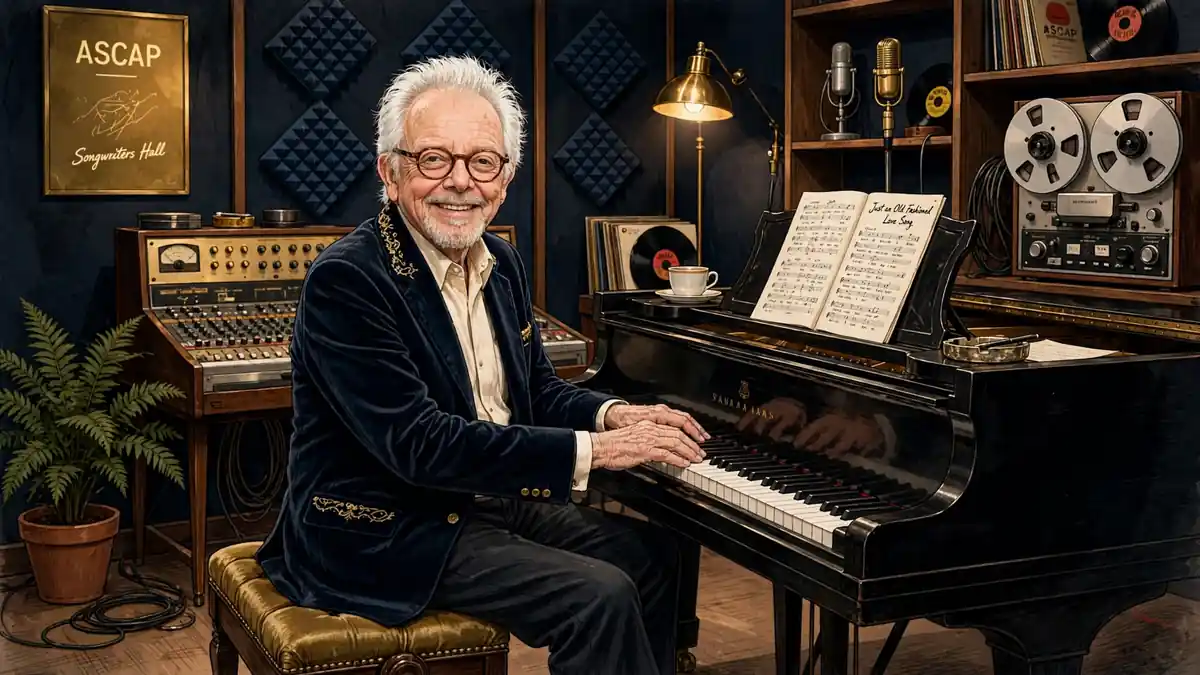
Paul Williams‘s net worth is estimated at $7 million to $14 million as of November 2026. The Oscar-winning songwriter behind “Evergreen” and “Rainbow Connection” built that fortune from more than 500 songs, a run of 1970s hits for the Carpenters and Three Dog Night, film scores, acting roles, and 17 years as president and chairman of ASCAP — the organization that collects performance royalties for American songwriters.
Paul Williams: Quick Facts
| Estimated net worth | $7 million – $14 million (range: $7 million to $14 million) |
|---|---|
| Profession | Songwriter, composer, singer, actor |
| Nationality | American |
| Born | September 19, 1940 (age 86) |
| Height | 5 ft 1 in (1.57 m) |
| Primary income sources | Songwriting royalties, film scores, acting, ASCAP leadership, books |
| Active years | 1964–present |
| Last reviewed | November 2026 |
- Early Life and Background
- Education
- Career Journey
- Rise to Fame
- Main Sources of Income
- Salary and Earnings
- Businesses and Investments
- Brand Deals and Sponsorships
- Houses, Cars and Other Assets
- Awards and Achievements
- Net Worth Growth Over the Years
- Social Media Presence
- Personal Life
- Sources & Reporting
- Frequently Asked Questions
Early Life and Background
Paul Hamilton Williams Jr. was born on September 19, 1940, in Omaha, Nebraska, the son of Paul Hamilton Williams Sr., an architectural engineer, and Bertha Mae Williams, a homemaker. The family story reads like a postwar American split screen: one brother, John J. Williams, became a NASA rocket scientist who worked on the Mercury and Apollo programs and received the NASA Distinguished Service Medal, the agency’s highest honor, in 1969. Another brother, Mentor Williams, became a songwriter himself and wrote Dobie Gray’s 1973 hit “Drift Away” — a song that still earns its writers money half a century later.
Williams was 13 when his father died. The loss pushed the family west to Long Beach, California, where the teenage Williams threw himself into school productions. Acting came first; songwriting came later. That order matters for understanding his money story: Williams never set out to be a behind-the-scenes writer. He wanted to perform, and the songs were a way in. The performing instinct stayed with him his whole career — he sang his own material, acted in his own films, and hosted television — and it shaped a catalog that pays him as a writer, a performer, and a recording artist at once.
Omaha in 1940 and Long Beach in the 1950s gave him two different Americas to write about. The Nebraska childhood supplied the plainspoken, small-town warmth that runs through “Rainbow Connection” and “We’ve Only Just Begun.” The California years supplied the show-business fluency — the speed, the jokes, the comfort with a room full of strangers — that made him a fixture of 1970s talk shows and variety television. Both halves still show up in his work: the sentimental lyricist and the fast-talking showman, sharing one five-foot-one frame.
His height — 5 ft 1 in (1.57 m), per Celebrity Net Worth — became part of his public identity in an era when leading men were expected to tower. Williams turned it into a joke and a calling card instead, playing the diminutive schemer Little Enos Burdette in the Smokey and the Bandit films and the pint-sized villain Swan in Phantom of the Paradise. The roles paid acting fees, kept his name in front of audiences between songwriting paydays, and made him recognizable to people who had never bought one of his records.
Education
No college degree sits on Williams’s record, and no outlet has ever reported one. His schooling was the Long Beach public school system, where he acted in school productions after the family moved from Omaha, followed by the harder school of Los Angeles auditions, open mics, and television comedy writing rooms. He has been candid in interviews that his real education came from working alongside funnier, sharper people and learning to keep up.
That gap is worth stating plainly because it shapes the financial picture. Williams built his fortune without the credentialed path — no music conservatory, no business degree, no family money. His training was practical: write a song, get it cut, get paid. The discipline that later made him a credible president of ASCAP and a certified drug rehabilitation counselor came from the same place: he learned by doing, then went back and formalized what he had learned. After getting sober in 1990, he studied through UCLA and became a Certified Drug Rehabilitation Counselor, a credential he earned in midlife and has used in recovery advocacy ever since.
The lesson for readers tracking his net worth is simple. Williams’s asset was never a diploma or a single hit. It was a skill — writing a lyric that strangers want to sing at weddings — repeated across hundreds of songs and six decades. School productions in Long Beach were the first place he practiced it.
Career Journey
Williams began his professional songwriting career in Los Angeles with Biff Rose, a comedy writer and performer he met while working on a television comedy show. The two wrote “Fill Your Heart,” recorded by Rose on his 1968 album The Thorn in Mrs. Rose’s Side and covered the same year by Tiny Tim as the B-side of “Tiptoe Through the Tulips.” David Bowie later cut his own version for Hunky Dory in 1971. One song, three very different artists, three separate royalty streams — the pattern of Williams’s whole career was already visible in his first success.
In 1969 he formed a studio band called The Holy Mackerel, which released one album. It failed to chart. The failure cost him little and taught him plenty: his gift was writing songs for other voices, not fronting a band. Rose helped him land at A&M Records, where he began working with composer Roger Nichols. The Nichols partnership produced the run that made Williams rich: Three Dog Night’s “An Old Fashioned Love Song,” “Out in the Country,” and “The Family of Man”; Helen Reddy’s “You and Me Against the World” (written with Kenny Ascher); and the Carpenters’ “We’ve Only Just Begun,” “Rainy Days and Mondays,” and “I Won’t Last a Day Without You.”
“We’ve Only Just Begun” started life as a jingle. Williams and Nichols wrote it for a Crocker National Bank television commercial featuring newlyweds, and the Carpenters turned it into a wedding standard that has been licensed, covered, and played at receptions for more than fifty years. A bank ad became a lifetime annuity — one of the sharpest examples in pop history of a commercial job turning into a catalog asset. Every wedding season still sends a little money Williams’s way.
Film work opened a second front. Williams wrote and sang on Brian De Palma’s Phantom of the Paradise (1974), playing the villain Swan and earning an Oscar nomination for the music. He wrote the score and lyrics for Bugsy Malone (1976). He contributed “You’re So Nice to Be Around” to Cinderella Liberty (1973) with music by John Williams, earning another Oscar nomination. Then came the two songs that define him: “Evergreen,” the love theme from A Star Is Born (1976), with lyrics by Williams and music by Barbra Streisand, which won the Academy Award for Best Original Song and the Grammy for Song of the Year; and “Rainbow Connection,” written with Kenny Ascher for The Muppet Movie (1979) and sung by Jim Henson as Kermit the Frog, which earned an Oscar nomination and later entered the Library of Congress National Recording Registry.
Television paid him too. Williams wrote the lyrics to The Love Boat theme — music by Charles Fox, first sung by Jack Jones and later by Dionne Warwick, whose own fortune we profile separately — a weekly network theme that ran for years. He wrote themes for the sitcoms It Takes Two and Condo, sang “Flying Dreams” for The Secret of NIMH, and wrote “What Would They Say” for the TV film The Boy in the Plastic Bubble (1976). Theme songs are quiet earners: a few minutes of music, played every week, generating performance royalties for as long as the show airs in reruns.
Acting ran alongside the music the whole way. His film debut was Gunther Fry in the satire The Loved One (1965). He played Virgil, the genius orangutan, in Battle for the Planet of the Apes (1973) — and appeared on The Tonight Show Starring Johnny Carson that same year still wearing the ape makeup, because filming had run late. He played Little Enos Burdette in all three Smokey and the Bandit films (1977, 1980, 1983), voiced the Penguin in Batman: The Animated Series and other DC Animated Universe projects, and took a late-career film role as the Butcher, an arms dealer, in Edgar Wright’s Baby Driver (2017). Television guest spots filled the gaps: The Odd Couple, Hawaii Five-O, Match Game, Hollywood Squares, Fantasy Island, The Fall Guy, Community (2014), and a recurring role in Goliath in 2018 and 2019.
The career’s third act surprised everyone, including Williams. In March 2012, Daft Punk announced he had written “a couple of tunes” for their album Random Access Memories. He co-wrote “Touch” and “Beyond,” sang on “Touch,” and shared in the album’s Grammy for Album of the Year in 2014 as a featured artist — speaking on the duo’s behalf at the ceremony alongside Nile Rodgers. At 73, the 1970s hitmaker was suddenly on the biggest electronic record of the decade, introducing his voice to listeners born after his hits were already oldies.
In April 2009, Williams was elected president and chairman of ASCAP, the American Society of Composers, Authors and Publishers. He still holds the post in 2026 — 17 years leading the organization that collects and distributes performance royalties to hundreds of thousands of songwriters. The New York Times, profiling him in December 2025 ahead of a 92nd Street Y tribute, found him working out of ASCAP’s New York offices and walking the halls of Congress to argue that “there would be no music industry without songwriters and composers and the publishers who support us.” The job keeps him at the center of the business that pays him, and it pays a salary of its own — though ASCAP does not publish executive pay for its elected leadership, so we do not put a number on it.
Spring 2025 brought another reminder that his oldest song still works. At Coachella in April 2025, Williams performed “Rainbow Connection” with Portugal. The Man and Weird Al Yankovic during the Yo Gabba Gabba! set. In December 2025, the 92nd Street Y celebrated him with “The Lovers, the Dreamers & Me: The Songs of Paul Williams.” In June 2026 he appeared at Fan Expo Anaheim. Stage adaptations of Phantom of the Paradise (under the title “Paradise”) and Guillermo del Toro’s Pan’s Labyrinth are in development, the latter with Gustavo Santaolalla writing music and J.J. Abrams’s Bad Robot involved.
Rise to Fame
Williams’s rise did not follow the usual arc. He never had a hit record of his own in the way the Carpenters or Three Dog Night did. His fame arrived sideways: audiences learned his songs first and his name second. “We’ve Only Just Begun” was a wedding song before most people who sang it could have named its writer. “Rainbow Connection” belonged to a frog before it belonged to its lyricist. That is the songwriter’s bargain — the work outlives the face — and Williams collected on it twice over, because he also put his face on screen often enough to become famous in his own right.
The turning point was 1970–1971. The Carpenters’ “We’ve Only Just Begun” and “Rainy Days and Mondays,” plus Three Dog Night’s “An Old Fashioned Love Song,” put Williams’s name on three of the biggest records of the era within months of each other. Radio could not escape him. The songs were different — a wedding ballad, a rainy-day lament, a breezy love song — and that range became his calling card. Producers learned that Williams could write for any voice, any mood, any room.
Phantom of the Paradise in 1974 made him a cult figure. Playing Swan — a Faustian record producer who steals a composer’s music and sells his soul — Williams was essentially playing a dark mirror of his own industry, and he wrote the songs his character stole. The film flopped on release and grew into a midnight-movie legend. Cult fame pays slowly but it pays for a long time: revival screenings, soundtrack sales, and a stage adaptation now in development all trace back to a 1974 box-office disappointment.
“Evergreen” in 1976 was the commercial peak. The song topped the charts, won the Oscar and the Grammy, and tied Williams to Barbra Streisand, one of the biggest stars on the planet, for good. A songwriter who has written a No. 1 for Streisand never has to introduce himself again. The award shelf filled up fast after that — an Oscar, three Grammys, two Golden Globes — and the Songwriters Hall of Fame inducted him, sealing the reputation that still opens doors in 2026.
Television made him a household face through the late 1970s and 1980s. The Love Boat theme played in millions of living rooms every week. Talk-show appearances — Johnny Carson’s Tonight Show above all — turned him into a personality, the quick-witted little guy with the big songs. By the time Smokey and the Bandit made Little Enos a catchphrase, Williams was famous three ways at once: as a writer, as an actor, and as a talk-show guest. Few songwriters ever manage one of those. He managed all three, and each one fed the others.
Main Sources of Income
Williams’s money comes from five streams, and the balance between them explains why his fortune is measured in millions rather than tens of millions. First is songwriting royalties — mechanical royalties from record sales and streaming, performance royalties collected by ASCAP when his songs play on radio, television, and in venues, and synchronization fees when a film, ad, or TV show licenses one of his songs. With more than 500 songs to his name, recorded by Elvis Presley, Frank Sinatra, Ella Fitzgerald, Ray Charles, David Bowie, Tony Bennett, Willie Nelson, Diana Ross, Luther Vandross, and Kermit the Frog, the catalog is broad enough that something of his is almost always earning somewhere.
Second is film and television music: scores and songs for Phantom of the Paradise, Bugsy Malone, A Star Is Born, The Muppet Movie, and The Muppet Christmas Carol, plus television themes. Film work pays in layers — an upfront composing fee, soundtrack royalties, and performance royalties every time the film airs.
Third is acting: film roles from The Loved One in 1965 through Baby Driver in 2017, voice work as the Penguin, and dozens of television guest spots. Acting fees were never his main income, but they were steady, and residuals from the Smokey and the Bandit trilogy and Batman: The Animated Series still arrive.
Fourth is his ASCAP leadership role, held since 2009, and the speaking, advocacy, and appearance work that comes with it. Fifth is books and stage work: his 2014 book Gratitude and Trust, co-written with Tracey Jackson, the Happy Days stage musical that debuted in 2007, and the Pan’s Labyrinth and Phantom of the Paradise stage adaptations now in development.
The shape of the fortune matters more than the size. Williams owns a share of a catalog that has been earning for sixty years. Catalogs like his do not spike; they compound. A wedding song, a Muppet song, and a Streisand ballad do not go out of fashion in the same year, so the income floor stays high even when no new hit arrives. The trade-off is that he wrote most of his hits as a co-writer — with Roger Nichols, Kenny Ascher, Biff Rose, and Streisand — so the royalties are split. A songwriter who writes alone keeps the whole pie. Williams split his pies, and the splits are why his net worth sits at $7–$14 million while a solo-writing peer with a comparable catalog can be worth far more.

Salary and Earnings
No outlet has ever published a Williams salary, and no filing discloses one. Songwriters of his generation were not paid salaries; they were paid in advances, royalties, and fees, and the numbers stayed private. What follows is what the public record actually supports — and where it stops.
The clearest earnings data comes from TheRichest’s financial tables, which track retail sales of the records his songs appeared on. The A Star Is Born soundtrack sold roughly 4.75 million copies, a retail value TheRichest estimates near $6.18 million; the “Evergreen” single sold about 2.325 million copies, worth roughly $3.02 million at retail. The Carpenters’ A Song for You album sold about 3.1 million copies (about $4.03 million retail), and their self-titled Carpenters album about 4 million (about $5.2 million retail). These are gross retail figures for whole albums, not Williams’s personal income — his share was a writer’s royalty on the songs he co-wrote, split with his collaborators and publishers, after the label and retailer took their cuts. We include them because they show the scale of the machine his songs fed, not because they are his bank balance.
Performance royalties are the quiet engine. Every radio play of “We’ve Only Just Begun,” every wedding DJ spinning “An Old Fashioned Love Song,” every television rerun of The Love Boat generates a small payment, collected by ASCAP and distributed to Williams as a writer and publisher. Over six decades, those small payments add up to the bulk of the fortune. The exact annual figure is private, but the structure is public: a catalog of standards earns every year, in good years and bad, with no touring and no new recording required.
Acting pay is the smallest stream and the least documented. His Smokey and the Bandit role, his Penguin voice work, and his Baby Driver appearance each carried a fee, and the first two still generate residuals. No figure for any of them has been reported. The honest statement is that acting supplemented the songwriting income rather than rivalling it.
One more earnings fact deserves a line of its own: in 2013, at age 73, Williams earned a Grammy as a featured artist on Daft Punk’s Album of the Year, Random Access Memories. The album sold millions and streamed in the billions. His co-writing and vocal credits on “Touch” and “Beyond” gave a 1970s songwriter a 2010s payday — proof that a catalog writer’s earning life does not end when the hits stop coming.
| Record / project | Reported sales | Retail value (TheRichest est.) | Williams’s connection |
|---|---|---|---|
| A Star Is Born soundtrack (1976) | ~4.75 million copies | ~$6.18 million | Co-wrote “Evergreen” |
| “Evergreen” single (1976) | ~2.325 million copies | ~$3.02 million | Lyrics; No. 1 hit |
| Carpenters, Carpenters (1971) | ~4 million copies | ~$5.2 million | “Rainy Days and Mondays,” “I Won’t Last a Day Without You” |
| Carpenters, A Song for You (1972) | ~3.1 million copies | ~$4.03 million | “We’ve Only Just Begun” era |
| The Muppet Movie soundtrack (1979) | ~700,000 copies | ~$910,000 | “Rainbow Connection” with Kenny Ascher |
| Baby Driver soundtrack (2017) | ~60,000 copies | ~$78,000 | Acted in the film as the Butcher |
Read the table as scale, not salary: retail value is what buyers paid for whole records, and Williams’s writer’s share was a slice of a slice. The table earns its place because it shows why two outlets can look at the same career and land $7 million apart — the gross numbers are large, the personal share is private, and every estimator has to guess the split.
Businesses and Investments
Williams is not known as a businessman in the way some of his peers are. There is no Williams restaurant chain, no tequila brand, no venture fund, and no reported real estate empire. His business life has run through institutions and intellectual property rather than companies he founded.
The institution is ASCAP. As president and chairman since 2009, Williams leads the organization that licenses music and pays songwriters, and he has used the platform to lobby Congress on creators’ rights — work the New York Times described in December 2025 as his main focus these days. ASCAP is a member-owned nonprofit, not a Williams asset, so the presidency is a leadership role and a salary, not equity. Its value to his net worth is indirect: it keeps him at the center of the royalty system that pays him, and it keeps his name current in an industry that forgets fast.
The intellectual property is the catalog itself — more than 500 songs, administered through publishers, generating royalties year after year. Unlike peers such as Carole King, whose catalog and solo career put her fortune near $100 million, Williams has never been reported to sell his publishing rights. That matters: in the 2020s, catalog sales turned many legacy songwriters into nine-figure sellers overnight. Williams either was never offered a deal that matched his price or chose to keep the income stream. Either way, his fortune is a flow, not a lump sum — steady royalties rather than a single giant check.
Stage work is his other business line. He wrote the music and lyrics for the Happy Days musical, which debuted in 2007, created the story and songs for Disney’s Emmy-nominated A Muppets Christmas: Letters to Santa, and is now developing stage versions of Phantom of the Paradise and Pan’s Labyrinth. Stage musicals pay writers through royalties on productions, and a hit stage show can out-earn a hit record over time. Neither project has reached Broadway yet, so their financial contribution so far is development fees and option money rather than running royalties.
His book, Gratitude and Trust: Six Affirmations That Will Change Your Life (2014), co-written with Tracey Jackson and featured on Oprah’s Super Soul Sunday, added author royalties and speaking work in the recovery world. It also fits the pattern: Williams monetizes what he knows — songwriting, survival, recovery — rather than lending his name to products he does not use.
On investments, the record is silent. No outlet reports a stock portfolio, a property flip, or a startup stake. That silence is itself information: a fortune built on royalties and fees, held in a catalog, needs no side bets to make sense. We do not invent an investment portfolio to fill the gap.
Brand Deals and Sponsorships
Williams has no documented endorsement career. No sneaker deal, no watch ambassadorship, no soft-drink commercial with his face on it appears in any profile, and that absence fits the era and the job. Songwriters in the 1970s were not brands; they were craftsmen. The brands that paid Williams were the ones that hired his pen.
The sharpest example is the Crocker National Bank commercial that became “We’ve Only Just Begun.” A bank paid Williams and Roger Nichols to write a jingle about newlyweds, and the jingle outgrew the ad, became a Carpenters hit, and then became a wedding standard. It is the only brand deal in his career that anyone remembers, and it is also the most profitable one — because the brand paid once and the song has paid ever since.
Later in life, the closest thing to sponsorship has been advocacy work: appearances for recovery organizations, the 2015 Hookist collaboration and FacingAddiction.org concert on the National Mall, and his public role as a spokesman for sobriety. These pay in reputation and purpose rather than fees, and they feed the speaking and appearance income that supplements his royalties.
For readers comparing him with modern artists, the contrast is the point. A 2020s pop star can earn more from one endorsement than Williams earned from a year of songwriting in the 1970s. Williams’s fortune was built the old way — one song at a time, paid in fractions of pennies per play, over sixty years. The total is smaller than a sneaker deal, but it has lasted longer than most of them.
Houses, Cars and Other Assets
Here the honest answer is short: no verified public record of Williams’s homes, cars, or property holdings exists. No outlet has reported a house purchase, a mortgage record, or a car collection, and we do not fill that gap with guesses. What can be said is circumstantial. Williams has lived and worked in the Los Angeles area for most of his career, was interviewed by the New York Times in ASCAP’s New York offices in late 2025, and sat for a long lunch interview in Palos Verdes, California, in 2026 — all consistent with a Southern California base and regular bicoastal travel for ASCAP business.
The assets that matter to his net worth are not houses or cars. They are the publishing rights to more than 500 songs, the master and performance royalties attached to them, and the residual streams from his film and television acting. A songwriter’s wealth lives in paper — copyrights, royalty statements, and catalog valuations — not in a garage. TheRichest once listed his official website, paulwilliamsofficial.com, at a nominal value of $1,200 in 2018, a reminder that even the small digital assets get counted by somebody, and that the big number is the catalog, not the domain.
Two other assets deserve mention because they are real and lasting. The first is the National Recording Registry honor for “Rainbow Connection,” which the Library of Congress added to its collection of recordings “worthy of preservation for all time.” The second is his Songwriters Hall of Fame membership. Neither has a price tag, but both raise the value of everything attached to his name — the catalog, the stage adaptations, the speaking fees. Reputation is an asset class for a songwriter, and Williams’s is gilt-edged.
Awards and Achievements
Williams’s awards shelf is the strongest evidence for his fortune, because every award on it attached his name to a song that went on earning. The headline wins: one Academy Award (Best Original Song, “Evergreen,” 1976), three Grammy Awards (including Song of the Year for “Evergreen” and a featured-artist Grammy for Daft Punk’s Random Access Memories), two Golden Globe Awards, and an Ivor Novello International Award. The Songwriters Hall of Fame — which calls him “one of the most beloved and respected music creators in the world today” — lists six Oscar nominations, nine Grammy nominations, six Golden Globe nominations, and two Emmy nominations across his career.
The nomination list tells the fuller story. Oscar nominations for “You’re So Nice to Be Around” (Cinderella Liberty, 1973), the Phantom of the Paradise score (1974), “Evergreen” (won, 1976), and the Muppet Movie score and “Rainbow Connection” (1979). Golden Globe recognition for the A Star Is Born score with Kenny Ascher. An Emmy nomination for the Disney holiday special A Muppets Christmas: Letters to Santa, for which he created the story and wrote the songs.
Beyond the trophies, three achievements carry weight that no statuette measures. He has led ASCAP since 2009 — the longest run of any president in the organization’s modern era — steering it through the streaming transition that rewrote how songwriters get paid. He has been sober since 1990, turned that experience into a counseling credential and a book, and become one of the music industry’s most visible recovery advocates. And he is still working at 86: a Coachella stage in 2025, a 92nd Street Y tribute in December 2025, a Fan Expo appearance in June 2026, and two stage musicals in development. Longevity is the achievement that underwrites all the others, because a songwriter only gets paid while the songs are remembered — and Williams keeps giving people reasons to remember them.
Net Worth Growth Over the Years
No outlet has published year-by-year net worth estimates for Williams, so the table below does not invent them. Instead it tracks the career events that moved the fortune, era by era — the honest version of a growth story for a private individual whose money arrives as royalties, not press releases.
| Era | What happened | Effect on the fortune |
|---|---|---|
| 1964–1970 | Early songwriting with Biff Rose; “Fill Your Heart” cut by Tiny Tim and David Bowie; Holy Mackerel album flops | Modest advances and first royalties; the catalog begins |
| 1971–1973 | Carpenters and Three Dog Night hits; “We’ve Only Just Begun” becomes a wedding standard | First serious royalty income; the catalog’s core is built |
| 1974–1979 | Phantom of the Paradise, Bugsy Malone, “Evergreen” Oscar and Grammy, “Rainbow Connection,” Love Boat theme | Peak earning years: awards, film fees, and a catalog that now earns from records, film, and television at once |
| 1980–1989 | Smokey and the Bandit sequels, voice work, television themes; addiction disrupts the work | Acting fees and residuals continue; songwriting output slows as addiction takes hold |
| 1990–2008 | Sober since 1990; UCLA counseling credential; Muppet Christmas Carol songs; Paul Williams Still Alive documentary (2011) | Catalog royalties carry the income; recovery advocacy and writing open a second career |
| 2009–2019 | ASCAP president and chairman; Daft Punk’s Random Access Memories (2013); Baby Driver (2017); Goliath (2018–2019) | Leadership salary plus a surprise late-career payday from Daft Punk; catalog keeps compounding |
| 2020–2026 | Streaming-era catalog income; Coachella 2025; 92nd Street Y tribute 2025; stage adaptations in development | Estimated $7M–$14M range; the catalog earns without new hits, and stage projects offer future upside |
The pattern is a songwriter’s classic: a steep climb in the 1970s, a long plateau sustained by royalties, and a late lift from leadership and legacy work. The fortune did not spike on a catalog sale, because no sale has been reported. It grew the slow way — a little every year, for sixty years — which is why the range between the two main estimates is so wide, and why both ends of it are plausible.
Peer comparison sharpens the picture. Carole King, a fellow songwriter of the same generation, is estimated at $70 million to $100 million — her fortune rests on a solo recording career (Tapestry sold more than 30 million copies) on top of her writing. Diane Warren, the most prolific hit songwriter of the modern era, is estimated at $60 million to $100 million depending on the outlet, with Celebrity Net Worth at $100 million, largely on the presumed value of her Realsongs publishing catalog. Williams wrote as many standards as either of them, but he split his biggest songs with collaborators, never had a blockbuster solo album, and never sold his catalog. The $7–$14 million range is the price of sharing the credit — and the reward for a catalog that has never stopped paying.
Social Media Presence
Williams keeps a light social media footprint, which fits a man whose working life predates the internet by decades. He posts on Instagram as @PaulieLama2, the handle noted in a 2026 interview profile, where he shares appearances, recovery reflections, and the occasional joke — the same quick wit that made him a talk-show staple in the 1970s. His official website, paulwilliamsofficial.com, remains his home base online.
Social media is not a meaningful income line for Williams, and no outlet reports follower counts or sponsorship earnings tied to his accounts. That is worth stating because it separates him from the modern celebrity economy: his fortune was built before follower counts existed, and it does not depend on them now. The Coachella appearance in 2025 and the 92nd Street Y tribute later that year reached audiences through footage and press coverage rather than through his own feed, which is how legacy artists tend to travel in the streaming era — the work circulates, the man drops in.
Personal Life
Williams has been married three times. His first marriage, to Kate Clinton in 1971, produced two children, Sarah and Cole Williams (born 1981). In 1993 he married Hilda Keenan Wynn, daughter of actor Keenan Wynn. His third wife is writer Mariana Williams, to whom he remains married. The Songwriters Hall of Fame bio calls his children “his best work,” a line Williams himself has echoed in interviews.
The personal story that most shaped his later life is recovery. Williams struggled with alcohol and substance abuse through the 1970s and 1980s, years when his songwriting output dried up and his career stalled. He has been sober since 1990 — 35 years by the time the New York Times profiled him in December 2025 — and he turned the experience into a second vocation: certification as a drug rehabilitation counselor through UCLA, advocacy work to reduce the stigma around addiction, and the 2014 book Gratitude and Trust, co-written with Tracey Jackson. In 2015 he helped lead a global virtual songwriting collaboration that produced “Voice of Change,” performed by 10,000 people on the National Mall for FacingAddiction.org. The recovery work pays little in money and a great deal in standing; it is also the reason his late career exists at all. As he told the Times, when he was drinking he imagined things that were not there — then he got sober, and two robots called and asked him to make an album.
Smaller facts round out the portrait. He completed more than 100 skydives in the 1970s. His favorite Muppet, he told an interviewer in 2026, is Gonzo. He still carries a walking cane to interviews and jokes about his hearing — “if I try to sing for an hour and a half, it could be painful for the audience” — and then sings anyway. The 2011 documentary Paul Williams Still Alive, directed by Stephen Kessler and premiered at the Toronto International Film Festival, caught him at the hinge between the two halves of his life: the hitmaker who nearly lost it all, and the elder statesman who got it back.
Sources & Reporting
Wikipedia — biographical spine: birth date and place, family details, career chronology, filmography, discography of key songs, ASCAP presidency, sobriety, and 2025–2026 appearances; reporting window through September 2026.
Britannica — career summary and song list, updated September 15, 2026; corroborated the Nichols and Ascher collaborations and the Love Boat theme.
Songwriters Hall of Fame — awards tally (one Oscar, three Grammys, two Golden Globes, Ivor Novello; six Oscar, nine Grammy, six Golden Globe, two Emmy nominations), artist list, and ASCAP role.
Celebrity Net Worth — the $7 million estimate, height of 5 ft 1 in, and profession listing; the low end of our published range.
TheRichest — the $14 million estimate and the earnings table (record sales and retail values for the A Star Is Born soundtrack, “Evergreen,” Carpenters albums, and other projects); the high end of our published range.
The New York Times — December 3, 2025 profile by Elysa Gardner: ASCAP presidency confirmed current, 35 years sober, Coachella spring 2025, 92nd Street Y tribute, Pan’s Labyrinth and Phantom of the Paradise stage projects.
Turner Classic Movies — TCM Classic Film Festival 2026 program notes: awards tally, National Recording Registry honor for “Rainbow Connection,” and stage projects in development.
Palos Verdes Pulse — 2026 lunch interview: sobriety, ASCAP leadership, Coachella, recovery advocacy, and the @PaulieLama2 Instagram handle.
IMDb — filmography detail and career chronology, including the Baby Driver role and Goliath appearances.
Reporting window: October–November 2026. Figures are estimates built from public reporting, not audited statements. Where outlets disagree on net worth, we publish the range and name the outlets behind each end of it.
Frequently Asked Questions
What is Paul Williams’ net worth in 2026?
Paul Williams’ net worth is estimated at $7 million to $14 million as of November 2026. Celebrity Net Worth puts him at $7 million, while TheRichest puts him at $14 million. The gap reflects how hard songwriter fortunes are to pin down: his wealth sits in publishing royalties from more than 500 songs, split with co-writers, with no catalog sale or public filing to anchor a single number. We publish the range rather than picking one outlet’s guess.
What songs did Paul Williams write?
His best-known songs include “We’ve Only Just Begun” and “Rainy Days and Mondays” for the Carpenters, “An Old Fashioned Love Song” and “Out in the Country” for Three Dog Night, “You and Me Against the World” for Helen Reddy, “Evergreen” for Barbra Streisand, “Rainbow Connection” for Kermit the Frog in The Muppet Movie, and the Love Boat theme. He also co-wrote “Touch” and “Beyond” for Daft Punk’s Random Access Memories in 2013. In total he has written more than 500 songs, recorded by artists from Elvis Presley and Frank Sinatra to David Bowie and Willie Nelson.
Is Paul Williams still alive?
Yes. Paul Williams is alive and active at 86. In April 2025 he performed “Rainbow Connection” at Coachella with Portugal. The Man and Weird Al Yankovic, in December 2025 the 92nd Street Y celebrated his career with a tribute concert, and in June 2026 he appeared at Fan Expo Anaheim. He remains president and chairman of ASCAP, a post he has held since 2009.
How old is Paul Williams?
Paul Williams is 86 years old. He was born Paul Hamilton Williams Jr. on September 19, 1940, in Omaha, Nebraska, so he turned 86 in September 2026. His career has run for more than six decades, from his first songwriting work in 1964 to his stage projects in development in 2026.
Did Paul Williams write “Rainbow Connection”?
Yes — Paul Williams co-wrote “Rainbow Connection” with composer Kenny Ascher for The Muppet Movie (1979), where it was sung by Jim Henson as Kermit the Frog. The song was nominated for the Academy Award for Best Original Song and was later added to the Library of Congress National Recording Registry. It is one of two Williams songs on the American Film Institute’s list of top movie songs of all time, alongside “Evergreen.”
Who is Paul Williams married to?
Paul Williams is married to writer Mariana Williams, his third wife. He was previously married to Kate Clinton (1971), with whom he has two children, Sarah and Cole Williams, and to Hilda Keenan Wynn (1993), daughter of actor Keenan Wynn. Williams has spoken publicly about his family as the part of his life he values most.
What is Paul Williams doing now?
As of 2026, Williams serves as president and chairman of ASCAP, where he advocates for songwriters’ rights in Washington, and he continues to perform and develop stage work. Recent activity includes his Coachella performance in April 2025, a 92nd Street Y tribute in December 2025, a Fan Expo appearance in June 2026, and stage adaptations of Phantom of the Paradise and Pan’s Labyrinth in development. He has been sober since 1990 and remains active in addiction recovery advocacy.
How tall is Paul Williams?
Paul Williams is 5 feet 1 inch tall (1.57 m), according to Celebrity Net Worth. His short stature became part of his screen identity — he played the diminutive Little Enos Burdette in the Smokey and the Bandit films and the pint-sized villain Swan in Phantom of the Paradise — and he has joked about it throughout his career.
Final Thoughts
Paul Williams’s $7 million to $14 million fortune is the honest price of a particular kind of career: the songwriter who wrote the songs everybody knows and kept only a share of each one. He never had a blockbuster solo album, never sold his catalog for a nine-figure check, and never chased an endorsement. What he did was write more than 500 songs, win an Oscar, three Grammys, and two Golden Globes, lead ASCAP for 17 years, get sober, and keep showing up — at Coachella at 84, at the 92nd Street Y at 85, on a stage somewhere at 86.
The range in the estimate is not a failure of research; it is the research. Two serious outlets looked at the same catalog and landed $7 million apart, because a songwriter’s wealth lives in royalty splits and private publishing deals that no filing ever reveals. What is certain is the shape of it: a fortune built slowly, paid in fractions of pennies per play, that has now been earning for sixty years and shows no sign of stopping. A wedding song from a bank commercial, a frog’s ballad about rainbows, and a Streisand love theme walk into a bar — and the punchline is that all three are still paying the man who wrote them.
Published on November 22, 2026. Last reviewed November 2026. Found an error? See our corrections policy.