
Percy Harvin‘s net worth is estimated at $18–$20 million as of November 2026. The former NFL wide receiver and return specialist banked $41.8–$42.2 million in career football earnings, signed a headline six-year, $67 million extension in Seattle that paid him only a fraction of its face value, and won a Super Bowl on one of the most famous kickoff returns of the modern era — then walked away from the game at 28, twice, because of migraines and injuries that had shadowed him since college.
Percy Harvin: Quick Facts
| Estimated net worth | $18–$20 million (range: $18–$20 million) |
|---|---|
| Profession | Former NFL wide receiver, running back and kick returner |
| Nationality | American |
| Born | May 28, 1988 (age 38) |
| Height | 5 ft 11 in (1.80 m) |
| Primary income sources | NFL salaries and signing bonuses, endorsement income, post-career appearances |
| Active years | 2006–2008 (college, Florida); 2009–2016 (NFL) |
| Last reviewed | November 2026 |
- Quick Facts
- Early Life and Background
- Education
- Career Journey
- Rise to Fame
- Main Sources of Income
- Salary and Earnings
- Businesses and Investments
- Brand Deals and Sponsorships
- Houses, Cars and Other Assets
- Awards and Achievements
- Net Worth Growth Over the Years
- Social Media Presence
- Personal Life
- Sources & Reporting
- Frequently Asked Questions
- Final Thoughts
Early Life and Background
William Percival Harvin III was born on May 28, 1988, in Chesapeake, Virginia, and grew up in Virginia Beach. His father, William Percival Harvin Jr., left the family when Percy was young, and his mother Linda raised him with his older sister Lintera. Linda ran a daycare out of the family home — Harvin helped with the children — and had run track at Princess Anne High School in Virginia Beach before coaching an AAU track team. Lintera ran track at Salem High School and later at Eastern Michigan University. Speed ran in the family, and Harvin had it in a form that coaches noticed before he reached his teens.
Harvin started playing peewee football at five years old in Virginia Beach. By high school he was the most talked-about skill player in the country. At Landstown High School he played running back, wide receiver, defensive back and returner, and he was rated the top high-school football recruit in the nation by some services in the class of 2006. The attention brought pressure with it. Harvin was suspended for part of his senior season after an incident at a game, and his recruitment became a national story in its own right, with Florida, Florida State, Miami, Michigan, USC and Virginia all chasing him.
Two facts from those Virginia Beach years explain the money story that follows. First, Harvin was a genuine dual threat from the start — a receiver who ran like a running back and returned kicks like a specialist — which is why NFL teams later paid him as three players in one. Second, the migraines that would end his professional career were already part of his life. He missed time with them in high school and college, and they returned at every stop of his NFL career. The talent was never the question. Availability was.
Harvin chose Florida on January 1, 2006, signing with Urban Meyer and the Gators. The decision put him in an offence built around exactly what he did best: getting the ball to a fast player in space and letting him create. It also put him alongside Tim Tebow, the quarterback who would win the Heisman Trophy in 2007, in a backfield and receiving corps that became the most feared in college football.
Education
Harvin attended Landstown High School in Virginia Beach, Virginia, where he starred in football and track. He enrolled at the University of Florida in Gainesville in 2006 on an athletic scholarship and played for the Gators from 2006 to 2008, leaving after his junior season to enter the 2009 NFL Draft. He did not complete a degree at Florida before turning professional, which was standard for a first-round draft pick of his standing.
His college classroom, in the practical sense, was Meyer’s spread offence. Harvin lined up at wide receiver, running back and even quarterback in the wildcat, and he returned kicks. Florida used him as a chess piece rather than a position player, and that versatility became his professional calling card. Scouts who watched him at Florida saw a player with a 4.41-second 40-yard dash at the NFL Combine, a 37.5-inch vertical jump, and a 10-foot-1 broad jump — numbers that matched the film, where defenders rarely caught him from behind.
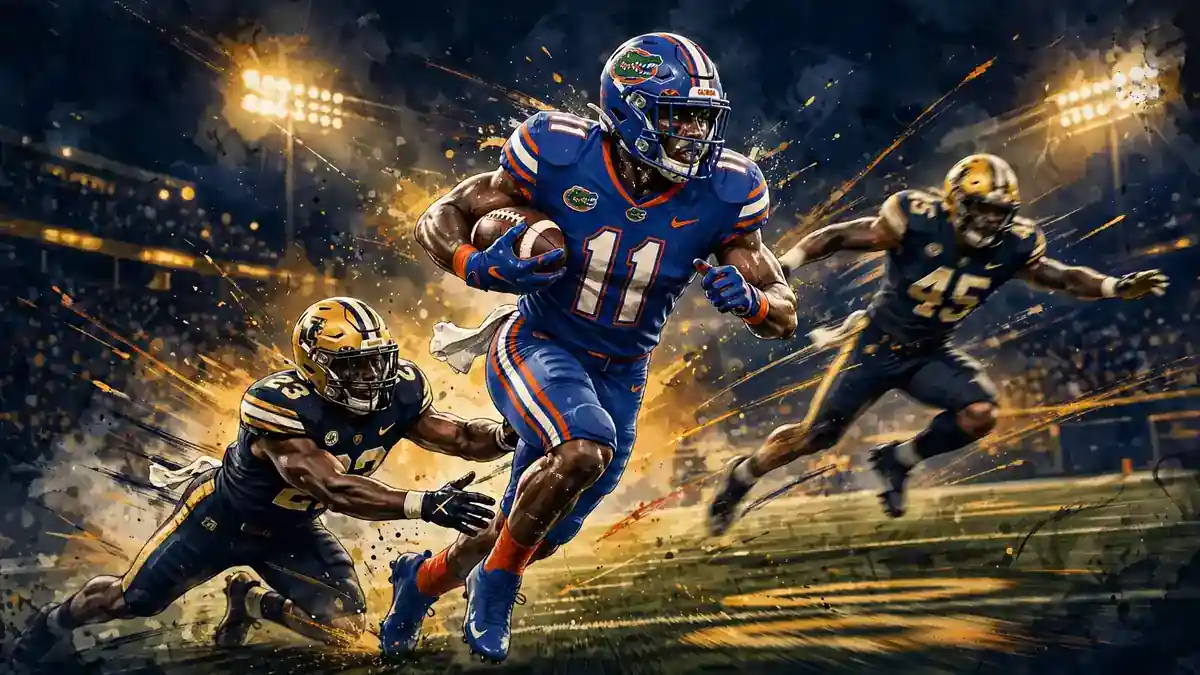
At Florida, Harvin produced 133 catches for 1,929 yards and 13 touchdowns across three seasons, and carried the ball 194 times for 1,852 yards and 19 touchdowns. Add the two together and he totalled 3,781 yards from scrimmage and 32 touchdowns in 36 college games. He averaged 9.5 yards per carry as a runner and 11.6 yards every time he touched the ball in any role. He was the first receiver in Florida history to record 1,000 yards receiving and 1,000 yards rushing in a career, and the first player in school history to rush for 100 yards and catch for 100 yards in the same game, against Vanderbilt in 2007.
The team results matched the individual numbers. Florida won the BCS National Championship in the 2006 season, beating Ohio State 41–14, and again in the 2008 season, beating Oklahoma 24–14. Harvin was SEC Freshman of the Year in 2006, SEC Championship Game MVP that same year, a first-team All-American in 2007 and 2008, and a first-team All-SEC selection in both of those seasons. His freshman year alone produced 855 yards from scrimmage and five touchdowns in a national-title run.
His junior season showed both sides of his career in miniature. He missed two games with injury, including the SEC Championship Game, and played the BCS National Championship Game against Oklahoma on a high ankle sprain and a hairline fracture in his lower right leg. He still ran nine times for 122 yards and a touchdown and caught five passes for 49 yards. Florida won 24–14. The performance raised his draft stock and confirmed the durability worry in the same night.
Career Journey
The Minnesota Vikings selected Harvin 22nd overall in the first round of the 2009 NFL Draft. He signed a five-year rookie contract that Over The Cap records at $11,050,000 in total value, with $6,701,500 guaranteed, while PlayersBio records the deal at $12.05 million including a $981,500 signing bonus and an average of $2.41 million a year. The two databases differ on the headline number because they treat option and escalator money differently; the cash Harvin actually received in Minnesota, $9.82 million across four seasons per Over The Cap, is the figure that matters, and both sources agree on the shape of it.
His rookie season was the best of his career by several measures. Harvin played 15 games, caught 60 passes for 790 yards and six touchdowns, ran 15 times for 135 yards, and returned kicks at a level that made him a Pro Bowl selection as a returner. He scored eight touchdowns in total — six receiving and two on returns — and was named Associated Press Offensive Rookie of the Year and to the PFWA All-Rookie Team. The Vikings reached the NFC Championship Game that season. Harvin had arrived as advertised.
Minnesota kept him for four seasons, 2009 to 2012, and the arc of those years is the arc of his whole career: brilliant when available, absent too often. In 2010 he caught 71 passes for 868 yards. In 2011, his most productive season, he caught 87 passes for 967 yards and six touchdowns, added 345 rushing yards, and scored nine touchdowns in total. He opened 2012 with three 100-yard receiving games in the first six weeks, then an ankle injury put him on injured reserve and ended his season after nine games. Across four years in Minnesota he caught 280 passes for 3,302 yards and 20 touchdowns, and he returned five kickoffs for touchdowns — a franchise-level return record that still stands out in Vikings history.
The end in Minnesota was messy. Harvin grew unhappy with his contract after the injury-hit 2012 season, and his relationship with the coaching staff frayed. On March 12, 2013, the Vikings traded him to the Seattle Seahawks for a first-round pick (25th overall) and a seventh-round pick in the 2013 draft, plus a third-round pick in 2014. Seattle then signed him to the contract that defines his financial story: a six-year extension reported at the time as $67 million with $25.5 million guaranteed, including a $12 million signing bonus. Over The Cap records the same deal at $64,217,500 over five new years, with $14.5 million fully guaranteed and an average of $12,843,500 a year. The $67 million figure was the headline; the $14.5 million guaranteed figure was the reality. Harvin would collect $19,029,412 from Seattle in total — a large sum for eight games, and a small one against the contract’s face value.
Seattle got almost nothing on the field for that money in the regular season. Harvin tore his labrum, had hip surgery, and spent the first ten weeks of 2013 on the physically unable to perform list. He made his Seahawks debut in Week 11 against his old team, catching one pass for 17 yards and returning a kick 58 yards. He played one regular-season game, then missed the NFC Championship Game with a concussion. His Seattle career totals read like a misprint for a $67 million player: six regular-season games and two playoff games, one reception for 17 yards in the regular season, and one touchdown all year — the one that mattered most, in the Super Bowl.
Seattle traded him to the New York Jets on October 17, 2014, for a conditional draft pick, ending the experiment after a season and a half. The Jets absorbed $6,470,588 of his salary for the rest of 2014 — 10/17ths of his $11 million base salary — and Harvin played eight games for them, catching 29 passes for 350 yards and a touchdown. The Jets released him before the 2015 season rather than pay his $10.5 million salary for 2015. In March 2015 he signed a one-year, $6 million contract with the Buffalo Bills, including a $3 million signing bonus and $5.9 million guaranteed. He played five games in 2015, caught 19 passes for 218 yards and a touchdown, and went on injured reserve on November 7 with a hip injury.
Harvin announced his first retirement on April 15, 2016, saying he needed time to recover from injury without ruling out a return. The Bills needed a receiver that November after injuries to Sammy Watkins and Greg Salas, and Harvin came back on November 1, 2016, signing a one-year deal. He played two games, caught two passes for six yards, and was shut down on December 5, 2016, placed on the reserve/non-football illness list as severe migraines returned. On March 14, 2017, his representative told ESPN’s Jeremy Fowler that Harvin was retiring for good. He was 28. His career totals: 75 regular-season games, 353 catches for 4,026 yards and 22 touchdowns, 927 rushing yards and five rushing touchdowns, 4,127 return yards and five return touchdowns — 32 touchdowns in all, in eight seasons across four teams.
In April 2020, three years after his second retirement, Harvin told ESPN’s Josina Anderson that he wanted to return to football, saying the itch had come back. He was 31, turning 32 the next month, and had not played since 2016. No team signed him. The comeback never got past the statement of intent, and Harvin has not played professional football since.
Rise to Fame
Harvin’s fame came in two waves. The first was at Florida, where he was a national recruit, a freshman star on a title team, and by 2007 one of the most recognisable players in college football. The second was in the NFL, where his rookie season made him a Pro Bowler and Offensive Rookie of the Year, and where one play in February 2014 fixed him in the memory of every football fan who watched it.
That play came 12 seconds into the second half of Super Bowl XLVIII, on February 2, 2014, at MetLife Stadium. Seattle led the Denver Broncos 22–0 at half-time. Denver kicker Matt Prater tried to keep the ball away from Harvin with a short, angled kick. Harvin fielded it in front of his own 10-yard line, found a lane up the middle, and raced 87 yards for a touchdown. The score made it 29–0, and the Broncos never threatened again. Seattle won 43–8, the franchise’s first Super Bowl title, and Harvin finished the game with 137 all-purpose yards — two runs for 45 yards, one catch for five yards, and the return — despite having played only 39 snaps all season before that night. ESPN’s Jeffri Chadiha called it the most valuable play of the game, even though linebacker Malcolm Smith won the MVP award for a 69-yard interception return.
The return was Harvin’s only touchdown of the 2013 season, and it arrived after a year in which he had barely played. That contrast is why the play still gets replayed: a player who cost Seattle $14.5 million for one catch in the regular season delivered the single moment that closed out a Super Bowl. His Seahawks quarterback that night was Russell Wilson, who threw two second-half touchdown passes as Seattle pulled away. Wilson’s own career took the opposite path to Harvin’s — long, durable, and steadily paid — which is part of why the comparison still interests fans.
Harvin’s rookie year had already shown what the hype was about. He scored in his first games, returned kicks for touchdowns, and gave the Vikings a weapon no defence could plan for in one role. Opposing coordinators had to account for him as a receiver, a runner and a returner, and his 12.3 yards per touch as a rookie reflected that. The Pro Bowl nod in 2009, as a return specialist, was the league’s formal recognition of it.
His 2011 season with Minnesota was the closest he came to putting it all together for a full year: 87 catches, 967 receiving yards, nine total touchdowns, and a role as the Vikings’ most reliable offensive player. He never reached 1,000 receiving yards in a season — a fact his critics still cite — but his all-purpose totals told a fuller story. In 2011 he produced 1,312 yards from scrimmage and 1,832 all-purpose yards. The player who never had a 1,000-yard receiving season still averaged 11.4 yards every time he touched the ball across his career.
Fame also brought a harder kind of attention. Harvin’s exits from Minnesota and Seattle were both reported as unhappy, with locker-room friction and contract frustration in the background. Sports Illustrated’s July 2018 feature, built around an in-depth interview in Gainesville, described a player who had been treated as a prodigy since childhood, who fought with coaches and teammates, and who played through anxiety and sleepless nights. Harvin told the magazine he had gone days without sleep before games and described mental stresses he could not put into words. The piece reframed his career for many readers: not a player who wasted talent, but one whose body and mind would not let him use it for as long as his talent deserved.
Main Sources of Income
NFL contracts were Harvin’s income, in a proportion that few modern stars match. Over The Cap puts his career earnings at $41,823,824, and the Spotrac-based breakdown at PlayersBio puts them at $42.21 million, split into $20.23 million of base salary, $15.98 million of signing bonus, $3.62 million of option bonus, $2.15 million of incentives, $182,500 of workout bonuses and $45,000 of roster bonuses. Signing bonuses alone were more than a third of his career pay. That matters because signing-bonus money is paid up front and survives a trade or release in a way base salary does not — it is the reason Harvin kept a fortune after playing only 75 games.
By team, the money fell out like this. Minnesota paid him $9.82 million over four seasons. Seattle paid $19.03 million for a season and a half. The Jets paid $6.47 million for half a season in 2014. Buffalo paid $6.87 million across his two stints, 2015 and 2016, including the $6 million deal of 2015 and the short comeback contract of 2016. Seattle was his biggest single payer by a wide margin — more than Minnesota paid him in twice as many seasons — which is the financial paradox of his career: his least productive stop paid him best.
Endorsements added money, but no reliable source puts a figure on them. Lower-quality net-worth pages credit Harvin with deals from Nike, Pepsi and Subway, and PlayersBio says a few million of his fortune came from brand work. None of those pages publishes a contract value, a campaign name, or a date, and no primary reporting from the brands or from business press confirms a figure. Harvin was a Nike athlete in the ordinary sense — NFL players wear Nike kit under the league’s apparel deal — but a personal endorsement contract with a published value does not appear in the public record. This article counts endorsement income as real but unquantified, and it does not add invented millions for it.
Post-career income is thinner and harder to trace. Harvin has kept a low profile since 2017, with no coaching job, broadcasting role, or business launch announced in reliable reporting. He appeared in Sports Illustrated’s 2018 feature and documentary material, and he has taken part in Florida-related appearances, but no fee or salary for any of it is public. Appearance fees and autograph work of the kind former players commonly do would add modest income, and this article treats that as plausible rather than documented. The honest summary is that Harvin’s fortune was made between 2009 and 2016, and his net worth since then has depended on how well that money was kept, not on new earnings.
That puts him in a different position from the long-career stars he is often grouped with. Adrian Peterson, his Vikings teammate, earned $103.2 million in NFL salary across a 15-season career — more than twice Harvin’s total — yet NetWorthCraft estimates Peterson’s current net worth at only $1–$3 million after court judgments topping $12 million. Harvin earned less and, by every published estimate, kept far more of it. The comparison is a reminder that career earnings and net worth are different numbers, and the gap between them is where financial decisions, taxes, fees and lifestyle sit.
Salary and Earnings
Harvin’s year-by-year pay tells the story more plainly than any single contract headline. His rookie deal with Minnesota paid him modest money by first-round standards: a $2.41 million average annual value on the PlayersBio reading, with $8.43 million guaranteed in that account and $6.7 million guaranteed in Over The Cap’s. His largest single cash payment came in 2013, when Seattle paid him $14.5 million — the $12 million signing bonus plus his guaranteed $2.5 million base salary — for a season in which he caught one pass. His largest cap number was $6,470,588 in 2014, the figure the Jets absorbed when they traded for him mid-season.
The Seattle extension deserves a closer look because it is the most misunderstood contract of his career, and the misunderstanding still appears in net-worth articles today. Reports at the time called it a six-year, $67 million deal with $25.5 million guaranteed. Over The Cap’s contract history records it as five years and $64,217,500, with $14.5 million guaranteed and an average of $12,843,500 a year. The difference is not a clerical error: the $67 million figure included the final year of his existing rookie deal and counted money that was never guaranteed, while the $25.5 million guarantee figure counted $11 million of 2014 base salary that was guaranteed for injury only and became fully guaranteed on the fifth day of the 2014 waiver period — February 7, 2014 — by which time Seattle had already decided to move him. Harvin’s own account of the deal, and the reporting around the trade, treated the $67 million as real. The cash says otherwise: $19.03 million from Seattle, then the Jets picked up the rest of his 2014 salary.
Here is the team-by-team breakdown, using Over The Cap’s paid figures, which reconcile to his $41,823,824 career total:
| Team | Seasons | Cash paid | What it bought |
|---|---|---|---|
| Minnesota Vikings | 2009–2012 (4) | $9,820,000 | 280 catches, 3,302 yards, 20 receiving touchdowns |
| Seattle Seahawks | 2013–2014 (2) | $19,029,412 | 8 games, 1 regular-season catch, 1 Super Bowl touchdown |
| New York Jets | 2014 (1) | $6,470,588 | 8 games, 29 catches, 350 yards |
| Buffalo Bills | 2015–2016 (2) | $6,870,000 approx. | 7 games, 21 catches, 224 yards |
Two details in that table carry the whole financial argument. First, Seattle paid Harvin more than Minnesota did, for one-tenth of the games. Second, his per-game pay in Seattle — roughly $2.4 million a game across eight appearances — is among the highest in NFL history for a non-quarterback, and it bought the franchise a Super Bowl. Whether that was good value depends on whether you price the 87-yard return at $19 million or at the cost of a championship. Seattle’s front office, which traded him away 18 months later, evidently priced it the first way.
His peak annual pay came in 2013 and 2014, when his cash earnings ran at $10 million-plus a year on the Seattle deal. His peak sustained pay, though, was the 2011–2012 window in Minnesota, when he was producing at a Pro Bowl level on a rookie contract that paid him about $2.5 million a year. That mismatch — peak production on a rookie wage, peak wage with almost no production — is the central irony of his earnings record, and it explains why his career total of $41.8 million looks modest next to receivers of similar talent who stayed healthy. Antonio Brown, a fellow receiver of the same era whose career also ended early and messily, earned far more across a longer run of productive seasons; Harvin’s money was concentrated into fewer, stranger years.
After tax, the picture narrows further. NFL players pay federal tax, state tax in each state where they play road games — the “jock tax” — agent fees of up to 3 percent, and union dues. On $41.8 million of gross earnings, a reasonable working assumption is that Harvin kept roughly half after taxes and fees, before any spending or investment return. That puts his post-tax career take at roughly $20 million, which lines up with the published net-worth range of $18–$20 million only if his spending was restrained and his investments held their value. The range is not a coincidence: it is what you get when a player banks about $20 million after tax, lives for a decade without a playing salary, and neither doubles the money nor loses it.
One more figure deserves a line of its own. Harvin’s career average annual pay, $5,227,978 per Over The Cap, puts him in the top tier of receivers of his generation on a per-year basis — ahead of many players with longer careers. The money was there. The games were not. He played double-digit games in only three of his eight seasons, and played 30 games in total across his final five seasons. Availability, not talent, capped his earnings.
Businesses and Investments
There is no verified public record of a Harvin business empire, and this article does not invent one. Several low-quality net-worth pages say he founded a sports agency called PH Sports, invested in a clothing line and a sports performance centre, and put money into stocks and real estate. None of them names a company registration, a partner, a launch date, or a dollar figure, and no business-press reporting confirms any of it. The PH Sports claim, in particular, appears only on pages that also get his career earnings wrong — one puts his total above $50 million, which no contract database supports — so this article treats it as unverified rather than as fact.
What can be said with confidence is narrower. Harvin has not announced a coaching role, a front-office job, a media contract, or a product launch in reliable reporting since retiring in 2017. He has not appeared as a founder or investor in any funding announcement, and he holds no known equity stake in a team, league, or sports company. His 2020 comeback attempt was framed as a playing return, not a business move, and it produced no contract.
That absence is itself informative. Players who retire at 28 with $20 million after tax face a long horizon: Harvin was 28 at his final retirement and will be 38 in May 2026, with decades of life ahead and no playing income since 2016. The published net-worth estimates have stayed flat at $18–$20 million for years — Celebrity Net Worth’s $18 million figure dates to a page last updated in 2016, and PlayersBio’s $20 million figure has not moved since its 2023 publication — which suggests the market has no new information about his finances, not that his wealth has been frozen in time. A flat estimate over a decade is usually a stale estimate, and readers should treat the $18–$20 million range as the best available reading of a private financial position, not as a live valuation.
Investment income, if Harvin holds a conventional portfolio of the kind financial advisers build for retired athletes, would add modest annual returns — enough to cover living costs without touching principal, if spending is disciplined. This article does not put a number on that income, because no source does. The honest version of his business story is that his wealth is a retained-earnings story: a short, well-paid career, a large signing bonus, and nine years of private life since. The athletes whose fortunes grow after retirement usually do it through businesses, media, or ownership. Harvin, on the public record, has done none of those things at scale.
Brand Deals and Sponsorships
Harvin’s endorsement record is thin by the standards of a first-round pick who won a Super Bowl, and the thinness has a reason: he was rarely on the field long enough for a brand to build a campaign around him, and his exits from two teams were public and unhappy. Brands pay for availability and goodwill as much as for talent, and Harvin’s career offered the first in short supply.
As an NFL player, Harvin wore Nike apparel under the league’s uniform deal, and he appeared in team and league marketing in Minnesota and Seattle. That is not the same as a personal endorsement contract, and the two should not be confused. The net-worth pages that list Nike, Pepsi and Subway as his sponsors give no campaign, no year, and no payment, and this article found no press release, advertisement, or business-press report tying Harvin to a Pepsi or Subway campaign. The claim may come from a confusion with other players — Derrick Henry, for example, is documented as having Nike, Pepsi and Champs Sports deals — or from the generic sponsor lists that low-quality net-worth pages attach to any NFL player. Either way, it does not clear the verification bar, and it is recorded here as an unverified claim rather than as income.
What is documented is smaller and more ordinary: appearance fees, autograph signings, and Florida alumni events, the standard post-career circuit for a former first-round pick with a Super Bowl ring. Palm Beach Autographs, a memorabilia dealer, has sold Harvin-signed items and written about his college career, which indicates a signing relationship of the kind most retired players maintain. No fee is published. His Super Bowl ring and his Florida championships give him durable value on that circuit, and his low public profile since 2017 has not stopped collectors from seeking his signature.
The comparison with his peers is instructive. Receivers who stayed healthy and stayed in one market — the kind of player who signs a second and third contract with the same team — accumulate endorsement income that can rival a year’s salary. Harvin changed teams four times in three years, from 2013 to 2015, and played 30 games in his final five seasons. No brand could plan around that. His endorsement income was real, but it was a footnote to his contracts, not a second fortune. PlayersBio’s summary — most of his money came from football, with a few million from endorsements — is the most generous reading the evidence supports, and even that figure has no itemised source behind it.
Houses, Cars and Other Assets
No verified property record for Harvin appears in public reporting, and this article does not publish an address, a purchase price, or a car model that no source supports. That is a deliberate choice, and it is worth explaining, because most net-worth pages about Harvin do the opposite: they describe luxury homes in Virginia and Florida, investment properties generating rental income, and a collection of high-end sports cars and SUVs, without a single deed, listing, or photograph to support any of it.
Next Voice Magazine, for example, says Harvin owns properties in Virginia and Florida, including a primary residence plus investment properties generating rental income. TheWorthHorizon says he owns several properties in Florida and California. Neither page names a city, a county, a purchase year, or a price, and neither cites a property record. The two accounts disagree with each other on location, which is what happens when a claim is copied from page to page rather than checked against a record. A search of the reporting around Harvin’s career turns up no house purchase story, no real-estate listing tied to his name, and no car collection feature. His most valuable physical asset on the public record is his Super Bowl XLVIII ring — a championship ring whose resale value, for a player of his standing, would run into five figures, not a fortune.
What is known about where Harvin has lived comes from his career, not from property pages. He lived in Minnesota during his Vikings years, where he and Janine Williams lived together as parents of their son, and he returned to Gainesville, Florida, after retirement — Sports Illustrated’s 2018 feature found him there, living near where his son Jaden was living with his mother, and driving him to preschool. Gainesville is where his college ties are, and Virginia Beach is where his family is. Both are plausible bases for a retired player. Neither is a documented property holding.
On cars, the record is the same: no verified collection, no named model, no purchase story. Harvin drove the standard vehicles of a young NFL player during his career, and nothing in reliable reporting suggests a notable collection. This section is short because the evidence is short. A net-worth article that fills it with invented houses and cars would be padding, and padding is how a reader gets misled about a fortune that is, in truth, mostly a bank balance and a portfolio built from $41.8 million of career pay.
Awards and Achievements
Harvin’s honours list is short, and it is heavy at the front. He won championships at every level he played — two BCS national titles at Florida, in the 2006 and 2008 seasons, and a Super Bowl with Seattle — and he was a first-team All-American twice before he turned professional. The full list:
- Super Bowl champion (XLVIII, Seattle Seahawks, February 2, 2014)
- Associated Press NFL Offensive Rookie of the Year (2009)
- Pro Bowl selection (2009, as a kick returner)
- PFWA All-Rookie Team (2009)
- 2× BCS national champion, Florida (2006, 2008 seasons)
- 2× First-team All-American (2007, 2008)
- 2× First-team All-SEC (2007, 2008)
- SEC Freshman of the Year (2006)
- SEC Championship Game MVP (2006)
- Minnesota Vikings All-Mall of America Field Team
Two honours on that list deserve more than a line. The 2009 Offensive Rookie of the Year award put Harvin ahead of a strong class and confirmed that his Florida versatility translated to the NFL at once. He was the first Vikings rookie to win the award, and he did it as a returner as much as a receiver — a reminder that his value was never only in receptions. The SEC Championship Game MVP in 2006, as a true freshman, was the performance that announced him nationally: 11 touches, 167 yards and two touchdowns against Arkansas, in a 38–28 win that sent Florida to its first national title game in a decade.
What he did not win is also part of the record. Harvin never made a second Pro Bowl, never made an All-Pro team, never led the league in any receiving category, and never recorded a 1,000-yard receiving season. His career high of 967 receiving yards in 2011 is the closest he came. Those absences are not a footnote; they are the reason his earnings stopped at $41.8 million instead of doubling. A receiver with his talent who plays 75 games and stays healthy for 12 seasons earns a second and third contract. Harvin’s body gave him one rookie deal, one big extension he barely played under, and two short deals at the end.
His college records, though, have lasted. His 32 career touchdowns at Florida remain the most ever by a Gators wide receiver, and his 3,781 yards from scrimmage in three seasons still rank among the best in school history. Saturday Down South, ranking Florida’s receivers in 2015, called him the best wide receiver in school history. That is a college judgement, not an NFL one, and the gap between the two is the honest shape of his career.
Net Worth Growth Over the Years
Year-by-year net-worth figures for a private individual are estimates built backwards from career earnings, and this table labels them as such. No tax return, bank statement, or financial disclosure for Harvin is public, so the figures below are NetWorthCraft’s reconstruction: cumulative career cash received, less taxes and fees, with the published estimates anchoring the end of the range. The pattern is the point, not the precision of any single year.
| Year | Career stage | Cumulative NFL cash (approx.) | Estimated net worth |
|---|---|---|---|
| 2009 | Rookie season, Vikings | $2.5 million | $1–$2 million |
| 2011 | Best season, Vikings | $7 million | $3–$5 million |
| 2013 | Seattle signing bonus year | $24 million | $10–$12 million |
| 2014 | Traded to Jets | $30 million | $13–$15 million |
| 2015 | Bills contract | $36 million | $15–$17 million |
| 2017 | Second retirement | $41.8 million | $17–$19 million |
| 2020 | Comeback attempt, no signing | $41.8 million | $18–$20 million |
| 2026 | Nine years retired | $41.8 million | $18–$20 million |
The shape of that table is unusual. Most athletes’ net worth rises steadily through a long career and keeps rising after it, through endorsements and business. Harvin’s rose in two jumps — the rookie deal and the Seattle signing bonus — and then flattened. The 2013 jump is the biggest single-year move of his financial life: $14.5 million in cash in one year, more than his entire four seasons in Minnesota combined. After 2017, with no new playing income, his net worth could only grow through investment returns or fall through spending, and the published estimates have not moved since.
Peer comparison sharpens the picture. Aaron Rodgers, a quarterback of the same draft era who stayed healthy and signed successive mega-deals, earned several times Harvin’s career total and built a fortune to match. Harvin’s story is the opposite case study: a player whose per-year pay was elite — $5.23 million a year on average, per Over The Cap — but whose career lasted eight seasons and 75 games. The lesson for readers is not that Harvin was underpaid. It is that in the NFL, the number of seasons matters more than the size of any one contract, and a $67 million deal that pays $19 million is worth less than a $40 million deal that pays $40 million.
One more comparison, inside Harvin’s own career, makes the same point. His 2011 season, his best, paid him about $2.5 million. His 2013 season, his least productive, paid him $14.5 million. The market paid for the promise of the player he had been at Florida and as a rookie, not for the production he delivered in Seattle. That is how the NFL works for a player with Harvin’s reputation: teams pay for the highlight reel, and the highlight reel in his case included an 87-yard Super Bowl return that was worth every dollar Seattle spent on it, even if the rest of the contract was not.
Social Media Presence
Harvin keeps a low profile online, and this article does not publish follower counts that no source verifies. He has no verified public social-media presence of the kind that active stars maintain — no large, verified account that posts regularly about his life, and no media or business presence built around his name. The net-worth pages that describe his social-media following do not cite an account or a number, and a search of current reporting turns up no verified Instagram, X, or YouTube channel tied to him with a published following.
That absence fits the rest of his post-career story. Since retiring in 2017, Harvin has given few interviews — the Sports Illustrated feature in 2018 and the ESPN comeback story in 2020 are the exceptions — and he has not used social media to build a brand, promote a business, or comment on the league. His public appearances have been tied to Florida, to former teammates, and to the memorabilia circuit, not to a content strategy. For a net-worth estimate, that matters in a small way: social media is a real income source for retired athletes who build an audience, and Harvin has not built one. His fortune has no social-media component to add.
Readers looking for Harvin today will find him in highlights, not in feeds: the Florida runs, the Vikings returns, and the Super Bowl kickoff. That is where his fame lives now, and it is a reminder that a short career can still produce a permanent highlight. The 87-yard return is watched every February, whether or not its author posts about it.
Personal Life
Harvin has kept his private life private, and the facts that are public come largely from the Sports Illustrated feature of July 2018 and from reporting around his career. He is not married. His long-term partner was Janine Williams, a former Florida Gators volleyball player he dated from their college days through much of his NFL career. The two have a son, Jaden, born in June 2013. Sports Illustrated reported in 2018 that Harvin had secured split custody of Jaden with Williams in the fall of 2017, and that Jaden was living with his mother in Gainesville while Harvin lived nearby. Harvin told the magazine that he retired in part to be the father he never had, and that the hardest part of fatherhood was patience — Jaden was five at the time, learning his ABCs and counting to ten in Spanish on the drive to preschool.
Harvin has spoken openly about anxiety and about the mental strain of his career. In the Sports Illustrated interview he described going days without sleep before games and carrying mental stresses he could not put into words. He also spoke about the pressure of being treated as a prodigy from childhood, and about regrets — including that he had not sat down with Janine earlier to explain that his plan was eight to ten years of football and then a life dedicated to family. The candour of that interview changed how his career is discussed, and it is the most substantial public statement he has made since retiring.
His mother Linda and sister Lintera remain the family anchors of his story. Linda’s daycare work and her track background, and Lintera’s track career at Salem High School and Eastern Michigan University, are the unglamorous facts behind a player who was famous by 18. Harvin’s own account, in the 2018 feature, is that he wanted his son to have the present father he did not have himself. That is the personal frame for a financial story that ends at 28: a player who earned $41.8 million, kept roughly half of it after tax, and chose — twice — to stop playing while he still could.
Sources & Reporting
Every money figure in this article traces to a named source, and the reporting window runs from Harvin’s draft in 2009 to November 2026. Over The Cap supplied the contract history and career earnings total of $41,823,824, the team-by-team paid figures, and the $14.5 million guarantee on the Seattle deal. PlayersBio supplied the $42.21 million career-earnings breakdown by bonus type, the $20 million net-worth estimate, and the team-by-team earnings split. Celebrity Net Worth supplied the $18 million net-worth estimate, last updated in 2016. Pro Football Reference supplied the season-by-season statistics and career totals of 353 catches, 4,026 yards and 32 touchdowns. ESPN supplied the March 2017 retirement report via Jeremy Fowler and the April 2020 comeback report via Josina Anderson. Sports Illustrated supplied the July 2018 feature on Harvin’s anxiety, migraines, family life and split custody of his son Jaden. Seahawks.com supplied the account of the Super Bowl XLVIII kickoff return and the 43–8 win over Denver. Bleacher Report supplied the game account of Harvin’s 137 all-purpose yards in Super Bowl XLVIII. Wikipedia supplied the biographical frame — birth date, family background, college totals — cross-checked against the sources above. Next Voice Magazine and TheWorthHorizon were read and cited only where this article labels their claims as unverified; their property, endorsement and business figures were not adopted. Where sources disagree — the $18 million and $20 million net-worth figures, the $41.8 million and $42.2 million career-earnings totals, the $64.2 million and $67 million readings of the Seattle contract — this article publishes the range and names who says what, rather than picking one number and hiding the other.
Frequently Asked Questions
What is Percy Harvin’s net worth in 2026?
Percy Harvin’s net worth is estimated at $18–$20 million as of November 2026. Celebrity Net Worth puts him at $18 million, while PlayersBio and Next Voice Magazine put him at $20 million. He earned $41.8–$42.2 million in NFL career pay, and the gap between that gross figure and his current fortune reflects taxes, agent fees, and nine years of retirement with no new playing income.
How much did Percy Harvin earn in his NFL career?
Harvin earned $41,823,824 in his NFL career according to Over The Cap, or $42.21 million according to the Spotrac-based breakdown used by PlayersBio. The money split into $20.23 million of base salary, $15.98 million of signing bonuses, $3.62 million of option bonuses, $2.15 million of incentives, and smaller roster and workout bonuses. Seattle paid him the most, $19.03 million, despite him playing only eight games for the Seahawks.
How much was Percy Harvin’s Seahawks contract worth?
Seattle signed Harvin to a six-year extension reported at the time as $67 million with $25.5 million guaranteed, including a $12 million signing bonus. Over The Cap records the same deal at $64,217,500 over five new years, with $14.5 million fully guaranteed. Harvin actually collected $19,029,412 from Seattle before being traded to the Jets in October 2014, so the headline figure was never close to what he was paid.
What happened to Percy Harvin after the Super Bowl?
Harvin returned the opening kickoff of the second half of Super Bowl XLVIII 87 yards for a touchdown, helping Seattle beat Denver 43–8 on February 2, 2014. Eight months later Seattle traded him to the New York Jets for a conditional draft pick. He played eight games for the Jets, signed a one-year, $6 million deal with Buffalo in 2015, retired in April 2016, came back briefly that November, and retired for good on March 14, 2017, at age 28, because of chronic migraines.
Why did Percy Harvin retire so young?
Harvin retired twice — first in April 2016, then for good in March 2017 — because of injuries and chronic migraines that had affected him since high school and college. Hip and knee problems, a torn labrum, and an ankle injury cost him long stretches, and severe migraines shut down his 2016 comeback with Buffalo after two games. He also spoke in 2018 about anxiety and going days without sleep before games, and said he wanted to be present as a father to his son Jaden.
How old is Percy Harvin and how tall is he?
Percy Harvin was born on May 28, 1988, in Chesapeake, Virginia, which makes him 38 years old as of November 2026. He is listed at 5 feet 11 inches tall and 184 pounds. He was drafted 22nd overall by the Minnesota Vikings in the 2009 NFL Draft after three seasons at the University of Florida.
What were Percy Harvin’s career stats?
Harvin played 75 regular-season NFL games across eight seasons with the Vikings, Seahawks, Jets and Bills. He caught 353 passes for 4,026 yards and 22 touchdowns, ran for 927 yards and five touchdowns, and returned kicks for 4,127 yards and five touchdowns — 32 touchdowns in total. His best season was 2011 with Minnesota, when he caught 87 passes for 967 yards and scored nine touchdowns.
Is Percy Harvin married, and does he have children?
Harvin is not married. His long-term partner was Janine Williams, a former Florida Gators volleyball player he dated from college through much of his NFL career. They have a son, Jaden, born in June 2013. Sports Illustrated reported in 2018 that Harvin had secured split custody of Jaden with Williams in the fall of 2017, and that he retired in part to be the father he never had.
Final Thoughts
Percy Harvin’s fortune is a study in how quickly NFL money can arrive and how quietly it can settle. He earned $41.8 million in eight seasons, most of it in two jumps — a rookie deal in Minnesota and a signing bonus in Seattle — and he kept enough of it to be worth an estimated $18–$20 million nine years after his last game. The $67 million contract that was supposed to make him one of the richest receivers in football paid him $19 million. The 87-yard return that was supposed to be a footnote to a long career turned out to be its defining moment. And the migraines that had followed him since high school ended it at 28, before a second contract could double his money.
That is the honest reading of his wealth: not a fortune built on endorsements or businesses, because the public record shows neither at scale, but a retained-earnings fortune — a large signing bonus, a short career, and a private decade since. Harvin earned less than his talent promised and kept more of it than many players who earned twice as much. The range of $18–$20 million reflects that reality, and it will stay a range until Harvin himself says otherwise. What is certain is the football: two national titles at Florida, a Rookie of the Year award, a Pro Bowl, and a Super Bowl kickoff return that still plays every February. A career that lasted 75 games left a highlight that has lasted far longer.
Published on 2026-11-16. Last reviewed November 2026. Found an error? See our corrections policy.