
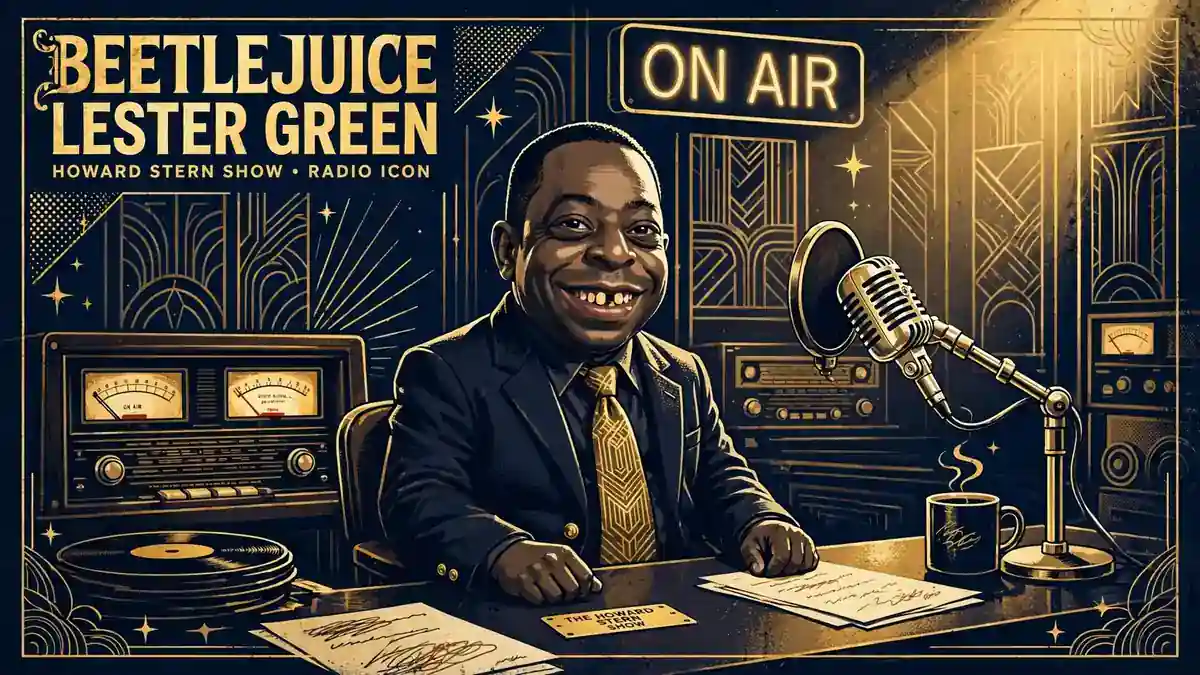
Beetlejuice‘s net worth is estimated at $200,000 to $500,000 as of November 2026. The entertainer born Lester Green turned a single 1999 appearance on The Howard Stern Show into a 25-year career spanning radio, two feature films, novelty songs, a merchandise line, and a one-of-one NFT that sold for $15,000 — all without ever signing a major studio contract or headlining a tour of his own.
Beetlejuice: Quick Facts
| Estimated net worth | $400,000 (range: $200,000 to $500,000) |
|---|---|
| Profession | Comedian, actor, radio personality, internet personality |
| Nationality | American |
| Born | June 2, 1968 (age 58) |
| Height | 4 feet 2 inches (some biographies list 4 feet 3 inches) |
| Primary income sources | Howard Stern Show appearances, film roles, music, merchandise, social media, NFT and crypto ventures |
| Active years | 1999–present |
| Last reviewed | November 2026 |
- Early Life and Background
- Education
- Career Journey
- Rise to Fame
- Main Sources of Income
- Salary and Earnings
- Businesses and Investments
- Brand Deals and Sponsorships
- Houses, Cars and Other Assets
- Awards and Achievements
- Net Worth Growth Over the Years
- Social Media Presence
- Personal Life
- Sources & Reporting
- Frequently Asked Questions
Early Life and Background
Lester Green was born on June 2, 1968, in Browns Mills, New Jersey, and grew up in Jersey City, New Jersey, as the second youngest of six children. That much is consistent across the strongest sources. The record gets messier on the details: several secondary biographies list Jersey City as his birthplace instead of Browns Mills, which appears to confuse where he was born with where he was raised. Celebrity Net Worth, the most thoroughly sourced profile available and updated on November 13, 2026, gives Browns Mills as the birthplace and Jersey City as the place he grew up, and that is the version this article uses.
Green was born with dwarfism and microcephaly, a neurological condition marked by an unusually small head size that can be associated with differences in brain development and intellectual functioning. The conditions shaped his physical development and his appearance throughout his life, and they are central to understanding both his public image and the long-running argument about it. His adult height is most commonly listed at 4 feet 2 inches by Celebrity Net Worth; other biographies, including Net Worth Post and The Biography, list 4 feet 3 inches. The one-inch gap is a small thing, but it is a useful warning about this subject: even basic facts about Green vary from source to source, because so little of his life has ever been documented by a major outlet in depth.
What the sources agree on is the personality. From a young age, Green enjoyed entertaining people, and he developed an outgoing, quick-witted manner that later made him a natural on live radio. He had no formal show-business training and no family connection to entertainment. His route into the business came through an unusual corner of it: in the 1990s he was discovered by Sean Rooney, a promoter and manager who ran an entertainment business built around performers with dwarfism. Rooney recruited Green for his shows and began managing his career, arranging public appearances and building a small act around him.
It was during the Rooney years that Green picked up the name the world knows him by. The nickname Beetlejuice came from his resemblance to the title character in Tim Burton’s 1988 film Beetlejuice, played by Michael Keaton. The resemblance was a joke that stuck, then became a stage name, then became the only name most of the public ever uses for him. He has no connection to that film or its 2024 sequel, Beetlejuice Beetlejuice — he did not appear in either one, and the film’s fortune belongs to its stars, not to him. That confusion is so common that it shapes the search results for his name: a large share of pages titled “Beetlejuice net worth” are actually writing about the fictional character or about Michael Keaton, whose own fortune runs to somewhere between $40 million and $55 million depending on the outlet. Green’s own money story is a different one, and a much smaller one, built on radio rather than Hollywood.
One detail from Green’s Jersey City childhood surfaced years later on Stern’s show and is worth recording because it comes from a named witness. On October 2, 2007, actor Jerry O’Connell revealed on the broadcast that he and Green had known each other growing up, because O’Connell’s mother had been Green’s special education teacher at PS 31 in Jersey City. It is a small, human detail, and it is one of the few verified facts about Green’s early years that does not come from a net-worth content farm. It also fixes his schooling to a real place: PS 31 in Jersey City, where he received special education.
Education
Almost nothing about Lester Green’s formal education has been publicly documented beyond the PS 31 detail. He attended special education classes at PS 31 in Jersey City, where Jerry O’Connell’s mother taught him — a fact O’Connell shared on the Stern show in 2007. No source of any weight records a high school graduation, a college, a degree, or any further schooling, and this article will not invent one. That gap matters for the money story in a concrete way: Green entered entertainment with no credential, no training, and no institutional backing, and his earning power has always rested on a single asset — his personality on a microphone — rather than on any qualification a casting director or employer could price.
The absence of an education record is itself a finding about how this corner of celebrity works. For most actors, a biography can be built from school plays, drama programs, and early auditions. For Green, the paper trail starts in 1999, at age 31, when he walked into a radio studio. Everything before that is family memory and a handful of anecdotes told on air, and every net-worth site that prints a confident “education” section for him is filling space with guesswork. Readers should treat any site that claims a specific high school or college for Green as unreliable on the rest of its figures too.
Career Journey
Green’s career began on July 14, 1999, when Sean Rooney brought him to the studio of The Howard Stern Show alongside another performer, Frank “Third Degree” Burns, while promoting Rooney’s entertainment business. According to Stern Show executive producer Gary Dell’Abate, Rooney had intended to steer attention toward Burns. Stern ignored that plan. He was immediately drawn to Green — to his answers, his timing, and his habit of departing from any script in front of him — and the appearance became an instant success. Green started returning regularly, and within months he was one of the most recognizable personalities attached to the show.
The timing mattered. In 1999, Stern was at the height of his terrestrial-radio power, broadcasting to millions of listeners a day, and a memorable guest on his show could become famous overnight in a way that is hard to reproduce now. Green became a member of the Wack Pack, Stern’s rotating cast of eccentric regulars, and over the following years he appeared in countless radio segments, comedy routines, interviews, and promotional spots. His stock in trade was his distinctive speaking style, his larger-than-life claims, and a seemingly endless supply of spontaneous catchphrases. Stern has described him as a once-in-a-lifetime guest, and he has frequently been called the most popular Wack Pack member in the show’s history.
One early appearance became legend inside Stern’s audience. In January 2000, Stern sent Green to Las Vegas to accept an Adult Video News award on his behalf. Green wore an earpiece so producers could feed him lines, but he kept departing from the script, and the acceptance speech spiraled into one of the show’s most replayed moments before he had to be escorted from the stage. It was the template for everything that followed: put Green in front of a live audience, give him a loose plan, and let the unpredictability do the work.
Radio fame opened doors that radio alone could not have. In 2001, Green appeared in two theatrical films in the same year: he played Lil’ Zip, a member of a freak show, in the cult comedy Bubble Boy starring Jake Gyllenhaal, and he made a cameo as himself — depicted as the brain of Marlon Wayans’ stoner character Shorty Meeks — in Scary Movie 2. Another Wack Pack member, Matthew McGrory, also appeared in Bubble Boy. Green went on to appear in the Howard Stern-produced comedy series Son of the Beach, made a guest appearance on the professional wrestling program WCW Monday Nitro, and in 2003 played a character called Super Juice in an episode of the musical comedy Doggy Fizzle Televizzle. In 2005 he provided voice work for the video game True Crime: New York City, voicing a character named Zeke. His later screen credits include the 2012 horror comedy Girls Gone Dead, which also featured Stern Show personality Sal Governale, and a role as Hairless Cat in the 2014 comedy Apartment Troubles. Net Worth Post counts six acting credits in total, a small filmography that tells its own story: Hollywood used Green as a memorable cameo, never as a leading man, and the film money was always a side stream next to radio.
In 2009, Green starred in his own five-episode reality series, This Is Beetle, which aired on Howard TV and followed his daily life and adventures outside the radio studio. It was the closest he ever came to carrying a show under his own name. The same year, Sean Rooney died, and his brother Bobby Rooney took over as Green’s longtime manager, overseeing his appearances, business ventures, and social media presence — a working relationship that continues today and that explains much of Green’s second act as an internet personality.
One of the stranger episodes in Green’s career came in 2008, when director Michael Bay’s casting team contacted his representatives about the possibility of using his voice for one of the robot characters in the 2009 blockbuster Transformers: Revenge of the Fallen. Green and Bobby Rooney traveled to Princeton University, where the movie was filming, to meet Bay. According to Bobby Rooney’s account on the Stern Show, Bay was enthusiastic about the idea and even showed Green a computer-generated character accompanied by a recording of his voice. Green was uncooperative during the meeting, the proposed collaboration fell apart, and he never appeared in the finished film. Photographs from the set circulated among Stern listeners afterward, and the story survives as a reminder of how close Green came, twice, to a mainstream Hollywood payday — and how his own unpredictability, the same quality that made him famous, kept him from collecting it.
Rise to Fame
Green’s rise was fast and total. Within a year of his July 1999 debut he was a fixture of the biggest radio show in America, and within two years he had film credits, a television profile, and a fan base that knew his catchphrases by heart. The mechanism was simple: Stern’s show gave him the largest live audience in radio, and his unscripted answers gave Stern moments no writer could have produced. Clips of his appearances circulated for years, first on Howard TV and fan sites, later on YouTube, Instagram, and TikTok, where short videos of his catchphrases found a second audience that had never heard a Stern broadcast.
The high-water mark of his standing inside Stern’s world came in 2015, when Stern named him the greatest Wack Packer of all time. It was a title voted on by the show’s audience and staff, and it settled an argument that had run for years among listeners about who the Wack Pack’s defining member was. By then Green had already been away from the show for some time — his last regular run of appearances ended around February 2016 — but the title stuck, and it is still the first line of most biographies of him.
His fame has always carried an argument with it, and an honest profile has to record it. Some listeners and commentators have questioned whether the program exploited Green’s disabilities for entertainment, pointing to the earpiece stunts, the scripted humiliations, and the way his answers were mined for laughs. Other fans have argued the opposite: that Green plainly enjoyed performing, that he was paid and promoted, and that his charisma and popularity were real. Stern himself has called him a once-in-a-lifetime guest. There is no settled answer, and the money figures cannot settle it — but the argument is part of why Green remains a recognizable name decades after his debut, and why his profile draws search traffic long after his regular radio career ended.
The other force behind his longevity is the internet’s memory. A clip of Green saying “Just hanging around” became a widely shared meme. His 2004 recording “This Is Beetle,” also known as “The Beetlejuice Song,” was covered by rock bands including Staind and Blues Traveler — Blues Traveler performed their version on the Stern Show on September 19, 2005. Each clip introduced him to listeners too young to have heard his original run, and each one fed the merchandise and social media income that sustains him now. Fame, for Green, did not end when the radio appearances thinned out. It changed shape, from broadcast to meme, and the money followed the same path.
Main Sources of Income
Green’s income has never come from one big contract. It comes from a stack of modest streams, each tied to a different phase of his career, and the stack is the reason his net worth sits in the hundreds of thousands rather than the millions. The streams, in rough order of importance, are radio appearances, film and television work, music, merchandise, social media, and a handful of digital ventures including an NFT and a cryptocurrency.
Radio is the foundation. Green spent the best part of two decades as a recurring guest on The Howard Stern Show, and that show was the engine of everything else. Appearance fees for Stern guests have never been disclosed for Green, and neither Stern’s show nor Green’s management has ever published a per-appearance figure. What is documented is the scale of the platform: Stern’s SiriusXM contracts rank among the richest in broadcasting — his own fortune is estimated at $650 million to $750 million by Net Worth Radar as of October 2026 — and a regular guest on that show commanded real appearance money, personal-appearance bookings, and a profile that could be sold elsewhere. To put Green’s money in perspective, Howard Stern’s net worth is roughly 1,750 times Green’s anchored figure, a gap that says everything about who captured the value in that relationship. Stern owned the show; Green owned the moments.
Film and television paid in smaller, lumpier amounts. His two 2001 films, Bubble Boy and Scary Movie 2, were his biggest screen paydays, followed by smaller roles in Girls Gone Dead and Apartment Troubles, voice work in True Crime: New York City, and his five-episode reality series This Is Beetle on Howard TV in 2009. None of these roles carried a reported salary, and none of them led to a second wave of casting. The film work functioned as a credential and a source of clips, not as a salary ladder. That is the honest reading of a six-credit filmography spread over 13 years: Hollywood paid Green for novelty appearances, and it stopped calling when the novelty aged.
Music is the most underrated stream. Green recorded several novelty songs and comedy tracks, and two of them traveled far beyond his own audience. His 2004 recording “This Is Beetle” became a fan favorite on the Stern Show, and it was covered by Staind and Blues Traveler, with Blues Traveler performing it live on the show in September 2005. In 2002 he appeared in the music video for rapper N.O.R.E.’s single “Grimey,” which put him in front of a hip-hop audience. In 2015 he released “Beetle in the House,” which later received a remix featuring Snoop Dogg, Sean Paul, and Big Freedia; Stern premiered the remix in February 2021. Streaming royalties for novelty tracks of this kind are small, and no figure has ever been published for Green’s music income, but the collaborations matter commercially in a different way: each one attached his name to a bigger artist’s audience, and each one kept his catalog earning long after the recording date.
Merchandise and social media are the streams that pay today. Green’s official online store, Beetle Merch, sells T-shirts, collectible cards, and other products carrying his image and catchphrases, with clothing typically priced around $25 to $30 per item. His official Instagram account, @beetlepimp, has attracted more than three million followers, making him one of the most prominent internet personalities to come out of the Stern Show. Sponsored posts, video monetization, and merchandise sales are the income sources The Biography and Net Worth Post both name alongside his acting work, and they are the only streams still growing: every viral clip of an old Stern appearance sends a new wave of buyers to the store and followers to the account. His YouTube channel, launched on November 9, 2019, had gathered close to 150,000 subscribers and more than 20 million total views by May 2023, according to Net Worth Post — modest by YouTube standards, but real money for a channel built entirely on archive clips.
Salary and Earnings
There is no published salary for Lester Green, and any article that prints one as fact is guessing. No contract, filing, or verified interview has ever disclosed what Stern’s show paid him per appearance, what he earned for Bubble Boy or Scary Movie 2, or what his merchandise business turns over in a year. Celebrity Net Worth says so directly on his profile: his actual earnings from merchandise, endorsements, and other commercial ventures have not been publicly disclosed. That sentence is the most important line in the source record for this section, and it is the reason this article reports a range rather than a single confident number.
The secondary figures that do circulate should be handled with care. Scintillating Stars, which puts his net worth at $500,000, also claims he earns approximately $12,000 per month and $68,000 annually — two numbers that contradict each other on their face, since $12,000 a month is $144,000 a year, not $68,000. The same page says he “made $500,000 thousand as of April 2023,” a typo that would mean $500 million. A source that cannot keep its own arithmetic straight cannot be trusted for a salary figure, and this article does not repeat its income claims as fact. It cites them only as evidence of how unreliable the secondary market for Green’s finances is.
What can be stated with a number attached is narrow but real. His one-of-one NFT, launched through Goldin Auctions in February 2022, sold for $15,000 after 21 bids, with the winning bidder receiving a signed physical rookie card and a video of Green telling his life story. That is the single largest verified one-off payday in his public record, and it is worth pausing on: a single digital collectible earned him roughly 4% of his entire estimated net worth in one sale. His merchandise has a published price point — T-shirts at $25 to $30 — which lets a reader do rough math on what the store would need to sell to matter, but without sales volumes the math stays hypothetical. His YouTube channel’s 20 million-plus views imply advertising revenue in the low five figures over its lifetime at typical rates, but that is an inference, not a reported figure, and it is labeled as one here.
The pattern across his career is consistent: Green earned appearance money, not salary money. He was paid to show up, not employed to stay. That distinction explains both the size of his fortune and its shape — a career of one-off payments, small royalties, and merchandise margins, with no multi-year contract, no syndication check, and no backend participation in any film or show. It also explains why the estimates cluster where they do: $200,000 from the cautious biographers, $400,000 from Celebrity Net Worth, $500,000 from the optimistic ones. None of those numbers requires Green to have earned more than a working entertainer’s living across 25 years, and none of them requires him to have lost a fortune either.
Businesses and Investments
Green’s business ventures are small, personal, and run through his manager Bobby Rooney rather than through any company with public filings. The most durable is Beetle Merch, his official online store, which sells T-shirts, collectible cards, and other products featuring his image and catchphrases. Celebrity Net Worth confirms the store exists and gives the $25 to $30 price range for clothing; neither it nor any other source publishes revenue, margins, or sales volumes. The store’s real value is as a monetization channel for his social following: with more than three million Instagram followers, even a tiny conversion rate on a $25 shirt produces meaningful income, and the store needs no tour, no studio, and no new material to keep selling.
In 2016, Green introduced a branded line of flavored vaping products called “Beetle’s Juice,” with his manager explaining that Green had an ownership interest in the venture. The line received a burst of coverage on the Stern Show at launch and then faded from public view; no sales figures, no distribution deal, and no current status have ever been reported. It reads, in hindsight, as a classic celebrity licensing play from the mid-2010s vaping boom — a name on a product, a short burst of attention, and an uncertain tail. This article does not count it as a live income stream, because no evidence says it still is one.
The digital ventures are better documented and more interesting. In February 2022, Green’s representatives launched a one-of-a-kind NFT through Goldin Auctions — billed as the first and only official Beetlejuice NFT — which included a digitally authenticated trading card, a signed physical collectible, and a video of Green telling his life story. It sold for $15,000 after 21 bids. The sale is the most precisely documented transaction of Green’s career, and it is the closest thing to a verified earnings datapoint in his file. Around the same period, Green promoted BeetCoin, a cryptocurrency venture associated with his name, during his December 2021 return to the Stern Show. No market capitalization, holder count, or price history for BeetCoin has been published by any reliable source, and this article treats it as a promotional venture, not as an asset with a measurable value. The same caution applies to the “own cryptocurrency Bitcoin” claims that appear on some low-quality net-worth pages, which confuse a branded token with an actual holding and should be ignored.
On investments more broadly, there is nothing to report — and that is itself a finding. No property record, no stock portfolio, no business filing, and no investment interview has ever surfaced for Lester Green. The wealth he has is the wealth of a working entertainer who was paid over 25 years and kept enough of it to sit in the low six figures. Readers comparing him with actors who parlayed fame into production companies or property portfolios should understand the difference: Green’s career produced income, not capital, and his net worth is a savings balance built from appearance fees and merchandise margins, not an investment portfolio.
Brand Deals and Sponsorships
Green’s endorsement history is thin, and the record is honest about that. No major brand deal — no national commercial, no long-term ambassadorship, no product line with a public partner — has ever been documented for him. The commercial relationships that do exist are the ones already covered in this article: the N.O.R.E. “Grimey” video in 2002, the Snoop Dogg, Sean Paul, and Big Freedia remix of “Beetle in the House” premiered in 2021, the Beetle’s Juice vaping line in 2016, and the Goldin Auctions NFT in 2022. Each was a one-off collaboration or licensing play, not a sponsorship contract, and none of them carried a published fee.
The near-miss with Transformers: Revenge of the Fallen deserves a second look here, because it is the closest Green ever came to a major-studio payday. In 2008, Michael Bay’s casting team contacted his representatives about using his voice for a robot character, and Green traveled to Princeton University to meet Bay in person. Bay was enthusiastic enough to show him a computer-generated character voiced with his recording. The deal collapsed because Green was uncooperative in the meeting. No fee was ever discussed in public, and the role went to someone else, but the episode shows the ceiling on Green’s commercial value at his peak: a director of Bay’s stature was willing to build a character around his voice. It also shows why that ceiling was never reached — the same unpredictability that made him unmissable on live radio made him unusable on a film set with a schedule.
What Green has instead of brand deals is the modern equivalent: sponsored social media posts and video monetization. The Biography notes that he increased his fortune through sponsored posts shared across his social media platforms and through video monetization, and Net Worth Post names the same streams. With more than three million Instagram followers, a single sponsored post from Green’s account reaches an audience larger than most cable shows, and that reach has a market price even if no rate card has ever been published. It is a modest, realistic income — not a fortune, but a living — and it is the stream most likely to be paying him right now.

Houses, Cars and Other Assets
There is no public record of a house, a car collection, or any other major asset owned by Lester Green, and this section will not invent one. No property deed, no real-estate listing, and no verified interview about his home has ever surfaced. What is known is where he lives, not what he owns: after his last regular run on the Stern Show ended around February 2016, Green moved to Georgia, where he spent time with his mother and sister and made fewer public appearances. He was still based in Georgia when he returned to the show remotely from a hotel room there on December 14, 2021, alongside Bobby Rooney.
The Georgia move is a useful datapoint for the money story in two ways. First, it fits the profile of an entertainer whose income had thinned: Georgia’s cost of living is far below New York’s or Los Angeles’, and living with family is the lowest-overhead arrangement available. Second, it marks the point where Green’s public life effectively paused — five years without a live Stern appearance — before social media pulled him back. Readers should not read a mansion or a car collection into the silence. The honest statement is that Green’s assets, as far as any public record shows, are his name, his social accounts, his merchandise store, and whatever savings his 25 years of appearance fees left behind.
One more asset deserves a mention because it is real and it is appreciating: his archive. Decades of Stern Show appearances, film cameos, and novelty songs constitute a catalog that still earns — through YouTube views, TikTok clips, and the merchandise those clips drive. The catalog’s value is not something a bank would lend against, but it is the reason Green can earn money in 2026 without recording anything new. In that sense his most valuable property is not a house or a car. It is a library of moments, and it keeps paying.
Awards and Achievements
Green has never won a mainstream entertainment award, and no honest profile should pretend otherwise. His trophy case is a different kind: a title, a moment, and a set of numbers that measure a kind of fame the award shows never built a category for.
The title is the one that matters most inside his world. In 2015, Howard Stern named Green the greatest Wack Packer of all time, a judgment from the show’s audience and staff that settled years of debate among listeners. It is the closest thing to an official honor Green has received, and it is the line that opens most biographies of him for a reason: it is a verdict from the only institution that ever employed him in any sustained way.
The moment is the January 2000 Adult Video News awards speech in Las Vegas. Stern sent Green to accept an award on his behalf, Green wore an earpiece so producers could feed him lines, he kept departing from the script, and he had to be escorted from the stage. It is still replayed and quoted more than 25 years later, and it is the single most famous five minutes of Green’s career. No plaque marks it, but it did more for his earning power than any award could have: it made him a permanent part of Stern Show lore, and lore is what sells T-shirts in 2026.
The numbers complete the picture. More than three million Instagram followers on @beetlepimp. Close to 150,000 YouTube subscribers and more than 20 million total views. Two feature films in a single year, 2001. A novelty song covered by Staind and Blues Traveler. A remix featuring Snoop Dogg, Sean Paul, and Big Freedia. A one-of-one NFT that sold for $15,000 after 21 bids. A five-episode reality series under his own name. None of these is a conventional achievement, and that is the point: Green’s career was built outside the conventional paths, and its markers are measured in followers, views, and bids rather than in statuettes.
Net Worth Growth Over the Years
Green’s net worth has not grown in the way a movie star’s does — there was no breakout payday, no franchise check, no compounding investment portfolio. It has moved in small steps, tracking his visibility: up when he was on the radio every week, flat when he moved to Georgia, and gently up again as social media gave his old clips a second life. The table below uses the figures the sources actually published, with the source named for each year, so readers can see how the range was built rather than taking a single number on trust.
| Year | Estimated net worth | What the sources said |
|---|---|---|
| 2021 | $200,000+ | The Biography and Net Worth Post both put him at over $200,000 as of mid-2021 to January 2022. |
| 2022 | $200,000 – $500,000 | His NFT sold for $15,000 through Goldin Auctions in February 2022; secondary sites split between $200,000 and $500,000. |
| 2023 | $500,000 | Scintillating Stars and Famous Wealthy People held at $500,000; no new primary reporting behind the figure. |
| 2024 | $400,000 | Celebrity Net Worth carried $400,000 after its March 2024 publication; the figure has held since. |
| 2025 | $200,000 – $500,000 | Outlets diverged again — some held $500,000, others repeated the older $200,000 figure — with no new disclosure to settle it. |
| 2026 | $200,000 – $500,000 (anchored $400,000) | Celebrity Net Worth updated its profile on November 13, 2026, keeping $400,000; this article anchors there. |
Two things stand out in that record. The first is how little the number has moved in five years: the entire range across 2021 to 2026 fits inside $300,000, which is what a working entertainer’s savings look like when the income is steady but modest. The second is how much of the disagreement is a sourcing problem rather than a money problem. The $200,000 figures come from biographies written in 2021 and 2022 and repeated ever since; the $500,000 figures come from content sites that updated their year without updating their reporting; the $400,000 figure comes from the one outlet that revisited the profile in November 2026. Anchoring to the freshest serious source is the honest choice, and the range around it is the honest admission that nobody outside Green’s household knows the exact number.
Peer comparison makes the scale plain. The table below sets Green against the two men whose names are most often confused with his — the host who made him famous, and the actor who played the character he was named after. Both figures are ranges, because both men have the same disclosure problem Green has, at a larger scale.
| Person | Estimated net worth (2026) | How it was built |
|---|---|---|
| Howard Stern | $650 million – $750 million | Decades of SiriusXM contracts; Net Worth Radar put him at $700 million in October 2026. |
| Michael Keaton | $40 million – $55 million | Batman ($5 million in 1989, $11 million for the 1992 sequel), Beetlejuice, Birdman; Celebrity Net Worth says $55 million, Parade says $50 million, LoveMoney says $40 million. |
| Beetlejuice (Lester Green) | $200,000 – $500,000 | Radio appearances, film cameos, music, merchandise, social media, one NFT sale. |
The gap between Stern and Green — roughly 1,750 times — is the real story of this article. Green supplied some of the most memorable moments in the history of Stern’s show, and Stern captured nearly all of the money the show generated. That is not an accusation; it is the economics of radio. The host owns the platform, the guest owns the appearance. Green’s $400,000 is a fair price for a career of appearances, and it is also a measure of how little of a billion-dollar broadcast business ever reaches the people who make its best moments.
Social Media Presence
Social media is where Green’s career lives now, and it is the part of his story that most competitors under-report. His official Instagram account, @beetlepimp, has attracted more than three million followers, according to Celebrity Net Worth’s November 2026 update — a number that makes him one of the most-followed personalities ever to come out of the Stern Show, and a larger audience than many working television actors command. Short videos of his catchphrases and old Stern appearances circulate constantly on Instagram, TikTok, and YouTube, and one clip of him saying “Just hanging around” became a widely shared meme that introduced him to an audience born after his radio peak.
His YouTube channel, launched on November 9, 2019, had gathered close to 150,000 subscribers and more than 20 million total views by May 2023, according to Net Worth Post. The most-watched videos, as of that date, were clips with titles like “Beetlejuice’s Sister & Mom,” “Beetlejuice Speaks Spanish (Howard Stern Show) Part 1,” and “Beetlejuice Gets New Teeth (Howard Stern Show) Part 1” — archive material, not new recordings, which is the point. Green’s channel earns from work he did years ago, and it will keep earning as long as the clips keep circulating.
The commercial side of that following is straightforward. His management has used the audience to sell merchandise through Beetle Merch, to place sponsored posts, and to monetize video — the same three streams The Biography names as the drivers of his fortune beyond acting. No follower count guarantees income, and a large share of his followers arrived through memes rather than through any purchase intent, but three million followers is a real asset in 2026: it is the reason a T-shirt store can sell without advertising, and it is the reason Green’s name still draws search traffic a decade after his last regular radio run. The open question is how long the archive can carry him. Every year further from 1999, the clips get older and the audience that remembers the original broadcasts gets smaller. For now, the meme pipeline is still flowing.
Personal Life
Green has kept his private life largely outside the spotlight, despite his willingness to discuss outrageous and frequently exaggerated personal stories on the Stern Show. That distinction matters: almost everything the public “knows” about his romances, his family, and his daily life comes from on-air bits that were designed to be funny, not factual, and this article does not repeat them as biography. No reliable source records a wife, a partner, or children for Green, and the net-worth pages that list a “wife” or “kids” in their quick-fact boxes are filling in blanks they have no evidence for. The honest answer is that his relationship status is not publicly documented.
What is documented is family. Green has maintained close relationships with members of his family, particularly his mother and his sister, and he moved to Georgia to be near them after his regular Stern appearances ended around February 2016. His sister and mother appear in his most-watched YouTube videos, and they were with him in spirit, if not in person, when he returned to the show remotely from a hotel room in Georgia in December 2021. His longtime manager Bobby Rooney, who took over after his brother Sean’s death in 2009, has organized his professional appearances and handled his business opportunities throughout the transition from radio personality to internet celebrity.
On health, the record needs care. Green lives with dwarfism and microcephaly, conditions he has had since birth, and they have shaped his life and his public image. Beyond that, periodic rumors about his health — including death hoaxes that circulate on social media every few years — have no basis in verified reporting. As of November 2026 he is alive, based in Georgia, and active on social media through his management. The most recent solid reporting on his condition is the December 2021 Stern appearance itself, in which he spoke with Stern and co-host Robin Quivers, discussed his family life, and promoted BeetCoin. Readers who see alarming headlines about Green’s health should check whether the story names a source; the ones that do not are repeating a rumor, and the ones that do are usually repeating a clip from years ago.
The Georgia years are the quietest chapter of his life, and they are also the most revealing about his money. A man who had spent 17 years at the center of the biggest radio show in America moved in with family, stepped back from public appearances for five years, and came back only when social media made it possible to earn without leaving home. It is not the arc of a man who banked millions and retired. It is the arc of a working entertainer who earned a living, kept his overhead low, and found a second audience online.
Sources & Reporting
Celebrity Net Worth — the $400,000 net worth figure, the July 14, 1999 debut date, the January 2000 AVN Awards story, the Transformers meeting with Michael Bay, the Beetle Merch price range, the Beetle’s Juice venture, the Goldin Auctions NFT, the December 14, 2021 return, and the 3 million Instagram followers. Profile published March 28, 2024; updated November 13, 2026 — the freshest serious source on Green.
Wikipedia — birth date and place, the 2015 Greatest Wack Packer title, the February 2021 return, the NFT sale price of $15,000 after 21 bids, the filmography including Bubble Boy, Scary Movie 2, Girls Gone Dead, and Apartment Troubles, and the Snoop Dogg, Sean Paul, and Big Freedia remix. Page last reviewed in this reporting window, October–November 2026.
Net Worth Post — the $200,000 floor figure, the 4 feet 3 inches height listing, the six acting credits, the YouTube channel launch date of November 9, 2019, with close to 150,000 subscribers and more than 20 million views, and the Browns Mills birthplace. Article updated May 14, 2026.
The Biography — the “over $200,000” estimate as of mid-2021, the sponsored-post and video-monetization income streams, and the Jersey City birthplace claim, which conflicts with Celebrity Net Worth and Wikipedia and is flagged in this article rather than adopted.
Scintillating Stars — the $500,000 ceiling figure as of January 2026 and the 58-year-old age listing; its monthly and annual income claims are internally contradictory and were not used as fact. Page updated May 10, 2025, with a November 2026 refresh note.
Net Worth Radar — Howard Stern’s $700 million estimate as of October 2026, with the $650 million to $750 million published range, used for the peer comparison table.
Parade — Michael Keaton’s $50 million net worth estimate and the $5 million Batman salary, published January 2, 2026, used for the peer comparison table.
The Howard Stern Show — the show’s own archive and quiz pages confirming Green’s long-running status as a signature Wack Pack guest.
Reporting window: November 13–16, 2026. Figures are estimates drawn from public reporting, not audited statements. Where sources disagreed — on the birthplace, the height, and the net worth itself — this article publishes the range and names who says what, rather than picking the most flattering number.
Frequently Asked Questions
What is Beetlejuice’s net worth in 2026?
Beetlejuice’s net worth is estimated at $200,000 to $500,000 as of November 2026, anchored at $400,000. Celebrity Net Worth, the freshest serious source after its November 13, 2026 update, puts him at $400,000. Scintillating Stars says $500,000, while The Biography and Net Worth Post hold at $200,000 or over. Outlier claims of $2 million and above come from thin sources with no reporting behind them, so this article excludes them.
What is Beetlejuice’s real name?
His real name is Lester Green. Some secondary biographies give his full name as Lester Napoleon Green, with Napoleon as a middle name, but the strongest sources — Celebrity Net Worth and Wikipedia — use Lester Green. He took the stage name Beetlejuice in the 1990s because of his resemblance to the title character in Tim Burton’s 1988 film.
How old is Beetlejuice?
Beetlejuice is 58 years old. He was born Lester Green on June 2, 1968, in Browns Mills, New Jersey, and grew up in Jersey City. He turns 59 on June 2, 2027.
How tall is Beetlejuice?
Beetlejuice’s height is most commonly listed at 4 feet 2 inches by Celebrity Net Worth, though several other biographies list 4 feet 3 inches. He was born with dwarfism and microcephaly, conditions that shaped his physical development and his appearance throughout his life.
Is Beetlejuice still alive? What happened to him?
Yes, Beetlejuice is alive as of November 2026. He moved to Georgia to live near his mother and sister after his regular Howard Stern Show appearances ended around February 2016, which is why he seemed to disappear for five years. He returned to the show in February 2021 and again live on December 14, 2021. Death rumors about him that circulate on social media have no basis in verified reporting.
Is Beetlejuice the character from the 1988 movie?
No. The movie character Beetlejuice was played by Michael Keaton in Tim Burton’s 1988 film and its 2024 sequel, and Lester Green has no connection to either film. Green got the nickname because people thought he resembled Keaton’s character, and the name stuck as his stage name. Keaton’s own net worth is estimated at $40 million to $55 million — a separate fortune from Green’s.
What is Beetlejuice doing now?
As of 2026, Beetlejuice lives in Georgia near his family and earns through his social media presence and merchandise. His Instagram account @beetlepimp has more than three million followers, his YouTube channel has close to 150,000 subscribers, and his Beetle Merch store sells T-shirts and collectibles. He makes occasional appearances on The Howard Stern Show, most recently returning live in December 2021.
How much did Beetlejuice’s NFT sell for?
Beetlejuice’s one-of-one NFT sold for $15,000 after 21 bids through Goldin Auctions in February 2022. The winning bidder received a digitally authenticated trading card, a signed physical rookie card, and a video of Green telling his life story. It is the largest verified one-off payday in his public record — roughly 4% of his entire estimated net worth in a single sale.
Final Thoughts
Beetlejuice’s net worth — $200,000 to $500,000, anchored at $400,000 — is a modest fortune by celebrity standards, and that modesty is the honest story. Lester Green never had a franchise, a syndication deal, or a multi-year contract. He had a microphone, a personality nobody could script, and 25 years of showing up. The Howard Stern Show gave him the biggest audience in radio, two films gave him a credential, a merchandise store and three million Instagram followers gave him a living after radio ended, and a single NFT sale gave him the most precisely documented payday of his life at $15,000.
The number that matters most in this article is not Green’s. It is Howard Stern’s $650 million to $750 million, sitting next to Green’s $400,000 in the same table. Green made some of the most memorable moments in the history of that show, and the show kept nearly all of the money. That is how the business worked, and it is why Green’s fortune is measured in hundreds of thousands while his fame is measured in millions of followers. If you came here for a single number, take $400,000 — the freshest serious figure, updated November 13, 2026 — and remember the range around it, because the range is the truth: nobody outside Green’s household knows the exact figure, and the sources that pretend otherwise are the ones to distrust.
Published on November 16, 2026. Last reviewed November 2026. Found an error? See our corrections policy.