
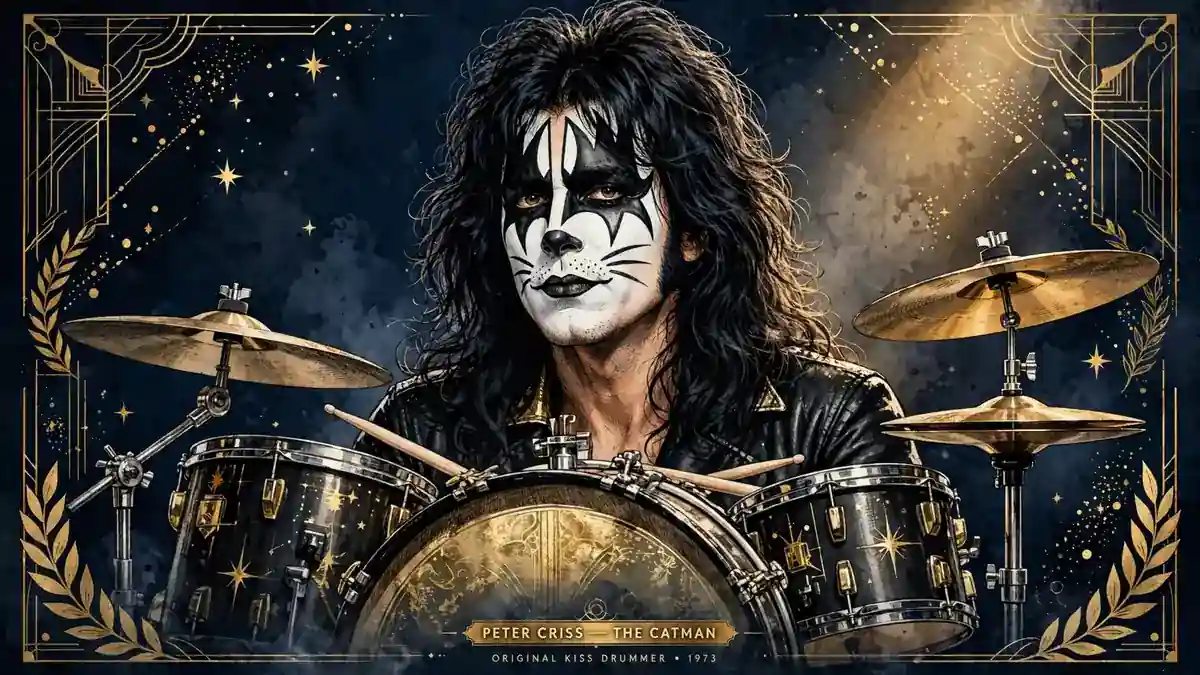
Peter Criss‘s net worth is estimated at $3 million to $5 million as of November 2026. The original KISS drummer — the Catman behind the kit and the voice of “Beth,” the band’s biggest American hit — built his fortune in the 1970s, then watched most of the band’s later billions pass him by after a 1982 buyout that Gene Simmons says left him with “very little” from KISS these days. At 80, Criss is recording again: a self-titled solo album released on December 19, 2025, his first in 18 years, arrived the day before his 80th birthday.
Peter Criss: Quick Facts
| Estimated net worth | $5 million (range: $3 million to $5 million) |
|---|---|
| Profession | Drummer, singer, songwriter |
| Nationality | American |
| Born | December 20, 1945 (age 80) |
| Height | 5 ft 9 in (1.75 m) |
| Primary income sources | KISS royalties, “Beth” songwriting royalties, solo albums, book sales, live appearances |
| Active years | 1964–2017, 2025 |
| Last reviewed | November 2026 |
- Early Life and Background
- Education
- Career Journey
- Rise to Fame
- Main Sources of Income
- Salary and Earnings
- Businesses and Investments
- Brand Deals and Sponsorships
- Houses, Cars and Other Assets
- Awards and Achievements
- Net Worth Growth Over the Years
- Social Media Presence
- Personal Life
- Sources & Reporting
- Frequently Asked Questions
Early Life and Background
Peter George John Criscuola was born on December 20, 1945, in Brooklyn, New York, into an Italian-American family. Brooklyn in the 1950s gave him two things that shaped the rest of his life: the swing and jazz records his parents played at home, and a neighborhood drum culture that treated the kit as a serious instrument rather than a noisy hobby. Criss grew up idolizing jazz drummers, and the swing feel he absorbed as a kid never left his playing — even at the height of KISS’s hard-rock years, his drumming swung where his peers pounded.
He was a working musician long before the makeup. Through the 1960s Criss played in a string of New York bands, learning the unglamorous side of the trade: bar gigs, session work, and the discipline of showing up night after night. His first notable break came with Chelsea, a band that released a self-titled album in 1970. Chelsea never broke through, but it gave Criss two things that later mattered enormously. First, it put him in a room with guitarist Stan Penridge, the collaborator with whom he sketched the song that became “Beth.” Second, it taught him that talent alone does not pay the rent — a lesson that would come back to him, hard, a decade later.
After Chelsea folded, Criss kept grinding through bands with names that now read like footnotes — Lips, the Barracudas, the Sounds of Soul — while holding down day work. By 1972 he was 27 years old, a veteran club drummer in a city full of them, and still waiting for the break that would change his life. It arrived in the form of a newspaper advertisement.
Education
Criss did not come up through a conservatory or a music college, and no formal education record is published for him. His training was the New York club circuit and private study with working drummers. He has spoken over the years about studying the great jazz drummers — Gene Krupa’s showmanship and swing left a visible mark on the way Criss played, and on the way he presented himself behind the kit. Where other hard-rock drummers of the 1970s built their style on power alone, Criss played with a jazz drummer’s sense of dynamics, ghost notes, and space.
That informal education mattered more than any diploma for his career. The swing feel is what made his drumming on “Beth” work, what gave KISS’s ballads their lift, and what set him apart from the interchangeable heavy hitters of the era. It also explains why, decades later, his solo work wandered into jazz standards and Broadway material on the 2007 album One for All — the kid from Brooklyn who learned drums from jazz records never stopped being that kid.
What his early years did not teach him was the business of music. Criss has been candid in interviews and in his 2012 autobiography that he trusted others with contracts and money in ways he later regretted. That gap in his education — financial, not musical — is the single biggest reason his net worth sits at $5 million while his bandmates’ fortunes run into the hundreds of millions.
Career Journey
In late 1972, Gene Simmons and Paul Stanley placed an advertisement in Rolling Stone looking for a drummer. Criss answered it. The audition, in a loft on East 23rd Street in Manhattan, went well enough that the two guitarists hired him on the spot — and, by Criss’s own account, he pushed them to take the theatrical concept further than they had planned, arguing that the band needed a visual identity as strong as its sound. Guitarist Ace Frehley joined weeks later, and in January 1973 the four men became KISS.
The first KISS show, on January 30, 1973, at the Coventry club in Queens, paid the band $50 and drew fewer than ten people. Within three years that same band was one of the biggest live draws in America. Criss’s role was the Catman — cat-whisker makeup, a drum riser, and a swing drummer’s feel underneath the fire-breathing and blood-spitting. He also became the band’s secret vocal weapon: while Simmons and Stanley handled most lead vocals, Criss sang the ballads, and his rough, emotional voice gave KISS a softer side that radio could play.
The breakthrough came with Alive! in 1975, the double live album that turned KISS from a cult act into a commercial force, and then with Destroyer in 1976, the band’s first platinum studio album. Criss played on the first seven KISS studio albums, from the 1974 debut through Dynasty in 1979, plus the four solo albums the band released simultaneously in 1978. His own self-titled solo record that year peaked at No. 43 on the Billboard 200 — the weakest commercial showing of the four, a fact that stung at the time and still gets cited in KISS histories.
By 1979 the original lineup was coming apart. Criss’s drumming on Unmasked (1980) was largely replaced in the studio, and he left the band in 1980, burned out and struggling with substance problems he has since discussed openly. He spent the 1980s in solo projects — Out of Control (1980), Let Me Rock You (1982), a short-lived band called Balls of Fire that played just seven shows before he walked away to spend time with his young daughter — and in guest spots, including a reunion with Frehley on the guitarist’s 1989 album Trouble Walkin’.
The money story of those years is one most net-worth roundups skip, and it is the key to the whole estimate. In 1982, Simmons and Stanley bought out Criss’s ownership stake in KISS — and Frehley’s too. Simmons has described it plainly in interviews since: “We bought him out — in 1982.” From that point on, Criss and Frehley were salaried employees when they played with the band, not owners. When KISS reunited in 1996 for a massively successful tour, Criss was back behind the kit as a hired hand on a salary, not as a partner sharing the profits. He played the reunion run from 1996 to 2001, returned again from 2002 to 2004, and then left for the last time.
After 2004, Criss kept a low public profile. He released Cat No. 1 in 1994 and One for All in 2007, a genre-hopping record that mixed rock with jazz and Broadway covers. He played his final full concert on June 17, 2017, at the Cutting Room in New York City, retiring from touring at 71. His last appearance on stage with KISS came earlier, at the band’s Rock and Roll Hall of Fame induction in 2014 — the four original members performed together that night for the first time in years, and have not done so since.
Then, in April 2025, came the surprise: Criss announced a new self-titled solo album, his first in 18 years, co-produced with Barry Pointer and featuring guitarists John 5 and Michael McLaughlin, bassists Billy Sheehan and Matthew Montgomery, and keyboardist Paul Shaffer. The album, released on December 19, 2025 — the day before his 80th birthday — was billed as his most rock-driven solo record ever, and Criss promoted it with a signing appearance at Rough Trade in New York on release day. The comeback gave his story a final chapter nobody had expected, and it put the Catman back on stage, in a manner of speaking, at an age when most of his peers had long since retired. It was a bittersweet year for the 1970s rock generation: 2025 also saw the death of Ozzy Osbourne, another frontman who had kept recording into his seventies.
Rise to Fame
Criss’s fame arrived in two waves. The first was KISS itself: between 1975 and 1979 the band became a merchandising phenomenon as much as a rock act, with lunch boxes, dolls, comic books, and a Marvel comic printed, famously, with the band members’ blood mixed into the ink. Criss’s Catman face was on all of it. The second wave was a single song.
“Beth” began life as “Beck,” a demo Criss wrote with Stan Penridge during their Chelsea days, a gentle ballad mocking a bandmate’s wife who kept calling him home from rehearsals. During the Destroyer sessions, producer Bob Ezrin reworked it — slowed the tempo, added orchestration, changed the title — and the result became the B-side of “Detroit Rock City.” Radio DJs flipped the single, listeners called in for the ballad instead of the rocker, and Casablanca Records released “Beth” as its own A-side in August 1976. It reached No. 7 on the Billboard Hot 100, earned a gold record from the RIAA, and won the 1977 People’s Choice Award for Favorite Song. It remains KISS’s biggest commercial hit in the United States.
The song made Criss the band’s most unlikely star. At concerts he sang it alone, spotlit, while the rest of the band left the stage — a quiet moment in the middle of the loudest show in rock. That image, a drummer in cat makeup singing a love song, is the one most fans carry of him, and it is the reason his name still draws a search volume of around 1,100 a month half a century later. Few frontmen of his era kept that kind of drawing power into their eighties — Mick Jagger is the rare exception, still touring with the Rolling Stones past 80 — but Criss’s fame was always built on one song rather than a lifetime on the road.
It is also the subject of the loudest argument of his later life. In a January 2026 interview on the Professor of Rock YouTube channel, Simmons said Criss “had nothing to do” with writing “Beth,” calling the song’s origin story “mythology” and crediting Penridge and Ezrin. Criss answered through Billboard, saying Simmons “wasn’t there from the conception of the song” and defending his co-writing credit, which stands on the record alongside Penridge and Ezrin. The dispute matters to his money: a co-writing credit on a gold, still-played catalog song pays publishing royalties; a credit he did not hold would not. On the paperwork, the credit is his, and the royalties follow it.
The other milestone of his later career arrived in December 2025, when KISS received the Kennedy Center Honors — the ceremony took place on December 7, 2025, and aired on CBS on December 23. Criss attended as a founding member, a reminder that whatever the money arguments, his place in the band’s history is not in dispute.
Main Sources of Income
Criss’s money comes from five streams, and their relative weight has flipped completely since the 1970s. In the KISS years, touring and record sales paid the bills. Today, the catalog does the work.
KISS record royalties. Criss played on the albums that built the KISS catalog — the 1974 debut, Hotter Than Hell, Dressed to Kill, Destroyer, Rock and Roll Over, Love Gun, Dynasty, and the 1975 live breakthrough Alive!. KISS has sold more than 100 million records worldwide, according to the band’s own figures cited by Pophouse Entertainment. As a performer on those records, Criss earns artist royalties, though the rate he receives is far below what an owner-partner would collect — and the 1982 buyout means he holds no equity in the catalog itself.
“Beth” songwriting royalties. This is the most durable income he has. As a credited co-writer with Penridge and Ezrin, Criss collects publishing royalties every time “Beth” is played on radio, streamed, licensed, or covered. The song’s gold certification, its People’s Choice Award, and its permanent place on classic-rock radio give it a long earning tail — and unlike his KISS ownership stake, nobody bought this credit out from under him.
Solo music. Six solo studio albums, from the 1978 debut through the 2025 self-titled record, generate modest streaming and sales income. The 1978 album’s No. 43 Billboard peak was the commercial high-water mark of his solo career, and none of the follow-ups matched it. The 2025 album, with its all-star guest list and the publicity of a comeback at 79, is the first solo release of his with a real marketing push in decades, and its sales and streaming will be the freshest addition to his income in years.
Books. His autobiography, Makeup to Breakup: My Life In and Out of Kiss, co-written with Larry Sloman and published on October 23, 2012, remains in print and sells steadily to KISS’s large, book-buying fanbase. One low-quality content farm claims the book sold more than 100,000 copies and earned him $1.5 million to $2.5 million; we could not verify those numbers against any credible source, so we do not use them. What is safe to say is that a KISS tell-all by an original member is a durable backlist seller, and it pays him author royalties year after year.
Appearances and conventions. Since retiring from touring in 2017, Criss has earned appearance fees at fan conventions, album signings — including the December 19, 2025 signing at Rough Trade in New York — and KISS-related events. These are one-off fees, not a salary, but for a retired musician they are the closest thing to a paycheck.
Salary and Earnings
Here is the honest answer: nobody outside the band’s accountants knows what Peter Criss was paid, year by year, and any site that prints a precise KISS-era salary for him is guessing. What the record does show is the structure of his pay, and the structure explains the $5 million figure better than any invented number could.
In the original KISS partnership, the four members shared in the band’s earnings as owners. That ended in 1982. Simmons has said, on the record and more than once, that he and Stanley bought out Criss’s and Frehley’s ownership stakes that year, and that the two men became salaried employees afterward. “Very little,” Simmons said when asked recently how much Criss makes from KISS these days. “We bought him out — in 1982.”
That single sentence is the most important earnings fact in this article. It means Criss did not share in the 1996 reunion tour’s profits as an owner — he was paid a salary to play the tour. It means he did not share in the End of the Road farewell tour (2019–2023), because he was not in the band at all. And it means he did not share in the April 2024 sale of the KISS catalog, brand name, and intellectual property to Pophouse Entertainment, a deal the Associated Press and Bloomberg reported at more than $300 million. That transaction was structured with Simmons and Stanley; as guitarist Bruce Kulick later explained, the other members and estates were left to separate, case-by-case arrangements over likeness rights, and Criss was not a party to the main deal.
To see the gap that buyout created, compare the bandmates. Celebrity Net Worth estimates Gene Simmons at around $400 million and Paul Stanley at around $200 million — both men kept their ownership stakes and sold them to Pophouse. Ace Frehley, bought out alongside Criss, is estimated by the same outlet at around $1 million. Criss, at $5 million, sits between Frehley and the two owners — a gap measured in hundreds of millions of dollars, created by one contract decision in 1982.
What does he earn now? No public figure exists. The credible pieces are small and steady: publishing royalties from “Beth” and his other KISS co-writes (“Baby Driver” and “Dirty Livin’,” both written with Penridge, per American Songwriter), artist royalties from the KISS albums he played on, solo-album income, book royalties, and appearance fees. One content site claims an annual income of around $400,000; that number appears without a source and we do not repeat it as fact. The pattern of his life — a modest Connecticut home, a quiet retirement, a comeback album recorded with friends rather than a stadium tour — fits a man living comfortably on catalog income, not a man with a nine-figure fortune. It is the same arc as Tom Petty, another 1970s rocker whose later years were shaped less by touring paydays than by the value of the songs he had already written — except Petty kept his catalog, and Criss sold his stake in his.
Businesses and Investments
Criss was never a businessman in the Simmons mold. Simmons built a licensing empire of thousands of KISS products and, later, a portfolio of business ventures outside music. Criss built no comparable portfolio, and no public record shows him founding a company, taking a major investment stake, or running a business of any scale.
What he did try was small and music-adjacent. In the late 1980s he talked about opening a recording studio and starting his own label, to be called Catman Records, and about writing an autobiography then titled A Face Without a Kiss. The label never materialized. The book did, a quarter-century later, as Makeup to Breakup. His own label imprint, Silvercat Records, released One for All in 2007 — a self-release vehicle rather than a business empire, and a reminder that by the 2000s Criss was operating as an independent artist, not a mogul.
His most consequential business decision was not an investment but a divestment: the 1982 sale of his KISS ownership stake. Viewed as a transaction, it is the worst deal of his career in hindsight — the stake he sold would eventually be worth a share of a $300 million catalog sale — but it was made at a moment when he was leaving the band, struggling personally, and taking cash in hand over a future he could not see. Plenty of musicians have made the same trade. Few have had the arithmetic laid out so publicly afterward. The contrast with Prince, who spent his career fighting to control his masters and his catalog, is sharp: where Prince treated ownership as sacred, Criss treated it as something he could sell when he needed out — and the two estates tell the difference.
On the investment side, there is no public record of stock portfolios, property empires, or venture stakes. His wealth, such as it is, sits in the catalog — the records he played on, the song he co-wrote — and in one house. That is a thinner base than most rock stars of his stature, and it is why the estimate lands where it does.
Brand Deals and Sponsorships
Criss’s endorsement history reads like a drummer’s résumé rather than a celebrity brand portfolio. He has been an endorser of DW drums, Zildjian cymbals, Pro-Mark drumsticks, and Remo drumheads — the working tools of his trade, supplied under the standard artist endorsement deals that give a professional drummer free or discounted gear and a listing in the manufacturer’s artist roster. These deals pay in equipment and credibility, not in the seven-figure checks that guitarists and singers command from consumer brands.
He never had the kind of consumer endorsement career his bandmates built. Simmons put his face on everything from soda to coffins; Criss put his on drumheads. The KISS merchandising machine itself was the biggest brand deal of his life, and it was a band deal, not a personal one — his Catman face sold lunch boxes and action figures by the million in the late 1970s, and the money from that machine flowed through the band partnership he later sold out of.
In recent years his commercial activity has been limited to his own releases: the 2025 album’s promotion, the Rough Trade signing, and the usual run of interviews. There are no reported sponsorships, no product lines, and no paid social-media partnerships in his name — which fits a retired musician whose public life runs through his official website, petercriss.net, rather than through brand work.

Houses, Cars and Other Assets
The one hard asset figure in Criss’s public record is a house. He owned a home in Greenwich, Connecticut, which was listed for sale at $1.875 million — reported by multiple outlets in 2021, with the listing price also given as $1.87 million. A $1.875 million listing is not a $1.875 million sale price, and the final sale terms were not publicly reported, so we do not count the full figure as cash in hand. But the listing tells a story: a working rock star’s comfortable suburban home, not a mansion, and roughly a third of his estimated net worth sitting in a single property.
Criss has also lived in Wall Township, New Jersey, where he was based in the late 2000s, and he has been reported as a resident of the New York area for most of his life. No other property holdings are publicly documented, and there is no record of a real-estate portfolio — the “real estate portfolio” that some low-quality net-worth sites credit him with appears to be invented, built by copying the Greenwich listing into a table and calling it a portfolio.
On cars, the record is silent. No publication has documented a collection, and Criss has never been photographed or interviewed as a car collector. He has described himself as a firearms enthusiast with a large collection he uses for target shooting — a hobby he mentioned on The Tomorrow Show in 1979 — but a gun collection is a personal interest, not a financial asset we can value, and we do not try.
The honest picture of his assets is modest: a house, a catalog, a songwriting credit, and a book. That is the whole portfolio, and it adds up to $5 million, not $50 million.
Awards and Achievements
Criss’s trophy case is thin by design — drummers rarely collect the solo awards singers do — but the entries in it are heavyweight.
The headline is the Rock and Roll Hall of Fame. KISS was inducted in 2014, with Criss honored as a founding member alongside Simmons, Stanley, and Frehley. The four original members performed together that night, the last time they have shared a stage. For a drummer who started out answering a newspaper ad, it is the formal verdict on his career.
The second is the song. “Beth” won the 1977 People’s Choice Award for Favorite Song, was certified gold by the RIAA, and reached No. 7 on the Billboard Hot 100 — still KISS’s highest-charting single in the United States. VH1 later ranked it No. 3 on its list of the 25 Greatest Power Ballads. Those are the kinds of honors that keep a song on the radio for fifty years, and radio play is what keeps the royalties coming.
The third is the catalog itself. Destroyer, the album that carries “Beth,” was KISS’s first platinum studio album. Alive!, the 1975 double live record that made the band, has sold millions of copies and is routinely ranked among the greatest live albums ever made. Criss played on both.
The most recent honor came in December 2025, when KISS received the Kennedy Center Honors — the ceremony on December 7, broadcast on CBS on December 23 — with Criss recognized as a founding member. It was a late-career capstone, arriving in the same month as his new solo album and his 80th birthday.
Net Worth Growth Over the Years
Criss’s net worth has barely moved in the published estimates for a decade, and that flat line is itself informative. A fortune built on a catalog, a songwriting credit, and a house does not compound the way an equity stake in a $300 million brand does. The table below shows the published estimates — not audited figures — and the story they tell is one of stability, not growth.
| Year | Estimated net worth | What changed |
|---|---|---|
| 2020 | $5 million | Wealthy Persons repeats the long-standing Celebrity Net Worth figure; Criss is retired from touring |
| 2022 | $3 million to $5 million | Information Cradle reports a $1 million to $5 million range, later refined to $3 million as of 2022 |
| 2024 | $5 million | Editorialge and others hold the $5 million figure; KISS sells its catalog to Pophouse for $300 million-plus — Criss is not a party to the deal |
| 2025 | $5 million | New solo album announced in April, released December 19; Kennedy Center Honors in December |
| 2026 | $3 million to $5 million | Our estimate: anchored at $5 million, with the range reflecting the $3 million low end reported by Information Cradle |
Two things stand out. First, the estimate has not grown since 2020, while his former bandmates’ fortunes jumped with the Pophouse sale — the buyout froze his upside. Second, the outliers in the other direction are easy to spot and easy to dismiss: one site claims $14 million by 2026 with a year-by-year table that invents endorsements and a recording studio, and another puts a confused figure of $60 million to $100 million on a man it calls “Peter Kriss,” a KISS bassist who does not exist. Neither survives a source check, and neither moves our estimate.
Social Media Presence
Criss keeps a deliberately small online footprint. His official website, petercriss.net, is his main public channel, carrying news of the 2025 album and his appearances. He does not run the kind of daily social-media operation that younger musicians use to sell records, and there is no verified, widely cited social account of his that we can responsibly link here — several fan-run accounts trade on his name, and we do not want to send readers to one by mistake.
What he does have is a fan infrastructure that does the work for him. KISS’s official channels, the KissFAQ community run by historian Julian Gill, and the rock press — Blabbermouth, Ultimate Classic Rock, Chaoszine — covered the 2025 album announcement in detail, and the announcement video Criss recorded for KissFAQ was the single most-shared piece of his news in years. For a retired drummer, that is the modern equivalent of a social strategy: let the community carry the message.
The commercial upshot is modest. Criss earns nothing measurable from social media itself; his income arrives through the catalog, the song, and the book. The 2025 album’s promotion shows the limit and the strength of his position: he can still command a news cycle at 79, but he does it through interviews and a signing table, not through a feed.
Personal Life
Criss has been married three times. His first wife was Lydia Di Leonardo, married in 1970 and divorced in 1979 — the woman he has said “Beth” was written for, though the song’s origins reach back to the Chelsea days and to Penridge’s draft. His second wife was Debra Jensen, a former Playboy Playmate and Coppertone model, married in 1979 and divorced in 1994. Their daughter Jenilee was born in 1981. His third wife is Gigi Criss, married since May 1998, and the marriage has lasted more than a quarter-century — the longest and quietest relationship of his life.
In 2008, while working out, Criss found a lump on his chest and went to a doctor. The diagnosis was breast cancer — a disease men rarely expect and rarely talk about. He was treated with a lumpectomy, and as of 2021 he remained cancer-free. He has spoken about the experience sparingly, but the fact of it matters to his story: a rock star who survived a health scare that, by his own account, he caught early because he paid attention to his own body.
He has been open, in his autobiography and in interviews, about the substance problems that contributed to his 1980 departure from KISS, and about the work of getting past them. The candor is part of why the book sold: Criss does not present himself as a victim of Simmons and Stanley, even when the money story invites that reading. He presents himself as a man who made choices — some good, one very expensive — and lived with them.
Today, at 80, he lives a retired musician’s life in the New York area, with his wife Gigi, a daughter, and a new album that nobody expected. The Catman, it turns out, had one more record in him.
Sources & Reporting
Celebrity Net Worth — the $5 million net worth figure, the most widely repeated estimate, carried by its Peter Criss profile and syndicated across the net-worth press.
Far Out Magazine — independent $5 million estimate in its KISS and Peter Criss coverage, updated within the last week of this review.
Information Cradle — the low end of the range ($1 million to $5 million, refined to $3 million as of 2022), plus biographical detail on his marriages, daughter, and the $1.87 million Greenwich home listing.
Wikipedia — biographical spine: birth date and place, Chelsea and KISS timeline, 1982 buyout context, marriages, daughter, 2008 breast cancer diagnosis and lumpectomy, 2012 autobiography, 2017 retirement, and the 2025 album and Kennedy Center Honors.
Billboard — Criss’s 2025 response to Simmons’s claim about the “Beth” songwriting credit, via its reporting on the dispute.
Rolling Stone — Paul Stanley’s 2014 position on the “Beth” authorship question, cited in the Wikipedia account of the song.
American Songwriter — Criss’s KISS songwriting credits beyond “Beth,” including “Baby Driver” and “Dirty Livin’.”
Associated Press — the April 2024 Pophouse deal: KISS’s catalog, brand name, and intellectual property sold for more than $300 million.
Blabbermouth — the 2025 solo album’s release date (December 19, 2025), guest musicians, and the Rough Trade signing appearance.
Ultimate Classic Rock — the April 2025 album announcement and Criss’s final full concert, June 17, 2017, at the Cutting Room.
Reporting window: November 2026. Figures are estimates drawn from public reporting; no audited financial statement for Peter Criss exists, and the $3 million to $5 million range reflects disagreement among the outlets above rather than precision.
Frequently Asked Questions
What is Peter Criss’s net worth in 2026?
Peter Criss’s net worth is estimated at $3 million to $5 million as of November 2026, anchored at $5 million. Celebrity Net Worth and Far Out Magazine both put him at $5 million, while Information Cradle reports a lower range. The modest figure reflects the 1982 buyout of his KISS ownership stake, which left him outside the band’s later nine-figure catalog sale.
Is Peter Criss still alive?
Yes. Peter Criss is alive and, as of November 2026, 80 years old — he turned 80 on December 20, 2025, the day after releasing his new self-titled solo album. He retired from touring in 2017 but returned to recording in 2025, and KISS received the Kennedy Center Honors in December 2025 with Criss recognized as a founding member.
Why did Peter Criss leave KISS?
Criss first left KISS in 1980, burned out and struggling with substance problems, after his drumming on the band’s 1980 album Unmasked was largely replaced in the studio. He returned for the 1996 reunion tour, played until 2001, came back from 2002 to 2004, and then left for the final time. He retired from touring altogether in 2017 after a farewell show at the Cutting Room in New York.
How much does Peter Criss make from KISS now?
Very little, according to Gene Simmons, who has said he and Paul Stanley bought out Criss’s ownership stake in 1982. Criss still earns artist royalties from the KISS albums he played on and publishing royalties as a co-writer of “Beth,” but he holds no equity in the band and was not a party to the 2024 sale of the KISS catalog to Pophouse Entertainment for more than $300 million.
Did Peter Criss write “Beth”?
Criss is officially credited as a co-writer of “Beth” alongside Stan Penridge and producer Bob Ezrin, and he sang the song. The credit has been disputed: in January 2026 Gene Simmons said Criss “had nothing to do” with writing it and credited Penridge and Ezrin, while Criss told Billboard that Simmons “wasn’t there from the conception of the song.” On the paperwork, the co-writing credit — and the royalties that follow it — remain his.
What is Peter Criss doing now?
He released a new self-titled solo album on December 19, 2025 — his first in 18 years — featuring John 5, Billy Sheehan, and Paul Shaffer, and co-produced with Barry Pointer. He promoted it with a signing at Rough Trade in New York on release day. He no longer tours, having retired from live performance in 2017.
How old is Peter Criss?
Peter Criss was born on December 20, 1945, in Brooklyn, New York, which makes him 80 years old as of November 2026. He released his comeback solo album the day before his 80th birthday.
Who is Peter Criss married to?
Peter Criss has been married to his third wife, Gigi Criss, since May 1998. He was previously married to Lydia Di Leonardo (1970–1979) and Debra Jensen (1979–1994). He has one daughter, Jenilee, born in 1981.
Final Thoughts
Peter Criss’s $5 million net worth is the most interesting number in KISS’s financial history — not because of its size, but because of what it reveals. He co-founded one of the most merchandised bands on earth, sang its biggest hit, and played on the records that built a catalog worth more than $300 million. He walks away with $5 million because of one decision, made in 1982, to sell his ownership stake back to the two men who kept theirs.
That is the story this estimate tells: a working musician’s fortune, built on a song, a catalog, and a house, rather than a mogul’s fortune built on equity. And at 80, with a new album out and a Kennedy Center Honor on the shelf, Criss seems less interested in relitigating the money than in playing the drums. The Catman got the last word after all — it just arrived on a record, not a balance sheet.
Published on November 20, 2026. Last reviewed November 2026. Found an error? See our corrections policy.