
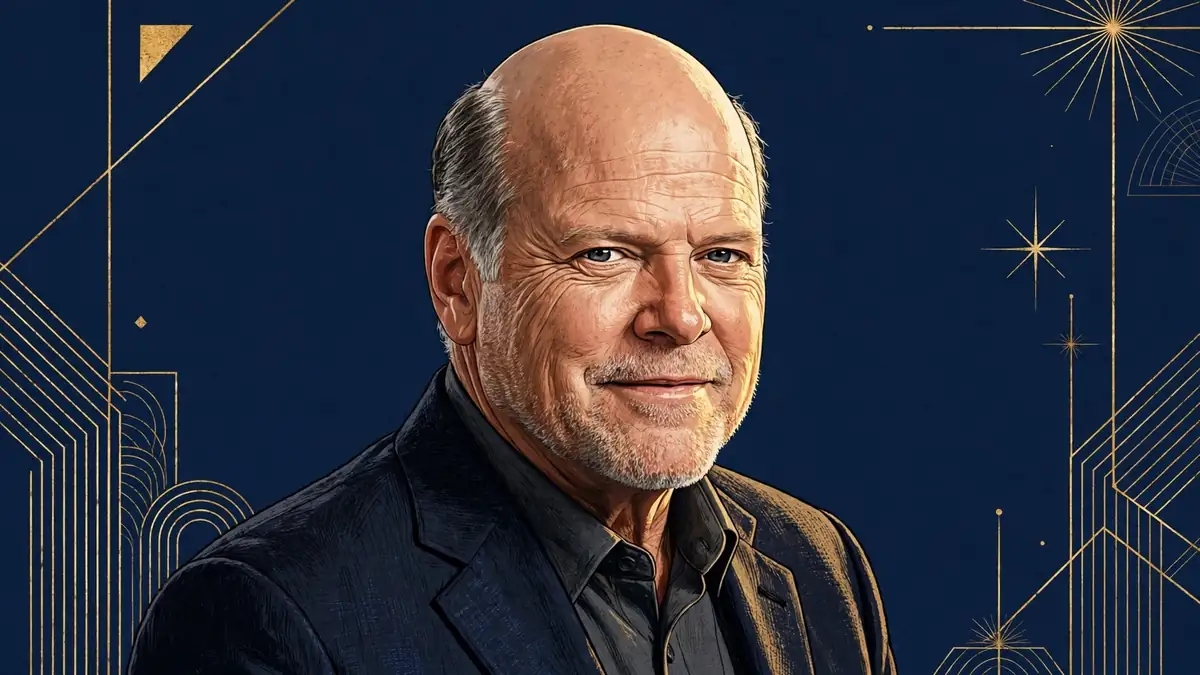
Rex Linn‘s net worth is estimated at $4 million to $5 million as of November 2026. The figure rests on nearly four decades of steady screen work: a ten-season run as Sergeant Frank Tripp on CSI: Miami, a scene-stealing turn as banker Kevin Wachtell on Better Call Saul, seven seasons as Principal Tom Petersen on Young Sheldon, and a late-career second act opposite his fiancée Reba McEntire on NBC’s Happy’s Place — a sitcom renewed for a third season in February 2026. Linn never chased leading-man paydays. He built his money the slow way, one recurring role at a time, after walking away from a bank vice presidency when his employer collapsed in 1982.
Rex Linn: Quick Facts
| Estimated net worth | $5 million (range: $4 million to $5 million) |
|---|---|
| Profession | Actor (film and television) |
| Nationality | American |
| Born | November 13, 1956 (age 69; turns 70 on November 13, 2026) |
| Height | 6 feet 4 inches (1.93 m) |
| Primary income sources | Television salaries and residuals, film roles, producing, narration work |
| Active years | 1986–present |
| Last reviewed | November 2026 |
- Early Life and Background
- Education
- Career Journey
- Rise to Fame
- Main Sources of Income
- Salary and Earnings
- Businesses and Investments
- Brand Deals and Sponsorships
- Houses, Cars and Other Assets
- Awards and Achievements
- Net Worth Growth Over the Years
- Social Media Presence
- Personal Life
- Sources & Reporting
- Frequently Asked Questions
Early Life and Background
Rex Maynard Linn was born on November 13, 1956, in Spearman, Texas, a small Panhandle town near the Oklahoma border, to Darlene Deere and James Paul Linn. He spent his first twelve years in Spearman before the family moved to Oklahoma City in August 1969, where his father practiced law. The move shaped everything that followed: Oklahoma gave him his schooling, his first jobs, his first taste of performing, and the plainspoken manner that later became his screen trademark.
Oklahoma City in the 1970s was a long way from Hollywood, and Linn’s route into acting ran through ordinary work. As a teenager he held a part-time job at the Oklahoma City Zoo. He attended Heritage Hall School and later Casady School, an independent Episcopal-affiliated school in the city. The acting bug arrived in November 1975, when the nineteen-year-old watched Jack Nicholson in One Flew Over the Cuckoo’s Nest and announced to his family that he was an actor. His high-school stage career ended almost as fast as it began: during a production of Fiddler on the Roof, Linn demolished part of a set during a musical number, and his drama coach ordered him off the stage and advised him to direct his energy elsewhere. He took the advice in the short term and went to college instead.
That early detour matters to the money story. Linn did not arrive in Los Angeles as a twenty-year-old chasing auditions. He arrived as a thirty-something former banker with a mortgage-sized sense of risk, a man who had already held a serious job and lost it through no fault of his own. The patience that defines his career — the willingness to play the sheriff, the detective, the banker, the principal, year after year — was learned in Oklahoma long before a camera found him.
He remains tied to the state. Linn is a former chairman of the Oklahoma City chapter of Ducks Unlimited, won the Oklahoma state duck-calling competition in 1986, and finished fourth nationally the same year. In 1994 he received a star on the Carpenter’s Square Theatre Walk of Fame in Oklahoma City, a hometown honor that predates his television fame by nearly a decade. He has narrated documentaries for the University of Oklahoma’s InvestEd program and supported children’s charities and the arts in his home state, including presenting at the National Association of Police Organizations TOP COPS awards in Washington, D.C., in May 2007.
Education
Linn graduated from Oklahoma State University in 1980, where he studied radio, television, and film. The degree is more than a line on a biography page: it explains why a working character actor has lasted forty years in a business that discards most of its players. He understood cameras, schedules, and crews before he ever stood in front of one, and that professionalism shows up in the record — directors and showrunners kept bringing him back. CSI: Miami kept him for ten seasons. Young Sheldon kept him for seven. Better Call Saul brought Kevin Wachtell back across six years.
After graduation he did not head west. He stayed in Oklahoma and built a banking career, rising to vice president of energy lending at Lakeshore Bank in Oklahoma City. One biography site reports he earned about $124,000 a year in that role — a strong salary for the early 1980s, and a figure we repeat only as that site’s report, since no primary record confirms it. What the record does confirm, through Wikipedia and The Oklahoman, is the job, the title, and the ending: on July 5, 1982, Lakeshore Bank went insolvent, and Linn’s banking career ended with it. He was twenty-five.
The collapse forced a choice. Linn persuaded a talent agent to represent him in the Oklahoma market while taking a job with an oil company overseeing field operations in western Oklahoma. He shot commercials, auditioned for film and television parts around his day job, and landed his first film role in Dark Before Dawn, a project produced by his best friend Edward K. Gaylord II. The bank failure, in hindsight, was the best thing that happened to his finances: it pushed him out of a comfortable salary and into the profession that would eventually pay him for four decades.
Career Journey
Linn’s first substantial screen role came in 1989, when he played serial killer Floyd Epps in Night Game opposite Roy Scheider. A year later he played a sheriff in an episode of The Young Riders, and that was enough to convince him the work was in Los Angeles. He moved west and spent the early 1990s collecting the small film parts that build a character actor’s reel: My Heroes Have Always Been Cowboys (1991), Thunderheart (1992), Sniper (1993), and guest shots on Northern Exposure, Raven, and The Adventures of Brisco County, Jr.
The year 1993 changed his standing. In Cliffhanger, the Sylvester Stallone action thriller, Linn played Richard Travers, one of the film’s villains. The picture grossed about $255 million worldwide against a $70 million budget, and it remains Linn’s best-known film role outside the United States — the one international audiences cite first. The same year he appeared in Sniper as Colonel Weymuth. From Cliffhanger onward, he has appeared in more than 35 films, and the count keeps growing.
The mid-1990s stacked big-budget credits at a steady pace: Iron Will, Wyatt Earp (1994) as Frank McLaury opposite Kevin Costner, Clear and Present Danger (1994), Drop Zone (1994), Cutthroat Island (1995), Tin Cup (1996), The Long Kiss Goodnight (1996), Ghosts of Mississippi (1996), Breakdown (1997) as Sheriff Boyd, The Postman (1997), The Odd Couple II (1998), and Rush Hour (1998) as Agent Dan Whitney. Rush Hour went on to gross more than $240 million worldwide and launch a franchise. Linn’s parts in these films were supporting roles — a sheriff here, an agent there — but supporting roles in hit films pay twice: once in the paycheck, and again in the casting directors’ memory.
Television filled the gaps between films and eventually took over. Linn had a recurring role on JAG from 1995 to 2000, played Karl Vasick on The Fugitive in 2000–01, and took guest spots on 3rd Rock from the Sun, Nash Bridges, Walker, Texas Ranger, and The Pretender. He also worked outside the camera: he narrated three audiobooks — One Ranger (2005), A Man Called Cash (2005), and Missing Persons (2006) — and a documentary for the University of Oklahoma’s InvestEd program. His most recent film credit is the political thriller An Acceptable Loss (2018), in which he played the President opposite Jamie Lee Curtis.
The 2010s kept the television work coming at a pace most actors his age would envy. He played General Alan Langdon on The Lottery (2014), Senator Burke on State of Affairs (2015), Rear Admiral McBride on The Brink (2015), Bill Lexington on Nashville (2015–16), and Nathan Riggs on Lethal Weapon (2017–18). In 2018 he played Dick DeGuerin in the Waco miniseries, and from 2022 to 2023 he recurred as Buck Barnes on Big Sky. He also appeared in Django Unchained (2012) as Tennessee Henry and Appaloosa (2008) as Sheriff Clyde Stringer — two more westerns for an actor whose frame and voice were made for the genre.
Rise to Fame
Linn’s rise was not a single breakout but a slow accumulation that peaked with CSI: Miami. He joined the CBS procedural in 2002 as Sergeant Frank Tripp, a no-nonsense Miami homicide detective with a dry wit and a short fuse for nonsense. The casting story is pure Linn: he was, by his own account, tricked into reading for the part during the first season. He stayed for the entire run — ten seasons, until the series ended in 2012 — and Celebrity Net Worth notes he appeared in more than 180 episodes. Episode guides count 187, a total that puts him among the most present faces in the franchise. For a character actor, that kind of tenure is the financial equivalent of a pension: a decade of steady network pay, plus residuals that continue to arrive every time the show airs in syndication or streams.
CSI: Miami also fixed his screen identity. Before it, Linn was a reliable utility player. After it, he was Frank Tripp — the lawman audiences trusted on sight. That identity paid off in casting for years: sheriffs, detectives, generals, and authority figures of every stripe. The show’s success gave him room to be selective, and the residuals gave him the freedom to take smaller prestige parts without worrying about the rent.
The second wave of fame arrived in his sixties. From 2016 to 2022 he played Kevin Wachtell, the polished Mesa Verde bank president, in thirteen episodes of Better Call Saul — a role with a neat irony, given his real-life banking past. The part put him in front of prestige-television audiences and critics who had never watched a procedural. Then came Young Sheldon, where he played Principal Tom Petersen in 26 episodes from 2017 to 2024. The CBS sitcom gave him a younger audience and, as it turned out, a personal life: Reba McEntire guest-starred as June, and the two reconnected on that set after first meeting thirty years earlier.
The third act is happening now. Since October 2024 Linn has played Emmett, the soft-spoken cook at the tavern at the center of NBC’s Happy’s Place, opposite McEntire. The show premiered on October 18, 2024, earned a second season that premiered November 7, 2025, and was renewed for a third season on February 2, 2026, with the new season premiering October 23, 2026, per Deadline. In February 2026 he also joined the cast of the Apple TV+ series Stick alongside Owen Wilson. At sixty-nine, Linn is working more visibly than he did at fifty — a rare trajectory, and the reason his net worth is still moving rather than coasting.
Main Sources of Income
Television salaries sit at the center of Rex Linn’s money. A decade as a series regular on a CBS procedural, seven seasons recurring on a hit sitcom, six years on a prestige cable drama, and a current main role on an NBC sitcom add up to the bulk of his estimated fortune. Network television pays in three layers: the episodic fee, the annual raises written into long-running contracts, and the residuals that follow a show into syndication and streaming. CSI: Miami alone, with more than 180 episodes in the catalog, generates residual income years after the finale aired.
Film work is the second stream. Linn has appeared in more than 35 films, most of them studio pictures with real budgets — Cliffhanger, Wyatt Earp, Clear and Present Danger, Rush Hour, Django Unchained. Supporting players on films of that size earn solid day rates and, on occasion, small backend participation, though no public record shows Linn holding backend points on any picture. The film money matters less as a lump sum than as a career effect: those credits kept his quote up and his name in casting conversations between television jobs.
Producing and narration round out the picture. Linn has producer credits and has narrated audiobooks and documentaries, including the three audiobooks listed in his filmography and the InvestEd fraud documentaries. Narration pays modestly but steadily, and it suits a voice that casting directors have described as gravelly and unmistakable. He has also done commercial work since his Oklahoma days, when commercials were his first paid screen jobs.
What Linn does not have, as far as the public record shows, is a business empire. There is no restaurant chain, no clothing line, no production company with a public slate, and no endorsement portfolio. His wealth is a working actor’s wealth: earned on set, saved over decades, and parked — as far as anyone can tell — in real estate and ordinary investments rather than in splashy ventures. That modesty is exactly why the $10 million and $12 million figures floating around low-quality blogs look wrong: nothing in his public career supports a fortune twice the size of the best-sourced estimate.

Salary and Earnings
No verified source has ever published Rex Linn’s per-episode salary, and this article will not invent one. That honesty matters, because the numbers circulating online are a mess. One low-quality blog claims he earned $60,000 to $100,000 per episode on CSI: Miami; another puts the figure at about $100,000 an episode; a third estimates his annual income at roughly $500,000. None of them names a source — no contract, no filing, no interview, no trade report. We treat those figures as unverified blog claims, not facts, and we do not use them to build the estimate.
What can be said with confidence is structural. A series regular on a successful CBS procedural in the 2000s earned a strong middle-class-to-upper-middle-class network salary, with contractual raises across ten seasons. Linn joined CSI: Miami as a recurring player and became a main-cast member, which typically means a renegotiated deal as the show proved itself. Ten seasons of that, plus residuals, is the financial spine of his career. The residuals deserve emphasis: a show with 187 episodes in syndication generates payments to its regulars for years, and CSI: Miami has aired constantly since 2012.
The later roles paid at a different scale. Recurring parts on Better Call Saul (13 episodes) and Young Sheldon (26 episodes) pay per-episode guest-star and recurring rates set by union scale and negotiation, not series-regular money — but they arrived while the CSI: Miami residuals were still flowing, which is how a working actor’s income compounds: new paychecks stack on old residuals instead of replacing them. His current main role on Happy’s Place, renewed through a third season, restores a regular salary in his late sixties, and the Stick casting adds a streaming paycheck on top.
The one hard salary figure in his life comes from banking, not acting: the biography site Married Biography reports he earned about $124,000 a year as a vice president at Lakeshore Bank. We flag it as that site’s report, not a verified fact. Even so, it frames the gamble he took in 1982: he walked away from a six-figure salary in his mid-twenties for commercials and bit parts, and it took the better part of a decade before acting paid him anything close to what the bank had.
Annual income today is best described as a range rather than a number. In a year with a main sitcom role, a streaming part, and residuals from three long-running shows, a working actor of Linn’s standing can earn comfortably into six figures; in a quiet year, residuals alone keep the floor high. We do not publish a single annual-income figure because no source supports one.
Businesses and Investments
There is no public record of Rex Linn running a business. He has no company with a public filing, no brand he founded, and no investment portfolio that has ever been disclosed or profiled. That absence is itself informative: Linn’s money comes from acting, and his public financial footprint is a house, a career, and a long run of paychecks.
His one documented business-adjacent move is producing. Linn carries producer credits alongside his acting work, and several biographies describe him as an actor-producer. Producing for a character actor usually means small-scale involvement — developing a project, attaching himself to a script, shepherding an independent film — rather than running a company. No produced title with a public budget carries his name as a lead producer, so we do not assign a dollar value to this work. It is a side stream, not a second fortune.
On investments, the honest statement is that nothing is public. Some net-worth blogs claim Linn has expanded into real estate investment and “business opportunities,” but those passages appear in articles that also invent lawsuit rumors and round-number fortunes, and they name no property, no company, and no deal. We do not repeat them. The single real-estate fact on the record is his Sherman Oaks home, covered in the assets section below. Beyond that, any claim about his portfolio would be guesswork, and this article does not guess.
The career itself was the investment. Linn’s working life shows a pattern that financial planners would recognize: he traded short-term upside for duration. He never held out for a starring role that might never come; he took the recurring detective, the bank president, the principal, and the cook, and he stayed employed for forty years. Duration is what turns good pay into real wealth, and duration is the one asset in his story that is fully documented.
Brand Deals and Sponsorships
Rex Linn has no endorsement portfolio on the public record. He has never fronted a national advertising campaign as a celebrity endorser, and no brand partnership, sponsorship deal, or paid social-media promotion is attached to his name. His commercial work dates to his Oklahoma years, when he shot local and regional commercials as a working actor — paid acting jobs, not endorsement deals.
That is normal for his lane. Character actors of Linn’s generation earn their money from studios and networks, not from brands. The endorsement economy belongs to leads, athletes, and influencers with large social followings. Linn’s following is modest and his public image is that of a steady professional rather than a lifestyle figure, so brands have never been a meaningful income stream for him. Any article that lists “brand endorsements” as a major pillar of his wealth is padding; we list it here only to say plainly that the pillar is empty.
The closest thing to a commercial association in his recent career is Happy’s Place itself, where his on-screen partnership with Reba McEntire doubles as a real-life one. The show’s marketing leans on the couple, and that visibility helps both of them — but it is a television salary, not a sponsorship, and it is counted in the television section of this article, not here.

Houses, Cars and Other Assets
The best-documented asset in Rex Linn’s life is his home. The Los Angeles Times reported on November 2, 2010, that Linn had bought a four-bedroom house in Sherman Oaks, California. The biography site Married Biography puts the purchase price at $1,415,000 for a 3,355-square-foot home with five bathrooms. The price is that site’s report rather than a figure from the Times piece, but the purchase itself is confirmed by the Times, and the size and price are consistent with Sherman Oaks values in 2010. Wikipedia lists him as living in Sherman Oaks with his dogs, Jack and Choctaw.
Fifteen years of Los Angeles property appreciation have likely done quiet work for his net worth. A $1.415 million purchase in 2010, held through the 2010s and 2020s housing cycles, would be worth materially more today even before any improvements — though we do not publish a current valuation, since no recent sale or listing gives us one. The house is also a clue to his spending habits: Sherman Oaks is comfortable, not showy, and a single long-held home fits a man whose career has been about steady accumulation rather than display.
Linn also spends time at the property in Leipers Fork, Tennessee, where he proposed to McEntire on Christmas Eve 2024, walking down to a creek on the land with a ring he had carried across two continents. Whether that land is his, hers, or shared is not public, so we do not list it as his asset. The couple was forced to evacuate their Los Angeles home twice during the January 2025 wildfires, an experience McEntire has said delayed their decision to announce the engagement.
On cars, the record is silent. No publication has profiled Linn’s vehicles, and no paparazzi car-spotting story attaches a luxury collection to his name. That silence fits the rest of the picture: he is not a collector, and his money does not show up in garages. We do not invent a fleet. His visible assets are a house, a career catalog of more than 180 episodes of one show and dozens of films, and the residuals that catalog keeps paying.
Awards and Achievements
Rex Linn’s trophy shelf is thin by design — character actors rarely collect the hardware that leads do — but his career markers are real. In 1994 he received a star on the Carpenter’s Square Theatre Walk of Fame in Oklahoma City, a hometown honor recognizing his stage and screen work. In 1986 he won the Oklahoma state duck-calling championship and placed fourth in the national competition, a distinction he still mentions in interviews and one that says something about where he comes from.
His professional achievements are measured in tenure rather than trophies. Ten seasons as a main-cast member on a top-ten CBS procedural. Thirteen episodes of one of the most acclaimed dramas of the century. Twenty-six episodes of a sitcom that ran for seven seasons. A filmography of more than 35 films, including two pictures — Cliffhanger and Rush Hour — that each grossed more than $240 million worldwide. A third-season renewal on a network sitcom at age sixty-nine, when most actors his age are retired or forgotten.
He has also been recognized off screen. In May 2007 he presented awards at the National Association of Police Organizations TOP COPS ceremony in Washington, D.C. — a fitting honor for an actor who has played more lawmen than almost anyone working. He has narrated three audiobooks and documentaries for the University of Oklahoma. None of these are Emmys, and Linn has never been nominated for one, but they add up to a career that casting directors trust: when a show needs an authority figure who will show up prepared and make the scene work, Rex Linn gets the call.
It is worth saying plainly that the absence of major awards is not a gap in his story; it is the story. Linn built a $5 million fortune without ever being the star, without a franchise lead, and without a single awards-season campaign. That is the achievement this article measures.
Net Worth Growth Over the Years
Linn’s wealth did not spike; it compounded. The table below uses dated third-party estimates rather than invented year-by-year figures, so readers can see how the number moved as his career did. Every entry names the outlet behind it.
| Period | Published estimate | What was driving it |
|---|---|---|
| 2021–2022 | $2 million to $5 million | Post-CSI: Miami residuals plus Better Call Saul and Young Sheldon runs; Country Thang Daily’s range |
| May 2023 | Over $5 million | Young Sheldon still airing; The Legit’s estimate |
| 2024 | About $5 million | Happy’s Place premieres; StylHub’s estimate |
| September 2025 | $5 million | Happy’s Place season 2 confirmed; Celebrity Net Worth’s updated figure |
| November 2026 | $4 million to $5 million | Happy’s Place season 3 premieres October 23, 2026; Stick role; our estimate |
Two patterns stand out. First, the serious outlets converge: once you set aside the $10 million and $12 million outliers from content-farm blogs, every careful profile lands between $2 million and $5 million, and the most recent ones all say $5 million. Second, the number has been flat for years, which is exactly what a residuals-based fortune looks like. Linn is not getting richer in leaps; he is collecting steadily, and the third season of Happy’s Place keeps the line moving up rather than down.
How does he compare with the people around him? The gap is wide, and it is instructive. Celebrity Net Worth puts Reba McEntire at about $95 million — nearly twenty times Linn’s fortune — built on fifty years of country music, touring, television, and business. Kevin Costner, his Wyatt Earp co-star, sits at about $250 million on our site’s own estimate, built on leading-man paydays and Yellowstone. Sylvester Stallone, his Cliffhanger co-star, is listed at about $400 million by Celebrity Net Worth. Linn’s $5 million is a working actor’s fortune next to stars’ fortunes — and that is the point. He earned it without ever being the name above the title.
| Person | Estimated net worth | Connection to Linn |
|---|---|---|
| Rex Linn | $4 million to $5 million | — |
| Reba McEntire | About $95 million | Fiancée; Happy’s Place co-star |
| Kevin Costner | About $250 million | Wyatt Earp co-star |
| Sylvester Stallone | About $400 million | Cliffhanger co-star |
Peer figures are the cited outlets’ estimates, not ours, and they are shown for scale only.
Social Media Presence
Rex Linn keeps a low profile online. He is on Instagram, where he has posted photos with McEntire — including one in January 2020, early in their relationship — but he is not an influencer, and his following is small next to the stars he works with. He does not run a YouTube channel, a TikTok account, or a paid-promotion business. His social media presence earns him nothing measurable, and it costs him nothing either: he posts when he has something to share and goes quiet for long stretches.
That restraint is a choice, and it fits the rest of his career. Linn’s public image is built on screen work, not on content. The attention he does get online comes mostly through McEntire, whose posts about the couple reach millions, and through Happy’s Place, where the show’s accounts feature the two of them together. He benefits from that exposure without having to manufacture it himself.
For readers looking for him: his Instagram is the only social account with a meaningful public presence. We do not link to personal accounts in this article, and we would warn readers against the fan and impersonator accounts that use his name and photos. The reliable way to follow his work is through the shows themselves — Happy’s Place on NBC, Young Sheldon and Better Call Saul in streaming, and CSI: Miami in syndication.
Personal Life
Linn has never been married, and for most of his career his private life stayed private. That changed in 2020, when the world learned he was dating Reba McEntire. The two first met in 1991 on the set of the Kenny Rogers television film The Gambler Returns: The Luck of the Draw, where Linn played Henry. They were friends for nearly thirty years. They reconnected in 2020 when McEntire guest-starred as June on Young Sheldon — Linn played Principal Petersen, the school administrator who kept crossing paths with her character — and began dating in late 2020, just as the pandemic was keeping them in separate states and forcing them to talk for hours a day over video calls.
McEntire has spoken warmly about the relationship in the years since, telling People in 2022 that Linn was “the love of my life.” The couple’s working life and private life have run together ever since: they co-star on Happy’s Place, where she plays Bobbie, who inherits her late father’s Knoxville tavern, and he plays Emmett, the tavern’s soft-spoken cook and Bobbie’s love interest. Steve Howey, who played Van Montgomery on McEntire’s earlier sitcom Reba, is part of the same television family tree.
The engagement stayed secret for almost a year. Linn proposed on Christmas Eve 2024, walking with McEntire down to a creek on their property in Leipers Fork, Tennessee, and asking her to marry him with a black diamond ring he had carried across two continents. She said yes three times, by her own account. They had planned to announce the news in January 2025, when filming on Happy’s Place resumed — then the Los Angeles wildfires forced them to evacuate twice, neighbors lost homes, and the couple decided to keep the engagement private for another eight months. The news finally became public at the Emmy Awards in September 2025, when McEntire referred to Linn as her fiancé on the red carpet.
The wedding is on hold, and the reason is work. Speaking to E! News on the Grammys red carpet in February 2026, McEntire said they were waiting on a third-season pickup for Happy’s Place and that Linn had been picked up on Stick with Owen Wilson — “so that kind of pushed the wedding back, ’cause he says, ‘Work comes first.'” TV Insider reported the next day that NBC had renewed Happy’s Place for a third season. As of November 2026 the couple has announced no wedding date, and reporting suggests it will likely wait until 2027. Linn, who would become McEntire’s third husband, has said nothing to hurry it along.
Outside the relationship, Linn lives in Sherman Oaks with his dogs, Jack and Choctaw. He is a University of Texas Longhorns fan — he once took a day off from CSI: Miami to attend the 2005 Rose Bowl, when Texas beat USC for the national championship — and a former chairman of the Oklahoma City chapter of Ducks Unlimited. At 6 feet 4 inches and about 220 pounds, he is one of the tallest men on any set he walks onto, and directors have used that frame for thirty years to make authority figures look the part.
One rumor deserves a direct answer because search results keep surfacing it: some biography sites carry “cancer” in their headlines about Linn. No credible reporting supports any cancer diagnosis, and neither Linn nor McEntire has ever mentioned one. The word appears to be search-bait attached to biography pages, not a fact. We do not repeat it as a claim, and readers should treat those headlines as the junk they are.
Sources & Reporting
Reporting window: October–November 2026. Figures were checked against the sources below in November 2026; the estimate is dated November 2026 and will be revised when new reporting emerges.
Celebrity Net Worth — the $5 million net worth figure, updated September 16, 2025; the “more than 180 episodes” count for CSI: Miami; career summary. This is the most authoritative net-worth source for Linn and the anchor of our estimate.
Wikipedia — birth date and place, education, the July 5, 1982 Lakeshore Bank insolvency, filmography and episode counts, the Happy’s Place third-season renewal (February 2, 2026, per Deadline), and the 2026 Georgie & Mandy’s First Marriage guest appearance.
The Oklahoman — Linn’s Oklahoma career, the bank job, the duck-calling championship, and the Carpenter’s Square Walk of Fame star, reported across 1988–2009.
Los Angeles Times — the November 2, 2010 report that Linn bought a four-bedroom house in Sherman Oaks; the $1,415,000 price and 3,355-square-foot size come from the biography site Married Biography.
People — McEntire’s account of the relationship, the Christmas Eve 2024 proposal, and the delayed announcement; corroborated by TV Insider and Parade in February–October 2026.
Vulture — the account of Linn and McEntire reconnecting on the Young Sheldon set, October 2023.
The Legit — height (6 feet 4 inches), weight (about 220 pounds), and the “over $5 million” estimate as of May 2023.
Deadline — the February 2, 2026 report that NBC renewed Happy’s Place for a third season, premiering October 23, 2026.
Lower-quality net-worth blogs (The Most 10, Wear Magazines, Cine Net Worth, Bijog) were read for coverage and rejected where they conflicted with the sources above: their $10 million and $12 million figures and their per-episode salary claims name no source and are not used in this article.
Frequently Asked Questions
What is Rex Linn’s net worth?
Rex Linn’s net worth is estimated at $4 million to $5 million as of November 2026, anchored on the $5 million figure published by Celebrity Net Worth in September 2025. The money comes from nearly forty years of acting, above all his ten-season run on CSI: Miami, plus Better Call Saul, Young Sheldon, and his current role on Happy’s Place.
How old is Rex Linn?
Rex Linn was born on November 13, 1956, in Spearman, Texas. He is 69 years old as of November 2026 and turns 70 on November 13, 2026. He is still working full-time, with a main role on NBC’s Happy’s Place and a part in the Apple TV+ series Stick.
Is Rex Linn married to Reba McEntire?
Not yet. Rex Linn and Reba McEntire are engaged. He proposed on Christmas Eve 2024 at their property in Leipers Fork, Tennessee, and they announced the engagement at the Emmy Awards in September 2025. They have no wedding date yet; McEntire said in February 2026 that filming commitments for Happy’s Place and Stick had pushed the wedding back, likely to 2027.
What is Rex Linn’s salary per episode?
No verified source has published Rex Linn’s per-episode salary. Blogs claiming $60,000 to $100,000 an episode for CSI: Miami name no source and are not reliable. What is documented is the structure: ten seasons as a series regular on a CBS procedural, with contractual raises and residuals from more than 180 episodes, plus recurring pay on Better Call Saul and Young Sheldon and a regular salary on Happy’s Place.
How tall is Rex Linn?
Rex Linn is 6 feet 4 inches tall (1.93 m) and weighs about 220 pounds, according to The Legit. His height and frame helped define his screen career — he has played sheriffs, detectives, generals, and authority figures for three decades.
What was Rex Linn in?
His best-known roles are Sergeant Frank Tripp on CSI: Miami (2002–2012), Kevin Wachtell on Better Call Saul (2016–2022), Principal Tom Petersen on Young Sheldon (2017–2024), and Emmett on Happy’s Place (2024–present). His films include Cliffhanger (1993), Wyatt Earp (1994), Rush Hour (1998), and Django Unchained (2012).
Where does Rex Linn live?
Rex Linn lives in Sherman Oaks, California, in a four-bedroom house he bought in 2010 for a reported $1,415,000. He also spends time at a property in Leipers Fork, Tennessee, with fiancée Reba McEntire, where he proposed on Christmas Eve 2024.
Did Rex Linn really work in a bank?
Yes. Before acting, Rex Linn rose to vice president of energy lending at Lakeshore Bank in Oklahoma City. The bank went insolvent on July 5, 1982, ending his banking career and pushing him toward acting full-time. The irony was not lost on Better Call Saul, which cast him as Mesa Verde bank president Kevin Wachtell.
Final Thoughts
Rex Linn’s estimated $5 million fortune is the least flashy kind of Hollywood money, and that is what makes it worth writing about. He did not inherit it, marry into it, or win it with a single role. He earned it the way a carpenter earns a house: a decade on one show, seven seasons on another, six years on a third, and more than 35 films in between — all of it after a bank collapse in 1982 forced him to start over at twenty-five.
The lesson of his career is duration. Linn never held out for stardom, and stardom never came, but the work never stopped either. At sixty-nine he is on a network sitcom with a third season, on a streaming series with Owen Wilson, and engaged to one of the biggest names in country music — a late-career peak that most actors never reach. The $5 million figure is modest next to Reba McEntire’s $95 million or Kevin Costner’s $250 million, and Linn would probably be the first to say so. It is also entirely his own, built one recurring role at a time, and it is still growing.
Published on November 11, 2026. Last reviewed November 2026. Found an error? See our corrections policy.