
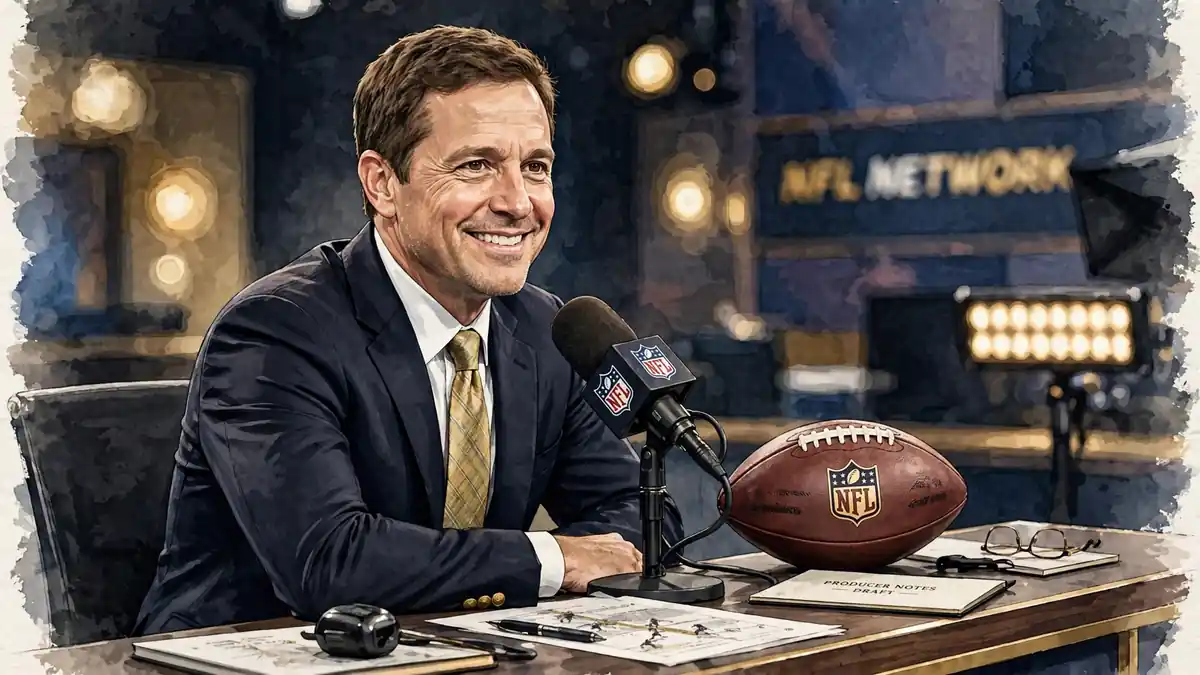
Rich Eisen‘s net worth is estimated at $20 million to $40 million as of November 2026. The longtime NFL Network anchor built that fortune across three decades in sports television — seven years at ESPN, more than twenty years as the face of NFL Network, and a daily talk show he owns outright and now licenses to ESPN in a deal modeled on Pat McAfee’s arrangement.
Rich Eisen: Quick Facts
| Estimated net worth | $30 million (range: $20 million to $40 million) |
|---|---|
| Profession | Sportscaster, television host, radio host, author |
| Nationality | American |
| Born | June 24, 1969 (age 57) |
| Height | 6 feet 0 inches (1.84 m) |
| Primary income sources | NFL Network salary, The Rich Eisen Show (owned and licensed), ESPN licensing deal, speaking engagements, book royalties |
| Active years | 1990–present |
| Last reviewed | November 2026 |
- Early Life and Background
- Education
- Career Journey
- Rise to Fame
- Main Sources of Income
- Salary and Earnings
- Businesses and Investments
- Brand Deals and Sponsorships
- Houses, Cars and Other Assets
- Awards and Achievements
- Net Worth Growth Over the Years
- Social Media Presence
- Personal Life
- Sources & Reporting
- Frequently Asked Questions
Early Life and Background
Richard Eisen was born on June 24, 1969, in Brooklyn, New York, and grew up on Staten Island. He is the son of Joel Eisen, who died in December 2019, and Eveline Eisen. His father worked in journalism and his mother taught high school, so the dinner-table conversation in the Eisen house ran toward news and sports from the start. Eisen has a brother, Jeff.
Staten Island in the 1970s and 1980s shaped the broadcaster he became. Eisen grew up a fan of the New York Jets, the New York Yankees and, later, the Michigan Wolverines — three loyalties that still surface constantly on his show, usually when the Jets give him fresh material. The Jets fandom is not a bit he adopted for television. It dates to childhood, and it is the reason his annual on-air suffering during football season reads as genuine: it is.
Sports journalism caught his attention while he was still in high school on Staten Island. His father first hoped he would become an athlete, then backed the journalism plan once it was clear where his son’s talent sat. That early support mattered. Eisen left New York for college with a clear idea of the career he wanted, and he spent the next four years building the clips and contacts to get it.
Education
Eisen enrolled at the University of Michigan in 1987 and graduated with a Bachelor of Arts degree in 1990. At Michigan he served as co-sports editor of The Michigan Daily, the university’s student newspaper, and joined the Pi Kappa Phi fraternity. The Daily job was his first real newsroom: deadlines, editing, and writing about a football program that expected to win every Saturday. Michigan’s communications program gave him the degree; the student paper gave him the craft.
He kept going. In 1992 he entered Northwestern University’s Medill School of Journalism and earned a Master of Science degree in broadcast journalism in 1994. Medill is one of the country’s top journalism schools, and the master’s put him on the television track rather than the newspaper track. While studying, he worked as the Medill News Service’s Washington correspondent in 1994, filing broadcast reports from the capital before he had a full-time television job.
The two degrees explain the shape of his career. Michigan gave him the sports writing base and the Wolverines loyalty that still defines his Saturdays in the fall. Medill gave him the broadcast polish and the Washington reporting stint that made him hireable as an on-air anchor straight out of school. He was 25 when he finished the master’s, and within two years he was at ESPN.
Career Journey
Eisen’s first job was in print. He worked as a staff writer for the Staten Island Advance from 1990 to 1993, covering local sports in the borough where he grew up, then spent 1993 and 1994 at the Chicago Tribune. Print taught him reporting discipline — checking facts, writing clean copy on deadline — and the Tribune line on his resume carried weight when he moved into television.
His first television job was far from New York. In 1994 he became a sports anchor and reporter at KRCR-TV, the ABC affiliate in Redding, California, a small market where a young anchor does everything: shoot, write, edit and present. He stayed at KRCR until 1996. The Redding years are the part of his resume competitors skip, but they are the reason he looked comfortable on camera from his first ESPN appearance. Small-market television is a brutal, fast education, and Eisen got two years of it.
ESPN hired him in 1996. He was 26, straight from Redding, and the network paired him with Stuart Scott on the 2 a.m. SportsCenter. The pairing worked. Scott brought the catchphrases and the cool; Eisen brought dry humor, sharp writing and a gift for impressions, most famously his dead-on take on Atlanta Braves broadcaster Skip Caray. The two became one of the most popular anchor teams of that SportsCenter era, and the show’s late-night slot gave them room to be looser than the daytime desk allowed.
At ESPN, Eisen’s assignments kept widening. He hosted the network’s reality series Beg, Borrow & Deal, served as a host for Major League Baseball coverage, guest-hosted The Dan Patrick Show and The Tony Kornheiser Show on ESPN Radio, and hosted the ABC show Domino Day. He also worked the Home Run Derby, conducting player interviews from the field. His biggest single reporting moment at ESPN came in 2001, when he broke the news of St. Louis slugger Mark McGwire’s retirement from baseball live on SportsCenter, then sat down with McGwire days later for the exclusive interview explaining the decision. Breaking a story of that size on the network’s flagship show is the kind of moment that fixes a broadcaster’s reputation inside the industry.
In June 2003, Eisen left ESPN to become the first on-air talent hired by the brand-new NFL Network. The channel launched in November 2003, and Eisen was its face from day one — the anchor of NFL Total Access, the network’s flagship program, which he hosted until August 2011. He signed a new long-term deal with NFL Network in 2010 and became host of NFL GameDay Morning, the network’s first pregame show. He remains host of NFL Total Access and NFL GameDay Highlights, plus the network’s Thursday Night Football pregame, halftime and postgame shows, and he anchors the network’s NFL Draft and NFL Scouting Combine coverage. In 2018 he signed a four-year deal with NFL Network that ran through the summer of 2022, and he has stayed the network’s signature host since.
The third act of his career is the show that carries his name. Eisen launched The Rich Eisen Show on October 6, 2014, taking over the noon-to-3 p.m. ET slot on Fox Sports Radio from Jay Mohr. The show has since moved through DirecTV’s Audience Network, NBC Sports Network and Peacock, and The Roku Channel in September 2022, with distribution on SiriusXM and Westwood One radio along the way. The key fact about the show is ownership: Eisen owns it. Every move was a licensing deal, not an employment contract, which is why the show survived each platform change with its audience intact.
That ownership model paid off in May 2025, when The Athletic‘s Andrew Marchand reported that Eisen was returning to ESPN after more than two decades away. The deal was officially announced in July 2025: starting September 2, 2025, the audio show moved to ESPN Radio’s noon ET slot, with the video show streaming on ESPN+, Disney+ and ESPN’s direct-to-consumer service. Eisen kept ownership and editorial control, licensing the show to ESPN in the same structure as The Pat McAfee Show. He stayed with NFL Network as host of GameDay and its draft coverage, so the ESPN deal added a second home rather than replacing the first. On August 18, 2025, he anchored SportsCenter for the first time since 2003, hosting a retro-themed show alongside Mina Kimes that honored Stuart Scott, who died in January 2015. His show is also simulcast on ESPN during the College Football Playoff when Pat McAfee is on site — a scheduling detail that says plenty about where Eisen now sits in ESPN’s plans. For a closer look at the broadcaster whose licensing deal set the template for Eisen’s return, see our profile of Pat McAfee’s net worth and ESPN deal.
Rise to Fame
Eisen’s rise did not come from one viral moment. It came from being the steady voice in the room for every big football event for twenty years. The NFL Draft, the Scouting Combine, Thursday Night Football, the playoffs — Eisen has hosted them all, year after year, until his face became part of the furniture of football season for American viewers. Longevity is the fame here, and it is rarer than it looks: very few broadcasters hold a network’s flagship chair for two decades.
Two things lifted him above the other studio hosts. The first was the Stuart Scott partnership at ESPN, which made him famous to a generation of late-night SportsCenter viewers before he ever anchored an NFL show. The second was the 40-yard dash. Each spring, Eisen runs the 40-yard dash in a full suit and tie at the Scouting Combine — a stunt that began as a joke and became the Run Rich Run charity campaign for St. Jude Children’s Research Hospital. The sight of a middle-aged broadcaster in a suit sprinting for charity is funny, and the fundraising behind it is serious: roughly $6 million raised for St. Jude since the campaign’s fundraising began, according to St. Jude’s own 2024 release. The dash made Eisen a character in football culture rather than a presenter of it, and it gave him a story no other anchor could copy.
The 2025 ESPN return was the capstone. Returning to the network he left in 2003 — this time as an owner licensing his own show, on his own terms, with a slot on ESPN Radio and a streaming home on ESPN+ and Disney+ — turned Eisen from a network employee into a media owner. The Ringer’s August 2025 profile framed it as a homecoming on modern terms, and that framing is right: he came back with bargaining power he did not have at 26.
Main Sources of Income
Eisen’s income comes from five streams, and the balance between them is what makes his finances different from a salaried anchor’s. The NFL Network salary is the foundation. The Rich Eisen Show is the growth engine, because he owns it and licenses it rather than drawing a paycheck for it. Speaking engagements, book royalties and assorted television work add the rest.
NFL Network salary. The anchor chair at NFL Network is the largest single paycheck. Celebrity Net Worth reports his annual salary from the network at $5 million, a figure repeated across most net-worth outlets. The network has never confirmed it — broadcasters’ contracts are private, and NFL Network does not publish talent pay — but the $5 million figure has been stable in reporting for years, and it fits the market for a flagship host who has held the chair since 2003. His 2010 long-term deal and the 2018 four-year extension both reset his pay upward, and the 2025 ESPN arrangement sits on top of the NFL Network role rather than replacing it.
The Rich Eisen Show. The daily three-hour show, noon to 3 p.m. ET, is Eisen’s own property. He launched it independently in 2014 and has licensed it to Fox Sports Radio, DirecTV, NBC Sports, Peacock, The Roku Channel and now ESPN. Ownership changes the math completely: instead of a salary, Eisen collects licensing fees and keeps the show’s advertising and sponsorship revenue, minus production costs. EssentiallySports reports he makes more than $5 million a year from his non-NFL Network work, with the show as the largest piece. The 2025 ESPN licensing deal — same structure as McAfee’s, which Marchand reported as a five-year deal worth more than $85 million for McAfee — is the most valuable version of this arrangement yet, though Eisen’s own terms were not disclosed.
Speaking engagements. Eisen is a regular paid speaker at corporate events, league functions and charity galas. EssentiallySports reports he earns around $50,000 to $100,000 per speaking engagement. Even a handful of these a year adds several hundred thousand dollars, and they cost him little beyond travel: the same stories he tells on the show, told live to a room.
Book royalties. His book Total Access: A Journey to the Center of the NFL Universe was published by St. Martin’s Press in 2007, at the height of his early NFL Network fame. Book money for a broadcaster is modest next to television pay, but it has paid him for nearly two decades, and the book keeps his name in front of readers who found him through the network first.
Other television and radio work. Eisen has worked across CBS Sports, NBC Sports, Fox Sports Radio, SiriusXM and DirecTV over the years, and he has acting credits in films including Draft Day (2014), The Kid (2000) and That’s My Boy (2012). These are supporting income, not the core, but they show how wide his booking net is: when one network’s schedule has a gap, another one fills it.
Salary and Earnings
The honest answer on Eisen’s salary is that the network figure is widely reported and the total is not. Celebrity Net Worth lists his NFL Network salary at $5 million a year, and Information Cradle, SuperbHub and SportsJone all repeat that number. No primary source has ever confirmed it, because NFL Network does not disclose talent contracts, but the consistency of the reporting — and the fact that it has held steady for years while his role only grew — makes $5 million the best-supported figure available. Some outlets stretch it: TechBullion cites reports of $5 million to $10 million a year at the peak of his NFL Network contract, and Networthlist puts his total annual earnings at $10 million once the show and other work are added. Treat the $10 million total as an estimate built on the $5 million salary plus EssentiallySports’ report of $5 million-plus from other work.
Context helps. In 2017, ESPN’s then-president John Skipper confirmed the network’s highest-paid on-air talent earned base salaries of $1 million to $3 million a year, plus bonuses — and Eisen left ESPN in 2003, before that scale applied to him. The NFL Network market is different: a flagship host who anchors the draft, the combine and Thursday nights commands more than a studio analyst. For comparison, Chris Berman’s net worth sits at a similar $30 million after a far longer ESPN career, and Berman’s own deal with ESPN was extended through 2029 in the same May 2025 announcement cycle that brought Eisen back. The two men are the same generation of anchor, and their fortunes rhyme.
The salary picture changed in 2025. The ESPN licensing deal does not replace the NFL Network salary; it stacks on top of it. Eisen now draws his network pay, his show’s licensing and advertising revenue from ESPN’s platforms, and his speaking and book income at the same time. That stacking is the real story of his recent earnings growth: he is being paid by two major sports media companies at once for work that largely overlaps, because the show he owns can live on both.
What he does not earn is also worth saying. Eisen has never had a player’s contract, a shoe deal or a franchise payday. His money is broadcaster money: salary plus ownership of a show plus speaking fees, accumulated over thirty years without a single windfall year. The $20 million to $40 million range reflects that shape — steady accumulation, not a spike.
Businesses and Investments
Eisen’s main business is the show itself. The Rich Eisen Show is produced through his own operation — Networthlist identifies the vehicle as Eisen Network, a production company that creates content for NFL Network, ESPN and other outlets — and the ownership structure is the most important business fact about him. Most broadcasters rent out their time. Eisen owns the program, hires the staff, and licenses the finished product. That is why the show survived five platform moves in eleven years: the audience follows the show, not the channel, and the channel pays for access.
The licensing model is the business. Each deal — Fox Sports Radio in 2014, DirecTV’s Audience Network, NBC Sports and Peacock, The Roku Channel in 2022, ESPN in 2025 — was a fresh license with fresh terms, and each move raised the show’s value. The ESPN deal is the peak of that ladder: placement on ESPN Radio, ESPN+, Disney+ and the direct-to-consumer service puts the show in front of the largest sports audience in America, and the McAfee comparison tells you how ESPN prices this kind of talent. McAfee’s five-year licensing deal was worth more than $85 million; Eisen’s terms were not disclosed, and his audience is smaller than McAfee’s, so no one should read McAfee’s number as Eisen’s. But the structure is the same, and the structure is what matters: the network pays the owner, not the employee.
Beyond the show, Eisen’s investing record is private. No filings, interviews or profiles describe a stock portfolio, a startup stake or a real-estate empire, and this article does not invent one. One reported holding stands out: SuperbHub and other outlets report he is a co-owner of Sacramento Republic FC, the USL Championship soccer club. The size of that stake is not public, and it should be read as a passion investment in a growing lower-division club rather than a wealth driver. The honest summary is that Eisen’s business is media, and his media business is the show.
He has also built a small merchandising line around the program — RichEisenShop.com, promoted on air alongside the show’s YouTube channel and social accounts — and the show’s YouTube channel itself, with roughly 1.15 million subscribers and 1.45 billion total views as of November 2026, is a revenue line through advertising. Neither is large next to the licensing fees, but both are his, which is the point.
Brand Deals and Sponsorships
Eisen’s endorsement profile looks different from an athlete’s. He does not front shoe campaigns or soft-drink ads. His deals are the ones a trusted sports voice gets: sponsors who buy into the show, the audience and the credibility, rather than a face on a billboard.
The show’s sponsors are the core of it. The Rich Eisen Show runs with a rotating cast of advertisers across its radio, streaming and YouTube distribution, and because Eisen owns the show, sponsorship revenue flows to his company rather than to a network’s sales department. The show’s distribution — ESPN Radio, ESPN+, Disney+, SiriusXM, YouTube — gives sponsors a three-hour daily window in front of a football-first audience, and that is the inventory Eisen sells. Specific sponsor names and rates are not public, and this article does not guess at them.
His speaking work functions as a second endorsement channel. Corporations and leagues pay $50,000 to $100,000 per appearance, per EssentiallySports, for Eisen to host events, moderate panels and tell the stories that made him famous. The 40-yard dash is the third: the Run Rich Run campaign is a charity vehicle, not a paid endorsement, but it keeps Eisen’s name attached to St. Jude Children’s Research Hospital in front of millions of viewers every draft season, and that goodwill is worth more than a one-off ad deal.
The honest limit on this section is worth stating plainly. Unlike athletes whose deals are announced in press releases, a broadcaster’s sponsorship income is private. No outlet has published a list of Eisen’s brand partners with dollar figures, and the outlets that claim to know his endorsement income are guessing. What is documented is the show’s sponsorship model, the speaking fees and the charity platform — and those three are enough to explain the income without inventing a fourth.

Houses, Cars and Other Assets
Eisen lives in the Los Angeles area with his wife Suzy Shuster and their three children, near Coldwater Canyon in Beverly Hills, California. That is the part of his address the public record supports. The family moved to Los Angeles when his NFL Network career made the West Coast his base, and they have been there for more than two decades.
One property report circulates widely and deserves a careful telling. SuperbHub, citing the property blog Yolanda’s Little Black Book, reports that Eisen and Shuster bought a Los Angeles home for $7.75 million in 2016 — described in some outlets as an $8 million house on Crest Street — through a trust identified as the “Juice Bar Trust.” That is a single-sourced report from a gossip-leaning property blog, not a confirmed county record in the reporting we reviewed, so we present it as reported rather than verified. If the figure is right, a $7.75 million purchase would be the largest single asset in his portfolio and would fit comfortably inside a $20 million to $40 million net worth. If it is wrong, the rest of the estimate still stands on his salary history alone.
What is not in the record is just as telling. No credible outlet has published a verified list of Eisen’s cars, watches or other luxury purchases, and he does not show them off on social media. His public image is a man in a suit at a desk, not a man posing with a fleet. The 40-yard dash is the only regular display of his physical life, and it is for charity. The asset story here is a house in Beverly Hills and a career, not a collection.
Awards and Achievements
Eisen’s trophy shelf is thinner than a player’s and more interesting than it looks. The Rich Eisen Show has earned Emmy nominations for Outstanding Daily Studio Show, the daytime-television recognition that matters most for a daily program. A nomination in that category puts the show alongside the biggest names in daytime sports television, and it is the formal recognition of what the audience numbers already showed.
The award that means the most to him is not a television honor. In 2017, Eisen received the Pat Summerall Award at the Legends for Charity Dinner during Super Bowl LI week in Houston, in recognition of his charity work. The award is named for the late broadcaster Pat Summerall and goes to a sports media figure whose off-air work matches their on-air career. Eisen earned it through Run Rich Run and his St. Jude fundraising, and he was later named St. Jude Ambassador of the Year for 2021.
The career achievements around those awards are the real list. First on-air talent hired by NFL Network in June 2003. Host of NFL Total Access from the network’s launch. Host of NFL GameDay Morning, the network’s first pregame show. Anchor of the NFL Draft and Scouting Combine coverage for more than two decades. Creator and owner of a daily show that survived five platform moves and landed on ESPN in 2025. And the McGwire retirement scoop in 2001, the single reporting moment that proved he could break news as well as present it. None of those comes with a trophy, and all of them pay.
Net Worth Growth Over the Years
Eisen’s wealth grew the way a broadcaster’s wealth grows: slowly, then faster once he owned something. The table below is an estimate built from the reported figures at each stage, not a set of audited numbers. The early years are thin because the money was thin — a staff writer’s pay, then a small-market anchor’s pay — and the later years jump because the show and the licensing deals arrived.
| Year | Estimated net worth | What changed |
|---|---|---|
| 1996 | Under $1 million | Joins ESPN from KRCR-TV in Redding |
| 2003 | $2 million – $4 million | Leaves ESPN as first on-air hire at NFL Network |
| 2007 | $5 million – $8 million | Publishes Total Access; NFL Network established |
| 2010 | $8 million – $12 million | Signs long-term NFL Network deal; hosts GameDay Morning |
| 2014 | $12 million – $16 million | Launches The Rich Eisen Show, which he owns |
| 2018 | $18 million – $25 million | Signs four-year NFL Network deal; show on Peacock/Roku |
| 2022 | $20 million – $30 million | Show moves to The Roku Channel and SiriusXM |
| 2025 | $25 million – $40 million | ESPN licensing deal; returns to SportsCenter desk |
| 2026 | $20 million – $40 million | Current range; outlets split between $20M and $40M |
Two things stand out in that timeline. First, the 2014 launch of his own show is the hinge: everything before it is salary accumulation, and everything after it is salary plus ownership. Second, the 2025 ESPN deal is the second hinge, because it put the show he owns onto the biggest sports platform in the country. If the ESPN licensing terms are strong — and the McAfee comparison suggests the structure pays well — the top of the range will keep rising. If they are modest, the $20 million floor still holds on the strength of twenty-plus years at NFL Network alone.
One caution about the numbers floating around online: a handful of low-quality clone sites claim Eisen is worth $60 million to $75 million, and at least one puts the figure at $300 million to $350 million. Neither claim has a source, a filing or a named outlet behind it, and the $300 million figure would make Eisen richer than most team owners’ broadcasters by an order of magnitude. Ignore both. The serious outlets cluster between $20 million and $40 million, and that is where this article stays.
Social Media Presence
Eisen’s social media presence is really the show’s presence, and the numbers are strong for a daily sports talk program. The show’s YouTube channel, @richeisenshow, had about 1.15 million subscribers and roughly 1.45 billion total views as of November 2026, according to vidIQ’s channel tracking, after adding around 10,000 subscribers and 42 million views in October 2026 alone. The channel carries nearly 50,000 videos — full shows, interviews and clips — and it is the show’s main on-demand home now that the program streams on ESPN+ and Disney+.
His personal X account, @richeisen, has about 1.3 million followers, a figure that has held roughly steady since 2023 and that Eisen himself has cited on air. The show’s Instagram account sits near 474,000 followers, with TikTok around 394,000, according to the MN2S talent agency’s audience listing, and the show’s Facebook page has passed a million followers, as Eisen has noted on the program. The show’s phone line, 844-204-RICH, is as much a part of the brand as any handle: callers get through, and the best calls become segments.
Social media matters to his net worth in a direct way. The YouTube channel earns advertising revenue, the clips drive listeners to the ESPN Radio show, and the combined audience is what sponsors pay for. A host with a million-plus YouTube subscribers and a daily three-hour show can charge for attention that a host without them cannot. The audience is the asset, and Eisen has spent eleven years building it under his own name.
Personal Life
Eisen married Suzy Shuster in 2003. They met at ESPN in February 1997, when Shuster was working at the network — she went on to become a producer and a college football sideline reporter for ESPN on ABC — and they got engaged on Valentine’s Day 2002, five years after meeting. Shuster holds a bachelor’s degree in history from Columbia University and has worked at ESPN, Turner Sports and ABC Sports. The two briefly co-hosted Eyes on Sports with Suzy Shuster and Rich Eisen, and they have been married for more than two decades, which is a long time in an industry that moves people between cities every few years.
They have three children: sons Xander and Cooper, and a daughter, Taylor. The family also has two Golden Retriever rescue dogs. Eisen is Jewish, and he and Shuster have raised their children in the Jewish faith. The family lives near Coldwater Canyon in Beverly Hills, California, and Eisen’s fandom — Jets, Yankees, Michigan Wolverines — is a family affair: his children grew up hearing the same loyalties, and the Jets’ annual disappointments are a shared household event.
Eisen keeps his private life mostly private. His father, Joel, died in December 2019, and Eisen has spoken about him rarely and warmly on the show. He does not post his children on social media for content, and the family’s public appearances are mostly tied to charity events, especially Run Rich Run, where St. Jude patient ambassadors and their families run alongside him at the Rose Bowl. The personal life section of this article is short because Eisen has chosen to keep it that way, and that choice deserves respect rather than speculation.
Sources & Reporting
Reporting window: May 2025 – November 2026, with career history drawn from the outlets below. Every money figure in this article traces to one of these sources or is labeled as our estimate.
- Celebrity Net Worth — net worth $20 million; NFL Network salary $5 million a year. The most-cited baseline figure for Eisen.
- EssentiallySports — net worth around $40 million; 2018 four-year NFL Network deal; salary $5 million plus $5 million-plus from other work; speaking fees $50,000–$100,000 per engagement.
- The Athletic (Andrew Marchand) — May 2025 report of the ESPN return; licensing structure modeled on Pat McAfee; Eisen keeps ownership and editorial control; terms undisclosed.
- The Ringer — August 2025 profile of the ESPN homecoming; September 2, 2025 start on ESPN Radio, ESPN+ and Disney+; August 18, 2025 SportsCenter return with Mina Kimes.
- St. Jude Children’s Research Hospital — Run Rich Run history: 20th year in 2024 at the Rose Bowl; approximately $6 million raised since fundraising began; Pat Summerall Award 2017; Eisen named 2021 St. Jude Ambassador of the Year.
- Wikipedia — career timeline: born June 24, 1969; Michigan BA 1990; Northwestern Medill MS 1994; ESPN 1996–2003; NFL Network from June 2003; show launch October 6, 2014; Roku move September 2022; ESPN return 2025.
- TechBullion — net worth approximately $30 million as of 2025–2026; salary range $5 million–$10 million at peak contract.
- SuperbHub — net worth $20 million; $7.75 million Los Angeles home purchase in 2016 via the “Juice Bar Trust,” citing Yolanda’s Little Black Book; salary $5 million.
- SportsJone — net worth approximately $40 million as of 2025; confirms Eisen is not leaving NFL Network; show ownership and ESPN licensing details.
- Sports Illustrated — May 2025 report on the ESPN return and licensing structure.
- Information Cradle — height 6 feet 0 inches; first on-air hire at NFL Network; 2010 long-term deal; GameDay Morning host.
- vidIQ — The Rich Eisen Show YouTube channel: 1.15 million subscribers, 1.45 billion views, as of November 17, 2026.
- MN2S — audience reach: YouTube 1.1 million, Instagram 474,400, TikTok 394,200.
- On3 — McAfee’s five-year ESPN licensing deal worth more than $85 million, cited as the model for Eisen’s arrangement.
How we estimated: Eisen’s wealth is not disclosed in any filing, so we triangulated the published estimates. The low end ($20 million, Celebrity Net Worth and SuperbHub) rests on the $5 million salary over twenty-plus years. The high end ($40 million, EssentiallySports and SportsJone) adds the show’s licensing and sponsorship income. Our anchored $30 million sits where TechBullion lands and where the two camps meet. The range is honest about the disagreement; the anchor is our judgment of the best-supported middle. Figures were last reviewed in November 2026 and will be corrected if new reporting emerges.
Frequently Asked Questions
What is Rich Eisen’s net worth in 2026?
Rich Eisen’s net worth is estimated at $20 million to $40 million as of November 2026, anchored at $30 million. Celebrity Net Worth puts him at $20 million, while EssentiallySports and SportsJone put him near $40 million. The range reflects that disagreement; no public filing discloses his actual wealth.
How much does Rich Eisen make a year?
His NFL Network salary is widely reported at $5 million a year. EssentiallySports reports he earns more than $5 million a year from his other work — mainly The Rich Eisen Show, which he owns and licenses — plus $50,000 to $100,000 per speaking engagement. Combined annual earnings are estimated at up to $10 million, though the total is not confirmed by any primary source.
Is Rich Eisen leaving NFL Network?
No. His 2025 deal with ESPN covers only The Rich Eisen Show, which moved to ESPN Radio, ESPN+ and Disney+ in September 2025. He remains the host of NFL Network’s GameDay programming and its NFL Draft coverage.
Who is Rich Eisen’s wife?
Rich Eisen is married to Suzy Shuster, a sportscaster and former ESPN college football sideline reporter. They met at ESPN in 1997, got engaged on Valentine’s Day 2002 and married in 2003. They have three children: sons Xander and Cooper, and daughter Taylor.
How old is Rich Eisen?
Rich Eisen was born on June 24, 1969, in Brooklyn, New York, which makes him 57 years old as of November 2026. He grew up on Staten Island and graduated from the University of Michigan in 1990.
How tall is Rich Eisen?
Rich Eisen is 6 feet 0 inches tall (1.84 m). His height is listed consistently across his biographical profiles.
What is Run Rich Run?
Run Rich Run is Eisen’s annual charity campaign for St. Jude Children’s Research Hospital. Each spring he runs the 40-yard dash in a full suit and tie — a tradition from the NFL Scouting Combine — and the campaign has raised roughly $6 million for St. Jude since fundraising began. The 20th run took place at the Rose Bowl in April 2024, where Eisen ran 6.25 seconds.
Where does Rich Eisen live?
Rich Eisen lives with his family near Coldwater Canyon in Beverly Hills, California. Reports cite a Los Angeles home purchased for $7.75 million in 2016, though that figure comes from a single property-blog report and is not independently confirmed.
Final Thoughts
Rich Eisen’s $20 million to $40 million fortune is a case study in how a broadcaster gets rich without ever signing a player’s contract. The first twenty years were salary: ESPN, then NFL Network, then a long-term deal and a four-year extension. The second act is ownership. Launching The Rich Eisen Show in 2014 and keeping it through five platform moves turned a job into an asset, and the 2025 ESPN licensing deal — same structure as Pat McAfee’s, on the biggest sports platform in the country — is the payoff for that patience.
The range in this article is the honest version of the story. Outlets that know his salary put him at $20 million; outlets that price the show put him at $40 million. Our $30 million anchor splits the difference, and the real number probably moves with the ESPN deal’s terms, which were never disclosed. What is not in doubt is the direction: a man who owns his show, draws a network salary and gets paid to speak is still adding to his wealth at 57, and the 2025 return to ESPN suggests the next few years will be his best-paid yet.
Published on 2026-11-20. Last reviewed November 2026. Found an error? See our corrections policy.