
Richard Fortus‘s net worth is estimated at $3.5 million to $10 million as of November 2026. The wide range is the honest answer: the trackers that follow working rock musicians disagree sharply on this one, and Fortus has never disclosed his finances, so this article shows every published figure, names who said what, and explains why the low end is the better-supported number. What is certain is the career behind it: twenty-four years as the rhythm guitarist of Guns N’ Roses, a seat on the $584.2 million Not in This Lifetime reunion tour, and a long session career that ran from Rihanna and N’Sync to the film scores for Monster and The Fast and the Furious. He turned sixty on November 17, 2026, one day before this article was last reviewed, and he is still on stage with the band in its 2026 world tour.
Richard Fortus: Quick Facts
| Estimated net worth | $3.5 million to $10 million (range: $3.5 million–$10 million) |
|---|---|
| Profession | Guitarist, session musician, songwriter |
| Nationality | American |
| Born | November 17, 1966 (age 60) |
| Height | 5 feet 10 inches (178 cm) |
| Primary income sources | Guns N’ Roses touring pay, session work, royalties, film and television music |
| Active years | 1984–present |
| Last reviewed | November 2026 |
- Early Life and Background
- Education
- Career Journey
- Rise to Fame
- Main Sources of Income
- Salary and Earnings
- Businesses and Investments
- Brand Deals and Sponsorships
- Houses, Cars and Other Assets
- Awards and Achievements
- Net Worth Growth Over the Years
- Social Media Presence
- Personal Life
- Sources & Reporting
- Frequently Asked Questions
Early Life and Background
Richard Fortus was born on November 17, 1966, in St. Louis, Missouri, and he grew up there in a household where music came first. His own account of those years, given in interviews with Legendary Rock Interviews and Celestion, reads like a record-collection education: as a boy he was fixed on prog rock and art rock — David Bowie, King Crimson, Yes, early Genesis, Peter Gabriel, Iggy Pop — before The Clash reached him at about thirteen and rewired everything toward punk. That split stayed with him. The classical training gave him technique and an ear for arrangement; the punk years gave him the attack and the work rate. Both are audible in the way he plays inside Guns N’ Roses today, holding down rhythm parts that leave Slash room to solo while keeping the songs moving at arena volume.
Fortus started on violin as a small child, then drums, before the guitar took over — a path that explains why musicians who have worked with him keep describing him as a multi-instrumentalist rather than a one-instrument player. By fourteen or fifteen he had his first band, The Eyes, and the group built a real following across St. Louis and the Midwest, playing the Laclede’s Landing clubs and branching out to Chicago, Indianapolis, Kansas City, and Springfield. The band was not a school hobby. It signed to Atlantic Records, changed its name to Pale Divine, and released a debut album, Straight to Goodbye, in 1991. Touring in support of that record put Fortus on the road with the Psychedelic Furs, one of his favourite bands, and that tour changed the direction of his career twice over: first he joined the Furs, then he formed a new band with their singer.
St. Louis matters to the money story in a quiet way. Fortus left for New York in the 1990s, built a session career there, and eventually came home: he now lives in St. Louis County, Missouri, with his wife and daughters, rather than in Los Angeles or New York like most of his Guns N’ Roses bandmates. A musician who keeps his home base in the Midwest is making a different cost-of-living choice from a peer who buys in Beverly Hills, and that choice shows up in how far touring pay stretches. The property record in this article — a Lower East Side apartment listed at $1.195 million in 2019 — belongs to his New York years, not to a Los Angeles mansion phase that never happened.
One more early fact shapes the whole profile: Fortus was never an overnight success. He was thirty-five when Guns N’ Roses called, with eighteen years of bands, sessions, and road work already behind him. The net worth range in this article looks modest next to Axl Rose’s reported $200 million-plus fortune, and the reason is mostly timing. Fortus missed the 1980s and early 1990s, when the original band sold more than 100 million records and banked the catalogue wealth. He arrived in 2002, when the band was rebuilding, and his money has been earned show by show, session by session, ever since.
Education
Fortus attended Central Visual and Performing Arts High School in St. Louis, the city’s specialist arts school, according to biographical listings that trace his schooling. The school fits the rest of the record: a teenager already playing in a working band, studying in an environment built around performance rather than a standard curriculum. No college or university education is recorded for him, and none is claimed here. His training was practical — violin and drums as a child, guitar from his teens, then the road. By the time he was twenty, he was learning the music business the way session players do: by taking the gig, playing it well, and getting called back.
That matters because the session career that followed depended on reading, versatility, and reliability more than on a degree. A guitarist who can walk into a pop session in the morning, a rock tour rehearsal in the afternoon, and a film-score date at night is selling a skill set that school cannot hand out. Fortus built that skill set in St. Louis clubs and on the road with Pale Divine, and it is the reason his name kept coming up for other people’s records through the 1990s and 2000s.
Career Journey
Fortus’s career falls into four clear chapters, and each one paid differently. The first was The Eyes and Pale Divine, from 1984 to the early 1990s: an independent release, Freedom in a Cage, produced by David Probst, then the Atlantic deal and the 1991 debut. Money at that stage was small — a major-label debut for a cult alternative band pays in advances and tour support, not in wealth — but the chapter bought him the two things that paid later: a reputation and a network.
The second chapter was the Psychedelic Furs and Love Spit Love, from 1992 to 2000. After the Furs split, Fortus formed Love Spit Love with Furs frontman Richard Butler and drummer Frank Ferrer in 1992, and the band released two albums in the 1990s. When the Furs re-formed in 2000, Fortus joined as second guitarist and played on the live album Beautiful Chaos: Greatest Hits Live; Love Spit Love went on indefinite hiatus soon after. The Butler connection ran deep — the two men wrote most of Love Spit Love’s songs together — and Ferrer, his Love Spit Love bandmate, later became his Guns N’ Roses bandmate as well, holding the drum chair from 2006 to 2025. Careers in rock are built on those long relationships, and Fortus’s is a case study in it.
The third chapter was New York session work, running through the 1990s and 2000s alongside the band work. This is the part of his career that the net worth trackers mostly skip, and it is the part that probably paid his rent for a decade. According to D’Addario and Celestion, who both list him as an artist, Fortus toured or recorded with Rihanna, Enrique Iglesias, N’Sync, Fiona Apple, BT, The Crystal Method, Ben Folds, Puff Daddy, Jesse Malin, Divinyls, and Pink, and he played in downtown New York scene bands Honky Toast and The Compulsions. His film-score contributions include Monster and The Fast and the Furious franchise. Session fees are not public, and this article does not invent them, but a guitarist trusted by that range of artists — pop, rock, electronic, hip-hop sessions — was working steadily at the top of the New York session market. A player like Dave Grohl, who also moved between bands and other people’s records, shows the same pattern: versatility is its own income stream, and it keeps paying between band tours.
The fourth chapter, Guns N’ Roses, began with a phone call at the end of 2001. Fortus had worked with Tommy Stinson and Brain, both in the band at the time, and he was asked to come to Los Angeles to audition. He joined officially in July 2002, replacing Paul Tobias. He has now held the job for twenty-four years, which makes him the longest-serving guitarist in the band’s history alongside the founding members — D’Addario put it plainly in his artist profile, noting that after eighteen years he was the longest-tenured member next to Axl Rose and Dizzy Reed, and six more years have passed since then.
Rise to Fame
Fortus did not become famous the way the original Guns N’ Roses members did. There was no debut album selling 30 million copies, no year on top of the charts. His rise was slower and stranger: he joined a famous band at its lowest commercial ebb and stayed long enough to be standing on stage when it became one of the biggest touring acts on the planet again.
The early Guns N’ Roses years were the Chinese Democracy era. The album had been in production since the late 1990s, and it finally arrived on November 23, 2008, after a reported production cost of around $14 million — described by Consequence as the most expensive rock album in history. Fortus played on it, and it remains the only studio album he has recorded with the band. The record sold respectably but never matched the catalogue, and the tours of that period played theatres and arenas rather than stadiums. For a salaried touring musician, that meant steady work rather than a windfall. The money story of those years is one of endurance: Fortus stayed, played, and waited while the band’s business sorted itself out.
The turn came in 2016. After years of public feuding, Slash and Duff McKagan rejoined the band for the Not in This Lifetime tour, and Fortus — who had kept the band on the road through the lean years — kept his chair beside them. The tour ran from April 1, 2016, to November 2, 2019, played 158 shows, sold 5,371,891 tickets, and grossed $584.2 million, according to figures reported to Billboard Boxscore and carried by Wikipedia. At its close it ranked as the third-highest-grossing tour in Billboard Boxscore history. Fortus was on stage for all of it, playing rhythm guitar next to Slash. That is the single biggest money event of his career, and the Salary section below works through what it did — and did not — mean for his bank balance.
His standing inside the band is visible in the way other members talk about him. Slash has praised Fortus’s playing in interviews carried by GNR fan site GNR Central, and Fortus himself has said his longevity comes down to keeping the music first — a line he gave Louder in 2016, when he had already been in the band for fourteen years and watched the lineup change around him repeatedly. He is not the member the cameras chase. He is the member the band cannot replace without the sound changing, and in a touring business that kind of reliability is the asset. He also outlasted the original members who drifted away early: former Guns N’ Roses guitarist Izzy Stradlin left the band in 1991, eleven years before Fortus arrived, and Fortus has now spent more than twice as long in the band as Stradlin did.
The band kept moving after the reunion tour. It launched the Because What You Want & What You Get Are Two Completely Different Things Tour on May 1, 2025, in Incheon, South Korea — its first show in a year and a half, and the first with new drummer Isaac Carpenter, who replaced Frank Ferrer after Ferrer’s departure on March 19, 2025, ending a nineteen-year run behind the kit. Fortus played the 2025 dates through Europe, the Middle East, Asia, and Latin America, and on November 24, 2025, the band announced a 2026 world tour alongside two new songs. At sixty, he is still touring stadiums, which is the plainest evidence that his earning years are not over.
Main Sources of Income
Fortus’s income comes from four streams, and their balance has shifted over time. Touring pay is the largest by far in the reunion era. Session and touring work for other artists was the largest in the 1990s and 2000s, when Guns N’ Roses was touring less. Royalties are real but modest: he has one studio album with Guns N’ Roses, plus writing and playing credits scattered across other people’s records, and the Love Spit Love and Dead Daisies catalogues. Film and television music — including the scores for Monster and The Fast and the Furious franchise — adds a fourth, smaller stream. No single stream makes him rich on its own. The fortune, such as it is, is the sum of forty years of all four.
Touring is where the numbers get serious, and it is also where the numbers get misunderstood. The Not in This Lifetime tour grossed $584.2 million, but that figure is gross ticket revenue reported to Billboard Boxscore, not profit, and certainly not Fortus’s pay. Out of that gross come the promoter’s share, venue costs, a production that filled stadiums, crew wages, transport, insurance, and the band’s own business costs, before any musician is paid. Axl Rose, as the owner of the band name and catalogue, sits at the top of that waterfall; Slash and McKagan, as returning partners, sit near it; Fortus, as a long-serving touring member, is paid as a musician on the tour. The band’s internal pay split is private, and this article does not invent a per-show salary for him. What can be said with confidence is that three and a half years of stadium touring at that scale is the best-paid work of his life, and that it sits behind the top end of his net worth range.
Session work paid differently: fees per date, per record, per tour, with no backend. A guitarist who toured with Rihanna and Enrique Iglesias, recorded with N’Sync and Fiona Apple, and cut hip-hop sessions in New York was earning professional session rates across genres, and the range of artists is itself the point — when one genre went quiet, another called. The Dead Daisies added a third kind of pay in 2013–2016: a working rock band with albums (a self-titled debut on August 9, 2013, and Revolucion in 2015) and constant touring, including a two-month US run opening for Def Leppard and Kiss. Fortus left the Daisies in 2016 to focus on Guns N’ Roses, which tells its own story about where the money was.
Thin Lizzy, which he joined briefly as lead guitarist in 2011, paid in a different currency: reputation. Fortus called it the peak of his career in an interview with The Rock Pit, because the band had mattered so much to him growing up — to play in that guitar lineage, alongside Scott Gorham’s band, was the honour, and the fee was secondary. That attitude runs through his whole career: he takes the gigs that keep him playing, and the money follows the playing rather than the other way round.

Salary and Earnings
There is no published salary for Richard Fortus, and any article that prints one is guessing. What exists instead is a set of hard numbers around him, and they are worth laying out plainly, because they show both how much money passed through his career and how little of it was his.
The reunion tour is the anchor. Billboard Boxscore reported $584.2 million grossed from 5,371,891 tickets across 158 shows, an average of about $3.7 million in gross ticket sales per show. The opening two nights in Las Vegas in April 2016 alone sold 28,889 tickets for $7.3 million. Those are promoter-reported grosses, and they made the tour the third-highest-grossing in Boxscore history when it ended in November 2019, winning Top Tour and Top Draw at the Billboard Live Music Awards in 2017. Fortus played every one of those 158 shows. If he were a partner splitting the net, his share would be enormous; as a touring member, his pay was a salary and fees negotiated with the band’s business, and the gap between those two numbers is the gap between his $3.5–$10 million net worth and Slash’s reported $120–$175 million.
That gap is the most useful fact in this whole article, and it is worth pausing on. Slash returned in 2016 as a partner with a catalogue, a solo career, and endorsement deals. Fortus returned to the same stage as the musician who had kept the band alive through the Chinese Democracy years. Both men played the same shows. The difference in their fortunes is not about talent — Fortus’s playing is praised by Slash himself — it is about ownership. Slash owns a share of the business; Fortus is paid by it. The same logic explains Axl Rose’s reported $200–$230 million: he owns the name and the catalogue, including Appetite for Destruction, which has sold more than 30 million copies. Fortus joined fourteen years after that album came out.
Before the reunion, the numbers were smaller. The Chinese Democracy tour played arenas, not stadiums, and the album’s reported $14 million production cost is a reminder of how much of that era’s money went into the record rather than into the musicians’ pockets. The session years paid in fees, not fortunes. Put together, a realistic reading of his earnings is a long, steady climb — modest money through the 1990s, solid professional money through the 2000s, and the best years of his life from 2016 onward — rather than a single spike. The growth table later in this article tracks what the trackers actually said, year by year, instead of inventing a salary curve.
One more earnings fact deserves a line of its own: the 2025 tour. The Because What You Want & What You Get Are Two Completely Different Things Tour ran through Asia, Europe, the Middle East, and Latin America in 2025, ending at Wacken Open Air on July 31, and the 2026 world tour announced in November 2025 keeps the touring income going. A sixty-year-old guitarist still playing stadiums is still earning, and any estimate that treats his fortune as frozen in 2019 is out of date.
Businesses and Investments
Here the honest answer is short: there is no public record of Richard Fortus running a business, holding a company directorship, or making a named investment. No filing, interview, or credible report ties him to a restaurant, a clothing line, a tech startup, or a production company. That absence is itself a finding, and it separates him from peers who built wealth outside music. It also means two widely circulated claims about his business life are wrong, and they need naming.
The first wrong claim comes from a 2026 blog post that credits Fortus with stakes in production companies, early tech investments, and sustainable agriculture, citing an anonymous financial adviser supposedly quoted in Forbes in 2021. No such Forbes piece exists in any searchable record, no company is named, and the same post claims he was earning a guitarist’s salary off Appetite for Destruction in 1987 — fifteen years before he joined the band. The whole thing is fabricated, and this article does not repeat its figures except to warn readers off them.
The second wrong claim, from another 2026 blog post, says Fortus co-founded My Chemical Romance in the late 1990s and owns a large share of its catalogue, including the hits “Helena” and “Welcome to the Black Parade.” That is false in every detail. My Chemical Romance was formed in New Jersey in 2001 by Gerard Way; its guitarists were Ray Toro and Frank Iero. Fortus has never played with the band, never written with them, and owns none of their catalogue. The post’s $10–$15 million net worth figure is built on that invented connection, so it cannot be trusted either. Readers who meet those claims elsewhere should treat them as fiction.
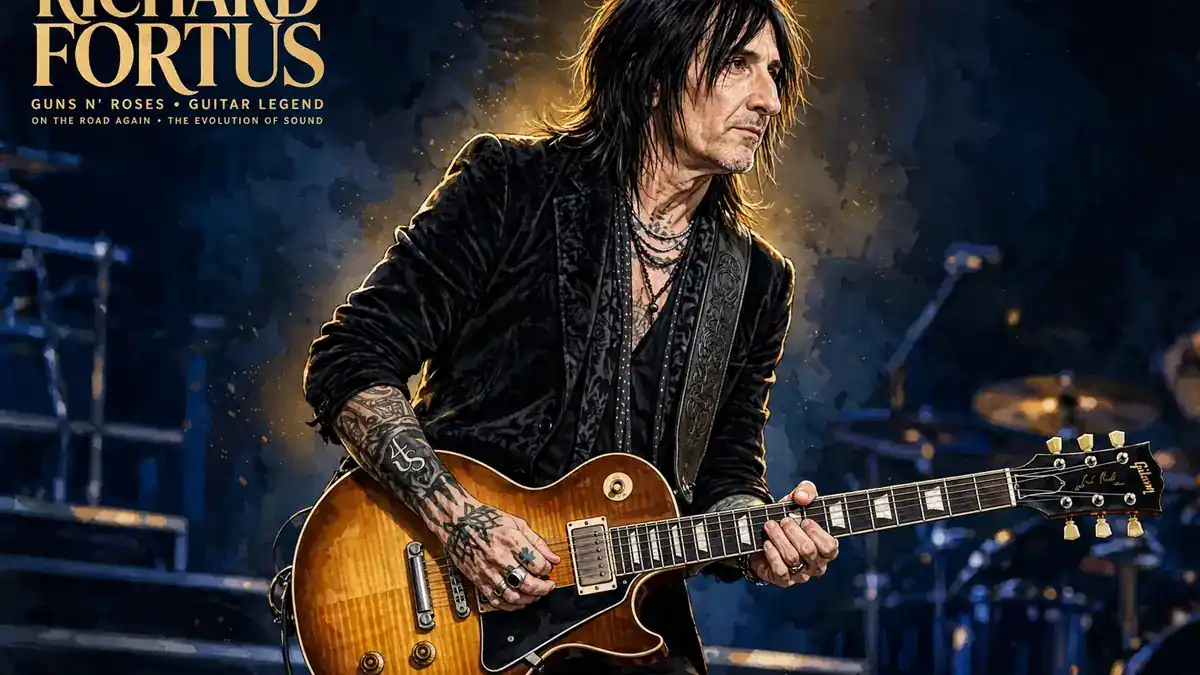
What Fortus does own, as far as the public record shows, is his gear — and it is serious gear. He is known for playing vintage-style Gibson Les Pauls, including the sunburst model in our featured illustration, and Gretsch guitars, and he is listed as an artist by D’Addario and has spoken at length to Celestion about speakers. A working guitarist’s collection of vintage instruments is a real asset class — a 1950s Les Paul can be worth six figures — but no inventory of his collection is public, so this article puts no number on it. The point is qualitative: his wealth, such as it is, sits in forty years of work and the tools of that work, not in a portfolio of companies.
Real estate is the one investment-like holding with a paper trail, and it is covered in the Assets section below. Beyond that, the responsible statement is that his money has been earned and, by all appearances, kept quietly — no flash businesses, no public deals, no headlines about losses either.
Brand Deals and Sponsorships
Fortus has artist relationships with music-equipment makers, and they should not be mistaken for the endorsement fortunes that pop stars sign. He is listed as an artist by D’Addario, the string and accessories maker, and he has given detailed interviews to Celestion about the speakers he uses. Those are the standard working relationships of a professional guitarist: the maker supplies gear and support, the player uses it on stage and talks about it. They are not, on any public evidence, paid sponsorships worth hundreds of thousands a year.
The claim that his signature models with ESP and Fender add $500,000 to $1 million a year in brand deals comes from the same My Chemical Romance blog post debunked above, and it is invented. Fortus is not known as an ESP or Fender signature artist, and no such deal is recorded by either company. Readers should also be wary of the $20 million figure attached to the same claims in a second blog post, which pairs the invented deals with invented tech stakes. Neither post names a verifiable source for any of its numbers.
The comparison with his bandmates is instructive. Slash’s name is on a Gibson signature Les Paul line, and Mick Jagger‘s Rolling Stones have spent sixty years turning a band name into a merchandising machine. Fortus has never had that kind of deal, because his public profile never reached that level — he is the rhythm guitarist, not the frontman, and the market pays frontmen for endorsements. What he has instead is the respect of the gear world: when D’Addario and Celestion want a working guitarist to talk about strings and speakers, they call him. That respect is real. It just does not come with a seven-figure cheque.

Houses, Cars and Other Assets
The clearest property fact about Richard Fortus is the New York apartment. Famous People Today reported that in 2019 he listed his apartment on New York’s Lower East Side for $1.2 million — $1.195 million in the listing detail carried by HomeDecorToday. A $1.2 million listing for a working musician’s city apartment is believable, and it fits the session-years story: he lived in New York through the 1990s and 2000s, when the session work was there. Whether the apartment sold, and at what price, is not in the public record, so this article reports the listing, not a sale.
The second property claim is weaker and is labelled as such. HomeDecorToday, a property blog, says Fortus owns a house in Woodland Hills, California, bought for $429,000 and now estimated at $549,000, and that he currently resides there. That sits uneasily with Wikipedia’s statement that he lives in St. Louis County, Missouri, with his wife and daughters. Both could be true at different times, or one could be out of date — property blogs recycle old listings, and musicians move. This article reports the Woodland Hills figures as a single blog’s claim, not as verified fact, and does not count the house as a confirmed asset.
What is confirmed is the St. Louis base. Fortus married a St. Louis attorney, lives in St. Louis County, and has talked in interviews about growing up in the city and returning there. A family home in St. Louis County costs a fraction of a comparable house in Los Angeles, and that is a genuine, if unglamorous, part of his financial picture: his living costs are lower than those of a peer who settled in California, so the same touring pay goes further.
On cars, the record is blank. No interview, listing, or credible report describes a car collection, a luxury purchase, or a specific vehicle owned by Fortus, and this article will not invent one. The same goes for watches, art, and other luxury assets that net worth sites often pad into a profile. The assets that can be named with confidence are the property listing above, his guitars and equipment, and the future earnings from a touring career that is still active at sixty. That is a thinner list than the one attached to most rock stars, and it is one of the reasons the bottom of his net worth range is the better-supported figure.
Awards and Achievements
Fortus’s honours are the band’s honours, and the biggest is the Rock and Roll Hall of Fame. Guns N’ Roses were inducted in 2012, in their first year of eligibility, with the classic lineup honoured and the current band carrying the name forward. Fortus was a member of the band at the time, in his tenth year, and the induction marked the moment the group he had joined in its wilderness years was formally recognised as one of the defining rock bands of all time.
The touring honours came later. The Not in This Lifetime tour won Top Tour and Top Draw at the Billboard Live Music Awards in November 2017 and was nominated for Top Rock Tour at the 2017 Billboard Music Awards. Those awards are trade awards, but they track the thing that actually pays: the tour was, by Billboard’s own Boxscore count, one of the highest-grossing tours ever staged, and Fortus played every show.
His personal achievements are better measured in longevity and range than in trophies. He has been a member of Guns N’ Roses since 2002 — twenty-four years, longer than any guitarist in the band’s history apart from the founders. He has played with the Psychedelic Furs, Love Spit Love, Thin Lizzy, and the Dead Daisies, and toured with artists as different as Rihanna and Enrique Iglesias. He survived a motorcycle crash in 2015 that broke his shoulder blade, collarbone, six ribs, and a toe, bruised a lung, lacerated his liver, and gave him concussion — and he was back on stage within weeks, in time for the Kiss Kruise at the end of October that year. And he is still there: on stage in 2025 and 2026, playing stadiums at sixty, while peers like Ozzy Osbourne, who kept touring into his seventies, show how long a rock career can run when the body holds up. For a working musician, that durability is the achievement that pays.
Net Worth Growth Over the Years
Most net worth articles print a smooth growth curve with a figure for every year. This one does not, because no such figures exist for Fortus. What exists is a trail of tracker estimates, and the honest way to show growth is to print the trail, with dates, so readers can see how the number moved — and how much the trackers disagree with each other.
| Year | Published estimate | Source |
|---|---|---|
| 2023 | $3.5 million | TheThings, ranking the band members by net worth |
| 2023 | $5 million | Celebrity Birthdays, last updated December 11, 2023 |
| 2023 | $6 million | Jukebugs, citing Celebrity Net Worth |
| 2024 | $8 million | HomeDecorToday, in a property profile |
| 2025 | $10 million | Famous People Today, updated March 4, 2025 |
| 2026 | $3.5 million–$10 million | NetWorthCraft estimate, November 2026 |
Two things stand out in that table. First, the number roughly triples in two years across the trackers, from $3.5 million to $10 million, with no event in Fortus’s career that would explain a tripling — no new album, no catalogue sale, no business launch. The reunion tour ended in 2019, before the lowest figure was published. The rise looks like trackers copying each other upward rather than new information arriving. Second, the lowest figure is also the oldest and the most careful: TheThings and TheRichest both print $3.5 million, and both trace their numbers to Celebrity Net Worth, the longest-running tracker in this niche. The $20 million figure printed by Cinenetworth on a Slash page, and the $86 million printed by a content-farm page that marks its own verification status as “Not Verified,” sit outside the table because they have no sourcing at all.
The shape of a real career sits underneath the table. The 1990s were lean: a major-label debut, club tours, session fees. The 2000s were steady: the Furs, Love Spit Love, New York sessions, then Guns N’ Roses from 2002. The 2010s were the climb: Chinese Democracy touring, the Dead Daisies, then the reunion tour from 2016 to 2019, which is the one period when his income jumped. The 2020s are the plateau: the band toured again in 2023, 2025, and 2026, and the pay from those tours lands on top of a base built over forty years. A range of $3.5 million to $10 million, anchored toward the lower half, fits that shape. A single figure of $10 million would need evidence of assets or deals that nobody has produced.
Social Media Presence
Fortus keeps a public profile on Instagram, where he posts tour photographs, guitar pictures, and behind-the-scenes shots from the road — the standard feed of a working touring musician. He is not a social media personality in the modern sense: there are no brand campaigns, no sponsored posts of record, and no follower count cited here because no verified figure was available at the time of writing. His public presence is the stage, not the feed, and that is consistent with a musician of his generation, who built a career before social media existed and never needed it to get hired.
For readers, the practical point is that his Instagram is a useful check on what he is doing now — which tour, which guitar, which city — and not a source of income in the way it is for younger musicians. No endorsement income is attributed to his social media in this article, because none is documented.
Personal Life
Fortus married Stephanie Howlett, a St. Louis-based attorney, on December 10, 2016. The couple live in St. Louis County, Missouri, with their two daughters. The daughters, Paisley Piper Fortus, born November 5, 2005, and Clover Blue Fortus, born January 6, 2008, are from his earlier relationship with his former partner Jen. Fortus has spoken about his daughters in interviews — his fifteen-year-old was in a band of her own at the time of a Celestion interview — but the family keeps a low profile, and this article does not go beyond the public record.
The most serious episode of his personal life was the motorcycle crash of September 17, 2015. Fortus described it himself in a statement carried by Louder, Ultimate Classic Rock, and Gibson: “I broke my shoulder blade, collar bone, six ribs, a toe, I have a bruised lung, lacerated liver and a concussion.” He added that his doctors had assured him of a full recovery, and that he had never missed a show in his entire career — a run the crash finally broke, forcing him to miss the Dead Daisies’ Australian and New Zealand tour. He was back in time for the Kiss Kruise, which sailed from Miami on October 30, 2015, about six weeks later. The speed of that return says something about the man: a guitarist whose hands and shoulders are his living does not sit out longer than he must.
He is sixty now, married, a father of two, living in the city where he grew up, and still playing stadiums. That is a settled life by rock standards, and it is part of why the money story reads the way it does: no divorces in the public record, no bankruptcies, no legal disputes over money, no rehab headlines. The drains on a rock fortune — the ones that cut other musicians’ net worth in half — do not appear in his record. What appears instead is a long, unglamorous accumulation: show fees, session fees, royalties, one apartment listing, and a career that never stopped.
Sources & Reporting
Wikipedia — Richard Fortus biography, Not in This Lifetime tour figures, Guns N’ Roses lineup and 2025–2026 tour history; accessed November 2026. The tour gross of $584.2 million and the 5,371,891 ticket count are carried from Billboard Boxscore reporting.
Billboard — Boxscore reporting on the Not in This Lifetime tour: $584.2 million grossed, 158 shows, 5.4 million tickets, third-highest-grossing tour in Boxscore history at its close in November 2019; also the 2017 Top Tour and Top Draw honours.
TheThings — “Which Member Of Guns N’ Roses Has The Highest Net Worth?”, ranking Fortus at $3.5 million; also the $32 million figure for Frank Ferrer and $230 million for Axl Rose used in the peer comparison.
TheRichest — “The Current Net Worth Of The Members Of Guns N Roses, Ranked,” February 26, 2023, also putting Fortus at $3.5 million and tracing its figures to TheThings, Grunge, Celebrity Net Worth, and Biography.
Celebrity Birthdays — Richard Fortus profile, $5 million net worth, last updated December 11, 2023; also the 5 feet 10 inches height figure.
Jukebugs — “Axl Rose Net Worth,” March 28, 2023, putting Fortus at $6 million and Melissa Reese at $5 million, citing Celebrity Net Worth.
Famous People Today — Richard Fortus profile, $10 million net worth, updated March 4, 2025; also the 2019 Lower East Side apartment listing at $1.2 million.
HomeDecorToday — Richard Fortus house profile, November 6, 2024, $8 million net worth and the Woodland Hills house figures ($429,000 purchase, $549,000 current estimate); treated in this article as a single low-authority blog claim.
D’Addario — Richard Fortus artist profile: Pale Divine’s Atlantic signing, the Love Spit Love albums, tours with Rihanna, Enrique Iglesias, Crystal Method, Jesse Malin, and BT, and his status as the longest-tenured member next to Axl Rose and Dizzy Reed.
Celestion — “Speaker World” interview with Fortus: his prog-rock and punk influences, the Eyes and Pale Divine years, session work, film scores for Monster and The Fast and the Furious, and his daughters.
Ultimate Classic Rock — September 28, 2015, report of the motorcycle accident, quoting Fortus’s own statement about his injuries.
Louder — September 2015 report of the crash and the missed Dead Daisies tour, plus a 2016 interview in which Fortus explains his longevity in Guns N’ Roses.
Consequence — Guns N’ Roses artist page: Chinese Democracy production cost of around $14 million, the 2012 Rock and Roll Hall of Fame induction, and the 2025 tour kickoff with new drummer Isaac Carpenter on May 1, 2025.
A-4-D — Legendary Rock Interviews, July 27, 2015, and The Rock Pit, March 28, 2013: Fortus in his own words on The Eyes, Pale Divine, Love Spit Love, Thin Lizzy, the Dead Daisies, and the 2001 Guns N’ Roses audition.
Stereo Embers Magazine — “These Days Of Daisies” interview: the Dead Daisies’ early tours, the Def Leppard and Kiss support run, and Fortus’s session history with Divinyls, N’Sync, Crystal Method, and Pink.
Rocks Off Magazine — Axl Rose net worth profile, revised 2026, putting Axl at around $230 million and Fortus at $3.5 million.
Reporting window: November 2026. Figures that could not be traced to a named outlet — including the $20 million and $86 million net worth claims and the My Chemical Romance connection printed by two AI-written blogs in 2026 — were checked, found false, and excluded from the estimate; they are described in the Businesses section so readers who meet them elsewhere know why they are wrong.
Frequently Asked Questions
What is Richard Fortus’s net worth in 2026?
Richard Fortus’s net worth is estimated at $3.5 million to $10 million as of November 2026. The range reflects real disagreement among the trackers: TheThings and TheRichest put him at $3.5 million, Celebrity Birthdays at $5 million, Jukebugs at $6 million, HomeDecorToday at $8 million, and Famous People Today at $10 million. The lower half of the range is the better-supported figure, because Fortus is a touring member rather than a partner in the band’s business, and no catalogue sale or business deal has ever been reported for him.
How much does Richard Fortus make from Guns N’ Roses?
No salary has ever been published, and the band’s internal pay split is private. What is public is the scale of the work: the Not in This Lifetime reunion tour grossed $584.2 million from 158 shows between 2016 and 2019, according to Billboard Boxscore. That is gross ticket revenue, not profit, and Fortus is paid as a touring musician rather than as a partner, so his share is a salary and fees — substantial over three and a half years of stadium shows, but far below the shares of Axl Rose, Slash, and Duff McKagan, who own parts of the business.
How old is Richard Fortus?
Richard Fortus was born on November 17, 1966, in St. Louis, Missouri, and he turned 60 on November 17, 2026. He is still touring with Guns N’ Roses, playing the band’s 2026 world tour at sixty.
Is Richard Fortus still in Guns N’ Roses?
Yes. Fortus has been a member of Guns N’ Roses since July 2002, when he joined officially to replace Paul Tobias, and he played the band’s 2025 tour and its 2026 world tour. He is the longest-serving guitarist in the band’s history alongside the founding members, and the current lineup is Axl Rose, Slash, Duff McKagan, Dizzy Reed, Fortus, Melissa Reese, and drummer Isaac Carpenter, who joined in March 2025.
Who is Richard Fortus’s wife?
Richard Fortus married Stephanie Howlett, a St. Louis-based attorney, on December 10, 2016. The couple live in St. Louis County, Missouri. He has two daughters, Paisley Piper Fortus, born November 5, 2005, and Clover Blue Fortus, born January 6, 2008, from his earlier relationship with his former partner Jen.
How tall is Richard Fortus?
Richard Fortus is 5 feet 10 inches tall (178 cm), according to biographical profiles. He was born on November 17, 1966, in St. Louis, Missouri.
Was Richard Fortus in My Chemical Romance?
No. Richard Fortus has never played with My Chemical Romance, never written with them, and owns none of their catalogue. The band was formed in New Jersey in 2001 by Gerard Way, and its guitarists were Ray Toro and Frank Iero. The claim that Fortus co-founded the band and owns a share of its catalogue comes from an AI-written blog post published in 2026, and the $10–$15 million net worth figure built on it is not reliable.
Why is Richard Fortus worth less than Slash and Axl Rose?
Timing and ownership. Fortus joined Guns N’ Roses in 2002, fourteen years after Appetite for Destruction sold more than 30 million copies, so he missed the catalogue wealth. Axl Rose owns the band name and catalogue, reported at $200–$230 million, and Slash returned in 2016 as a partner with a solo career and endorsement deals, reported at $120–$175 million. Fortus is paid as a touring musician, and his fortune is the sum of forty years of touring pay, session fees, and royalties — real money, but a different kind of money from owning the catalogue.
Final Thoughts
Richard Fortus’s net worth — $3.5 million to $10 million, anchored toward the lower half — is the fortune of a working musician, not a rock star owner. He joined Guns N’ Roses at thirty-five, after eighteen years of bands and sessions, and he has spent the twenty-four years since keeping one of the biggest bands in the world on stage: through the Chinese Democracy years, through the $584.2 million reunion tour, through a motorcycle crash that should have ended his playing, and into a 2026 world tour at sixty. The trackers disagree about the exact number, and the honest article says so. What they agree on is the shape of the story: a guitarist who was never the richest member of his band, and never needed to be, because the work itself never stopped.
Published on November 18, 2026. Last reviewed November 2026. Found an error? See our corrections policy.