
Richard Lewis‘s net worth is estimated at $7 million as of November 2026. Lewis died on February 27, 2024, so the figure is the value of his estate at his death rather than a fortune still growing — a point that matters, because several low-quality sites now claim he is worth far more. The money came from a stand-up career that ran for more than 50 years, a network sitcom co-starring Jamie Lee Curtis, 40 episodes of Curb Your Enthusiasm, a memorable turn as Prince John in Robin Hood: Men in Tights, two memoirs, and decades of touring and late-night television.
Richard Lewis: Quick Facts
| Estimated net worth | $7 million at death (February 2024) (range: $7 million — see the note on outlier claims) |
|---|---|
| Profession | Stand-up comedian, actor, writer, author |
| Nationality | American |
| Born | June 29, 1947, Brooklyn, New York (age 76 at death) |
| Height | 5 feet 9 inches (1.75 m) |
| Primary income sources | Stand-up touring and specials, television acting, film roles, book sales, endorsements |
| Active years | 1971–2024 |
| Last reviewed | November 2026 |
- Quick Facts
- Early Life and Background
- Education
- Career Journey
- Rise to Fame
- Main Sources of Income
- Salary and Earnings
- Businesses and Investments
- Brand Deals and Sponsorships
- Houses, Cars and Other Assets
- Awards and Achievements
- Net Worth Growth Over the Years
- Social Media Presence
- Personal Life
- Sources & Reporting
- Frequently Asked Questions
- Final Thoughts
- Related Profiles
Early Life and Background
Richard Philip Lewis was born on June 29, 1947, in Brooklyn, New York, and raised in Englewood, New Jersey. His father, Bill Lewis, worked as a caterer. His mother, Blanche, was a small-time actress. The household was Jewish, though Lewis later described himself as not especially religious. He was the class clown at school, the kid who caused trouble and got laughs for it, and the habit never left him.
The family dynamic shaped the comedy. Lewis was younger than his siblings by a wide gap, and author William Knoedelseder wrote in I’m Dying Up Here that the age gap left Lewis isolated for long stretches of his childhood — isolation that later fed the anxious, self-lacerating voice of his act. His mother, by several accounts, was a difficult presence at home. Lewis spent a small fortune on therapy across his adult life and turned the sessions into material, joking on stage about psychiatrists the way other comics joked about airlines.
One childhood friendship turned out to be worth more than money. At a summer camp when he was 12, Lewis met Larry David. David had been born three days after Lewis, and the two boys stayed close for the rest of their lives. Decades later, that friendship put Lewis on Curb Your Enthusiasm as a fictionalized version of himself — the role that introduced him to a whole new generation and kept him earning into his seventies.
Englewood in the 1950s and 1960s was a comfortable middle-class suburb, and the Lewises were not rich. His father’s catering business paid the bills without building wealth, and nothing in Lewis’s early life suggests inherited money. Every dollar he eventually held came from work he did after 1971. That matters for the net worth picture: there was no family fortune behind the $7 million, no trust fund, no property passed down. He earned it one club date at a time.
He also carried a family wound that steered his career. In April 1971, his father died of a heart attack at 57. Lewis was 23. The loss pushed him toward the stage — within weeks he was trying stand-up in Greenwich Village, and he later said the grief and the need to make sense of it sat underneath everything he performed. The parallel is hard to miss: Lewis himself died of a heart attack at 76, in February 2024, after living with Parkinson’s disease.
Education
Lewis graduated from Dwight Morrow High School in Englewood in 1965, then enrolled at Ohio State University, where he studied marketing and communications. He earned a Bachelor of Science in Business Administration in Marketing in 1969 and joined the Alpha Epsilon Pi fraternity. The marketing degree looks like a strange detour for a man who became famous for screaming about his neuroses on stage, but it gave him a working life first: after graduation he spent about five years working two and sometimes three jobs at once — advertising copywriter, librarian in the archives of the Museum of Modern Art, and sporting goods clerk — while writing jokes on the side.
Ohio State stayed in his life long after he left Columbus. He remained a devoted Buckeyes fan who trash-talked the University of Michigan at every chance, according to a 2022 piece in The Lantern, the university’s student newspaper. In November 2023, just three months before his death, Ohio State’s Fisher College of Business gave him its Alumni Achievement Award — a late-career honor that most obituaries missed, and a reminder that the university saw him as one of its own even though comedy, not business, made his name.
The copywriting years were the real education. Writing ad copy taught him to land a line fast, and moonlighting as a gag writer for working comics — including Morty Gunty — taught him what made a room laugh. He was not a kid who dreamed of stand-up and walked straight onto a stage. He was a 23-year-old with a day job, a dead father, and a notebook full of jokes he was afraid to perform himself.
Career Journey
Lewis first tried stand-up at an open mic in Greenwich Village in 1971, at the now-closed Champagne Gallery. The crowd response told him he had something. He kept his copywriting job by day and worked the clubs at night — the Improvisation, Pips, and the Ice House in Pasadena — for three years before the big break arrived. David Brenner discovered him performing in Greenwich Village, introduced him to the Los Angeles club circuit, and helped him land his first appearance on The Tonight Show Starring Johnny Carson in 1974. The first Tonight Show spot did not go well, by Lewis’s own account, but it put his name in front of the country.
1974 was the hinge year. Alongside the Tonight Show debut came a tour with Sonny and Cher and a regular guest slot on their variety show. Rodney Dangerfield hired him for $75 to fill in at Dangerfield’s, his New York club — a small fee that Lewis remembered for the rest of his life because of what it represented. He was no longer a copywriter doing jokes on the side. He was a working comic with a television credit and a road schedule.
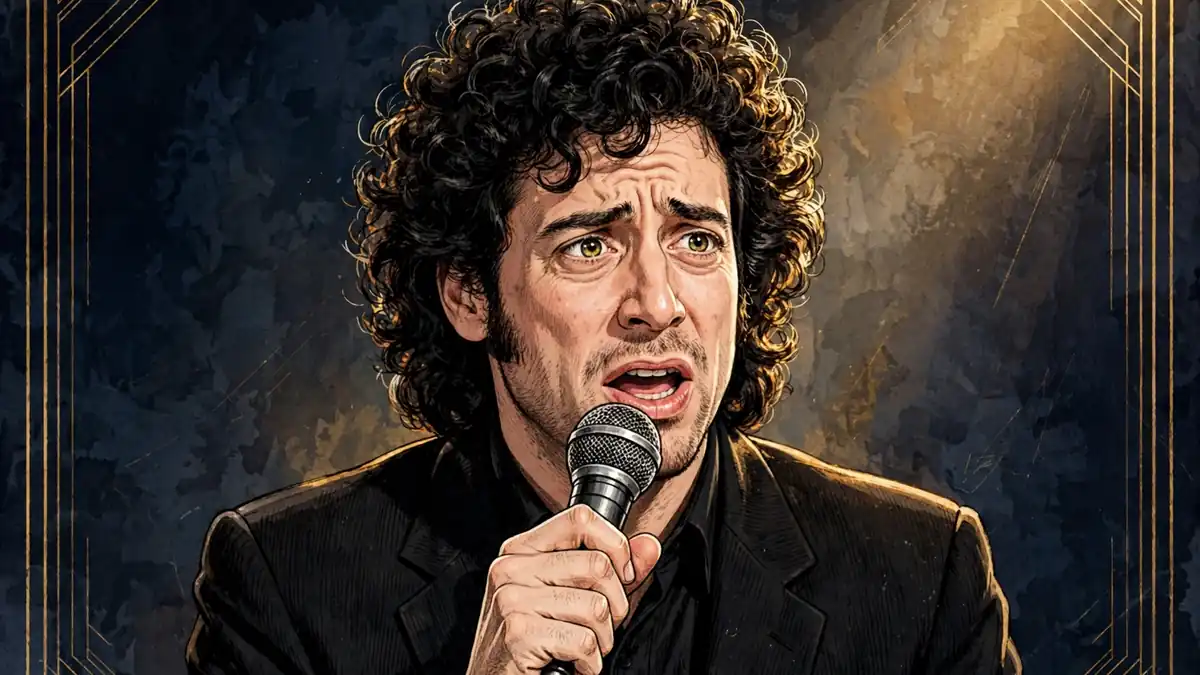
Through the late 1970s he built the act that became his trademark: black clothes, wild dark curls, and frantic, stream-of-consciousness rants about therapy, women, his family, and his own body. The press started calling him the “Prince of Pain,” a nickname that stuck for fifty years. His screen acting debut came in 1979 with Diary of a Young Comic, a 90-minute film that aired on NBC in the slot normally reserved for Saturday Night Live.
The 1980s turned him into a cable star. He recorded three specials he later grouped as his “Trilogy from Hell”: I’m in Pain for Showtime in 1985, the CableACE-nominated I’m Exhausted for HBO in 1988, and I’m Doomed for HBO in 1990. A fourth, Richard Lewis: The Magical Misery Tour, followed on HBO in 1997. The specials paid, they sold on home video, and they kept his touring calendar full — the economic engine of his career for two decades.
Television gave him his steadiest paycheck. From 1989 to 1992 he co-starred with Jamie Lee Curtis on the ABC sitcom Anything but Love, playing Marty Gold for 56 episodes across four seasons. In 1993 he starred with Don Rickles on the Fox sitcom Daddy Dearest. The same year he played Prince John in Mel Brooks’s Robin Hood: Men in Tights, the film role most people remember him for. Film work continued through the 1990s — Once Upon a Crime (1992), Wagons East (1994), Drunks (1995), in which he played a struggling alcoholic, and Leaving Las Vegas (1995) — along with later appearances in Vamps, She’s Funny That Way, and Sandy Wexler.
He never stopped working the clubs. His website claimed he may hold the record for late-night talk show appearances, with well over 100 guest slots: 22 on The Tonight Show, 44 on Late Night with David Letterman, and nine more on Letterman’s CBS Late Show. Those appearances paid little by themselves, but they sold tickets in every city he toured, and touring was where a stand-up of his era actually made money.
The final act began in 1999, when the Curb Your Enthusiasm pilot put him on screen as himself, sparring with Larry David. He appeared in 40 episodes across 25 years, including the pilot and the final season, which premiered on February 4, 2024. His last episode aired less than two weeks before his death. In April 2023 he announced he had been living with Parkinson’s disease for about two years and was retiring from stand-up. He kept acting. Curb was the last job, and it ended almost exactly when he did.
Rise to Fame
Lewis’s rise was slow, then sudden. The slow part ran from 1971 to 1974: open mics, club dates, and a day job. The sudden part was the Tonight Show in 1974 and the Sonny and Cher tour the same year, which took a New York club comic and made him a national name in months. Newspapers and magazines — the New York Daily News and New York magazine among them — started naming him one of the comics to watch by the mid-1970s.
The 1980s made the fame stick. The Showtime and HBO specials turned his stage act into something people could watch at home, and his regular late-night appearances kept him in front of audiences between tours. By the end of the decade he was famous enough to carry a network sitcom. Anything but Love ran for four seasons on ABC, and for most Americans who did not follow stand-up, Marty Gold — the neurotic magazine writer opposite Jamie Lee Curtis — was who Richard Lewis was.
The 1993 double hit of Daddy Dearest and Robin Hood: Men in Tights put him on movie screens as Prince John, a preening, cowardly villain played for laughs. The film grossed far more than its budget and became a cable staple, which meant residuals kept arriving for years. It also gave him the one film role that casual fans still quote back at him.
The strangest part of his rise came last. Curb Your Enthusiasm started in 1999, when Lewis was 52, and it made him more famous at 60 and 70 than the sitcom had at 40. Playing himself — the same neurotic, kvetching friend Larry David had known since summer camp — he reached viewers who had never seen a stand-up special. The show ran for 12 seasons, and Lewis was in it from the pilot to the final year. For a comic whose first big break came in 1974, that is a 50-year run of relevance, and it is the reason his name still draws search traffic in 2026.
Comedy Central’s list of the 100 greatest stand-up comedians of all time included Lewis, and the honor mattered to him more than most awards would have. He was a comic’s comic — Jonathan Winters was a close friend in Winters’s later years, and younger comics like Artie Lange and Bobby Slayton named him as an influence. Fame, for Lewis, was never the stadium kind. It was the kind where other comedians, and then the public, kept coming back for five decades.
Main Sources of Income
Stand-up comedy paid the bills for most of Lewis’s life. From the mid-1970s onward he toured constantly — clubs, colleges, theaters — and the road was the steadiest income a comic of his generation had. A headliner at his level in the 1980s and 1990s could command several thousand dollars a night, and Lewis worked the road for decades, not years. The four cable specials added fees and home-video income on top of the touring, and the specials doubled as advertising: every time one aired, the phone rang in the next city.
Television acting was the second pillar. Anything but Love gave him four seasons of network sitcom pay plus residuals that continued long after the show ended, and Daddy Dearest added a second sitcom credit. Curb Your Enthusiasm paid him for 40 episodes across 25 years — a long, slow drip of HBO money rather than a single windfall. He also took recurring television work where it came, including Rabbi Richard Glass on 7th Heaven and a B-movie producer on the sitcom Rude Awakening, plus voice work on Rude Dog and the Dweebs.
Film roles were the third stream, smaller but real. Prince John in Robin Hood: Men in Tights was the highest-profile part, and the film’s long life on cable and home video produced residuals. Leaving Las Vegas, Drunks, Once Upon a Crime, and Wagons East added supporting-role fees across the 1990s, and late-career parts in Vamps, She’s Funny That Way, and Sandy Wexler kept the film income going into his sixties.
Books were a fourth stream. The Other Great Depression, published in 2000, was a memoir of essays about his alcoholism, eating disorder, family, and recovery, and he promoted it on The Howard Stern Show and a national book tour. Reflections From Hell followed in 2015. Neither book was a blockbuster, but both sold steadily to his fan base, and the first book’s paperback and audio editions extended its life. He also wrote satirical humor pieces for magazines, including Playboy, across the 1990s.
Endorsements rounded out the picture. In the 1990s Lewis fronted ads for Snapple, Certs breath mints, and Boku — national campaigns that paid a working comic far more than a club date. He was a natural pitchman for those brands: the anxious, fast-talking everyman was exactly the character the ads wanted.
Salary and Earnings
Here is the honest part, and it is the part most net worth pages skip: almost none of Lewis’s individual paychecks were ever made public. HBO never disclosed what it paid supporting players on Curb Your Enthusiasm. ABC never published his Anything but Love salary. His book advances, endorsement fees, and nightly touring guarantees were private deals. Any page that prints a precise per-episode Curb salary for Lewis is guessing, and we will not do that.
What the record does show is the shape of a working comic’s earnings across 50 years. The earliest hard number is the $75 Rodney Dangerfield paid him to fill in at Dangerfield’s in the 1970s — a small fee from a night when he was still proving himself. By the mid-1980s, with a Showtime special and a national touring profile, he was earning a headliner’s money: thousands per night, dozens of dates a year, plus the special itself. Network sitcom work in the early 1990s paid far better than clubs. A co-star on a four-season ABC sitcom earned a solid six-figure salary per season at the time, along with residuals that arrived for years after the final episode aired.
The Curb years are the hardest to price and the most often exaggerated. Lewis appeared in 40 episodes over 25 years — roughly one or two episodes a season, not a series-regular schedule. HBO pays guest and recurring players per episode, and while the top stars of a hit show earn huge sums, a recurring player in a handful of episodes a year earns a comfortable but not enormous amount. The value of Curb for Lewis was steadiness and visibility: a quarter-century of paid work on television’s most respected comedy, plus the touring boost that came with being on it.
The residuals tell the rest of the story. Anything but Love ran in syndication. Robin Hood: Men in Tights played on cable for decades. The HBO specials were re-aired and sold on home video. Each of those streams was small on its own, and together they produced the kind of long-tail income that keeps a retired comic comfortable. His final years added no new touring income — he retired from stand-up in 2023 — but the residuals and the Curb final season kept money coming in until his death.
That is why the $7 million figure holds up. It is the total a 50-year career in comedy produces when the career includes a network sitcom, a quarter-century on HBO, four specials, two books, national ad campaigns, and constant touring — minus the costs of a life lived in Los Angeles, decades of therapy, and medical bills in his final years. It is a working comic’s fortune, not a mogul’s, and the size of it is the point: Lewis was rich because he worked for fifty years, not because one deal made him rich.
Two warnings about numbers you may see elsewhere. TheMost10 claims Lewis was worth $10 million in 2022 and $18 million in 2026, and ILikeToDabble projects $16 million for 2025. Both pages offer no source for the jump, and the 2026 figure is impossible on its face: Lewis died in February 2024, so his estate could not have grown through new work in 2025 and 2026. Those numbers look generated, not reported. At the other end, MarriedWiki once put him between $200,000 and $900,000 — a stale figure from before his Curb years had fully paid out. The credible middle, repeated by Celebrity Net Worth and every obituary that named a figure, is $7 million.
Businesses and Investments
Lewis was not a businessman in the way some comedians are. He never launched a production company, a tequila brand, a podcast network, or a chain of clubs. There is no record of him investing in startups, buying into restaurants, or flipping property. His business was himself: the act, the specials, the books, and the roles. That is worth stating plainly, because net worth pages often pad this section with invented ventures. Lewis had none to pad with.
What he did have was a long, diversified career inside one industry. Stand-up, sitcoms, film, books, endorsements, and voice work spread his income across enough streams that no single dry spell could sink him. When sitcom work slowed in the mid-1990s, the road was there. When the road got harder in his seventies, Curb was there. That is a business strategy, even if he never called it one.
His one documented investment was his home. He and his wife bought their three-bedroom, three-bathroom Los Angeles house in 2016 for $1.53 million, and Los Angeles prices rose for most of the eight years he owned it. A house is not a business, but in his case it was the largest single asset he held at death, and it is the only property record in the public file. There are no reports of other homes, rental properties, or commercial holdings.
He also invested in the unglamorous kind: his health and his sobriety. He got sober in 1994 after a hospital stay at 44 for a mix of alcohol and drugs, and stayed sober for nearly 30 years. The money he did not spend on addiction across those three decades is not a line item anyone can price, but it is real. A comic who kept drinking at his 1990s pace does not reach 76 with a $7 million estate and a 25-year HBO run. The sobriety was the investment that protected all the others.
Brand Deals and Sponsorships
Lewis’s most visible brand work came in the 1990s, when he fronted national campaigns for Snapple, Certs breath mints, and Boku. The Snapple ads fit him best: the brand sold itself as the odd, straight-talking alternative to the big soda companies, and Lewis — all black clothes, all nerves, all jokes about his own misery — was the human version of that pitch. The fees for national campaigns of that kind ran into six figures for a recognizable comic, though the exact amounts were never disclosed.
The Certs and Boku spots used the same persona. Advertisers in that era hired comics to play themselves, and Lewis’s self was the product: the worried, fast-talking New Yorker who could make anxiety funny in thirty seconds. He did not do the modern version of brand work — no Instagram sponsorships, no podcast ad reads, no merchandise line — because his peak endorsement years came before any of that existed, and by the time it did, he was in his seventies and working less.
He also earned money from his writing for magazines, including satirical pieces for Playboy in the 1990s. Those were fees, not sponsorships, but they belong in the same column: companies paid him because his voice sold things, whether the thing was iced tea, breath mints, or a magazine.
One brand relationship was personal rather than commercial. He was close to Ringo Starr — the former Beatle’s album release party in 1998 was where Lewis met his future wife, Joyce Lapinsky, who worked in music publishing. Starr sent condolences to Lapinsky after Lewis died, and Lewis used to joke that Starr had introduced him to his wife. It earned him nothing in cash and meant more to him than the ad campaigns did.

Houses, Cars and Other Assets
The Los Angeles home is the one asset with a paper trail. Lewis and Joyce Lapinsky bought the three-bedroom, three-bathroom house in 2016 for $1.53 million, according to property reporting cited in coverage of his marriage. It was their sanctuary: a comfortable, mid-size home in a city where working actors live, not a mansion in the hills. He died there, at home, on February 27, 2024, and his wife still lived there at the time of his death.
There are no public records of other homes. Lewis spent his adult life in two cities — New York in the 1970s, Los Angeles from the late 1970s onward — and the 2016 purchase is the only property transaction tied to his name in the reporting. He was not a property collector, and his estate’s real estate was one house, not a portfolio.
Cars barely register in his story. He was photographed over the years in ordinary vehicles, and no reporting ties him to a luxury collection, a classic car habit, or a six-figure automobile. The contrast with other celebrity net worth profiles is the point: Lewis spent money on therapy, on his marriage, on his dogs, and on staying sober. He did not spend it on fleets.
The rest of his estate was the invisible kind: residuals from Anything but Love, Curb Your Enthusiasm, Robin Hood: Men in Tights, and the HBO specials; royalties from two books; and whatever remained of five decades of touring and acting fees after taxes and living costs. None of that shows up in a photograph, which is why so many net worth pages invent cars and houses to fill the section. We would rather say what the record shows: one house, bought for $1.53 million, and a long tail of entertainment income.
Awards and Achievements
Lewis never won an Emmy or a Grammy, and his trophy shelf was thin by Hollywood standards. What he collected instead was the respect of his peers and a set of honors that meant more to a working comic than a statue. I’m Exhausted earned a CableACE nomination for best stand-up comedy special in 1988, and I’m Doomed won him a second CableACE nomination in 1990. Those were the industry’s top prizes for cable comedy at the time, and two nominations in three years put him in the front rank of his generation.
Comedy Central named him one of the 100 greatest stand-up comedians of all time, a list that functions as the closest thing comedy has to a hall of fame. He was also the subject of a 2005 DVD retrospective, Richard Lewis: Concerts from Hell: The Vintage Years, with an interview by Bill Zehme — the kind of package only comics with a real legacy get.
The late honors were personal. Ohio State’s Fisher College of Business gave him its Alumni Achievement Award in November 2023, three months before he died. He had spent his twenties working copywriting jobs with that marketing degree, and the university’s decision to honor the comedian, not the businessman, said something about how both sides saw the career.
His real achievement was the run itself. Fifty-three years passed between his first open mic in 1971 and his final Curb episode in 2024. He appeared on The Tonight Show 22 times and on David Letterman’s shows 53 times. He co-starred on a network sitcom, played a film villain people still quote, wrote two books, stayed sober for thirty years, and worked on television’s most respected comedy from its pilot to its final season. Most comics get one of those things. He got all of them.
Net Worth Growth Over the Years
No audited record of Lewis’s wealth exists for any single year of his life, so the honest way to show growth is a timeline of the career markers that moved the number, with the figure itself anchored only where a source states it.
| Year | Career marker | What it meant for his money |
|---|---|---|
| 1971 | First stand-up gig in Greenwich Village; father dies of a heart attack at 57 | Starting from zero — day jobs in copywriting, libraries, and retail while he learned the clubs |
| 1974 | Tonight Show debut; Sonny and Cher tour; $75 fill-in for Rodney Dangerfield | First national exposure; road work begins paying a living wage |
| 1979 | Screen debut in Diary of a Young Comic on NBC | First film fee; television acting becomes a second income stream |
| 1985–1990 | Three cable specials: I’m in Pain, I’m Exhausted, I’m Doomed; two CableACE nominations | Special fees plus home-video income; touring demand rises sharply |
| 1989–1992 | Co-stars on ABC’s Anything but Love (56 episodes) | First steady network salary and long-term residuals — the biggest single lift of his career |
| 1993 | Prince John in Robin Hood: Men in Tights; Daddy Dearest with Don Rickles | Film fees and decades of cable residuals from the Mel Brooks hit |
| 1994 | Gets sober after a hospital stay; stays sober for nearly 30 years | The decision that protected his earnings and his career for the rest of his life |
| 1999 | Curb Your Enthusiasm pilot; plays himself for 25 years | A quarter-century of HBO pay, steady work into his seventies, and a new generation of fans |
| 2000 | Memoir The Other Great Depression published | Book advance and royalties; national tour and talk-show promotion |
| 2016 | Buys Los Angeles home with his wife for $1.53 million | Largest single asset in the estate; Los Angeles prices rise through the years he owns it |
| 2023 | Reveals Parkinson’s diagnosis; retires from stand-up; receives Ohio State alumni award | Touring income ends; residuals and the Curb final season carry the last year |
| 2024 | Dies February 27, age 76, of a heart attack | Net worth at death: $7 million, per Celebrity Net Worth |
The shape of the curve is a working comic’s curve: slow in the 1970s, steep through the sitcom and special years of the late 1980s and early 1990s, flat and steady through the Curb decades, then frozen at death. There was no single windfall, no sale, no inheritance. The $7 million is fifty years of work, saved and compounded, and it stopped growing on February 27, 2024. Any site that shows it rising after that date is not reporting. It is inventing.
For scale, his closest collaborators ended up far richer, which says more about their deals than about his talent. Celebrity Net Worth puts Larry David at about $400 million, built on Seinfeld syndication, and Jerry Seinfeld at about $950 million on the same stream. Jamie Lee Curtis, his Anything but Love co-star, sits near $60 million after a film career that ran parallel to his. Howard Stern, whose show Lewis promoted his book on, is listed near $650 million. Lewis never owned a piece of a syndication goldmine. He owned his act, his residuals, and his house — and that added up to $7 million.
Social Media Presence
Lewis was not a social media star, and his accounts were modest by celebrity standards. He posted on X, formerly Twitter, where his following sat in the tens of thousands rather than the millions, and he used the account the way an older comic does: jokes, tour dates, and the occasional personal note. His most important post there was also his saddest duty. In April 2023 he used X to tell fans he had been living with Parkinson’s disease for about two years, that he was retiring from stand-up, and that he was focusing on writing and acting. The post was plain and direct — “I have Parkinson’s disease but I’m under a doctor’s care and everything is cool” — and it set the terms for his final year in public.
His last posts before his death were small and human: notes to friends, jokes, and thanks to fans. The List later called his final tweet heartbreaking in hindsight, and it was — a working comic saying goodnight to an audience he had performed for since 1971. There was no farewell tour announcement, no goodbye post, no final special. He finished the Curb season, went home, and died there.
After his death, the accounts stayed up as memorials. Fans and fellow comics filled the replies with clips: the Tonight Show sets, the Curb arguments with Larry David, the Prince John scenes. His wife, Joyce Lapinsky, asked for privacy in the statement released through his publicist, Jeff Abraham, and she has not turned his accounts into a brand. There is no official store, no posthumous merchandise line, no managed legacy feed. The social media footprint is what he left: a comic’s account, frozen in February 2024, with the jokes still there for anyone who wants them.
Personal Life
Lewis married late and happily. He met Joyce Lapinsky, who worked in music publishing, at a Ringo Starr album release party in 1998. They got engaged in 2004 and married on January 2, 2005. The marriage lasted 19 years, until his death, and by every account it steadied him. Friends noted how much the two loved each other, and Lewis joked on stage that he kept waiting for the rug to be pulled out from under him — that the marriage was a practical joke and she was secretly married to someone in Italy. She kept saying no.
The couple had no children. Lewis was close to his nieces and nephews, and he and Lapinsky shared their home with a small dog he mentioned often in his final interviews. “I love my wife, I love my little puppy dog and I love all my friends and my fans,” he said in one of his last public statements — a sentence that reads now like a man taking stock.
His health shaped his last decade more than his work did. He had four back surgeries in quick succession before the Parkinson’s diagnosis, and he talked openly about the operations in interviews: “I had four surgeries back to back to back to back, it was incredible, I couldn’t believe it, it was bad luck, but that’s life.” He did physical therapy three times a week after the diagnosis and kept working through it, filming the final Curb season while managing tremors and stiffness.
The addiction story was the one he told most honestly. He drank and used drugs through the 1970s and 1980s, and at 44 he landed in the hospital after a mix of alcohol and drugs nearly killed him. August 1994 was the darkest point. He got sober, stayed sober for nearly 30 years, and wrote about the whole mess in The Other Great Depression — including an eating disorder he had hidden for years. He also spent a fortune on therapy, and he said so on stage, turning the analyst’s couch into the best material he ever had.
He died at home in Los Angeles on the night of February 27, 2024, of a heart attack, at 76. His publicist, Jeff Abraham, confirmed the death and passed on his wife’s thanks for the love and support, and her request for privacy. His death certificate listed Parkinson’s disease as a secondary cause. The final Curb episode he filmed, in which his character tells Larry David’s character about dying — “When I die, I want you to know how much I care about you. You’re my best friend. You’re getting the money” — aired less than two weeks before he died. Life and the show had become the same story, and he knew it.
Sources & Reporting
Celebrity Net Worth — the $7 million net worth estimate and the core biographical facts (born June 29, 1947; died February 27, 2024, age 76).
Associated Press (via NPR/KSUT) — obituary reporting: death at home in Los Angeles of a heart attack at 76, Parkinson’s diagnosis revealed in 2023, the $75 Rodney Dangerfield fill-in, the Larry David friendship, and his charity work with Comic Relief and Comedy Gives Back.
The New York Times — full obituary, cited via Legacy.com’s death notice.
Legacy.com — death notice: died February 27, 2024, at home in Los Angeles of a heart attack, age 76; Curb Your Enthusiasm pilot in 1999 and final appearance in a 2024 episode.
Jewish Journal — the richest single profile: father’s death of a heart attack at 57 in April 1971, Ohio State graduation in 1969, the 100-plus late-night appearances (22 Tonight Show, 44 Late Night, 9 Late Show), and 40 Curb appearances including the pilot.
Wikipedia — career chronology: stand-up debut 1971, Tonight Show 1974, specials dates (1985, 1988, 1990, 1997), Anything but Love 1989–1992, Robin Hood: Men in Tights 1993, Fisher College Alumni Achievement Award November 2023.
IMDb — height 5 feet 9 inches, birth name Richard Philip Lewis, marriage to Joyce Lapinsky January 2, 2005, meeting Larry David at summer camp at 13.
The Lantern — Ohio State student newspaper: death at 76, graduation in 1969, Buckeyes fandom, and the 2001 book-signing coverage of The Other Great Depression.
The List — final X post and Parkinson’s announcement in April 2023, final Curb season 12 appearance, and the “Vertical Drop, Horizontal Tug” death scene.
eCelebrityMirror — the 2016 Los Angeles home purchase ($1.53 million, three bedrooms, three bathrooms), Parkinson’s listed as secondary cause on the death certificate, and the marriage timeline (met 1998, engaged 2004, married 2005, no children).
Jukebugs — memoir coverage: The Other Great Depression and his openness about addiction, anxiety, depression, and an eating disorder.
Internewscast — net worth explainer confirming the $7 million Celebrity Net Worth figure and the stand-up specials list.
Reporting window: obituary and career coverage from February–March 2024, with profile updates and the Ohio State alumni award from November 2023, and this article reviewed in November 2026. Where figures conflict, this article names the source and explains the gap rather than picking a middle number.
Frequently Asked Questions
What was Richard Lewis’s net worth when he died?
Richard Lewis was worth an estimated $7 million at his death on February 27, 2024, according to Celebrity Net Worth. The figure was repeated by nearly every outlet that covered his death. It reflects more than 50 years of stand-up touring, four cable specials, a four-season network sitcom, 25 years on Curb Your Enthusiasm, two books, and endorsement deals, minus a lifetime of living costs in Los Angeles.
How did Richard Lewis die?
Richard Lewis died of a heart attack at his home in Los Angeles on the night of February 27, 2024. He was 76. His publicist, Jeff Abraham, confirmed the death. Lewis had revealed in April 2023 that he had been living with Parkinson’s disease for about two years, and his death certificate listed Parkinson’s as a secondary cause of death.
Who was Richard Lewis’s wife?
Richard Lewis was married to Joyce Lapinsky, who worked in music publishing. They met at a Ringo Starr album release party in 1998, got engaged in 2004, and married on January 2, 2005. The marriage lasted 19 years, until his death in 2024. Lapinsky asked for privacy in the statement released after his death.
How old was Richard Lewis when he died?
Richard Lewis was 76 when he died. He was born on June 29, 1947, in Brooklyn, New York, and died on February 27, 2024, in Los Angeles. His final Curb Your Enthusiasm episode aired less than two weeks before his death.
What was Richard Lewis best known for?
Richard Lewis was best known for three things: his neurotic, self-deprecating stand-up act, which earned him the nickname the “Prince of Pain”; his co-starring role as Marty Gold opposite Jamie Lee Curtis on the ABC sitcom Anything but Love (1989–1992); and his 25-year run playing a fictionalized version of himself on HBO’s Curb Your Enthusiasm. Film fans also remember him as Prince John in Robin Hood: Men in Tights (1993).
What was Richard Lewis’s salary on Curb Your Enthusiasm?
HBO never disclosed what it paid Richard Lewis for Curb Your Enthusiasm, and no reliable source has published a per-episode figure. Lewis appeared in 40 episodes over 25 years as a recurring player, not a series regular, so his pay was per-episode guest money rather than a star salary. Any page that prints an exact Curb salary for him is guessing. The steady, long-running HBO work mattered more to his $7 million estate than any single paycheck did.
Did Richard Lewis have children?
No. Richard Lewis and his wife, Joyce Lapinsky, had no children during their 19-year marriage. Lewis was close to his nieces and nephews, and he and Lapinsky shared their Los Angeles home with a small dog he mentioned often in his final interviews.
What is Richard Lewis’s net worth in 2026?
Richard Lewis’s net worth in 2026 is still $7 million, because he died in February 2024 and his estate has not grown through new work since then. Some content-farm sites claim $16 million or $18 million for 2025 and 2026, but they offer no source, and the figures are impossible on their face — a person who died in 2024 cannot earn new income in 2025 and 2026. The $7 million figure from Celebrity Net Worth remains the credible estimate.
Final Thoughts
Richard Lewis died with $7 million, and the number tells the truth about his career: he was a working comic who got rich slowly, by showing up for fifty years. No single deal made him. No syndication goldmine, no brand empire, no inheritance. He earned it in clubs, on a network sitcom, on HBO, in movies, in books, and in ad campaigns — and he kept it by getting sober in 1994 and staying sober for thirty years.
The figure also carries a warning for anyone reading net worth pages in 2026. Lewis has been dead for more than two years, yet sites keep publishing bigger numbers for him, as if death were a career move. It is not. The $7 million is frozen in February 2024, and any number larger than it needs a source, not a spreadsheet. Celebrity Net Worth gave the figure, the obituaries confirmed it, and the career record supports it. That is enough.
What survives him is not the money. It is the act — the black suit, the wild hair, the frantic confession that turned anxiety into art — and the friendship with Larry David that carried him from a summer camp at 12 to the final season of Curb Your Enthusiasm. His last scene on the show was about dying, and he played it the way he played everything: as himself, telling the truth, and making it funny.
Published on November 5, 2026. Last reviewed November 2026. Found an error? See our corrections policy.