
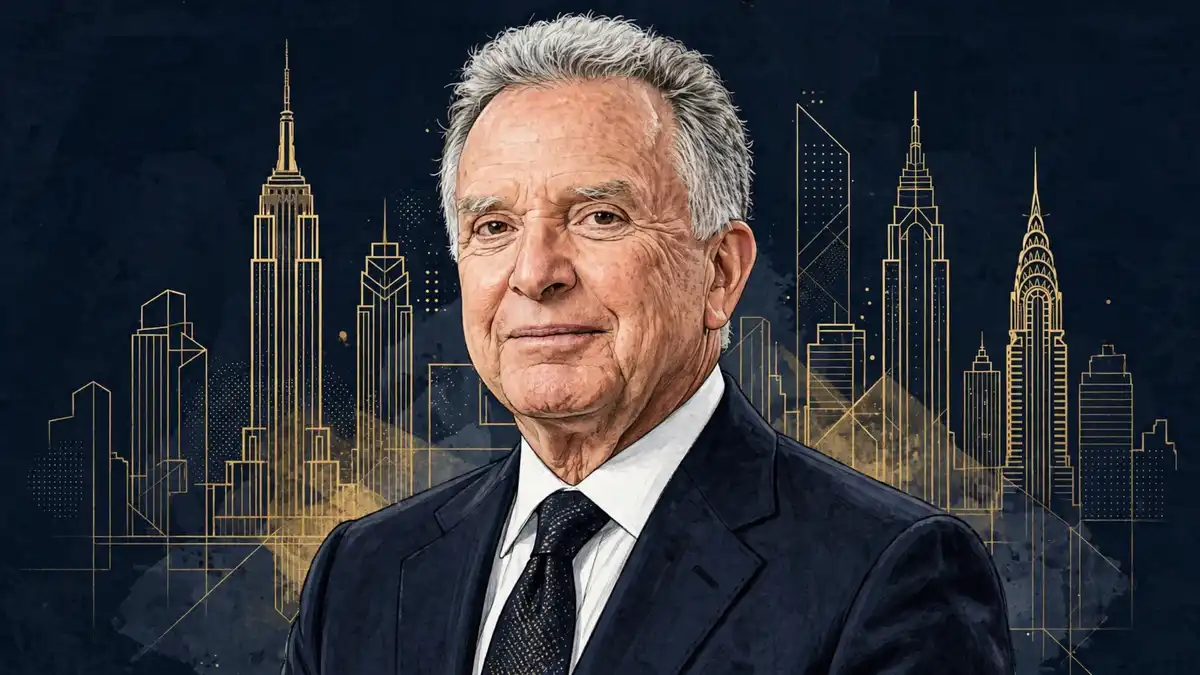
Steve Witkoff‘s net worth is estimated at $2 billion to $2.3 billion as of November 2026. The Bronx-born developer built that fortune the slow way — buying beaten-down apartment buildings in the 1980s, then Manhattan landmarks in the 1990s and 2000s — and the fast way, through a family crypto venture that added hundreds of millions in a single year. Forbes put him at $2.3 billion in April 2026, up 15% in twelve months, while he served as President Donald Trump’s special envoy to the Middle East — a job he does unpaid.
Steve Witkoff: Quick Facts
| Estimated net worth | $2.3 billion (Forbes, April 2026) (range: $2 billion to $2.3 billion) |
|---|---|
| Profession | Real estate developer and investor; founder of the Witkoff Group; U.S. Special Envoy to the Middle East and Special Envoy for Peace Missions |
| Nationality | American |
| Born | March 15, 1957 (age 69) |
| Height | Not publicly documented |
| Primary income sources | Real estate development and asset sales, Witkoff Group ownership, cryptocurrency (World Liberty Financial), property investments |
| Active years | 1983–present |
| Last reviewed | November 2026 |
- Early Life and Background
- Education
- Career Journey
- Rise to Fame
- Main Sources of Income
- Salary and Earnings
- Businesses and Investments
- Brand Deals and Sponsorships
- Houses, Cars and Other Assets
- Awards and Achievements
- Net Worth Growth Over the Years
- Social Media Presence
- Personal Life
- Sources & Reporting
- Frequently Asked Questions
Early Life and Background
Steven Charles Witkoff was born on March 15, 1957, in the Bronx, New York City, and raised in Baldwin Harbor and Old Westbury on Long Island. His father, Martin Witkoff, ran a women’s clothing manufacturer, George Simonton Inc., as its president. His mother, Lois Birnbaum Witkoff, worked as an interior designer. The household sat squarely in the city’s garment and design trades — close enough to Manhattan deal-making to see it up close, far enough from inherited wealth that Witkoff started his career on a lawyer’s salary.
That upbringing shows up in the way he has always talked about buildings. Where other developers describe square footage, Witkoff talks about buying something other people have written off and making it worth more than anyone expected. The habit started early. As a young attorney he watched clients buy distressed property in neighborhoods banks had stopped lending to, and he kept notes on which of those bets paid off. By his late twenties he was making the same bets with his own money.
Witkoff is Jewish, and his family background in the Bronx and Long Island placed him inside the same New York real estate circles — lawyers, lenders, contractors, small landlords — that later supplied his first partners and his first tenants. He has never presented himself as a self-made myth. The record shows something more ordinary and more instructive: a well-connected lawyer who switched sides of the table, from advising buyers to becoming one, and kept doing it for forty years.
The Bronx-to-boardroom arc matters because it explains the shape of the fortune. Witkoff did not inherit a portfolio, marry into one, or ride a single lucky deal. He assembled it building by building, starting with walk-up apartment houses in Washington Heights and the northwest Bronx, then moving downtown as his capital grew. Every later landmark — the Daily News Building, the Woolworth Building, the Park Lane Hotel — sits on top of that first layer of unglamorous rental stock.
Education
Witkoff began his studies at Union College in Schenectady, New York, then transferred to Hofstra University, where he earned a bachelor’s degree in political science in 1980. Three years later, in 1983, he graduated with a law degree from Hofstra Law School. The legal training did more than give him a credential. Real estate law taught him how deals are actually put together — title, financing, zoning, partnership agreements — and that fluency became his edge when he crossed over into development.
His first job was at Dreyer & Traub, a New York real estate law firm. Donald Trump was a client of the firm, and the two men met through work in 1986. The relationship that began as lawyer and client grew into a business relationship and then a personal friendship that has now lasted four decades. Witkoff also practiced at Rosenman & Colin before leaving law to buy property full time.
One story from those early years has been retold so often it has become part of the Witkoff record: in 1986, a cash-strapped Trump needed lunch during a deal, and Witkoff bought him a sandwich. The anecdote is small, and Witkoff himself has never made much of it, but it captures the dynamic that later defined his career — he was useful to powerful people before he was powerful himself, and he remembered who owed whom a favor.
The Hofstra years also explain his comfort with negotiation as a discipline rather than a talent. Law school rewards preparation, patience, and knowing the other side’s documents better than they do. Colleagues in the real estate world have described him in exactly those terms: smart, personable, and a talented negotiator with a common touch, in the words of peers quoted by The Wall Street Journal in November 2024.
Career Journey
Witkoff’s career breaks into three clear acts: the lawyer who bought buildings on the side, the landlord who became a developer, and the developer who became a diplomat. Each act made the next one possible, and each one left a paper trail of prices, partners, and square footage that lets us trace the fortune instead of guessing at it.
Act one began in 1985, when Witkoff and fellow Dreyer & Traub attorney Larry Gluck co-founded Stellar Management. The name was a portmanteau of their first names — Steve and Larry. The pair pooled personal savings, borrowed from banks, and bought cheap apartment buildings in Washington Heights and the northwest Bronx. At one point Stellar owned 85 buildings with more than 3,000 apartments, many of them in some of New York’s poorest neighborhoods. The model was simple: buy distressed rental stock, fix the buildings, stabilize the tenants, and hold. It was also slow, hands-on work — the opposite of the trophy deals that would come later.
In 1995, Witkoff pushed into lower Manhattan, buying inexpensive office buildings as the downtown market bottomed out. The timing was the whole bet. New York commercial property in the mid-1990s was cheap because the early-1990s recession had emptied offices and scared off lenders. Witkoff, who had spent a decade underwriting exactly that kind of distress, moved while the market was still frightened. In 1996 he secured financing from Credit Suisse First Boston for 33 Maiden Lane, a 27-story tower designed by Philip Johnson and John Burgee, and the following year leased its top 13 floors to the Federal Reserve Bank of New York on a 25-year term. A central bank as a tenant turned a speculative purchase into a cash-flowing asset.
Also in 1996, Witkoff and business partner Rubin Schron bought the Daily News Building for $138 million. The Art Deco landmark on East 42nd Street gave him a trophy address and a lesson he would repeat: famous buildings with tired finances can be bought, repositioned, and held for decades. By October 1998, the Witkoff Group operated 11 million square feet of commercial and retail space and held an ownership interest in 7,500 apartments, plus land and hotel developments. The Wall Street Journal reported that by 1998 he controlled a portfolio of 30 office buildings with an estimated worth of $2.5 billion — a firm-level figure, not his personal net worth, but a measure of how fast the machine had grown in thirteen years.
Act two opened in 1997, when Witkoff left Stellar Management and founded the Witkoff Group, becoming its chairman and chief executive. The new firm, privately held and headquartered in New York City, moved into residential construction and land rehabilitation. A planned $2 billion initial public offering of the company in 1998 was cancelled when the real estate market collapsed, and Witkoff and Gluck dissolved their partnership — Gluck taking the residential properties, Witkoff taking the office buildings. The split defined the next two decades: Witkoff would chase scale, landmarks, and luxury, while Gluck kept the rental base.
From there the deals got bigger and more public. In 2013, Witkoff and Harry Macklowe bought the Park Lane Hotel on Central Park South for $660 million. That same year, Witkoff and Fisher Brothers paid $223 million for a parcel of land in Tribeca and built 111 Murray Street, a 792-foot residential tower. He bought the upper 30 floors of the Woolworth Building for $138 million and converted them into ultra-luxury condominiums. As of 2019, the Witkoff Group owned about 50 properties in the United States and internationally, and the firm has said it has financed, repositioned, or built more than 70 properties in total.
Not every bet paid. The Fontainebleau Las Vegas project, bought for $600 million, was meant to open in 2020 as The Drew — named after his late son Andrew — but construction stopped in March 2020 as the pandemic shut Nevada down. In February 2021, Koch Real Estate Investments bought the property, the original Fontainebleau name was restored, and the hotel finally opened in December 2023. The episode cost Witkoff years and, by most accounts, money — and it is the clearest reminder in his record that even billionaires sell at the wrong time when a crisis hits.
Act three began in November 2024, when President-elect Trump announced Witkoff as his Special Envoy to the Middle East. Witkoff had no diplomatic experience. He took the role unpaid, kept his business holdings through a long and scrutinized divestment process, and became the administration’s main channel to Moscow and to the parties in the Gaza war within months of taking office.
Rise to Fame
For most of his career, Witkoff was famous inside real estate and unknown outside it. That changed twice: first when Forbes put him on its billionaires list, and then when Trump handed him the hardest diplomatic jobs in the world. Forbes estimated his wealth at $2 billion in 2025, ranking him 1,763rd worldwide, and the number gave the public a handle on a man who had spent forty years avoiding the spotlight.
The second change was louder. Announced as Middle East envoy on November 12, 2024, Witkoff had already helped push the January 2025 Gaza ceasefire and hostage exchange over the line before Trump formally took office, working alongside Brett McGurk, President Biden’s lead negotiator, and Qatari prime minister Sheikh Mohammed bin Abdulrahman Al Thani. The deal swapped 33 hostages held by Hamas for around 1,000 Palestinian prisoners and paused a fifteen-month war for six weeks. The New York Times called it a vivid example of cooperation between two men representing bitter political rivals.
His rise as a negotiator rested on the same reputation that built the fortune: he closes. In February 2025, Trump sent him to Moscow, where he met President Vladimir Putin and helped negotiate a prisoner swap that freed American Marc Fogel in exchange for Russian citizen Alexander Vinnik. By March 2025 he had become the main channel between the Trump administration and the Russian presidency. He assumed the Middle East envoy office formally on May 6, 2025, and was appointed Special Envoy for Peace Missions on July 3, 2025.
The fame has not been uncomplicated. His praise for Putin, his use of Kremlin-provided translators, a misread of Putin’s remarks in August 2025 that briefly shifted U.S. sanctions policy, and a 28-point Ukraine peace plan drafted with Russian envoy Kirill Dmitriev in November 2025 all drew sharp criticism from diplomats, senators, and commentators. A leaked October 2025 phone call in which he advised Putin aide Yuri Ushakov on negotiating with Trump brought calls for his dismissal from members of Congress. Trump defended him, calling the call a standard form of negotiation. The controversies matter to the money story because they explain why his wealth is now discussed as a conflict-of-interest question, rather than a rich list entry.
Before the envoy role, his public profile was thin by design. He gave a speech on the fourth night of the Republican National Convention in July 2024, co-chaired the Presidential Inaugural Committee with former senator Kelly Loeffler, and had served on Trump’s Great American Economic Revival Industry Groups during the first administration. He was also on the golf course with Trump at Trump International Golf Club in West Palm Beach on September 15, 2024, when Ryan Wesley Routh attempted to assassinate the former president. Each appearance added a layer to a public image that, until 2024, had been almost entirely private.
Main Sources of Income
Witkoff’s money comes from four streams, and the balance between them shifted sharply in 2025. Real estate development and asset sales remain the foundation. Ownership of the Witkoff Group is the second stream. Cryptocurrency, through World Liberty Financial, is the third — and the one that explains the jump in his Forbes number. A smaller set of investments, including a stake in an Abu Dhabi data-centre venture tied to Elon Musk’s xAI, rounds out the picture.
Development profits work the way they have for forty years: buy land or a tired building, finance the repositioning, sell condominiums or lease the space, and keep the spread between the purchase price and the finished value. The Park Lane Hotel shows the pattern at full scale. Witkoff and Macklowe paid $660 million in 2013; a decade later, after a troubled partnership with financier Jho Low and the 1MDB scandal, Witkoff sold his stake to Qatar Holding for $623 million in 2023, exiting a heavily indebted investment with his capital largely intact. The Woolworth Building’s upper floors, bought for $138 million, became ultra-luxury condominiums sold at prices far above the purchase cost. The 111 Murray Street tower, built on $223 million of Tribeca land, added another high-margin residential project to the ledger.
Rental income and long-term holds form the quieter half of the real estate stream. The 33 Maiden Lane deal, with the Federal Reserve Bank of New York locked in for 25 years on the top 13 floors, is the model: a creditworthy tenant, a long lease, and decades of predictable cash flow. The Daily News Building, bought for $138 million in 1996, has produced rental income for nearly thirty years. These are the assets that make a developer’s wealth durable — they pay whether or not the next deal closes.
World Liberty Financial changed the mix. The crypto firm was founded by his sons Zach and Alex Witkoff with members of the Trump family, and Forbes credited it as the main driver of Witkoff’s 15% wealth increase in his first year in the administration. Reporting on the venture has put the family’s take from token sales and related transactions at at least $200 million, and the Witkoff family receives 12.5% of the venture’s net protocol revenue through an entity called WC Digital Fi LLC, with at least $31 million paid upfront from a $500 million investment by an Abu Dhabi-linked fund. Those are family-level figures, not Witkoff’s personal bank balance, and crypto revenue is volatile — but they explain why a real estate fortune suddenly grew by hundreds of millions in a year when property markets were flat.
The fourth stream is newer and harder to price. Forbes reported that Witkoff holds an equity stake in a data-centre project in Abu Dhabi partnered with Musk’s xAI, part of a partnership valued in the billions. The stake is reported to be worth hundreds of millions of dollars. Because the venture is private and the stake size has not been disclosed, we treat it as a real but unquantified contributor — it supports the Forbes figure without letting us pin a number on it ourselves.

Salary and Earnings
The most striking number in Witkoff’s earnings record is zero. He serves as Special Envoy to the Middle East and Special Envoy for Peace Missions in an unpaid capacity, drawing no government salary for two of the most demanding jobs in American diplomacy. That fact is central to understanding his finances: his income does not come from Washington at all, which is exactly why his business ties have drawn so much scrutiny.
His federal financial disclosure, filed in June 2025 and made public that September, gives the only hard numbers on his personal balance sheet. Witkoff disclosed assets worth at least $350 million, and the filing listed six assets valued at more than $50 million each — among them his Southampton home, a corporation tied to the One High Line condominium and hotel project, and a cash account at a U.S. bank. The same disclosure showed he had sold a $120 million stake in the Witkoff Group as part of his divestment from the firm he founded, a sale Bloomberg first reported. A White House spokesperson said in September 2025 that he was still finalizing that divestment.
Disclosure floors understate wealth by design — assets are reported in bands, debts are netted separately, and private company stakes are hard to value — so the $350 million figure is a floor, not a total. Forbes, which values the Witkoff Group as a going concern and counts the crypto holdings, lands far higher. The $120 million stake sale is useful in a different way: it shows a single slice of his firm changing hands at nine figures, which is consistent with a company worth well over a billion dollars.
On the crypto side, the family’s reported take of at least $200 million from World Liberty Financial token sales is the largest single earnings event of his recent career, and it arrived in a year when his real estate holdings were largely flat. The 12.5% share of net protocol revenue gives the family an ongoing cut of the venture’s income instead of a single payout. How much of that flows to Steve Witkoff personally, versus his sons and the wider family, has not been disclosed — another reason our estimate is a range rather than a single figure.
Smaller, dated earnings help fill out the picture. In July 2025, Bloomberg reported that Witkoff sold a Miami Beach waterfront property for more than double its purchase price. In November 2022, he listed a Miami Beach lot for $19.95 million. These are the visible tips of a portfolio that turns over quietly: properties bought, improved, and sold at multiples of their purchase price, with most transactions never making the news.
Businesses and Investments
The Witkoff Group is the business. Founded in 1997 and privately held, it has financed, repositioned, or built more than 70 properties, with about 50 properties owned as of 2019 across New York, Miami, Los Angeles, Las Vegas, Chicago, Dallas, and Philadelphia, plus international holdings. Its portfolio mixes office towers, hotels, luxury condominiums, and land developments, and its best-known assets read like a walking tour of Manhattan: the Daily News Building, the Woolworth Building, 33 Maiden Lane, 111 Murray Street, the Park Lane Hotel, and the One High Line condominium project, which Bloomberg reported Witkoff helped revive in 2023.
Miami is the firm’s second home. The Shore Club Private Collection in Miami Beach, redeveloped with a loan closed alongside Monroe Capital in 2023, and the Shell Bay Residences, a luxury condo and private club project steered by his son Alex, anchor a South Florida pipeline that has grown as New York deals got harder to finance. In 2025, Witkoff partnered with Len Blavatnik and Barry Sternlicht on a stalled Miami Beach project, adding two more billionaire partners to a roster that already included Harry Macklowe, Rubin Schron, and Fisher Brothers.
World Liberty Financial is the investment that changed his wealth trajectory. Co-founded by his sons Zach and Alex with the Trump family, the crypto venture put the Witkoff family at the center of the administration’s crypto policy and its profits at the same time. The family’s 12.5% share of net protocol revenue, the reported $31 million upfront payment from a $500 million Abu Dhabi-linked investment, and the at-least-$200 million from token sales together make it the most lucrative single venture of Witkoff’s career — and the most controversial, since his son Alex was soliciting investment from several of the same Middle Eastern governments his father was negotiating with. The New York Times documented those overlapping solicitations in 2025.
The xAI-linked data-centre stake in Abu Dhabi extends the pattern into artificial intelligence infrastructure. Forbes reported the holding as part of its April 2026 wealth update, describing an equity stake in a data-centre venture partnered with Musk’s xAI. The partnership itself has been described as a $10 billion arrangement involving Musk’s companies. Witkoff’s exact share has not been disclosed, so we count it as a supporting asset for the Forbes estimate rather than a separately valued line item.
His earlier investment record includes the Stellar Management rental base, the cancelled $2 billion IPO of 1998, and the Fontainebleau Las Vegas purchase and sale. The Fontainebleau episode deserves a closer look because it shows his risk appetite: buying a half-built resort and casino project for $600 million, planning to open it as The Drew, then selling to Koch Real Estate Investments in February 2021 after the pandemic stopped construction. The property opened as Fontainebleau Las Vegas in December 2023 under new ownership. Whether the sale made or lost money has not been disclosed, and we do not guess.
Brand Deals and Sponsorships
Witkoff has no endorsement deals, no sponsorship contracts, and no product lines — and that absence is itself informative. He is a developer, not a celebrity, and his income has never depended on lending his name to someone else’s product. The partnerships that matter in his record are joint ventures, not brand deals: Macklowe on the Park Lane, Fisher Brothers on 111 Murray Street, Schron on the Daily News Building, Monroe Capital on the Shore Club, Blavatnik and Sternlicht on the Miami Beach project, and the Trump family on World Liberty Financial.
Those partnerships work differently from sponsorships. Each partner brings capital, land, or political access, and each takes a share of the project’s profit. The Park Lane deal shows both sides of that coin: a $660 million purchase with a famous partner, a financing structure that later involved Jho Low and the 1MDB scandal, and an exit to Qatar Holding that preserved most of the capital. A brand deal pays a fee for a face; a joint venture pays a share of a building. Witkoff has only ever done the second kind.
The closest thing to a personal brand in his record is the Witkoff Group name itself, which now carries weight with lenders, city agencies, and Gulf sovereign funds. That reputation is the asset that let him raise money for the Park Lane, the Shore Club, and the Abu Dhabi data centre — and it is also the asset that critics say he carried into diplomacy, where a developer’s Rolodex became an envoy’s contact list.
Houses, Cars and Other Assets
Witkoff’s most valuable disclosed personal asset is his home in Southampton, New York, one of six holdings his 2025 financial disclosure valued at more than $50 million each. The Hamptons property sits in the same category as his stake in the One High Line project and a large cash account at a U.S. bank — the three named items in the disclosure’s top band, with the other three above-$50 million assets not publicly identified.
His Miami Beach footprint is better documented in the press. In November 2022, he listed a Miami Beach lot for $19.95 million, and in July 2025 Bloomberg reported he sold a Miami Beach waterfront property for more than double what he paid for it. The firm’s Miami holdings — the Shore Club Private Collection, the Shell Bay Residences, and the Blavatnik-Sternlicht project — are company assets rather than personal homes, but the line between the two has always been thin in a privately held family firm, and the disclosure treats his company stake as his largest single asset.
On cars, the public record is silent. No reliable outlet has documented Witkoff’s personal vehicle collection, and we do not invent one. Developers of his generation tend to treat cars as transport rather than trophies, and nothing in his disclosure or in press coverage suggests otherwise. The same restraint applies to art, yachts, and aircraft: none are documented in the public record, and this profile leaves them out rather than speculating.
What is documented is the scale of the company behind the personal assets. At its late-1990s peak, the firm operated 11 million square feet of commercial and retail space with an ownership interest in 7,500 apartments. The portfolio has since shifted toward fewer, larger, more luxurious assets — a deliberate move from volume to value that explains why a smaller property count can support a larger personal fortune.
Awards and Achievements
Witkoff holds no major real estate industry awards in the public record, and this profile does not invent any. His achievements are measured in deals, not trophies, and the deal list is long enough to stand on its own: 85 buildings and 3,000 apartments assembled at Stellar Management; the Daily News Building for $138 million; 33 Maiden Lane financed through Credit Suisse First Boston with the Federal Reserve as a 25-year tenant; the Park Lane Hotel for $660 million; 111 Murray Street on $223 million of Tribeca land; the Woolworth Building’s upper floors converted to luxury condominiums; the Fontainebleau Las Vegas project bought for $600 million and sold to Koch Real Estate Investments; the One High Line revival; and the Shore Club and Shell Bay projects in Miami Beach.
His public-service record adds a different kind of achievement. He co-chaired the Presidential Inaugural Committee for Trump’s second inauguration, spoke at the 2024 Republican National Convention, served on the Great American Economic Revival Industry Groups during the first Trump administration, and helped negotiate the January 2025 Gaza ceasefire and hostage exchange, the October 2025 ceasefire, and the February 2025 prisoner swap that freed Marc Fogel. Whatever the controversies around his methods, the fact that a man with no diplomatic experience became the administration’s main channel to Moscow within three months of his appointment is, on its own terms, a remarkable rise.
Forbes’ billionaires list is the closest thing to a formal honor in his record. The 2025 listing at $2 billion, rank 1,763rd worldwide, and the April 2026 update to $2.3 billion, put a public number on a private fortune for the first time and made Witkoff a reference point in every discussion of wealth and power in the second Trump administration.
Net Worth Growth Over the Years
Witkoff’s wealth grew in steps, not in a straight line, and the public record captures only a few of those steps. The table below uses only figures tied to a named outlet or a federal filing, and it labels firm-level numbers as firm-level so they are never mistaken for personal net worth.
| Year | Figure | What it measures |
|---|---|---|
| 1998 | $2.5 billion | Value of the 30-building office portfolio under Witkoff’s control, per The Wall Street Journal — firm assets, not personal wealth |
| 1998 | $2 billion (cancelled) | Planned IPO valuation of the Witkoff Group, cancelled when the real estate market collapsed |
| 2025 | $2 billion | Forbes estimate; ranked 1,763rd worldwide |
| June 2025 | At least $350 million | Federal financial disclosure floor, with six assets above $50 million each; includes a $120 million Witkoff Group stake sale |
| April 2026 | $2.3 billion | Forbes estimate, up 15% in one year, driven by World Liberty Financial |
| 2026 | $782 million | Bloomberg Billionaires Index, per Bisnow — a far lower valuation of the same private holdings |
The Forbes-to-Bloomberg gap deserves a straight explanation, because readers searching for Witkoff’s net worth will find both numbers. Forbes values his stake in the Witkoff Group as a going concern, counts the World Liberty Financial holdings at something close to their token-sale value, and includes the data-centre stake. Bloomberg’s index applies steeper discounts to private real estate and crypto positions and arrives at $782 million. Neither tracker has access to his tax returns or the firm’s books, so neither number is a fact — they are two professional judgments about the same opaque portfolio, and the honest presentation is to show both and anchor on the fresher, higher Forbes figure while naming the lower one.
The growth story underneath the numbers is the shift from rental volume to trophy value. The 1998 portfolio was big and cheap: 85 buildings, 3,000 apartments, 11 million square feet. The 2026 portfolio is smaller and far more expensive per square foot: Central Park South hotels, Tribeca towers, Miami Beach waterfront. The crypto windfall of 2025–2026 then added a third leg that has nothing to do with square footage at all. That is why the Forbes number jumped 15% in a single year while the property market stood still.
Social Media Presence
Witkoff keeps almost no public social media profile. He has no verified personal account with a large following on X, Instagram, or Facebook, and he does not post about his deals, his family, or his diplomacy. News about him arrives through the White House, through the press, and through the occasional podcast — most notably his March 2025 interview with Tucker Carlson, in which he discussed the Ukraine negotiations at length.
That silence is a choice, and it fits the rest of the record. For forty years he built a fortune without a public persona, and he entered diplomacy the same way, letting the negotiations speak and leaving the commentary to others. The cost of that silence is that the public record about him is written by journalists, critics, and financial trackers rather than by Witkoff himself — which is why this profile leans on named outlets and a federal filing rather than on anything he has said about his own wealth.
Personal Life
Witkoff married Lauren Jill Rappoport in 1987. She was then an associate at the Manhattan law firm Botein, Hays & Sklar, and she later became executive vice president of sales and marketing at the Witkoff Group. Public records describe the couple as separated. Lauren Rappoport’s full biography and career at the Witkoff Group covers her own path through the family firm in detail. The couple had three sons, and the family story is inseparable from the business story: the firm Witkoff built is now run, in large part, by his children.
Their eldest son in the public record, Andrew, died in 2011 at the age of 22 from an OxyContin overdose at a sober living facility in California. Witkoff has spoken about the loss publicly, including at a White House opioid summit in March 2018, where President Trump introduced him to speak about the epidemic. The Fontainebleau Las Vegas project was to have been named The Drew, after Andrew, before the pandemic halted construction and the property changed hands.
His surviving sons run the empire now. Alex Witkoff is co-chief executive of the Witkoff Group and steers projects including the Shell Bay Residences in Miami. Zach Witkoff serves as executive vice president of development at the firm and co-founded World Liberty Financial. The handover is unusually clean for a family business: the father took the diplomatic job, the sons took the company, and the crypto venture — the fastest-growing part of the fortune — belongs to the younger generation outright.
Witkoff’s friendship with Donald Trump, now forty years old, is the thread that ties the personal and the professional together. They met through legal work in 1986, did deals together, played golf together — including on September 15, 2024, the day of the assassination attempt at Trump International Golf Club in West Palm Beach — and now govern together, with Witkoff as the president’s envoy and his sons as partners in the Trump family’s crypto venture. Few relationships in American public life have paid off so directly, or drawn so much scrutiny, as this one.
Sources & Reporting
Forbes — the anchor for this estimate: $2 billion in 2025, $2.3 billion in April 2026, up 15% in one year, with the increase driven by World Liberty Financial; also the source for the xAI-linked Abu Dhabi data-centre stake.
Bloomberg — the Bloomberg Billionaires Index valuation of $782 million; first reporting of the $120 million Witkoff Group stake sale and the June 2025 financial disclosure; the July 2025 Miami Beach waterfront sale at more than double the purchase price; the One High Line revival and the September 2026 Moscow trip.
The Wall Street Journal — the 1998 portfolio figure of 30 office buildings worth $2.5 billion; the November 2024 peer assessment of Witkoff as a talented negotiator with a common touch.
The New York Times — the Qatari financing of the Witkoff Group during the first Trump administration; Alex Witkoff’s solicitation of Middle Eastern governments for World Liberty Financial investment; the January 2025 Gaza ceasefire negotiations.
Bisnow — the divestment timeline and the $120 million stake sale details; the Bloomberg $782 million figure; the September 2025 disclosure of assets worth at least $350 million.
Wikipedia — the consolidated biography used to cross-check dates and deal figures (birth, education, Stellar Management, the Daily News Building, the Park Lane Hotel, 111 Murray Street, the Fontainebleau sale, envoy appointments, and the November 2025 28-point peace plan), verified against the outlets above.
CoinPaper — the early-2026 estimate of around $2 billion and the $2.5 billion 1998 portfolio figure as reported in its net worth profile.
PoliticianNetWorth — the $2 billion 2026 estimate, the Woolworth Building purchase price of $138 million, and the family’s at-least-$200 million take from World Liberty Financial.
Reporting window: November 2024 – November 2026, with historical deal figures from 1985–2023 drawn from the outlets above. Figures are estimates built from public reporting; the Witkoff Group is privately held and publishes no audited financial statements.
Frequently Asked Questions
What is Steve Witkoff’s net worth in 2026?
Steve Witkoff’s net worth is estimated at $2 billion to $2.3 billion as of November 2026. Forbes put him at $2.3 billion in April 2026, up from $2 billion in 2025. The Bloomberg Billionaires Index values him far lower, at $782 million, because it discounts his private real estate and crypto holdings more steeply.
How did Steve Witkoff make his money?
He made it in New York real estate. Starting as a lawyer, he co-founded Stellar Management in 1985, buying cheap apartment buildings in Washington Heights and the Bronx, then founded the Witkoff Group in 1997 and bought Manhattan landmarks including the Daily News Building, the Woolworth Building, and the Park Lane Hotel. More recently, his family’s crypto venture, World Liberty Financial, added at least $200 million.
What is the Witkoff Group?
The Witkoff Group is the privately held real estate development firm Witkoff founded in 1997 and chaired as chief executive. It has financed, repositioned, or built more than 70 properties, including office towers, hotels, and luxury condominiums in New York, Miami, Los Angeles, and Las Vegas. His son Alex now serves as co-chief executive.
What is Steve Witkoff’s role in World Liberty Financial?
World Liberty Financial was co-founded by his sons Zach and Alex Witkoff with members of the Trump family. Steve Witkoff’s family receives 12.5% of the venture’s net protocol revenue, and reporting puts the family’s take from token sales at at least $200 million. Forbes credited the venture as the main driver of his 15% wealth increase in 2025–2026.
Does Steve Witkoff get paid as Trump’s envoy?
No. He serves as Special Envoy to the Middle East and Special Envoy for Peace Missions in an unpaid capacity, drawing no government salary. His income comes from his business holdings, which is why his divestment from the Witkoff Group has drawn close scrutiny.
Who is Steve Witkoff’s wife?
Steve Witkoff married Lauren Jill Rappoport in 1987. She was an associate at the Manhattan law firm Botein, Hays & Sklar and later became executive vice president of sales and marketing at the Witkoff Group. Public records describe the couple as separated. Their sons Alex and Zach now run the Witkoff Group, and their son Andrew died in 2011 at age 22.
How old is Steve Witkoff?
Steve Witkoff was born on March 15, 1957, in the Bronx, New York City, making him 69 years old as of November 2026.
How did Steve Witkoff meet Donald Trump?
They met through legal work in 1986, when Witkoff was a real estate attorney at Dreyer & Traub and Trump was a client of the firm. The professional relationship grew into a business relationship and then a four-decade personal friendship, and Trump appointed Witkoff as his Middle East envoy in November 2024.
Final Thoughts
Steve Witkoff’s $2.3 billion fortune is really two fortunes stitched together. The first was built the old way, over forty years, one distressed building at a time — from 85 walk-up apartment houses in the Bronx to the Park Lane Hotel on Central Park South. The second arrived in a single year, when a family crypto venture turned a real estate developer into a beneficiary of the administration he serves. Forbes counts both; Bloomberg counts the first and discounts the second; the truth sits in the range between them, and this profile shows both numbers rather than hiding the disagreement.
What makes Witkoff different from other billionaires on the rich lists is that his wealth and his job now point at each other. He negotiates with the same governments his sons raise money from, he holds a stake in a data-centre venture tied to the world’s richest man, and he does the diplomacy for free. Whether that arrangement is a conflict of interest or simply the way a dealmaker governs is the question his critics and his defenders will argue about for years. The money, at least, is documented: $2 billion to $2.3 billion, built on Manhattan land, Miami waterfront, and a crypto ledger — and still growing while he works unpaid.
Published on November 5, 2026. Last reviewed November 2026. Found an error? See our corrections policy.