
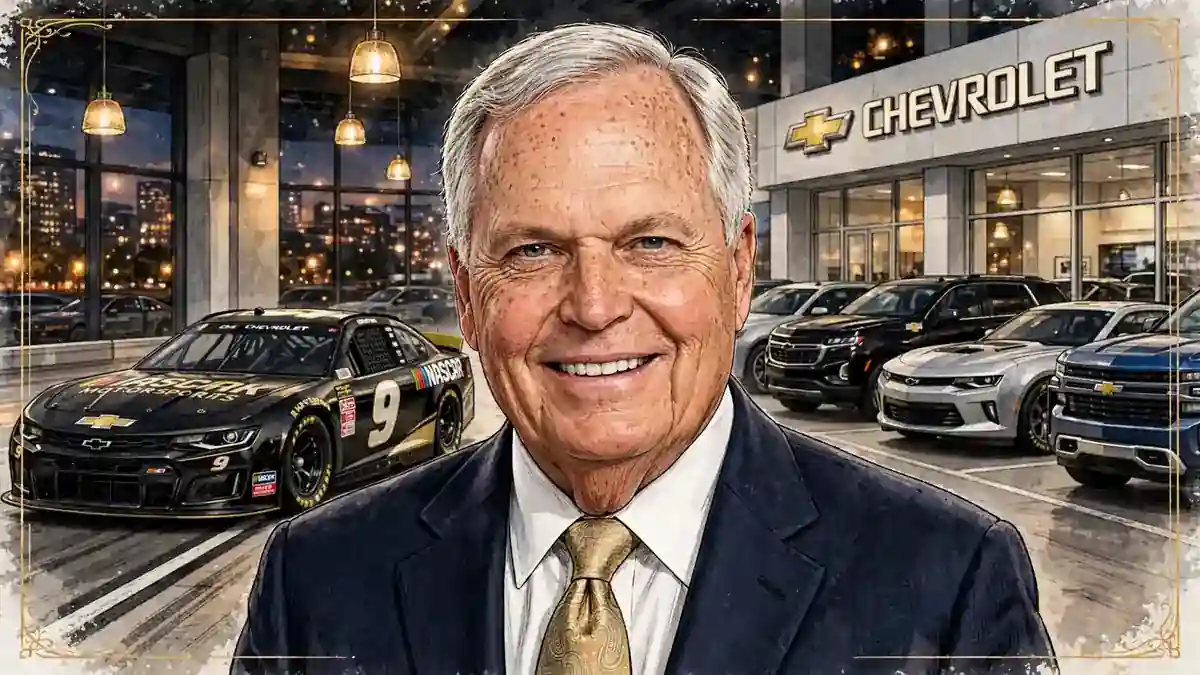
Rick Hendrick‘s net worth is estimated at $1 billion to $1.2 billion as of November 2026. The 77-year-old Charlotte businessman built that fortune from a single struggling Chevrolet dealership he bought at 26, turned it into the largest privately held dealership group in the United States with more than $14.5 billion in annual revenue, and spent four decades building Hendrick Motorsports into the most successful team in NASCAR Cup Series history — a team that won its record 16th championship on November 8, 2026.
Rick Hendrick: Quick Facts
| Estimated net worth | $1 billion to $1.2 billion (range: $1 billion to $1.2 billion) |
|---|---|
| Profession | Automotive dealer, NASCAR team owner; Chairman and CEO of Hendrick Automotive Group, founder and owner of Hendrick Motorsports |
| Nationality | American |
| Born | July 12, 1949 (age 77) |
| Height | Not publicly disclosed |
| Primary income sources | Hendrick Automotive Group (dealership profits and distributions), Hendrick Motorsports (race team, sponsorships and prize money), JR Motorsports co-ownership, car collection and private investments |
| Active years | 1976–present |
| Last reviewed | November 2026 |
- Early Life and Background
- Education
- Career Journey
- Rise to Fame
- Main Sources of Income
- Salary and Earnings
- Businesses and Investments
- Brand Deals and Sponsorships
- Houses, Cars and Other Assets
- Awards and Achievements
- Net Worth Growth Over the Years
- Social Media Presence
- Personal Life
- Sources & Reporting
- Frequently Asked Questions
- Final Thoughts
Early Life and Background
Joseph Riddick Hendrick III was born on July 12, 1949, in Warrenton, North Carolina, and grew up on his family’s tobacco farm near Palmer Springs, Virginia, in the South Hill area. His father, Joseph Hendrick, worked the farm, and the boy who would one day run a 141-franchise dealership empire learned to work with his hands early. At 14, he was already drag racing at local strips in a self-built 1931 Chevrolet — a car he rebuilt with his father and still owns today, now the oldest vehicle in a collection that numbers more than 200.
The farm years shaped the way Hendrick ran businesses for the next half century. People who worked for him in later years describe a boss who walked the shop floor, knew technicians by name, and judged a store by how its customers were treated on a Saturday morning. That hands-on habit started in Virginia, where a teenager who fixed his own race car learned that machinery rewards patience and that a reputation, once lost, costs more to rebuild than any engine.
By his early twenties Hendrick had moved from the farm into the car business proper. He opened a small used-car lot with Mike Leith, an established new-car dealer, who made the 23-year-old his general sales manager. The job taught him the two skills that later defined his career: how to sell a car to a person who had walked in planning to buy nothing, and how to read a dealership’s books well enough to know which departments were carrying the store and which were quietly losing money.
Nothing in his background pointed to inherited wealth. There was no family fortune behind the Bennettsville purchase, no trust fund, no silent partner with deep pockets. When Hendrick bought his first franchise in 1976 he sold everything he owned to do it — a fact he has repeated in interviews for decades, because it remains the cleanest explanation of how he thinks about risk: bet on yourself, and then work until the bet pays.
Education
Hendrick attended Park View High School in South Hill, Virginia. He did not follow a college-to-corporate path, and no university degree appears in his public record. His education, in the practical sense, came from the sales floor and the service bay: first as a teenage drag racer who learned engines by taking them apart, then as a general sales manager at 23, then as an owner-operator at 26 who had to learn payroll, floorplan financing, manufacturer relations and hiring all at once.
That absence of formal business schooling became part of his management style. Hendrick hired experienced operators, gave them room, and stayed close to the numbers himself. When the federal case against him in 1997 forced him out of his own companies for a year, the businesses kept running under deputies he had trained — evidence, his supporters say, that the system he built did not depend on one man’s daily presence. His critics read the same episode differently, and the full story is covered in the career section below, because no honest account of his fortune can skip it.
He has since been honored by institutions that normally celebrate degreed executives: the Automotive News lifetime achievement award in 2014, induction into the International Motorsports Hall of Fame in 2013, the NASCAR Hall of Fame in 2017 and the Motorsports Hall of Fame of America in 2020. None of those honors came from a classroom. They came from 50 years of selling cars and winning races.
Career Journey
On September 14, 1976, at 26, Hendrick took over a struggling Chevrolet dealership in Bennettsville, South Carolina, and became the youngest Chevrolet dealer in the United States at the time, according to Hendrick Automotive Group’s own history. The store was losing money. Within a few years he had turned it into the most profitable dealership in its region — the first proof that his instinct for retail operations was real and not a one-off.
Expansion followed fast. He acquired City Chevrolet in Charlotte in 1977, opened a freestanding Honda dealership in Columbia, South Carolina, in 1979, and pushed the business into California by 1983. Each new store followed the same pattern: buy a franchise with room to improve, fix the sales process and the service department, keep the staff, and let the manufacturer relationships do the rest. By 2009 the group was selling 100,000 vehicles a year, servicing 1.5 million cars and trucks, and reporting revenue above $3.5 billion. By 2016 revenue had reached $9 billion. By 2025 it had passed $14.5 billion, according to the company’s own reporting — a figure Celebrity Net Worth lists slightly lower, at $13.6 billion, a gap this article flags rather than smooths over, since the two numbers come from different reporting windows and definitions of group revenue.
Racing ran alongside the dealerships from the start. Hendrick had owned drag-racing boat teams that won three championships before he founded All-Star Racing in 1984 with five employees. The team — renamed Hendrick Motorsports — ran its first NASCAR Cup Series race at the 1984 Daytona 500, and driver Geoff Bodine won at Martinsville that same season, the team’s first victory. The early years were thin: the team nearly folded in its first season before a sponsor deal kept it alive, a story Hendrick still tells as proof that the racing business was a gamble, not a vanity project.
The gamble paid off in stages. Terry Labonte delivered the team’s first Cup Series championship in 1996. Jeff Gordon, signed as a young driver Hendrick spotted early, won four titles in 1995, 1997, 1998 and 2001 and turned the No. 24 car into a national brand. Jimmie Johnson then won five straight championships from 2006 to 2010 and seven in total, a run no other NASCAR driver has matched. Chase Elliott added a title in 2020, and Kyle Larson won in 2021, then again in 2025 and 2026. On November 8, 2026, Larson’s win at Homestead-Miami Speedway gave Hendrick Motorsports its record-extending 16th Cup Series championship — and Larson his third title and second in a row.
The hardest stretch of Hendrick’s career came in 1996 and 1997, and any account of his wealth that skips it is incomplete. In November 1996 he was diagnosed with chronic myelogenous leukemia. A month later a federal grand jury in Asheville indicted him in the American Honda bribery investigation, which alleged that dealers had given cash, cars and houses to Honda executives in exchange for favorable allocations of scarce cars and dealerships. Hendrick pleaded guilty in August 1997 to one count of federal mail fraud, involving a mailed payment to a Honda executive; the conspiracy and money-laundering counts were dropped under the plea agreement. On December 31, 1997, he was sentenced to a $250,000 fine, 12 months of home confinement and three years of probation, and barred from involvement with his companies during that year. His brother John ran Hendrick Motorsports and Jim Perkins ran the dealership group in his absence. President Bill Clinton granted him a full pardon in December 2000. Hendrick has acknowledged giving hundreds of thousands of dollars in benefits to Honda executives while maintaining he received nothing in return — his stated position, not a reversal of the plea. The episode cost him a year of control at the exact moment his health was at its worst, and it remains the sharpest test his businesses ever faced.
He came back from both crises. His leukemia went into remission in December 1999, and he was declared cancer-free in 2000. The dealership group kept growing through the 2000s, the race team kept winning, and by the time he entered the NASCAR Hall of Fame in January 2017 he was being introduced as the winningest team owner in the sport’s history — a title the numbers still support, with more than 320 Cup Series victories, 324 by one count from Wikipedia and more than 325 by Celebrity Net Worth’s newer tally.
The 50-year mark arrived on September 14, 2026, when Hendrick Automotive Group celebrated half a century since the Bennettsville store opened under his leadership. Two months earlier, in July 2026, the group announced it had acquired Foreign Cars Italia, adding Ferrari, Aston Martin, Bentley, Alfa Romeo and Maserati franchises plus another Porsche store — proof that at 77 Hendrick was still buying dealerships rather than winding the business down.
Rise to Fame
Hendrick became famous in two different worlds at once, and the two fed each other. In the car business he was the dealer who turned a failing store into the biggest private retail group in the country. In NASCAR he was the owner whose cars won so often that his name became shorthand for the sport’s establishment. Jeff Gordon’s rainbow-colored No. 24 car in the 1990s put Hendrick Motorsports on television every Sunday; Jimmie Johnson’s five straight titles in the late 2000s made dominance feel routine; Kyle Larson’s 2026 championship, the team’s 16th, made the record book read like a Hendrick family history.
The fame carried a price. The Honda case made him a national news story in 1997 for reasons no businessman wants. The 2004 plane crash that killed his son made him a figure of public sympathy. The leukemia diagnosis made his charity work — the Hendrick Marrow Program, founded in 1997 — personal in a way no press release could fake. Through all of it, Hendrick stayed visible at the track, in the garage, and at his dealerships, and that visibility became part of the brand: customers and fans could see the owner, not just the logo.
His standing among NASCAR owners is best measured against his peers. Roger Penske, owner of Team Penske, is worth about $8 billion according to Forbes-linked reporting, and Michael Jordan’s net worth — Jordan co-owns 23XI Racing, a rival NASCAR team — sits near $3.2 billion to $3.8 billion. Hendrick, at about $1 billion, ranks third among NASCAR owners by wealth, ahead of Gene Haas at roughly $1.1 billion by some lists and behind the two giants. The ranking matters less than what it shows: in a sport where team ownership usually burns money, Hendrick is one of the few owners whose racing operation sits beside a business that prints it.
Main Sources of Income
Hendrick’s money comes from two engines, and the dealership group is by far the larger one. Hendrick Automotive Group sells new and used vehicles, runs service and parts departments, operates 22 collision centers and four accessories distribution operations, and earns finance and insurance income on the cars it sells. With more than 210,000 vehicles sold and nearly 2.7 million cars and trucks serviced in 2025, the group’s profit comes from volume across 141 franchises rather than from any single store. Dealership groups of this size typically earn low-single-digit margins on new-car sales and far healthier margins on used cars, service and parts — and Hendrick’s scale, with 31 manufacturer nameplates across 13 states, lets the group absorb a bad year for one brand with a good year for another.
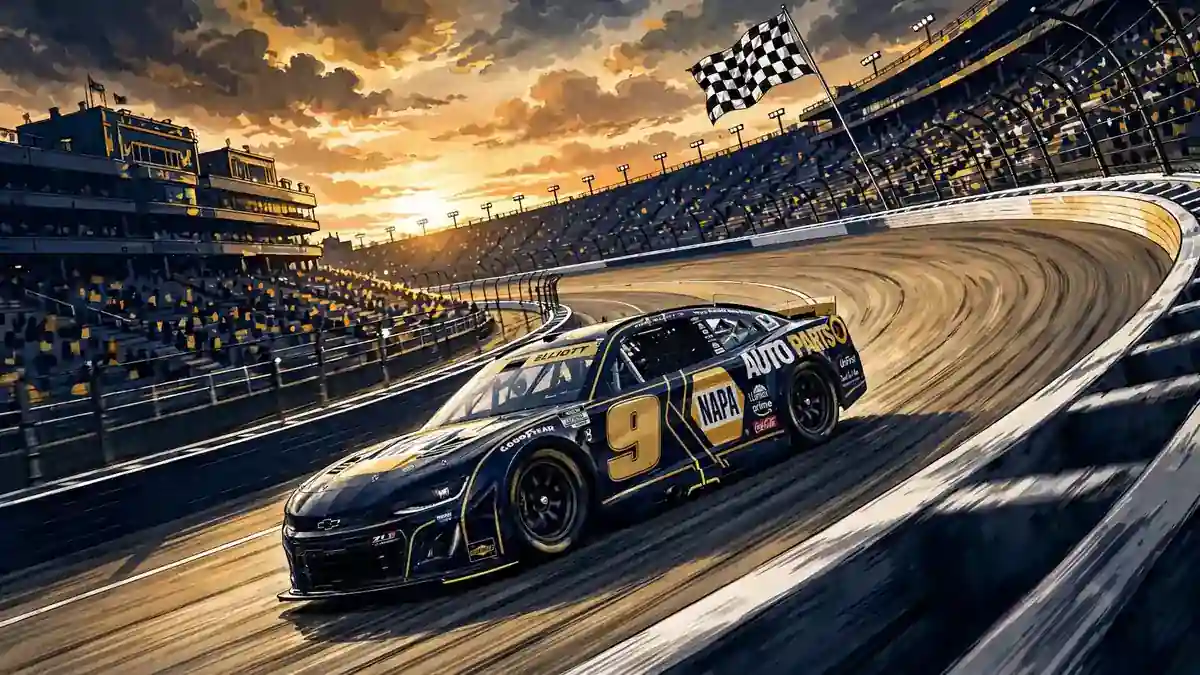
Hendrick Motorsports is the second engine and the more visible one. A top NASCAR Cup Series team earns from sponsorship deals on its four cars, from NASCAR’s charter and prize-money system, from manufacturer support from Chevrolet, and from merchandising and licensing. The team fields four full-time Cup cars — the Nos. 5, 9, 24 and 48 — for Kyle Larson, Chase Elliott, William Byron and Alex Bowman. Sponsorship on a leading Cup car runs into eight figures a year per car, and a team that wins 16 championships can charge for that record. One weak source claims the team generates $300 million to $400 million a year; that figure is not supported by any filing or named outlet, so this article does not repeat it as fact. What the record does support is that the team is the winningest in Cup history, and winning teams command the best sponsors.
The third income stream is JR Motorsports, the NASCAR Xfinity Series team Hendrick co-owns with Dale Earnhardt Jr. and Kelley Earnhardt Miller. It is smaller than the Cup operation but consistently competitive, and it gives Hendrick a stake in the sport’s development ladder — the place where future Cup drivers are found before rival teams sign them.
Private investments and the car collection round out the picture. Hendrick’s collection of more than 200 vehicles, including 120-plus rare Corvettes, has appreciated sharply: he paid $1.05 million for the first production 2014 Corvette Stingray, $1.1 million for the first production 2024 Corvette E-Ray at a charity auction, and $3.7 million for the first 2025 Corvette ZR1, VIN 001, at Barrett-Jackson Scottsdale in January 2025. Those are purchases, not sales, so they tie up cash rather than produce income — but first-production Corvettes have historically held or gained value, and the collection is a real asset on any honest accounting of his wealth.
What Hendrick does not have is a public salary. He owns his companies outright rather than drawing a disclosed executive paycheck, so there is no salary figure to report. His income arrives as ownership distributions and the rising value of the businesses themselves — the reason his net worth is an estimate built from the size of those businesses, not a number from a pay stub.
Salary and Earnings
There is no public salary for Rick Hendrick, and any site that prints one is guessing. Hendrick Automotive Group and Hendrick Motorsports are privately held, so neither files the executive-pay disclosures that public companies must publish. As founder, chairman and CEO of the dealership group and majority owner of the race team, Hendrick takes his return as an owner: distributions from dealership profits, the value of a race team whose charters and sponsorship book have grown with its win record, and the appreciation of the assets he holds personally.
The scale of the dealership business gives the best sense of the cash involved. Group revenue passed $14.5 billion in 2025 on more than 210,000 vehicles sold. Even at the thin margins typical of new-car retail, a group of that size generates tens of millions a year in operating profit before the higher-margin service, parts, used-car and finance departments are counted. Hendrick owns the group outright, so that profit accrues to him and his family rather than to outside shareholders — the structural fact that explains how a car dealer becomes a billionaire while a salaried dealership executive does not.
Race-team economics work differently. A Cup Series team spends most of what it takes in: four cars, hundreds of employees, wind tunnels, simulators and engine programs cost roughly what sponsorship and prize money bring in. The profit in racing is lumpy — a championship season pays better than a winless one — and the real return is the value of the team itself. Hendrick Motorsports, with 16 championships and more than 320 wins, would be worth far more today than the five-employee operation Hendrick started in 1984, and that appreciation is part of his wealth even though it only turns into cash if he ever sells.
Two numbers from his history show the other side of the ledger. The 1997 sentence cost him a $250,000 fine, a year of home confinement and a year away from his companies. The 2004 crash cost him his son and his brother and, for a time, the senior management of his race team. Neither loss shows up in a net worth table, but both shaped how the money was made afterward: the companies were rebuilt around deputies and systems rather than around one man, and that is why they survived the worst year of his life intact.
Businesses and Investments
Hendrick Automotive Group is the business that made the fortune. It began with one Chevrolet store in Bennettsville in 1976 and now operates 141 franchises representing 31 manufacturers across 13 states, with 103 dealership locations, 22 collision centers and four accessories operations, headquartered in Charlotte, North Carolina, at 6000 Monroe Road, and employing more than 11,000 people. The group celebrated its 50th anniversary in September 2026, and its July 2026 acquisition of Foreign Cars Italia — Ferrari, Aston Martin, Bentley, Alfa Romeo, Maserati and another Porsche franchise — shows it is still expanding into luxury marques where margins are fattest.
The group’s growth tells the story in numbers. Revenue was above $3.5 billion in 2009, when it sold 100,000 vehicles and serviced 1.5 million. It reached $9 billion in 2016. Recent reporting puts it above $12 billion, and the 2025 figure is reported as more than $14.5 billion by the company and by SuperYachtFan, and $13.6 billion by Celebrity Net Worth. The honest reading is that revenue sits in the $13.6 billion to $14.5 billion range depending on the reporting window — either way, roughly four times the 2009 figure, built without taking the company public.
Hendrick Motorsports is the second business: founded in 1984 as All-Star Racing, based in Concord, North Carolina, on a campus at 4400 Papa Joe Hendrick Boulevard, employing more than 500 people, and fielding four full-time Cup Series Chevrolets. Its record — more than 320 Cup wins and 16 championships — makes it the winningest team in the sport’s history, and that record is itself an asset: sponsors pay to be on winning cars, Chevrolet invests in a winning partner, and the team’s charters have value in NASCAR’s franchise system.
JR Motorsports, co-owned with Dale Earnhardt Jr. and Kelley Earnhardt Miller, competes in the Xfinity Series and has won multiple championships of its own. It is the smallest of the three businesses but the most personal: Earnhardt’s father raced against Hendrick’s drivers for years, and the partnership ties the two most famous families in modern NASCAR together.
Outside the operating companies, Hendrick’s investments are concentrated in things he understands: cars, property and aviation. The Hendrick Heritage Center, a 58,000-square-foot private facility near Charlotte, houses more than 200 collector vehicles, including 122 rare Corvettes according to a 2023 Detroit Free Press report — among them the 1931 Chevrolet he rebuilt as a teenager, a 1967 Corvette once owned by Roy Orbison, and the first-production examples of the 2014 Stingray, the 2020 C8, the 2023 Z06 and the 2024 E-Ray. He also owns the 163-foot Trinity yacht WHEELS, valued at about $35 million, and a 2021 Gulfstream G650ER registered to HMS Holdings LLC at the Hendrick Motorsports address.
The charity side of the business is the Hendrick Marrow Program, founded in 1997 after his leukemia diagnosis, which has raised more than $15 million for Be The Match and the national marrow donor program. In 2015 he and his wife Linda formally established the Hendrick Family Foundation to bring the family’s giving — marrow donation, children’s hospitals, food drives and education — under one banner. In January 2006 the couple gave $3 million to Levine Children’s Hospital in Charlotte, which named its pediatric intensive-care facilities the Ricky Hendrick Centers for Intensive Care in memory of their son.
Brand Deals and Sponsorships
Hendrick does not do celebrity endorsements — he is the one other brands pay to be near. The sponsorship story of his career is the sponsor book of Hendrick Motorsports, and it reads like a list of American corporate heavyweights: the team’s four Cup cars have carried backing from companies across automotive, food, finance, retail and technology, with primary sponsors paying eight-figure annual sums for the hood of a car that wins races on national television most weeks of the year.
The structure is what matters for his net worth. A Cup Series team does not sell one sponsorship; it sells inventory across four cars, dozens of races, and a season that runs from February to November. Championship-winning teams can charge more per race and sign longer deals, and Hendrick’s 16 titles give his sales team the strongest pitch in the garage. Manufacturer support from Chevrolet adds engineering help, wind-tunnel time and marketing money that a smaller team cannot buy at any price.
On the dealership side, the “sponsorship” runs the other way: Hendrick Automotive Group is itself a sponsor and advertiser across the Southeast, and its stores carry the Hendrick name in 13 states. The group’s 50th anniversary in 2026 was marketed across its dealerships, tying the retail brand to the racing brand in a way few competitors can copy — a customer who watches Kyle Larson win on Sunday can buy a Chevrolet from a Hendrick store on Monday, and the company owns both ends of that transaction.
His own collecting habit has also turned into a public brand exercise. His purchases of first-production Corvettes at Barrett-Jackson auctions — the 2014 Stingray for $1.05 million, the 2024 E-Ray for $1.1 million at a charity auction, the 2025 ZR1 VIN 001 for $3.7 million — are covered as news, and the money from the charity lots goes to good causes. The collection is genuine, not a marketing prop, but it has made “Rick Hendrick” a name Corvette buyers know worldwide, which is worth more to a Chevrolet dealer than any advertisement.
Houses, Cars and Other Assets
Hendrick and his wife Linda live in Charlotte, North Carolina, in a gated community near a golf course. In August 2000 he paid $3.65 million for a 12,803-square-foot residence on more than 1.6 acres, with six bedrooms and eight bathrooms. He has also owned property in the Florida Keys, including a residence on Sunset Key near Key West — the area where he and Linda survived the 2011 plane crash. This article does not publish a private home address, and no reliable public record puts a current market value on the Charlotte house; any site that prints one is estimating from county records, not from a sale.
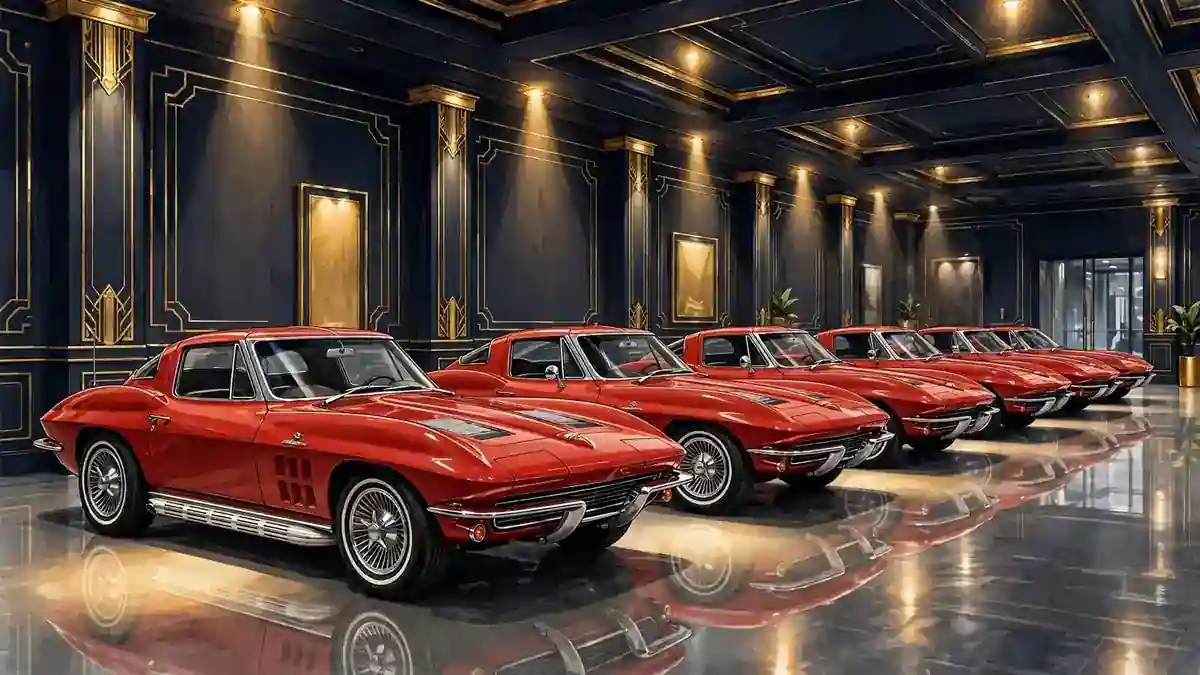
The car collection is the asset everyone asks about, and it is the one Hendrick talks about most freely. The Hendrick Heritage Center, a 58,000-square-foot private facility near Charlotte, holds more than 200 vehicles, including 122 rare Corvettes by the Detroit Free Press’s 2023 count. The collection includes his first car — the 1931 Chevrolet he rebuilt with his father as a teenager — a 1967 Corvette once owned by singer Roy Orbison, a 1969 Dodge Charger Daytona, a 1970 Plymouth Superbird, and the first-production Corvettes listed above. It also holds championship-winning NASCAR cars and family memorabilia, including tributes to his son Ricky and his father, known in the family as Papa Joe. The center is not normally open to the public, though car clubs and private groups occasionally receive guided tours.
On the water, Hendrick owns WHEELS, a 49.7-meter (163-foot) yacht built by Trinity Yachts and delivered in 2009. SuperYachtFan values it at about $35 million, with annual running costs of $2 million to $3 million, six guest cabins for 12 guests and room for a crew of eight. In the air, a 2021 Gulfstream G650ER is registered to HMS Holdings LLC at the Hendrick Motorsports campus address in Charlotte. Between the yacht, the jet, the collection and the Charlotte house, the visible personal assets alone run well past $100 million before the businesses are counted — which is why the $1 billion net worth estimate, large as it sounds, still leaves room for argument in either direction.
One honest caveat belongs here. The $1 billion figure is a third-party estimate, and the real number could be higher: the dealership group alone, at $14.5 billion in annual revenue, would be worth several billion dollars if it were sold at the multiples public dealership groups command, and Hendrick owns it outright. Against that, the businesses carry debt, the race team is expensive to run, and the collection and the yacht cost money to keep. The range we publish — $1 billion to $1.2 billion — reflects the consensus of the outlets that track him, not a valuation of the group, and readers should treat it as an informed estimate rather than a bank balance.
Awards and Achievements
Hendrick’s trophy case has two shelves: the racing one and the business one. On the racing side, the headline is the record itself — 16 NASCAR Cup Series championships as an owner, more than 320 Cup Series victories, and the status of winningest team owner in the sport’s history. The championships break down as Terry Labonte in 1996, Jeff Gordon in 1995, 1997, 1998 and 2001, Jimmie Johnson in 2006, 2007, 2008, 2009, 2010, 2013 and 2016, Chase Elliott in 2020, and Kyle Larson in 2021, 2025 and 2026. No other owner has 16. The team has also won championships in the Xfinity Series through JR Motorsports and counts multiple Daytona 500 victories among its 320-plus wins.
The individual honors followed. Hendrick was inducted into the International Motorsports Hall of Fame in 2013, received the Automotive News lifetime achievement award in 2014, entered the NASCAR Hall of Fame in January 2017 as part of a class that also included Richard Childress, Raymond Parks, Mark Martin and Benny Parsons, and joined the Motorsports Hall of Fame of America in 2020. He was still an active owner when he entered the NASCAR Hall of Fame — one of the first active individuals to be honored that way — and he has said he has no plans to slow down.
On the business side, the achievement is the group itself: from one store in 1976 to 141 franchises in 2025, from $3.5 billion in revenue in 2009 to more than $14.5 billion in 2025, and a 50th anniversary in 2026 that few private dealership groups ever reach. The charity record belongs here too: the Hendrick Marrow Program has raised more than $15 million for Be The Match since 1997, and the Hendrick Family Foundation, established with Linda in 2015, now carries the family’s giving across children’s hospitals, food drives and education. He and Linda received the Be The Match Foundation’s Leadership for Life Award in 1999.
Net Worth Growth Over the Years
Hendrick’s wealth grew slowly for two decades and then compounded with the dealership group’s scale. The table below uses published estimates and company-reported revenue — two different things, and the table keeps them separate so the growth is visible without pretending the revenue was his personal income.
| Year | Milestone | Published estimate / company figure |
|---|---|---|
| 1976 | Buys Bennettsville Chevrolet at 26 | One struggling franchise; personal assets sold to fund the purchase |
| 1984 | Founds All-Star Racing (later Hendrick Motorsports) | Five employees; first Cup win at Martinsville the same year |
| 1996 | First Cup championship (Terry Labonte) | Team value rising; leukemia diagnosis the same year |
| 2009 | Dealership group passes 100,000 vehicles sold a year | Group revenue above $3.5 billion |
| 2016 | Group revenue reaches $9 billion; Jimmie Johnson wins seventh title | Published net worth estimates around $1 billion |
| 2020 | Chase Elliott wins Cup title; Hendrick enters Motorsports Hall of Fame of America | Net worth estimated at $1 billion |
| 2023 | Heritage Center reported at 220 collector cars, 122 Corvettes | Net worth estimated at $1 billion |
| 2025 | Kyle Larson wins second title; group revenue passes $14.5 billion | Net worth estimated at $1 billion to $1.2 billion |
| 2026 | Group’s 50th anniversary; Larson wins third title, team’s 16th championship | Net worth estimated at $1 billion to $1.2 billion |
The pattern is worth stating plainly: the net worth estimate has sat near $1 billion for a decade while the revenue of the business behind it quadrupled. That gap is the strongest sign that the public estimate is conservative. A private dealership group doing $14.5 billion a year does not stay a $1 billion personal fortune forever unless debt, taxes and the cost of the race team eat the difference — or unless the estimators simply have not updated their math. We report the consensus, and we show the revenue, so readers can judge the gap for themselves.
For comparison, the richest NASCAR owners list puts Roger Penske at about $8 billion and Michael Jordan’s net worth near $3.2 billion to $3.8 billion, with Hendrick third at about $1 billion. Among racing drivers, Lewis Hamilton’s net worth is the usual yardstick for a driver’s fortune, built from salary and endorsements rather than team ownership — a different kind of money from Hendrick’s, and a useful reminder that owning the team has historically been worth more than driving for one.
Social Media Presence
Rick Hendrick does not run a public personal social media account, and this article does not link to any profile claiming to be his. At 77, he is of a generation of owners who communicate through their companies, and his public presence runs through Hendrick Motorsports and Hendrick Automotive Group, which both maintain official accounts covering race weekends, driver announcements and dealership news. Fans looking for him will find him in the garage on race day and in victory lane photographs, not in a personal feed.
That absence is itself a data point. Unlike drivers and younger team owners who build personal brands online, Hendrick’s reputation was built before social media existed, in showrooms and at racetracks, and it travels by word of mouth among customers and fans. The companies’ accounts do the talking now, and they have millions of followers between them — an audience Hendrick owns without ever posting himself.
Personal Life
Hendrick is married to Linda Hendrick, whom he reportedly met at an ice cream parlor, and the couple have been together for decades. They have two children: a daughter, Lynn Carlson, and a son, Joseph Riddick “Ricky” Hendrick IV, who died in 2004. Lynn’s work with hungry and homeless children in Charlotte, which Hendrick has credited with opening his eyes to the problem, helped shape the family’s charitable focus.
The family’s hardest day came on October 24, 2004, when a Hendrick Motorsports Beechcraft Super King Air 200 flying to the race at Martinsville Speedway in Virginia crashed in fog, killing all ten people aboard. Among them were Ricky Hendrick, 24, who had driven in NASCAR’s Truck and Busch series before retiring from driving to learn to run the Motorsports company; his brother John Hendrick, 53, the team’s president; his nieces Kimberly and Jennifer Hendrick; Randy Dorton, the head of engine operations; and Jeff Turner, along with other team members and crew. Hendrick was driving home from lunch when an employee called and asked him to pull over. He drove home, told Linda, and waited for confirmation that there were no survivors. Harvard Business Review later wrote about how he rebuilt the company after losing its senior management in a single afternoon — the piece is one of the frankest accounts of his leadership, and it is cited in the sources below.
Seven years later, on October 31, 2011, Hendrick and Linda survived a second plane crash when their aircraft landed long at Key West International Airport in Florida. Linda suffered minor injuries; Rick suffered three broken ribs and a fractured clavicle. The couple’s survival, after the loss of their son in the earlier crash, is part of why their story is told in NASCAR circles with a respect that goes beyond wins and losses.
His own health battle came earlier. Diagnosed with chronic myelogenous leukemia in November 1996, he was treated while the federal case against him was unfolding, went into remission in December 1999 and was declared cancer-free in 2000. The experience led directly to the Hendrick Marrow Program, founded in 1997, and to two decades of fundraising for transplant patients — work he has described in interviews as a debt he owes, not a hobby. In a 2016 interview with Inc. magazine he put it plainly: he had leukemia 20 years earlier and recovered, and he had spent the 20 years since raising money for people who need transplants.
He lives in Charlotte, North Carolina, near the businesses he still runs, and at 77 he remains chairman and CEO of the dealership group and the owner in the garage on race weekends. The Foreign Cars Italia acquisition in July 2026 and the 16th championship in November 2026 suggest he is not planning a farewell tour.
Sources & Reporting
Celebrity Net Worth — the $1 billion net worth estimate, the 141-franchise and $13.6 billion revenue figures, the 325-plus Cup wins, the Charlotte house purchase price of $3.65 million, and the yacht and jet details. Reporting window: updated November 2026.
Forbes — peer wealth context, including the Roger Penske and Michael Jordan figures used in the owner ranking. Reporting window: 2025–2026 rich lists.
NASCAR — the 2017 Hall of Fame class announcement, the team’s championship history, and the November 8, 2026, 16th championship. Reporting window: 2016–2026.
Hendrick Motorsports — team history, the 1984 founding as All-Star Racing, driver lineup and championship record. Reporting window: company history pages, accessed November 2026.
Harvard Business Review — “Crucible: A New Will to Win” (September 2010), the account of the 2004 plane crash, the leukemia diagnosis, the Honda case and the rebuilding of the company. Reporting window: 2010.
Detroit Free Press — the 2023 report on the Hendrick Heritage Center: 58,000 square feet, 220 collector cars, 122 rare Corvettes. Reporting window: 2023.
SuperYachtFan — the WHEELS yacht details ($35 million value, $2–3 million annual running costs), the $14.5 billion 2025 group revenue figure, and the 200-plus vehicle collection. Reporting window: updated October 2026.
Wikipedia — biographical spine: birth date and place, the 1997 guilty plea and sentence, the 2000 presidential pardon, the 324 Cup wins, and the Hall of Fame inductions. Cross-checked against the named outlets above; reporting window: updated November 2026.
Where sources disagree — the 2025 revenue figure ($13.6 billion versus $14.5 billion) and the net worth estimate ($1 billion versus $1.2 billion) — this article publishes the range and names who says what, rather than picking the larger number. Figures for the race team’s annual revenue that appear on low-authority net worth sites without a named source were not used.
Frequently Asked Questions
What is Rick Hendrick’s net worth in 2026?
Rick Hendrick’s net worth is estimated at $1 billion to $1.2 billion as of November 2026. Celebrity Net Worth lists $1 billion, the figure most outlets repeat, while PlayersBio lists $1.2 billion. His companies are privately held, so the figure is a third-party estimate, not a disclosed balance sheet.
How did Rick Hendrick make his money?
He made it in car dealerships first and racing second. In 1976, at 26, he bought a struggling Chevrolet dealership in Bennettsville, South Carolina, and built it into Hendrick Automotive Group — 141 franchises across 13 states with more than $14.5 billion in annual revenue in 2025. He founded Hendrick Motorsports in 1984, and the team has won a record 16 NASCAR Cup Series championships.
How old is Rick Hendrick?
Rick Hendrick was born on July 12, 1949, in Warrenton, North Carolina, which makes him 77 years old as of November 2026. He celebrated the 50th anniversary of his automotive business in September 2026.
Who is Rick Hendrick’s wife?
His wife is Linda Hendrick, whom he reportedly met at an ice cream parlor. They have been married for decades and have two children: daughter Lynn Carlson and son Ricky Hendrick, who died in a 2004 plane crash. Together they founded the Hendrick Family Foundation in 2015.
What happened to Rick Hendrick’s son Ricky?
Ricky Hendrick, 24, was killed on October 24, 2004, when a Hendrick Motorsports plane crashed in fog on its way to a race at Martinsville Speedway in Virginia. All ten people aboard died, including Rick’s brother John, his nieces Kimberly and Jennifer, and senior team members. Ricky had raced in NASCAR’s Truck and Busch series and was learning to run the family race team.
How many championships has Hendrick Motorsports won?
Hendrick Motorsports has won a record 16 NASCAR Cup Series championships as of November 8, 2026, when Kyle Larson won his third title at Homestead-Miami Speedway. The titles belong to Terry Labonte (1996), Jeff Gordon (four), Jimmie Johnson (seven), Chase Elliott (2020) and Kyle Larson (2021, 2025, 2026). The team has also won more than 320 Cup Series races.
How many dealerships does Rick Hendrick own?
Hendrick Automotive Group operates 141 franchises representing 31 manufacturers across 13 states, with 103 dealership locations, 22 collision centers and four accessories operations, and more than 11,000 employees. It is the largest privately held automotive retail organization in the United States, and it generated more than $14.5 billion in revenue in 2025.
What is Rick Hendrick’s car collection and yacht worth?
His private Hendrick Heritage Center holds more than 200 vehicles, including 122 rare Corvettes, in a 58,000-square-foot facility near Charlotte. He has paid $1.05 million for the first 2014 Corvette Stingray, $1.1 million for the first 2024 Corvette E-Ray and $3.7 million for the first 2025 Corvette ZR1. His yacht WHEELS, a 163-foot Trinity built in 2009, is valued at about $35 million.
Final Thoughts
Rick Hendrick’s fortune is the least mysterious billion dollars in American business: one dealership bought at 26, run well for 50 years, grown into a 141-franchise group doing more than $14.5 billion a year, with a race team beside it that wins more than any other in NASCAR history. The $1 billion to $1.2 billion estimate looks conservative next to the revenue behind it, and the gap is the honest story — private companies do not publish balance sheets, so the public number lags the business.
The record that will outlast the money is the one on the track: 16 championships, more than 320 wins, and a team that was still winning its 16th title in November 2026, 42 years after it started with five employees. The charity record runs beside it — more than $15 million raised for marrow transplants, a children’s hospital wing named for his son, and a family foundation that carries the work forward. Hendrick built all of it after a leukemia diagnosis, a federal conviction and pardon, and the loss of his son and brother in a single afternoon. That is the part of the story no estimate can price.
Published on November 13, 2026. Last reviewed November 2026. Found an error? See our corrections policy.