
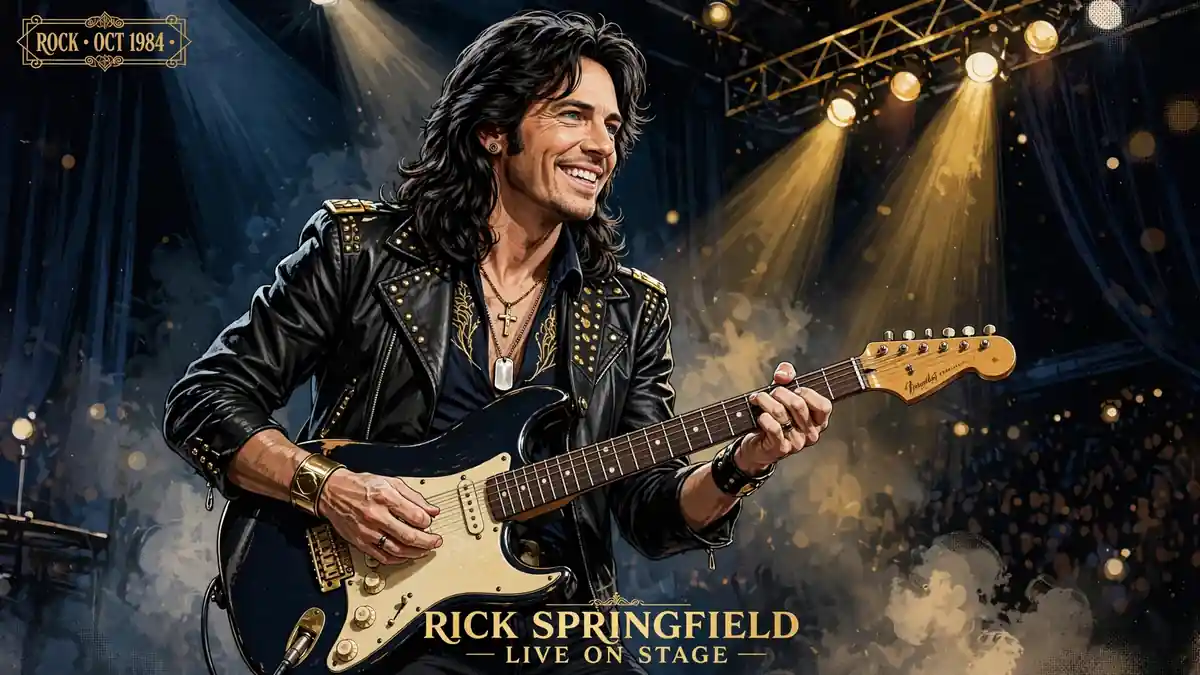
Rick Springfield‘s net worth is estimated at $10 million–$20 million as of November 2026. The Australian-American singer, actor and author built that fortune on a 1981 No. 1 single that never stopped paying, a long run as Dr. Noah Drake on General Hospital, five decades of touring, bestselling books, Malibu property — and, in 2025, a rare gold-coin collection that went under the hammer at Stack’s Bowers.
Rick Springfield: Quick Facts
| Estimated net worth | $10 million–$12 million (most-cited) (range: $10 million–$20 million) |
|---|---|
| Profession | Singer-songwriter, actor, author |
| Nationality | Australian-American |
| Born | August 23, 1949, Guildford, New South Wales, Australia (age 77) |
| Height | 6 ft 1 in (185 cm) |
| Primary income sources | Music royalties and publishing, touring, acting residuals, book royalties, collectibles |
| Active years | 1969–present |
| Last reviewed | November 2026 |
- Early Life and Background
- Education
- Career Journey
- Rise to Fame
- Main Sources of Income
- Salary and Earnings
- Businesses and Investments
- Brand Deals and Sponsorships
- Houses, Cars and Other Assets
- Awards and Achievements
- Net Worth Growth Over the Years
- Social Media Presence
- Personal Life
- Sources & Reporting
- Frequently Asked Questions
- Final Thoughts
Early Life and Background
Rick Springfield was born Richard Lewis Springthorpe on August 23, 1949, in Guildford, New South Wales, Australia. His father, an Australian Army officer of Scottish heritage, and his English-born mother moved the family between military bases in Australia and the United Kingdom, so Springfield spent his childhood packing, unpacking and starting over in new towns. The constant moves left a mark: he learned to make friends fast, and he learned to lean on music as the one thing that travelled with him.
He picked up the guitar at 13 and started playing in teenage bands on both sides of the world. By the end of the 1960s he was a working musician in the Australian rock scene, and in 1969 he joined Zoot, the band that gave him his first taste of national fame. Zoot’s management cooked up a publicity stunt called “Think Pink — Think Zoot,” dressing the band in bright pink satin to chase a teenage audience. It worked too well: the group got boxed in as a teenybopper act, and the members staged a public burning of their pink outfits to try to win back a harder rock image. The damage was done, though, and Springfield left Zoot in 1971 to go solo.
His first solo single, “Speak to the Sky,” became a hit in Australia in 1971 and crossed over to the United States, where it reached the Top 20. It was the first proof that the kid from the army bases could write a song that travelled further than he had. He released his debut album, Beginnings, in 1972 and moved to the United States to chase a bigger stage.
Education
Springfield has no university degree on record, and his schooling was shaped by the same army-base moves that shaped his childhood. He has described his real education as the bands he played in: learning songs by ear, writing his own material, and figuring out how a stage worked by standing on one night after night. The guitar lessons he took as a teenager and the harmonies he worked out in rehearsal rooms were his classroom.
When his recording career stalled in the mid-1970s, he invested in a different kind of training. He took acting lessons and worked deliberately on an American accent, treating performance as a second trade he could fall back on. That decision, made when his albums were not selling, turned out to be the one that paid for his house, his family and the second half of his career: the acting work kept him visible and solvent while he kept writing songs, and it put him in the room when General Hospital came calling in 1981.
Career Journey
Springfield’s American career began with a false start. After Beginnings, he signed with Columbia Records and released Comic Book Heroes in 1973. The record failed to break him in the United States, and another album recorded in the same period was shelved by the label. He filled the gap with television and voice work, including the 1970s children’s animated series Mission: Magic!, where he voiced a principal character, wrote songs, and saw the show run for 16 episodes.
He signed a contract with Universal Studios and started booking television appearances through the late 1970s — a recurring role on The Young and the Restless, spots on The Rockford Files and The Six Million Dollar Man. The work was steady, but the music career that had brought him to America was stalled, and he was, by his own later account, close to giving up on it.
Everything changed in 1981. RCA released Working Class Dog in February of that year, and in the same weeks Springfield joined General Hospital as Dr. Noah Drake. He was on daytime television five days a week just as his single “Jessie’s Girl” started climbing the charts, and the two audiences fed each other: soap viewers bought the record, and record buyers tuned in to the soap. Within months he was a rock star and a television heartthrob at the same time, a combination almost nobody else in pop history has pulled off.
The run that followed was dense. Success Hasn’t Spoiled Me Yet arrived in 1982 with the No. 2 hit “Don’t Talk to Strangers.” Living in Oz followed in 1983 with “Affair of the Heart” and “Human Touch.” In 1984 he starred in the film Hard to Hold, playing rock musician Jamie Roberts and recording the soundtrack, which produced another Top 10 single in “Love Somebody.” Tao, released in 1985, was certified gold. He stayed on General Hospital until 1983, then returned to the role repeatedly — 2005 to 2008, again in 2012, and for the show’s 50th anniversary in 2013, appearing alongside his son Liam.
Through the 1990s he kept both careers going. He starred in the detective series High Tide from 1994 to 1997, appeared in the Broadway musical Smokey Joe’s Café in 1995, and held an extended Las Vegas engagement at the MGM Grand from 2000 to 2002. Recording slowed, then resumed: Rocket Science, his most recent album of new material, arrived in February 2016, and Orchestrating My Life, a set of orchestral re-recordings of his catalog, followed in 2019.
The 2010s brought a second wave of prestige acting work. He appeared in the second season of HBO’s True Detective in 2015, played Greg — the guitarist boyfriend of Meryl Streep’s character — in the film Ricki and the Flash the same year, turned up in the twelfth season of Supernatural, and played Pastor Charles on FX’s American Horror Story: Cult in 2017. In August 2025 he was confirmed in the cast of Ryan Murphy’s Hulu legal drama All’s Fair, alongside Naomi Watts, Kim Kardashian, Glenn Close and Sarah Paulson.
He has never stopped touring. His “Stripped Down” solo show — Springfield alone on stage with a guitar and stories — runs alongside full-band dates, and in late 2025 he announced a fresh run of 2026 dates. He closed 2025 as a featured performer on Dick Clark’s New Year’s Rockin’ Eve with Ryan Seacrest on December 31, then opened the 2026 leg in March with dates in Dallas, Lake Charles, Charleston and Napa. Ticketmaster listings show the current run continuing through March 6, 2027, with a final date at the Ameristar Casino in Kansas City. At 77, he is still jumping off stages and working rooms that hold thousands.
Rise to Fame
The rise was not instant. “Jessie’s Girl” climbed the Billboard Hot 100 slowly through the spring and summer of 1981 before reaching No. 1, and it finished the year at No. 5 on Billboard’s year-end singles chart. In 1982 the song won Springfield the Grammy Award for Best Male Rock Vocal Performance — the only Grammy win of his career. Working Class Dog reached No. 7 on the Billboard 200, and “I’ve Done Everything for You,” written by Sammy Hagar, became another major hit from the same record.
What made the breakthrough unusual was the double exposure. Most rock stars get one launch; Springfield got two at once. General Hospital was at its ratings peak in 1981 — the Luke and Laura wedding that November drew one of the largest daytime audiences in television history — and Springfield was on screen in the middle of it, five days a week, while his record was on the radio. Celebrity Net Worth puts it plainly: the simultaneous success on radio and daytime television gave him an unusually broad audience and turned him into one of the defining pop-culture figures of the early 1980s.
The song refused to fade. VH1 ranked “Jessie’s Girl” No. 20 on its list of the 100 Greatest Songs of the ’80s. Glee covered it in 2010 and introduced it to a new generation. It turns up in films, commercials, television shows and classic-rock radio rotations, and every one of those placements pays the songwriter. That durability is the financial core of this article: a single three-minute song, written about a friend’s girlfriend and a stained-glass classmate named Jessie, has paid Springfield for 45 years.
He followed the peak with discipline rather than excess. “Don’t Talk to Strangers” reached No. 2 in 1982. “Affair of the Heart” and “Love Somebody” kept him in the Top 10 into 1984. By the time the chart hits slowed, he had a catalog, a television career, a touring base and a name that still sold tickets — the four legs that have carried his income ever since.
Main Sources of Income
Springfield’s money comes from five streams, and the balance between them has shifted with age. In the 1980s, record sales and television paid the bills. In 2026, the catalog and the road do.
Music royalties and publishing sit at the center. Springfield wrote or co-wrote his hits, and PowerNetWorth reports that he owns the rights to most of his solo work, including “Jessie’s Girl” and “Love Somebody.” That ownership matters more than the size of any single royalty check: every radio spin, stream, sync placement and cover version pays the writer and the publisher, and Springfield is both. “Jessie’s Girl” alone has sold millions of copies, streams in the millions every year — reports put his Spotify audience at more than 3 million monthly listeners — and has been licensed to films, television shows and commercials for four decades. A catalog like that behaves like an annuity: it pays every month, it needs no new work to keep paying, and it grows more valuable as the song’s cultural footprint grows.
Touring is his most visible and probably his most lucrative current income source. Springfield plays mid-size theatres and casino venues across the United States, and the economics of that circuit are strong for a legacy act with a loyal audience. Ticket prices on the current run typically fall between about $69 and $234 depending on the seat, and his shows add merchandise and VIP meet-and-greet packages on top of the ticket price. PowerNetWorth estimates his touring income at $500,000 to $800,000 a year, with total yearly earnings between $1.5 million and $2 million in 2026 — a figure we treat as that outlet’s estimate, since Springfield discloses no financial statements. The 2026 schedule lists around 10 dates on Ticketmaster at the time of writing, running from November 19, 2026 in Des Plaines, Illinois through March 6, 2027 in Kansas City, with stops at Four Winds Casino in New Buffalo, Parx Casino in Bensalem, Foxwoods in Mashantucket, the Paramount in Huntington and the MotorCity Casino in Detroit.
Acting residuals form the third stream. General Hospital episodes repeat, stream and get clipped endlessly, and SAG-AFTRA residuals follow. Guest roles on True Detective, Supernatural and American Horror Story pay at modern prestige-television rates, far above the soap-opera money he started on, and his 2025 casting in All’s Fair keeps that stream current.
Books pay in advances and royalties. His 2010 autobiography Late, Late at Night: A Memoir reached No. 13 on the New York Times Best Seller list, and his 2014 novel Magnificent Vibration added a second title to the shelf. A bestseller’s advance for a celebrity memoir of that profile would typically run into six figures, and the book’s afterlife — paperback, audio, foreign editions — keeps paying long after publication week.
Collectibles and licensing round out the picture. Springfield licenses his songs for film, television and advertising, and in 2025 he turned a private passion into public money when he auctioned part of his rare gold-coin collection. The details are in the businesses section below — but the short version is that a hobby he had quietly built for decades turned out to be worth hundreds of thousands of dollars in a single week.
Salary and Earnings
No verified salary figure exists for most of Springfield’s career, because neither his record label nor his television employers ever published one. What the record does show is a clear arc: modest pay at the start, a sharp rise in 1981 and 1982, and a long, steady tail of royalties and touring income that has now lasted longer than the peak itself.
The one hard number from his early career is his General Hospital starting pay: about $750 a week when he joined the soap in 1981, according to contemporary reports. That figure is worth pausing on, because one of the net-worth sites that covers Springfield — TheRichest — publishes an earnings table that lists his weekly General Hospital salary as $750,000. That number is plainly a data error: $750,000 a week would have made a daytime soap actor the highest-paid performer on television in 1981, and no other source supports it. The $750-a-week figure is the credible one, and the error is a useful reminder that net-worth tables should be read with care, including ours.
TheRichest’s same table lists estimated earnings of $1,000,000 each for the platinum albums Working Class Dog, Success Hasn’t Spoiled Me Yet and Hard to Hold, and $500,000 for the gold-certified Tao. Those are that site’s own modeled estimates, not label accounting, but they point in the right direction: the early-1980s albums were the biggest paydays of his recording career, and the money arrived in lump sums tied to certification milestones rather than as a salary.
For current earnings, PowerNetWorth’s 2026 estimate breaks down as $500,000 to $800,000 a year from touring, around $400,000 from music royalties, and $300,000 to $500,000 from acting residuals and public appearances, for a yearly total of $1.5 million to $2 million. Treat that as one outlet’s model, not a verified fact — but it lines up with what the public record shows: a working legacy act with a valuable catalog, a full touring calendar and a current television role should be earning in the low seven figures a year before tax, management and agent commissions.
How does that compare with his peers? The table below uses Celebrity Net Worth’s estimates for three fellow rockers of the same era, all of whom have live profiles on NetWorthCraft:
| Artist | Signature hit | Estimated net worth (per Celebrity Net Worth) |
|---|---|---|
| Tom Petty | “Free Fallin'” | $95 million at his death in 2017 |
| Steve Perry | “Don’t Stop Believin'” | $100 million |
| Bob Seger | $60 million | |
| Rick Springfield | “Jessie’s Girl” | $10 million–$20 million |
Springfield sits well below the three of them, and the gap has a clear cause. Petty, Perry and Seger all fronted or anchored bands with deep multi-platinum catalogs and stadium-scale touring histories; Springfield’s commercial peak was shorter, built on a smaller stack of hit albums, and his biggest single asset is one song rather than a library of them. The comparison also shows why the $10 million–$20 million range is honest: Springfield earned a great deal across five decades, but he never had a $100 million touring year or a nine-figure catalog sale, and his wealth reflects a working musician’s career rather than a superstar’s windfall.
Businesses and Investments
Springfield owns no major company and has no reported stake in a startup, a restaurant chain or a product line. PowerNetWorth states the position plainly: he has no known ownership in major companies, and no active business venture outside entertainment. His investments are his catalog, his property and his collections — and the collections turned out to be the most interesting part of the story.
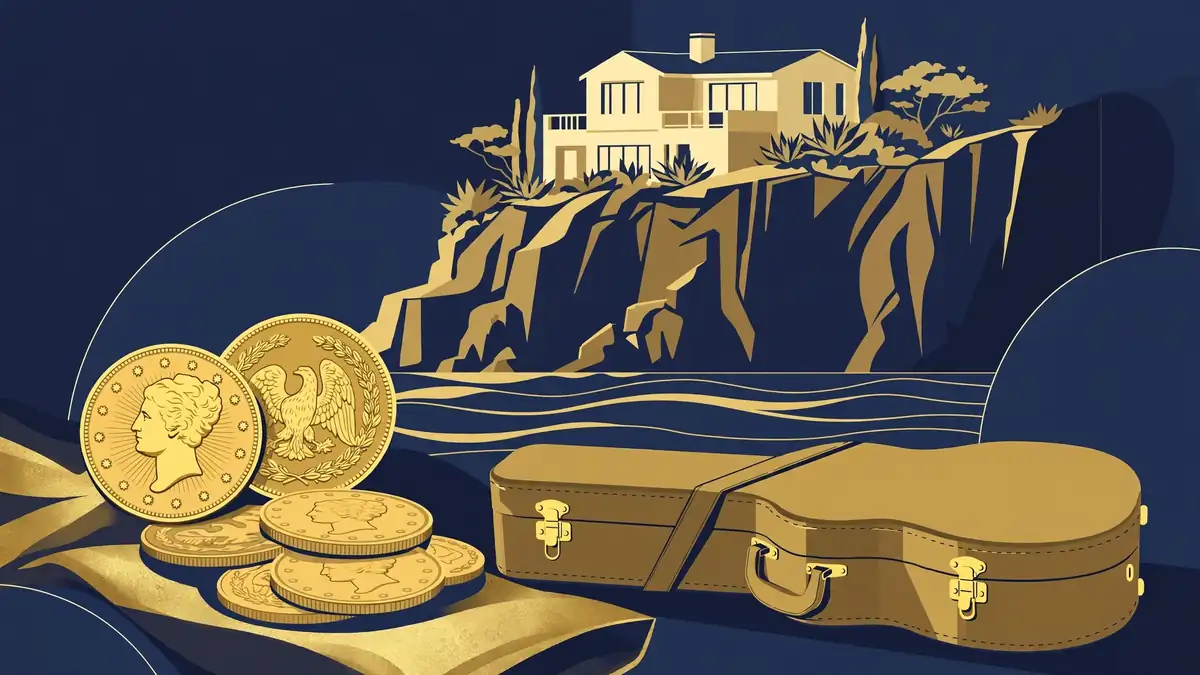
In July 2025, Stack’s Bowers Galleries announced it would auction the Rick Springfield Collection: about three dozen rare United States gold coins Springfield had assembled over decades, with the stated aim of building a world-class U.S. gold type set. The collection went under the hammer in the firm’s Summer 2025 Global Showcase Auction, August 25–30 and September 2–5, at its Griffin Studios in Costa Mesa, California. The highlights read like a museum checklist: an 1879 $4 gold “Flowing Hair” Stella graded Proof-65 by PCGS, a 1907 Saint-Gaudens double eagle graded MS-67+, an 1833 “Capped Head Left” quarter eagle graded MS-66, and a 1796 Capped Bust Right quarter eagle.
The bidding was strong. NGC reported that an 1825 quarter eagle graded MS-65, from a session devoted to Springfield’s gold rarities, realized $240,000, and that a 1909 Saint-Gaudens Proof double eagle graded PF-68 led the NGC-certified coins in the sale at $336,000. More than a dozen NGC-certified coins in the auction realized six figures. Stack’s Bowers’ own year-end review called the Springfield collection one of the standout cabinets of 2025 and noted “very spirited bidding.” The total proceeds were not published as a single figure, but with multiple lots clearing $100,000 each, the sale returned well into seven figures before fees — a serious sum for a collection most fans never knew existed.
Springfield’s own words on the collection say a lot about how he thinks about money. “I always wanted to own some of the best coins from the best country in the best condition I could collect,” he told the American Numismatic Association’s magazine, The Numismatist. “We are the stewards of these historical items for a period in time.” He also offered the buyer of his collection two tickets and two VIP backstage passes to a concert in a city of the buyer’s choice — a showman’s touch on a numismatist’s sale.
Coins were not his only collection. He has also collected classic arcade machines, comic books and action figures, and IdolSheet reports that he once sold a rare vintage Star Wars collection for $250,000. The pattern is consistent: Springfield buys things he loves, keeps them for decades, and buys the best examples he can afford. Held long enough, that habit turns a hobby into an asset class.
The catalog itself is the investment that matters most. Unlike many of his peers, Springfield has never publicly announced a sale of his songwriting catalog — no nine-figure deal with a publishing fund, no press release about cashing out. Steve Perry, by contrast, kept his Journey songwriting interests while his former bandmates sold theirs. Springfield appears to have kept his too, which means the royalty stream that built his wealth is still his, and still paying.
Brand Deals and Sponsorships
There is no record of Springfield fronting a major endorsement campaign, and that absence is itself informative. He never became a sneaker spokesman, a fragrance face or a car commercial regular. His brand work is narrower and more on-brand: his music licensed to films, television shows and commercials; his name on concert bills and casino marquees; VIP meet-and-greet packages sold to fans who want a photograph and a handshake after the show.
The book deals are the closest thing to a brand partnership in his career. Late, Late at Night was published by Simon & Schuster in 2010 and became a New York Times bestseller; the publisher’s backing put the book in stores nationwide and turned a personal story about depression into a commercial success. His 2025 coin auction carried a similar partnership logic: Stack’s Bowers, America’s oldest numismatic auction house, put its name and its buyer network behind his collection, and both sides benefited.
The touring circuit supplies the rest. Casino and theatre venues book Springfield because his name still moves tickets to an audience with money to spend, and the venues pay a guaranteed fee plus a share of the room. It is not a sponsorship in the logo-on-a-shirt sense, but it is the same economics: a trusted name, attached to a room full of buyers, for one night.
Houses, Cars and Other Assets
Springfield’s property history is one of the best-documented parts of his finances, because Malibu real estate leaves a paper trail. For much of the 1980s he lived at Lavender Hill Farm, a 2.5-acre estate inside the gated Sierra Retreat community in Malibu. In 1989 he sold it to Mel Gibson for $3 million. Gibson held the property for more than two decades and sold it in 2013 for $9.3 million — a reminder that Springfield sold early, and that Malibu land has been one of the great wealth compounding machines of the last forty years.
In 1996 he paid $490,000 for another home in Malibu. Celebrity Net Worth estimates that property is worth about $3 million today — a sixfold gain on a house bought for under half a million dollars. The two Malibu transactions frame his approach to property: buy in a place you love, hold for decades, and let the land do the work.
There is no public record of an exotic car collection, a private jet or a yacht, and Springfield has never cultivated that image. His visible assets are the house, the catalog and the collections — guitars, coins, arcade machines, comic books and action figures. The guitar collection alone has value beyond sentiment: the instruments he played on his hit records are, by definition, one of one.
Awards and Achievements
Springfield’s trophy shelf is thinner than his chart record might suggest, but the entries on it are the ones that last. The list below covers the honors that carry weight with audiences and with the industry:
- Grammy Award, 1982 — Best Male Rock Vocal Performance for “Jessie’s Girl,” his only Grammy win. Living in Oz earned him a further Grammy nomination the following year.
- Billboard No. 1, 1981 — “Jessie’s Girl” topped the Hot 100 and finished the year at No. 5 on Billboard’s year-end singles chart.
- RIAA certifications — Working Class Dog, Success Hasn’t Spoiled Me Yet and Hard to Hold all reached platinum; Tao was certified gold.
- New York Times bestseller, 2010 — Late, Late at Night: A Memoir reached No. 13 on the Best Seller list. Rolling Stone later ranked it No. 23 on its list of the 25 Greatest Rock Memoirs of All Time.
- VH1, 100 Greatest Songs of the ’80s — “Jessie’s Girl” placed at No. 20.
- 25 million records sold worldwide — the career total reported by Celebrity Net Worth.
- Broadway, 1995 — a run in Smokey Joe’s Café, the rare rock star who can hold a Broadway stage.
- Las Vegas residency, 2000–2002 — an extended engagement at the MGM Grand.
- 50 years on stage — from Zoot in 1969 to a tour running into March 2027, one of the longest continuous performing careers in rock.
Net Worth Growth Over the Years
Springfield has never published a financial statement, so the year-by-year figures below are modeled estimates based on his career earnings, property records and the published estimates of the outlets that track him. The shape of the curve is the point: a steep climb in 1981–85, a long plateau, and a slow rise since 2010 as touring, streaming and collectibles added new income to the old catalog.
| Year | Estimated net worth | What drove it |
|---|---|---|
| 1971 | Under $100,000 | “Speak to the Sky” hit; Zoot years behind him |
| 1981 | About $1 million | “Jessie’s Girl” No. 1; Working Class Dog platinum; General Hospital debut |
| 1985 | About $5 million | Three platinum albums; Tao gold; film and touring income |
| 1990 | About $6 million | Malibu property sold to Mel Gibson for $3 million in 1989 |
| 2000 | About $7 million | MGM Grand residency; catalog royalties; 1996 Malibu home appreciating |
| 2010 | About $8 million | Late, Late at Night bestseller; continued touring |
| 2015 | About $9 million | True Detective, Ricki and the Flash; catalog streaming growth |
| 2020 | $10 million | Celebrity Net Worth’s published estimate, December 2020 |
| 2025 | $10 million–$15 million | Coin collection auction returns seven figures; All’s Fair casting |
| 2026 | $10 million–$20 million | CNW $10M; TheRichest $12M; PowerNetWorth $20M — full range |
Two things stand out in that table. First, the growth is slow and steady rather than explosive — the profile of a working musician, not a lottery winner. Second, the range widens at the end rather than narrowing: the more income streams Springfield adds (streaming, prestige television, collectibles), the harder it becomes for any single outlet to pin his wealth to one number. That widening range is honest. Anyone who gives you a single exact figure for Rick Springfield’s net worth is guessing with more confidence than the evidence supports.
Social Media Presence
Springfield uses social media the way a touring musician should: as a noticeboard, not a diary. His Instagram, Facebook and X accounts carry tour announcements, backstage photographs, ticket links and clips from the stage, and his official site, rickspringfield.com, lists dates and merchandise. He does not publish follower counts as a selling point, and no reliable third-party count was available at the time of writing — so we are not inventing one here.
The streaming numbers tell a cleaner story than the follower counts. Reports put his Spotify audience at more than 3 million monthly listeners, a remarkable figure for an artist whose last Top 40 hit came in 1984. That audience is the long tail of “Jessie’s Girl” and the rest of the catalog: younger listeners who found the song through Glee, through film soundtracks, through their parents’ record collections, and through playlists that never stop serving it. Every one of those streams pays a fraction of a cent — and millions of fractions add up to a real royalty check every month.
Personal Life
Springfield married Barbara Porter in 1984. They met while she was working at the recording studio where he made Working Class Dog, and they have two sons together, Liam and Joshua. Liam appeared with his father on General Hospital during the show’s 50th anniversary in 2013. The family has long been based in the Los Angeles area, around the Malibu home Springfield bought in 1996.
He has spoken openly about living with depression for most of his life. He attempted suicide at 17, an experience he wrote about candidly in Late, Late at Night, and in 2018 he revealed that he had contemplated suicide again the previous year, while discussing the deaths of Chris Cornell and Robin Williams. The memoir’s honesty about depression, infidelity and insecurity is the reason it sold: readers who knew the upbeat hits met a far more complicated person behind them, and the book’s success remade his public image in his sixties.
The memoir also discusses his early relationship with actress Linda Blair, who later became famous for The Exorcist. He has been frank about the mistakes of his younger years in interviews since, and that frankness — about money, fame, mental health and failure — is part of why audiences still show up. Springfield’s act in 2026 is not nostalgia alone; it is a performer who has survived the parts of fame that break people, and who is willing to say so on stage.
Sources & Reporting
Celebrity Net Worth — the $10 million net worth figure (page updated September 10, 2026), the 25-million-records career total, the Malibu property history (Lavender Hill Farm sale to Mel Gibson for $3 million in 1989; the 1996 home bought for $490,000, now worth about $3 million), the Grammy win, the New York Times bestseller ranking and the Rolling Stone memoir ranking.
TheRichest — the $12 million net worth estimate and the album-earnings table (about $1,000,000 per platinum album, $500,000 for the gold-certified Tao); also the source of the erroneous $750,000 weekly General Hospital salary figure debunked in this article.
PowerNetWorth — the $20 million net worth estimate, the 2026 yearly-earnings model ($1.5 million–$2 million, split across touring, royalties and appearances), and the reporting that Springfield owns the rights to most of his solo work.
Stack’s Bowers Galleries — the July 2025 announcement of the Rick Springfield Collection auction, the collection’s size (about three dozen coins) and the August–September 2025 sale dates.
The Numismatist (American Numismatic Association) — the September 2025 feature on the collection, including Springfield’s quotes and the concert-ticket offer to the buyer.
NGC — the August 2025 auction results: the 1825 quarter eagle at $240,000 and the 1909 Saint-Gaudens Proof double eagle at $336,000, with more than a dozen NGC-certified coins realizing six figures.
Ticketmaster — the 2026–2027 tour dates and venues (November 19, 2026 through March 6, 2027) and the “Stripped Down” solo-show format.
Rolling Stone — via Celebrity Net Worth: the No. 23 ranking of Late, Late at Night among the 25 Greatest Rock Memoirs of All Time.
The New York Times — via Celebrity Net Worth: the No. 13 Best Seller list peak for Late, Late at Night in 2010.
Reporting window: July 2025–November 2026. Figures are estimates drawn from public reporting; Springfield has published no audited financial statement, and this article will be corrected if new evidence emerges.
Frequently Asked Questions
What is Rick Springfield’s net worth in 2026?
Rick Springfield’s net worth is estimated at $10 million–$20 million in 2026. Celebrity Net Worth puts it at $10 million (updated September 2026), TheRichest at $12 million, and PowerNetWorth at $20 million. Our most-cited range is $10 million–$12 million, with the top of the range reflecting touring, publishing and collectibles income the lower estimates underweight. No audited figure exists, so every number is an estimate.
How old is Rick Springfield in 2026?
Rick Springfield was born on August 23, 1949, in Guildford, New South Wales, Australia, which makes him 77 years old in November 2026. He is still touring: his current run of dates stretches from November 2026 through March 2027.
Is Rick Springfield still alive and touring?
Yes. Springfield is alive, performing and recording. He closed 2025 on Dick Clark’s New Year’s Rockin’ Eve, toured through 2026 with his full band and his “Stripped Down” solo show, and has dates listed on Ticketmaster through March 6, 2027, ending in Kansas City. He also joined the cast of Ryan Murphy’s Hulu drama All’s Fair in 2025.
How much does Rick Springfield make from “Jessie’s Girl”?
No exact royalty figure has ever been published, and Springfield does not disclose his checks. What is known: he wrote the song and owns the rights to most of his solo work, so he collects writer and publisher royalties on every radio play, stream, sync placement and cover version. Reports put his Spotify audience at more than 3 million monthly listeners, and PowerNetWorth estimates his total music royalties at around $400,000 a year.
What was Rick Springfield’s salary on General Hospital?
He started at about $750 a week when he joined General Hospital as Dr. Noah Drake in 1981. One net-worth site lists the figure as $750,000 a week, but that is a data error — no daytime actor earned anything close to that in 1981. He played Noah Drake from 1981 to 1983 and returned to the role in 2005–08, 2012 and 2013.
Who is Rick Springfield married to?
Rick Springfield has been married to Barbara Porter since 1984. They met at the recording studio where he made Working Class Dog, and they have two sons, Liam and Joshua. Liam appeared alongside his father on General Hospital for the show’s 50th anniversary in 2013.
How many records has Rick Springfield sold?
More than 25 million records worldwide, according to Celebrity Net Worth. His biggest seller is the 1981 album Working Class Dog, which reached No. 7 on the Billboard 200 and was certified platinum, powered by the No. 1 single “Jessie’s Girl.” Success Hasn’t Spoiled Me Yet and Hard to Hold also went platinum, and Tao was certified gold.
What is Rick Springfield doing now in 2026?
He is touring the United States with his band and his “Stripped Down” solo show, with dates running through March 6, 2027. In 2025 he auctioned his rare gold-coin collection through Stack’s Bowers Galleries — several coins realized six figures — and joined the cast of Ryan Murphy’s Hulu legal drama All’s Fair. He also contributed to the tribute album Play On: A Raspberries Tribute.
Final Thoughts
Rick Springfield’s $10 million–$20 million fortune is not the story of one lucky song. It is the story of a career built to last: a No. 1 single that never stopped paying, a television role that made him famous twice over, a touring habit that never quit, a memoir that told the truth, and a coin collection that turned out to be worth a small fortune on its own. The numbers disagree because the career kept adding new chapters — streaming, prestige television, collectibles — faster than the estimators could keep up.
The honest answer is the range, and the range is generous. At 77, Springfield is still selling tickets, still playing the song, and still adding to the fortune. Most one-hit wonders fade; this one built a five-decade business out of a three-minute record, and the business is still open.
Published on 2026-11-14. Last reviewed November 2026. Found an error? See our corrections policy.