
Joe Namath‘s net worth is estimated at $25 million as of November 2026. The figure rests on the most widely cited estimate in circulation — Celebrity Net Worth’s $25 million — and it captures a fortune built in three acts: a record-breaking $427,000 rookie contract with the New York Jets in 1965, the Super Bowl III guarantee that turned a quarterback into a national celebrity, and a 50-year run of endorsements that stretched from Noxzema shaving cream in 1973 to Medicare commercials still airing in 2026. At 83, Namath still earns from his name, still lives in the same Florida town he settled in decades ago, and still owns the most famous promise in football history.
Joe Namath: Quick Facts
| Estimated net worth | $25 million (range: $18 million–$45 million; $25 million is the most widely cited figure) |
|---|---|
| Profession | Former NFL quarterback, actor, broadcaster, advertising spokesman |
| Nationality | American |
| Born | May 31, 1943 (age 83) |
| Height | 6 feet 2 inches (188 cm) |
| Primary income sources | NFL contracts, endorsements and commercials, acting, broadcasting, books |
| Active years | 1965–1977 (playing); 1969–present (media and endorsements) |
| Last reviewed | November 2026 |
- Early Life and Background
- Education
- Career Journey
- Rise to Fame
- Main Sources of Income
- Salary and Earnings
- Businesses and Investments
- Brand Deals and Sponsorships
- Houses, Cars and Other Assets
- Awards and Achievements
- Net Worth Growth Over the Years
- Social Media Presence
- Personal Life
- Sources & Reporting
- Frequently Asked Questions
- Final Thoughts
Early Life and Background
Joseph William Namath was born on May 31, 1943, in Beaver Falls, Pennsylvania, a steel town about 30 miles northwest of Pittsburgh. His father, John Andrew Namath, worked in the steel mills; his mother, Rose, kept the household. Joe was the youngest of four sons, with an older adopted sister, and the family lived in the town’s Lower End neighborhood. Money was tight, and the steel mill set the rhythm of daily life.
Sports gave him a way out and a way up. At Beaver Falls High School he starred in football, basketball and baseball, and his arm drew attention from professional baseball scouts as well as college football programs. The quarterback path won. He carried a small-town chip on his shoulder into every room he entered afterward — the swagger that later made him famous was, by his own account in his 2019 autobiography All the Way: My Life in Four Quarters, rehearsed on those Beaver Falls fields, where he learned that confidence could be a weapon before it became a brand.
One detail most net-worth profiles skip: Namath was the only athlete ever listed on President Richard Nixon’s master list of political opponents, made public during the Watergate investigation in 1973. Fame had already carried him far past football by then, and the listing is a small, telling marker of how large his public profile had grown — a quarterback famous enough to worry a president.
Education
Namath played college football at the University of Alabama under the legendary coach Paul “Bear” Bryant from 1962 to 1964. Bryant’s program was built on discipline, and Namath’s talent tested its limits. He led the Crimson Tide to the 1964 national championship, the season that made him the most coveted quarterback prospect in the country.
His college career ended on a sour note that says something about the man. Bryant suspended Namath for the final two games of his senior season, including the Orange Bowl, for breaking team rules. Namath has spoken about the episode with regret rather than resentment, and the suspension did nothing to dent his draft stock: two professional leagues wanted him, and they were about to bid against each other for his signature.
Career Journey
The bidding war was the first fortune Namath ever made. In the 1965 drafts he was selected first overall by the New York Jets of the American Football League and 12th overall by the St. Louis Cardinals of the NFL. The Jets won him with a three-year deal reported at $427,000 including a signing bonus — the richest rookie contract in pro football history at the time, and the deal that made Namath the first professional athlete in any sport to earn a $100,000 annual salary. The Jets’ own history records the contract as a reported $400,000; the $427,000 figure, repeated across reporting, includes the bonus money. Either way, it was an extraordinary sum for 1965 — roughly $4.4 million in 2026 dollars.
The bidding war itself was a business story. The AFL and NFL were fighting a costly war for talent, and the Jets’ owner Sonny Werblin understood that signing the most glamorous college quarterback in America was worth more than the player alone — it was a statement that the AFL could compete for stars. The Cardinals, who held Namath’s NFL rights, could not match the Jets’ offer, and the signing gave the young league instant credibility. Namath’s contract did more than enrich him: it reset the market for every quarterback who followed, and it made the AFL’s case to television networks and sponsors that the league was a serious product.
Namath won the Jets’ starting job in his third game and was named AFL Rookie of the Year in 1965. In 1967 he became the first professional quarterback to pass for 4,000 yards in a season, finishing with 4,007. He played 12 seasons for the Jets, from 1965 to 1976, and finished his career with one season for the Los Angeles Rams in 1977. The New York Jets’ official history credits him with 1,886 completions for 27,663 yards and 173 touchdowns across his career. Knees wrecked by injuries limited him badly in his final years — he could barely play in that last Rams season — but the numbers and the moments had already secured his place.
He was inducted into the Pro Football Hall of Fame in 1985, eight years after he retired.
Rise to Fame
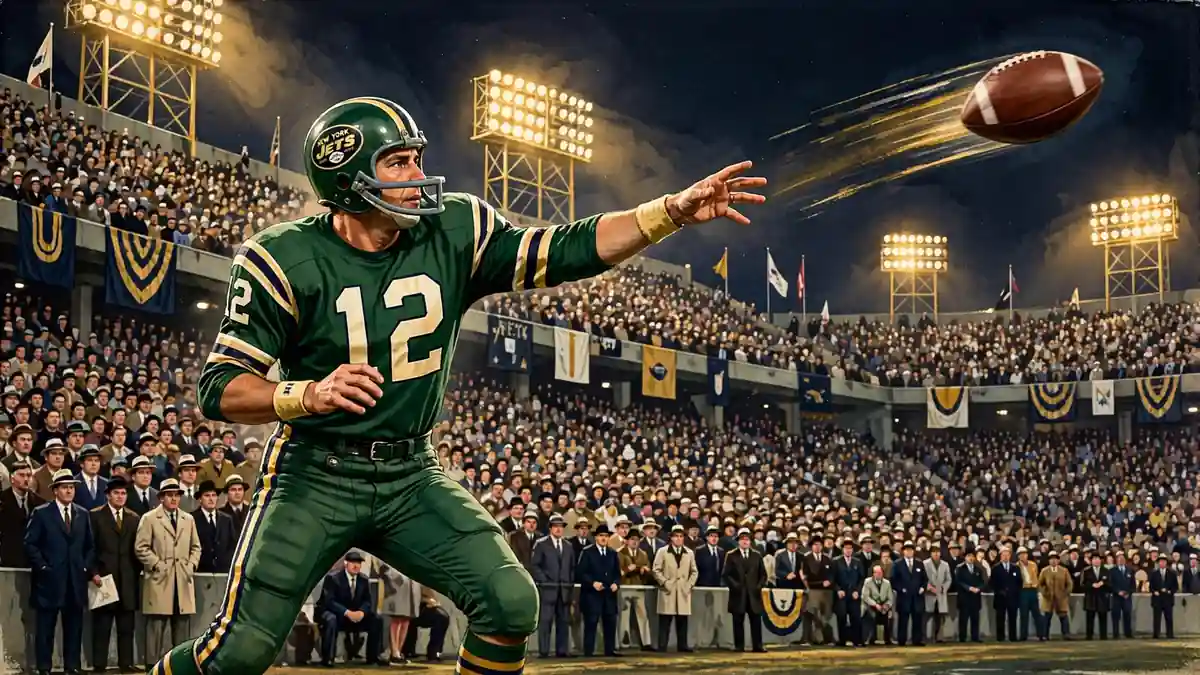
Three days before Super Bowl III, on January 12, 1969, Namath walked into the Miami Touchdown Club and guaranteed his Jets would beat the Baltimore Colts. The Colts were 18-point favorites, the NFL’s champion against an AFL upstart that most of the football world considered a lesser league. Namath’s promise was treated as Broadway bravado — the nickname “Broadway Joe” had stuck because of his nightlife, his fur coats and his ease in front of a camera — and then he delivered. The Jets won 16–7, Namath was named Super Bowl MVP after an efficient 206-yard passing game, and the AFL had its defining victory. The win remains the Jets’ only Super Bowl championship.
The guarantee changed the economics of Namath’s life. Before it, he was a well-paid quarterback. After it, he was a national celebrity whose name sold shaving cream, milk flavoring and pantyhose. It also changed the economics of the sport: the AFL-NFL merger followed, and the Super Bowl became the event that now dominates American television. Namath’s promise is the hinge on which both his fortune and modern football’s money turn.
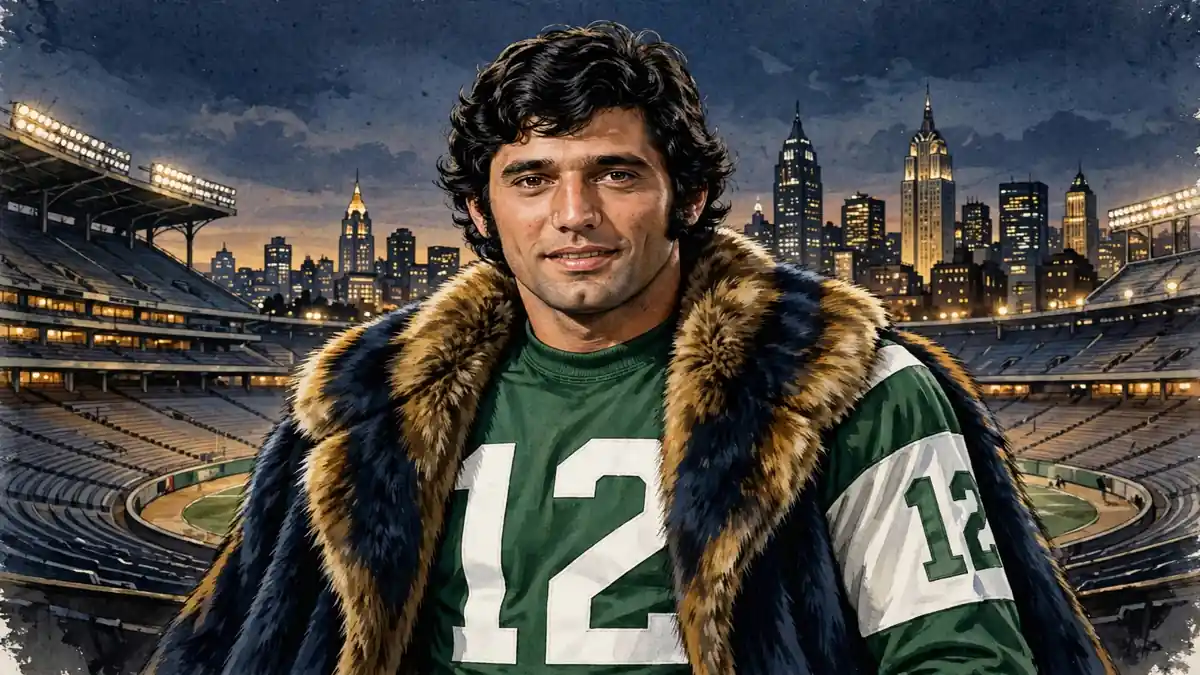
His sideline style became part of the package. He wore a full-length fur coat on the sidelines, a look the NFL later banned by requiring league-approved team apparel for everyone on the sideline. The coat, the guarantee and the grin were a single product: Broadway Joe, the first athlete whose fame belonged as much to Madison Avenue as to the stadium.
The aftermath of the guarantee reached far beyond one trophy. The AFL-NFL merger, already agreed in principle, gained unstoppable momentum after an AFL team beat the NFL’s best on the biggest stage, and the Super Bowl’s television value climbed with every year that followed. Namath’s promise is replayed every January, which means his name is refreshed in the public mind every year without him lifting a finger — a form of free advertising no endorsement deal can buy. That annual replay is the quiet engine of his later income: it keeps Broadway Joe current for each new generation of advertisers.
Main Sources of Income
Namath’s money came from four streams, and their order matters. Football paid first and least. His documented playing contracts add up to roughly $2–3 million across 13 seasons — serious money in the 1960s and 1970s, but a fraction of what a modern quarterback earns in a single season. Endorsements paid second and, over time, far more. Acting and broadcasting paid third, and the long tail — Medicare commercials, appearances, books — still pays today.
The split is the story of this fortune. Namath earned like a 1960s athlete and spent like one too, but he kept monetizing his name for five decades after he stopped throwing passes. Most quarterbacks of his era stopped earning when they stopped playing. Namath never did, because the Super Bowl III guarantee gave him a brand that outlived his knees.
Here is how the streams break down:
- NFL contracts (1965–1977): roughly $2–3 million in total reported salary, led by the $427,000 rookie deal and the $900,000 two-year Jets contract of 1975.
- Endorsements and commercials (1969–present): more than 40 commercials, from Noxzema and Ovaltine in the 1970s to Medicare and hearing-aid spots in the 2020s. One estimate puts his endorsement income alone near $1.5 million by the mid-1970s — and it kept coming for another 50 years.
- Acting and broadcasting: films, a television series, dozens of guest spots, a talk show, and a season as a Monday Night Football color commentator.
- Books and appearances: his 2019 autobiography, the 2012 documentary Namath, paid appearances and speaking engagements.
Salary and Earnings
Namath’s contract history reads like a timeline of football’s salary revolution, because he kept setting the market. Each deal below is reported in the press of its time; where figures differ between sources, we say so.
| Year | Team / Deal | Reported value |
|---|---|---|
| 1965 | New York Jets — rookie contract, 3 years | $427,000 (Jets’ own history cites a reported $400,000 base) |
| 1972 | New York Jets — new two-year deal | About $500,000 |
| 1975 | New York Jets — two-year contract | $900,000 |
| 1977 | Los Angeles Rams — one-year contract | $150,000 |
His peak single year was 1975. One reported estimate puts his combined football salary and endorsement income that year above $1.45 million — roughly $8.5 million in 2026 dollars — which made him, by that account, the highest-paid celebrity of 1975. The figure is an estimate rather than a filing, and we flag it as such, but it tracks with what is documented: a $900,000 contract running at the same time as a dozen active endorsement deals.
The contrast with today’s quarterbacks is the point most profiles miss. Troy Aikman earned about $55.5 million in NFL salary across 12 seasons with the Dallas Cowboys — and then signed a five-year, $90 million ESPN broadcasting contract that pays more than his entire playing career. Namath’s whole playing career paid roughly what a modern backup quarterback makes in a season. In 2026 dollars, his roughly $2–3 million in career playing salary equates to about $15–20 million — a comfortable sum, but a fraction of the $55.5 million Aikman earned before broadcasting, and a reminder that Namath’s fortune was built after football, not during it, and that is why the endorsement story below matters more than the contract table.
For comparison, here is where Namath sits among the great quarterbacks of his era and the ones who followed, using Celebrity Net Worth’s published estimates:
| Quarterback | Era | Estimated net worth (Celebrity Net Worth) |
|---|---|---|
| Joe Montana | 1979–1994 | $150 million |
| John Elway | 1983–1998 | $145 million |
| Brett Favre | 1991–2010 | $100 million |
| Troy Aikman | 1989–2000 | $65 million |
| Dan Marino | 1983–1999 | $50 million |
| Terry Bradshaw | 1970–1983 | $45 million |
| Joe Namath | 1965–1977 | $25 million |
The gap is a calendar, not a talent ranking. Montana, Elway and Favre played in the era of free agency and television money; Namath played before both. What closes the gap is that Namath monetized fame itself — a skill the later quarterbacks learned from him.
Businesses and Investments
Namath’s most famous business venture lasted only months, and it nearly cost him his career. After the Super Bowl III victory in 1969 he opened Bachelors III, a popular nightclub on Manhattan’s Upper East Side. The club drew sports stars, entertainers and politicians — and, by many accounts, organized-crime figures. NFL Commissioner Pete Rozelle, protecting the league’s image, ordered Namath to sell his interest. Namath refused, and in a tearful news conference in June 1969 he announced his retirement from football rather than give up the club. He relented within weeks, sold his stake, and reported to the Jets in time for the season. The episode is usually told as a scandal; financially, it was a lesson. Namath never again tied his money to a business he had to defend in public.
His later business life was quieter and steadier. Real estate was the anchor: a Florida home he has held for decades, bought when waterfront property in Tequesta cost a fraction of today’s prices. He invested in a diversified portfolio of stocks and bonds, according to profiles of his finances, and he kept his overhead low — a ranch house, two boats, a small circle. There is no record of a failed restaurant chain, a clothing line or a tech investment in his name, and that absence is part of the $25 million: the fortune survived because it was never gambled on a second act that failed.
He also put his name to charity rather than commerce. The Joe Namath Foundation raises funds for charitable causes, and his public appearances in later years have leaned heavily toward foundation and community work. One 2024 legal dispute over a failed business investment was reported in the press, but no figure was attached to it and it left no visible dent in the public estimate of his wealth.
His screen career, which most net-worth pages reduce to a single line, deserves a fuller account because it paid for decades. Namath hosted The Joe Namath Show in 1969, starred in the film C.C. and Company alongside Ann-Margret in 1970, and headlined the short-lived 1978 television series The Waverly Wonders. He guest-starred as himself on The Brady Bunch, The Love Boat, Married… with Children, The A-Team, ALF and The Simpsons, guest-hosted The Tonight Show Starring Johnny Carson several times, and served as a color commentator on NFL broadcasts — including the 1985 season of Monday Night Football. He also appeared in summer-stock stage productions of Damn Yankees, Fiddler on the Roof and Li’l Abner. Each appearance paid modestly on its own; together, they kept his name in front of casting directors and advertisers for half a century. His 2019 autobiography and the 2012 documentary Namath added book advances, royalties and licensing income in his seventies, and both keep his story in print and on screen for new audiences.
Brand Deals and Sponsorships
Namath was the first athlete to be a pitchman first and a player second, and the deal list is the longest part of his money story. FanBuzz counts more than 40 commercials across his career. The landmarks:
- Noxzema shaving cream (1973): the famous Super Bowl VII spot in which a then-unknown Farrah Fawcett shaved him. It ran during the game and became one of the most remembered commercials of the decade.
- Hanes Beautymist pantyhose (1974): Namath wearing pantyhose on camera, a spot that was genuinely shocking in 1974 and is still cited as one of the boldest athlete endorsements ever filmed.
- Ovaltine (1970s): the milk flavoring brand that put him in front of children and families, widening his audience beyond sports fans.
- Brut cologne and Schick razors (1970s): the grooming deals that made him the face of men’s products for a generation.
- Nike (1997): a comeback-themed campaign showing the 54-year-old Namath attempting a return with Nike Zoom Air shoes.
- Skechers: footwear spots in his later years, keeping him on television into his seventies.
- Medicare Coverage Helpline and Medicare Advantage (2018–present): the seasonal open-enrollment campaigns that air every October to December, plus MDHearingAid spots in the same lineup. These are his current income stream, and they are the reason a 2026 viewer still sees his face on television.
The Medicare work carries a wrinkle most profiles ignore. A February 2024 analysis flagged concerns about aggressive marketing tactics and misleading claims in the senior-health advertising space, and Namath’s spots were part of that conversation. The criticism was aimed at the industry’s practices, not at Namath personally, and the spots continue to air. It is worth recording because it is the only blemish on a 50-year endorsement record — and because it shows his name still carries enough weight, at 83, to be worth arguing about.
What made all of it work was a quality no other athlete of his era had. Namath was the first sports figure whose appeal crossed every demographic line at once: men admired the quarterback, women noticed the style and the grin, and children knew him from Ovaltine commercials and television guest spots. Advertisers could buy one spokesman and reach a whole household. That is why the deals kept coming long after his knees gave out, and why his endorsement career outlasted his playing career by nearly five decades — a record no quarterback of his generation matched.

Houses, Cars and Other Assets
Namath lives in Tequesta, Florida, a quiet town on the Loxahatchee River in Palm Beach County, and he has lived there for decades. His home is a ranch house on about 1.5 acres of riverfront land, with four bedrooms, three bathrooms, a 41-foot swimming pool and a dock holding two boats. Tequesta’s waterfront homes now sell in the multi-million-dollar range, and his property — bought long before the area’s prices climbed — is one of the largest single assets in his portfolio. The exact current value is not public, and we do not guess at one.
His daughter Jessica lives next door with her children, a family arrangement that keeps the Namath household close. His younger daughter Olivia lives in California with her family. The house is the physical center of a fortune that was never about display: no reported fleet of exotic cars, no string of properties, no art collection in the press. The assets are a home, boats, investments and a name.
On cars, the public record is thin, which is itself informative. Namath’s era of fame predates the celebrity-car culture, and his name rarely appears in connection with vehicle collections. We report what is documented and leave the rest out rather than inventing a garage.
Awards and Achievements
- Super Bowl III champion and MVP (January 1969) — the guarantee, delivered.
- Pro Football Hall of Fame — inducted August 3, 1985.
- AFL Player of the Year (1968) and unanimous All-Pro selection.
- AFL Rookie of the Year (1965).
- First professional quarterback to pass for 4,000 yards in a season (4,007 yards, 1967).
- Four-time all-league selection (1967–1969, 1972) and a place on the AFL’s all-time team (1969).
- National champion at Alabama (1964) under Bear Bryant.
- Five Pro Bowl / AFL All-Star selections across his career.
- New York Jets Ring of Honor and a retired-era legacy as the franchise’s defining player.
The honors list matters to the money story in one specific way: the Hall of Fame induction in 1985 kept Namath’s name in the football conversation through the broadcasting era, which kept the endorsement calls coming. Fame that stops being refreshed stops paying. His never did.
Net Worth Growth Over the Years
The table below is our estimate, built from the documented contracts, the endorsement timeline and the published $25 million anchor. Early-year figures are approximations, not filings, and we label them as such.
| Year | Estimated net worth | What moved it |
|---|---|---|
| 1965 | ~$0.4 million | Record rookie contract with the Jets |
| 1969 | ~$1 million | Super Bowl III win, MVP, first endorsement wave |
| 1975 | ~$3 million | Peak year: $900,000 contract plus a dozen active deals |
| 1985 | ~$8 million | Hall of Fame induction, broadcasting, steady endorsements |
| 2000 | ~$15 million | Decades of commercials, acting residuals, investments compounding |
| 2010 | ~$20 million | Continued advertising work, real-estate appreciation in Florida |
| 2020 | ~$25 million | Medicare campaigns begin; estimate stabilizes |
| 2026 | $25 million | Current published estimate (Celebrity Net Worth) |
Two things stand out. First, the fortune grew slowly and never spiked — there was no single windfall after 1975, only fifty years of steady work. Second, it stopped growing in the public estimates around 2020, which is normal for a retired athlete in his eighties living on investment income and endorsement residuals. The $25 million figure has now been repeated, unchanged, by the major estimators for several years running.
The plateau has a plain explanation. Namath’s income today is residual: Medicare spots pay a fee, appearances pay a fee, and his investments compound quietly. He has not sold the Tequesta house, so its appreciation sits unrealized. He has launched no product line, taken no front-office job and signed no broadcasting contract since his 1985 Monday Night Football season. A fortune that grows only through compounding and residuals grows slowly, and the published estimate reflects that. If a new book, a documentary deal or a property sale were announced, the number would move; until then, $25 million is the honest figure.
Why do some pages disagree? The $18 million figure comes from thinly sourced pages with no methodology. The $45 million figure appears on similar pages. The $135 million figure, found on a handful of low-quality sites, claims career earnings near $50 million — a number that collapses against the documented contracts, which total roughly $2–3 million. We publish the range, anchor on $25 million, and show the working so readers can see why the outliers fail.
Social Media Presence
Namath keeps a low-key footprint online, which fits a man of 83 who built his fame before the internet existed. His main public presence is his official Facebook page, where updates about appearances, the Joe Namath Foundation and throwback material from his playing days are posted. He does not run a high-volume personal brand on Instagram or X, and there is no verified personal account of his that posts daily.
That restraint is a financial fact as much as a personal one. Modern athletes monetize social followings directly; Namath’s income comes from television commercials and appearances, the channels that have paid him since 1969. His name trends whenever the Jets make the playoffs or a Super Bowl anniversary arrives, and the 2019 autobiography and 2012 documentary keep new material in circulation without him having to post.
Personal Life
Namath met Deborah Mays, an aspiring actress, while taking a voice class in 1983. He was 39; she was 22. They married on November 7, 1984, and Namath — a lifelong bachelor until then — used to say, “She caught my last pass.” The couple had two daughters, Jessica (born 1986) and Olivia (born 1991). The marriage ended in divorce in 2000, and the girls lived with their father in Florida.
Family is now the center of his life in Tequesta. Jessica lives next door with her children — John, Emerson and Jemma — and Olivia lives in California with her three children, including Natalia, born in 2007. Namath has six grandchildren in total. His daughters’ lives have occasionally drawn press attention, including Olivia becoming a mother at 16, but Namath has kept the family largely out of the spotlight since the divorce.
He has spoken openly about his drinking in his playing years and after retirement, including in his autobiography, and about the discipline it took to step back from it. The candor fits the pattern of his public life: the guarantee, the fur coat, the commercials — Namath has always sold honesty about who he is, and the market has always bought it.
Sources & Reporting
Every figure in this article traces to a named source. Where sources conflict, we publish the range and name who says what.
- Celebrity Net Worth — the $25 million net-worth estimate, and the peer figures in the comparison table (Montana $150M, Elway $145M, Favre $100M, Aikman $65M, Marino $50M, Bradshaw $45M).
- New York Jets (official team history) — career statistics (1,886 completions, 27,663 yards, 173 touchdowns), the reported $400,000 rookie contract, Super Bowl III details, Hall of Fame induction in 1985.
- Wikipedia — biography, dates and family details: born May 31, 1943 in Beaver Falls; Alabama and Bear Bryant; the 1965 drafts; Bachelors III and the Rozelle standoff; marriage to Deborah Mays in 1984, daughters Jessica and Olivia, divorce in 2000; residence in Tequesta, Florida; acting credits.
- FanBuzz — the commercial history: more than 40 commercials, the Hanes Beautymist pantyhose spot (1974), Noxzema with Farrah Fawcett, Ovaltine, Nike (1997), Skechers and Medicare spots.
- Acting Magazine — the full commercial roster and dates, including Medicare Coverage Helpline work since 2018 and the February 2024 analysis of aggressive senior-health marketing.
- The Daily View — the reported $1.45 million combined 1975 income figure and the $150,000 Rams contract; treated here as a reported estimate, not a filing.
- StuffaBlog and NextBiography — contract timeline (1972 deal near $500,000; 1975 deal of $900,000) and the $25 million consensus; cross-checked against the stronger sources above.
- Famous People Today — family and real-estate detail: the Tequesta ranch house on the Loxahatchee River, the 41-foot pool and two boats, Jessica living next door.
- Pittsburgh Senior News — the 2019 autobiography All the Way: My Life in Four Quarters and the Beaver Falls background.
Reporting window: November 2026. Figures are public estimates unless labeled as documented contract values. Inflation conversions use the U.S. Bureau of Labor Statistics CPI series. Net-worth growth figures before 2026 are NetWorthCraft estimates.
Frequently Asked Questions
What is Joe Namath’s net worth in 2026?
Joe Namath’s net worth is estimated at $25 million as of November 2026. Celebrity Net Worth puts him at $25 million, and most current profiles agree. A few weaker pages publish $18 million or $45 million, and one outlier claims $135 million — a figure that does not square with his documented contracts, which total roughly $2–3 million in playing salary.
Is Joe Namath still alive?
Yes. Joe Namath is alive and 83 years old as of November 2026. He lives in Tequesta, Florida, and still appears in Medicare commercials and at public events.
How old is Joe Namath?
Joe Namath was born on May 31, 1943, in Beaver Falls, Pennsylvania, which makes him 83 years old in 2026.
How much did Joe Namath make in the NFL?
Namath’s documented playing contracts total roughly $2–3 million. His rookie deal with the New York Jets in 1965 was worth a reported $427,000 over three years — a record at the time. He later signed a deal near $500,000 in 1972, a $900,000 two-year contract in 1975, and a $150,000 one-year deal with the Los Angeles Rams in 1977. His endorsements earned him far more than football did.
Did Joe Namath win a Super Bowl?
Yes. Namath guaranteed a Jets victory over the Baltimore Colts three days before Super Bowl III on January 12, 1969, then delivered a 16–7 upset win as an 18-point underdog and was named Super Bowl MVP. It remains the Jets’ only Super Bowl championship.
Who was Joe Namath’s wife?
Joe Namath was married to Deborah Mays, an aspiring actress he met in a voice class in 1983. They married on November 7, 1984, had two daughters — Jessica (born 1986) and Olivia (born 1991) — and divorced in 2000. He has not remarried.
Where does Joe Namath live now?
Joe Namath lives in Tequesta, Florida, in a ranch house on the Loxahatchee River with a 41-foot pool and a dock holding two boats. His daughter Jessica lives next door with her children.
What is Joe Namath doing now?
At 83, Namath still appears in Medicare Coverage Helpline commercials that air during open enrollment, makes public appearances, and supports the Joe Namath Foundation. His 2019 autobiography, All the Way: My Life in Four Quarters, remains his most recent book.
Final Thoughts
Joe Namath’s $25 million is the most instructive fortune in football history, because it was not built by football. His playing contracts totaled roughly $2–3 million — less than a modern quarterback earns in a season — and everything after that came from a single asset: a name made famous by a promise kept on January 12, 1969. The Super Bowl III guarantee turned a quarterback into a celebrity, and the celebrity into a pitchman, and the pitchman into a 50-year income stream that still pays in 2026. Montana, Elway and Favre all ended up richer, because they played in the television-money era Namath helped create. But none of them monetized fame itself as early, or as durably, as Broadway Joe. The fur coat is in a museum of memory now. The $25 million is the receipt.
Published on November 14, 2026. Last reviewed November 2026. Found an error? See our corrections policy.