
Sixto Rodriguez‘s net worth at his death in August 2023 is estimated at $50,000 to $1 million as of November 2026. That wide range is the honest answer, and it is also the story: the Detroit folk singer whose two early-1970s albums flopped in America became a platinum-selling star in South Africa without ever seeing the money, spent decades doing demolition work for a living, and then — after the Oscar-winning film Searching for Sugar Man found him in 2012 — toured the world in his seventies while still living in the same modest Detroit house he had bought at a government auction for $50. No catalog sale, no estate filing and no verified payout ever turned that late fame into a multi-million-dollar fortune, which is why the $5 million and $6 million figures repeated across copycat net-worth sites do not survive a check of the record.
Sixto Rodriguez: Quick Facts
| Estimated net worth | $50,000 to $1 million at death (range: $50,000–$1 million) |
|---|---|
| Profession | Singer-songwriter, folk-rock musician |
| Nationality | American |
| Born | July 10, 1942, Detroit, Michigan (died August 8, 2023, aged 81) |
| Height | No reliable published figure |
| Primary income sources | Record royalties, concert touring, reissue sales |
| Active years | 1967–2018 (recording 1967–1971, with later live albums; touring into 2018) |
| Last reviewed | November 2026 |
- Early Life and Background
- Education
- Career Journey
- Rise to Fame
- Main Sources of Income
- Salary and Earnings
- Businesses and Investments
- Brand Deals and Sponsorships
- Houses, Cars and Other Assets
- Awards and Achievements
- Net Worth Growth Over the Years
- Social Media Presence
- Personal Life
- Sources & Reporting
- Frequently Asked Questions
- Final Thoughts
Early Life and Background
Sixto Diaz Rodriguez was born on July 10, 1942, in Detroit, Michigan, the sixth child of Mexican immigrant working-class parents, Ramón and María Rodriguez. His first name was the clue to his place in the family: Sixto, the sixth. His mother died when he was a boy, and he grew up in a single-parent, working-class household in the industrial side of Detroit — far from the polished Motown image the city sold to the rest of America, and much closer to the factories, demolition sites and barrooms that later filled his songs.
Music reached him first through his father, who played Mexican folk songs at home. Rodriguez picked up the guitar in his teens and started playing Detroit bars while still a young man, often with his back to the audience — a habit that became part of his legend and that he never fully dropped. The bar scene gave him his first audience and his first reputation: a singer whose plainspoken lyrics about the inner-city poor, the draft, drugs and corrupt city politics sounded like Bob Dylan filtered through Detroit concrete. That Dylan comparison followed him from his first press notices to his obituaries, and it was both a compliment and a commercial problem. Record executives heard a potential Dylan; radio programmers in 1970 heard something harder to place.
Detroit shaped the economics of his whole life as much as its music. He stayed in the city through every phase of his career — the flop years, the manual-labor decades and the late rediscovery — and the city stayed cheap enough, and familiar enough, that a man with almost no recorded income for twenty years could still keep a roof over his head and keep playing local bars. That rootedness is central to the net-worth story: unlike the stars who converted fame into property portfolios in Los Angeles or New York, Rodriguez never left the market where a house could be bought for $50.
Education
Rodriguez studied philosophy at Wayne State University in Detroit, and he kept studying long after most musicians would have quit school for the road. He earned his bachelor’s degree in philosophy in 1981 — a full decade after his second album had flopped and while he was working manual jobs to support his family. Friends in Detroit remembered a demolition worker who could carry a refrigerator up three flights of stairs and then quote Blake or Whitman over a beer, and the degree was not a footnote to that image. It was the same mind that wrote the songs: literate, argumentative and allergic to easy slogans.
Wayne State closed the circle in May 2013, when the university awarded him an honorary Doctor of Humane Letters degree, a year after Searching for Sugar Man made him famous in his own country for the first time. The honorary doctorate was one of the few formal honors of a career that had almost no industry awards in its first forty years, and it arrived not for record sales but for the body of work that had finally been heard at home.
Career Journey
Rodriguez’s recording career, in its first act, lasted about four years and produced almost nothing in American sales. In 1967 he released a single, “I’ll Slip Away,” on the small Impact label under the name Rod Riguez — a label invention, not his choice. Detroit producers Dennis Coffey and Mike Theodore heard him playing in bars, including the smoky club on the Detroit River that the New York Times later identified as the Sewer, and brought him to producer Harry Balk, who signed him. Balk’s Gomba Music held a songwriting arrangement with Rodriguez dating to 1966, a detail that mattered enormously decades later when the royalty lawsuits began.
The path from Balk to a record deal ran through Clarence Avant, whose Sussex Records released Cold Fact in March 1970, produced by Coffey and Theodore with Motown session musicians. The album drew a handful of favorable notices and sold poorly. Its opening track, “Sugar Man,” gave the later documentary its title and gave Rodriguez his enduring nickname, but in the United States in 1970 it gave him almost no income. Coming from Reality, produced by Steve Rowland and released in 1971, sold poorly as well. Sussex dropped him while he was working on a third album, and by the mid-1970s Rodriguez had walked away from the music business as a full-time pursuit.
What he did next defines the middle of his life and explains why his net worth stayed near zero for so long. He went back to work in Detroit: demolition, renovation and construction labor, the kind of work that paid by the day and left no royalties. He kept playing bars, including the Old Miami in the Cass Corridor, and he ran for public office several times — city council and mayor — and lost each time. He did not own a telephone for long stretches, did not chase a comeback, and by his own later account had put rock-stardom dreams behind him by the time the next chapter arrived.
That chapter opened in Australia before it opened in South Africa. A warehouse find of several thousand copies of Cold Fact in New York in 1976 sold out in Australia within weeks; the album reached No. 23 on the Australian charts in 1978 and stayed on the charts for fifty-five weeks. Rodriguez toured Australia in 1979, playing sold-out shows including four sellouts of the 2,000-seat Regent Theatre, and returned in 1981 for shows with Midnight Oil, releasing a live album there. He knew, by then, that he had fans somewhere overseas. What he did not know was the scale of what was happening in South Africa, where his records had become something closer to scripture.
Rise to Fame
South Africa made Rodriguez famous in a way no marketing plan could have arranged. Cold Fact arrived there in the early 1970s — released officially by A&M Records in 1971 and reissued under the RPM label in 1974 — and spread through a country cut off from much of the world by apartheid-era isolation. Copies were passed from older brother to younger sibling; cassette dubs circulated where vinyl could not. The songs landed with white liberal youth chafing under apartheid and conscription: “Sugar Man,” “I Wonder,” “Crucify Your Mind” and “The Establishment Blues” sounded like dispatches from a parallel struggle, and fans repeated the line that Rodriguez was more popular in South Africa than Elvis Presley. Stephen “Sugar” Segerman, the Cape Town record-store owner whose nickname came from the song, later said that to South Africans of his generation, Cold Fact was one of the most famous records of all time.
The fame came with a fog of false death stories. With no reliable information crossing the ocean, South African fans invented endings for their hero: he had shot himself on stage, set himself on fire, died of an overdose, or been locked in a mental institution. None of it was true. Rodriguez was alive in Detroit, hammering nails. The rumors persisted into the 1990s, when Segerman and journalist Craig Bartholomew-Strydom began a serious search, building on the fan website “The Great Rodriguez Hunt” that Rodriguez’s own daughter had found in 1997. In 1998 they found him — still in Detroit, still working — and persuaded him to tour South Africa for the first time.
The 1998 tour was six sold-out shows before audiences who had waited nearly thirty years. Rodriguez was presented with a platinum disc for Cold Fact‘s South African sales, and he returned for more than thirty further performances in the country over the following years. A South African documentary, Dead Men Don’t Tour, captured the 1998 trip, but the story still had not reached America. That took a Swedish filmmaker, Malik Bendjelloul, and a second documentary, Searching for Sugar Man, released in 2012. Bendjelloul followed Segerman and Bartholomew-Strydom’s search, interviewed Rodriguez, his daughters, Coffey, Theodore and the label men, and pressed Avant on camera about the missing royalties. The film won the Academy Award for Best Documentary Feature in 2013 and a BAFTA, and it did what twenty years of cult fandom had not: it introduced Rodriguez to the United States. Within months he was playing the Beacon Theatre in New York in April 2013, appearing on 60 Minutes and The Late Show with David Letterman, and touring America and Europe as a seventy-year-old headliner.
The rediscovery also corrected the record in one important way for this article: the film’s most dramatic implication — that a fortune in royalties had been stolen — was never matched by a verified payout. The South African sales were real. The money reaching Rodriguez was not, for reasons detailed below, and the gap between those two facts is the whole financial story.
Main Sources of Income
Rodriguez had three real income streams in his life, and they arrived in the wrong order for building wealth. The first was the original Sussex record deal, which paid little because the records did not sell in the market where the contract operated. The second was manual labor in Detroit — demolition, renovation and construction — which paid his bills from the mid-1970s through the 1990s and produced no assets beyond the cheap house it helped him keep. The third, and the only one that ever produced meaningful music money, was the late-life combination of reissue royalties and touring that began in 1998 and accelerated after 2008.
Within that third stream, touring did the heavy lifting. The 1998 South African tour, the Australian tours of 1979 and 1981, and the post-documentary tours of 2012 to 2018 put him in front of paying audiences in venues far larger than the Detroit bars of his youth. Reissue royalties added a second layer: Light in the Attic Records reissued Cold Fact and Coming from Reality in the United States in 2008 and 2009, and those editions — unlike the 1970s South African pressings — were part of a chain that actually paid the artist. The documentary’s soundtrack album added another royalty line. Streaming, which arrived too late to matter much to his lifetime earnings, now generates posthumous income for his estate, but no figure for it has been published.
What Rodriguez did not have is as telling as what he did. He never sold his catalog for a lump sum, the move that turned peers like Bob Dylan into nine-figure fortunes. He never had a hit single in the American market to generate publishing windfalls. He had no endorsement career, no acting career, no branded product and no property empire. His income was wages, then royalties, then concert fees — and he spent the concert-fee years giving much of it away, as his family and interviewers reported.

Salary and Earnings
No salary figure for Rodriguez was ever published by a reliable outlet, and this section says so plainly rather than filling the gap with the “$1 million annual salary” repeated by some net-worth aggregators. That claim appears on sites that also repeat the $6 million net-worth figure without naming a source, and it collapses against the documented facts: a man with a million-dollar annual income does not live for decades in a $50 auction house without a telephone, and does not spend his seventies telling interviewers he gave his tour money to his family.
The earnings that can be documented are specific and modest by star standards. Nielsen SoundScan figures cited in album reporting put Cold Fact at about 201,000 copies sold in the United States since tracking began in 1991, with about 173,000 of those after the film opened and about 98,000 after the Oscar win; Coming from Reality moved about 105,000 copies, with about 99,000 after the film and about 60,000 after the Oscar. Those are American sales only, and they represent the royalty-bearing reissue era — the sales that actually paid him. At typical artist royalty rates on reissue albums, that volume produces tens of thousands of dollars over a decade, not millions, and it was split with labels, publishers and managers before it reached him.
The South African numbers look bigger and paid him less. Reports consistently put South African sales of Cold Fact at around 500,000 copies, and the album was certified platinum there in 1998 and five-times platinum in Australia. But the royalty chain for those sales was broken at multiple links, as the next section explains, and Rodriguez himself received nothing from the 1970s South African sales that made him a legend there. The 1998 tour and later tours were the first South African money he actually touched, and tour fees for a cult folk act — even sold-out ones — sit in a different universe from stadium rock paydays.
The post-documentary years, 2012 to 2018, were his peak earning period, and even that peak was brief and deliberately unbanked. He toured the United States, Europe, South Africa and Australia as a headline act in his seventies, played major rooms including the Beacon Theatre, and commanded fees far above anything he had earned before. He also, by multiple accounts, distributed much of that money to his daughters, extended family and friends rather than accumulating it. That choice, repeated in interviews and family accounts, is the single biggest reason a late-life fortune never materialized — and it is why an estimate built from gross tour revenue would badly overstate what he kept.
Businesses and Investments
Rodriguez had no business empire, and the honest version of this section is short. He never founded a company, launched a brand, bought rental property or invested in a venture that produced public returns. His working life outside music was employment, not enterprise: demolition and renovation crews in Detroit, where he learned a trade and earned a wage. His only documented property transaction is the purchase of his own home, covered below, which was a place to live rather than an investment strategy.
The closest thing to a business dispute in his life was not a business he owned but a fight over who owned his songs. In May 2014, Gomba Music — Harry Balk’s company, which held the 1966 songwriting arrangement with Rodriguez — sued Clarence Avant and his Interior Music company in Detroit federal court, alleging that Avant had fraudulently credited Rodriguez’s compositions to others, including under the names “Jesus Rodriguez” and “Sixth Prince,” to bypass Gomba’s deal. Avant denied wrongdoing. Rodriguez was not the direct plaintiff, though he stood to benefit if Gomba won. The case did not produce a jackpot: a federal judge later granted summary judgment to Avant and Interior, finding that the evidence showed Balk had effectively abandoned the arrangement with Rodriguez. Later reports described settlement discussions around the broader royalty claims, but no verified settlement amount has ever been published, and no outlet with access to the parties has put a dollar figure on what Rodriguez himself received. Any net-worth article that prices this dispute is guessing.
The royalty mechanics explain why the South African fortune never arrived. Music-business analysis published after the film, notably by MuseWire, laid out the chain: Rodriguez’s Sussex contract paid a royalty of about 10 percent of wholesale, less deductions, against recoupable recording costs; foreign sales paid at half the domestic rate; and the South African licensee, according to the film’s own reporting, never remitted royalties to the American companies at all. With Sussex folding in the mid-1970s and the South African company beyond practical legal reach, there was no pipe through which the money could flow. The film’s confrontation with Avant — “You think somebody’s going to worry about a 1970 contract?” — became its most quoted scene precisely because it dramatized a dead end, not because it recovered a fortune.
Brand Deals and Sponsorships
Rodriguez had no brand deals or sponsorships of any commercial significance, and that absence is itself a data point. The modern celebrity playbook — endorsements, licensing, product lines — requires a fame window in which a star is both famous and marketable to advertisers. Rodriguez’s fame windows never lined up: in the 1970s he was unknown, in the 1990s his fame was confined to South Africa and Australia, and after 2012 he was a seventy-year-old folk singer whose image was built on refusing commercial polish. No brand signed him, and no credible report claims otherwise.
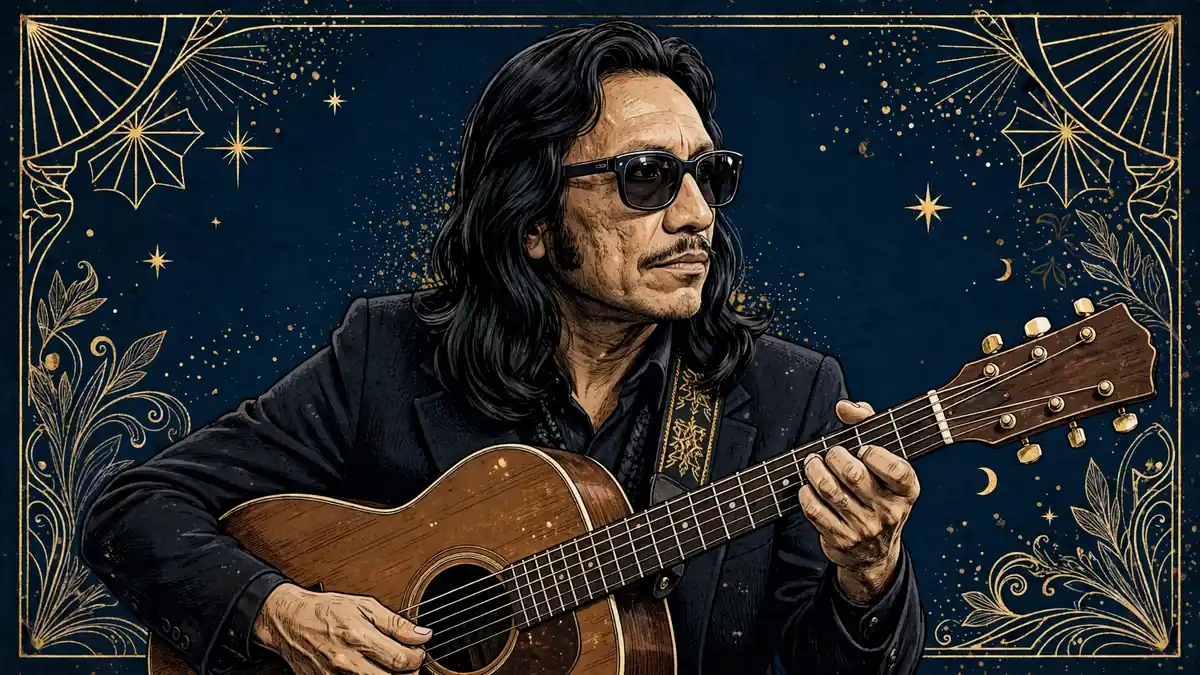
His name did appear on commercial products in one limited sense: reissued albums, a documentary soundtrack, a live album from Australia, and the 2015 biography Sugar Man: The Life, Death and Resurrection of Sixto Rodriguez by Craig Bartholomew Strydom and Stephen “Sugar” Segerman. Those are publishing and recording products, not sponsorships, and their income flowed through the royalty channels already described. His likeness — dark glasses, long hair, suit jacket — became iconic through the Cold Fact cover and the film, but it was never licensed into an advertising campaign during his lifetime.

Houses, Cars and Other Assets
Rodriguez’s asset list fits in one paragraph, and that is the point. In 1976 he bought a dilapidated house in Detroit’s historic Woodbridge neighborhood at a government auction for $50 — about $257 in 2022 dollars, according to inflation-adjusted reporting of the sale. He lived there for the rest of his life, was still recorded as living there in 2013, and walked its streets on camera in Searching for Sugar Man. The house was not a portfolio play: Detroit in the 1970s was shedding population and property values, and the purchase price tells you what the market thought of the building. Its later value, after decades of Detroit’s uneven recovery and Woodbridge’s historic-district status, was never publicly appraised or reported, and this article does not invent one. Even a generous appraisal of a modest Woodbridge home would add, at most, a low-six-figure asset to an estate — and only if it was owned outright and unencumbered, which no public record confirms.
He owned no reported second home, no car collection and no luxury assets. Contemporary accounts describe a man who did not own a telephone for years, wore the same style of dark suit and sunglasses on stage that he wore in the film, and traveled light. His guitar — an acoustic, played in his distinctive fingerpicked style — was his working tool, not a collector’s item. No auction record, probate filing or estate inventory has been published that would let anyone price his personal property, and the absence of such records is consistent with a modest estate rather than a hidden one.
That modesty is the strongest evidence against the $5 million and $6 million figures. A multi-million-dollar estate leaves traces: property records, catalog transactions, investment accounts, a probate fight. Rodriguez’s estate left none in public reporting. What it left was a house, a catalog whose royalties had only begun paying him in his late sixties, and a reputation that grew larger after his death than his bank balance ever did during his life.
Awards and Achievements
Rodriguez’s awards shelf was nearly empty for forty years and then filled, all at once, through someone else’s film. Searching for Sugar Man won the Academy Award for Best Documentary Feature at the 2013 Oscars and a BAFTA for Best Documentary, and those are the honors most often attached to his name. He did not win a Grammy, and his albums received no American gold or platinum certification in his lifetime. The platinum discs he did receive were South African and Australian: Cold Fact was certified platinum in South Africa in 1998 and five-times platinum in Australia, honors that recognized sales in markets where he had been a star for decades without knowing it.
His other honors were civic and academic rather than commercial. The honorary Doctor of Humane Letters from Wayne State University in May 2013 recognized a graduate who had returned to finish his degree while working construction. His songs’ afterlife is its own achievement: “Sugar Man” was sampled by Nas on “You’re Da Man” from the 2001 album Stillmatic, covered by Just Jinger in 1998 and Paolo Nutini, and used by DJ David Holmes to open his 2002 mix album Come Get It I Got It; the Dave Matthews Band covered his work; and his anti-apartheid resonance made him a reference point in South African cultural history far beyond record sales. The BBC World Service devoted a 2022 Outlook episode to his rediscovery, a year before his death.
Net Worth Growth Over the Years
The table below is an illustrative reconstruction, not a bank statement. No audited figures exist for any year of Rodriguez’s life, so each row reflects the documented evidence for that period — record sales, touring, housing and lifestyle — rather than a precise balance.
| Period | What happened | Estimated position |
|---|---|---|
| 1970–1971 | Cold Fact and Coming from Reality flop in the United States; Sussex deal pays little | Near zero; living as a working musician |
| 1976 | Buys Woodbridge house at government auction for $50; working demolition and construction | Modest; wage income, one cheap home |
| 1979–1981 | Australian tours, sold-out theatres, live album; still unknown in America | Low five figures at most; tour fees, no royalty windfall |
| 1998 | First South African tour, six sold-out shows, platinum disc; returns for 30+ shows | Rising; first meaningful music income in decades |
| 2008–2009 | Light in the Attic reissues in the United States; royalty chain finally pays the artist | Steady royalty income begins |
| 2012–2013 | Searching for Sugar Man, Oscar win, American television, world touring | Peak earning years; much of it shared with family |
| 2018 | Touring winds down after a run ending with a Detroit hometown show | Peak passed; royalties and savings only |
| August 2023 | Dies aged 81 in Detroit after a stroke and illness | $50,000–$1 million (see estimate note) |
The shape of that curve is the opposite of a normal celebrity fortune. Most stars peak early and spend decades managing wealth; Rodriguez earned almost nothing from music for thirty years, earned real money for about six, and gave much of it away. Any growth chart that shows a smooth climb to $5 million is inventing both the slope and the destination.
Social Media Presence
Rodriguez was not a social-media figure, and his official presence was maintained by others. His official website, Sugarman.org, run with Stephen “Sugar” Segerman, was the channel through which his death was announced on August 8, 2023, with condolences to his daughters Sandra, Eva and Regan. That announcement, confirmed by his daughter Sandra to Segerman at 5:30 p.m. Detroit time, remains the authoritative death notice. He did not run a personal social-media brand, post lifestyle content or monetize a following, and no verified follower counts or social-media earnings can be attached to his name. Posthumous accounts and fan pages keep his music circulating, but they are not estate income in any documented amount.
His cultural afterlife runs on the film and the songs rather than on profiles. Searching for Sugar Man continues to introduce new listeners — the mechanism by which a 1970 album keeps finding audiences — and streaming keeps the catalog earning for his estate. Neither stream has produced a published figure, and this article does not estimate one.
Personal Life
Rodriguez married Konny Rodriguez, whom he met in 1972 while both were students at Wayne State University; they married in the early 1980s, according to the Associated Press obituary, which quoted Konny Rodriguez after his death. He had three daughters — Sandra, Eva and Regan — who were named in the Sugarman.org death announcement and who, with Konny, were his closest family at his death. His granddaughter Amanda Kennedy was among those confirming his death to reporters the following day.
He lived his private life the way he lived his public one: in Detroit, without display. Friends described evenings at the Old Miami and Motor City Brewing Works, philosophy talk over beer, and a man who treated fame, when it finally arrived, as an oddity to be enjoyed rather than a status to be defended. He ran for Detroit city council and mayor more than once and lost; the campaigns were sincere, local and unpaid, of a piece with songs that had always taken the side of the city’s poor against its powerful.
Rodriguez died on August 8, 2023, in Detroit, at 81, after a stroke and a period of illness in the preceding months. His wife described a short illness. He had turned 81 the previous month and had been celebrated at a tribute concert in Detroit. A memorial service was held on August 12, 2023, at the Majestic Theatre in Detroit, and he was buried at Holy Cross Cemetery in Detroit. The death notice on Sugarman.org was brief, and in keeping with the man, it asked for condolences to his daughters and family rather than listing achievements.
Sources & Reporting
Celebrity Net Worth — the $50,000 net-worth figure at death, the only named estimate with a stated public-source method; used as the low anchor of our range.
The New York Times — August 9, 2023 obituary: birth and death dates, Detroit bar discovery by Coffey and Theodore, the 2012 framing of his story, and the South African search narrative; reporting window 2012–2023.
Associated Press — August 2023 obituary carried widely (including WCIA): death announcement via Sugarman.org, wife Konny’s account of a short illness, the 1996 search by Segerman and Bartholomew-Strydom, and his manual-labor years.
Encyclopaedia Britannica — biographical spine: born July 10, 1942, died August 8, 2023, genre range and protest lyrics, and the 2012 documentary as the turning point.
NME — August 2023 death report: stroke and illness in his final months, confirmation via Segerman and daughter Sandra, and the 2012 documentary context.
The Guardian — reporting on the 2014 royalties dispute between Gomba Music and Avant’s Interior Music, cited via NME’s coverage of the dispute.
Detroit Free Press (via Sugarman.org’s republication) — May 2014 reporting on the Gomba lawsuit against Clarence Avant, the alleged fraudulent crediting, and the claimed 500,000 South African sales.
Justia (federal court records) — the Eastern District of Michigan opinion in Gomba Music v. Avant, granting summary judgment to Avant and Interior and recording that Balk had effectively abandoned the arrangement.
MuseWire — music-business analysis of the royalty chain: the 10-percent Sussex rate, recoupment, half-rate foreign royalties, and why South African payments never reached Rodriguez.
Wikipedia (Cold Fact and Sixto Rodriguez entries, cross-checked against chart and obituary reporting) — album dates, A&M South Africa release in 1971, Australian chart peak No. 23 in 1978 over fifty-five weeks, South African platinum in 1998, Australian five-times platinum, and Light in the Attic reissues in 2008–2009.
Okayplayer (OkayAfrica) — the 1998 six-show sold-out South African tour, the platinum disc presentation, and the unclear destination of South African profits.
NPR (via WCBE/NPR reporting) — the 1979 Australian tour, the Regent Theatre sellouts, and Rodriguez’s own account of playing for 7,000 people abroad and returning to hammering nails in Detroit.
Far Out Magazine — August 2023 death report: the 1976 $50 government-auction house purchase and his daughters’ confirmation of the death.
Lower-quality aggregators (Waploaded, Naijapopstar, Tattlewiki, Superstars Biography, MusicianWages) were read and deliberately NOT used as sources for figures: they repeat $5 million, $6 million or $1 million without naming a source, and one repeats an unsourced “$1 million salary.” They are named here so readers can see why our range rejects them.
Frequently Asked Questions
What was Sixto Rodriguez’s net worth when he died?
Estimates range from $50,000 to $1 million at his death on August 8, 2023. Celebrity Net Worth puts the figure at $50,000. The $5 million and $6 million figures on copycat sites name no source and fit none of the documented facts — no catalog sale, no property portfolio, and a modest Detroit house — so this article treats them as unreliable and keeps the range wide and low.
How did Sixto Rodriguez die?
Rodriguez died on August 8, 2023, in Detroit, aged 81, after a stroke and a period of illness in the months before his death. His wife, Konny Rodriguez, described a short illness. His death was announced on his official website, Sugarman.org, and confirmed by his daughter Sandra.
Was Sixto Rodriguez really famous in South Africa?
Yes — and on a scale that is hard to overstate. Cold Fact was released in South Africa in 1971, spread through vinyl and cassette copies under apartheid, and became an anthem for white liberal youth opposed to the regime. Fans said he was more popular there than Elvis Presley, and he received a platinum disc for South African sales on his first tour there in 1998.
Did Rodriguez ever receive his South African royalties?
Not from the 1970s sales. The royalty chain was broken: his Sussex contract paid about 10 percent of wholesale against recoupable costs, foreign sales paid at half rate, and the South African licensee never remitted royalties to the American companies. A 2014 lawsuit by Harry Balk’s Gomba Music against Clarence Avant alleged fraudulent crediting, but a federal court later granted summary judgment to Avant’s side, and no verified payout to Rodriguez has ever been published.
What is Searching for Sugar Man about?
It is Malik Bendjelloul’s 2012 documentary about two South African fans, Stephen ‘Sugar’ Segerman and Craig Bartholomew-Strydom, who set out to learn whether the Rodriguez of Cold Fact was really dead — fans had long believed he had killed himself on stage — and found him alive and working construction in Detroit. The film won the 2013 Academy Award for Best Documentary Feature.
How much did Rodriguez’s Detroit house cost?
He bought a dilapidated house in Detroit’s Woodbridge neighborhood at a government auction in 1976 for $50, roughly $257 in 2022 dollars. He lived there for the rest of his life, including through his late-career fame.
Was Sixto Rodriguez married, and did he have children?
He married Konny Rodriguez, whom he met at Wayne State University in 1972; they married in the early 1980s. He had three daughters, Sandra, Eva and Regan, who were named in the Sugarman.org announcement of his death.
What happened to Rodriguez’s music after his death?
His catalog — Cold Fact (1970), Coming from Reality (1971), the Australian live album and the Searching for Sugar Man soundtrack — continues to sell and stream, with royalties flowing to his estate. No estate value or posthumous earnings figure has been published, so this article does not estimate one.
Final Thoughts
Sixto Rodriguez’s fortune was never the point of his story, and inflating it would betray the story. The documented record shows a singer who made two great albums, watched them fail at home, became a legend in a country he had never visited, earned almost nothing from that legend for thirty years, and then spent his seventies touring the world and handing much of the money to his family. At his death in August 2023, a range of $50,000 to $1 million fits every verified fact: the $50 house, the late-arriving royalties, the brief touring peak, and the absence of any sale or estate that could support a bigger number. The $5 million figure that fills search results is a copy of a copy, and it deserves to be retired.
What endures is not a balance sheet but a catalog. Two albums, recorded in Detroit in 1969–1971, outlived a record label, an apartheid regime, a rumor of suicide and four decades of obscurity, and they are still finding listeners today. That is a rarer achievement than a fortune, and it is the one Rodriguez actually kept.
Published on November 4, 2026. Last reviewed November 2026. Found an error? See our corrections policy.