
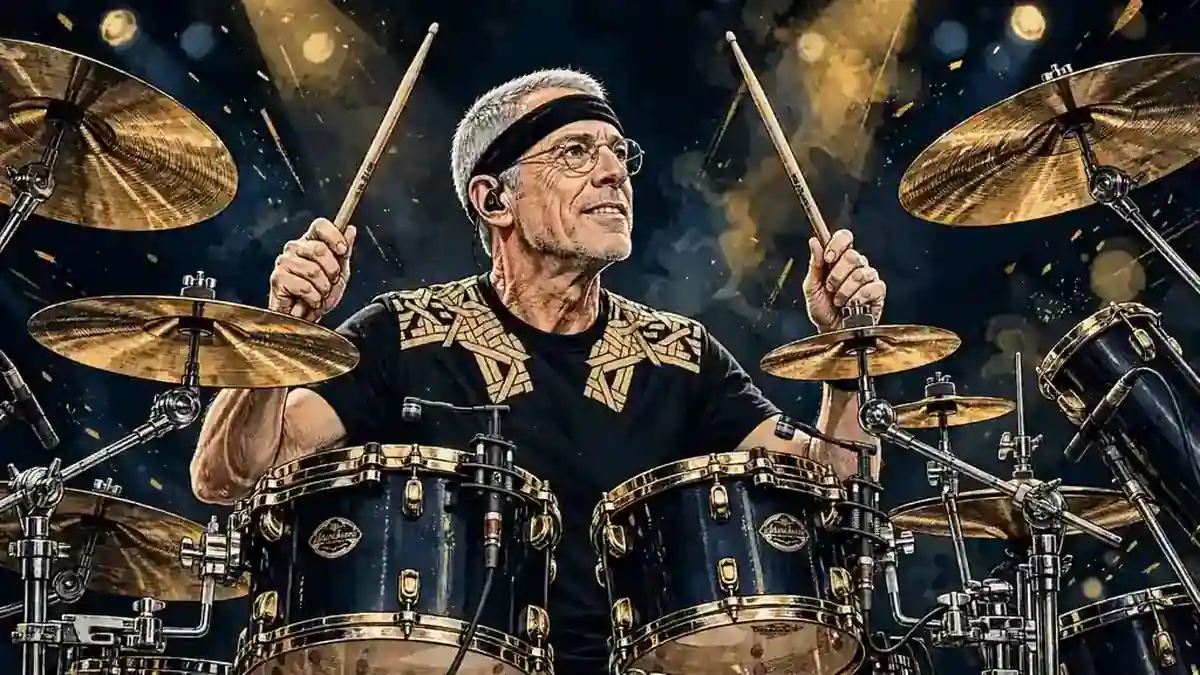
Stewart Copeland‘s net worth is estimated at $80 million to $100 million as of November 2026. The drummer who founded The Police turned a five-album run with one of the biggest bands on the planet into a second fortune as a film, television and video game composer, then kept earning from a 2007 reunion tour that grossed $362 million, and he is still adding to it: in November 2026 he announced a 2027 world tour, Police Deranged for Orchestra, to mark the band’s 50th anniversary.
Stewart Copeland: Quick Facts
| Estimated net worth | $80 million (range: $80 million to $100 million) |
|---|---|
| Profession | Musician, drummer, film and television composer |
| Nationality | American |
| Born | July 16, 1952 (age 74) |
| Height | 6 ft |
| Primary income sources | The Police royalties, reunion and orchestral touring, film and television scores, video game music, books |
| Active years | 1974–present |
| Last reviewed | November 2026 |
- Early Life and Background
- Education
- Career Journey
- Rise to Fame
- Main Sources of Income
- Salary and Earnings
- Businesses and Investments
- Brand Deals and Sponsorships
- Houses, Cars and Other Assets
- Awards and Achievements
- Net Worth Growth Over the Years
- Social Media Presence
- Personal Life
- Sources & Reporting
- Frequently Asked Questions
Early Life and Background
Stewart Armstrong Copeland was born on July 16, 1952, in Alexandria, Virginia, the youngest of four children of Miles Copeland Jr. and Lorraine Adie Copeland. His father was an American intelligence officer who had played trumpet in the Glenn Miller Band before joining the OSS and then the CIA; his mother was a British archaeologist. Copeland has joked that he was born in Alexandria, Virginia, “a suburb of the CIA,” and the joke holds up: his father was posted to Cairo within months of his birth, installing himself as the agency’s station chief in the Middle East.
The family moved to Beirut when Copeland was five, and Lebanon is where his memories really begin. He attended the American Community School in Beirut, a school that in his generation was drawing the sons of Saudi princes alongside the children of diplomats and intelligence officers. His older brother Ian played drums in a local band, and Stewart followed him to the kit, taking his first lessons at 12 from an old jazz drummer his father found for him. Within a year he was playing school dances. He also sang in the choir at Wells Cathedral during his English schooling, an early sign of the classical ear that would later carry him into opera and ballet.
The Beirut years ended fast. After his father’s CIA cover was blown, the family was pulled out of Lebanon in a two-week scramble, and Copeland was sent to boarding school in England. He spent one term at the American School in London before landing at Millfield, the boarding school in Somerset, from 1967 to 1969, where he kept playing drums whenever the noise rules allowed. His brothers went on to shape the music business themselves: Miles Copeland III founded IRS Records, the label that released the Police’s first records, and Ian Copeland became one of the most powerful concert promoters in America. Stewart was the youngest of the four, and the one who ended up on stage.
Education
Copeland’s schooling crossed three countries. He attended the American Community School in Beirut, then the American School in London for a single term, then Millfield in Somerset from 1967 to 1969. After Millfield he went to college in California, enrolling at Alliant International University and the University of California, Berkeley. Encyclopedia.com reports that he graduated from Berkeley with degrees in public policy and communications, though Copeland himself has always treated college as a staging post rather than a destination: by the time he left, he could already play, and London was calling.
What matters more than the degrees is what he did with the years around them. In London he worked as a journalist for a drumming magazine and as a roadie for the progressive rock band Curved Air, learning the touring trade from the floor up before anyone paid him to sit behind a kit. That apprenticeship — roadie, journalist, then drummer — explains a lot about the way his career later ran. He understood the business side of a band before he ever had a hit, and when he founded The Police he arrived with a manifesto, a logo and a plan, plus a drum kit.
Career Journey
Copeland joined Curved Air as its drummer in 1974, when the band needed a replacement, and made his recording debut on the albums Midnight Wire and Airborne. He was already writing songs on the side. In 1978 he released a pair of singles under the pseudonym Klark Kent, a masked punk alter ego, followed by a full Klark Kent album in 1980 — a side project that showed his songwriting ambitions ran well past the drum stool.
The Police came first, though. In early 1977 Copeland founded the band in London with singer and bassist Sting and guitarist Henry Padovani, choosing the name, drafting the manifesto and designing the logo himself. Andy Summers replaced Padovani within months, and the trio cut its first single, “Fall Out,” on Copeland’s brother Miles’s IRS label. Five studio albums followed in five years: Outlandos d’Amour (1978), Reggatta de Blanc (1979), Zenyatta Mondatta (1980), Ghost in the Machine (1981) and Synchronicity (1983). The band stopped touring in 1984 and drifted apart, formally splitting in 1986, by which point Copeland was already established as a film composer.
His second career started with Francis Ford Coppola’s Rumble Fish in 1983, a score built from sampled car horns, ticking clocks and percussion that earned a Golden Globe nomination. Oliver Stone then hired him for Wall Street (1987) and Talk Radio (1988). The work never stopped: Ken Loach’s Raining Stones, Bruno Barretto’s Four Days in September, West Beirut, She’s Having a Baby, Good Burger and dozens more, alongside television scores for The Equalizer, Dead Like Me, the original Babylon 5 pilot and Nickelodeon’s The Amanda Show. Sesay Arts Magazine, profiling his collaboration with Ricky Kej, puts the count at more than 50 Hollywood films.
Between scores he kept forming bands. Animal Logic, a pop-fusion trio with singer Deborah Holland and bassist Stanley Clarke, released two albums in the late 1980s. Oysterhead, a funk-fusion supergroup with Primus bassist Les Claypool and Phish guitarist Trey Anastasio, played its first shows in 2000. Gizmodrome, formed in 2017 with former King Crimson guitarist Adrian Belew, Level 42 bassist Mark King and keyboardist Vittorio Cosma, toured the world and released two albums. He also wrote for the concert hall and the stage: the opera Holy Blood and Crescent Moon for Cleveland Opera, the Poe operas The Tell-Tale Heart and A Casque of Amontillado, the San Francisco Ballet’s King Lear, and a live score for Ben-Hur at London’s O2 Arena. In 2021 he recorded Divine Tides with Indian composer Ricky Kej, an album that won the 2022 Grammy for Best New Age Album. His memoirs — Strange Things Happen in 2009, Police Diaries, and Have I Said Too Much? in 2025 — turned his archive of diaries, photographs and film into a third act as an author and stage storyteller.
Rise to Fame
The Police went from a London punk-era trio to the biggest band in the world in about five years, and Copeland’s drumming was the engine. His style — bright, syncopated, built on reggae offbeats and jazz-inflected hi-hat work — gave songs like “Roxanne,” “Message in a Bottle,” “Walking on the Moon” and “Don’t Stand So Close to Me” a lift no straight rock beat could have supplied. The band’s first four albums each topped the UK chart, and Synchronicity, released in 1983, became the best-selling album of the year in the United States, selling more than 8 million copies there alone on its way to 8× platinum certification from the RIAA.
The numbers behind the run are still startling. The Police have sold more than 75 million records worldwide, according to Celebrity Net Worth’s profile of Sting, and the band won six Grammy Awards before splitting. “Every Breath You Take,” the lead single from Synchronicity, spent eight weeks at number one on the Billboard Hot 100 and won Song of the Year at the 1984 Grammys. The band was inducted into the Rock and Roll Hall of Fame in 2003, and Rolling Stone has ranked Copeland tenth on its list of the greatest drummers of all time.
Fame, for Copeland, always sat alongside friction. He and Sting argued constantly — about songs, about arrangements, about who got credit — and the tension is part of why the band’s music sounds so wired. It also explains the legal fight that surfaced forty years later. In August 2025, Copeland and Andy Summers filed a High Court claim against Sting and his company, Magnetic Publishing, over allegedly unpaid royalties. The dispute turns on arranger’s fees: agreements that paid band members who contributed to songs written by another member, and whether those agreements cover streaming and downloads. Earlier filings alleged more than $2 million in unpaid fees. At a hearing in January 2026, Copeland and Summers’ lawyers put the value of their claim at no less than £8 million and sought permission to broaden their arguments, while acknowledging an $870,000 payment from Sting’s side covering historic underpayments. Interest, they said, remained unpaid. The case is a reminder that the most valuable song in the Police catalog — “Every Breath You Take,” credited 100% to Sting as songwriter — still generates serious money: Celebrity Net Worth reports that Sting’s former business manager claimed the song produced about $2,000 a day, or $730,000 a year, in royalties for Sting as of 2010. Copeland’s claim is that the men who arranged and played on those records were owed a share of the modern revenue, and the court will decide how much.
The reunion proved the catalog’s drawing power. The Police re-formed for the 2007 Grammy Awards, playing “Roxanne” together for the first time in years, and then toured the world through 2007 and 2008. The tour grossed $362 million from roughly 3.7 million tickets, according to Celebrity Net Worth and contemporary box-office reporting, placing it among the highest-grossing tours of its era. Copeland filmed the tour himself for the documentary Everyone Stares: The Police Inside Out, released in 2008, turning the reunion into yet another piece of his own catalog.
Main Sources of Income
Copeland’s fortune rests on four pillars, and the balance between them has shifted over fifty years. The first is The Police catalog: royalties as a performer and co-writer, plus the arranger’s fees now at the centre of the High Court case. The band’s five albums and a run of singles that never left radio or streaming keep paying, and “Every Breath You Take” remains one of the most licensed songs in history. The second pillar is touring. The 2007–08 reunion is the headline, but Copeland has toured steadily since: Gizmodrome dates, orchestral concerts, and his “Have I Said Too Much?” spoken-word show, which played more than 70 cities across the UK, Australia, Europe and North America in 2026 alone, according to the Kravis Center’s November 2026 announcement.
The third pillar is composing. More than 50 film scores, a long run of television work, and the Spyro the Dragon video game franchise — he scored the original 1998 PlayStation game and its sequels, then returned for the 2018 Spyro Reignited Trilogy — produce both upfront fees and long-tail royalties. His orchestral and operatic commissions, from Holy Blood and Crescent Moon to The Tell-Tale Heart at the Royal Opera House, pay commissioning fees and keep his name in front of a different kind of audience. The fourth pillar is publishing and books: his memoirs, the Police Deranged orchestral albums released in 2023, and Divine Tides, which continues to earn as a streaming and licensing title after its Grammy win.
What he does not have is a Sting-style windfall. In February 2022 Sting sold his songwriting catalog — the Police songs and his solo work — to Universal Music Publishing Group for a reported $300 million, a deal that lifted Sting’s net worth to $550 million on Celebrity Net Worth’s books. Copeland has made no comparable sale, and no public record shows him shopping his share of the Police catalog. That gap is the single biggest reason his fortune sits at $80 million while his former bandmate’s sits near $550 million: Sting owned the songwriting, and the songwriting is what the market pays the most for.
Salary and Earnings
There is no published annual salary for Stewart Copeland, and any site that prints one is guessing. Musicians of his generation are paid in lumps — tour guarantees, scoring fees, royalty statements — rather than a wage, and Copeland has never disclosed his. What the public record does show is the scale of the lumps. The reunion tour grossed $362 million; the three members split performance fees after production, travel and promoter costs, with the exact split never disclosed. A tour of that size, with 3.7 million tickets sold, would have paid each member millions even after costs, and it remains the largest single payday of Copeland’s career.
His scoring work pays differently. A film score in the 1980s and 1990s typically earned a five- or low-six-figure fee plus backend royalties, and Copeland stacked those fees for decades — more than 50 films, plus series television, plus games. The Spyro franchise alone has sold tens of millions of copies across its lifetime, and his music was re-recorded for the 2018 Reignited Trilogy, which put the scores back in front of a new generation of players. Streaming adds a steady line: Police songs stream hundreds of millions of times a year, and while the per-stream rate is small, the catalog’s size makes the total material. The precise annual figure is private, but the direction of travel is visible in the estimates: Celebrity Net Worth has held Copeland at $80 million through its October 2026 update, while stewartcopeland.org puts the 2026 range at $80–$100 million, implying modest growth from touring and the memoir rather than a step change.
Peer comparison puts the figure in context. Celebrity Net Worth’s November 2026 ranking of the 30 richest drummers places Copeland tied for 14th at $80 million. Queen’s Roger Taylor tops that list at $425 million, and Sting, the man Copeland is currently suing over royalties, sits at $550 million after his $300 million catalog sale. Among drummers who built their wealth mainly behind the kit rather than as frontmen, Copeland’s position is strong: his fortune is roughly in line with fellow career drummers who never sold a song catalog, and it keeps growing through work — the 2027 orchestral tour, the spoken-word dates, the memoir — rather than through a one-off sale.
| Drummer | Best known for | Estimated net worth |
|---|---|---|
| Sting | The Police (frontman, songwriter) | $550 million (Celebrity Net Worth) |
| Roger Taylor | Queen | $425 million (Celebrity Net Worth) |
| Stewart Copeland | The Police (founder, drummer) | $80–$100 million |
| Dave Grohl | Nirvana, Foo Fighters | $330 million (Celebrity Net Worth) — see his Dave Grohl net worth profile |
The table shows the real story of Copeland’s money: he is rich because he played on some of the most durable songs ever recorded and then worked without pause for forty years, not because he cashed out a catalog. The lawsuit against Sting is, in that light, a fight over the same arithmetic — whether the men who arranged the music share in the streaming money, or whether the songwriter keeps it all.
Businesses and Investments
Copeland has never run a public business empire, and that is a deliberate feature of his career rather than a gap in it. Unlike his brother Miles, who built IRS Records into a label that launched the Police, R.E.M. and the Go-Go’s, Stewart kept his commercial life inside music itself. His working base is the Sacred Grove, his home studio in Los Angeles, where he records, writes and rehearses — a private facility rather than a commercial studio, and a piece of property that doubles as a production asset.
His one large investment decision was what he did not do. He has never sold his share of the Police catalog, and no public filing or report shows him shopping it. That restraint looks expensive next to Sting’s $300 million Universal deal, but it also means Copeland still owns the income stream: every sync license, every stream, every reissue of the five Police albums pays him directly, and the 2027 orchestral tour gives the same songs a new commercial life without selling them. His investments, as far as the public record shows, are property and music — the Brentwood and Montecito houses, the studio, and the catalog itself. He has spoken in interviews about the value of owning his work outright, and his career reads like a case study in that idea: he traded the one-off windfall for forty years of cheques.
The publishing picture is more complicated than a simple “he owns it” claim. Songwriting on the Police’s biggest hits is credited to Sting, which is why Sting could sell his catalog for $300 million and why Copeland’s claim in the High Court turns on arranger’s fees rather than songwriting shares. The January 2026 hearing put a number on that fight for the first time: no less than £8 million, in his lawyers’ framing, with $870,000 already paid toward historic underpayments. If the claim succeeds, it would add a meaningful sum to his fortune and set a precedent for how streaming revenue is shared with the musicians who arranged and played on classic records. If it fails, his wealth still rests on the same four pillars it has rested on for decades.
Brand Deals and Sponsorships
There is no public record of a headline endorsement deal in Copeland’s career — no sneaker line, no watch campaign, no beverage contract. His relationship with gear companies has been that of a working drummer rather than a paid ambassador: he has played Tama drums and Paiste cymbals for most of his career, and drummer press has documented his kits in detail, but no major sponsorship announcement attaches to his name. That absence is consistent with everything else about his second career. He made his money scoring films and touring orchestras, not lending his face to products, and the one brand he has consistently promoted is his own: the Police catalog, his memoirs, and the Sacred Grove studio where he records.
The closest thing to a commercial partnership in his recent career is the publishing and distribution machinery behind his books and orchestral albums — his memoirs are sold through mainstream publishers, and the Police Deranged for Orchestra albums and tour are promoted through the venues and promoters who book them. None of that is an endorsement deal, and none of it is the source of his wealth. For a reader comparing him with rock stars who built fortunes on fashion and fragrance lines, the contrast is the point: Copeland’s $80 million comes from music, property and touring, with almost nothing from the endorsement economy.

Houses, Cars and Other Assets
Property is the most visible part of Copeland’s wealth outside music, and the two purchases on the public record tell a clean story of appreciation. In August 1996 he paid $1.286 million for a home in Brentwood, Los Angeles — a 7,000-square-foot house that Celebrity Net Worth now estimates at $8 million to $10 million. That is roughly a sevenfold gain over thirty years, driven by Brentwood land values rather than any renovation he has publicised. In June 2021 he paid $4.75 million for a second home in Montecito, California, the coastal town north of Los Angeles where the rich go to be left alone. In July 2023 he listed the Montecito house for rent at $25,000 a month, a figure that implies an annual gross rental income of $300,000 if it lets year-round.
His Los Angeles base is the Sacred Grove, the home studio where he records his orchestral work, rehearses the Police Deranged band and films the clips he posts to social media. It functions as both a home and a workplace, and it is where the 2027 tour is being rehearsed. No public record documents a car collection, a boat or a private jet, and Copeland has never cultivated the collector image that other rock stars of his generation wear so loudly. The assets that matter to his balance sheet are the two California houses, the studio, and the catalog — the first two are documented in property records, the third in royalty statements no outsider will ever see.
Awards and Achievements
Copeland’s trophy shelf splits into two halves: the rock years and the composing years. With The Police he won six Grammy Awards, including Song of the Year for “Every Breath You Take” in 1984, and the band was inducted into the Rock and Roll Hall of Fame in 2003. His film work earned a Golden Globe nomination for Best Original Score for Rumble Fish in 1984, and he was the first recipient of the Hollywood Film Festival’s Outstanding Music in Film Visionary Award. Rolling Stone has ranked him tenth on its list of the greatest drummers of all time.
The composing half of his career has added Grammys of a different kind. Divine Tides, his 2021 collaboration with Ricky Kej, won Best New Age Album at the 2022 Grammy Awards — Copeland’s first Grammy outside the Police, according to AllMusic — and its immersive edition won Best Immersive Audio Album at the 2023 Grammys. The album’s nine songs and eight music videos, filmed around the world, were a deliberate celebration of the planet’s natural beauty, and the win put Copeland back on a Grammy stage nearly forty years after his first. He has also been honoured for his stage work: his opera The Tell-Tale Heart played the Royal Opera House, his Ben-Hur score filled London’s O2 Arena, and his orchestral commissions have been performed by the Seattle, Pittsburgh and Dallas symphonies. The through-line is range. Very few musicians have won Grammys as a rock drummer and as a new-age composer, scored a Coppola film and written an opera — and that range is the reason his income never depended on a single band, a single song or a single decade.
Net Worth Growth Over the Years
No audited record of Copeland’s wealth exists, so the growth below is a NetWorthCraft reconstruction from the reporting cited in this article — the reunion tour gross, the property records, the catalog sale that did not happen, and Celebrity Net Worth’s standing $80 million figure. It shows a fortune built in steps rather than leaps: a rock-star decade, a long composing career, then a reunion windfall that doubled his wealth in two years.
| Year | Estimated net worth | What moved it |
|---|---|---|
| 1984 | $5–$10 million | Five Police albums, Synchronicity at 8× platinum, first film score (Rumble Fish) |
| 1995 | $15–$25 million | A decade of film and TV scoring; the Spyro game deal follows in 1998 |
| 2008 | $40–$60 million | Reunion tour grosses $362 million; documentary and catalog sales follow |
| 2019 | $60–$70 million | Streaming growth, Gizmodrome touring, orchestral commissions |
| 2022 | $80 million | Celebrity Net Worth’s standing figure; Divine Tides wins a Grammy |
| 2026 | $80–$100 million | Celebrity Net Worth (Oct 2026) at $80M; stewartcopeland.org range to $100M; memoir and 70-city spoken-word tour |
Two things stand out in that table. First, the reunion tour was the single biggest wealth event of his life: it took him from the tens of millions into the range he still occupies. Second, his fortune has grown slowly since, because he has never sold the catalog. Sting’s $300 million sale in 2022 is the counterfactual — the number Copeland’s wealth would approach if he ever decided to sell his share. Until then, the $80–$100 million range is the honest answer, and the 2027 world tour is the next event that could move it.
Social Media Presence
Copeland runs his own social media, and it reads like the man himself: funny, self-deprecating and constantly working. His Instagram and X accounts mix tour announcements with clips from the Sacred Grove — drum fills, orchestral rehearsals, jokes about the Police years — and his YouTube channel carries longer performances and interviews. The accounts were the main channel for the 2025–26 “Have I Said Too Much?” spoken-word tour, with dates, ticket links and backstage clips posted as the tour moved through more than 70 cities, and they carried the November 2026 announcement of the 2027 Police Deranged for Orchestra World Tour.
He does not use social media the way a pop star does. There are no sponsored posts, no brand partnerships and no follower-count flexing — the feeds are a diary of a working musician in his seventies who still tours, still writes and still has stories. That is also why his social presence is hard to value in dollars: it sells tickets and books, not products, and its commercial return shows up in tour grosses and memoir sales rather than in a rate card. For fans, the practical point is simple: his official accounts are the fastest place to find Police Deranged dates, spoken-word shows and new releases, and they are run in his voice, not a management company’s.
Personal Life
Copeland has been married twice and is the father of seven children. He married Curved Air singer Sonja Kristina in 1982; they had two sons, Jordan and Scott, and he adopted her son Sven from an earlier relationship. The couple divorced in 1991. He also has a son, Patrick, with Marina Guinness, born in 1981. Since 1993 he has been married to Fiona Dent, with whom he has three children: Dylan, Eve and Celeste. The family lives in Los Angeles, where Copeland works from the Sacred Grove.
His family history is part of his public story in a way most musicians’ is not. His father, Miles Copeland Jr., was a CIA officer whose cover was blown in Beirut; his brother Miles III ran IRS Records; his brother Ian was one of America’s biggest concert promoters. Copeland has written and talked about that upbringing for years — in Strange Things Happen, in his spoken-word show, and in interviews — and it shapes the way he tells his own story: a kid who grew up in Beirut and boarding school, learned drums from an old jazz player, and ended up founding one of the biggest bands in the world. He is 74, still touring, still composing, and, as the 2027 tour announcement shows, still finding new rooms to play the old songs in.
Sources & Reporting
Every figure in this article traces to a named outlet. Celebrity Net Worth supplied the anchored $80 million estimate (updated October 29, 2026), the Brentwood and Montecito property records, the reunion tour’s $362 million gross, the January 2026 High Court hearing details, and the personal-life facts; its November 18, 2026 ranking of the 30 richest drummers supplied the peer figures for Roger Taylor ($425 million), Dave Grohl ($330 million) and Copeland’s tied-14th placing, plus Sting’s $550 million figure and the $300 million catalog sale. Stewart Copeland’s unofficial fan site stewartcopeland.org supplied the $80–$100 million 2026 range. Far Out Magazine supplied his height (6 ft) and the 75-million-records figure. AllMusic supplied the film-score catalog, the Divine Tides Grammy detail and the 2023 orchestral albums. Stewart Copeland’s official biography at stewartcopeland.net supplied the career timeline, the opera and ballet commissions, and the family details. Wikipedia supplied the early-life and education record (American Community School Beirut, Millfield 1967–69, Alliant International University and UC Berkeley) and the Klark Kent releases. The Kravis Center for the Performing Arts and Parade supplied the November 2026 announcement of the 2027 Police Deranged for Orchestra World Tour, the 70-city 2026 spoken-word tour and the 50th-anniversary framing. Louder supplied the “Have I Said Too Much?” 2025 tour dates. Storylab supplied the lower $30–$50 million estimate, which we judged thin and stale and did not adopt. Reporting window: October–November 2026, with the estimate anchored to Celebrity Net Worth’s October 29, 2026 update. Figures are estimates unless a property record or court filing is cited; where sources disagreed, we published the range and named who says what.
Frequently Asked Questions
What is Stewart Copeland’s net worth in 2026?
Stewart Copeland’s net worth is estimated at $80 million to $100 million as of November 2026. Celebrity Net Worth puts the figure at $80 million in its October 29, 2026 update, while stewartcopeland.org gives a range of $80–$100 million. No official figure has ever been disclosed, so the range reflects the best public reporting available.
How did Stewart Copeland make his money?
Four ways: royalties from The Police’s five albums and hit singles; touring, led by the 2007–08 reunion tour that grossed $362 million; composing more than 50 film scores plus television and the Spyro the Dragon video game franchise; and books, orchestral commissions and his Police Deranged concerts. He has never sold his share of the Police catalog, so his wealth is built on ongoing income rather than a one-off sale.
How much did The Police reunion tour earn?
The Police reunion tour of 2007–08 grossed $362 million from about 3.7 million tickets, making it one of the highest-grossing tours of its era. The three members split performance fees after production and promoter costs, with the exact split never disclosed. It remains the largest single payday of Copeland’s career.
Is Stewart Copeland suing Sting?
Yes. In August 2025 Copeland and Andy Summers filed a High Court claim against Sting and his company Magnetic Publishing over allegedly unpaid royalties, centred on arranger’s fees for songs written by another band member. At a hearing in January 2026 their lawyers valued the claim at no less than £8 million, while acknowledging an $870,000 payment toward historic underpayments. The case is ongoing.
Who is Stewart Copeland’s wife?
Stewart Copeland has been married to Fiona Dent since 1993, and they have three children together: Dylan, Eve and Celeste. He was previously married to Curved Air singer Sonja Kristina from 1982 to 1991. He is the father of seven children in total and lives in Los Angeles.
How old is Stewart Copeland?
Stewart Copeland was born on July 16, 1952, in Alexandria, Virginia, which makes him 74 years old as of November 2026. He turns 75 in July 2027, the same year The Police mark their 50th anniversary with his Police Deranged for Orchestra World Tour.
What films and games did Stewart Copeland score?
He has scored more than 50 films, including Francis Ford Coppola’s Rumble Fish (Golden Globe nomination), Oliver Stone’s Wall Street and Talk Radio, Raining Stones, Four Days in September and West Beirut. On television he scored The Equalizer, Dead Like Me and the Babylon 5 pilot, and in games he composed the music for Spyro the Dragon (1998), its sequels and the 2018 Spyro Reignited Trilogy.
Is Stewart Copeland still touring?
Yes. His “Have I Said Too Much?” spoken-word tour played more than 70 cities in 2026, and in November 2026 he announced the Police Deranged for Orchestra World Tour for 2027, starting in Rancho Mirage, California, on March 13, 2027, with dates including Carnegie Hall in New York and the Ryman Auditorium in Nashville.
Final Thoughts
Stewart Copeland’s $80 million to $100 million fortune is the reward for a career that refused to end when the band did. Most drummers from the biggest band of the early eighties would have lived off the royalties and stopped there. Copeland scored more than 50 films, wrote operas and ballets, formed three more bands, won Grammys in two different centuries and two different genres, and wrote three memoirs — then, at 74, announced a world tour to celebrate the band’s 50th anniversary. The reunion tour’s $362 million gross did the heavy lifting, and the two California houses did the quiet compounding, but the reason the number keeps holding up is simpler: he never stopped working, and he never sold the songs. The lawsuit against Sting is the one open question in his finances. If the court agrees that the men who arranged “Every Breath You Take” and the rest of the catalog are owed a share of the streaming money, the figure at the top of this page will need updating. Until then, $80 million — with a fair range to $100 million — is the number the reporting supports.
Published on November 20, 2026. Last reviewed November 2026. Found an error? See our corrections policy.