
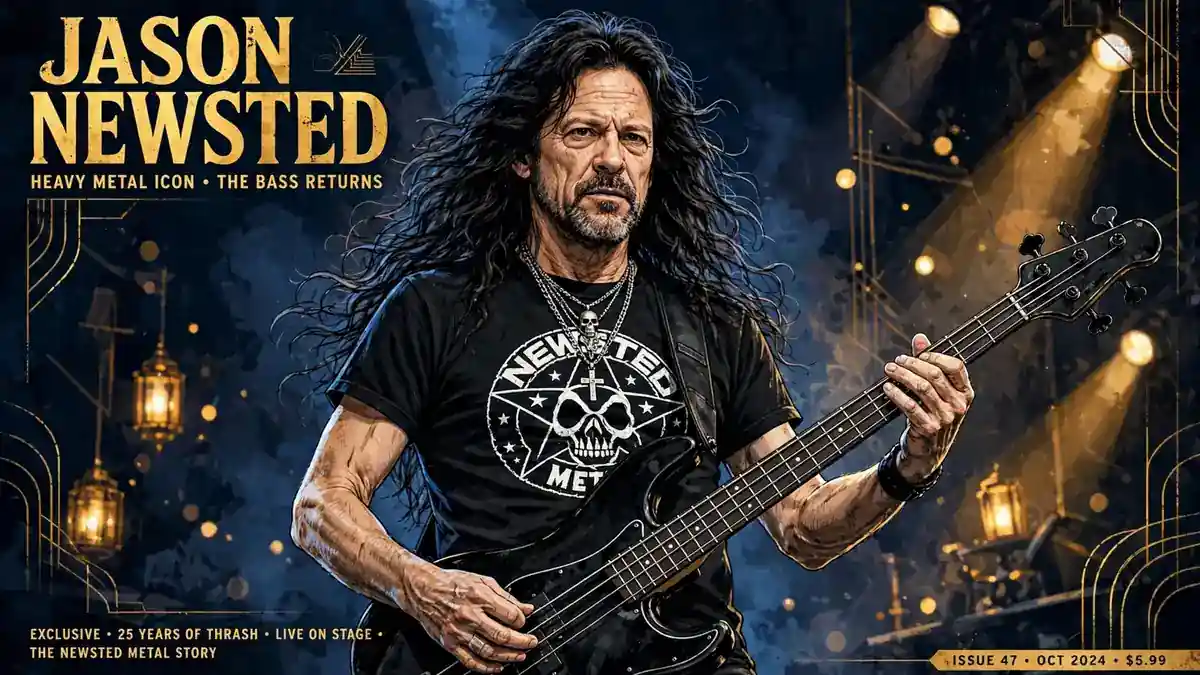
Jason Newsted‘s net worth is estimated at $40 million–$60 million as of November 2026, anchored at $60 million by Celebrity Net Worth’s February 2026 update. The former Metallica bassist joined the biggest metal band on the planet at $500 a week in 1986, played on the best-selling album of the SoundScan era, walked away from it all in 2001, and then built a second act as a painter whose canvases sell for as much as $125,000 apiece. He also owns a vineyard, runs his own record label, and has bought and sold millions of dollars of American real estate — from a 545-acre Montana ranch to a $6.1 million lakefront property in New York.
Jason Newsted: Quick Facts
| Estimated net worth | $60 million (range: $40 million–$60 million) |
|---|---|
| Profession | Musician, songwriter, visual artist, record label owner |
| Nationality | American |
| Born | March 4, 1963 (age 63) |
| Height | 6 ft 1 in (1.85 m) |
| Primary income sources | Metallica royalties and touring, songwriting, art sales, Chophouse Records, real estate, wine |
| Active years | 1981–present |
| Last reviewed | November 2026 |
- Early Life and Background
- Education
- Career Journey
- Rise to Fame
- Main Sources of Income
- Salary and Earnings
- Businesses and Investments
- Brand Deals and Sponsorships
- Houses, Cars and Other Assets
- Awards and Achievements
- Net Worth Growth Over the Years
- Social Media Presence
- Personal Life
- Sources & Reporting
- Frequently Asked Questions
Early Life and Background
Jason Curtis Newsted was born on March 4, 1963, in Battle Creek, Michigan, and grew up in a working-class household in Niles, Michigan, a small city near the Indiana border. His childhood soundtrack was Motown, classic rock and early heavy metal — the radio staples of a Michigan kid in the 1970s — and the bands that pulled him toward the bass were Kiss, Black Sabbath and Led Zeppelin, the three acts Celebrity Net Worth names as his early inspirations. The bass chose him early: while other teenagers in Niles were learning guitar riffs, Newsted was drawn to the low end, the instrument that holds a band together and rarely gets the spotlight.
Niles was not a music-industry town, and nothing in Newsted’s upbringing pointed toward arenas. He played in local bands through his teens, learning the unglamorous side of the trade — loading gear, playing bars, splitting small guarantees — before the thrash movement gave him a lane. By the early 1980s he had moved west to Arizona, where the desert metal scene was forming around bands that played faster and louder than anything on the radio. That move set up the first real break of his career: Flotsam and Jetsam, a Phoenix thrash band he helped form, became his full-time job from 1981 onward.
The detail that matters for the money story is how long Newsted spent broke. He was 23 years old, five years into a working band, when Metallica called — and his starting pay in the biggest metal band in the world was $500 a week, a figure he has discussed in interviews and that TalkBass documented from his own account. Some fan accounts put the number at $400 a week plus expenses. Either way, the richest chapter of his life began on a hired-hand wage, not a windfall. That gap — between the weekly paycheque and the $60 million estimate — is the whole arc of this article.
Newsted’s family background stayed out of the spotlight throughout his career, and he has kept it that way. What the record shows is a self-taught, working-class musician who treated the bass as a trade: practice, touring, session work, and a willingness to take the hardest gig in metal — replacing a dead legend — when it arrived.
Education
There is no record of Newsted attending college or holding a formal music degree, and no credible source claims one. His education was the road: five years with Flotsam and Jetsam, then fifteen years inside Metallica’s touring and recording machine, then two decades of running his own label, studio and art practice. The absence of a classroom credential is worth stating plainly because it shapes the earnings story — every dollar Newsted made came from playing, writing, touring, recording and selling work he made himself, not from a credential or a corporate ladder.
What he did learn, and what shows up in his later business moves, is the economics of a working band. In Flotsam and Jetsam he learned how little a thrash band earned in the mid-1980s. In Metallica he learned how a band becomes a company: publishing splits, merchandising, touring grosses, and the difference between being a salaried sideman and being a partner. That last lesson cost him. Newsted has said he spent his first year in Metallica effectively as a hired hand — paid weekly, not a partner in the band’s business — and the contrast with Robert Trujillo’s later deal, which included a reported $1 million advance on joining in 2003, is a sore point fans still argue about. The business education, in other words, arrived as lived experience, and it explains why he later built Chophouse Records as his own shop rather than signing his projects to someone else’s.
His painting education followed the same pattern. He took up painting seriously while recovering from a shoulder injury in the mid-2000s, encouraged by his wife Nicole, an artist. There was no art school; there were years of large canvases in a home studio, a first gallery show in San Francisco in 2010, and then representation by a Paris gallery. The self-taught thread runs through the whole career: bass, business, painting — learned by doing, in public, at full volume.
Career Journey
Newsted’s career breaks into three acts, and each one paid differently. Act one was Flotsam and Jetsam, the Arizona thrash band he played with from 1981 to 1986. The band released Doomsday for the Deceiver in 1986, a debut that earned real respect in underground metal circles and put Newsted on the radar of bigger bands. The money was thin — club guarantees and small record advances — but the album proved he could write, record and tour at thrash speed, and it put him in the room when Metallica needed a bassist.
Act two began in tragedy. On September 27, 1986, Metallica’s bassist Cliff Burton was killed when the band’s tour bus crashed in Sweden. Metallica auditioned dozens of players and chose the 23-year-old from Flotsam and Jetsam. Newsted joined in October 1986, stepping into a band grieving a bandmate, carrying a fan base that loved Burton, and joining two founders — James Hetfield and Lars Ulrich — who ran the group as a tight partnership. His debut with the band was the 1987 EP The $5.98 E.P. – Garage Days Re-Revisited, and his first full studio album was 1988’s …And Justice for All.
The Justice album was a commercial breakthrough — a Grammy nomination, the single “One,” and a mainstream audience for a band that had lived underground — but it carried a wound Newsted has never hidden. His bass tracks were mixed so low on the final record that fans still debate whether the bass is audible at all. The slight became part of his story: the new guy, doing the job, barely heard on the record. He stayed, and the next album changed everything. He also earned songwriting credits that pay to this day, co-writing “Blackened,” “My Friend of Misery” and “Where the Wild Things Are,” the three Newsted co-writes Ultimate Classic Rock singles out as his notable contributions to the Metallica catalogue.
Act two ran fifteen years, through five studio albums, and ended on January 17, 2001, when Newsted announced his departure as the band prepared to record its eighth album, the record that became 2003’s St. Anger. His public statement cited “private and personal reasons and the physical damage I have done to myself over the years while playing the music that I love.” Behind that sentence sat a sharper dispute, laid out in a 2001 Playboy interview with the band: Newsted wanted to release an album with his side project Echobrain, and Hetfield opposed it, saying “when someone does a side project, it takes away from the strength of Metallica” and comparing it to “cheating on your wife.” Newsted countered that Hetfield himself had played on other people’s records; Hetfield replied, “My name isn’t on those records, and I’m not out trying to sell them.” In a December 2013 interview with Scuzz TV, Newsted added that Metallica’s management at Q Prime had wanted to promote Echobrain — and then, on Hetfield’s demand, backed off. His account of the call back from management: “Sorry we’re not going to be able to help you with that Echobrain thing.” The band nearly broke up entirely in the months that followed, with Hetfield entering rehab and the turmoil later documented in the film Metallica: Some Kind of Monster.
Act three has lasted longer than act two. After leaving Metallica, Newsted played with Echobrain, joined Canadian progressive thrash band Voivod under the pseudonym Jasonic, and toured with Ozzy Osbourne’s touring band — a stint that connects his story to Ozzy Osbourne’s net worth and solo career, built on the same touring circuit. He formed the band Papa Wheelie at his home studio in 1997, played in Rock Star Supernova, and in 2012 fronted his own band, Newsted, releasing the Metal EP in January 2013 and the album Heavy Metal Music that August. The band toured fast — 17 or 18 countries in its first months, on the Gigantour bill — and Newsted has said he poured millions of dollars of his own money into that project and others like it. In August 2016, after two years out of the public eye, he formed Jason Newsted and the Chophouse Band, an acoustic Americana outfit that plays benefit shows and, in the summer of 2026, undertook its first-ever North American headlining tour: eight dates including Northampton, Albany, Alexandria, Grand Rapids and Knoxville, announced in April 2026 by Backstage Axxess. Across his whole career, Wikipedia’s discography count credits him with more than 250 recordings, spanning studio albums, live material, soundtracks and charity releases.
The through-line is independence. Newsted left the biggest metal band in the world because it would not let him make music outside it, then spent the next twenty-five years making music outside it — on his own label, in his own studio, with his own money. That choice cost him the Metallica touring paycheque and bought him the catalogue royalties, the art career and the businesses that make up the $60 million estimate.
Rise to Fame
Newsted did not rise to fame gradually; he was dropped into it. One month he was the bassist of a respected but small Arizona thrash band, the next he was on stage with Metallica, a band already carrying the weight of Burton’s death and a fan base watching every note the new guy played. The audition itself was the break — dozens of players tried out, and the 23-year-old won the chair — and the first two years tested whether he could hold it. …And Justice for All put him on a Grammy-nominated record and on MTV with “One,” the band’s first real video, even as the mix buried his bass.
The Black Album was the explosion. Released in 1991, the self-titled Metallica debuted at number one and became the best-selling album of the SoundScan era — certified 16-times platinum in the United States alone, and later 2-times Diamond. It has sold more than 16 million copies in the US, and Celebrity Net Worth notes it still sells around 5,000 copies a week, decades after release. The singles — “Enter Sandman,” “Sad But True,” “The Unforgiven,” “Nothing Else Matters” — turned Metallica from a metal band into a stadium band, and Newsted’s aggressive picking style, high backing vocals and physical stage presence became part of the show. The tour that followed ran for years and played to millions.
The 1990s kept the machine running: Load in 1996 and Reload in 1997 pushed the band toward a groove-driven, alternative-influenced sound that split the old fan base and still sold in the millions; Garage Inc. in 1998 collected the band’s covers; and S&M in 1999, recorded live with the San Francisco Symphony, put Metallica in concert halls the band had never played. Through it all, Newsted was the band’s live engine — the backing vocals, the headbanging, the energy that carried marathon sets. Fame, for him, was never the frontman kind. Hetfield sang, Ulrich talked, and Newsted held the bottom end together in front of 50,000 people a night.
The Rock and Roll Hall of Fame induction in 2009 sealed the legacy, and it came with a detail that says a lot about how the band views him: Newsted was inducted as a member of Metallica, eight years after he quit. He played with the band that night, the first time the four men had shared a stage in years. The six Grammy Awards he won with Metallica, the Hall of Fame plaque, and the Black Album’s sales figures are the three credentials every profile of him leads with — and the three that underpin the royalty income still flowing to him in 2026.
Main Sources of Income
Newsted’s money comes from five streams, and the balance between them has shifted hard since 2001. During the Metallica years, touring and record royalties were nearly everything. Since the split, the catalogue has kept paying while art, business and property have grown around it.
Metallica royalties. The foundation. Newsted played on five studio albums, co-wrote three songs, and shares in the performance and publishing income of the most successful metal catalogue ever recorded. The Black Album alone — 16-times platinum, still moving about 5,000 copies a week — generates royalty income year after year, and Celebrity Net Worth repeats the long-standing claim that the members could live off Black Album royalties alone. Newsted’s share is smaller than Hetfield’s or Ulrich’s, because they wrote most of the songs, but his performer royalties and his three co-writing credits pay on every sale, stream and sync. He has also said he remains part of the business end of the band, with a steady flow from the back catalogue.
Touring and live performance. Fifteen years of Metallica world tours, then Voivod, Ozzy Osbourne’s band, the Newsted band’s Gigantour run, and the Chophouse Band’s benefit and headlining dates. Touring was the biggest paycheque of the 1990s; today it is smaller and selective — the Chophouse Band’s eight-date 2026 headlining tour is a club-scale run, not a stadium gross, and the band has played benefit shows for veteran relief, animal rehabilitation and youth music education since 1992.
Art sales. The second act that became a real income stream. Newsted’s large abstract paintings, priced between $20,000 and $125,000 through Art Miami and his Paris gallery 55Bellechasse, sell in volume — six sold in the first week after he signed with the gallery, according to the South Florida Sun Sentinel’s 2017 reporting. Smaller prints on Artsper list at $2,200 and $2,600. Artnet reported in 2017 that two or three large paintings were selling at a time, with half the proceeds from the Art Miami showing going to the Perry J. Cohen Foundation.
Businesses. Chophouse Records, his label and studio, has issued his releases since 2002; the Chophouse Basses custom line; and the vineyard wine he produces under the Maison de Glace label from Suisun Valley grapes. None of these is a public company with reported revenue, so their contribution is estimated, not itemised — but they are real operating businesses, not vanity projects, and they have run for decades.
Real estate. The most documentable wealth outside music: a Walnut Creek mansion sold for $2.3 million in 2019, a Montana ranch listed at $4.95 million, a $6.1 million lakefront purchase in New York in 2020, and homes in Jupiter, Florida and Michigan. Property is where the estimate gets concrete, because deeds and listings leave a paper trail that royalty guesses do not.
Salary and Earnings
The honest answer to “what was Jason Newsted’s salary?” is that it changed completely three times, and only the first number is on the record. When he joined Metallica in October 1986, he was paid $500 a week, a figure from his own interviews that TalkBass documented — with some fan accounts recalling $400 a week plus expenses. At $500 a week, that is $26,000 a year, in a band that was not yet turning a profit as a touring act and had exactly one gold album, Master of Puppets. He was not a partner in the band’s business to start; he was a hired hand, paid weekly, with hotel rooms, meals and travel covered. The contrast matters because it is the baseline every later figure is measured against.
What he earned after the first year is not public. Metallica has never disclosed member salaries, and Newsted has never published a pay stub. What the record does show is the scale of the machine he joined. The Black Album’s 16-times-platinum US sales, the multi-year world tour, and the Load and Reload cycles turned Metallica into one of the highest-grossing touring acts of the 1990s. The band placed at number 30 on Forbes’ 2019 World’s Highest-Paid Celebrities list, a reminder that the touring grosses stayed enormous long after Newsted left. His cut of that era came as salary, tour profit shares and, over time, a partnership stake — but the split was never disclosed, and any article that prints a precise annual salary for his Metallica years is guessing. We do not.
What can be said with sources behind it is the peer picture. The South China Morning Post’s 2022 ranking of Metallica members, built on Celebrity Net Worth figures, put Lars Ulrich at $350 million, James Hetfield at $300 million, Kirk Hammett at $200 million, Newsted at $60 million and Robert Trujillo at $30 million. A 2026 BBN Times piece, also citing Celebrity Net Worth, put the four current members at a combined $960 million, with Ulrich at $400 million and Trujillo at $60 million — the Trujillo number is the one that moves between sources, so we treat his figure as a $30 million–$60 million range. The shape is consistent in every version: the two founders sit far above the rest, Hammett sits in the middle, and the two bassists — the hired men, in different decades — sit at the bottom. Newsted’s $60 million is the top of the bassist bracket, and it reflects fifteen years in the band against Trujillo’s two decades at a lower royalty base.
The comparison that puts Newsted’s number in context is his fellow bassist Krist Novoselic, whose Nirvana fortune we estimate at $80 million — a similar story of a bassist in a generation-defining band, with a similar mix of catalogue royalties and later business interests. Newsted’s fifteen years of arena touring against Novoselic’s shorter Nirvana run shows up in the gap the other way: Novoselic’s catalogue is smaller but his publishing position was stronger from the start.
After 2001, the earnings picture gets thinner and more honest. The Newsted band’s Heavy Metal Music cycle in 2013 was a working-band tour, not a stadium gross, and Newsted has said he poured millions of his own dollars into the project — money going out, not coming in. Voivod and the Ozzy Osbourne touring stint paid session and touring rates. The Chophouse Band plays clubs and benefits. The money that sustains the $60 million estimate in 2026 is not a current salary; it is the catalogue, the paintings, the businesses and the property portfolio, all compounding quietly while the touring paycheques shrank.
Businesses and Investments
Newsted’s business life is a one-man conglomerate built around a single word: Chophouse. The Chophouse began in 1992 as his personal studio in the San Francisco Bay Area — the “house where you keep your chops up,” as the band’s own bio puts it — conceived after the Black Album’s success gave him the money and the downtime to build a room where friends from other bands could play for the love of it. It grew into Chophouse Records, the independent label that has issued his releases since 2002, and the Chophouse Band, the acoustic outfit that has played benefit shows since 1992 and headlined its first North American tour in the summer of 2026. The label is small and independent by design: it exists to put out Newsted’s music on his terms, not to chase chart positions.
The most surprising business is the wine. In 2005 Newsted bought a vineyard in Suisun Valley, California, and began producing wine under the Maison de Glace label. The vineyard sits in the Napa Valley orbit — some profiles describe it as a Napa vineyard, others place it precisely in Suisun Valley — and the wine is a small-batch operation, sold through the label rather than mass-distributed. No revenue figure is public, and we do not invent one, but a vineyard bought in 2005 in California wine country is an asset that has appreciated for twenty years as well as a product line.
Then there is the gear. Newsted has built a line of custom bass guitars sold under the Chophouse Basses name, and his endorsement history reads like a bassist’s hall of fame: ESP Guitars, EMG Pickups and Dunlop Strings have all carried his name. The sharpest data point is the most recent. In July 2024, Sadowsky announced a Limited Edition Jason Newsted Signature bass — his first signature model since the company’s endorsement began in 1997. The run was thirteen instruments in total: eight four-string models at $7,500 and five five-string models at $7,800. By September 1, 2024, every one of them had sold. Thirteen basses at roughly $7,500 apiece is about $97,500 in gross retail sales — small money next to a $60 million net worth, but the sell-out in under two months shows the name still moves product at premium prices, twenty-three years after he left the band.
The investment that deserves a hard look is the one Newsted himself has flagged: he told The Vinyl District in 2013 that he had “poured millions of dollars” into his post-Metallica projects. That is the other side of the business story. Running your own label, funding your own band, and touring a new project on your own dime is an investment with real downside, and the Newsted band’s fast, expensive 2013 rollout — 17 or 18 countries in a few months — was funded by the Metallica money, not by a record label advance. The $60 million estimate survives that spending because the catalogue and the property kept pace, but the spending is why the estimate is a range, not a single confident number.
Brand Deals and Sponsorships
Newsted’s endorsement career has been about instruments, not lifestyle brands. There are no sneaker deals, no watch campaigns, no soft-drink spots in his record — and that absence is itself a data point. Bassists in metal bands do not get the frontman deals, and Newsted’s commercial partnerships have stayed inside the gear world where his name carries weight.
The long-running relationships are ESP Guitars, EMG Pickups and Dunlop Strings, the three names every profile of his gear lists. He has played ESP basses through most of his career, and the EMG pickups and Dunlop strings are the working parts of his sound — the aggressive pick attack that defined his Metallica tone. These are endorsement arrangements of the standard kind for a touring musician: instruments and gear supplied, a signature association, and a fee structure that is never disclosed. We do not print a dollar figure for any of them, because no source does.
The Sadowsky deal is the exception that proves the rule, because it is the only one with public prices. The July 2024 limited edition — thirteen basses, $7,500 for the four-string, $7,800 for the five-string, sold out by September 1 — is the cleanest endorsement data point in his file. It also shows how his brand value works in 2026: scarcity and legacy, not volume. Thirteen instruments, sold to collectors and serious players, at prices that reflect a Rock and Roll Hall of Fame name.
The art world has its own version of a brand deal: representation by Paris gallery 55Bellechasse, which took on global representation of his work after his Art New York showing in 2018, and his Art Miami presence through director Nick Korniloff. Gallery representation is not a sponsorship, but it functions the same way — a commercial partner putting its name and its client list behind the product — and it is the channel through which his paintings reach their $20,000–$125,000 price points.
Houses, Cars and Other Assets
Property is where Newsted’s wealth is most visible, because every deal leaves a record. The file has four anchor transactions, and each one is sourced to a listing or a sale report.
The Walnut Creek house was his long-time California base: a 6,700-square-foot mansion east of San Francisco. He listed it in August 2019 for $2.9 million and sold it in November 2019 for $2.3 million, according to Celebrity Net Worth — a $600,000 haircut from asking price, and a reminder that even rock stars sell at a discount when they want out. The house had five bedrooms across 6,729 square feet on a 1.37-acre lot, per the Healthyton profile that tracked the listing.
The Montana ranch is the biggest single property in his history. The Rockin JN Ranch in Sula, Ravalli County, Montana, is a 545-acre spread with multiple ponds, a custom-built 6,000-square-foot timber-framed mansion, a three-bedroom manager’s quarters, a two-bedroom guest apartment, a machine shop and a greenhouse. He listed it in October 2017 for $4.95 million. Here the record gets careful: reports in July 2021 said the ranch had sold, but Celebrity Net Worth notes that no official transaction was recorded, so its understanding is that he still owns it. Other profiles say he sold it for $4.95 million. We report both and flag the conflict rather than picking the tidier version — the honest statement is that the ranch was listed at $4.95 million and its sale status is unconfirmed in public records.
The New York purchase is the most recent big ticket. In early 2020, Newsted spent $6.1 million on a three-acre lakefront property on Skaneateles Lake in New York, per Celebrity Net Worth and the Black Star News roundup. A $6.1 million purchase in 2020, on top of the Florida homes, is the clearest evidence that the fortune was still growing two decades after Metallica — this is not a man living off a dwindling pile.
Around those three anchors sit the rest of the portfolio: several homes in the upscale community of Jupiter, Florida, where he has lived and painted for years, and a large country property in Michigan, his home state. The Jupiter base matters because it is also his studio — the paintings that sell for six figures are made in the Jupiter house, and the Art Miami connection that launched his art career came through a neighbour, Art Miami director Nick Korniloff, who visited the house, saw the work, and gave him six weeks to put a show together.
On cars, the record is thin, and we say so. Unlike Hetfield, whose custom car collection is famous, Newsted has no widely reported garage of exotics, and no credible source attaches a car collection value to him. The assets that matter are the catalogue, the paintings, the vineyard, the label and the land. The Suisun Valley vineyard, bought in 2005, is both a business and a land asset; the 545 Montana acres, whether sold or held, are the largest single holding in his history; and the three-acre Skaneateles Lake parcel is the newest.
Awards and Achievements
The headline honours are six Grammy Awards won with Metallica and induction into the Rock and Roll Hall of Fame in 2009, both cited in the Backstage Axxess announcement of the Chophouse Band’s 2026 tour. The Grammys span the Black Album era and the 1990s run; the Hall of Fame induction came eight years after he left the band, and he played with Metallica on the night. Those two lines are the achievement core of every profile, and they are also the commercial core — Grammy-winning, Hall of Fame catalogue is catalogue that keeps selling.
The sales achievements sit underneath the trophies. The Black Album is the best-selling album of the SoundScan era, certified 16-times platinum in the US and 2-times Diamond, with more than 16 million US copies sold and weekly sales of around 5,000 copies still being reported decades later. …And Justice for All earned a Grammy nomination and gave the band its first mainstream hit with “One.” Load and Reload both debuted at number one. S&M, the live album with the San Francisco Symphony, was a commercial and critical success that expanded the band’s audience beyond metal. Five studio albums, a live symphony record, a covers collection — all with Newsted on bass and backing vocals.
The songwriting credits are a quieter achievement with a direct pay-off: “Blackened,” “My Friend of Misery” and “Where the Wild Things Are” carry his name as a co-writer, which means publishing income on top of performer royalties every time they are played, streamed or licensed. “Blackened” opens …And Justice for All; “My Friend of Misery” is the deep cut fans cite as his signature contribution, a song built around his bass line.
Outside music, the art career has its own honours list: a first gallery show at Micaëla Gallery in San Francisco on May 4, 2010; Art Miami in December 2017 with paintings priced to $125,000; a first show in Basel at the Frame fair in 2018, where his works were priced at €12,000; global representation by Paris gallery 55Bellechasse; and the “LIKE MIND” joint exhibition with his wife Nicole at the Lighthouse ArtCenter in Tequesta, Florida, running January 19 to March 1, 2023. The 2026 Chophouse Band headlining tour — the band’s first, thirty-four years after the Chophouse began — is the latest entry: a working musician still booking new rooms at 63.
One more number belongs here: more than 250 recordings across his career, per Wikipedia’s discography count — studio albums, live releases, soundtracks, cover albums and charity records. It is the volume figure that explains the royalty base better than any single album does.
Net Worth Growth Over the Years
Year-by-year net worth tables for private individuals are usually invented, so this one is built only from published estimates with named sources — the points where a real outlet printed a real number. The gaps are honest gaps.
| Year | Published estimate | Source | What drove it |
|---|---|---|---|
| 1986 | ~$26,000 a year (salary) | Newsted interviews via TalkBass | $500-a-week starting pay on joining Metallica |
| 1991 | Not published | — | Black Album released; 16-times platinum US sales begin |
| 2001 | Not published | — | Leaves Metallica after 15 years; catalogue royalties continue |
| 2021 | $50 million | Wealthy Persons | Metallica royalties, art sales, property |
| 2024 | $50 million | Superstars Biography | Same base; Sadowsky signature bass sells out |
| 2026 | $60 million | Celebrity Net Worth (updated Feb 13, 2026); Far Out; Scintillating Stars | Catalogue, art at up to $125,000 per canvas, Skaneateles Lake property |
Three things stand out in that table. First, the estimate has been flat at $50 million–$60 million for five years, which is what a mature catalogue fortune looks like: the Black Album sells steadily, the art sells steadily, and nothing spikes the number. Second, the stale $40 million figure still circulating in some roundups traces to older Celebrity Net Worth pages and to Musician Wages, which cites an outdated CNW number — it is not a 2026 figure, and profiles that print it are behind the current update. Third, the biggest jump in his life is the one the table cannot show: from $26,000 a year in 1986 to a multi-million-dollar fortune by the late 1990s, a climb driven entirely by the Black Album cycle and never captured in a published estimate at the time.
The peer table tells the same story from the side. Using the South China Morning Post’s 2022 ranking built on Celebrity Net Worth figures: Lars Ulrich $350 million, James Hetfield $300 million, Kirk Hammett $200 million, Jason Newsted $60 million, Robert Trujillo $30 million–$60 million (sources conflict on Trujillo; CNW-based roundups print both). The two founders own the songwriting; the lead guitarist owns a share of it; the bassists, in both eras, own the smallest slices. Newsted’s position — fourth of five, ahead of his successor despite leaving twenty-five years ago — reflects fifteen years on the biggest-selling records against Trujillo’s longer tenure on smaller-selling ones.
Social Media Presence
Newsted keeps a lower online profile than most musicians of his stature, and the numbers reflect that. His official website, newstedheavymetal.com, remains the hub for his projects, and the Chophouse Band’s 2026 tour was announced through press and the band’s own channels rather than a viral social push. He is not a daily poster, and his public presence runs through gallery announcements, tour notices and the occasional interview — the 2013 Scuzz TV interview about his Metallica departure, the 2009 Rolling Stone interview in which he said he had “never regretted leaving Metallica” — rather than a feed.
That restraint is a deliberate choice, and it fits the second act. The art world runs on gallery openings and collector relationships, not follower counts; the Chophouse Band plays benefits and club dates, not arena livestreams. Fans looking for him will find the official site, the Chophouse Records pages and coverage of the 2026 tour dates. Anyone quoting a precise follower count for him in 2026 is working from an unverified snapshot, so we do not print one.
Personal Life
Newsted has been married twice. His first marriage, in 1988, lasted less than a year. He married Nicole Leigh Smith in 2012, and the two have been together since. Nicole is an artist, and she is the person the art story turns on: she encouraged him to try painting while he recovered from his shoulder injury, and the couple have exhibited together, most recently in the “LIKE MIND” show at the Lighthouse ArtCenter in Tequesta, Florida, in early 2023. The Sun Sentinel’s 2017 profile of his art career describes paintings priced in six figures hanging in the Jupiter studio the two share.
He has spoken openly about the physical cost of his Metallica years — neck and back injuries from years of headbanging, and the shoulder injury from 2004 to 2008 that stopped him playing heavy metal bass and pushed him toward the canvas. The injury is the hinge of the whole second act: without it, there is no painting career, no Art Miami show, and no six-figure canvases. He has also said, plainly and repeatedly, that he does not regret leaving Metallica. “I tell you very honestly, one billion per cent, I have never regretted leaving Metallica,” he told Rolling Stone in 2009. “It was the right thing for everyone.”
Home, for the last decade, has been Jupiter, Florida, with the Michigan country property and the New York lake house rounding out the map. The Florida base is where the painting happens, where the Chophouse Band rehearses, and where the neighbour who launched his art career — Art Miami’s Nick Korniloff — first saw the work. He donates art-sale proceeds to the Perry J. Cohen Foundation, which supports arts, marine and wildlife education, and to Little Kids Rock, which brings music teaching into schools. The philanthropy is small-scale and local, like the rest of the second act: Jupiter galleries, Florida foundations, benefit gigs for veterans and kids.
Sources & Reporting
Celebrity Net Worth — the $60 million estimate, updated February 13, 2026; the Black Album’s 16-times-platinum certification and ~5,000 weekly copies; the Walnut Creek listing ($2.9 million) and sale ($2.3 million, November 2019); the Rockin JN Ranch listing ($4.95 million, October 2017) and the unconfirmed July 2021 sale reports; the $6.1 million Skaneateles Lake purchase in early 2020; the January 2001 departure and the Echobrain dispute. Reporting window: profile published October 2019, updated February 2026.
Far Out — the $60 million estimate, birth date March 4, 1963, height 6 ft 1 in, the January 2001 departure meeting, the Echobrain dispute and the Playboy interview quotes, and the 2009 Rolling Stone “never regretted” quote. Reporting window: 2023–2026.
Scintillating Stars — the $60 million 2026 estimate; the Flotsam and Jetsam years and the 1988 …And Justice for All debut; the Black Album’s $21 million estimated album earnings as printed; the first gallery show at Micaela Gallery in May 2010. Reporting window: updated November 2026.
Wealthy Persons — the $50 million estimate as of September 2021, the older anchor for the range. Reporting window: September 2021, updated July 2026.
Musician Wages — the stale $40 million figure, cited as an older Celebrity Net Worth number; used here to document the low end of the range and to flag it as outdated. Reporting window: April 2024.
Artnet — the Art Miami December 2017 showing, paintings priced $20,000–$125,000, half of proceeds to the Perry J. Cohen Foundation, and the 55Bellechasse representation. Reporting window: November 2017.
The Art Newspaper — the first Basel show at the Frame fair in 2018, works priced at €12,000. Reporting window: June 2018.
Wikipedia — career timeline, the 250-plus recordings count, the Voivod “Jasonic” pseudonym, the Sadowsky July 2024 limited edition (13 basses, $7,500/$7,800, sold out by September 1, 2024), and the Chophouse Band formation in 2016. Reporting window: accessed November 2026.
Backstage Axxess — the Chophouse Band’s first-ever North American headlining tour, eight dates in summer 2026, the six Grammy Awards and the 2009 Rock and Roll Hall of Fame induction. Reporting window: April 2026.
TalkBass — the $500-a-week starting pay on joining Metallica in 1986, from Newsted’s own interviews, and the fan-accounted $400-a-week variant. Reporting window: September 2018.
The Vinyl District — the 2013 interview in which Newsted said he had “poured millions of dollars” into his post-Metallica projects; the Metal EP and Heavy Metal Music rollout. Reporting window: August 2013.
Estimates in this article are built from public reporting, property records and market reporting — not from audited financial statements. Where sources disagree, the article publishes the range and names who says what. Figures were last reviewed in November 2026.
Frequently Asked Questions
What is Jason Newsted’s net worth in 2026?
Jason Newsted’s net worth is estimated at $40 million–$60 million in 2026, anchored at $60 million by Celebrity Net Worth’s February 2026 update. Far Out and Scintillating Stars also print $60 million. Older estimates run lower — $50 million in 2021 and early 2024, $40 million in older roundups — so the honest figure is the range, not a single number.
Why did Jason Newsted leave Metallica?
Newsted quit Metallica on January 17, 2001, citing “private and personal reasons and the physical damage I have done to myself over the years.” The deeper dispute was creative: he wanted to release an album with his side project Echobrain, and frontman James Hetfield opposed it, saying a side project “takes away from the strength of Metallica.” Metallica’s management had initially wanted to promote Echobrain, then backed off on Hetfield’s demand. Neck and back injuries from years of headbanging were also a factor.
How much did Jason Newsted make in Metallica?
He started at $500 a week when he joined in October 1986 — about $26,000 a year — and was not a partner in the band’s business at first. His later Metallica earnings were never disclosed. What is documented is the scale of the machine: the Black Album sold more than 16 million copies in the US and still sells around 5,000 copies a week, and Newsted shares in the royalties as a performer and as co-writer of “Blackened,” “My Friend of Misery” and “Where the Wild Things Are.”
Is Jason Newsted still in Metallica?
No. He left in January 2001 after fifteen years and was replaced by Robert Trujillo in 2003. He was inducted into the Rock and Roll Hall of Fame as a member of Metallica in 2009 and played with the band that night, but he has not rejoined. He has said he has never regretted leaving.
What is Jason Newsted doing now?
He fronts Jason Newsted and the Chophouse Band, an acoustic Americana outfit that played its first-ever North American headlining tour — eight dates — in the summer of 2026. He paints large abstract canvases that sell for $20,000 to $125,000 through galleries in Miami, New York and Paris, runs Chophouse Records, and makes wine under the Maison de Glace label from his Suisun Valley vineyard.
Who is Jason Newsted’s wife?
Jason Newsted is married to Nicole Leigh Smith, an artist. They married in 2012. Nicole encouraged him to take up painting while he recovered from a shoulder injury, and the two have exhibited together, including the “LIKE MIND” show at the Lighthouse ArtCenter in Tequesta, Florida, in early 2023. His first marriage, in 1988, lasted less than a year.
How tall is Jason Newsted?
Jason Newsted is 6 ft 1 in (1.85 m) tall, according to Far Out. He was born on March 4, 1963, in Battle Creek, Michigan, which makes him 63 years old as of November 2026.
How much are Jason Newsted’s paintings worth?
His large original paintings have been priced between $20,000 and $125,000, according to Artnet’s 2017 reporting on his Art Miami showing. Six sold in the first week after he signed with Paris gallery 55Bellechasse. Smaller prints listed on Artsper sell for $2,200 to $2,600. His first gallery show opened at Micaëla Gallery in San Francisco in May 2010.
Final Thoughts
Jason Newsted’s $60 million is the strangest kind of rock fortune: it was built in the biggest metal band in the world, then protected by walking away from it. The $500-a-week kid from Niles, Michigan, joined Metallica to replace a dead legend, survived the buried bass mix on …And Justice for All, played on the best-selling album of the SoundScan era, and then quit at the peak of the machine because it would not let him make his own music. Twenty-five years later, the catalogue still pays, the paintings sell for six figures, the vineyard and the label keep running, and the Chophouse Band is headlining its first tour at 63. The range — $40 million to $60 million — is honest about what the public record can prove, and the top of it is where the freshest reporting lands. If there is a lesson in the number, it is that the fortune was never the salary. It was the catalogue, the land, and the nerve to leave.
Published on November 20, 2026. Last reviewed November 2026. Found an error? See our corrections policy.