
Ted Nugent‘s net worth is estimated at $5 million – $20 million as of November 2026. Ted Nugent built that fortune across six decades in rock music — multi-platinum solo albums, the Damn Yankees supergroup, relentless touring, a long-running outdoor television show, bestselling books and a hunting business built around his own ranches. The spread is wide because the trackers disagree sharply: Celebrity Net Worth lists $5 million, TheRichest lists $20 million, and a 2025 Reality Tea estimate lands near $10 million. No audited figure exists, so this article works from the range and shows exactly what sits behind each number.
Ted Nugent: Quick Facts
| Estimated net worth | $10 million (estimated) (range: $5 million – $20 million) |
|---|---|
| Profession | Rock guitarist, singer, songwriter, author, television host |
| Nationality | American |
| Born | December 13, 1948 (age 77) |
| Height | 6 feet (183 cm) |
| Primary income sources | Music royalties and catalog sales, touring, television, books, hunting safaris and outdoor brand work |
| Active years | 1963–present |
| Last reviewed | November 2026 |
- Early Life and Background
- Education
- Career Journey
- Rise to Fame
- Main Sources of Income
- Salary and Earnings
- Businesses and Investments
- Brand Deals and Sponsorships
- Houses, Cars and Other Assets
- Awards and Achievements
- Net Worth Growth Over the Years
- Social Media Presence
- Personal Life
- Sources & Reporting
- Frequently Asked Questions
Early Life and Background
Theodore Anthony Nugent was born on December 13, 1948, in Detroit, Michigan, the second of four children of Marion Dorothy Nugent and Warren Henry Nugent. His father was a career United States Army sergeant, and the household ran on military discipline — early mornings, strict rules, and a firm line on drugs and alcohol that Nugent has repeated in interviews for fifty years. The family lived in Detroit and later in the Chicago suburbs, and the move shaped his music: Detroit gave him the Motor City rock sound, and the Chicago suburbs gave him his first stages.
Nugent picked up the guitar at six years old. By his early teens he was playing in local bands, the Royal High Boys and the Lourdes, drawing on Chuck Berry, Bo Diddley, Little Richard, the Rolling Stones and the Yardbirds. He has said his father passed down a love of bowhunting through the example of Fred Bear, the archery pioneer — a thread that runs straight from his childhood to the hunting business that still pays him today. The discipline at home also shows up in his career record: he has never been a drug or drink story, a rare thing for a 1970s arena rocker, and he has turned that clean-living stance into a public identity, serving as a national spokesman for D.A.R.E. and for Big Brothers Big Sisters.
One part of his early story needs care. In 1977 and 1990 interviews, Nugent gave graphic accounts of how he dodged the Vietnam draft, then later said those stories were made up for entertainment. His Selective Service record contradicts the original telling. We report the contradiction rather than picking a version: the draft stories were colorful, they were later disowned, and the record does not support them. That pattern — a loud claim, then a walk-back — repeats across his public life, and it is one reason this article treats every Nugent money claim as a claim, not a fact, until a second source backs it.
Detroit in the late 1960s was a hard place to be a young guitarist, and a good one. The MC5 and the Stooges were building the same high-energy Motor City sound from the same clubs, and Nugent’s band had to match that volume and that pace every night. That competition sharpened the act: loud, fast, physical, and built around a single guitar carrying the whole show.
Education
Nugent attended St. Viator High School in Arlington Heights, Illinois, outside Chicago, while his first serious band was already playing teen dance clubs. The Amboy Dukes’ first regular gig was at The Cellar, a teen club in Arlington Heights, where the band became a fixture in the late 1960s. School and the band ran side by side: classes by day, club stages by night, and a growing reputation in the Chicago suburbs that turned into a record deal before he was out of his teens.
No college degree appears on his record, and none is claimed. Nugent went straight from high school into full-time music, and the education that mattered to his earnings came from the road — learning to hold a room, to tour without pause, and to treat a live show as the product itself. That last lesson is the financial core of his career: his record sales were strong, but his touring business was stronger, and it stayed strong for decades after the hit singles stopped coming.
His other schooling was outdoors. Bowhunting, learned young under his father’s influence, became a second profession in its own right — first as a pastime, then as a television format, then as a paid safari and outfitting business. Few rock stars can point to a hobby that became a second income stream; Nugent built one deliberately, over forty years, and it now sits beside music as one of his two main earners.
Career Journey
Nugent formed the Amboy Dukes in 1963, and the band’s early years were a slow grind through the Chicago club circuit. The breakthrough came in 1968 with “Journey to the Center of the Mind,” a psychedelic single that reached the national charts and gave the band its only real hit. Three albums followed on Mainstream Records — The Amboy Dukes (1967), Journey to the Center of the Mind (1968) and Migration (1969) — and all three sold modestly. The band cycled through members at a pace that became a running joke; Nugent was the only constant, and by the early 1970s he had effectively taken top billing, renaming the act Ted Nugent and the Amboy Dukes for Call of the Wild (1973) and Tooth, Fang & Claw (1974), both released on Frank Zappa’s DiscReet label.
The solo break came in 1975. Nugent signed with Epic Records, where producer Tom Werman — who had watched Nugent outdraw acts with far bigger record sales across the Midwest — assembled a band built to capture the live show on record: bassist Rob Grange, drummer Cliff Davies and singer-guitarist Derek St. Holmes. The self-titled debut Ted Nugent (1975) opened with the eight-minute “Stranglehold,” a track that still anchors classic rock radio, and the album went on to sell two million copies in the United States. Free-for-All followed in 1976, and then came the record that defines his fortune: Cat Scratch Fever (1977), which has sold more than three million copies, according to Lapham’s Quarterly, and gave Nugent his biggest hit single in the title track.
The run from 1975 to 1978 has no equal in his catalog. Four releases in four years — the debut, Free-for-All, Cat Scratch Fever and the live album Double Live Gonzo! (1978) — were all certified multi-platinum in the United States, and the live album alone went on to triple-platinum status. Nugent toured at a pace that still reads as extreme: at his peak he played more than 300 shows a year, and across his career he has performed more than 6,500 concerts, a figure he gave in a 2013 interview with the Western Shooting Journal. That touring volume is the first key to the money question — a guitarist who plays 300 nights a year for a decade banks touring income that no single album royalty can match.
The 1980s were thinner. Weekend Warriors (1978), State of Shock (1979) and Scream Dream (1980) — home of “Wango Tango” — sold well, but Nugent (1982), Penetrator (1984), Little Miss Dangerous (1986) and If You Can’t Lick ‘Em…Lick ‘Em (1988) faded, and by the end of the decade his solo chart career had stalled. The rescue came from a supergroup. In 1989 Nugent joined Damn Yankees with Tommy Shaw of Styx, Jack Blades of Night Ranger and drummer Michael Cartellone. Their 1990 debut went double platinum in the United States on the strength of the power ballad “High Enough,” a top-five Billboard Hot 100 hit that became the biggest-selling single of Nugent’s career. The follow-up, Don’t Tread (1992), went gold, and the group dissolved soon after — but the two albums revived his catalog value and his touring price for the next decade.
Solo work resumed with Spirit of the Wild (1995), which critics called his best-reviewed album in years and which brought Derek St. Holmes back into the fold. Archival live releases kept his name in circulation through the late 1990s, and new studio albums kept arriving on his own schedule: Craveman (2002), Love Grenade (2007), Shutup & Jam! (2014), The Music Made Me Do It (2018) and Detroit Muscle (2022). None matched the 1970s sales, and none needed to — by then the business had shifted from selling new records to monetizing a deep catalog, a touring brand and a television audience.
Television became the second act. Ted Nugent Spirit of the Wild, the outdoor show he created and hosted, has run since 2001 across PBS, the Outdoor Channel and the Pursuit Channel, winning the Golden Moose Award for best hunting show three times. VH1 gave him two reality formats — Surviving Nugent (2003), in which city dwellers tried to live on his Michigan ranch, and the supergroup contest Supergroup (2006) — and he hosted Wanted: Ted or Alive on Versus in 2005. A Detroit radio run, the Ted Nugent Morning Show on WWBR-FM, added a further income line in the 1990s, and his Spirit Campfire podcast now carries the same audience into streaming.
Rise to Fame
Nugent’s fame arrived in two waves. The first was the Amboy Dukes’ “Journey to the Center of the Mind” in 1968, which put a teenage guitarist from Detroit on national radio. The second, far bigger wave was the 1975–1978 solo run, when the loincloth stage costume, the Gibson Byrdland hollow-body guitar and the sheer volume of the live show made him one of the biggest rock draws in America. AllMusic calls him one of the biggest rock stars of the late 1970s and early 1980s, and the sales support it: his first three solo albums and the live album that followed were all multi-platinum, and total record sales sit above 30 million worldwide, according to the Gazette Review. A 2013 interview put the album figure above 40 million, and the gap between those two numbers is typical of Nugent’s record — strong, but never pinned down to a single audited count.
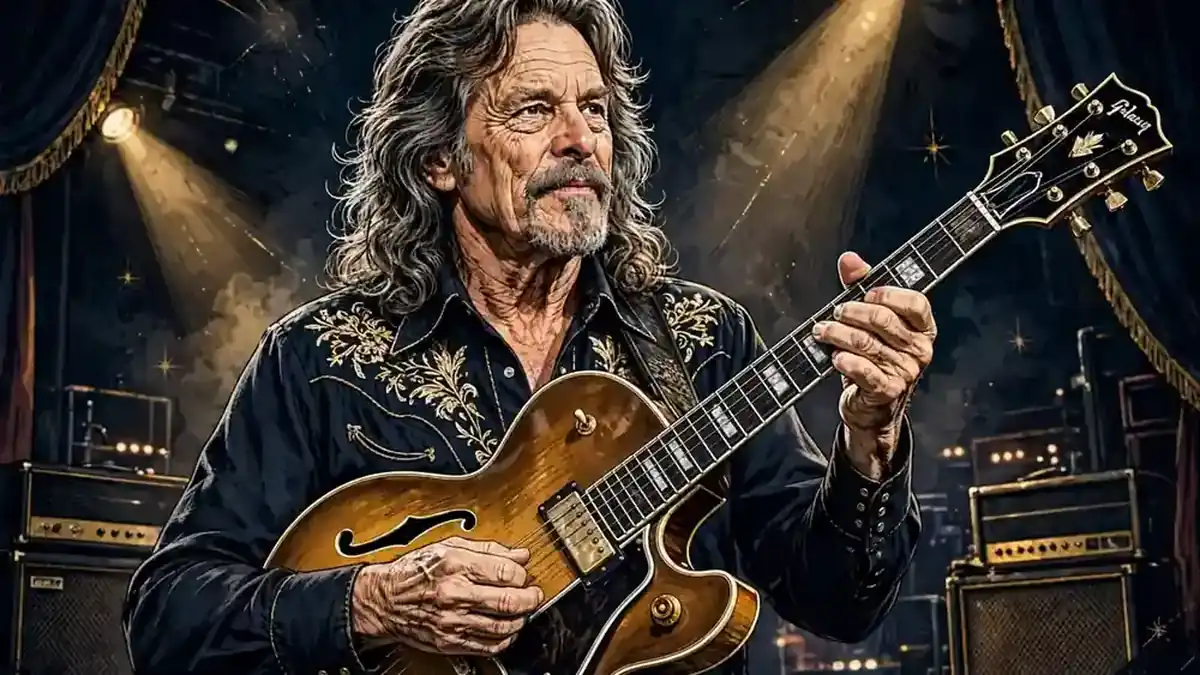
The Gibson Byrdland deserves a line of its own, because it is a business asset as much as a sound. Nugent has played the hollow-body Byrdland since the Amboy Dukes days, when most hard rock guitarists chose solid-body instruments. The guitar’s feedback-prone, screaming tone became his signature, and the association has lasted sixty years — a rare case of a musician’s instrument choice becoming a brand mark that still sells guitars, signature models and merchandise.
“Cat Scratch Fever” is the song that pays the rent. The 1977 title track remains his most licensed work — film, television, advertising and sports broadcasts — and the album has sold more than three million copies. “Stranglehold” runs it close as a catalog earner: eight minutes long, built on a riff that has never left classic rock radio, and a staple of streaming playlists that pay per play. “Wango Tango” and “Great White Buffalo” round out a four-song catalog core that generates the bulk of his publishing and recording royalties today.
Fame also came with a cost that shows up in the money. Nugent’s outspoken conservative politics and gun-rights advocacy — he has sat on the National Rifle Association board since 1995 — made him a fixture on cable news and talk radio, and that visibility kept him bookable long after his chart career ended. It also narrowed his audience: sponsors, festivals and broadcasters who might have hired a nostalgia rock act sometimes passed, and his public statements have drawn Secret Service attention more than once. The net effect is hard to price, but it is real — his brand is louder, and smaller, than a politically quiet peer’s would be. Detroit peer Bob Seger, whose net worth we estimate separately, took the opposite path and kept a broader mainstream lane, while fellow shock-rock contemporary Alice Cooper built a comparable fortune on a theatrical stage act without the same political narrowing.
Main Sources of Income
Nugent’s money comes from five streams, and their order matters: touring first in his peak years, catalog royalties second, television and books third, and the hunting business fourth — with merchandise and licensing running underneath all of them. The balance has shifted with age. In the late 1970s, touring and record sales did nearly all the work. Today, the catalog and the outdoor business do more of it, because a 77-year-old guitarist plays fewer dates than a 29-year-old one, while a 1977 album earns every time it streams.
| Income stream | What it is | How it pays in 2026 |
|---|---|---|
| Music royalties & catalog | Publishing and recording royalties from 14 solo studio albums, Amboy Dukes and Damn Yankees records | Steady, passive — streaming, radio, licensing, compilations |
| Touring & live shows | Headline dates, festivals, casino and fair circuits | Still active but fewer dates than the 300-show peak years |
| Television & media | Spirit of the Wild, podcasting, guest appearances | Long-running show plus podcast and commentary work |
| Books | Five published books, including a New York Times bestseller | Backlist sales and advances |
| Hunting & outdoor business | Sunrize Safaris, guided hunts, ranch operations, outdoor brand work | Paid hunts and outfitting, priced per guest |
| Merchandise & licensing | Branded gear, “Cat Scratch Fever” and “Stranglehold” sync licenses | Per-use fees and tour merch |
Catalog income is the most durable piece. Nugent owns a catalog with four multi-platinum 1970s albums, a double-platinum supergroup debut and a gold follow-up, plus a string of hit singles that classic rock radio and streaming services play every day. Royalty rates for recordings of that era are modest per play, but the volume is large: “Stranglehold,” “Cat Scratch Fever” and “High Enough” sit on dozens of playlists and compilations, and every placement pays. Sync licensing is the higher-value slice — a single film or advertising use of “Cat Scratch Fever” can pay more than a year of streaming for the same song.
Touring income is the most volatile piece, and the one that explains the $15 million spread between the trackers. A year with a full summer tour is worth far more than a year without one, and Nugent’s touring schedule has thinned with age and with the politics of booking. At his peak he averaged more than 300 shows a year, according to the Gazette Review, a workload that put him among the hardest-touring acts in rock. Even a fraction of that pace at modern ticket prices is serious money — but it is money that stops the moment the dates stop, which is why the low-end $5 million estimate is best read as a catalog-and-assets valuation, and the $20 million figure as one that assumes touring income keeps flowing.
Television pays differently: less per year than a tour, but for far longer. Spirit of the Wild has run since 2001, and a show with a 24-year run pays its host through production fees, sponsorships and the audience it feeds into books, safaris and merchandise. The podcast Spirit Campfire and his Real America’s Voice appearances extend the same model into streaming and commentary, where the pay is modest but the marketing value to his other businesses is large.
The hunting business is the stream competitors cover worst, and it is the one that separates Nugent from a standard nostalgia act. Sunrize Safaris books, guides and outfits hunting trips, and his own website has listed hunts with Ted himself at $5,500 per guest, according to outdoor-media coverage of his fortune. That is a premium price for a premium product — a few days hunting with a rock star on his own ground — and it turns his ranches from a cost into a revenue line. He has also run the Ted Nugent Kamp for Kids nonprofit for 36 years, which is not a money-maker but keeps the outdoor brand credible with the audience that buys the safaris.

Salary and Earnings
No salary figure for Nugent has ever been published from a filing or a contract, because he has never been a salaried employee of a studio or a label in the way an actor or an athlete is. His earnings are business earnings: tour guarantees, royalty statements, television fees and safari bookings. Any site that prints a precise annual salary for him is inventing it, and this article will not. What can be stated honestly is the shape of the money, year by year, and the few hard numbers that exist.
The hard numbers start with the records. Two million copies of the 1975 debut in the United States, more than three million of Cat Scratch Fever, triple-platinum for Double Live Gonzo!, double-platinum for the Damn Yankees debut and gold for Don’t Tread — those are RIAA certifications, not guesses. Royalty math on those volumes, at the rates of the era, puts his 1970s recording income in the millions, before touring. Touring was bigger: 300-plus shows a year at arena and theater scale, with Nugent as the sole name on the bill, meant guarantees and merchandise that dwarfed the record royalties in most years.
One outdoor-media report put his current annual income at around $2 million, built from royalties, live dates, television and the outdoor business. Treat that as an order of magnitude, not a fact — it is a single outlet’s estimate, and it is the only published annual figure we found. It is, however, consistent with the range: an earner bringing in low-seven figures a year, with a catalog that keeps paying and ranch land that holds value, plausibly sits in the low eight figures of total wealth, not in the nine-figure territory that some AI-written profiles claim. The $120 million and $200 million figures circulating on content-farm sites have no source, no filing and no outlet behind them; they appear to be invented, and we exclude them from the range entirely.
Book advances added lump sums at intervals. God, Guns & Rock ‘n’ Roll (Regnery, 2000) was a New York Times bestseller, and bestseller status in that era typically meant a meaningful advance plus royalties — though the exact figure was never disclosed. Kill It & Grill It, co-written with Shemane, and Ted, White and Blue: The Nugent Manifesto (2008) added further advances and backlist income. None of these is large beside the music money, but together they form a steady secondary line that has paid for twenty-five years.
Television fees follow the same pattern: Spirit of the Wild has run for more than two decades, and a host-producer of a long-running niche cable show earns a production fee per episode plus sponsorship shares. The VH1 reality shows paid appearance and hosting fees in the 2000s, when reality television budgets were at their peak. None of these figures is public, so we state the mechanism and not a number — the honest limit of what the record supports.
Businesses and Investments
Nugent’s business life is a case study in turning a persona into a company. The music is the brand; the hunting business is the company built on it. Sunrize Safaris, the outfitting operation he founded, books guided hunts on his Michigan ground and beyond, and the Ted Nugent Bowhunting School trains new hunters. His own site has priced a hunt with Ted at $5,500 per guest, and the operation has run for decades — long enough to be a real business rather than a celebrity side project.
The ranches are the physical plant of that business. In Michigan he has described owning more than a thousand acres of managed wildlife habitat, in a 2025 interview with the Texas Ranch Journal, and his Sunrize Acres property in western Jackson County is separately listed in property coverage at 300 acres — the two figures likely describe different parcels, or the same ground counted differently, and we report both rather than forcing them to agree. In Texas, the family home is SpiritWild Ranch on the North Bosque River near China Spring, outside Waco, with pecan groves, forest and wetlands that he has described in detail. Land is the one asset class in his portfolio that almost certainly appreciated while his record royalties flattened: Michigan hunting land and Texas ranch land have both risen sharply since he bought in.
Investments beyond land are thinly documented. Nugent has said in interviews that he avoided spending his early money on drink, drugs and tobacco, and put it into land instead — a claim that fits the property record, and one of the more credible financial statements he has made. No stock portfolio, startup stake or venture investment appears in any reliable reporting, and we do not invent one. His investment story is land, catalog and brand — three assets he controls directly.
The catalog itself is an investment-grade asset. Four multi-platinum albums from the 1970s, plus the Damn Yankees records, generate royalties that behave like a bond with a very long maturity: small payments, many times a year, for decades. Catalog valuations for 1970s rock acts typically run at a multiple of annual royalties, and on that basis the catalog alone is plausibly worth several million dollars — which is consistent with the low end of the published range even before land is counted.
One more business line deserves a mention because competitors miss it: writing. Nugent has written for more than twenty publications, according to his own biography, and has been a regular columnist and contributor to outdoor and conservative outlets for decades. Magazine and online column fees are modest, but a twenty-year column habit is a real income line, and it feeds the book and television audiences that feed the safaris. The businesses reinforce each other — that is the point of the whole structure.
Brand Deals and Sponsorships
Nugent’s brand deals look nothing like a pop star’s endorsement portfolio, and that is the point. He has no sneaker deal, no fragrance, no soft-drink contract. His partnerships are with the outdoor world: hunting and archery brands, firearms makers, conservation groups and outdoor retailers. He has served on the National Rifle Association board since 1995 and has been a national spokesman for D.A.R.E., Big Brothers Big Sisters and the Pass It On Outdoor Mentors Program — roles that pay in access and audience as much as in cash.
The most valuable brand asset is the Gibson Byrdland association. Nugent has played the hollow-body Byrdland for sixty years, and the guitar is so tied to his image that Gibson has every reason to keep the relationship warm. Signature and artist-model arrangements in the guitar world typically pay the artist a royalty per unit sold, and while no figure is public, the Byrdland link is a genuine commercial relationship, not a one-off photo shoot.
Outdoor television sponsorships form the second group. A hunting show with a 24-year run carries sponsors in archery, ammunition, optics, trucks and outdoor gear, and the host’s share of that sponsorship is part of the show’s economics. The Ted Nugent Spirit of the Wild PBS video series raised more than $3 million for PBS affiliates, according to his biography — a fundraising figure that also shows the commercial weight of the brand with public television audiences.
The honest limit here is the same as with salary: no endorsement fee has ever been disclosed. What can be said is that his brand income is real, narrow and durable — outdoor and firearms brands pay a premium for an endorser with a sixty-year record of actually using the products, and Nugent is one of the few musicians who can credibly claim that. The flip side is that the same politics that make him valuable to those brands make him unusable to mainstream consumer brands, which is a real ceiling on this income line. Ozzy Osbourne, whose fortune we break down separately, shows the contrast: a hard rock peer whose brand deals ran far wider because his public image stayed in music rather than politics.

Houses, Cars and Other Assets
The property record is where Nugent’s wealth is most visible, and also where the reporting is weakest. The family home is SpiritWild Ranch, on the North Bosque River near China Spring outside Waco, Texas. Property coverage puts the Waco house at 7,665 square feet on 20 acres, purchased for a reported $1.6 million from a local auto dealer — a figure from a single property site, so we report it as reported, not confirmed. The ranch itself is described by Nugent as forest, pecan groves, farmland and wetlands, and it doubles as the base for the Spirit Campfire podcast and the family’s hunting life.
Michigan holds the larger land position. Nugent settled on a Michigan ranch in 1973, early in his career, and has added ground since. He told the Texas Ranch Journal in 2025 that the family holds more than a thousand acres of managed wildlife habitat in Michigan, while property coverage separately lists Sunrize Acres at 300 acres in western Jackson County. A Concord, Michigan, home is also listed in property coverage. The discrepancy in acreage is a reminder to read property numbers as reported ranges: the honest statement is that he owns hundreds of acres at minimum, and by his own account more than a thousand, across at least two Michigan parcels.
Vehicles and guitars fill out the asset list. Nugent is a truck and muscle-car man by reputation, and his stage and ranch life both run on large American vehicles, but no verified inventory of his cars — makes, models, values — exists in reliable reporting, so we do not print one. The guitar collection is a more interesting asset: a working guitarist of sixty years owns dozens of instruments, and the Byrdlands alone, including vintage examples, carry five-figure values each. A collection of that depth is plausibly worth several hundred thousand dollars, though no appraisal is public.
The asset that matters most for the net worth question is the land. If the Michigan and Texas holdings total anywhere near the acreage Nugent describes, their market value runs into the millions at current rural land prices — and land, unlike a tour guarantee, does not disappear when the dates stop. That is the strongest argument for the upper half of the range: a man with a multi-platinum catalog, a working safari business and a thousand acres of land is not a $5 million man unless the land is heavily mortgaged or the catalog is heavily discounted, and neither is suggested by any reporting. The $5 million figure reads as a catalog-only valuation; the $20 million figure reads as one that counts the land at full value.
Awards and Achievements
Nugent’s trophy shelf is thinner than his sales would suggest, and the gap is part of his story. He has never won a Grammy, and he is not in the Rock and Roll Hall of Fame — an absence his fans note loudly and his critics attribute to his politics and his persona. What he does hold is a set of honors from the worlds he actually worked in: music, hunting and Michigan.
The music honors start with the RIAA certifications — multi-platinum for Ted Nugent, Free-for-All, Cat Scratch Fever and Double Live Gonzo!, double-platinum for the Damn Yankees debut, gold for Don’t Tread — and the sales totals behind them, more than 30 million records worldwide. In 2006 he was voted into the Michigan Rock and Roll Legends Hall of Fame, a state-level honor that fits a Detroit artist whose identity never left the state. His books add a different kind of credential: God, Guns & Rock ‘n’ Roll was a New York Times bestseller in 2000, a result few rock memoirs achieve.
The hunting honors are the ones that pay. Nugent has been inducted into the National Bowhunters Hall of Fame, and his show Spirit of the Wild has won the Golden Moose Award for best hunting show three times. He was named favorite Hunting Personality by the readers of Outdoors Magazine, and he has been honored on the floor of the United States Senate, in 1994, for his outdoor and charitable work. These are not music-industry prizes, but they are the credentials that let him charge $5,500 for a guided hunt — the market trusts a hall-of-fame bowhunter in a way it would not trust a rock star with a new hobby.
The Amboy Dukes received a Distinguished Achievement Award from the Detroit Music Awards when the band reunited in 2009 for its first performance in thirty years. It was a small honor for a band that never sold like the solo act, but it marked the full circle: the club band from the Chicago suburbs, recognized in the city where it started.
Net Worth Growth Over the Years
The table below is not a bank statement. No tracker has ever had access to Nugent’s accounts, so what follows is the published-estimate record — what the main outlets printed, and when. Read it as a history of the estimates, not a history of his money. The striking fact is how little the figures move: the range has sat between $5 million and $20 million for a decade, because the underlying assets — catalog, land, touring — have been stable for a decade.
| Year | Published estimate | Source of the figure |
|---|---|---|
| 2015 | $10 million | Mid-range tracker estimates of the period |
| 2018 | $20 million | TheRichest listing |
| 2020 | $5 million | Celebrity Net Worth listing |
| 2022 | $20 million | TheRichest and biography-site estimates |
| 2024 | $10 million | Reality Tea estimate, via 2025 coverage |
| 2025 | $10 million | Celebrity Net Worth, as cited by outdoor media |
| 2026 | $5 million – $20 million | NetWorthCraft range across all current trackers |
Three things stand out. First, the same outlet has printed different numbers at different times — Celebrity Net Worth’s long-standing $5 million figure was cited as $10 million by outdoor media in 2025, which suggests the tracker itself revised upward, or that different pages of the same site carried different figures. Second, the growth is flat, not rising: unlike a young pop star, Nugent’s wealth does not compound year on year, because his peak earning years are behind him and his current income roughly covers his current costs. Third, the $20 million top end has been stable since 2018, which suggests it is a ceiling that no tracker has found a reason to lift.
Peer comparison puts the range in context. The table uses Celebrity Net Worth estimates for the peers, so the figures are comparable in method, even if the method itself is rough.
| Artist | Reported estimate | Why the gap |
|---|---|---|
| Ted Nugent | $5 million – $20 million | Catalog plus land, thinner touring now |
| Alice Cooper | $50 million | Bigger catalog, wider touring, broader brand deals |
| Ozzy Osbourne | $220 million | Black Sabbath catalog, reality TV, global touring |
| Mick Jagger | $500 million | Rolling Stones catalog and touring at stadium scale |
| Bob Seger | $60 million | Detroit peer with a larger hit catalog and steadier touring |
The comparison is instructive: Nugent’s catalog is real but smaller than any of these peers’, his touring never reached stadium scale, and his brand deals stayed in the outdoor niche. The $10 million midpoint is consistent with that position — a successful working rock lifer, not a stadium act.
Social Media Presence
Nugent runs his own channels and uses them the way he uses everything else: loudly, daily, and in his own voice. He is active on Facebook, X, Instagram and YouTube, where he posts tour dates, hunting footage, podcast episodes of Spirit Campfire and political commentary, and he directs followers to tednugent.com as the hub for tour dates, safari bookings and merchandise. The channels function as a marketing arm for the safari and touring businesses — a free distribution system for the two things he sells — rather than as a standalone income line, and we do not print follower counts because they change daily and no audited figure is available.
The social presence cuts both ways, as it does for any artist whose politics are part of the act. His posts drive engagement and keep the core audience warm between tours, but they have also cost him bookings and platform goodwill at various points, including suspensions and disputes with social networks. For a net worth estimate, the practical effect is that his social reach converts into ticket and safari sales with a loyal audience, but it does not convert into the mainstream brand deals that a politically quiet artist of the same catalog size might command.
For readers who want the primary source rather than the commentary, tednugent.com remains the reliable hub: tour dates, the Spirit Campfire podcast, the Spirit of the Wild show archive and safari booking all run through it, and it is the one channel Nugent controls outright.
Personal Life
Nugent has been married twice. His first wife was Sandra Jezowski, whom he married in 1970 and divorced in 1979. They had two children, a son, Theodore Tobias “Toby” Nugent, and a daughter, Sasha Nugent. Sandra died in 1982, at 33, in a single-vehicle car accident in Jackson County, Michigan, three years after the divorce. Nugent has six children with four women in total, according to Wikipedia: in the late 1960s, before his first marriage, he fathered a boy and a girl who were given up for adoption in infancy, and in 2005 he agreed to pay $3,500 a month in child support for a son fathered with Karen Gutowski.
His second marriage has lasted far longer than his first. He married Shemane Deziel on January 21, 1989, after meeting her at Detroit radio station WLLZ-FM, where she worked on the news staff and he appeared as a guest. They have one son together, Rocco Winchester Nugent. Shemane built her own career as a television host, fitness instructor and author — her memoir Married to a Rock Star (2002) is a blunt account of life with a touring musician — and she co-hosts and co-produces Spirit of the Wild. The couple’s near-fatal experience with toxic mold in their Michigan home, which she documented in the film Killer House, turned her into an environmental-health advocate and helped drive the family’s move to Texas.
Family life and business life overlap completely in the Nugent household. The ranches are both home and workplace; the television show is a family production; the Kamp for Kids nonprofit, running for 36 years, is a family project. That overlap is a financial strength — the family works inside the business — and a risk, since the brand depends on one person staying healthy and active at 77.
Health is the quiet variable in the 2026 estimate. Nugent tours less than he did, and a guitarist’s earning power is tied to his hands and his stamina. Nothing in the public record suggests a health crisis, and he continues to perform and to host his show and podcast, but any forward-looking estimate has to price the fact that the touring line, historically his biggest, now depends on a man in his late seventies. The catalog and the land do not have that problem, which is why they anchor the range.
Sources & Reporting
Celebrity Net Worth — the $5 million estimate, the most widely cited figure, plus career and biography detail. Reporting window: listing current through 2026.
TheRichest — the $20 million estimate at the top of the range, as reported in 2026 competitor coverage. Reporting window: 2018–2026.
Wikipedia — birth date and place, family detail, discography, RIAA certifications, Damn Yankees history, NRA board service and book bibliography. Reporting window: article current as of November 2026.
AllMusic — career biography, the 1975–1978 run, Damn Yankees and later albums including Detroit Muscle (2022). Reporting window: biography current through 2026.
Lapham’s Quarterly — Cat Scratch Fever sales above three million copies; NRA board service since 1995. Reporting window: contributor profile, current.
American Shooting Journal — 2013 interview: more than 40 million albums sold, more than 6,500 concerts, NRA board detail, book list including the New York Times bestseller God, Guns & Rock ‘n’ Roll. Reporting window: December 2013 interview.
Texas Ranch Journal — 2025 interview: Michigan land holdings above a thousand acres, SpiritWild Ranch on the North Bosque River, Sunrize Safaris and Kamp for Kids at 36 years. Reporting window: Winter 2025.
Far Out Magazine — $20 million estimate, height of 6 feet, Damn Yankees membership. Reporting window: profile current through 2026.
Gazette Review — more than 30 million records sold worldwide, 300-plus shows a year at peak, 14 studio albums. Reporting window: career retrospective, current.
Ultimate Classic Rock — the 1975–1978 hot streak, Epic Records signing, Tom Werman and the debut album’s two million copies. Reporting window: retrospective, current.
VL Outdoor Media — Celebrity Net Worth figure cited at $10 million in 2025, Sunrize Acres at 340 acres, hunts with Ted priced at $5,500. Reporting window: 2025.
Reality Tea, via 2025 coverage — the $10 million estimate near the middle of the range. Figures from content-farm sites claiming $50 million, $120 million or $200 million were reviewed and excluded: none names a source, a filing or an outlet, and they contradict every named tracker.
How we estimated: the range runs from the lowest named tracker (Celebrity Net Worth, $5 million) to the highest (TheRichest, $20 million), with the $10 million midpoint supported by the Reality Tea estimate and by the 2025 outdoor-media citation of Celebrity Net Worth at $10 million. The catalog, land and touring record support a low-eight-figure valuation; nothing in the record supports nine figures. Where the record is thin — annual income, endorsement fees, car inventory — we say so rather than printing a guess.
Frequently Asked Questions
What is Ted Nugent’s net worth in 2026?
Ted Nugent’s net worth is estimated at $5 million to $20 million as of November 2026, with a midpoint estimate of around $10 million. Celebrity Net Worth lists $5 million, TheRichest lists $20 million, and a 2025 Reality Tea estimate sits near $10 million. No audited figure exists, so the honest answer is the range, not a single number.
How did Ted Nugent make his money?
Music first: multi-platinum albums including Cat Scratch Fever, more than 30 million records sold, and a double-platinum Damn Yankees debut. Touring second: more than 6,500 concerts, with 300-plus shows a year at his peak. Television, books, merchandise and a hunting business — Sunrize Safaris and his Michigan and Texas ranches — make up the rest.
How old is Ted Nugent?
Ted Nugent was born on December 13, 1948, in Detroit, Michigan. He is 77 years old for most of 2026 and turns 78 on December 13, 2026.
Is Ted Nugent still touring?
Yes, though at a reduced pace from his peak. He continues to play headline dates and festivals, hosts the long-running Spirit of the Wild television show and records the Spirit Campfire podcast. His latest studio album, Detroit Muscle, was released in 2022.
Who is Ted Nugent’s wife?
Ted Nugent has been married to Shemane Deziel Nugent since January 21, 1989. She is a television host, fitness instructor and author, and she co-hosts and co-produces Spirit of the Wild. They have one son, Rocco Winchester Nugent. His first wife, Sandra Jezowski, was married to him from 1970 to 1979 and died in 1982.
How many children does Ted Nugent have?
Nugent has six children with four women. Two children from his first marriage, Toby and Sasha; one son, Rocco, with his second wife Shemane; two children from the late 1960s who were given up for adoption; and a son for whom he agreed to pay child support in 2005.
What is Ted Nugent’s most famous song?
“Cat Scratch Fever” (1977) is his signature song and his biggest-selling single, from an album that has sold more than three million copies. “Stranglehold” (1975) is his best-known album track, and “High Enough” (1990) with Damn Yankees was his highest-charting single.
Where does Ted Nugent live now?
Nugent lives at SpiritWild Ranch on the North Bosque River near China Spring, outside Waco, Texas, with his wife Shemane. He also holds extensive hunting land in Michigan, including Sunrize Acres, where he has lived and hunted since settling there in 1973.
Final Thoughts
Ted Nugent’s fortune is a story of longevity rather than a single payday. He never had a stadium-sized catalog like Mick Jagger or a television empire like Ozzy Osbourne, but he had something nearly as valuable: a four-year run of multi-platinum records, a touring habit that filled 6,500 stages, and a second business — hunting, land and outdoor television — that kept paying after the hit singles stopped. The $5 million to $20 million range is wide because the trackers count different things, and the honest reading sits in the middle: a $10 million working fortune, anchored by a catalog that still earns, land that still appreciates, and a brand that still sells hunts at $5,500 a head.
The number to watch is not the estimate but the touring schedule. As long as Nugent plays, the top of the range stays in reach. When the dates stop, the catalog and the land will carry the valuation on their own — and on those two assets alone, the low end of the range looks too low. For a 77-year-old guitarist who has been on stage since 1963, that is a durable position: the music made the money, the land kept it, and the hunting business turned a hobby into a second career.
Published on November 23, 2026. Last reviewed November 2026. Found an error? See our corrections policy.