
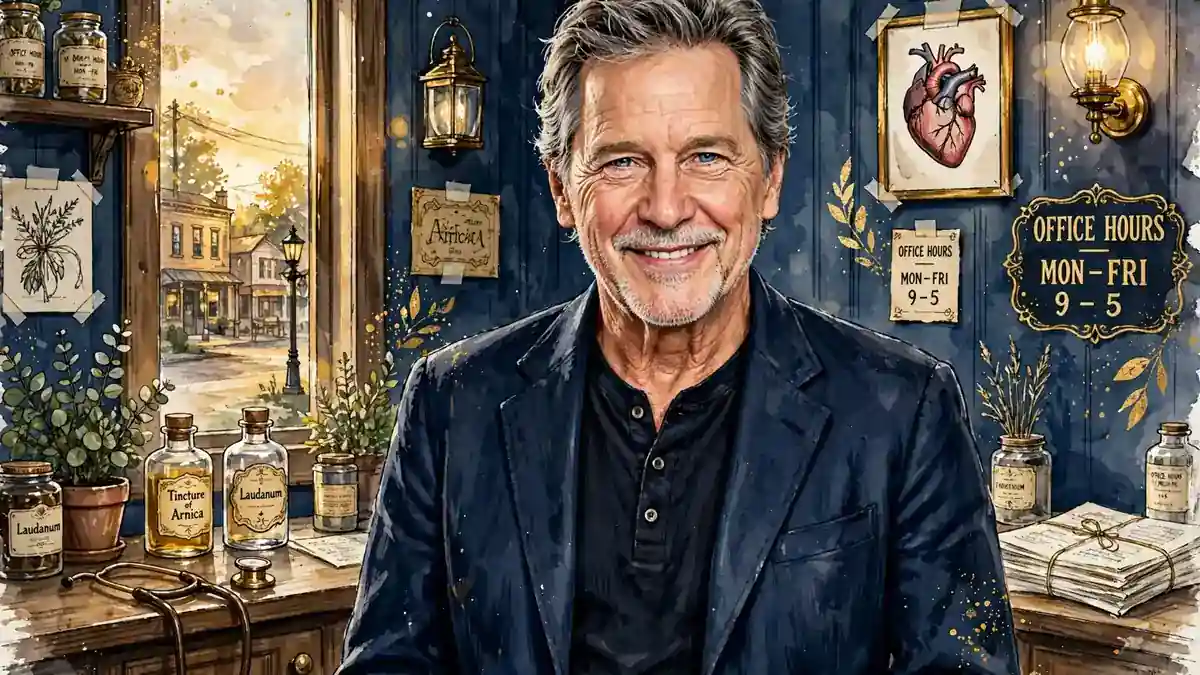
Tim Matheson‘s net worth is estimated at $7 million to $9 million as of November 2026. The figure rests on a career almost no working actor can match: a child performer in the early 1960s, the voice of Jonny Quest at sixteen, Eric “Otter” Stratton in Animal House — a film shot for $3 million that grossed $141.6 million — two Emmy nominations for The West Wing, and, since 2019, a steady starring role as Doc Mullins on Netflix’s Virgin River, a show renewed through a ninth season. His money comes from two parallel careers, acting and television directing, and the second one is the part most net worth pages skip.
Tim Matheson: Quick Facts
| Estimated net worth | $7 million (range: $7 million to $9 million) |
|---|---|
| Profession | Actor, television director, producer |
| Nationality | American |
| Born | December 31, 1947 (age 78) |
| Height | 6 feet 2 inches (1.88 m) |
| Primary income sources | Television and film acting, television directing, residuals, memoir royalties |
| Active years | 1961–present |
| Last reviewed | November 2026 |
- Early Life and Background
- Education
- Career Journey
- Rise to Fame
- Main Sources of Income
- Salary and Earnings
- Businesses and Investments
- Brand Deals and Sponsorships
- Houses, Cars and Other Assets
- Awards and Achievements
- Net Worth Growth Over the Years
- Social Media Presence
- Personal Life
- Sources & Reporting
- Frequently Asked Questions
Early Life and Background
Tim Matheson was born Timothy Lewis Matthieson on December 31, 1947, in Glendale, California, a Los Angeles suburb. His father, Clifford Matthieson, worked as a training pilot; his mother was Sally Matthieson. The household was unstable. In his 2024 memoir Damn Glad to Meet You: My Seven Decades in the Hollywood Trenches, Matheson writes about growing up with two alcoholic parents and about performing as a way out of a home where money and calm were both short. Publishers Weekly, reviewing the book, describes him as raised in 1950s Glendale by a single mother who struggled with alcohol and with making ends meet.
That background matters to the money story in a way a simple filmography cannot show. Matheson did not arrive in Hollywood with family wealth or a safety net. He started working at thirteen, and he has kept working, in one form or another, for more than sixty years. The fortune he holds today was assembled in small pieces across seven decades, not in a single franchise payday. He also served a tour of duty in the United States Marine Corps Reserve, a fact his memoir treats as one of the few structured, disciplined chapters of his youth.
His first screen work came fast. At thirteen he appeared as Roddy Miller in the CBS nostalgia comedy Window on Main Street during the 1961–62 season. Guest spots on Leave It to Beaver and My Three Sons followed. The pattern was set early: a working child actor who could move between comedy, westerns, and voice work without a long gap between jobs. Few child actors keep that rhythm into adulthood. Matheson is one of the exceptions, and the length of the run is the single biggest reason his net worth sits where it does.
One detail from his early years still shapes how he talks about his career. In the memoir he recalls sleeping on a pullout couch and walking through a closet to reach the bathroom, then stepping onto a set with a marble fireplace and a different life waiting behind the camera. Publishers Weekly quotes the line because it captures the split that ran through his childhood: a hard home life, and a professional life that rewarded him for showing up prepared. He learned early that the job itself was the asset.
Education
There is no public record of Matheson attending college or earning a degree, and this article does not invent one. His schooling was the set. By the time most of his peers were choosing majors, he was already a working actor with a decade of credits, and the practical education that mattered to his earnings came from directors, crews, and the business side of the sets he worked on.
One part of his school years is documented and worth noting. Matheson competed on the high school debate circuit and won the national championship of the Parliamentary Debate Association of the United States. Debate sharpened the two skills that later paid him twice over: clean delivery of long dialogue, and the ability to argue a position under pressure. The first made him a reliable guest star. The second made him a director who could hold a room.
His Marine Corps Reserve service added another layer of practical training. The memoir treats the military years as a counterweight to the chaos of his childhood home — fixed schedules, clear chains of command, and work that had to be finished whether anyone felt like it or not. That discipline shows up again and again in the way his career is structured: he took the jobs, learned the other side of the camera, and built a second income stream in directing rather than waiting for the next acting offer.
Readers looking for a university name on his résumé will not find one, and that absence is part of the story. Matheson’s wealth was built without the credential that anchors most high earners. It was built on volume, longevity, and a willingness to learn a second trade while the first one was still paying.
Career Journey
Matheson’s career breaks into four long chapters, and each one paid him in a different way. The first chapter, 1961 to 1977, was the child-actor and young-leading-man years. The second, 1978 to the mid-1990s, was film stardom built on Animal House and a run of studio comedies. The third, the late 1990s through the 2010s, was prestige television and a directing career that quietly became as important as the acting. The fourth, 2019 to now, is Virgin River — a streaming-era second act that introduced him to an audience that had never seen Animal House.
The voice work came first and it still pays. In 1964, at sixteen, Matheson voiced the lead in Hanna-Barbera’s Jonny Quest, one of the most durable animated adventure series of the decade. He also voiced Sinbad Jr. in Sinbad Jr. and His Magic Belt and Jace in the original Space Ghost. Voice work in the 1960s paid modest session fees by modern standards, but the shows never went away. Jonny Quest reruns, home video, and later revivals kept the character in circulation for sixty years, and Matheson returned to voice roles throughout his career, including Brad Chiles in Scooby-Doo! Mystery Incorporated and General Dudley in Fast & Furious Spy Racers.
His first film work of note arrived in 1968 with Yours, Mine and Ours, where he played Mike Beardsley, the oldest son in a blended family headed by Lucille Ball and Henry Fonda. The film was a box office hit, and the set changed his personal life: he met actress Jennifer Leak there, and the two married in 1968. The marriage ended in 1971, but the professional lesson stuck. Working beside Ball, who ran her own studio and understood the business of television as well as anyone alive, gave the young actor a first look at how performers could control their own economics.
Television westerns filled the next decade. In 1969 he joined NBC’s The Virginian in its eighth season as Jim Horn, a modern-day cowboy and horse thief. In the final season of Bonanza in 1972–73 he played Griff King, a parolee trying to rebuild his life as a ranch hand under Ben Cartwright. In 1976 he co-starred with Kurt Russell in the fifteen-episode NBC series The Quest, about two young men searching the West for their sister, a captive of the Cheyenne. None of these were star-making roles. All of them were steady paychecks, and steady paychecks across a decade are exactly how a working actor’s savings begin.
Film work ran alongside the television. He played Officer Phil Sweet in Magnum Force in 1973, sharing the screen with Clint Eastwood, whose own net worth now runs into the hundreds of millions. He appeared in Divorce American Style and How to Commit Marriage. The roles were supporting parts in studio pictures, the kind of work that builds a reputation with casting directors even when it does not build a fortune on its own.
The directing chapter began in the 1980s, while the acting career was still in full swing. Matheson started by directing episodes of shows he was acting in, then moved outward. His directing credits now span more than three dozen series: Third Watch, Ed, The Twilight Zone, Cold Case, Without a Trace, The West Wing, Psych, Shark, White Collar, Criminal Minds, Suits, Burn Notice — on which he also held a recurring acting role — and Hart of Dixie, where he directed eight episodes while starring as Dr. Brick Breeland. He directed the pilot of Covert Affairs in 2009, which premiered on USA Network in 2010, plus pilots for Fox’s The Good Guys, Lifetime’s Criminal Behavior, and USA’s Wild Card. Pilot directing matters financially: pilots pay more than standard episodes, and a picked-up pilot can mean a producing or directing relationship with the series that follows.
The 1990s and 2000s added film roles that kept his name in front of moviegoers between television jobs: the con man claiming to be Carol Brady’s thought-to-be-dead husband in A Very Brady Sequel in 1996, Vance Wilder Sr. in Van Wilder in 2002 — a part written as a nod to his own Animal House character, right down to a veiled reference to Dartmouth — and Henry Kaslan in the 2019 remake of Child’s Play. He played President Ronald Reagan in the 2019 television movie Killing Reagan, and took guest roles across the prestige-TV boom, from This Is Us to The Good Fight to Evil. In 2025 he joined 9-1-1: Nashville as Edward Raleigh, still adding credits at seventy-seven.
Rise to Fame
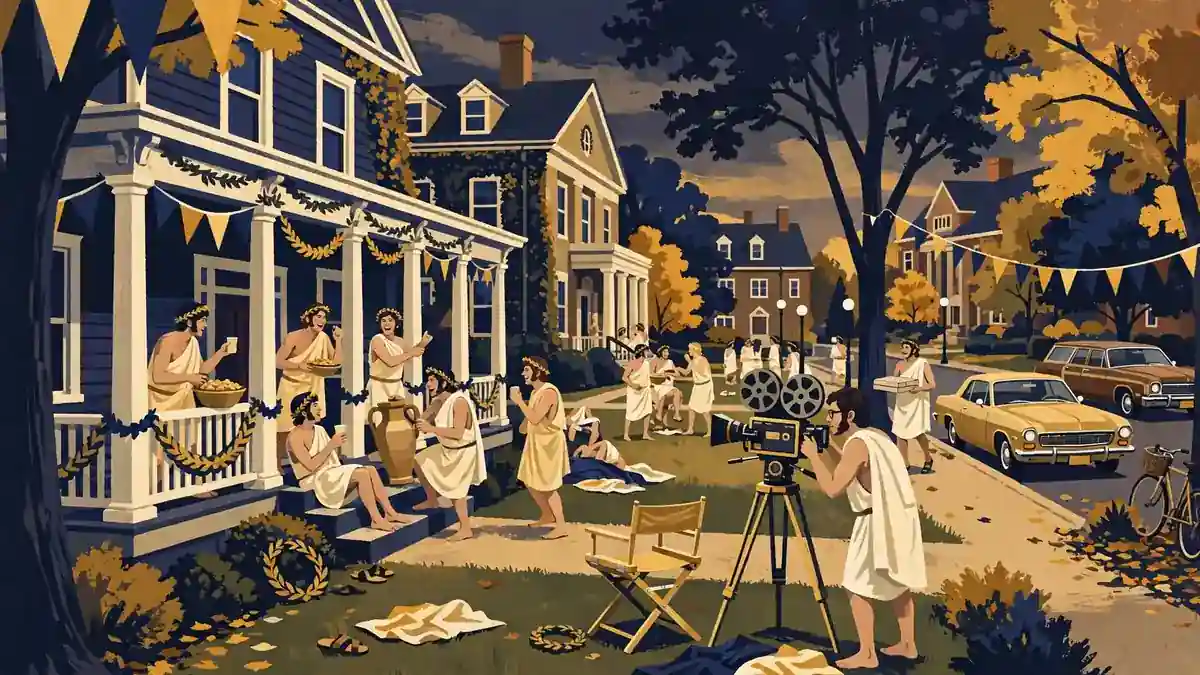
The role that made Matheson famous arrived on July 28, 1978, when National Lampoon’s Animal House opened in theaters. He played Eric “Otter” Stratton, the smooth-talking fraternity president who ran Delta House with a grin and a plan for every problem. The film was directed by John Landis and written by Harold Ramis, Douglas Kenney, and Chris Miller. It starred John Belushi as Bluto, and Matheson’s Otter was the cool counterweight to Belushi’s chaos — the character who made the fraternity look like fun rather than a riot.
The numbers behind Animal House explain why it still matters to Matheson’s finances nearly fifty years later. The film cost about $3 million to make. It grossed $141.6 million worldwide, including $120.1 million in the United States and Canada in its initial release, and became the highest-grossing comedy of its time. It opened in just twelve New York theaters, grossing $276,538 in its first weekend, then expanded to five hundred theaters and kept growing. The film won the People’s Choice Award in 1979 for favorite nonmusical motion picture, and its theatrical rentals alone were about $70.8 million.
Matheson did not walk away from that film rich. Nobody in the cast did except through the long tail. The economics of a 1978 studio comedy meant modest upfront salaries and residuals that grew as the film moved through theatrical re-release, home video, cable, and eventually streaming. The film’s real gift to Matheson was different: it made him a recognizable leading man for the next fifteen years. The roles that followed — 1941 with Spielberg and Belushi again in 1979, To Be or Not to Be with Mel Brooks and Anne Bancroft in 1983, Up the Creek in 1984, and Fletch in 1985, where he played the oily Alan Stanwyk opposite Chevy Chase, whose fortune is estimated at about $50 million — all trace back to Otter. Casting directors knew what he could do, and audiences knew his face.
One of the most famous money stories attached to Animal House is not Matheson’s but his co-star Donald Sutherland’s. Sutherland was offered a choice between a share of the film’s profits and a flat fee for his brief role as Professor Dave Jennings. He took the flat fee, expecting a modest success, and later estimated the decision cost him roughly $14 million in missed earnings, according to an interview with Variety reported by Parade in 2026. The anecdote is a reminder of how the film’s cast was paid: the people who took backend points on a $3 million comedy that grossed $141.6 million did very well, and the people who took flat fees did not. Matheson has never said publicly which side of that choice he fell on, and this article does not guess.
The second rise came two decades later, on television. In 1999 Matheson joined The West Wing as Vice President John Hoynes, a recurring role across twenty episodes from 1999 to 2006. Hoynes was a flawed, ambitious politician — a sex scandal forced his resignation — and Matheson played him with the same easy charm he had brought to Otter, now with twenty years of wear on it. The work earned him two Primetime Emmy nominations for Outstanding Guest Actor in a Drama Series, in 2002 and 2003. Working beside Allison Janney, who played press secretary C.J. Cregg, and the rest of Aaron Sorkin’s ensemble put Matheson back in front of the industry’s most serious audience, and it opened the directing door wider: he directed an episode of the show himself.
The third rise is the one paying him now. Since 2019 he has starred as Vernon “Doc” Mullins in Netflix’s Virgin River, the small-town doctor whose clinic anchors the series. The show premiered December 6, 2019, and its seventh season arrived March 12, 2026. Netflix renewed it for an eighth season in July 2025, before season seven even aired, and for a ninth season on November 13, 2026. Season eight, filmed from April to August 2026, premieres in 2027. With those renewals, Virgin River became Netflix’s longest-running scripted English-language live-action series, passing Grace and Frankie and Orange Is the New Black. Season seven spent four weeks in Netflix’s global Top 10, drawing 175.6 million viewing hours and 21.2 million completed views, according to What’s on Netflix’s November 2026 reporting. For an actor in his late seventies, a starring role on the platform’s longest-running drama is not a footnote. It is the steadiest paycheck of his career.
Between the second and third rises sits Hart of Dixie, where Matheson played Dr. Brick Breeland from 2011 to 2015 opposite Rachel Bilson, directing eight episodes while he acted in it. The double role — star and director on the same show — is the clearest picture of how his income works. He was paid to act, paid to direct, and paid residuals on both.
Main Sources of Income
Matheson’s money comes from four streams, and the mix is unusual for an actor of his generation. Acting fees are the largest single stream, but directing fees run close behind, and residuals tie the two together across decades. Memoir royalties are the newest and smallest stream. There is no public evidence of a large endorsement portfolio or a business empire, and this article does not invent one.
Television acting. This is the backbone. More than forty-six television series appear on his résumé, from The Virginian and Bonanza in the 1970s through The West Wing, Hart of Dixie, and Virgin River. Network and streaming series pay per episode, and a main-cast role on a long-running show compounds: each season adds fees, and each season adds residuals. Virgin River alone has run for seven seasons with two more ordered, and Matheson has been main cast throughout. Hart of Dixie ran four seasons. The West Wing ran seven, with Matheson recurring across twenty episodes.
Television directing. This is the stream most net worth pages undervalue. Matheson has directed episodes of more than three dozen series, including Criminal Minds, Cold Case, Suits, Burn Notice, Psych, White Collar, and Virgin River itself, where he has directed four episodes. Directing pays separately from acting, it pays on shows he does not appear in, and it kept paying during years when acting offers slowed. A director who can be trusted with a pilot — Matheson directed pilots for Covert Affairs, The Good Guys, Criminal Behavior, and Wild Card — commands higher fees than a director hired for a single mid-season episode, because the pilot sets the look, tone, and pace of the whole series.
Film acting and residuals. Forty-eight films appear on his résumé. The largest single contributor is Animal House, whose $141.6 million gross generated decades of residual payments across theatrical re-release, home video, cable, and streaming. Fletch, 1941, Van Wilder, and Child’s Play add smaller but continuing residual streams. Residuals are the reason a 1978 film still matters to a 2026 net worth: every new distribution window restarts the payments.
Voice work. Jonny Quest and his other 1960s animation roles pay at a lower rate than on-camera work, but the shows have never left circulation. Later voice roles, including Scooby-Doo! Mystery Incorporated and Fast & Furious Spy Racers, added fresh fees in the 2010s and 2020s.
Memoir and publishing. Damn Glad to Meet You was published by Hachette Books in November 2024 as a 384-page hardcover priced at $30, with an audio edition narrated by Matheson himself. Publisher advances and royalties for a celebrity memoir of this kind are real money, though far below a television season’s pay. The book’s value to his net worth is indirect as well as direct: the publicity tour put him in front of readers who then found Virgin River, and the book’s warm reception — Publishers Weekly called it “endearing,” and Aaron Sorkin supplied a cover blurb — reinforced his standing as a working actor with a story worth paying for.
Producing. BetaSeries credits Matheson with two production credits, and he has produced projects including Rosewood Lane. Producing fees are smaller than his acting and directing income, but they add a third chair at the table on projects he helps bring to life.
Salary and Earnings
No verified per-episode salary for Tim Matheson has ever been published, and this section says so plainly rather than presenting an estimate as a fact. No contract, filing, or studio leak puts a number on his West Wing, Hart of Dixie, or Virgin River pay. What follows is the honest picture: the ranges third parties estimate, the structure of how he is paid, and the numbers that are documented.
EatHealthy365, one of the few outlets to publish a detailed estimate, suggests Matheson would have commanded roughly $50,000 to $75,000 per episode during his West Wing era as a recurring guest star, and that a main-cast actor on a successful streaming drama can earn $100,000 to $300,000 per episode. Those are industry estimates, not reported salaries, and they should be read as a plausible band rather than a pay stub. Applied to his twenty West Wing episodes, the lower band implies roughly $1 million to $1.5 million in episodic fees for that role alone — before residuals. Applied to Virgin River, where he has appeared in more than forty episodes as a main cast member, the band implies a substantially larger total, which is consistent with the show being the steadiest income of his later career.
Directing fees follow a different structure. A television director is paid per episode, with pilot episodes paying more, and the Directors Guild sets minimums that rise with a show’s budget and the director’s experience. Matheson, with decades of credits and pilot work on his résumé, would command fees well above minimum. The exact figures are not public. What is public is the volume: more than three dozen series, multiple episodes on several of them, and pilot work on four series. Volume is the point. A director who works two or three episodes a year for twenty years accumulates a sum that rivals a single hit film.
Residuals are the third leg, and the hardest to quantify from outside. SAG-AFTRA residuals pay principal performers each time a production is reused — reruns, syndication, streaming, home video, foreign sales. Animal House has been reused in every window since 1978. The West Wing has run in syndication and on streaming for two decades. Virgin River streams globally. None of these payments is individually large for a supporting or recurring player, but together, across forty-plus years of reuse, they form a durable income floor that keeps paying whether Matheson is on set or not.
The memoir added a one-time advance plus royalties. Hachette does not publish advances, and this article does not guess at one. A $30 hardcover with 384 pages, a national publicity tour, and an audio edition is a real commercial proposition, and the book’s strong reviews suggest it sold well enough to earn out a mid-range celebrity advance. It is a modest stream next to television money, but it is new money in his late seventies, which is rare in itself.
One more earnings fact deserves a place here because it explains the shape of the whole fortune: Matheson never had a single enormous payday. There is no $20 million franchise check in his history, no backend windfall like the one Donald Sutherland turned down on Animal House. His $7 million to $9 million was assembled the slow way — episode fees, directing fees, and residuals, repeated across six decades, with spending discipline implied by the fact that he still works at seventy-eight because he wants to, not because a single bad bet forced him to.
Businesses and Investments
The most substantial business move of Matheson’s career came in 1989, when he and business partner Dan Grodnik bought National Lampoon. The magazine was in financial decline, and the two men hoped to turn it around. They could not reverse the magazine’s fortunes, and they sold the company in 1991. The venture lasted two years and is best read as a lesson rather than a windfall: Matheson bought a distressed media brand at the moment print humor magazines were losing ground, and he exited before the losses could grow. His memoir covers the episode with the candor of a man who learned from it, and the Independent Critic’s review of the book singles out the National Lampoon years as one of its most revealing sections.
Beyond that venture, there is no public record of Matheson founding companies, raising investment rounds, or holding a large equity portfolio. He is not a startup investor in the mold of some of his peers, and no filing or interview ties him to a venture fund, a restaurant chain, or a product line. His investments, as far as the public record shows, are the conventional kind: a long career, a home, and the residuals that keep arriving.
That conservatism is itself a financial fact. Many actors of his generation lost fortunes on restaurants, production companies, or real estate speculation. Matheson’s balance sheet shows no such blow-up. The National Lampoon purchase is the one visible risk, it was exited within two years, and the rest of his working life has been spent earning fees for work rather than betting on ventures. The result is a smaller fortune than the franchise stars of his era hold, and a more durable one than many of them kept.
His producing credits, including Rosewood Lane, sit in the same pattern: small, project-based, and tied to work he understands. Producing lets him share in a project’s upside without carrying the full financial risk of owning it. It is the business model of a man who learned, from the National Lampoon years, where his edge is — on the set, not in the boardroom.
Brand Deals and Sponsorships
Matheson has never built an endorsement portfolio, and the public record shows only one notable commercial appearance: a Volkswagen advertisement in 2008. There is no sneaker deal, no watch partnership, no spirits brand, and no paid social media campaign attached to his name. That is consistent with his career shape. He is a character actor and director, not a tabloid celebrity, and advertisers pay for reach and heat that he has never chased.
The absence is worth stating because it separates him from peers whose net worth is padded by endorsements. Bill Murray, whose fortune is estimated at $180 million, built part of his wealth on selective, high-value brand associations. Michael Douglas, estimated at $350 million, has carried luxury endorsements across his career. Matheson’s $7 million to $9 million was earned almost entirely from the work itself — acting fees, directing fees, and residuals — with no endorsement layer on top.
The memoir changed that picture slightly. A book tour is, in effect, a brand campaign for the author, and Hachette’s publicity machine put Matheson on podcasts, in bookstores, and in front of cameras through late 2024 and into 2025. The appearances paid in book sales rather than sponsorship fees, but they raised his public profile at exactly the moment Virgin River was heading into its seventh season. The two streams reinforced each other without a single endorsement contract being signed.

Houses, Cars and Other Assets
No verified property record for Tim Matheson is publicly documented, and this section does not invent one. No deed, listing, or tax record tying him to a specific home purchase or sale appears in the sources reviewed for this article. What is documented is that he and his wife Elizabeth Marighetto live in Hollywood, California, according to the biographical reporting on his marriage. Beyond that address in general terms, the record is silent.
That silence is normal for an actor of his profile. Unlike reality stars and franchise leads, whose home purchases are covered as news, a working character actor’s housing moves rarely make the property pages. The absence of a documented real estate portfolio is itself informative: it means no part of his estimated $7 million to $9 million can be attributed to a famous house flip or a property empire, and it means the fortune is best understood as career earnings, saved and invested over time, rather than asset appreciation.
The same honesty applies to cars. No verified collection, no auction record, and no interview in which Matheson discusses vehicles appears in the sources for this article. He is not known as a car collector, and no exotic vehicle is associated with his name in the public record. Readers who see car lists attached to his name on low-quality net worth pages should treat those lists as filler: they trace to no source.
What can be said about his assets is structural. A seventy-eight-year-old with a six-decade career, a current starring role on a Netflix series, and residual streams from some of the most re-watched film and television of the last fifty years holds his wealth in the least visible form: savings, investments, and future payments. The Animal House residuals, the West Wing residuals, and the Virgin River fees are not things you can photograph. They are the asset.
Awards and Achievements
Matheson’s awards shelf is modest next to the stars he worked with, and the reason is the shape of his career. He was a reliable leading man and a versatile supporting player, not an awards-season regular. The headline achievement is the pair of Primetime Emmy nominations for Outstanding Guest Actor in a Drama Series for The West Wing, in 2002 and 2003, for his work as Vice President John Hoynes. Two nominations for the same role, in consecutive years, from the Television Academy is a serious professional marker: it put him in the company of the best dramatic guest performers working in network television at the time.
The rest of his achievements are measured in longevity and range rather than trophies. He has worked in every decade from the 1960s to the 2020s — seven decades on screen, the span his memoir’s subtitle claims and his filmography supports. He has starred in one of the highest-grossing comedies of all time, played a vice president on one of the most acclaimed dramas of all time, and starred on Netflix’s longest-running scripted English-language live-action series. Very few performers can claim a hit in each of the last six decades. That is the achievement the awards do not capture.
His directing achievements run alongside the acting ones. Directing a pilot that gets picked up to series — he did it with Covert Affairs — is a director’s version of a hit, and his directing credits across Criminal Minds, Cold Case, Suits, Burn Notice, and Virgin River show a range few actor-directors match. The 2024 memoir added a publishing achievement: a well-reviewed book from a major publisher, with a blurb from Aaron Sorkin, the writer who created the show that earned him his Emmy nominations.
A peer comparison puts the scale of his fortune in context. Chevy Chase, his Fletch co-star, is estimated at about $50 million. Bill Murray, the Ghostbusters star whose 1980s run defined the era, is estimated at $180 million. Michael Douglas is estimated at $350 million. Matheson’s $7 million to $9 million is smaller than all three, and the reason is straightforward: he never carried a franchise, never took a backend windfall, and never built an endorsement portfolio. What he did instead was work for sixty-five years without stopping. The comparison table below sets the numbers side by side.
| Actor | Estimated net worth | Signature role | Breakout year |
|---|---|---|---|
| Tim Matheson | $7–$9 million | Otter in Animal House; Doc Mullins in Virgin River | 1978 |
| Chevy Chase | About $50 million | Clark Griswold; Fletch | 1975 |
| Bill Murray | About $180 million | Ghostbusters; Groundhog Day | 1979 |
| Michael Douglas | About $350 million | Wall Street; Fatal Attraction | 1975 |
Peer figures are third-party estimates: Chase at about $50 million per multiple 2026 estimates, Murray at $180 million per LoveMoney’s November 2026 ranking, and Douglas at $350 million per Celebrity Net Worth’s October 2026 update. The gap between Matheson and his peers is the price of a career built on steady work rather than franchise paydays — and the table also shows what that career bought: a fortune that survived six decades of industry change without a single public financial collapse.
Net Worth Growth Over the Years
The table below is an illustrative reconstruction, not a set of audited figures. No tax return or financial statement for Matheson is public, so the numbers are our estimates of how a career with his shape would accumulate, anchored on the $7 million figure Celebrity Net Worth publishes and the $6 million to $9 million spread across independent estimates. The pattern matters more than any single row: slow growth, no sudden jump, and a late-career lift from streaming.
| Year | Career marker | Estimated net worth |
|---|---|---|
| 1978 | Animal House opens; Otter becomes a cultural figure | Under $1 million |
| 1985 | Fletch; steady film leading roles | $1–$2 million |
| 1991 | National Lampoon sold; directing career under way | $2–$3 million |
| 1999 | The West Wing begins; Hoynes becomes a signature role | $2–$3 million |
| 2006 | The West Wing ends; directing volume peaks | $4–$5 million |
| 2015 | Hart of Dixie ends after four seasons | $5–$6 million |
| 2019 | Virgin River premieres on Netflix | $6–$7 million |
| 2024 | Memoir published; Virgin River season six | $7 million |
| 2026 | Virgin River season seven; seasons eight and nine ordered | $7–$9 million |
Three things stand out in that timeline. First, the 1978 to 1991 stretch shows how slowly a film actor’s wealth grew before the streaming era: thirteen years after the biggest comedy of its time, his estimated worth was still in the low single millions, because the pay structure rewarded the studio more than the cast. Second, the jump from 1999 to 2006 tracks the directing career as much as the acting: the West Wing years were also the years he directed across a dozen series. Third, the 2019 to 2026 lift is the streaming effect. A main-cast role on a Netflix series that runs for nine seasons pays more, more reliably, than anything the network era offered a supporting player.
One more pattern deserves attention. There is no down year in the table. No divorce settlement is public, no bankruptcy, no lawsuit over money. His second marriage, to Megan Murphy Matheson, ended in divorce in 2010 after twenty-five years, and the terms were never reported. The growth line assumes the settlement, whatever it was, did not break the trajectory — an assumption the current estimate supports, since the $7 million figure postdates the divorce by more than a decade.
Social Media Presence
Matheson keeps a low public social media profile, and this article does not invent follower counts or handles. No verified Instagram, X, or TikTok account with a large following is documented in the sources reviewed for this piece, and no social media metric is attached to his name by any major outlet. That is consistent with an actor of his generation who built his career before social media existed and whose current audience finds him through Netflix rather than through a feed.
His public presence in 2024 and 2025 ran through the memoir tour instead: bookstore events, podcast interviews, and press coverage of Damn Glad to Meet You. Netflix’s own publicity machine carries the Virgin River side — Tudum features, cast interviews, and first-look photos released through the platform’s channels. The season eight first-look photo, released alongside the season nine renewal announcement on November 13, 2026, travelled through Netflix’s press operation, not through a personal account.
The low profile has a financial side. A large social following can be monetized through sponsored posts and brand deals, and Matheson has none of that income. What the low profile saves him is the cost of the attention economy: no controversies, no cancelled campaigns, no reputation repair. For a seventy-eight-year-old whose income depends on being hired by studios and streamers, a clean, quiet public record is an asset in itself.
Personal Life
Matheson has been married three times. His first marriage was to actress Jennifer Leak, whom he met on the set of Yours, Mine and Ours; they married in 1968 and divorced in 1971. His second marriage was to Megan Murphy Matheson, from 1985 to 2010. The couple had three children together — Molly, Emma, and Cooper Matheson — before divorcing after twenty-five years. His third marriage is to Elizabeth Marighetto, whom he wed in March 2018. The couple live in Hollywood, California.
The memoir is candid about the personal cost of his early career. Matheson writes about two failed marriages, about addiction and the therapy that followed, and about the work he did with Dr. Phil Stutz, the psychiatrist whose methods he credits with helping him change long-standing patterns. Shortform’s summary of the book notes his account of learning to stop being self-involved, in his own phrase, and of finding a lasting partnership late in life with Marighetto. The Independent Critic’s review makes the same point: the book is unusually honest about his mistakes and unusually free of score-settling with former co-stars, with the possible exception of Rob Lowe.
His children have kept largely out of the public eye. Cooper Matheson, the youngest, has been described in online profiles as an engineer and nature enthusiast, with an estimated net worth of about $100,000 attributed to him by low-quality celebrity sites — a figure this article does not endorse, since it traces to no named source. Molly and Emma Matheson maintain private lives. Matheson himself has never used his family as publicity, and the memoir treats them with the same restraint.
Health has been part of the story too. The memoir discusses health obstacles alongside the career narrative, and his role as Doc Mullins — a doctor facing his own declining health on Virgin River — has given him a character whose struggles mirror the realities of aging in public. At seventy-eight, still starring on a Netflix series and still directing, he is working at an age when most of his peers have retired. The personal life and the professional life point the same way: a man who found stability late, and who is spending it doing the work he has done since he was thirteen.
Sources & Reporting
Celebrity Net Worth — the $7 million net worth figure, in a profile updated November 21, 2026; the anchor for this article’s estimate.
TVOverMind — the Virgin River cast ranking that puts Matheson at $6 million to $7 million and notes his directing career as a major income stream; season seven and season eight renewal reporting.
EatHealthy365 — the $7 million to $9 million estimate and the per-episode pay bands for his West Wing and streaming eras, presented here as third-party estimates, not verified salaries.
Wikipedia — the career record: birth date and place, Jonny Quest, Animal House, The West Wing (twenty episodes, two Emmy nominations), directing credits, Hart of Dixie, Virgin River, and the National Lampoon purchase and sale; Animal House box office of $141.6 million on a $3 million budget.
Publishers Weekly — the review of Damn Glad to Meet You (Hachette, $30, 384 pages, November 2024) and the account of his Glendale upbringing.
What’s on Netflix — Virgin River season seven viewing figures (175.6 million hours, 21.2 million views), the season eight and nine renewals, and the 2027 premiere window.
Parade — the Donald Sutherland Animal House backend anecdote (about $14 million in missed earnings, per his Variety interview) and the film’s $141 million gross.
LoveMoney — the November 2026 ranking of 1980s screen legends, with Bill Murray at $180 million and Michael Douglas at $350 million, used for the peer comparison.
Reporting window: November 2026. Figures were checked against live search results and publication pages on November 24–25, 2026. Where sources disagreed, this article publishes the range and names who says what. No salary, contract, or property figure in this article comes from an unnamed source.
Frequently Asked Questions
What is Tim Matheson’s net worth in 2026?
Tim Matheson’s net worth is estimated at $7 million to $9 million as of November 2026. Celebrity Net Worth lists him at $7 million in a profile updated November 21, 2026, TVOverMind’s Virgin River cast ranking puts him at $6 million to $7 million, and EatHealthy365 estimates $7 million to $9 million. The fortune comes from six decades of acting, a long television directing career, residuals from Animal House and The West Wing, and his current starring role on Netflix’s Virgin River.
How old is Tim Matheson?
Tim Matheson is 78 years old as of November 2026. He was born Timothy Lewis Matthieson on December 31, 1947, in Glendale, California, which means he turns 79 on December 31, 2026. He began acting at thirteen and has worked in every decade since the 1960s.
How tall is Tim Matheson?
Tim Matheson is 6 feet 2 inches tall (1.88 m). The height is consistent across his biographical profiles, including IMDb-derived listings and the 2026 body-measurement guides that track his Virgin River appearances.
Who is Tim Matheson’s wife?
Tim Matheson is married to Elizabeth Marighetto, whom he wed in March 2018. The couple live in Hollywood, California. He was previously married to actress Jennifer Leak from 1968 to 1971 and to Megan Murphy Matheson from 1985 to 2010, with whom he had three children.
How many children does Tim Matheson have?
Tim Matheson has three children — Molly, Emma, and Cooper Matheson — all from his second marriage to Megan Murphy Matheson. His memoir discusses his family life candidly, including the lessons he learned from two divorces before marrying Elizabeth Marighetto in 2018.
Was Tim Matheson in Animal House?
Yes. Tim Matheson played Eric “Otter” Stratton in National Lampoon’s Animal House (1978), the smooth-talking fraternity president of Delta House. The film, directed by John Landis and starring John Belushi, cost about $3 million and grossed $141.6 million, becoming the highest-grossing comedy of its time. The role made Matheson famous and still generates residuals nearly fifty years later.
What is Tim Matheson doing now?
Tim Matheson stars as Vernon “Doc” Mullins on Netflix’s Virgin River, whose seventh season premiered March 12, 2026. The show has been renewed for an eighth season, premiering in 2027, and a ninth season, announced November 13, 2026. He also published his memoir, Damn Glad to Meet You, in November 2024, and joined 9-1-1: Nashville as Edward Raleigh in 2025.
Did Tim Matheson direct episodes of The West Wing?
Yes. Tim Matheson directed an episode of The West Wing, where he also starred as Vice President John Hoynes across twenty episodes, earning two Emmy nominations for Outstanding Guest Actor in a Drama Series in 2002 and 2003. Directing is his second career: he has directed episodes of more than three dozen series, including Criminal Minds, Suits, Burn Notice, Cold Case, and Virgin River, and directed the pilots of Covert Affairs, The Good Guys, Criminal Behavior, and Wild Card.
Final Thoughts
Tim Matheson’s $7 million to $9 million is the least flashy fortune in the Animal House generation, and the most instructive. He never carried a franchise, never took a backend windfall, and never built an endorsement portfolio. He worked. A child actor at thirteen, the voice of Jonny Quest at sixteen, Otter at thirty, an Emmy-nominated vice president in his fifties, a director across three dozen series, and Doc Mullins on Netflix’s longest-running drama at seventy-eight. Each chapter paid him, and the residuals from the early chapters never stopped arriving.
The number to remember is not $7 million. It is sixty-five years. That is how long he has been paid to do this work, and how long the payments have compounded. The streaming era gave him the steadiest paycheck of his life just as most actors his age were retiring, and the memoir gave him a new income stream at seventy-seven. If his net worth grows from here, it will grow the same way it always has: one episode, one directing job, and one residual check at a time.
Published on November 25, 2026. Last reviewed November 2026. Found an error? See our corrections policy.