
Wayne Newton‘s net worth is estimated at $5 million to $50 million as of October 2026. Across six decades and more than 30,000 Las Vegas shows, the entertainer once billed as “Mr. Las Vegas” commanded a court-documented peak salary of $250,000 a week, filed for Chapter 11 protection on roughly $20 million of debt, spent a decade fighting NBC in a libel case he ultimately lost on appeal — and at 84, still sings at the Flamingo.
Wayne Newton: Quick Facts
| Estimated net worth | $5 million (range: $5 million – $50 million) |
|---|---|
| Profession | Singer, actor, Las Vegas entertainer |
| Nationality | American |
| Born | April 3, 1942 (age 84) |
| Height | 6 ft 1 in |
| Primary income sources | Live performances, music royalties, film/TV appearances |
| Active years | 1958–present |
| Last reviewed | October 2026 |
- Quick Facts
- Early Life and Background
- Education
- Career Journey
- Rise to Fame
- Main Sources of Income
- Salary and Earnings
- Businesses and Investments
- Brand Deals and Sponsorships
- Houses, Cars and Other Assets
- Awards and Achievements
- Net Worth Growth Over the Years
- Social Media Presence
- Personal Life
- Sources & Reporting
- Frequently Asked Questions
- Final Thoughts
Early Life and Background
Carson Wayne Newton was born on April 3, 1942, in Norfolk, Virginia, to Patrick Newton, an auto mechanic who served in the U.S. Navy during World War II, and Evelyn Marie Smith, who was of Cherokee ancestry. The family moved between Roanoke, Virginia, and Newark, Ohio, before settling in Phoenix, Arizona, in 1952 — a move driven by young Wayne’s severe asthma. Music arrived before schooling did: by age six he was playing piano, guitar, and steel guitar, and he sang in a strikingly high register that would become his trademark. He has spoken throughout his life about the importance of his mother’s Native American heritage to his identity.
Wayne and his older brother Jerry performed as the Rascals in Rhythm, working clubs, fairs, and theaters across Ohio. They toured with Grand Ole Opry roadshows, appeared on the regional television program “Ozark Jubilee,” and performed for President Dwight D. Eisenhower — a childhood résumé few entertainers of any generation can match. The act’s big turn came in 1958, when a Las Vegas booking agent spotted the brothers on Phoenix’s “Lew King Rangers Show” and offered them a short engagement on the Strip. They were booked to play six shows a day. What was meant to last a couple of weeks stretched into a multi-year run, and Wayne Newton — still a teenager — began learning the showroom craft that would carry his finances for the next six decades.
Education
Newton attended North High School in Phoenix, but left before finishing his junior year as the performing schedule took over. He never went to college, and no conventional résumé applies. His education was the stage itself: mentors like Jack Benny, Lucille Ball, and Bobby Darin, plus a self-taught command of what he has described as numerous instruments. For a career built on reading a room and holding it, the six-shows-a-day grind of late-1950s Las Vegas was the conservatory.
Career Journey
Newton’s national television debut arrived in 1962 on “The Jackie Gleason Show”, around the same period he appeared on the Western series “Bonanza.” Several of the era’s biggest names championed the young singer: Jack Benny hired him as an opening act, Lucille Ball became an important supporter, and Bobby Darin helped him secure a recording contract with Capitol Records — the deal that produced his signature song.
“Danke Schoen” was released in 1963 and reached #13 on the Billboard Hot 100, an unlikely pop hit built on old-world charm and Newton’s bright, unmistakable voice. He followed it with “Red Roses for a Blue Lady” in 1965 and, in 1972, “Daddy, Don’t You Walk So Fast,” which climbed to #4 on the Billboard charts and sold more than one million copies, earning a gold certification. Two decades later, “Danke Schoen” found an entirely new audience when Matthew Broderick lip-synced it during the parade sequence of the 1986 film “Ferris Bueller’s Day Off,” turning the recording into a pop-culture standard. The honest economics of his career are worth stating plainly: the records never made Newton a rock star in the album-selling sense, and that was never the point. In Las Vegas, a recognizable song fills a showroom — and the showroom, night after night for decades, was where the money was made.
Rise to Fame
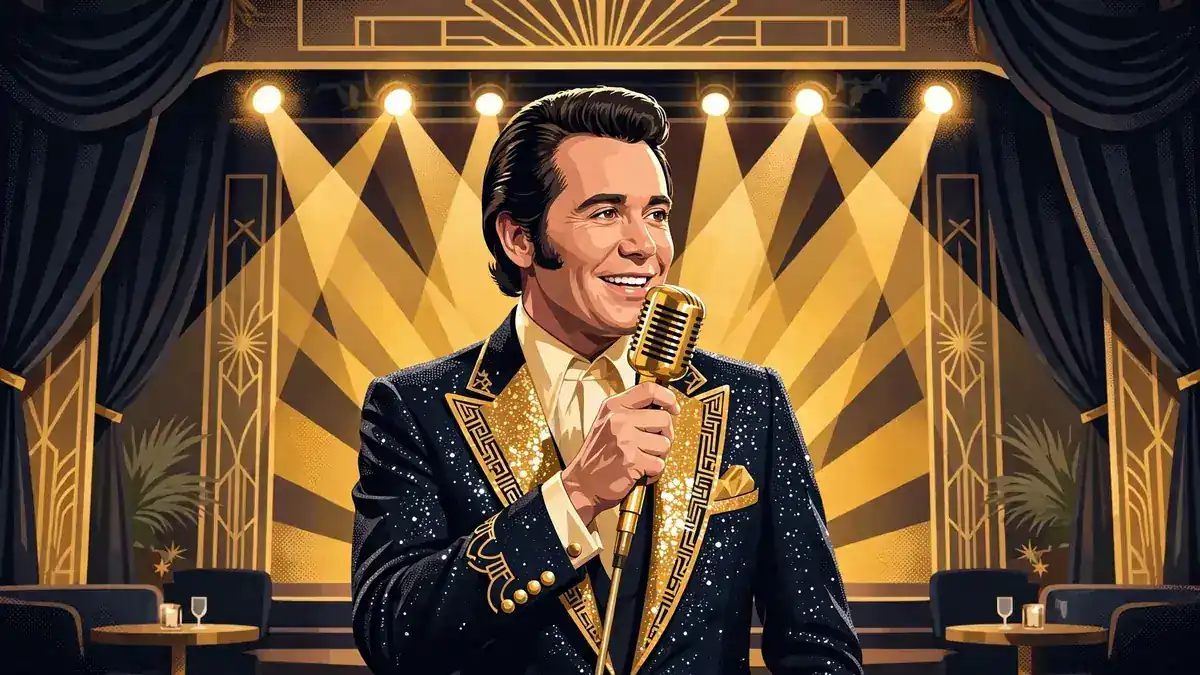
By 1963, Newton was headlining at the Flamingo — the same resort where, six decades later, he would still be performing. Over the decades he collected the nicknames that define his image: “The Midnight Idol,” “Mr. Entertainment,” and most enduringly, “Mr. Las Vegas.” The venues read like a history of the Strip itself: the Flamingo, Stardust, Desert Inn, Caesars Palace, Bally’s, the Tropicana, the Las Vegas Hilton, and the MGM Grand. His shows mixed singing with comedy, impressions, storytelling, and the polished glamour of classic Vegas entertainment — a format built for tourists and high rollers alike.
The milestones are genuinely extraordinary. Newton performed his 25,000th solo show in Las Vegas in 1994, and his total is now cited at more than 30,000 live performances — more shows in one city than any entertainer in its history. A road at Harry Reid International Airport, Wayne Newton Boulevard, is named for him. In 1999, he signed a landmark 10-year deal with the Stardust Resort and Casino calling for 40 weeks per year at six shows per week in a showroom named after him — a contract orchestrated by his business manager Jack Wishna that helped popularize the modern “headliner-in-residence” concept years before residencies became the industry’s dominant business model. The agreement ended amicably when the Stardust was demolished. Along the way came stranger chapters, including the 1983 Independence Day controversy: after Interior Secretary James G. Watt objected to the Beach Boys playing the National Mall, Newton — a friend and supporter of Ronald Reagan — was booked as the replacement, performing to mostly cheers and some boos in the middle of a national argument about pop music and patriotism.
Main Sources of Income
Newton’s income breaks down into four streams, and their proportions explain a lot about his finances. First, and overwhelmingly: live performance. Tens of thousands of paid shows across six decades made him one of the highest-grossing entertainers in Las Vegas history — a fundamentally different career from a recording artist’s, where the catalogue earns while you sleep. Second: record royalties. “Danke Schoen” enjoyed a second commercial life after “Ferris Bueller’s Day Off,” and “Daddy, Don’t You Walk So Fast” moved over a million units, but the catalogue is modest by the standards of the era’s biggest sellers. Third: film and television, where Newton’s Vegas persona became a marketable character. Credits include “Vegas Vacation” (playing himself as Clark Griswold’s romantic rival), the James Bond film “Licence to Kill,” “The Adventures of Ford Fairlane,” “Smokin’ Aces,” plus television spots on “Bonanza,” “The Lucy Show,” “Roseanne,” “Ellen,” “The Fresh Prince of Bel-Air,” “Ally McBeal,” and “According to Jim.” In 2007 he competed on “Dancing with the Stars” (eliminated third, partnered with Cheryl Burke) and became the first guest star on “The Price Is Right” after Drew Carey took over as host. In 2005 he hosted the E! reality competition “The Entertainer,” in which contestants vied to headline their own Las Vegas show. Fourth: licensing and nostalgia appearances. Taken together, the picture is of a fortune built almost entirely on the stage — which is precisely why its erosion, when it came, was so complete.
Salary and Earnings
The most precise earnings figure in Newton’s entire history comes not from a magazine estimate but from a courtroom. In the libel trial Newton v. NBC, sworn testimony established that before the network’s October 1980 broadcasts, Newton was earning $165,000 per week; his partner Ed Torres had agreed to raise that to $200,000 per week; and by the time of trial he was being paid $250,000 per week. On an annualized run-rate, the peak was roughly $13 million a year in early-1980s dollars — genuine headliner money, and a number no competitor’s estimate ever cites.
The showroom math behind it was industrial. The 1999 Stardust contract — 40 weeks a year, six shows a week — meant up to 240 paid performances annually in a single room, a throughput that explains how one singer could be called the highest-grossing act in the city’s history. The economics of the later career are leaner and more visible. In 2016 he returned with the intimate “Up Close & Personal” format at Bally’s; in 2019 he played Caesars Palace to mark his 60th year on stage; and through 2026 he has been headlining Bugsy’s Cabaret at the Flamingo with “Wayne: Up Close & Personal,” where general-admission tickets have been listed around $114 to $123, with VIP packages adding a meet-and-greet and souvenir photo. At 84, the model is a small room, a loyal audience, and low overhead — the opposite of the palace years, and a sensible one.
Businesses and Investments
For a man who earned as much as Newton did, the business portfolio is strikingly thin — and the one big investment outside the stage nearly destroyed him. From 1980 to 1982 he was part owner of the Aladdin Hotel, a partnership that generated a string of lawsuits and a failed 1983 attempt to buy the entire property. The trouble came from NBC’s October 6, 1980 “Nightly News” report, “Wayne Newton and the Law,” which emphasized his relationship with Guido Penosi, an alleged organized-crime figure, in connection with the Aladdin bid. Newton sued for libel. A jury awarded him $19,321,750 — $14,271,750 in compensatory damages, $5 million in punitive damages, and $50,000 presumed — but the trial judge struck the lost-income awards for lack of causal connection, keeping $225,000 for physical and mental suffering plus the $5 million punitive award. In 1990 the Ninth Circuit reversed and dismissed the case entirely; the U.S. Supreme Court denied review in 1991. A decade of litigation, enormous legal bills, and nothing to show for it: the costs of that fight account for much of the roughly $20 million in debts behind his 1992 bankruptcy filing.
His other enduring business was Arabian horse breeding, centered on Casa de Shenandoah, where he maintained stables, an equestrian pool, and a collection that at one point numbered dozens of prized Arabians. It was a passion project rather than a profit center — during the CSD litigation, the property’s horse-care costs were cited at $40,000 per month. Unlike peers who converted fame into restaurants, clothing lines, or production companies, Newton’s investments were the stage, the estate, and the horses. When the estate turned toxic, there was no diversified empire to fall back on.
Brand Deals and Sponsorships
Honesty requires a short section here: Newton has no major documented endorsement portfolio of the kind modern pop stars carry. There are no nine-figure sneaker deals, fragrance lines, or beverage contracts in his history. His brand equity has always been the name itself — “Mr. Las Vegas” as a living trademark — monetized through the residency, VIP meet-and-greets, and nostalgia bookings rather than through a sponsor’s logo. In an era when celebrity wealth is increasingly built on brand extensions, Newton is a case study of the older model: the personal appearance, sold directly, thousands of times.

Houses, Cars and Other Assets
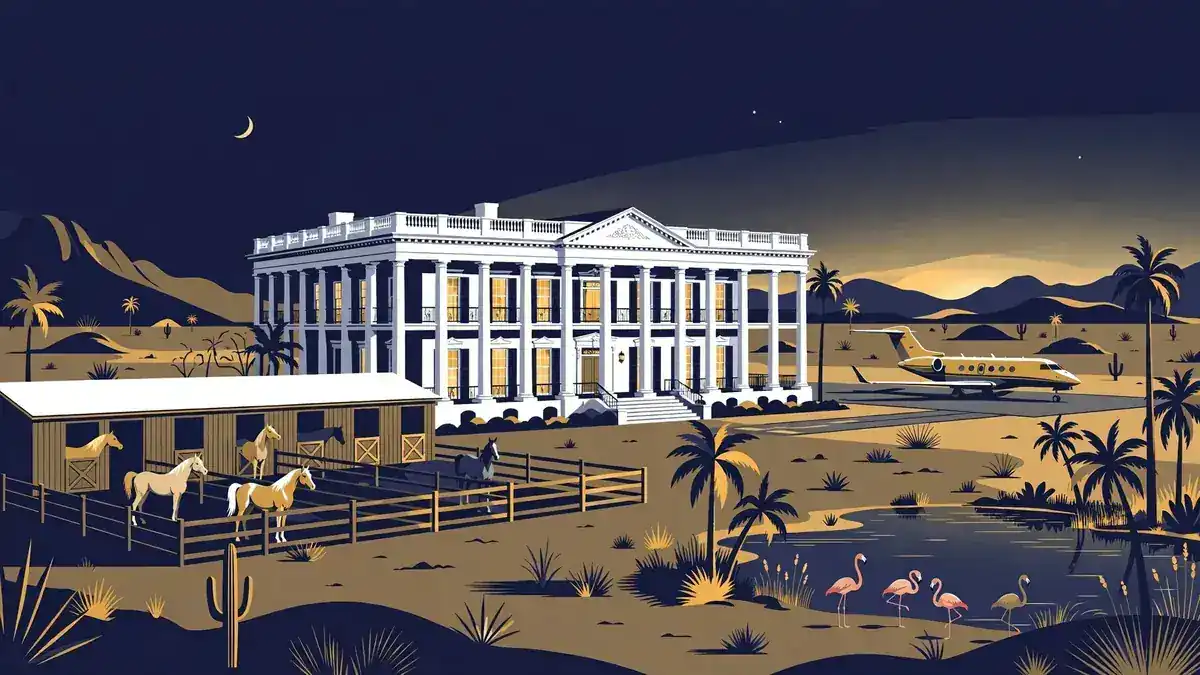
No single asset explains Newton’s finances better than Casa de Shenandoah. He bought his first five acres of vacant desert in 1966 and expanded the compound over decades into a 39.5-acre estate with a 14,000-square-foot white-pillared mansion, completed in 1978, which Newton designed himself in a classic Southern style at a construction cost of $4 million — roughly $19 million in today’s money. Around it: seven guest houses, stables with 50 stalls, an equestrian pool, a car museum, tennis courts, a jet terminal and private runway for his Fokker F28, and an exotic-animal facility that at various times held flamingos, penguins, wallabies, and a sloth. It was part home, part zoo, part private airport — and, as it turned out, a balance-sheet anchor.
The unwinding is a matter of public record. In 2010, billionaire NASCAR mogul Bruton Smith — a friend — sued Newton for defaulting on a $3.35 million loan and moved to foreclose on the estate. To save it, Newton struck a deal with Texas investors: CSD LLC bought the property in June 2010 for $18.7 million (some reports put it at $19.5 million), plus $10 million for ten additional acres, with the Newtons retaining a 20 percent stake. The plan was a Graceland-style public attraction. The terms were surreal on their face: CSD became the Newtons’ landlord at $1 a month and agreed to spend $2 million building them a new private home on the grounds. The partnership collapsed into years of litigation. CSD filed for Chapter 11 in 2012 and sued Newton for fraud and breach of contract, alleging he refused to vacate and hand over memorabilia; Newton countersued alleging fraud and mismanagement. Court filings traded lurid details — $40,000-a-month horse costs, removed rose bushes planted by his late mother, a filled-in meditation pond, disputes over a Rolls Royce Corniche built for Steve McQueen and paintings attributed to Renoir, Dalí, and Van Gogh. Both sides denied everything. The estate opened for public tours in 2015, closed in 2018, and in 2019 was liquidated out of bankruptcy for just $5.56 million, the proceeds going to creditors. It was later listed for $29.9 million in 2020 and $31.3 million in 2024 — numbers that describe the property’s land value, not Newton’s wealth, since by then he owned none of it.
The remaining assets tell the same story of maintenance costs eating equity. His Fokker F28 jet, once valued around $2 million, sat abandoned at Oakland County Airport in Michigan for more than three years, racking up over $60,000 in parking fees at $5,000 a month; it was eventually disassembled, transported, and reassembled on the estate grounds. A former pilot won a court judgment of more than $500,000 in back pay; a storage company was owed $271,000 by court order. The IRS filed a $341,000 tax lien as part of the 1992 bankruptcy and sued in 2005 for more than $1.8 million in taxes and penalties — one of Newton’s tax lawyers responded, “We believe the IRS owes him money.” He and his wife downsized in 2013 to a $3 million, 9,000-square-foot home on E. Oquendo Road, where in 2018 they interrupted burglars inside the house after a show. Newton and his wife later acquired a smaller property nearby, but the era of the 39-acre kingdom was over.
Awards and Achievements
The honors reflect the longevity rather than record sales. In 2008 Newton received the Woodrow Wilson Award for Public Service for his charitable and civic work. He was named chairman of the USO Celebrity Circle in the early 2000s, continuing a decades-long association with military morale tours that he himself ranked among his proudest work. “Daddy, Don’t You Walk So Fast” earned a gold record in 1972. The 1999 Stardust contract effectively made him the first headliner-in-residence of the modern era. And the informal honors — “Mr. Las Vegas,” the boulevard at the airport, the 25,000th-show milestone in 1994, the 60th year on stage in 2019 — are the kind that can’t be bought and can’t be seized by a creditor.
Net Worth Growth Over the Years
Newton’s wealth chart doesn’t slope gently upward; it crests, craters, and crests again. The figures below anchor to documented events rather than the smooth invented curves most net-worth sites publish.
| Year | Estimated position | What happened |
|---|---|---|
| 1980 | Peak earning power | Court testimony put his weekly salary at $165,000, rising to $200,000, then $250,000 at trial |
| 1992 | Financial collapse | Chapter 11 filing to reorganize ~$20 million in debts, including a $341,000 IRS lien |
| 1999 | Recovery | Reported “well off again”; signs landmark 10-year Stardust residency deal |
| 2005 | Tax trouble | IRS sues for $1.8 million in taxes and penalties; Newton disputes it |
| 2010 | Estate crisis | Sells majority of Casa de Shenandoah to CSD LLC (~$18.7–19.5M); Bruton Smith sues over $3.35M loan |
| 2013 | Downsizing | Moves to a $3 million, 9,000-square-foot home; Casa attraction plans stall |
| 2019 | Crown jewel lost | Casa de Shenandoah liquidated for $5.56 million, proceeds to creditors |
| 2026 | $5M–$50M range | Celebrity Net Worth anchors at $5M; aggregators circulate $50M; ongoing Flamingo residency |
Social Media Presence
Newton maintains accounts on Instagram, Facebook, and X, plus a Spotify artist page and an official website, all linked from his ticketing profiles. It is a modest, nostalgia-driven presence — tour dates, showroom photos, anniversary posts — befitting an 84-year-old whose audience buys tickets in person rather than streams. We won’t invent follower counts here; the meaningful number in his career has always been the show count.
Personal Life
Newton married Elaine Okamura in 1968; they had a daughter, Erin, in 1976, and divorced in 1985. In 1994 he married Kathleen McCrone, an attorney from Ohio; they have a daughter, Lauren Ashley, born in 2002. The family has stayed tightly knit through the financial wars — McCrone appeared beside him at the 2012 court hearings over Casa de Shenandoah, and her sister Tricia McCrone has served as the family’s publicist. Outside performing, his constants have been Arabian horses, the Cherokee heritage of his mother, and military-charity work that earned him the USO chairmanship.
Sources & Reporting
- Celebrity Net Worth — the $5 million estimate and the detailed financial-history timeline (1992 bankruptcy, IRS suits, Casa de Shenandoah liquidation, 1999 Stardust deal, career facts).
- Wikipedia — Chapter 11 filing and $20 million debt figure, NBC libel case background, Aladdin Hotel ownership, IRS disputes, Fokker F28 airport saga, Casa de Shenandoah sale timeline.
- Pollstar — the CSD museum-deal collapse, 2012 fraud/breach lawsuits and countersuits, $500,000 pilot judgment, Bruton Smith’s $3.35 million foreclosure attempt, $1.8 million IRS suit.
- Justia — court record of Newton v. NBC (677 F. Supp. 1066), including sworn testimony that Newton earned $165,000 to $250,000 per week in the early 1980s.
- CaseMine — appellate history: Ninth Circuit reversal and dismissal in 1990, Supreme Court denial of certiorari in 1991.
- The Real Deal — the 2024 $31.3 million listing of the former estate and the 2019 $5.56 million Smoketree acquisition.
- realtor.com — Casa de Shenandoah listing history, the 2010 sale and Newton’s retained 20 percent stake.
- Casino.org / Vital Vegas — the estate’s 2015 opening as a tourist attraction, 2018 closure, and Newton’s 2013 $3 million E. Oquendo home.
- Ticketmaster — 2026 “Wayne: Up Close & Personal” dates at Bugsy’s Cabaret, plus the career timeline (1963 Flamingo headliner, 1999 Stardust deal, 2019 Caesars 60th-year run).
- iGoVEGAS — the 30,000-plus show count, the six-shows-a-night-six-nights-a-week origin story, and Flamingo residency details.
- SeatGeek — 2026 Flamingo ticket listings at approximately $114–$123 general admission.
- Consequence — VIP meet-and-greet ticketing details for the Flamingo run.
Reporting window: sources span 1980 court records through October 2026 listings and ticketing pages. Estimates dated October 2026.
Frequently Asked Questions
What is Wayne Newton’s net worth in 2026?
We estimate Wayne Newton’s net worth at $5 million to $50 million as of October 2026. Celebrity Net Worth — the most widely cited authority on celebrity wealth — currently puts him at $5 million, citing his documented bankruptcies, lawsuits, and the loss of Casa de Shenandoah. Thinner aggregator sites circulate an unsourced $50 million figure. Given the public record of his debts and asset liquidations, we weight the lower end more heavily.
Is Wayne Newton still alive?
Yes. Born April 3, 1942, Wayne Newton is 84 years old and still performing. As of October 2026 he is headlining “Wayne: Up Close & Personal” at Bugsy’s Cabaret at the Flamingo in Las Vegas, with dates booked through December 2026.
Where does Wayne Newton perform now?
At Bugsy’s Cabaret inside the Flamingo Las Vegas on the Strip, in his show “Wayne: Up Close & Personal” — an intimate mix of his biggest hits, stories from six decades in show business, and audience questions. General-admission tickets have been listed around $114–$123, with VIP meet-and-greet packages available.
How old is Wayne Newton?
Wayne Newton was born Carson Wayne Newton on April 3, 1942, in Norfolk, Virginia, making him 84 years old in 2026. He began performing professionally as a child in the 1950s and has been active on stage for nearly 70 years.
Why did Wayne Newton file for bankruptcy?
In 1992 he filed for Chapter 11 to reorganize roughly $20 million in debts. Much of the debt traced to legal costs from his decade-long libel lawsuit against NBC — he won a $19.3 million jury verdict that was ultimately reversed on appeal — plus a $341,000 IRS tax lien. He recovered financially by 1999, but tax and legal troubles returned in the 2000s.
What happened to Casa de Shenandoah?
Newton sold a majority stake in his 39-acre Las Vegas estate to CSD LLC in 2010 for about $18.7–19.5 million, keeping 20 percent. The planned Graceland-style museum collapsed into lawsuits, the company went bankrupt in 2012, the attraction closed in 2018, and the estate was liquidated for $5.56 million in 2019 — the proceeds going to creditors, not Newton.
What is Wayne Newton’s most famous song?
“Danke Schoen,” released in 1963, reached #13 on the Billboard Hot 100 and became his signature recording. It found a second generation of fans through its use in 1986’s “Ferris Bueller’s Day Off.” His biggest chart hit was “Daddy, Don’t You Walk So Fast,” which hit #4 in 1972 and sold over a million copies.
How many shows has Wayne Newton performed?
More than 30,000 live shows in Las Vegas — a total routinely cited as the most by any entertainer in the city’s history. He marked his 25,000th solo show in 1994, and at one point in the 1960s he was performing six shows a night, six nights a week. His 2026 Flamingo run adds to the count.
Final Thoughts
Wayne Newton’s fortune is really two fortunes: the one he made and the one he kept. The one he made is almost beyond dispute — a court-documented $250,000 a week at his peak, 240-show years, and the most performances of any headliner in Las Vegas history add up to lifetime earnings that dwarf most rock stars. The one he kept ran into the NBC libel war, a $20 million bankruptcy, a billionaire’s foreclosure lawsuit, IRS battles, and a 39-acre estate that consumed cash faster than it stored it.
That is why the honest estimate carries a range and why we lean toward Celebrity Net Worth’s $5 million: the record of what left is better documented than the record of what stayed. The $50 million figure circulating on thin aggregator sites has no sourcing behind it, and sourcing is the entire game. What is not in dispute is the working life itself — six decades, 30,000 shows, a road at the airport, and a singer still walking out at the Flamingo at 84. Fortunes can be litigated away. That doesn’t.
Published on 2026-10-10. Last reviewed October 2026. Found an error? See our corrections policy.