
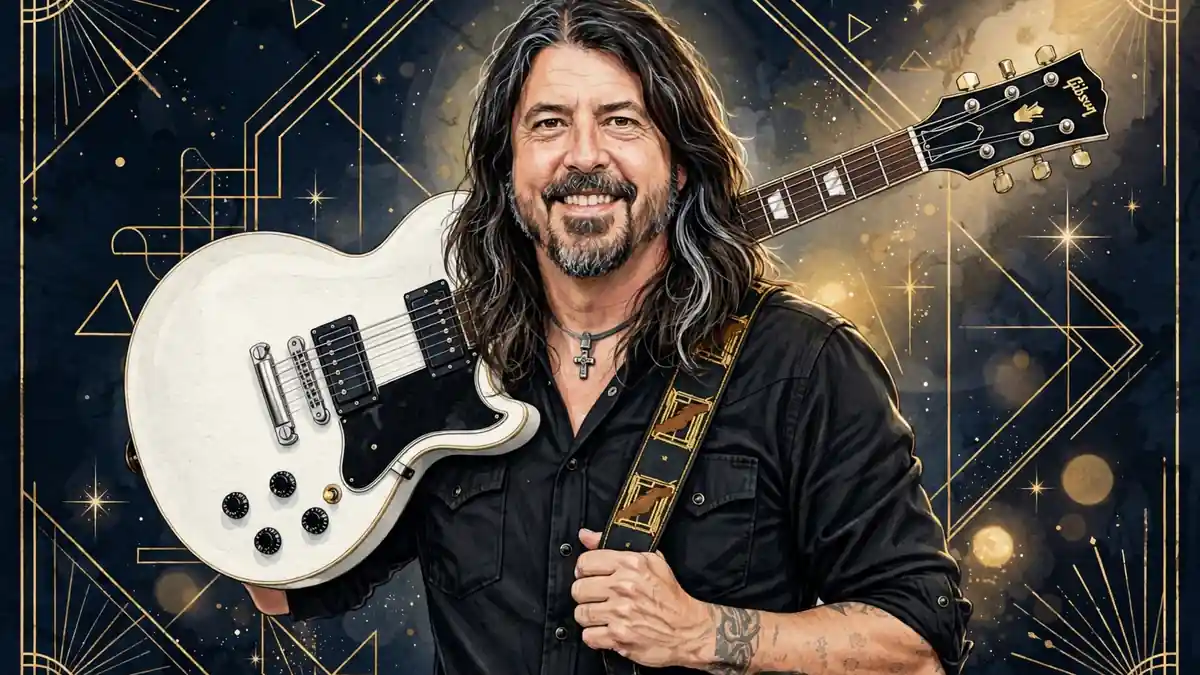
Dave Grohl‘s net worth is estimated at $330 million as of November 2026. The figure comes from Celebrity Net Worth’s October 2026 update, and Wealthy Gorilla publishes the same number — a rare point of agreement in a field where rival estimates for Grohl swing from $260 million to $450 million. What sets Grohl apart from almost every rock star of his generation is the shape of the fortune: he was already worth around $15 million at 25, by his own account, when Nirvana ended in 1994 — and then he built a second career worth more than twenty times that, largely because he owns the Foo Fighters outright, masters and all, instead of renting his own songs back from a record label.
Dave Grohl: Quick Facts
| Estimated net worth | $330 million (range: $260 million – $330 million) |
|---|---|
| Profession | Musician, singer, songwriter, record producer, director |
| Nationality | American |
| Born | January 14, 1969 (age 57) |
| Height | 6 ft (1.83 m) |
| Primary income sources | Foo Fighters recordings and touring, Nirvana royalties, Roswell Records licensing, Studio 606, film and book projects |
| Active years | 1986–present |
| Last reviewed | November 2026 |
- Early Life and Background
- Education
- Career Journey
- Rise to Fame
- Main Sources of Income
- Salary and Earnings
- Businesses and Investments
- Brand Deals and Sponsorships
- Houses, Cars and Other Assets
- Awards and Achievements
- Net Worth Growth Over the Years
- Social Media Presence
- Personal Life
- Sources & Reporting
- Frequently Asked Questions
Early Life and Background
David Eric Grohl was born on January 14, 1969, in Warren, Ohio, and grew up in Springfield, Virginia, after his parents split while he was still young. His mother, Virginia Jean Grohl, taught in public schools; his father, James Harper Grohl, worked as a journalist. The household was comfortable but far from wealthy, and the detail matters because Grohl’s later business sense — keeping his masters, starting his own label, buying his own studio — reads like the habits of someone who watched money carefully from an early age rather than someone handed a fortune.
Music reached him through Washington, D.C.’s punk scene. He taught himself guitar at 12, picked up drums soon after, and spent his teens playing in local hardcore bands around Springfield and Alexandria. The D.C. scene of the mid-1980s ran on a do-it-yourself code: bands booked their own shows, pressed their own records, and split the door money themselves. Grohl absorbed that code before he ever signed a contract, and it shaped every deal he made later — most plainly the decision to own the Foo Fighters’ recordings instead of handing them to a major label.
At 17, he joined the D.C. hardcore band Scream as their drummer, and the band’s touring schedule pulled him out of school. He has described those years as his real education in the music business: sleeping on floors, driving a van between club dates, and learning what a band actually earns on the road once the promoter, the venue, and the gas tank have all taken their cut. By the time Nirvana called, Grohl already knew how touring economics worked from the bottom up.
Education
Grohl attended Thomas Jefferson High School in Alexandria, Virginia, and later transferred to Bishop Ireton High School, also in Alexandria. He left school in his junior year to tour full-time with Scream — a decision that would look reckless on paper and turned out to be the single most valuable schooling he ever got. He has never earned a college degree, and he has never needed one: the record business he entered paid in road miles, and he collected plenty of those before he turned 20.
The gap in formal education shows up in his career in an unexpected way. Grohl learned the industry as a working drummer rather than through a business program, which may explain why his financial instincts stayed practical: own the recordings, control the touring, keep the overhead low, and never sell the catalog. Those are working-musician rules, not boardroom theories, and they built him a bigger fortune than most MBA-trained managers ever assemble for their clients.
He later turned the classroom into subject matter instead. His 2021 memoir The Storyteller: Tales of Life and Music became a New York Times bestseller, and his documentary Sound City (2013) — his debut as a film director — told the story of the Van Nuys studio where Nevermind was recorded. Both projects paid, and both reinforced the same brand: the drummer who learned by doing and now teaches the history he lived through.
Career Journey
Grohl’s career splits cleanly into two acts, and the money splits the same way. Act one ran from 1986 to 1994: four years drumming for Scream, then four years behind the kit in Nirvana. Act two started the day Nirvana ended and has run ever since — 32 years and counting as the founder, frontman, principal songwriter, and owner of the Foo Fighters. Few musicians get one career of that size. Grohl built two, and the second paid far more than the first.
Scream gave him his start. He joined in 1986 at 17, recorded two albums with the band, and toured North America and Europe on the hardcore circuit. The pay was thin — club guarantees and merch-table cash — but the road taught him stamina. When Scream broke up in 1990 during a tour, Grohl was stranded in Los Angeles with no band and no plan. A tape of his drumming reached Nirvana, who had just parted with drummer Chad Channing, and within weeks he was auditioning in Seattle.
He joined Nirvana in October 1990. The band recorded Nevermind in the spring of 1991 at Sound City Studios in Van Nuys, and the album landed in September 1991. Its second single, “Smells Like Teen Spirit,” turned a Seattle trio into the biggest rock band on the planet within months. Nevermind has sold more than 30 million copies worldwide, and Nirvana’s total record sales now stand above 75 million, according to industry tallies cited by multiple outlets. Grohl played on In Utero (1993) as well, the band’s raw, Steve Albini-produced follow-up that debuted at number one on the Billboard 200.
The first act ended in April 1994, when Kurt Cobain died in Seattle at 27. Grohl was 25. In a 2011 interview with Howard Stern, Stern pressed him on what he was worth when Nirvana ended, and Grohl put the number at around $15 million. That figure is the anchor for everything that followed: a 25-year-old drummer, already rich by any normal measure, who had just lost his band and his friend and had to decide what came next.
What came next was a one-man project. In October 1994, six months after Cobain’s death, Grohl booked a week at Robert Lang Studios in Seattle and recorded a 15-track demo almost entirely by himself — drums, guitar, bass, and vocals — under the name Foo Fighters, borrowed from the World War II term for unidentified flying objects. He pressed a few hundred cassette copies and handed them to friends. Capitol Records signed the project, and the self-titled debut album Foo Fighters arrived in July 1995. Grohl then recruited a real band — Nate Mendel on bass, Pat Smear on guitar, and William Goldsmith on drums — and went on the road.
The band’s second act kept compounding. The Colour and the Shape (1997) delivered “Everlong” and “My Hero,” the songs that still close Foo Fighters shows three decades later. There Is Nothing Left to Lose (1999) won the Grammy for Best Rock Album. One by One (2002), In Your Honor (2005), Echoes, Silence, Patience & Grace (2007), and Wasting Light (2011) — recorded in Grohl’s garage on analog tape — each added another layer of catalog, another round of radio royalties, and another stadium tour. By the 2010s, Foo Fighters were one of the few rock bands left that could headline stadiums anywhere in the world.
Side projects ran alongside the main band the whole way. Grohl drummed on Queens of the Stone Age’s Songs for the Deaf (2002), one of the most acclaimed rock records of its decade. He formed the supergroup Them Crooked Vultures in 2009 with Josh Homme and Led Zeppelin’s John Paul Jones. He recorded Probot (2004), a heavy-metal album built around guest vocalists from his favorite underground bands. He directed Sound City in 2013 and published The Storyteller in 2021. Each project widened his income base and his reputation as the hardest-working person in rock — a reputation that itself became a commercial asset.
The band’s hardest test came in March 2022, when drummer Taylor Hawkins died in Bogotá, Colombia, at 50, hours before a scheduled festival headline set. Grohl and the band cancelled the tour, played two tribute concerts in London and Los Angeles that September, and then returned with But Here We Are in June 2023 — an album written in the aftermath of the loss, with Grohl back behind the drums. A twelfth studio album, Your Favorite Toy, followed in April 2026, according to reporting by Celebrity Net Worth and Hispotion, and the band returned to stadium touring the same year.
Rise to Fame
Grohl’s first rise was sudden and total. Nevermind went from a modest Sound City session to a number-one album in about four months, and “Smells Like Teen Spirit” became the defining song of the 1990s. The band went from clubs to arenas to stadiums in a single album cycle, and Grohl — the new guy, the one with the huge drum sound — became famous as the engine of the loudest band in the world. The fame paid well: by his own 2011 estimate, he was worth around $15 million when it ended. But fame inside Nirvana came with a hard limit. Cobain wrote the songs, Cobain’s estate controls the publishing, and Grohl’s share of Nirvana’s money has always been the drummer’s share — substantial, but a fraction of what the songwriter’s side earns.
His second rise was slower, and it paid far better. Foo Fighters spent the late 1990s building an audience one tour at a time, and the band’s breakthrough to stadium scale arrived in the 2000s as their catalog deepened. The difference was structural: this time Grohl was the songwriter, the bandleader, and the owner. Every album, every stream, every licensing deal, and every ticket flowed through a company he controlled. The fame was his, and so was the business.
The numbers trace the second rise. Pollstar’s touring data, cited by Celebrity Net Worth, shows Foo Fighters playing 395 reported headline shows between 1999 and 2025, selling 6.9 million tickets and grossing $530.4 million — and those figures cover only shows reported to Pollstar, not every concert the band has played. The 2024 “Everything or Nothing at All” stadium run alone grossed $103.5 million from 31 shows, an average of about $3.3 million per night. That is the touring engine of a band that spent 30 years getting bigger instead of smaller.
Fame also brought the kind of cultural status that pays in ways that never show up on a royalty statement. Grohl has been inducted into the Rock and Roll Hall of Fame twice — with Nirvana in 2014 and with Foo Fighters in 2021 — a distinction shared by only a handful of musicians in history. He has performed at the White House, at the Kennedy Center Honors, at Paul McCartney’s side, and at the funerals and tributes of his heroes. That standing keeps him in demand for collaborations, documentaries, and guest appearances that other 57-year-old rockers never get offered.
The 2026 chapter added a fresh note. The band’s twelfth album arrived in April 2026, a new stadium run was announced with Queens of the Stone Age sharing the bill, and in September 2026 Grohl appeared at the MTV Video Music Awards alongside his wife Jordyn Blum — while Nirvana reunited on the same stage to honour Kurt Cobain. Three decades after Nevermind, Grohl is still the person both of his bands turn to when the moment matters.
Main Sources of Income
Grohl’s money comes from five streams, and the order matters: touring first, recordings second, Nirvana royalties third, licensing and publishing fourth, and everything else — books, film, guest work, his studio — fifth. The mix is unusually sturdy for a musician, because no single stream carries the whole fortune. When touring stopped during the pandemic, the catalog kept paying. When the band took time off after Hawkins’s death, the royalties kept paying. That is the point of owning your masters.
Touring. The road is the biggest earner, and the Pollstar figures prove it. Across 395 reported headline shows from 1999 through 2025, Foo Fighters grossed $530.4 million from 6.9 million tickets. The 2024 stadium run — 31 shows, 862,523 tickets, $103.5 million — averaged roughly $3.3 million in gross ticket sales per night, before merchandise. Stadium shows add a second layer: at a 40,000-capacity venue, even a modest merch spend per head turns into six figures a night. Grohl, as bandleader and owner, takes the largest share of that gross after costs, and the split favors him further because the band tours as a unit he controls rather than as a hired lineup.
Recordings and catalog ownership. This is the stream that separates Grohl from nearly every peer. He owns 100 percent of the Foo Fighters’ master recordings through his own label, Roswell Records, and licenses them to major labels for distribution — a structure Celebrity Net Worth singles out as the most important component of his fortune. In practice it means that when a Foo Fighters song streams, sells, or lands in a film, a far larger share of the money comes back to Grohl than a typical artist sees, because there is no label taking the traditional 80-plus percent of recording revenue. Foo Fighters have sold more than 30 million albums worldwide, and the catalog — twelve studio albums plus live records and compilations — generates streaming income every day whether the band is on tour or not.
Nirvana royalties. Grohl’s Nirvana income has run for more than 30 years and shows no sign of stopping. Nevermind remains one of the best-selling albums of all time, and Nirvana’s catalog — more than 75 million records sold — still earns from streaming, reissues, box sets, and licensing. Grohl’s share is the performer’s and co-writer’s share, not the songwriter’s share: Cobain wrote the songs, and the publishing flows through Cobain’s estate and the Nirvana LLC structure the surviving members set up with Courtney Love in 1997. In 2006, Love sold 25 percent of her share of Nirvana’s catalog to Primary Wave Music for a reported $50 million — a deal that set a public market price on the catalog and underlined how valuable Grohl’s smaller slice still is. The Nirvana stream is real money, but it is the smaller of his two band incomes, and that fact is the whole story of his career: the drummer’s share of one great band was worth about $15 million; the owner’s share of the next one was worth more than twenty times as much.
Licensing, publishing, and sync. Foo Fighters songs turn up in films, television, video games, and advertising, and each placement pays. “Everlong” alone has been licensed across decades of film and TV. Because Grohl controls both the masters and a large share of the publishing as principal songwriter, sync deals pay him on both sides of the transaction — a double dip that artists signed to traditional deals never see.
Books, film, and guest work. The Storyteller (2021) became a New York Times bestseller, and its audiobook — read by Grohl himself — won a Grammy for Best Audio Book, Narration & Storytelling Recording. Sound City (2013) earned critical praise and a Grammy for Best Compilation Soundtrack for Visual Media. Guest drumming and producing for other artists — Queens of the Stone Age, Tenacious D, Killing Joke, and many more — add session fees and goodwill that keep his name in circulation between Foo Fighters cycles.
Salary and Earnings
Grohl has no salary in the ordinary sense. He is not an employee; he is the owner of the business that employs the band. His annual income therefore swings with the touring calendar: in a stadium-tour year, his take-home runs far higher than in a studio year, when royalties and licensing carry the load. That structure is worth understanding, because the “$30 million a year” salary figures that circulate on net-worth aggregator sites are guesses, not reported facts — no outlet has published Grohl’s tax returns or a verified annual pay figure, and this article does not repeat those guesses as fact.
What can be measured is the gross. The 2024 stadium run produced $103.5 million in reported ticket gross across 31 shows. After venue costs, crew, transport, production, and the band’s own shares, the net to Grohl from that run alone runs into the millions — and that is before merchandise, which at stadium scale routinely adds hundreds of thousands of dollars per night. In non-touring years, the income floor comes from the catalog: Foo Fighters’ twelve albums and Nirvana’s catalog stream millions of times a month, and streaming, radio, and licensing royalties arrive whether Grohl is on stage or at home in Encino.
Two numbers frame his earnings growth. In 2011, at 42, he told Howard Stern he had been worth about $15 million when Nirvana ended in 1994. By October 2026, Celebrity Net Worth put him at $330 million. That is roughly 22 times the 1994 figure — growth driven almost entirely by the Foo Fighters years, and concentrated in the last decade as stadium touring scaled up and streaming turned the catalog into a permanent annuity. The lesson is plain: the Nirvana years made him rich; the Foo Fighters years made him wealthy.
Annual earnings estimates from aggregator sites cluster around $20–30 million in touring years, but treat those as rough guides rather than facts. The verifiable anchors are the Pollstar grosses, the catalog ownership, and the $330 million estimate itself. Any article that prints a precise yearly salary for Grohl without naming a source is inventing a number — and this one does not.
Businesses and Investments
Roswell Records. Grohl founded Roswell Records in 1995 to release Foo Fighters’ music on his own terms, and the label remains the legal home of the band’s entire catalog. The model is simple and rare: Roswell owns the masters and licenses them to a major label — currently RCA, part of Sony Music — for fixed terms, usually six to seven years at a time, after which the rights revert and Grohl can renegotiate. Most artists sign their masters away for life; Grohl rents his out and keeps the keys. The label also releases side projects, which keeps the overhead inside one company he controls.
Studio 606. In 2004, Grohl bought a warehouse in Northridge, California, for about $1.1 million and converted it into Studio 606, a world-class recording facility built around the Neve 8028 console from the original Sound City Studios. The studio is both a business and a creative asset: other artists pay to record there, Foo Fighters record there for free, and the room itself has become part of the band’s identity — the Sound City documentary was effectively a film about why that mixing desk mattered. A $1.1 million warehouse purchase that became one of the most famous studios in rock is the kind of investment that only looks obvious in hindsight.
The Storyteller and publishing. Grohl’s 2021 memoir became a bestseller and spawned a live storytelling tour, an audiobook, and a follow-up of short stories. Publishing advances and royalties for a celebrity memoir of that scale run into seven figures, and the book doubled as marketing for the band — a product that paid for itself twice.
Investments beyond music. Grohl has never publicized a venture-capital portfolio or a startup slate, and there is no credible reporting of him as a tech investor or a restaurant-chain owner — the kind of side businesses that fill out other celebrities’ net-worth pages. His investing has stayed close to home: property and his own companies. That conservatism is a choice, and it shows in the numbers. He has no reported business failures on the scale of other stars’ restaurant or clothing lines — but he does have one property loss, and it is worth recording because most net-worth pages leave it out.
The Oxnard loss. In 2006, Grohl paid $3.8 million for a beachfront property in Oxnard, California. He sold it in November 2015 for $2.9 million — a loss of about $900,000 before costs. The sale ran through the post-2008 coastal market, and it is a useful corrective to the idea that every Grohl purchase printed money. His Sherman Oaks house, bought for $569,000 in 2001 and sold for $1.6 million in July 2024, more than made up for it. But the Oxnard deal is the honest footnote: his real estate record is strong, not perfect.
Brand Deals and Sponsorships
Grohl is not a brand-deal musician in the usual sense. He has no sneaker line, no fragrance, no long-running ambassador contract with a car company or a watchmaker, and he has never built his public image around endorsements. What he has instead is a gear relationship: his signature Gibson DG-335 guitar, released in collaboration with Gibson, ties his name to one of the most respected instruments in rock. Guitar endorsements pay in a mix of cash, royalties, and instruments rather than the eight-figure checks that fashion and beverage deals bring — and they fit a musician whose brand is credibility, not luxury.
The absence of big-ticket endorsements is itself a financial statement. Grohl’s fortune was built on owning his work, not on renting his face to other companies, and his public image — the reliable, hard-working, famously friendly rock star — is worth more to him un-sponsored than it would be as a billboard. When he does appear in advertising, it is usually for a music product or a cause, and the fee is secondary to the fit.
His most visible commercial partnerships are with the companies that distribute his music: RCA/Sony for Foo Fighters recordings and the streaming platforms that pay for every play. Those are distribution deals, not sponsorships, and they are the reason the catalog keeps paying. In 2026, the band’s new stadium tour with Queens of the Stone Age as support act adds another layer of commercial partnership — a co-headline-scale package that lifts grosses for both bands and keeps ticket prices high.
Houses, Cars and Other Assets
Grohl’s property record is unusually well documented, because Celebrity Net Worth and Realtor.com have both traced his purchases through public records. The pattern is steady rather than flashy: he buys, holds for years, and sells only when the moment suits him. He is not a house-flipper, and his primary home has been the same Encino property for more than two decades.
Encino, California — the family home. In 2003, the same year he married Jordyn Blum, Grohl paid $2.2 million for an 8,342-square-foot home on two acres in Encino. Built in 1950, the single-story house has five bedrooms, a pool, and a three-car garage, and Realtor.com estimated its value at around $6.8 million in 2024. Grohl and Blum were married on the property’s tennis court in August 2003, according to Paul Brannigan’s biography This Is a Call. The house has nearly tripled in value since purchase — the single best property call of his life, and the one he still lives in.
Sherman Oaks, California — sold 2024. Grohl paid $569,000 for a Sherman Oaks home in 2001 and held it for more than two decades before selling it in July 2024 for $1.6 million — nearly three times the purchase price. The timing is notable: the sale came two months before his September 2024 Instagram post about fathering a child outside his marriage, and it remains the cleanest property win on his record.
Shoreline, Washington — early purchase. In 1993, at 24 and fresh off Nevermind‘s success, Grohl paid $335,000 for a roughly 4,000-square-foot home in Shoreline, Washington, near Seattle. It was his first major purchase as a rock star, and it dates from the brief window when Nirvana’s money was new and Seattle was still home.
Oxnard, California — the loss. The beachfront property he bought for $3.8 million in 2006 sold for $2.9 million in November 2015. Few net-worth pages mention it, because a $900,000 loss spoils a tidy story. It belongs in the record anyway: even Grohl’s property record has a down year, and the Encino and Sherman Oaks gains absorbed it easily.
Cars and other assets. Grohl’s car collection is modest by rock-star standards and rarely discussed in interviews, which is itself the point: he spends on instruments, not automobiles. His most valuable physical assets are musical — the Neve console at Studio 606, his collection of Gibson guitars including the DG-335 signature model, and the Foo Fighters master recordings themselves, which no insurer can price the way a house can be priced. The masters are the asset that matters: a catalog that earns every day, cannot be stolen, and grows more valuable as streaming keeps compounding.
Awards and Achievements
Grohl’s trophy shelf is one of the deepest in rock, and the counts vary by source — which is worth saying plainly, because aggregator sites print different numbers with equal confidence. Far Out Magazine credits him with 12 Grammy Awards; other tallies run as high as 16 or 17 depending on whether they count band wins, solo wins, and visual-media awards separately. Every count puts him in double figures, and the specific wins are well documented: Foo Fighters have won Best Rock Album for There Is Nothing Left to Lose, One by One, Echoes, Silence, Patience & Grace, and Wasting Light, plus Best Rock Performance wins for “All My Life” and “The Pretender,” and a Best Music Video win for “Learn to Fly.” Nirvana won one competitive Grammy — Best Alternative Music Performance for MTV Unplugged in New York in 1996 — and received the Grammy Lifetime Achievement Award in 2023.
The two Rock and Roll Hall of Fame inductions stand above the Grammys. Nirvana entered in 2014, in the band’s first year of eligibility, with Grohl and Krist Novoselic performing alongside guest vocalists including Joan Jett and Lorde. Foo Fighters entered in 2021, making Grohl one of the very few musicians inducted twice. He has also collected American Music Awards, MTV Video Music Awards, Brit Awards, and NME Awards across both bands, and his audiobook of The Storyteller won a Grammy of its own.
Beyond trophies, the achievements that pay are the records themselves. Nevermind has sold more than 30 million copies. Foo Fighters have sold more than 30 million albums. Wasting Light, recorded on tape in Grohl’s garage, debuted at number one on the Billboard 200 — a garage record beating the entire industry’s polished output. And the band’s 2024 stadium run, grossing $103.5 million, proved that a rock band formed in 1994 could still be one of the biggest live draws on earth thirty years later.
Net Worth Growth Over the Years
The growth table below uses the figures sources actually published, not a smooth curve invented for this article. Early years rely on Grohl’s own 2011 statement to Howard Stern; later years track Celebrity Net Worth’s published estimates, which climbed from about $300 million in 2022 to $330 million in 2026.
| Year | Estimated net worth | What moved it |
|---|---|---|
| 1994 | ~$15 million | Grohl’s own estimate of his wealth when Nirvana ended, given to Howard Stern in 2011 |
| 2000 | ~$30–40 million (estimated) | Foo Fighters’ first five years: three albums, rising tour grosses, Roswell Records established |
| 2010 | ~$120–150 million (estimated) | Wasting Light era; arena-to-stadium touring scale; catalog deepening |
| 2015 | ~$200 million (estimated) | Sonic Highways, HBO series, stadium headlining; Oxnard property sold at a loss |
| 2020 | ~$260–280 million (estimated) | Streaming growth on a twelve-album catalog; Medicine at Midnight released |
| 2022 | ~$300 million | Celebrity Net Worth estimate; post-Hawkins tribute concerts; But Here We Are in production |
| 2024 | $330 million | Celebrity Net Worth; $103.5 million stadium tour gross; Sherman Oaks sale at $1.6 million |
| 2026 | $330 million | Celebrity Net Worth October 2026 update; Wealthy Gorilla agrees; twelfth album and new stadium run |
Two things stand out. First, the curve bends upward after 2010, when Foo Fighters crossed from arenas into stadiums and streaming turned the catalog into a permanent income stream. Second, the estimate has held flat at $330 million since 2024 — not because Grohl stopped earning, but because the estimators have not revised upward while the 2026 tour is still running. If the stadium run performs as the 2024 run did, the next revision is more likely to rise than fall.
Social Media Presence
Grohl keeps a deliberately low social-media profile, and that restraint is part of his brand. He has no verified personal account pumping out daily content. His most famous social-media moment was not a promotion at all: in September 2024 he used Instagram to tell the world himself that he had fathered a daughter outside his marriage, writing that he planned to be “a loving and supportive parent” and that he was working to regain his family’s trust. The post — blunt, unspun, and posted without a publicist’s polish — was shared by every major outlet within hours, and it remains the clearest example of how Grohl uses social media: rarely, directly, and on his own terms.
Day-to-day promotion runs through Foo Fighters’ official channels, which announce tours, albums, and ticket sales to millions of followers across Instagram, X, and YouTube. Grohl also ran the @davestruestories Instagram account during The Storyteller era, posting handwritten memories and photographs from his career — a feed that read like a memoir in installments and drove book sales without a single ad buy. He has never chased the influencer economy, never sold a sponsored post that anyone can name, and never needed to: the band’s touring business does the marketing, and the catalog does the selling.
Personal Life
Grohl married Jordyn Blum, a former model and television producer, in August 2003, in a ceremony on the tennis court of their Encino home. They have three daughters together: Violet, born in 2006, who has performed on stage with her father and sings; Harper, born in 2009; and Ophelia, born in 2014. As of late 2026, the daughters are 20, 17, and 12. Grohl was previously married to photographer Jennifer Leigh Youngblood; that marriage ended in divorce in 1997, after Grohl admitted to infidelity.
The marriage to Blum faced its hardest test in September 2024, when Grohl announced on Instagram that he had “recently become the father of a new baby daughter, born outside of my marriage.” The child was born on August 1, 2024, and her mother was later identified as Jennifer Young, a rock fan from Florida living in Los Angeles, according to Page Six. Grohl said he intended to be a loving and supportive parent to the child and to work to regain his family’s trust. In February 2025, People reported that Blum had decided against divorce, and by September 2026 a source told People that Blum had forgiven him and that the couple were “very happy” again.
The repair work has been public in fragments. In a 2026 interview with The Guardian, Grohl said he had been in therapy six days a week for 70 weeks following the affair. On September 27, 2026, he and Blum attended the MTV Video Music Awards together, smiling for photographers with his arm around her waist, in one of their most visible joint appearances since the revelation. The couple have not discussed any financial settlement — none has been reported — and there is no public record of a divorce filing, which matters for the net-worth picture: unlike many celebrity splits, this crisis has not produced a reported division of assets.
Grohl’s father, James Harper Grohl, died in 2014. His mother, Virginia, wrote a book about raising a rock star, From Cradle to Stage (2017), which became a Paramount+ series hosted by mother and son. The family story — a public-school teacher raising the drummer of Nirvana in suburban Virginia — is one Grohl has told often, and it is the foundation of the image that has survived even the 2024 scandal: the hardest-working, most decent-seeming man in rock, now doing the hard work of repair in public.
Sources & Reporting
How this article was reported. The $330 million headline estimate comes from Celebrity Net Worth‘s Dave Grohl profile, updated October 2026 (snapshot dated October 5, 2026), which also supplied the $15 million Nirvana-era figure from Grohl’s 2011 Howard Stern interview, the Pollstar touring totals, and the property purchase and sale prices. Wealthy Gorilla publishes the same $330 million figure, and Far Out Magazine confirms the $330 million estimate alongside Grohl’s birth date, height, and Grammy count. Pollstar‘s touring data — 395 headline shows, 6.9 million tickets, $530.4 million gross from 1999 to 2025, and the 2024 stadium run’s $103.5 million from 31 shows — is reported via Celebrity Net Worth’s profile.
Property records. Realtor.com reported the Encino home’s details (8,342 square feet, five bedrooms, two acres, estimated value around $6.8 million) and the Sherman Oaks sale in September 2024. realestate.com.au syndicated the same property reporting. Screen Rant (January 2025) independently confirmed the Sherman Oaks sale price and the Encino valuation.
Personal life and 2024–2026 reporting. Hello! Magazine, iHeart, and The Hollywood Gossip reported the couple’s joint appearance at the 2026 MTV Video Music Awards on September 27, 2026, and the timeline of the September 2024 revelation. The Guardian‘s 2026 interview supplied Grohl’s account of therapy six days a week for 70 weeks. People reported in 2025 that Blum had decided against divorce and in September 2026 that she had forgiven him. Page Six identified Jennifer Young as the mother of the child born August 1, 2024.
Career and catalog. NPR and Rolling Stone have covered Grohl’s career across both bands; The Recording Academy records the Grammy wins and the 2023 Lifetime Achievement Award for Nirvana. The Rock & Roll Hall of Fame records the 2014 Nirvana and 2021 Foo Fighters inductions. The 2006 Primary Wave purchase of 25 percent of Courtney Love’s Nirvana catalog share for a reported $50 million is documented in published reporting on the Nirvana LLC structure. The 2026 album Your Favorite Toy (April 24, 2026) and the 2026 stadium run with Queens of the Stone Age are reported by Hispotion and Industry Hackerz.
Reporting window. Figures were checked against live reporting between October and November 2026. Where sources disagree — the net-worth range, the Grammy count, the Encino valuation — this article names the disagreement instead of picking the biggest number. The low outlier, NetWorthPost‘s $260 million (July 2026), and unsourced claims of $350–450 million on low-quality aggregator sites, were treated as outliers and excluded from the headline figure. Figures are estimates, not audited statements, and this article will be corrected if new evidence emerges.
Frequently Asked Questions
What is Dave Grohl’s net worth in 2026?
Dave Grohl’s net worth is estimated at $330 million as of November 2026, according to Celebrity Net Worth’s October 2026 update — a figure Wealthy Gorilla also publishes. Published estimates range from $260 million (NetWorthPost) to $330 million, with unsourced claims of $350–450 million on low-quality aggregator sites. The $330 million figure is the most consistently reported and best-sourced estimate.
How did Dave Grohl make his money?
Grohl made his money in two acts. As Nirvana’s drummer from 1990 to 1994 he earned royalties from one of the best-selling catalogs in rock — he has said he was worth about $15 million when that band ended. As founder, frontman, and principal songwriter of Foo Fighters since 1994, he earns far more: he owns 100 percent of the band’s master recordings through his own label, Roswell Records, and licenses them to major labels. Touring is the biggest earner — Foo Fighters grossed $530.4 million from 395 reported headline shows between 1999 and 2025, according to Pollstar — followed by recordings, licensing, Nirvana royalties, and his studio, book, and film work.
How much did Dave Grohl make from Nirvana?
Grohl himself put the figure at around $15 million when Nirvana ended in 1994, in a 2011 interview with Howard Stern. He continues to earn Nirvana royalties today — the band has sold more than 75 million records — but his share is the drummer’s and co-writer’s share, not the songwriter’s share. Kurt Cobain wrote the songs, so the publishing flows through Cobain’s estate and the Nirvana LLC structure. By comparison, Celebrity Net Worth estimated Cobain’s net worth at $50 million at the time of his death.
Does Dave Grohl own Foo Fighters’ music?
Yes. Grohl owns 100 percent of the Foo Fighters’ master recordings through Roswell Records, the label he founded in 1995. The band licenses the recordings to major labels — currently RCA, part of Sony Music — for fixed terms of about six to seven years, after which the rights revert to him. That ownership is the single most important reason his fortune reached $330 million: most artists never see the majority of their recording revenue, because their label keeps it.
How much do Foo Fighters make per concert?
On the 2024 “Everything or Nothing at All” stadium run, Foo Fighters grossed $103.5 million from 31 reported shows — an average of about $3.3 million in ticket sales per night, according to Pollstar. Across their whole career, 395 reported headline shows from 1999 to 2025 grossed $530.4 million from 6.9 million tickets. Those are gross ticket figures before venue costs, crew, and production; merchandise adds hundreds of thousands of dollars more per stadium night.
How many Grammy Awards has Dave Grohl won?
The count varies by source, because tallies differ on whether they count band wins, solo wins, and visual-media awards. Far Out Magazine credits Grohl with 12 Grammy Awards; other tallies run as high as 16 or 17. Documented wins include Best Rock Album for four Foo Fighters albums, Best Rock Performance for “All My Life” and “The Pretender,” and a Best Music Video win for “Learn to Fly.” He has also been inducted into the Rock and Roll Hall of Fame twice — with Nirvana in 2014 and with Foo Fighters in 2021.
Where does Dave Grohl live, and what houses does he own?
Grohl’s primary home is in Encino, California — an 8,342-square-foot, five-bedroom house on two acres that he bought for $2.2 million in 2003 and that Realtor.com estimated at around $6.8 million in 2024. He previously owned a home in Sherman Oaks, bought for $569,000 in 2001 and sold for $1.6 million in July 2024, and a beachfront property in Oxnard, bought for $3.8 million in 2006 and sold for $2.9 million in 2015. He also owns Studio 606, his Northridge recording facility, built in a warehouse he bought for about $1.1 million in 2004.
Is Dave Grohl still married to Jordyn Blum?
Yes. Grohl and Jordyn Blum, married since August 2003, remain together as of late 2026. In September 2024 Grohl announced on Instagram that he had fathered a daughter outside the marriage; the child was born August 1, 2024. Blum decided against divorce, according to People in 2025, and by September 2026 People reported she had forgiven him. The couple appeared together at the 2026 MTV Video Music Awards on September 27, 2026. Grohl told The Guardian in 2026 that he had been in therapy six days a week for 70 weeks. No divorce filing has been reported.
Final Thoughts
Dave Grohl’s $330 million fortune is really two fortunes stacked on top of each other. The first — about $15 million by his own count — came from four years as the drummer in the biggest band of the 1990s. The second, worth more than twenty times the first, came from refusing to repeat the deal that made the first one possible. When Nirvana ended, Grohl did not sign himself to a major label as a solo artist and hand over his recordings. He built his own label, kept his own masters, and spent thirty years touring them around the world at stadium scale. The Pollstar numbers tell the result: $530.4 million in reported ticket gross since 1999, a catalog that pays every day, and a 2026 stadium run that shows no sign of slowing down.
The honest version of the story includes the losses and the scars. He lost about $900,000 on a beachfront house in Oxnard. He lost his friend and bandmate at 25, and his drummer at 50. And in 2024 he damaged the marriage that had held his life together for two decades — then spent 70 weeks in therapy trying to repair it, in public, with his wife beside him at the 2026 VMAs. None of that shows up in a net-worth table, and all of it belongs in the story of how the money was made and what it cost.
For readers weighing the number itself: $330 million is the best-supported estimate, backed by two independent outlets and tested against real touring and property data. The range is $260 million to $330 million, and the direction of travel is up — a twelfth album, a stadium tour, and a catalog that grows more valuable every year. Grohl got rich twice, and the second time he owned the whole thing.
Published on November 8, 2026. Last reviewed November 2026. Found an error? See our corrections policy.