
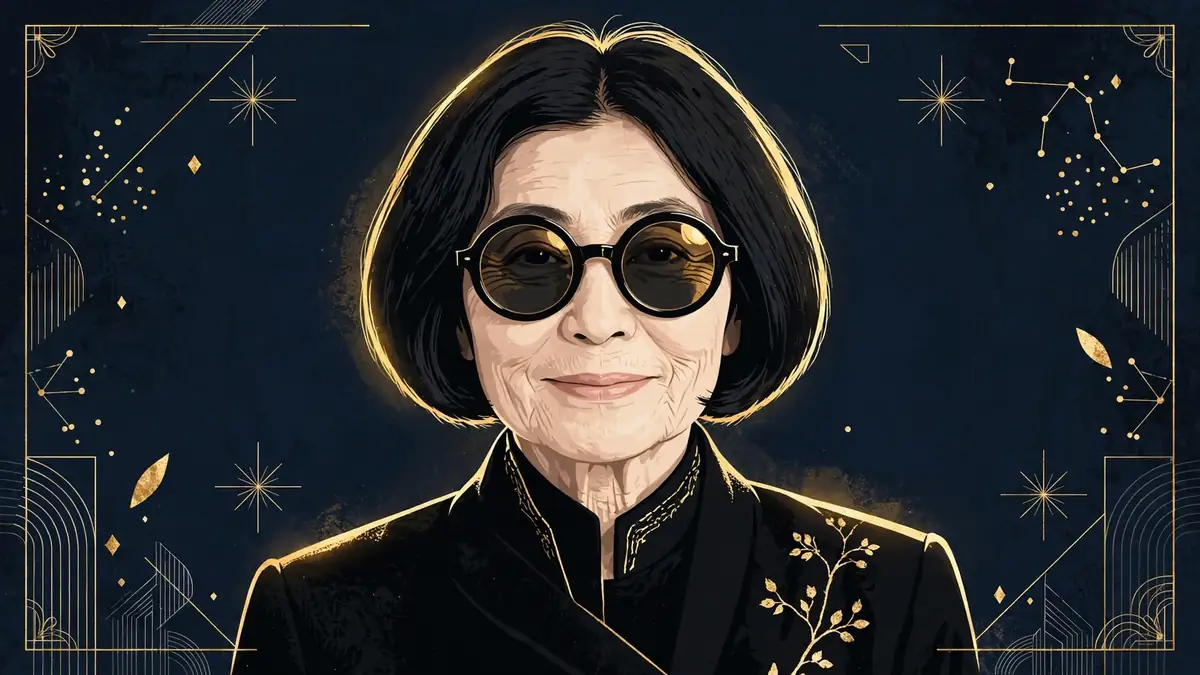
Yoko Ono‘s net worth is estimated at $700 million as of November 2026. The Japanese artist and musician built that fortune in two acts: a pioneering avant-garde career that began a decade before she met John Lennon, and 45 years as the steward of one of the most valuable song catalogues in music history after his death in 1980. The most widely cited figure comes from Celebrity Net Worth, which puts her at $700 million; other trackers place her between $600 million and $800 million, so this article uses $700 million as the anchor inside that range.
Yoko Ono: Quick Facts
| Estimated net worth | $700 million (range: $600 million – $800 million) |
|---|---|
| Profession | Artist, musician, filmmaker, author, peace activist |
| Nationality | Japanese |
| Born | February 18, 1933 (age 93) |
| Height | 5 feet 2 inches |
| Primary income sources | John Lennon estate and Beatles songwriting royalties, Apple Corps dividends, licensing, art sales and exhibitions, real estate |
| Active years | 1950s–present |
| Last reviewed | November 2026 |
- Quick Facts
- Early Life and Background
- Education
- Career Journey
- Rise to Fame
- Main Sources of Income
- Salary and Earnings
- Businesses and Investments
- Brand Deals and Sponsorships
- Houses, Cars and Other Assets
- Awards and Achievements
- Net Worth Growth Over the Years
- Social Media Presence
- Personal Life
- Sources & Reporting
- Frequently Asked Questions
- Final Thoughts
Early Life and Background
Yoko Ono was born on February 18, 1933, in Tokyo, Japan, into a family where money and music sat side by side. Her father, Eisuke Ono, was a banker and a classically trained pianist. Her mother, Isoko Yasuda, came from the Yasuda family, one of Japan’s great banking dynasties. The household was wealthy, cultured, and constantly moving: Eisuke’s banking career shuttled the family between Japan and the United States through Yoko’s childhood, and she grew up fluent in both worlds, trained from an early age in piano, singing, and composition.
War broke that sheltered childhood open. Ono was 12 years old in Tokyo during the American firebombing of the city in March 1945, one of the deadliest air raids of the Second World War. Her family survived and fled to the countryside, where food ran so short that they traded household possessions for necessities. The experience left a mark that never faded: a lifelong opposition to war that would later shape her art, her activism, and her public identity. It also gave her a firsthand sense of how quickly wealth can vanish — a useful instinct for someone who would later spend 45 years protecting a fortune.
After the war, Ono returned to Tokyo and to Gakushuin, one of Japan’s most prestigious schools, where she had studied before the war. She entered its university philosophy programme and became the first woman ever admitted to the course. The detail matters because it captures the two sides of Ono that the tabloid version of her life usually misses: she was an heir to a banking family and a serious intellectual, and she walked away from both advantages to make experimental art in New York. Her family’s wealth meant she never needed a commercial career. That freedom let her spend the 1950s and early 1960s making work almost nobody would pay for — instruction pieces, event scores, performances for tiny audiences — and it is the reason her own fortune, separate from Lennon’s, has always been hard to measure. She arrived at fame already financially independent, and she left her family’s money behind when she chose the avant-garde.
Her early years also explain the shape of her later wealth. Ono learned to think about value in non-financial terms — an instruction, an idea, a right — years before she had to think about royalties, publishing, and licensing. When Lennon died, she applied the same thinking to his catalogue: the songs were assets, but the rights around them — who could use them, in what form, for how long — were where the real money lived.
Education
Ono’s schooling ran through the best institutions Japan and America could offer. At Gakushuin in Tokyo she received a classical education alongside children of Japan’s elite, and her university philosophy studies made her the first woman admitted to that course — a fact her biographers return to because it undercuts the caricature of Ono as an untrained dilettante. She was, by training, a philosopher who made art.
In the early 1950s she left Japan for the United States, where her family had relocated, and enrolled at Sarah Lawrence College in New York. There she studied music and poetry and fell into the city’s experimental arts scene — the composers, poets, and performers working at the edges of what art could be. She left Sarah Lawrence before graduating to pursue her artistic ambitions full time, a decision that looks reckless on paper and turned out to be the hinge of her career. The college years gave her two things that mattered more than a degree: a network in New York’s downtown scene, including the composer La Monte Young, and a formal grounding in music that let her write, perform, and produce her own records for the next six decades.
Education, for Ono, never really stopped. Her 1964 book Grapefruit reads like a syllabus — more than 200 short instructions for artworks the reader completes in their head — and her later career kept returning to teaching by instruction: the Wish Tree installations that invite visitors to tie written wishes to a tree, the Imagine Peace Tower in Iceland that beams a column of light into the sky each winter. The through-line from Gakushuin philosophy student to conceptual artist is a straight one.
Career Journey
Ono’s career began years before she met John Lennon, and the timeline is the first thing most net-worth profiles get wrong. By the time Lennon walked into her Indica Gallery show in November 1966, she was already a known figure in New York’s experimental scene. In 1960 she rented a loft at 112 Chambers Street in Manhattan and, with La Monte Young, launched a series of events that mixed experimental music, visual art, poetry, and performance. The loft became a meeting point for the downtown avant-garde, and the artists who passed through it — John Cage, the Fluxus founder George Maciunas, the composer Toshi Ichiyanagi, who became her first husband — shaped the next decade of conceptual art.
Her first solo show opened in July 1961 at Maciunas’s AG Gallery in Manhattan: Paintings & Drawings by Yoko Ono, built around roughly 20 “instruction paintings,” works that consisted of a brief written direction telling the viewer how to imagine or enact the piece. The idea — that an artwork could be a set of words, completed by the audience — became her signature. In 1962 she returned to Japan for a concert and exhibition at Tokyo’s Sogetsu Art Centre, and on July 4, 1964, she self-published Grapefruit, a book of more than 200 instructions written between 1953 and 1964, divided into five sections: Music, Painting, Event, Poetry, and Object. Grapefruit is now treated as a landmark of conceptual art; at the time it was a self-published book by an artist almost nobody outside downtown New York had heard of.
Her most famous work, Cut Piece, was first performed in 1964 at the Yamaichi Hall in Kyoto. Ono sat silently on stage while audience members came up one at a time, cut away pieces of her clothing with scissors, and took the pieces with them. She performed it again at Carnegie Hall in 1965 — filmed by Albert and David Maysles — and returned to it as late as 2003 in Paris. In May 2025, the Berlin artist Peaches performed Cut Piece at the Gropius Bau as part of the exhibition YOKO ONO: MUSIC OF THE MIND, a sign of how far the work has travelled from a Kyoto concert hall into the art-history canon. Other early pieces — Painting to Be Stepped On, Bag Piece, Apple, Half-A-Room — and her experimental film Film No. 4, known as Bottoms, a 1966 reel of close-up shots of people walking on a treadmill, filled out a body of work that was radical, cheap to make, and almost impossible to sell. That last fact is the point: Ono spent her first decade as an artist deliberately making work the art market could not easily price.
The Lennon years, from 1969 to 1980, turned her into a recording artist and a public figure. The couple formed the Plastic Ono Band, recorded the albums Live Peace in Toronto 1969, Yoko Ono/Plastic Ono Band (1970), and Fly (1971), and staged the bed-ins for peace in Amsterdam and Montreal in 1969, where “Give Peace a Chance” was recorded in a hotel room. Her solo albums of the period — Approximately Infinite Universe (1973), Feeling the Space (1973) — sold modestly, and her music was often dismissed by rock critics of the time. The commercial verdict on her records changed later: remixes of her songs topped the American dance charts in the 2000s, with the Orange Factory remixes of “Open Your Box” reaching number one on the US club charts, and her catalogue found a second audience among electronic and experimental musicians.
After Lennon’s death, Ono’s career split in two. One half was management: the archives, the reissues, the licensing, the legal defence of the catalogue. The other half was art, and it grew steadily in stature. Her first museum retrospective, This Is Not Here, had opened at the Everson Museum in Syracuse in 1971; in 2015 the Museum of Modern Art in New York gave her a full solo show, Yoko Ono: One Woman Show, 1960–1971, 44 years after she had advertised a fake MoMA exhibition of her own in the Village Voice under the title Museum of Modern (F)art. The joke had become the real thing. Tate Modern, the Serpentine, and The Broad in Los Angeles — which hosted a major Ono exhibition in 2026 — have all staged her work, and the MUSIC OF THE MIND retrospective toured Europe through 2024 and 2025. An artist who once could not sell her work now anchors museum seasons.
Rise to Fame
Ono became famous in the way she least wanted: as the woman the world blamed for breaking up the Beatles. She met Lennon in November 1966 while preparing an exhibition at London’s Indica Gallery. The story both of them later told was that Lennon climbed a ladder to look through a magnifying glass at a tiny word on the ceiling — “YES” — and was charmed. They married on March 20, 1969, in Gibraltar, while Lennon was still married to his first wife Cynthia in the eyes of the press, and the couple spent the next 11 years collaborating on music, films, political activism, and experimental art.
The fame was immediate and hostile. The Beatles split in 1970, and Ono became the convenient explanation for millions of fans. The record is more complicated: the band’s business disputes, Allen Klein, and the four members’ own diverging ambitions did the work, and Lennon himself said so repeatedly. But the myth stuck, and it shaped Ono’s public image for decades. What the myth also did, financially, was bind her identity to Lennon’s catalogue in the public mind — which is why so many net-worth profiles treat her as a passive inheritor and skip the art career entirely.
The second rise came after 1980, and it was slower. Ono released Season of Glass in 1981, an album recorded in the months after Lennon’s murder, with a photograph of his bloodied glasses on the cover — a record that was both a memorial and a statement that she would keep working. The single “Walking on Thin Ice,” recorded with Lennon on the night he died, became her best-known song. Through the 1980s and 1990s she released albums, wrote books, and kept exhibiting, while the art world gradually caught up with the work she had made in the 1960s. The 2015 MoMA retrospective was the turning point: a major museum arguing, with a full show, that Ono belonged at the centre of the early-1960s New York avant-garde alongside John Cage, Nam June Paik, and George Maciunas. By the 2020s, the critical consensus had flipped — the woman once dismissed as a Beatles footnote is now written about as a pioneer of conceptual and feminist art. Fame, for Ono, arrived twice: once as a scandal, once as a vindication.
Main Sources of Income
Ono’s fortune rests on four pillars, and their proportions matter because most profiles collapse them into one word — “inheritance” — and stop there. The first pillar is the Lennon estate itself: the assets John Lennon left in 1980, which Celebrity Net Worth values at $200 million at the time of his death, or roughly $810 million in today’s money. The second is the income those assets kept producing: songwriting royalties, recording income, licensing, merchandise, and the Beatles’ corporate dividends, which have flowed for 45 years. The third is real estate, above all the Dakota apartments in Manhattan. The fourth is her own career: art sales, exhibitions, music royalties, books, and licensing of her own work.
The royalty stream is the engine. Lennon and Paul McCartney had already lost control of Northern Songs, the company that owned the publishing rights to many Beatles songs, selling their remaining shares in 1969. What the estate kept was the songwriter’s share — the royalties paid every time a Lennon-McCartney song or a Lennon solo song is played, streamed, sold, or licensed. Those payments never stopped. The Beatles remain one of the most streamed legacy acts on the planet, and Lennon’s solo catalogue — “Imagine,” “Jealous Guy,” “Working Class Hero,” “Happy Xmas (War Is Over)” — earns every year, with a sharp spike each Christmas. Celebrity Net Worth reports that Lennon’s estate generated an estimated $22 million in 2005 alone, $12 million in 2011, and $14 million in 2019, while Forbes calculated posthumous earnings of $17 million in 2024 and $12 million in 2025. Those are the estate’s gross earnings in individual years, not Ono’s personal income — the money flows through companies and trusts, and her share is private — but they show the scale of the machine she has run since 1980.
Licensing is the second gear of the same engine. Ono spent decades approving — and refusing — uses of Lennon’s music and image, from films and advertisements to the Cirque du Soleil show Love and Peter Jackson’s Get Back documentary. Each approval carries a fee, and each refusal protects the value of the next approval. She also managed Lennon’s archives, image, likeness, and artwork, and the family’s economic interests in Beatles-related businesses. The discipline paid off: the catalogue’s value grew rather than shrinking, which is the opposite of what usually happens to a dead artist’s estate.
Her own art and music form a smaller but real stream. Museum exhibitions pay fees, her books sell, her prints and multiples — she has sold affordable editions since the 1960s, some priced as low as 25 cents in her early sales lists — generate income, and her recordings earn streaming and sync revenue. None of this rivals the Beatles money, and this article does not pretend otherwise. But it matters for accuracy: Ono was earning from her own work before she met Lennon, and she kept earning from it after his death. The fortune is inherited in its origin and managed in its growth, and the management is the part of the story that explains why $200 million in 1980 became $700 million in 2026 instead of shrinking through taxes, divorce settlements, and bad investments.
One more stream deserves a mention because it is easy to miss: the copyright extension on “Imagine.” In 2017 the National Music Publishers Association formally recognised Ono as a co-writer of “Imagine,” crediting her lyrics and concept. The practical effect was financial as well as historical — adding a living co-writer extends the song’s copyright protection by 70 years past her death, keeping one of the most licensed songs in history inside the family’s control for decades longer than it would otherwise have been. It was a paperwork change worth a fortune, and it came from an artist who understood, better than almost anyone in rock, that rights are assets.
Salary and Earnings
Ono has never drawn a salary in the ordinary sense, and any profile that assigns her an annual wage is inventing one. Some low-quality sites claim she earns $97 million a year; no credible source supports that figure, and it appears to be a garbled version of the estate’s occasional big years. The honest way to describe her earnings is by the year, from the estate’s reported numbers, and by the mechanism — royalties, dividends, and licensing — rather than a made-up pay cheque.
The clearest public window into the money is the Lennon estate’s posthumous earnings, tracked year by year by Forbes and reported by Celebrity Net Worth: about $22 million in 2005, $12 million in 2011, $14 million in 2019, $17 million in 2024, and $12 million in 2025. The figures move with the release calendar — a reissue, a documentary, a Christmas season — and they are gross earnings of the estate’s businesses, before the costs of running them and before any division among the family’s companies and trusts. They are not Ono’s take-home pay, and this article does not present them as such.
The most concrete recent numbers come from Apple Corps, the Beatles’ company, whose accounts are filed in Britain and therefore public. For the 11 months ending December 2025, Apple Corps recorded £44 million in revenue and £6 million in pretax profit, and its accounts showed dividends of £900,000 to each of the four shareholder groups — McCartney, Ringo Starr, the Harrison family, and the Lennon family, whose 25 percent interest Ono has represented for decades. That £900,000 dividend is a single line in a single company’s accounts, and it is a small slice of the total — the same accounts record millions of pounds in payments connected to promotional services and name and likeness rights — but it is one of the few hard, audited numbers in the whole story, and it shows the Beatles business still paying its owners in 2026.
Her own earnings are smaller and less documented. Art sales, exhibition fees, book royalties, and her music catalogue — including the dance-chart remixes that topped the US club charts in the 2000s — produce steady, modest income next to the Beatles money. What the record does show is the absence of the usual celebrity fortune-drainers: no failed restaurant chain, no bankrupt fashion label, no debt-fuelled spending spree. Ono’s spending, by every account, has been conservative — property, art, and the costs of running the estate — and the fortune compounded because the income was reinvested rather than spent.
The comparison that puts the earnings in perspective is Paul McCartney, the only Beatle richer than the Lennon family interest. Forbes named McCartney the first British musician to become a billionaire in 2024, with a fortune built on the same catalogue plus his own publishing empire. Ono’s $700 million sits below that, and above Ringo Starr’s reported $350 million — a spread that tracks, roughly, the difference between owning the publishing and owning the songwriter’s share.
Businesses and Investments
The centre of Ono’s business life is a set of British companies that most profiles never name. The most important is Apple Corps, the Beatles’ company, which manages licensing, film projects, merchandise, and other commercial uses of the band’s identity. Apple Corps is divided among four shareholder groups — McCartney, Ringo Starr, the Harrison family, and the Lennon family — and Ono has represented the Lennon family’s 25 percent interest for decades. In October 2020 her son Sean Ono Lennon became a director of Apple Corps, and of other British companies tied to the family’s music, as Ono began handing the day-to-day running of the business to him. The handover was a management change, not a transfer of ownership: corporate filings still identify Ono herself as the holder of the major economic interests, with Sean serving alongside her as a director.
The filings give a rare, precise picture. Ono is listed as a person with significant control of Maclen (Music) Limited, the company tied to Lennon-McCartney compositions, holding more than 25 percent but no more than 50 percent of its shares and voting rights. She holds at least 75 percent of the voting rights in Lensolo Limited, another company connected to the Lennon family’s musical interests. Sean serves as a director of these companies but is not listed as a person with significant control — a legal distinction that confirms where the ownership still sits. These are not shell companies: they are the pipes through which Beatles and Lennon royalties flow, and Ono’s control of them is the legal foundation of her fortune.
Beyond the music companies, Ono’s investments have been property and, to a lesser degree, art. She bought the Dakota apartment with Lennon in 1973 and added units over the years; she owns a farm in upstate New York, in the Catskills, where she has spent increasing time since 2023. There is no public record of a stock portfolio, a venture fund, or a startup bet, and this article does not invent one. The investment story here is concentration, not diversification: one catalogue, one building, one family of companies, held for decades and managed tightly. It worked because the underlying asset — the Beatles’ music — appreciated while almost everything else in the music business depreciated.
The management handover to Sean is the most important business development of the last five years. Since October 2020 he has supervised archival releases, documentaries, remixes, and licensing, including the expanded Mind Games collection, which won a Grammy in 2025, and work on the documentary One to One: John & Yoko. He works with Universal Music Group and Sony Music Publishing on the archival programme. The transition matters for the net-worth picture because it answers the question of what happens to the fortune: it is being run, now, by the next generation, under the same ownership structure Ono built.
Brand Deals and Sponsorships
Ono has never been a brand ambassador in the usual celebrity sense, and there is no record of a sneaker deal, a perfume line, or a paid social-media campaign. Her relationship with brands has run in the opposite direction: companies have paid to use Lennon’s music and image, and Ono has decided — often slowly, often by refusing — which uses were acceptable. That gatekeeping is itself the business. A Beatles song in an advertisement is worth far more when it is rare, and Ono’s reluctance to license cheaply is one reason the catalogue’s value held up while other 1960s catalogues were strip-mined.
The licensing that did happen was large and selective: films, documentaries, the Cirque du Soleil production, reissue campaigns with Universal, and the Get Back project. Each carried a fee negotiated by the family’s companies, and each reinforced the catalogue’s prestige rather than diluting it. Her own art has also been licensed — prints, books, and exhibition merchandise — and her name has appeared on fashion and design collaborations, including a well-known 2012 menswear collection for the retailer Opening Ceremony, built around Lennon’s drawings and her own designs. The collection sold out quickly, a reminder that her own visual work has commercial value independent of the Beatles.
The honest summary is that brand money is a real but secondary stream. The fortune was not built on endorsements, and Ono’s public image — an artist and activist, not a pitchwoman — is one reason the licensing fees stayed high. Scarcity, in her case, was a strategy.

Houses, Cars and Other Assets
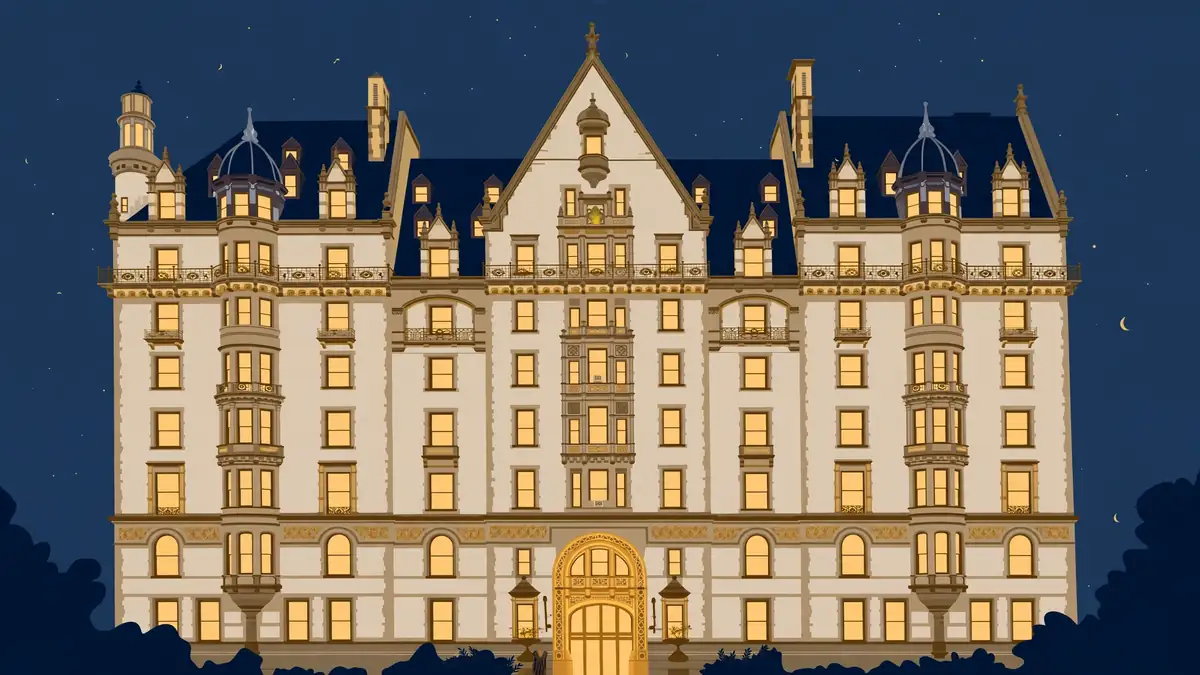
The Dakota is the centrepiece of Ono’s real estate wealth, and in 2026 it produced the freshest property story of her life. Ono and Lennon moved into the building — the first luxury apartment building in America, at 1 West 72nd Street on Manhattan’s Upper West Side — in 1973. Building records show comparable Dakota apartments selling for between $150,000 and $200,000 at the time, roughly $1.1 million to $1.5 million in today’s money; the exact price the couple paid has never been pinned down. They bought an adjacent apartment to create about 6,000 square feet of living space, and at least three more units on other floors for guests, offices, and storage. The seventh-floor apartment is where Annie Leibovitz photographed Lennon and Ono hours before his murder on December 8, 1980, in the building’s archway.
Today the primary apartment is valued at around $20 million by property platforms, and the monthly maintenance bill is reported at more than $20,000, according to Celebrity Net Worth. In July 2026, Realtor.com reported that Ono is about to become the Dakota’s longest-serving homeowner, with more than half a century of continuous ownership in the 94-unit building — no other resident matches her tenure. She has trimmed her footprint over the years, selling off some of the auxiliary units, and she now spends considerable time at her farm in upstate New York, but she has given no indication she plans to sell the primary residence. A $150,000 purchase in 1973 that is worth around $20 million in 2026 is a roughly 130-fold gain, and it is the single cleanest example in her portfolio of buy-and-hold wealth creation.
The Catskills farm is the second property, and the one where she now spends much of her time. Reports in 2023 and after describe her living there with Sean looking after her, after five decades at the Dakota. The farm’s value is not public, and this article does not guess at it; its significance is personal rather than financial, a retreat from the city where her husband was killed.
Cars barely register in the record. Ono has never been photographed with a car collection, and no credible source lists one; the family’s wealth was never displayed through vehicles. The same goes for jewellery and watches, which appear in profiles only as speculation. What the record does show, in the assets column, is the art: her own works, Lennon’s drawings and manuscripts, and the archives — tens of thousands of tapes, photographs, and documents — that underpin the reissue business. The archives are an asset in the truest sense: they generate new products every year, from box sets to documentaries, and their value grows as the material is mined. A private art collection built over 60 years is the hardest part of her fortune to value and one of the largest.
Awards and Achievements
Ono’s honours arrived late, and the lateness is part of the story. For decades the art world treated her as a footnote; the awards of the last twenty years read like a correction. In 2009 she received the Golden Lion for lifetime achievement at the Venice Biennale, the art world’s highest honour for a living artist. In 2015 the Museum of Modern Art staged Yoko Ono: One Woman Show, 1960–1971, her first solo exhibition at the museum, 44 years after her unauthorised Museum of Modern (F)art stunt. The show’s curators, Klaus Biesenbach and Christophe Cherix, made the case that she belonged at the centre of the early-1960s New York avant-garde, on equal footing with John Cage, Nam June Paik, and George Maciunas.
The music honours followed the same pattern. The expanded Mind Games collection, overseen by Sean, won a Grammy in 2025. Her dance remixes topped the American club charts in the 2000s, giving her a run of number-one records four decades after her first albums were dismissed. In 2017 the National Music Publishers Association formally added her as a co-writer of “Imagine,” the most consequential songwriting credit of her career, awarded 46 years after the song’s release. The Imagine Peace Tower, lit in Reykjavik each year between Lennon’s birthday on October 9 and the anniversary of his death on December 8, has become a permanent public monument to the couple’s activism.
Her first appearance on the Forbes 400 in 1982, with an estimated $150 million, was an achievement of a different kind: it made her one of the richest self-directed women in American public life, and it did so two years after her husband’s death, on the strength of an estate she was already managing. The retrospectives kept coming — Tate Modern, the Serpentine, and the touring MUSIC OF THE MIND show through 2024 and 2025, with The Broad in Los Angeles hosting a major exhibition in 2026. For an artist whose early work was designed to be uncollectable, the institutional recognition is the achievement that money cannot buy and that, in the end, protected the money too: a catalogue attached to a canonical artist is worth more than one attached to a punchline.
Net Worth Growth Over the Years
Ono’s fortune did not grow in a straight line, and the year-by-year table below mixes different kinds of numbers — Forbes rich-list estimates, contemporary press valuations, and Celebrity Net Worth’s current figure — so it should be read as a shape, not a bank statement. The shape is a fortune that roughly doubled in its first two years under her management, then compounded quietly for four decades as royalties, property appreciation, and licensing stacked up.
| Year | Estimate | What drove it |
|---|---|---|
| 1980 | About $100 million (modelled direct inheritance) | Lennon’s will: marital-share formula on a $200 million estate, plus executor and trustee control |
| 1982 | $150 million | Forbes 400 debut — royalties plus property, two years after Lennon’s death |
| 2021 | $650 million | Wealthy Persons estimate; catalogue and Dakota appreciation |
| 2026 | $700 million (range $600M–$800M) | Celebrity Net Worth anchor; Apple Corps dividends, reissues, Dakota at about $20M |
Two things explain the growth. The first is that the income never stopped: the estate earned in the tens of millions in strong years — $22 million in 2005, $17 million in 2024 — and the money was managed rather than spent. The second is that the two biggest assets appreciated for reasons outside anyone’s control: Beatles music became more valuable as streaming gave the catalogue a second life, and Manhattan real estate did what Manhattan real estate does. Ono’s contribution was to hold, to refuse bad deals, and to hand the operation to Sean at the right moment. The $700 million figure is best understood as the present value of that discipline: a $200 million estate in 1980, managed for 45 years, in a catalogue that never went out of print.
A note on the billion-dollar claims: some sites put Ono above $1 billion, usually by adding the gross value of the Lennon estate’s assets to her personal fortune. The distinction matters. The estate’s assets are shared with Sean, governed by trusts, and held through companies; her personal net worth — the number Celebrity Net Worth and the consensus of trackers report — is $700 million. This article uses the consensus figure and flags the higher claims as unconfirmed, rather than repeating them as fact.
Social Media Presence
Ono’s social-media presence is small, quiet, and mostly run in her name rather than by her. Her X account, under her name, posts her instruction pieces, peace messages, and archival photographs, and has long been her main public channel. She has largely retired from public life at 93, and her accounts now function as a bulletin board for her art and for Lennon’s legacy rather than a personal feed. There is no evidence of sponsored posts or brand partnerships on her accounts, and her income from social media is effectively zero — the accounts are a cultural asset, not a commercial one. The most newsworthy social-media moment of the last year came not from her but from Sean, who used a post in October 2026 to correct the decades-old story about the brothers’ inheritance, writing that he and Julian “inherited the same amount from our dad” and that their trusts were equal. It was a reminder that the family’s public record is now kept, in part, on social media.
Personal Life
Ono has been married three times. Her first husband was the composer Toshi Ichiyanagi, married in 1956 and divorced in 1962. Her second was the American film producer Anthony Cox, married in 1962 and divorced in 1969; their daughter Kyoko was born in 1963, and a custody battle after the divorce kept mother and daughter apart for decades before they reconciled. Her third marriage, to John Lennon in Gibraltar on March 20, 1969, lasted until his murder 11 years later. Their son Sean was born on October 9, 1975 — Lennon’s 35th birthday — and the couple spent the next five years largely out of public view, raising him at the Dakota while Lennon took a break from recording.
The years since 1980 have been defined by two things: the management of Lennon’s legacy and a slow withdrawal from public life. She never remarried. She raised Sean at the Dakota, defended the estate through the long dispute with Julian Lennon — settled confidentially in 1996, with the reported £20 million figure later challenged by Julian himself, who told Salon in 1998 that the actual settlement was substantially smaller — and kept working as an artist into her eighties. In 2020 she began handing the family’s business operations to Sean, who became a director of Apple Corps and the other family companies that October. In 2026 Sean became a father, with his partner Charlotte Kemp Muhl, welcoming a son named Aurelius — making Ono a grandmother again at 93.
Her health has shaped the last few years. Reports since 2023 describe her using a wheelchair, living mostly at the Catskills farm with Sean nearby, and rarely appearing in public. The withdrawal is consistent with a life that was never built around celebrity: the art, the activism, and the estate were the work, and the public appearances were incidental. She remains, at 93, the longest-serving homeowner at the Dakota, the holder of the Lennon family’s 25 percent of Apple Corps, and the co-writer of “Imagine” — three facts that sum up a life better than any single number.
Sources & Reporting
Celebrity Net Worth — the $700 million net-worth anchor; the $200 million valuation of Lennon’s estate at death ($810 million today); the 1979 will and trust structure; the $22 million (2005), $12 million (2011), $14 million (2019) posthumous-earnings years; Forbes’ $17 million (2024) and $12 million (2025) figures; Apple Corps’ 11-month accounts to December 2025 (£44 million revenue, £6 million pretax profit, £900,000 dividends per shareholder group); Maclen and Lensolo control filings; the Dakota purchase price range, 6,000 square feet, and maintenance above $20,000 a month; Sean’s October 2026 inheritance statement. Reporting window: page updated October–November 2026.
Forbes — Ono’s 1982 debut on the inaugural Forbes 400 at $150 million; the Lennon estate’s posthumous earnings for 2024 ($17 million) and 2025 ($12 million); McCartney’s billionaire status in 2024, used for the peer comparison.
Realtor.com — the July 29, 2026 report that Ono is about to become the Dakota’s longest-serving homeowner; the 1973 purchase context ($150,000–$200,000 for comparable units); at least three additional units bought; the primary apartment valued at around $20 million; her move toward the Catskills farm.
Berliner Festspiele / Gropius Bau — the YOKO ONO: MUSIC OF THE MIND exhibition history; Cut Piece first performed in Kyoto in 1964 and again at Carnegie Hall in 1965; the 1961 AG Gallery solo show; Grapefruit self-published July 4, 1964; the 2015 MoMA retrospective One Woman Show, 1960–1971; the 1971 Museum of Modern (F)art intervention.
Frieze — the “Open Your Box” remixes reaching number one on the US club charts; the early-2000s dance-chart run.
The Art Newspaper — the 2015 MoMA retrospective and its critical case for Ono as a central avant-garde figure.
Far Out Magazine — biographical details including her height (5 feet 2 inches) and the $700 million consensus figure.
Celebrity Net Worth (Sean Lennon inheritance article, October 2026) — TIME’s December 1980 valuation of the estate at $235 million; United Press International’s February 1981 figure of $250 million; the 1968 divorce trust of £100,000; Julian’s 1996 settlement and his 1998 Salon interview; Julian’s 2007 Primary Wave sale.
Figures in this article were checked against the sources above in November 2026. Where sources disagreed — above all on the total value of the Lennon estate in 1980 and on Ono’s net worth today — the article reports the range and names who says what, rather than picking the biggest number.
Frequently Asked Questions
What is Yoko Ono’s net worth in 2026?
Yoko Ono’s net worth is estimated at $700 million in 2026, according to Celebrity Net Worth, the most widely cited tracker of her fortune. Other estimates place her between $600 million and $800 million. The fortune comes from John Lennon’s estate, Beatles and solo songwriting royalties, the family’s 25 percent interest in Apple Corps, her Dakota real estate, and her own art and music career.
How did Yoko Ono get so rich?
She inherited the majority of John Lennon’s estate when he was murdered in 1980 — an estate valued at about $200 million at the time, or roughly $810 million in today’s money — and then spent 45 years managing it. The royalties from Lennon’s Beatles and solo songs never stopped, the Apple Corps dividends kept paying, and the Dakota apartments she bought for around $150,000–$200,000 in 1973 are now worth about $20 million. She was also already a working artist with her own income before she met Lennon, and her art career added exhibition fees, book sales, and music royalties.
How much did Yoko Ono inherit from John Lennon?
The exact amount is private. Lennon’s will, signed November 12, 1979, gave Yoko a direct inheritance calculated by a formula tied to half the estate’s adjusted value and the federal marital deduction, with the rest going into a trust she controlled as executor and trustee. On Celebrity Net Worth’s $200 million valuation of the estate, her direct share models at around $100 million in 1980. Contemporary press put the whole estate higher — TIME said $235 million in December 1980 and United Press International said $250 million in February 1981 — while the probate filings listed only $30 million in New York and $5.5 million in England and Wales, because those filings covered only part of the worldwide assets.
Is Yoko Ono a billionaire?
No, on the consensus estimate. Her net worth is reported at $700 million, below the billion-dollar line. Some sites claim more than $1 billion, but those figures usually add the gross value of the Lennon estate’s assets — which are shared with her son Sean, held through trusts and companies — to her personal fortune. The $700 million figure is the personal estimate carried by Celebrity Net Worth and most trackers.
Where does Yoko Ono live now?
She still owns her primary apartment at the Dakota on West 72nd Street in Manhattan, where she has lived since 1973, and she now spends much of her time at her farm in upstate New York in the Catskills. At 93 she has largely retired from public life because of health and mobility challenges, and her son Sean looks after her. She has given no indication she plans to sell the Dakota apartment, which is valued at around $20 million.
How old is Yoko Ono?
Yoko Ono was born on February 18, 1933, in Tokyo, Japan, which makes her 93 years old as of November 2026. She will turn 94 in February 2027.
Who manages John Lennon’s estate now?
Her son Sean Ono Lennon has run the family’s music business since October 2020, when he became a director of Apple Corps, Maclen Music, and the other family companies. He oversees archival releases, documentaries, remixes, and licensing, including the Grammy-winning expanded Mind Games collection. Ono herself still holds the major ownership interests — including the Lennon family’s 25 percent of Apple Corps — while Sean handles day-to-day management.
What is Yoko Ono’s Dakota apartment worth?
Her primary Dakota apartment is valued at around $20 million, according to property platforms cited by Realtor.com in July 2026. She and Lennon bought it in 1973, when comparable Dakota apartments sold for $150,000 to $200,000, and later added adjacent units to create about 6,000 square feet. The monthly maintenance bill is reported at more than $20,000. She has sold off some auxiliary units over the years but still owns the main seventh-floor apartment, making her the building’s longest-serving homeowner.
Final Thoughts
Yoko Ono’s $700 million is a strange fortune, and the strangeness is the story. It began with an avant-garde artist who made work designed to be uncollectable, continued with a marriage to the most famous songwriter alive, and was completed by 45 years of careful, unglamorous management after his murder. The numbers that anchor it are public and checkable: a $200 million estate in 1980, a $150 million Forbes 400 debut in 1982, an Apple Corps dividend of £900,000 per shareholder group in the 11 months to December 2025, a Dakota apartment bought for under $200,000 and now worth about $20 million. The management — the refusals as much as the deals, the handover to Sean in 2020, the 2017 co-writing credit on “Imagine” — is what turned those numbers into $700 million instead of a cautionary tale. At 93, largely out of public life, Ono’s fortune now belongs as much to the institutions that exhibit her work as to the charts that play her husband’s songs. The art world caught up with her eventually; the money never left.
Published on November 9, 2026. Last reviewed November 2026. Found an error? See our corrections policy.