
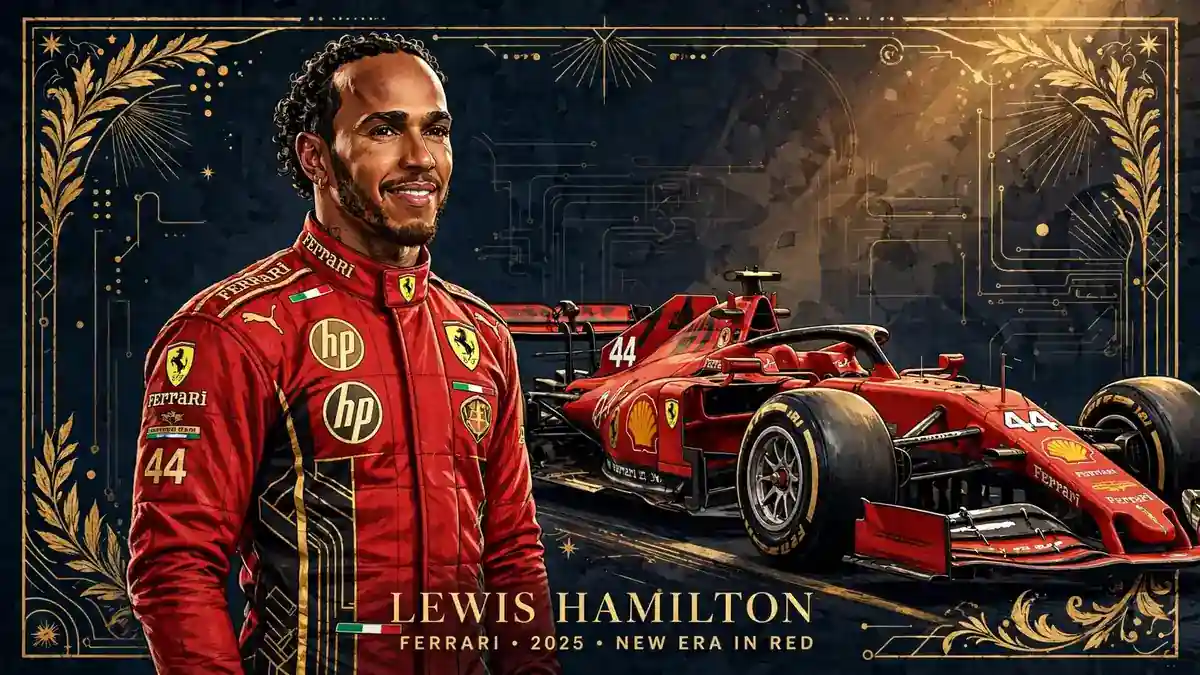
Lewis Hamilton‘s net worth is estimated at $450 million to $580 million as of November 2026. The seven-time Formula 1 world champion earns a reported $60 million base salary from Ferrari, banked the first $100 million single-year payday in F1 history in 2025 according to Sportico, and has built a property and business portfolio that stretches from a Monaco penthouse to a non-alcoholic tequila brand part-owned by drinks giant Pernod Ricard.
Lewis Hamilton: Quick Facts
| Estimated net worth | $450–$580 million (range: $450 million to $580 million) |
|---|---|
| Profession | Formula 1 racing driver (Ferrari) |
| Nationality | British |
| Born | January 7, 1985 (age 41) |
| Height | 5 ft 9 in (1.74 m) |
| Primary income sources | Ferrari salary, endorsements, business ventures, investments, property |
| Active years | 2007–present (Formula 1) |
| Last reviewed | November 2026 |
- Early Life and Background
- Education
- Career Journey
- Rise to Fame
- Main Sources of Income
- Salary and Earnings
- Businesses and Investments
- Brand Deals and Sponsorships
- Houses, Cars and Other Assets
- Awards and Achievements
- Net Worth Growth Over the Years
- Social Media Presence
- Personal Life
- Sources & Reporting
- Frequently Asked Questions
Early Life and Background
Lewis Carl Davidson Hamilton was born on January 7, 1985, in Stevenage, Hertfordshire, England. His father, Anthony Hamilton, worked in IT and took on extra jobs — at one stage three at once — to fund his son’s karting. His mother, Carmen Larbalestier, raised him in his early years before his parents separated when he was two. The family lived in a council flat in Stevenage, and money was tight enough that karting, a sport famous for chewing through cash, looked like an impossible dream rather than a career plan.
Hamilton started karting at eight, after his father bought him a second-hand go-kart for Christmas in 1991. He won his first British cadet karting title at ten. At that age he walked up to McLaren boss Ron Dennis at an awards ceremony and told him he wanted to race for McLaren one day. Dennis told him to call in nine years. Hamilton did — and in 1998, aged 13, he signed to the McLaren Young Driver Programme, the youngest driver ever taken on by the team. McLaren funded his junior career from that point, a deal that removed the financial barrier that ends most karting careers before they start.
His background matters to the money story for a second reason. Hamilton is the first and, so far, only Black driver to race in Formula 1. In 2020 he set up the Hamilton Commission with the Royal Academy of Engineering to investigate why so few Black people work in British motorsport, and in 2021 he founded Mission 44, a charitable foundation aimed at young people from underrepresented backgrounds. He has committed more than £20 million of his own money to Mission 44, according to reporting on the foundation’s launch — a figure that shows up in the business section below because it is also a deliberate, structured use of his wealth rather than a one-off donation.
The age angle of his career — what he achieved at 22, at 23, at 35, at 40 — is covered in full on our sister site: how old Lewis Hamilton is in 2026 and the records he set at every age traces each milestone against the all-time oldest-winner lists.
Education
Hamilton attended The John Henry Newman School, a Catholic secondary school in Stevenage. He has spoken openly about being bullied at school, including racist abuse, and about how karting gave him a place where results were measured by a stopwatch rather than by other people’s opinions. He left school without the kind of academic record that usually precedes a business career — his education, in the practical sense, happened in pit lanes, in simulator rooms, and in debriefs with engineers from the age of 13.
That early professional immersion explains a lot about his later business record. By the time most athletes start thinking about endorsements, Hamilton had already spent a decade inside a corporate machine at McLaren, learning how sponsors, image rights, and contract negotiations work from the inside. He studied for his racing licence the way other teenagers studied for exams, and he has said the discipline of the junior formulas — data, fitness, media training — shaped the way he now runs his companies.
He never went to university, and he has never pretended otherwise. The gap shows in the way he hires: Lewis Hamilton Ventures, the company that now holds his commercial interests, is run by professional managers, with Ross Connolly as chief operating officer, while Hamilton sets direction as chief executive. It is a structure that plays to his strengths — instinct for brand, appetite for risk, a huge public profile — and pays other people to handle the parts he did not train for.
Career Journey
Hamilton’s junior record reads like a checklist being ticked in order. He won the Formula Renault UK title in 2003, the Formula 3 Euro Series in 2005, and the GP2 championship in 2006 — the feeder series directly below Formula 1. He won the GP2 title in his rookie season, which is the result that forced McLaren to give him a race seat rather than another year of waiting. He made his Formula 1 debut for McLaren at the 2007 Australian Grand Prix, aged 22, alongside two-time world champion Fernando Alonso. He finished on the podium in his first nine races, a record for a debutant, and lost the 2007 title by a single point to Kimi Raikkonen.
He won his first world championship in 2008, at 23, by a single point from Felipe Massa, clinching it with a last-corner overtake at the Brazilian Grand Prix. He stayed at McLaren through 2012, winning 21 races, but the team slid from title contention after 2008. In September 2012 he announced a move to Mercedes for 2013 — a switch widely called a mistake at the time, because Mercedes had won a single race in three seasons as a works team. The timing turned out to be perfect: Formula 1 switched to hybrid engines in 2014, Mercedes built the best power unit on the grid, and Hamilton won six of the next seven championships — 2014, 2015, 2017, 2018, 2019 and 2020.
The Mercedes years are also where the fortune was made. His contracts there grew from a reported $20 million a year in 2013 to around $55 million by the early 2020s, and the team paid him through the hybrid era’s dominance while his profile grew into the biggest in the sport. He passed Michael Schumacher’s win record in 2020, reaching 95 victories that season, and his seventh title that year tied Schumacher’s championship record — the comparison that still frames every discussion of his place in the sport. Our profile of Michael Schumacher’s net worth puts the two seven-time champions side by side in financial terms as well.
In February 2024 came the announcement that reset the sport’s money order: Hamilton would leave Mercedes after 12 seasons and join Ferrari from 2025 on a multi-year deal. Ferrari is Formula 1’s most famous team and its most commercially powerful brand, and the deal made Hamilton, at 40, the highest-paid driver in the team’s modern history. The first season, 2025, was hard by his standards — no Grand Prix podium for the first time in his career — but he won the sprint race in China, his first victory in red, and Ferrari team principal Fred Vasseur confirmed in early July 2026 that Hamilton would drive for the team in 2027, with the contract’s option year taken up.
Rise to Fame
Hamilton was famous before he was rich. His debut season in 2007 made him a household name in Britain within months: a mixed-race kid from a Stevenage council estate, racing for McLaren, fighting a two-time champion teammate and nearly winning the title as a rookie. The 2008 championship, won on the last corner of the last lap of the last race, turned him into a national figure. He was appointed MBE in 2009 and knighted in December 2021, becoming Sir Lewis Hamilton — the fourth Formula 1 driver to receive a knighthood.
Fame in Formula 1 pays differently from fame in other sports. There are only 20 race seats, the season runs to 24 races across five continents, and the global television audience is measured in the hundreds of millions. Hamilton used that platform more deliberately than any driver before him. He became the sport’s most-followed driver, its most visible fashion figure, and its loudest voice on diversity and the environment. Sponsors pay for reach, and his reach extends well past motorsport fans into fashion, music, and film audiences — which is why his endorsement income, covered below, runs at a level no other current driver matches.
The Ferrari move pushed that fame into a new gear. His first day at Maranello in January 2025 — a photograph of him in a suit outside Enzo Ferrari’s old house — became the most-liked Formula 1-related post in Instagram history at the time, with millions of interactions in hours. Ferrari’s share price jumped on the announcement of his signing in February 2024, a market reaction that had nothing to do with his driving and everything to do with what his name does to a brand. That is the commercial logic behind the $60 million base salary: Ferrari is not only buying a driver, it is buying the most marketable name in the sport.
His 2025 season also gave the money story its most useful stress test. A driver who finishes a season without a podium would normally see his market value fall. Hamilton’s did not — because the Ferrari deal runs to 2027, the endorsements are tied to his name rather than his results, and his businesses kept growing. That separation between results and income is the clearest sign of how far his wealth has moved past the racetrack.
Main Sources of Income
Hamilton’s money comes from four places, and the balance between them has shifted over time. Racing salary is still the largest single stream — roughly $60 million a year in base pay from Ferrari — but it is no longer the majority of his annual income once endorsements and business returns are counted. Forbes estimated his total earnings at $100 million for the 12 months ending May 1, 2026, which means roughly $40 million came from outside the cockpit that year. Sportico went further, reporting that Hamilton earned $100 million in calendar year 2025, the first time any Formula 1 driver has reached nine figures in a single year.
The four streams break down like this. First, the Ferrari contract: base salary plus performance bonuses and image-rights payments, reported at up to $100 million a year all-in. Second, endorsements: long-term deals with fashion, watch, energy-drink, and technology brands, estimated by several outlets at around $30 million a year. Third, businesses: his stakes in Neat Burger, Almave, the +44 clothing label, and Dawn Apollo Films, plus returns from his investment portfolio. Fourth, property: a portfolio built over 19 years that has produced at least one documented multi-million-dollar profit on a sale, detailed in the assets section.
What makes the mix unusual for a racing driver is how little of it depends on winning. Endorsement contracts in Formula 1 are usually written around the driver’s image and reach, not race results, and Hamilton’s business stakes pay out on their own timetables. That matters now more than ever: 2025 was his weakest season on track, yet 2025 was also his highest-earning year. The two facts sit side by side without contradicting each other, because the second income stream was built to survive the first one fading.
Salary and Earnings
The headline number is the Ferrari base salary: $60 million a year, according to RacingNews365’s 2026 salary survey, cited by NBC Sports in March 2026. That makes Hamilton the second-highest-paid driver on the 2026 grid, behind only Max Verstappen. The same survey notes the contract runs through 2026 with an option for 2027 — an option Ferrari confirmed it had taken up in July 2026. German outlet Bild reported in 2026 that the deal in fact runs through the end of 2027, with a further option for 2028, and put the salary at $55 million plus advertising and image-rights income. The $5 million gap between the two reports is a reminder that Formula 1 contracts are confidential: teams and drivers never publish the numbers, and every figure in this section is a media estimate.
What is not in doubt is the scale of the total package. Celebrity Net Worth, Parade, and several specialist outlets report that Hamilton’s Ferrari deal is worth up to $107 million a year once bonuses and image rights are added. Forbes’ own accounting is more conservative: it put his total on-track earnings for the 2025 season at $70.5 million, including bonuses, and his overall earnings for the year ending May 1, 2026, at $100 million. The difference between the $70.5 million and the $100 million is the off-track money — endorsements, appearances, and commercial work — which Forbes counts separately from salary.
His pay history shows the arc. At McLaren, his salary grew from a rookie deal worth a reported few million a year in 2007 to around $27 million by 2012. At Mercedes, Spotrac’s records, cited by Athlon Sports, show his salary ranging from about $27 million in his early Mercedes years to as much as $76 million in his peak years once bonuses were included. His final Mercedes deal, signed for 2024, was reported at $60 million a year in base pay — the same base figure Ferrari matched, then exceeded with the bonus structure. Over 19 seasons, his career on-track earnings are estimated by industry outlets at more than $500 million before tax, which makes the Ferrari years the payoff phase of a career that was already the best-paid in the sport’s history.
| Era | Team | Reported annual pay |
|---|---|---|
| 2007–2012 | McLaren | Rising from a few million to about $27 million |
| 2013–2023 | Mercedes | About $27 million rising to $55 million base; up to $76 million with bonuses |
| 2024 | Mercedes | About $60 million base |
| 2025–2027 | Ferrari | $60 million base; up to about $100 million with bonuses and image rights |
One clause in the Ferrari deal deserves attention because it is rare in driver contracts: reporting on the agreement says a share of certain salary components is directed to Mission 44, Hamilton’s charitable foundation. The same reporting says the deal is linked to a joint investment fund with Exor, Ferrari’s parent company, reportedly valued at $272 million. Neither Ferrari nor Exor has confirmed the fund’s size, so treat that figure as reported rather than verified — but the shape of the deal is clear. Hamilton negotiated as a partner, not an employee.
Businesses and Investments
In September 2025 Hamilton renamed the holding company for his commercial interests from Project 44 to Lewis Hamilton Ventures, a move reported by FashionUnited that tied his racing career and his businesses under one name. The portfolio under that roof includes the +44 clothing label, Almave, the film production company Dawn Apollo Films, and what the company calls a growing set of sports, fashion, and media ventures. Hamilton is chief executive; Ross Connolly is chief operating officer. The rename was a statement of intent: at 40, with his driving career in its final phase, the businesses are the second act.
Neat Burger is the oldest of the ventures and the one with the clearest valuation marker. Hamilton co-founded the plant-based burger chain in 2019, and by 2023 reporting put its valuation past $100 million after funding rounds that brought in new investors. The chain expanded from London into the United States and the Middle East, riding the same plant-based wave that lifted its rivals. Valuations of private companies are soft numbers, and Neat Burger’s store count has been trimmed since its peak, but the $100 million mark is the figure the trade press reported, and it remains the single biggest paper gain in his portfolio outside property.
Almave is the venture with the most momentum. Launched in 2023 with distiller Ivan Saldana, it is the first non-alcoholic spirit made from blue agave in Jalisco, Mexico — a tequila in everything except the alcohol. Hamilton’s motivation, in his own words at the launch, was personal: he likes tequila but it does not fit an athlete’s life. The brand sells two expressions, Almave Ambar for sipping and Almave Blanco for mixing, priced around $37–$39 a bottle. In 2024 Pernod Ricard, the French drinks group, bought a minority stake — the kind of validation that turns a celebrity drinks label into a real drinks business. The global non-alcoholic drinks market was worth an estimated $1.46 trillion in 2023 and is forecast to reach $2.18 trillion by 2030, according to industry figures cited by Sportbible, which is the tailwind Almave is riding.
Dawn Apollo Films is his production company, and it has already had a hit. Hamilton was a producer on F1, the Apple Original Films racing drama starring Brad Pitt, which took more than $600 million at the worldwide box office in 2025. His role was hands-on: he advised on the racing scenes, drove in some of the filming, and used his credibility to get the sport’s cooperation. A producer credit on a $600 million film does not translate into a fixed payday — profit participation depends on the deal — but it puts him inside the film business with a calling card few first-time producers ever get.
His investment portfolio runs through stakes in food technology company NotCo, rapid grocery delivery firm Zapp, and TMRW Sports, the sports media and technology venture co-founded by Tiger Woods and Rory McIlroy, according to Tatler Asia’s 2026 survey of his holdings. The pattern is consistent: early-stage consumer and sports-tech bets where his name opens doors that money alone cannot. In 2022 he also joined the Walton-Penner ownership group that bought the NFL’s Denver Broncos for $4.65 billion, taking a minority stake alongside other investors. The Broncos deal is the clearest sign of his ambitions as an owner rather than an endorser: a slice of a franchise whose value has only risen since the purchase.
Brand Deals and Sponsorships
Hamilton’s endorsement income is estimated at roughly $30 million a year, and the list of brands is the longest of any current Formula 1 driver — Booking Agent Info counts 45 brand relationships across his career. The current core is fashion-led. He has a long-running partnership with Tommy Hilfiger, including the TOMMYXLEWIS collections; he signed as a Dior ambassador, fronting the luxury house’s menswear; and in 2024 he joined Lululemon as a brand ambassador, working with the company on product development and on youth programmes run through Mission 44.
The rest of the portfolio is built around performance and lifestyle: Puma, which supplies his race gear; Monster Energy; IWC Schaffhausen watches; Bose; Sony; and Petronas, the Mercedes-era fuel partner whose branding followed him through his most successful years. More recent additions include AG1 by Athletic Greens, which he began endorsing in 2021, the trading platform CFI, where he is global brand ambassador, and S.Pellegrino, whose “Dinner Dialogues” campaign he fronted. Some deals include equity rather than cash alone, which is why the $30 million-a-year estimate is a floor rather than a ceiling: when a brand he backs grows, his stake grows with it.
His value to sponsors rests on two things competitors cannot copy. The first is longevity: 19 seasons at the top means his face is familiar to three generations of sports fans. The second is range: his Instagram following sits at around 40 million, and his audience crosses from motorsport into fashion weeks, film premieres, and music — he attends the Met Gala, walks runways, and collaborates with designers. That range is why Dior and Lululemon pay him: they are not buying a racing driver, they are buying a cultural figure who happens to race.

Houses, Cars and Other Assets
Hamilton’s property portfolio is the most concrete part of his wealth, because houses leave paper trails. His main base is a penthouse in the Fontvieille district of Monaco, the quiet quarter of the principality away from the Grand Prix circuit, where top-floor apartments can sell for more than £30 million. Monaco charges no income tax, which is why so many drivers live there, and Hamilton has been based there for most of his career. The exact price he paid has never been reported.
In London he owns a four-storey Kensington mansion bought in 2017 for about £18.2 million from Christopher Bailey, the former Burberry creative director. The house, built in 1860, has four reception rooms, a 200-foot garden, and a summer house. In New York he bought a three-floor Tribeca penthouse in 2017 for around $44 million and sold it in 2021 for about $49.5 million, according to People — a profit of roughly $5.5 million on a home he reportedly never lived in. In 2019 he bought a second Manhattan penthouse, a 6,457-square-foot residence with Hudson River views, a private swimming pool, a home gym, and a squash court, for around $41 million, in a development part-owned by NFL star Tom Brady. He also owns a three-bedroom apartment in Luins, above Lake Geneva in Switzerland, bought in 2007 in his rookie season; a ranch in Colorado, near Aspen; and, since his Ferrari move, an apartment in Milan’s Porta Nuova district.
The car story took a surprising turn in 2025. Hamilton once owned one of the most talked-about collections in sport, reported to be worth up to £24 million, headed by a one-off 2013 Pagani Zonda 760LH — the only car in the 760 series carrying his initials — which he bought for about £1.7 million and sold in 2021 for a reported £7.5 million. Speaking to reporters at the 2025 Azerbaijan Grand Prix, he said he had sold the rest as well: “I don’t have any cars any more. I got rid of all my cars. I’m more into art nowadays.” He told Vanity Fair in 2022 that he no longer drove the cars he owned and used only a Mercedes electric SUV. The collection’s sale is a useful correction to the usual net-worth arithmetic: older profiles still count a $40 million car collection among his assets, but by his own account in 2025, that collection is gone.
Art is the replacement asset, and it is harder to value. Hamilton has spoken about collecting contemporary art, and his homes are furnished with pieces he has bought over the years. No public record values the collection, so we do not include a figure for it. The same caution applies to his watch collection, which includes rare IWC pieces from his endorsement work — valuable, but not something any outlet has priced reliably.
Awards and Achievements
The record book is where Hamilton’s claim to be the greatest Formula 1 driver of all time rests. Seven world championships (2008, 2014, 2015, 2017, 2018, 2019, 2020) tie him with Michael Schumacher, whose record stood for 16 years. He holds the all-time records for Grand Prix wins (105), pole positions (104), and podium finishes (202) — each of them a mark that stood for decades before he passed it. He has won at least one race in 15 different seasons, and he is the only driver to have won a race in every season from his debut through 2021.
The honours list runs past the track. He was voted BBC Sports Personality of the Year in 2014 and 2020, named Laureus World Sportsman of the Year in 2020, and appointed MBE in 2009 before his knighthood in December 2021. In 2020 he was named in Time magazine’s list of the 100 most influential people in the world. The Hamilton Commission report of 2021, which he commissioned, led to concrete changes in how British motorsport recruits young engineers — a legacy that has nothing to do with trophies and everything to do with the influence his fame buys.
Peer comparison puts the money in context. The table below uses the most recent outlet estimates for each driver, and the same warning applies to all of them: these are estimates, not bank statements.
| Driver | Estimated net worth | Source |
|---|---|---|
| Lewis Hamilton | $450–$580 million | Celebrity Net Worth / Sunday Times Rich List 2026 |
| Michael Schumacher | About $600 million | Celebrity Net Worth |
| Fernando Alonso | About $260 million | F1 Oversteer / Celebrity Net Worth |
| Max Verstappen | About $210 million | F1 Oversteer / Celebrity Net Worth |
Schumacher’s higher figure reflects a longer post-racing business career and decades of investment returns, not bigger salaries — Hamilton earned more per year at his peak than Schumacher ever did. Verstappen, who earns more per year than Hamilton now, is 13 years younger and a decade behind him on career earnings. The comparison that matters most for Hamilton’s future is with himself: his wealth is still growing in a season where he is not winning, which is the point at which a sports fortune usually starts to shrink.
Net Worth Growth Over the Years
The table below is our estimate of how Hamilton’s fortune grew, built from reported salaries, rich-list entries, and property records. The early figures are reconstructions — no rich list tracked a 23-year-old driver in 2008 the way it tracks him now — so read them as a shape, not a ledger.
| Year | Estimated net worth | What moved it |
|---|---|---|
| 2008 | About $30 million | First world title at McLaren; first major endorsements |
| 2012 | About $80 million | Peak McLaren salary; move to Mercedes announced |
| 2015 | About $160 million | Second and third titles; Mercedes salary rises |
| 2018 | About $285 million | Fifth title; property buying in London and New York |
| 2020 | About $350 million | Seventh title ties Schumacher; win record broken |
| 2022 | About $400 million | Denver Broncos stake; Neat Burger valuation rises |
| 2024 | About $450 million | Final Mercedes deal at $60 million; Ferrari signing announced |
| 2026 | $450–$580 million | Ferrari salary; $100 million earnings year; Almave and film returns |
Two things stand out in the shape. First, the steepest growth came between 2014 and 2020, the Mercedes hybrid era, when salary, bonuses, and endorsements all peaked at once. Second, the curve has not flattened since he stopped winning titles: the 2024–2026 rise is driven by the Ferrari contract and by businesses rather than by race results. That is the difference between a sports fortune and a business fortune, and Hamilton’s is crossing from one to the other.
The honest caveat is that the top end of the range depends on exchange rates. The Sunday Times values him in pounds, and £435 million converts to anywhere between $560 million and $590 million depending on the rate on the day. Celebrity Net Worth’s $550 million sits inside that band. The $450 million figure quoted by Parade and others is older and lower, and probably reflects a valuation made before the Ferrari deal was fully priced in. Our range covers all three without pretending any of them is exact.
Social Media Presence
Hamilton is the most-followed Formula 1 driver on social media, with around 40 million followers on Instagram, where he posts a mix of racing, fashion, travel, and activism. His following on X (formerly Twitter) is smaller but still in the millions, and his posts there tend to be race-weekend and campaign focused. On TikTok and YouTube his presence is lighter, which fits a driver whose public image is built on photographs — fashion shoots, paddock portraits, and behind-the-scenes film — rather than on video content.
The commercial value of that following is visible in the Ferrari announcement. His first-day photograph at Maranello drew millions of interactions within hours and was, at the time, the most-liked Formula 1-related Instagram post ever. Sponsors pay for that kind of reach directly: a single post from Hamilton reaches an audience that would cost a brand millions to buy through advertising. It is also why his endorsement income has held up through a winless season — the audience does not shrink when the results do.
His social media is also where his activism lives. Posts about diversity in motorsport, the environment, and his vegan diet reach the same audience as his race posts, and the combination is part of why fashion and lifestyle brands, not just car brands, want him. Few athletes manage to be a credible voice on social issues and a credible face for luxury brands at the same time; Hamilton does it by keeping the two separate in tone but consistent in message.
Personal Life
Hamilton has never married and has no children. His most public relationship was with singer Nicole Scherzinger, which ran on and off from 2007 to 2015. Since then he has been linked in tabloid reporting to various celebrities, most recently to reality star Kim Kardashian in 2026 rumours that neither party has confirmed. We do not report unconfirmed relationship rumours as fact, and none of them affects his net worth.
He is a committed vegan, a choice he has linked publicly to both animal welfare and the environment, and the diet is part of why he co-founded Neat Burger. He lives mainly in Monaco, spends time in London and Milan, and travels with his dog Roscoe, an English bulldog who has his own large social media following and regularly appears in Hamilton’s posts. His father Anthony remains a visible presence at races, and his half-brother Nicolas Hamilton, who races with cerebral palsy, is a driver in the British Touring Car Championship.
His charitable work is the most structured part of his personal life. Mission 44, founded in 2021, works on education and employment for young people from underrepresented backgrounds in the UK, and Hamilton has committed more than £20 million of his own money to it. The Hamilton Commission’s 2021 report, produced with the Royal Academy of Engineering, made ten recommendations for improving Black representation in motorsport, and several have been adopted by teams and by the sport’s governing bodies. He was knighted in December 2021, in part for services to motorsport and in part for this work off the track.
Sources & Reporting
Celebrity Net Worth — headline net worth estimate of $550 million; Ferrari total package reported at up to $107 million a year; career earnings context. Reporting window: page updated through 2026.
The Sunday Times — Rich List 2026 valuation of £435 million, the highest published figure for Hamilton and the top end of our range. Reporting window: 2026 Rich List.
Forbes — $100 million total earnings for the 12 months ending May 1, 2026; $70.5 million on-track earnings for the 2025 season; Hamilton ranked tenth among the world’s highest-paid athletes. Reporting window: 2025–2026 lists.
Sportico — first Formula 1 driver to earn $100 million in a single calendar year (2025). Reporting window: September 2025.
Parade — net worth estimate of $450 million; $60 million Ferrari base salary with up to $100 million including bonuses; salary history from Celebrity Net Worth, Spotrac, and Forbes. Reporting window: updated April 2026.
NBC Sports — 2026 driver salary survey citing RacingNews365: $60 million Ferrari base salary, second on the grid behind Max Verstappen. Reporting window: March 2026.
talkSPORT — sale of the Pagani Zonda 760LH for a reported £7.5 million in 2021; Hamilton’s 2025 statement that he had sold his entire car collection. Reporting window: 2025.
RacingNews365 — 2026 Formula 1 salary survey underlying the $60 million base figure. Reporting window: 2026.
FashionUnited — rename of Project 44 to Lewis Hamilton Ventures in September 2025; portfolio includes +44, Almave, and Dawn Apollo Films. Reporting window: September 2025.
Tatler Asia — survey of Hamilton’s investment portfolio, including NotCo, Zapp, and TMRW Sports. Reporting window: 2026.
F1 Oversteer — peer net worth estimates for Fernando Alonso (about $260 million) and Max Verstappen (about $210 million); 2026 contract survey. Reporting window: 2026.
Figures in this article reflect reporting through November 2026. Where outlets disagreed — most visibly on the Ferrari salary, reported between $55 million and $60 million in base pay — we published the range and named the source for each figure. Hamilton has never publicly disclosed his finances, and no figure here should be read as an audited fact.
Frequently Asked Questions
What is Lewis Hamilton’s net worth in 2026?
Lewis Hamilton’s net worth is estimated at $450 million to $580 million as of November 2026. Celebrity Net Worth puts him at $550 million, while The Sunday Times Rich List 2026 values him at £435 million — roughly $580 million. Lower estimates near $450 million come from older valuations made before the Ferrari deal was fully priced in.
How much does Lewis Hamilton earn at Ferrari?
Hamilton earns a reported $60 million a year in base salary from Ferrari, according to RacingNews365’s 2026 salary survey cited by NBC Sports. With performance bonuses and image-rights payments, his total Ferrari package is reported at up to $100 million a year. Forbes put his total earnings at $100 million for the 12 months ending May 1, 2026.
How much is Lewis Hamilton’s Ferrari contract worth?
The Ferrari deal is a multi-year contract that began in 2025 and runs through at least 2026, with an option for 2027 that Ferrari confirmed it had taken up in July 2026. German outlet Bild reported the deal runs through the end of 2027 with a further option for 2028. The total package is reported at up to $107 million a year including bonuses and image rights.
Is Lewis Hamilton the richest Formula 1 driver?
He is the richest active Formula 1 driver, ahead of Fernando Alonso at about $260 million and Max Verstappen at about $210 million. Michael Schumacher, who is retired, is estimated at about $600 million by Celebrity Net Worth, slightly ahead of Hamilton. Hamilton’s $100 million earnings year in 2025 was the first nine-figure year any F1 driver has recorded, according to Sportico.
What businesses does Lewis Hamilton own?
Hamilton co-founded the plant-based burger chain Neat Burger, the non-alcoholic agave spirit brand Almave, the +44 streetwear label, and the film production company Dawn Apollo Films, which produced the 2025 film F1. He also holds stakes in NotCo, Zapp, and TMRW Sports, and is a minority owner of the NFL’s Denver Broncos. All of his ventures sit under Lewis Hamilton Ventures, renamed from Project 44 in September 2025.
How many Formula 1 titles and wins does Lewis Hamilton have?
Hamilton has won seven Formula 1 world championships (2008, 2014, 2015, 2017, 2018, 2019, 2020), tying Michael Schumacher’s record. He holds the all-time records for Grand Prix wins (105), pole positions (104), and podium finishes (202). He won his first title with McLaren in 2008 and six more with Mercedes.
Where does Lewis Hamilton live?
Hamilton’s main home is a penthouse in the Fontvieille district of Monaco. He also owns a four-storey Kensington mansion in London bought for about £18.2 million in 2017, a Manhattan penthouse bought for around $41 million in 2019, an apartment in Luins, Switzerland, a ranch in Colorado, and an apartment in Milan’s Porta Nuova district bought after his move to Ferrari. He sold a Tribeca penthouse in 2021 for about $49.5 million, roughly $5.5 million more than he paid for it.
How much money has Lewis Hamilton earned in his career?
Hamilton’s career on-track earnings are estimated at more than $500 million before tax across 19 Formula 1 seasons, from his McLaren debut in 2007 through his Ferrari years. His salary grew from a few million a year as a rookie to $60 million a year in base pay at Ferrari, with bonuses taking peak Mercedes years as high as $76 million. Endorsements and business income sit on top of the racing pay.
Final Thoughts
Lewis Hamilton’s fortune is worth studying because it is changing shape in front of us. The racing money — a $60 million Ferrari salary, more than $500 million in career on-track earnings — is still the foundation, and the $100 million year Sportico recorded in 2025 shows it has not peaked yet. But the businesses are where the next chapter sits: a burger chain valued past $100 million, a tequila brand with Pernod Ricard as a shareholder, a film company with a $600 million hit, and a stake in an NFL franchise. The Ferrari contract runs to 2027, the endorsements are tied to a name rather than to results, and the property portfolio has already banked real profits. Win or lose on Sundays, the fortune is built to keep growing after the racing stops — and that, more than any single salary figure, is what puts Hamilton at the top of Formula 1’s rich list.
Published on November 10, 2026. Last reviewed November 2026. Found an error? See our corrections policy.