
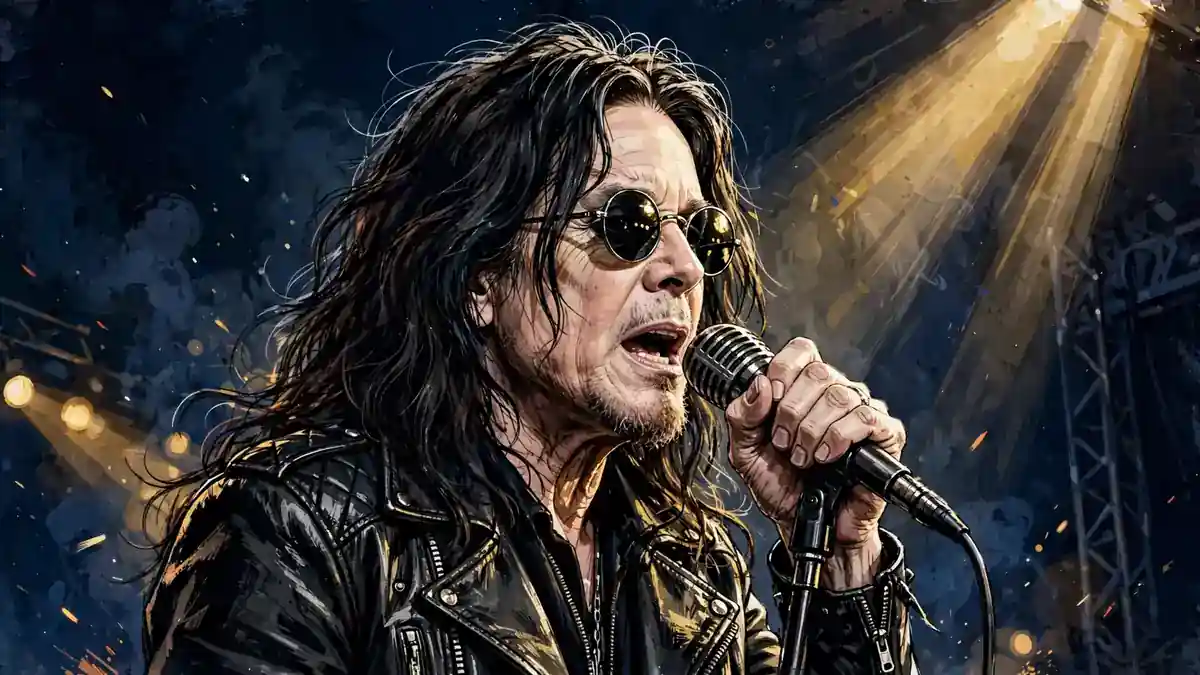
Ozzy Osbourne‘s net worth is estimated at $220–$230 million as of November 2026. The figure is the value placed on his estate at his death on July 22, 2025, when he was 76 — and it comes with a warning label most headlines skip: almost every published number counts Ozzy and his wife and manager Sharon Osbourne together, because their money was built, held and managed as one household for more than 40 years. The fortune rests on four pillars: Black Sabbath royalties from the band that invented heavy metal, a solo career that sold tens of millions of albums, the Ozzfest festival business Sharon built from nothing, and the MTV reality series that turned the family into television pioneers.
Ozzy Osbourne: Quick Facts
| Estimated net worth | $220 million at death (range: $220–$230 million) |
|---|---|
| Profession | Singer, songwriter, television personality |
| Nationality | English |
| Born | December 3, 1948, Aston, Birmingham, England (died July 22, 2025, aged 76) |
| Height | 5 feet 10 inches (178 cm) |
| Primary income sources | Black Sabbath and solo music royalties, touring, Ozzfest, television, merchandise and licensing |
| Active years | 1967–2025 |
| Last reviewed | November 2026 |
- Early Life and Background
- Education
- Career Journey
- Rise to Fame
- Main Sources of Income
- Salary and Earnings
- Businesses and Investments
- Brand Deals and Sponsorships
- Houses, Cars and Other Assets
- Awards and Achievements
- Net Worth Growth Over the Years
- Social Media Presence
- Personal Life
- Sources & Reporting
- Frequently Asked Questions
Early Life and Background
John Michael Osbourne was born on December 3, 1948, in Aston, a working-class district of Birmingham, England. His father, Jack Osbourne, worked as a toolmaker at the GEC factory. His mother, Lilian, worked on a factory production line. The family lived in a small two-bedroom house at 14 Lodge Road with six children, and money was short through most of Ozzy’s childhood. He has said in interviews that the house had no indoor bathroom for much of his youth and that the family counted every penny.
Birmingham shaped the sound he later sold to the world. Aston in the 1950s and 1960s was a landscape of foundries, rail yards and factory sirens, and the young Osbourne grew up with the noise of heavy industry as a daily soundtrack. Biographers have drawn a straight line from that environment to the grinding guitar tone of Black Sabbath: the band’s music sounded like the city that made it. Ozzy’s nickname came from school, where classmates shortened Osbourne to Ozzy. It stuck for the rest of his life and became one of the most valuable stage names in rock.
His childhood was not an easy one. He struggled with dyslexia and attention problems at school, and he has spoken openly about being bullied. He also survived sexual abuse as a child, a subject he addressed in his memoir I Am Ozzy (2010) and in later interviews. At 19 he was arrested for burglary after stealing from a clothing shop and served six weeks in Winson Green prison in Birmingham. He has described that short sentence as a turning point: he came out determined to make a living from music rather than from crime.
The first spark came from the Beatles. Hearing “She Loves You” as a teenager convinced him that a working-class boy from Aston could become a singer, and he has credited that single record with changing the direction of his life. He tried his hand at a string of manual jobs first — labouring on building sites, working as a plumber’s apprentice, a spell in a slaughterhouse and a job tuning car horns at a factory — before music took over. None of those jobs lasted. Music was the only work he ever wanted, and the only one that ever paid him properly.
His first band was Rare Breed, formed with Geezer Butler in 1967. It lasted only a few months and played two shows before splitting. The pair then joined a band called Earth with guitarist Tony Iommi and drummer Bill Ward. Earth played blues-rock covers in Birmingham pubs and clubs, and by 1969 the four had renamed themselves Black Sabbath — taking the name from a 1963 Boris Karloff horror film — and started writing the dark, heavy original material that would make them famous. The name change was the first of many decisions in which Ozzy’s instinct for drama and branding proved sharper than anyone around him expected.
Education
Ozzy Osbourne left school at 15 with no qualifications. His dyslexia went undiagnosed during his school years, and he has said he found reading and writing a struggle while other children moved ahead. Formal education ended early, and the jobs that followed were all manual. Nothing in his school record suggested a future in business, yet the career that followed showed a sharp commercial sense — mostly exercised through Sharon, who managed his affairs from the early 1980s, and through his own feel for what audiences wanted.
What he lacked in schooling he made up for in stagecraft. The early Sabbath years were an education in the music business conducted on the road: bad contracts, worse managers and the slow lesson that the people who controlled the money mattered as much as the people who made the music. That lesson shaped the rest of his working life. By the time he went solo in 1980, he and Sharon were determined to own the operation — the management, the touring company, the festival, the merchandising — rather than hand it to outsiders. The Ozzfest model, which made him a festival owner rather than a hired act, was the direct result of those early years of watching other people take the money.
He also educated himself in public. His 2010 memoir I Am Ozzy became a bestseller, and his final memoir, Last Rites, was published posthumously on October 7, 2025. The books, along with decades of interviews, gave him a second career as a storyteller — and a second income stream from publishing advances and royalties that most rock singers of his generation never matched.
Career Journey
Black Sabbath released their self-titled debut album on Friday, February 13, 1970. Critics hated it. The public bought it. Paranoid, released seven months later, reached number one in Britain and carried the singles “Paranoid” and “Iron Man” — two songs that still earn the estate money every time they are streamed, licensed or played on radio. Over the next eight years the band released eight studio albums with Ozzy as frontman: Black Sabbath (1970), Paranoid (1970), Master of Reality (1971), Vol. 4 (1972), Sabbath Bloody Sabbath (1973), Sabotage (1975), Technical Ecstasy (1976) and Never Say Die! (1978). Black Sabbath have sold more than 70 million albums worldwide, according to reporting on the band’s career totals.
By 1979 the partnership had broken down. Ozzy’s drinking and drug use had become unmanageable, his relationship with Iommi had soured, and the band fired him. He later described the months that followed as the lowest point of his life: divorced from his first wife Thelma, living in a hotel room in Los Angeles, drinking heavily and unsure whether his career was over. Sharon Arden, the daughter of Black Sabbath’s manager Don Arden, took over his management at that point and rebuilt the operation around him. They married on July 4, 1982, and she remained his manager for the rest of his career.
The solo comeback was fast and spectacular. Blizzard of Ozz, released in September 1980, carried “Crazy Train” and “Mr. Crowley” and went multi-platinum. Diary of a Madman followed in November 1981. Then tragedy struck: on March 19, 1982, guitarist Randy Rhoads — the young player at the heart of the solo sound — was killed in a plane crash in Florida at the age of 25. Ozzy has said the loss haunted him for the rest of his life, and it shaped the way he talked about his bandmates in later years.
He kept recording. Across the 1980s and 1990s he released a run of platinum albums — Bark at the Moon (1983), The Ultimate Sin (1986), No Rest for the Wicked (1988) and No More Tears (1991) — and toured relentlessly. In total he released 13 solo studio albums, the last two arriving late in life: Ordinary Man in February 2020 and Patient Number 9 in September 2022, the latter recorded while his health was already failing and featuring guest appearances from Eric Clapton, Jeff Beck, Tony Iommi and Dave Grohl. Combined sales across Black Sabbath and his solo work exceed 100 million albums, according to career reporting cited by networth.com and Parade.
The 1990s brought the move that turned him from a rich singer into a businessman. After Lollapalooza reportedly turned Ozzy down as a headliner, Sharon launched Ozzfest in 1996 — a touring heavy-metal festival with Ozzy closing every night. It ran for more than a decade, drew over four million fans by 2005 and grossed more than $170 million in its first ten years. Ozzy was not a hired act on someone else’s bill. He was the landlord, and the festival kept a share of every ticket, every T-shirt and every sponsor dollar.
Television arrived in 2002. The Osbournes premiered on MTV in March of that year and followed Ozzy, Sharon, Kelly and Jack around their Beverly Hills home. It became the most-watched series in MTV history at the time and won an Emmy for Outstanding Reality Program. The show ran for four seasons and 52 episodes until 2005, and it changed the family’s finances as much as their fame — the pay jump from season one to season two is one of the great contract renegotiations in television history, and it is covered in detail in the earnings section below.
Black Sabbath reunited several times, most notably for the album 13 in 2013 — the band’s first studio album with Ozzy in 35 years, which reached number one in Britain and America — and for a farewell tour that ended in Birmingham in February 2017. Parkinson’s disease, which Ozzy revealed publicly in January 2020, then forced a long retreat from touring. Spinal surgery, infections and falls kept him off the road for five years, and the farewell that finally came was a single night: July 5, 2025, at Villa Park in Birmingham, 17 days before his death.
Rise to Fame
Ozzy’s rise was not a single breakthrough but a series of them, each bigger than the last. The first came in 1970, when a band from Birmingham with a horror-film name and a sound no one had heard before sold records in numbers that stunned their label. The second came in 1980, when a singer fired from his own band for being unmanageable proved he could sell millions on his own name. The third came in 1996, when he became a festival owner. The fourth came in 2002, when a reality show made him a household name to people who had never bought a heavy-metal record.
What set him apart was the gap between the image and the man. On stage he bit the head off a bat in Des Moines in January 1982 — an incident he has always said he believed was a rubber toy thrown from the crowd — and built a reputation as rock’s wildest frontman. Off stage he was a devoted family man who did the school run and worried about his children’s homework. The Osbournes worked because it showed both at once: the Prince of Darkness shuffling around his kitchen in slippers, swearing at the dogs, and then walking on stage in front of 40,000 people. The contrast was the product, and it sold.
His fame also had a second engine: Sharon. She negotiated the contracts, launched the festival, managed the tours and turned the family name into a brand that covered music, television, books and merchandise. Ozzy has said many times that without her he would have died broke in the 1980s. The $220 million figure belongs to both of them in that sense. It was a partnership in the fullest meaning of the word, and every serious estimate of his wealth — including the Sunday Times Rich List, which tracked the couple together for more than two decades — values them as a unit.
By the time of his death, his cultural standing was beyond dispute. Black Sabbath had been inducted into the Rock and Roll Hall of Fame in 2006. Ozzy was inducted a second time, as a solo artist, in October 2024. His songs appear in films, adverts and video games, his face is on T-shirts in every city on earth, and his final concert drew a global livestream audience of 5.8 million people, according to Cure Parkinson’s. Few artists of any genre can claim a farewell that big.
Main Sources of Income
Ozzy’s money came from five streams, and the mix changed as his career went on. In the 1970s it was almost all record sales and touring with Black Sabbath. In the 1980s and 1990s it was solo albums and solo tours. From 1996 it was Ozzfest. From 2002 it was television. And through all five decades, the thread that never stopped paying was the catalogue: songs written in the 1970s that still earn royalties every day.
Black Sabbath royalties. The eight studio albums Ozzy recorded with Sabbath between 1970 and 1978 remain the foundation of the estate. “Paranoid”, “Iron Man”, “War Pigs” and “Crazy Train” — the last a solo song, but one that sits beside the Sabbath catalogue in licensing — are among the most licensed rock songs in the world. They appear in films, television shows, adverts and video games, and each use pays. The 2013 reunion album 13 added a fresh round of sales and a number-one chart position in both Britain and America. In 2010 Ozzy and Tony Iommi settled their long dispute over ownership of the Black Sabbath name, with reports at the time describing the pair as equal owners — a settlement that secured the estate’s share of the name’s future earnings.
Solo music. Thirteen solo studio albums sold tens of millions of copies. Blizzard of Ozz and Diary of a Madman are multi-platinum, and No More Tears (1991) remains his biggest-selling solo record. His solo catalogue also includes the publishing rights to more than 150 songs, according to estate reporting after his death. Streaming has given the catalogue a second life: after his death, his solo work and the Sabbath albums surged back up the charts, and those posthumous streams now earn money for the estate rather than for a living artist — a distinction that matters when reading any 2026 estimate.
Touring. Pollstar data cited in career reporting puts the lifetime gross of Ozzy’s live shows — solo and with Sabbath — at roughly $385 million from about 9.1 million tickets sold. Those are gross box-office figures, not profit, and touring carries heavy costs: crews, transport, staging and insurance. Even so, five decades of sold-out arenas and stadiums formed the largest single cash flow of his working life. His final show alone, Back to the Beginning, drew more than 40,000 people to Villa Park plus an estimated 5.8 million livestream viewers.
Ozzfest. The festival Sharon created in 1996 became the family’s most important business asset. It grossed more than $170 million by 2005 and drew more than four million fans in its first decade. Unlike a tour, a festival pays its owner on every act on the bill, every ticket, every sponsor and every merchandise stall. Ozzy was also reported to be the first rock star to sell more than $50 million in merchandise — a figure that covers both his own tours and the Ozzfest brand.
Television and media. The Osbournes paid the family handsomely, and it opened doors that music alone never would: Sharon’s judging roles on The X Factor in Britain and The Talk in America, the family’s books, and a long run of documentary and guest appearances. Sharon was reported by Parade to have earned about $5 million a year hosting The Talk, with a severance of a reported $5–10 million when she left — income that sits inside the couple’s combined $220 million.
Salary and Earnings
Ozzy never appeared on a published annual earnings list the way a film star or an athlete does, so the figures below are the best-documented money moments of his career. Some are gross revenue rather than personal profit, and this article keeps that distinction visible wherever it applies.
| Year | Deal or event | Reported figure |
|---|---|---|
| 2002 | Ozzy and Sharon’s combined income (Heat magazine rich list) | About £40 million |
| 2002 | The Osbournes season one — per family member, per episode | About $20,000 |
| 2002 | Miramax home video deal for The Osbournes DVDs | $7 million |
| 2002–2003 | The Osbournes season two contract — per family member | About $5 million |
| 1996–2005 | Ozzfest gross ticket revenue | More than $170 million |
| Career | Live shows gross (Pollstar data, solo and with Sabbath) | Roughly $385 million from 9.1 million tickets |
| Career | Merchandise sales (first rock star past the mark) | More than $50 million |
| 2019 | Sunday Times Rich List — Ozzy and Sharon combined | £150 million |
| 2025 | Back to the Beginning — reported charity gross | About £140 million ($190 million) |
| 2025 | Net worth at death (Celebrity Net Worth) | $220 million |
The television numbers deserve a closer look, because they show how fast the family’s pay changed once the show became a hit. Season one of The Osbournes paid each family member about $20,000 per episode — $80,000 per episode for the family across the four who appeared, or about $800,000 for the ten-episode first season, according to Parade’s breakdown. Once the show became the most-watched series in MTV history, Sharon renegotiated the season-two deal to about $5 million per family member. TheStreet has noted that across the later seasons that would amount to roughly $60 million for the family, plus the $7 million Miramax home video deal signed in July 2002. That single renegotiation — from $20,000 an episode to $5 million a season — is the clearest example of Sharon’s value as a manager, and it is why the couple’s wealth is always quoted as a joint figure.
The Ozzfest numbers tell a similar story about ownership. A touring singer is paid a fee. A festival owner is paid on everything. By 2005 Ozzfest had drawn more than four million fans and grossed more than $170 million, and the Osbournes held the brand. Later editions were less consistent — the 2007 festival was free to fans and sponsored, and the 2008 and 2010 editions were one-day events — but the first decade built the core of the family’s business wealth.
One figure that should not be quoted as income is the $190 million attached to the final concert. Back to the Beginning was a charity event. The £140 million figure reported by Billboard and others was a gross fundraising total, not money that went to the family. Sharon said on The Osbournes podcast in November 2025 that about $11 million remained for the three charities — Birmingham Children’s Hospital, Acorn Children’s Hospice and Cure Parkinson’s — once production, travel and accommodation costs were paid. The gap between the two numbers has been widely discussed since, and it is covered in full in the personal life and estate section below.
Businesses and Investments
Ozzy and Sharon ran their career as a family business, and the structure mattered as much as the talent. Sharon managed Ozzy from 1979, and the couple built a set of companies and brands around him rather than relying on a record label or a promoter to handle the money.
Ozzfest was the flagship. Launched in 1996 after Lollapalooza reportedly passed on Ozzy as a headliner, it became the first major touring festival built around a single artist’s name. Sharon produced it, Ozzy headlined it, and the family kept the brand. It ran annually through 2007 in its touring form, returned as a one-day event in 2008 and 2010, and came back for a final edition in 2016 and 2017. The festival’s gross of more than $170 million by 2005 made it one of the most successful rock festival brands of its era.
Merchandising was the second business. Ozzy was reported to be the first rock star to sell more than $50 million in merchandise, and the Ozzfest brand alone generated tens of millions in branded goods. The bat, the cross, the gothic lettering — the imagery was consistent for 50 years, and that consistency is what made it licensable. Posthumous merchandise, from the farewell concert range to the inevitable anniversary reissues, continues to sell.
Publishing and catalogue rights form the estate’s long-term asset. Ozzy’s solo publishing covers more than 150 songs, and his share of the Black Sabbath catalogue — secured in part by the 2010 name settlement with Tony Iommi — keeps earning from streaming, licensing and reissues. As of October 2026 there had been no reported sale of his music catalogue, according to networth.com’s estate reporting. That matters: unlike Bob Dylan, who sold his publishing catalogue to Universal in a deal reported at around $300 million, or Prince, whose estate has spent years monetising his vault, the Osbourne estate still holds its catalogue. If it is ever sold, the price would reset every estimate on this page.
Television production was a third strand. The Osbournes made the family producers as well as stars, and the format’s success led to further shows: Ozzy & Jack’s World Detour, which ran on A&E and the History Channel from 2016, and the podcast The Osbournes Podcast, which Sharon continued after Ozzy’s death. The family also earned from books — I Am Ozzy (2010) was a bestseller on both sides of the Atlantic, and Last Rites was published posthumously in October 2025.
Brand work and licensing. Late in life Ozzy lent his name to a run of unusual deals: a partnership with the canned-water brand Liquid Death, which sold cans of iced tea containing a trace of his DNA, and a role as brand ambassador and part-owner of Metal Casino, an online casino aimed at metal fans. Neither deal carried a published fee, so this article does not invent one — but both show how his name kept earning into his seventies, long after touring had stopped.
On the question of investments, the public record is thin. Unlike Jay-Z, whose venture portfolio is documented deal by deal, Ozzy’s wealth was built from operating income — records, tours, a festival and television — rather than from stock picks or startup stakes. The family’s money went into property, which is covered in the assets section below, and into the catalogue, which is the asset that will keep paying the heirs for decades.
Brand Deals and Sponsorships
Ozzy was never a conventional endorser. He did not front fragrance campaigns or fashion lines, and the deals he did sign were chosen for shock value rather than for a fee. The most talked-about was the Liquid Death collaboration, in which the brand sold limited cans of iced tea infused with a trace amount of Ozzy’s DNA. The cans sold out and changed hands for thousands of dollars on resale sites, according to reporting at the time. The stunt said more about his brand than any pay cheque: at 75, his name could still make a drinks launch into global news.
His longer-running commercial relationship was with Metal Casino, where he served as brand ambassador and part-owner. The partnership tied his image to an online casino aimed at rock and metal fans — a natural fit for his audience, and a reminder that his commercial value sat in the loyalty of a fanbase built over 50 years rather than in the broad-appeal market most celebrity endorsers chase.
Earlier in his career, the biggest “sponsorship” was Ozzfest itself. The festival carried sponsors across its run, and the sponsor money went to the festival company rather than to Ozzy personally — another reason the festival model paid better than touring alone. His image has also been licensed for video games, including the Guitar Hero and Rock Band franchises, and for film and television soundtracks, where “Crazy Train” and “Paranoid” remain two of the most licensed rock tracks of their era.
One deal that is often misread is the $7 million Miramax home video agreement from July 2002. It was not a sponsorship. It was a distribution deal for DVDs of the first two seasons of The Osbournes, signed at the height of the show’s popularity, and it shows how quickly the family converted television fame into cash in more than one format.
Houses, Cars and Other Assets
Property was the family’s most visible store of wealth, and their buying and selling over 30 years reads like a case study in high-end real estate. The pattern was consistent: buy a landmark home, live in it for years, then sell at a profit — or, in the case of the Los Angeles mansion, struggle to sell at all.
Welders House, Buckinghamshire. The family’s English base is Welders House, a Grade II-listed Georgian mansion in Jordans, Buckinghamshire, bought in 1993. The estate covers about 250 acres. It was Ozzy’s home at the time of his death on July 22, 2025, and the private funeral service was held on its grounds on July 31, 2025, after a public procession through Birmingham the day before. Sharon now spends most of her time there, according to reporting in late 2026. No public valuation of Welders House has been published, and this article does not guess at one.
Hancock Park, Los Angeles. The couple bought their Mediterranean Revival mansion in Hancock Park in 2015 for $11.85 million, according to property records cited by Mansion Global and the Wall Street Journal. The house was built in 1929, designed by architect A.K. Kellogg, and spans about 10,200 square feet with seven bedrooms and 11 bathrooms plus a guesthouse. They first listed it in July 2022 for $18 million, cut the price to $17.5 million, and then withdrew it when their planned move back to Britain stalled. Sharon relisted it in April 2026 for $17 million, and cut the asking price again to $16 million in October 2026. The house remains the estate’s most valuable single property asset — and the hardest to sell.
Beverly Hills. In the late 1990s the couple paid about $4 million for a Beverly Hills mansion that became the setting for The Osbournes. They sold it to pop star Christina Aguilera in 2013 for $11.5 million — a gain of roughly $7.5 million on the purchase price, and one of the family’s cleanest property profits.
Malibu. The couple sold an oceanfront beach house in Malibu for about $8 million in 2012, according to Australian property reporting on their portfolio.
Sierra Towers, West Hollywood. The couple bought a two-bedroom condo in the Sierra Towers building in 2014 for $4 million. They listed it in May 2023 at $4.795 million, cut the price by $300,000, and sold it in October 2024 for $4.35 million — a small profit on the 2014 price, and a reminder that even celebrity property does not always beat the market.
Cars. No verified public inventory of Ozzy’s car collection exists, and this article does not invent one. He was photographed over the years in a spread of luxury cars, and the family owned several high-end vehicles, but no reliable source has published a list with values. Any article that prints a precise car collection total for Ozzy is guessing.
The catalogue. The largest asset is not a house. It is the music: the Black Sabbath catalogue share, the solo publishing on more than 150 songs, the Ozzfest brand and the television format rights. Those assets have no published valuation, which is why the $220 million figure is an estimate rather than a balance sheet. If the catalogue is sold in the coming years, the sale price will give the first hard number the estate has ever produced.
Awards and Achievements
Ozzy’s trophy record reflects two careers, not one. With Black Sabbath he won two Grammy Awards — for the live version of “Iron Man” in 2000 and for “God Is Dead?” in 2014 — and the band was inducted into the Rock and Roll Hall of Fame in 2006. As a solo artist he was inducted a second time, in October 2024, joining the small group of performers honoured twice. His solo work also brought Grammy nominations across four decades, including for Patient Number 9 in 2023.
The list of firsts is long. Black Sabbath invented heavy metal — a claim no serious history of the genre disputes. Ozzy was the first rock star reported to sell more than $50 million in merchandise. The Osbournes won the Emmy for Outstanding Reality Program in 2002 and became the most-watched series in MTV history at the time. Ozzfest was the first major touring festival built around one artist. 13, the 2013 Sabbath reunion album, reached number one in Britain and America — 43 years after the band’s debut.
He also holds a quieter record: longevity. Few frontmen have headlined arenas in six different decades. His final concert, Back to the Beginning, reunited the original Black Sabbath lineup for the first time in 20 years and drew a livestream audience of 5.8 million. The show’s scale — 40,000 people in the ground, millions more watching online — was a fitting end to a career that began in Birmingham pubs.
His influence shows up in the wealth of the musicians who followed him. Mick Jagger, whose Rolling Stones career has run even longer, carries a reported net worth of around $500 million by Celebrity Net Worth’s estimate — a useful peer marker for what a half-century at the top of rock can be worth. Eminem, who has cited Ozzy as an influence and collaborated with the family, sits in the same bracket of career earners. The comparison is not exact — Jagger’s touring machine and Eminem’s record sales work differently from Ozzy’s festival-and-television model — but it puts the $220 million figure in context: a huge fortune, built differently from his peers’.
Net Worth Growth Over the Years
There is no year-by-year audited record of Ozzy’s wealth, and any table that prints one is inventing data. What exists is a set of anchor points from named sources, and this table sticks to those.
| Year | Anchor point | Figure |
|---|---|---|
| 1970–1978 | Black Sabbath’s eight studio albums with Ozzy; band becomes a global arena act | No published figure; early wealth built from record sales and touring |
| 1980–1982 | Solo breakthrough: Blizzard of Ozz and Diary of a Madman go multi-platinum | No published figure; solo career restores his earning power |
| 1996 | Ozzfest launches; festival ownership begins | Festival grosses $170M+ by 2005 |
| 2002 | Heat magazine rich list — Ozzy and Sharon’s combined income | About £40 million (income, not net worth) |
| 2002–2005 | The Osbournes — television fortune built | About $5M per family member per season from season two |
| 2013 | Beverly Hills mansion sold to Christina Aguilera | $11.5 million sale (bought for about $4 million) |
| 2019 | Sunday Times Rich List — Ozzy and Sharon combined | £150 million (about $190 million) |
| 2022 | Celebrity Net Worth long-standing estimate | $220 million |
| 2025 | Net worth at death, July 22, 2025 (Celebrity Net Worth; repeated by Parade, TheStreet, Distractify) | $220 million |
| 2026 | Estate value — this article’s range, allowing for posthumous earnings and the $230M outlier | $220–$230 million |
The gap between the 2019 Sunday Times figure (£150 million, about $190 million) and the $220 million at death is not a mystery. Rich lists value people in pounds and use different methods, and Celebrity Net Worth’s dollar figure has sat at $220 million for years. The honest reading is that the couple’s wealth was broadly flat in real terms through the 2010s and early 2020s: the touring stopped, the television work slowed, and the catalogue kept earning. One outlier deserves a warning: Cosmopolitan reported in March 2024 that the couple’s combined wealth totalled $440 million — exactly double the long-standing estimate. TheStreet flagged the discrepancy in July 2025, noting that no explanation exists for how the figure could have halved in a year. This article treats $440 million as an unsourced outlier and does not use it.
The viral $800 million figure deserves the same treatment. In the months after Ozzy’s death, TikTok and YouTube videos claimed his fortune had been divided at $800 million. Fact-checking by multiple outlets traced the number to a single unsourced social-media clip with no supporting evidence. The $800 million figure appears to mix up lifetime gross revenue — record sales, tour grosses and merchandise over 57 years — with net worth. Gross revenue is not wealth. The $220 million estimate stands.
Social Media Presence
Ozzy’s social media accounts were among the most followed of any rock musician of his generation, and they remain active as memorial pages run by his family and estate. His Instagram, X and Facebook accounts carried tour announcements, family photographs and the black humour his fans expected, and they became the family’s main channel for announcements in his final years — including the January 2020 statement revealing his Parkinson’s diagnosis and the July 2025 statement announcing his death.
After his death the accounts shifted to tribute mode: clips from Back to the Beginning, photographs from the Birmingham procession, and announcements about Last Rites and the Paramount+ documentary Ozzy: No Escape From Now. Posthumous streaming and social engagement surged in the weeks after July 22, 2025, with his catalogue returning to the charts in Britain and America. Those streams earn money for the estate, and they are part of why the 2026 range runs to $230 million at its top end rather than stopping at $220 million.
Sharon’s accounts have also become part of the story. Her posts about the estate, the Hancock Park sale and the September 2026 court filing over the executorship of Ozzy’s will have been picked up by the press and now function as the family’s public record. The social accounts are, in effect, the estate’s press office.
Personal Life
Ozzy married twice. His first marriage, to Thelma Riley, lasted from 1971 to 1982 and produced two children, Jessica and Louis. He also adopted Elliot, Thelma’s son from an earlier relationship. His second marriage, to Sharon Arden on July 4, 1982, lasted 43 years until his death and produced three children: Aimee, Kelly and Jack. All six children are heirs to the estate, though the terms of his will have not been made public.
The marriage to Sharon survived crises that would have ended most partnerships. There were affairs, a drink-driving crash, a 1989 incident in which Ozzy was arrested after attacking Sharon while intoxicated — an episode both have spoken about openly since — and long periods of separation. Sharon has said the couple renewed their vows and rebuilt the marriage more than once. The partnership that mattered most to the money was the professional one: she managed him, negotiated for him and built the businesses that made him rich.
His health dominated his final years. He revealed in January 2020 that he had been diagnosed with Parkinson’s disease, and in the years that followed he underwent spinal surgery, suffered infections and falls, and cancelled his farewell tour. He kept working where he could: Ordinary Man in 2020, Patient Number 9 in 2022, and the single farewell show in July 2025. He died at home at Welders House on July 22, 2025, 17 days after that show. His death certificate, reported in August 2025, listed out-of-hospital cardiac arrest and acute myocardial infarction, with coronary artery disease and Parkinson’s disease with autonomic dysfunction as joint causes. He was 76.
The farewell concert deserves its own paragraph because it produced the most argued-over numbers of his entire career. Back to the Beginning, on July 5, 2025, reunited the original Black Sabbath lineup at Villa Park in Birmingham for the first time in 20 years. More than 40,000 people attended and an estimated 5.8 million watched the livestream. Billboard and other outlets reported that the show had raised about £140 million (roughly $190 million) for Birmingham Children’s Hospital, Acorn Children’s Hospice and Cure Parkinson’s. In November 2025 Sharon said on The Osbournes podcast that about $11 million remained for the charities after production, travel and accommodation costs. The two figures are not necessarily in conflict — one is a gross fundraising total, the other a net remainder — but neither has been confirmed by published accounts from the beneficiaries, and Cure Parkinson’s has confirmed the audience scale without publishing a financial total. Readers should treat both numbers as reported, not audited.
The estate itself remains unsettled in public. As of October 2026 no official value of the estate had been published and no public probate inventory existed, according to networth.com’s estate reporting. Tabloid stories about the contents of his will have not been confirmed by the family. The only reported detail comes from a single unnamed source quoted by RadarOnline in July 2025, claiming Sharon was given a lifetime interest in the estate with the remainder to be split equally among the children. That claim should be read as unconfirmed. What is confirmed is the legal action that followed: in September 2026 Sharon filed papers in the British High Court seeking the removal of Ozzy’s longtime accountant, Colin Newman, as executor of the will, alongside the other two executors, his niece Georgina Maszlin and his assistant Melinda Varga. Parade reported the filing on September 9, 2026, citing The Sun. No reason for the request had been made public at the time of writing, and Newman had not responded publicly. Unconfirmed online reports have also cited roughly $8 million in unpaid tax liens against the estate; no tax authority or court filing has confirmed that figure, and it is noted here only so readers are not misled by it elsewhere.
His funeral was private, held on the grounds of Welders House on July 31, 2025. The day before, his cortege passed through Birmingham, where thousands of fans lined the streets and left flowers at the Black Sabbath bench on Broad Street. The city that made him said goodbye in the way it knew best: loudly, and in large numbers.
Sources & Reporting
Celebrity Net Worth — the $220 million net-worth estimate at death, for both Ozzy and Sharon (whose page notes the figure was combined until July 2025 and is now hers alone); updated April 15, 2026. The anchor figure for this article.
Parade — “Ozzy Osbourne Net Worth at the Time of His Death” (January 1, 2026): the $20,000-per-episode season-one pay, the $5 million season-two renegotiation, Sharon’s reported $5 million a year on The Talk, and the September 9, 2026 report of Sharon’s High Court filing to remove executor Colin Newman.
TheStreet — July 23, 2025: the $220 million estimate, the flagged $440 million Cosmopolitan outlier, and the $60 million family total across later Osbournes seasons.
NetWorth.com — “Ozzy Osbourne Net Worth 2026: $220 Million Legacy”: the Sunday Times Rich List £150 million figure for 2019, the Ozzfest $170 million gross, the 100-million-album career total, and the October 2026 estate status (no published probate value, no catalogue sale).
Mansion Global and The Wall Street Journal — the Hancock Park listing: bought 2015 for $11.85 million, listed July 2022 at $18 million, relisted April 2026 at $17 million.
Country and Town House and Parade — the October 2026 price cut on Hancock Park to $16 million and Sharon’s move to Welders House.
View.com.au — the property portfolio: Beverly Hills bought for about $4 million and sold to Christina Aguilera for $11.5 million in 2013, the Malibu sale at about $8 million, and the Sierra Towers sale at $4.35 million.
NME — Sharon Osbourne on the Back to the Beginning charity proceeds: about $11 million remaining after costs, November 2025.
Cure Parkinson’s — the farewell concert audience: 40,000-plus in attendance and an estimated 5.8 million livestream viewers, with no published financial total.
Distractify and Billboard — the $220 million estimate at death and the reported £140 million charity gross from the final show.
Reporting window: July 2025 – November 2026. Figures are estimates drawn from public reporting; no audited financial statement, probate inventory or catalogue valuation has been published for Ozzy Osbourne or his estate.
Frequently Asked Questions
What was Ozzy Osbourne’s net worth at the time of his death?
Ozzy Osbourne’s net worth was estimated at $220 million at the time of his death on July 22, 2025, according to Celebrity Net Worth. The figure was combined with his wife Sharon Osbourne, who managed his career for more than 40 years. This article carries a range of $220–$230 million to allow for the small number of outlets that publish $230 million and for posthumous earnings.
How much was Ozzy Osbourne worth in 2026?
In 2026 his estate is estimated at $220–$230 million. The top of the range reflects posthumous streaming, the Last Rites memoir, the Paramount+ documentary and merchandise from the farewell concert. No probate inventory has been published, so the figure remains an estimate rather than an audited value.
Was the $800 million Ozzy Osbourne fortune real?
No. The $800 million figure spread on TikTok and YouTube after his death and has no source behind it. It appears to mix up his lifetime gross revenue — record sales, tour grosses and merchandise over 57 years — with net worth. The widely reported estimate from Celebrity Net Worth and the obituary coverage is $220 million.
How did Ozzy Osbourne make his money?
Five streams: Black Sabbath royalties from eight 1970s studio albums plus the 2013 reunion album 13; a solo career of 13 studio albums that sold tens of millions of copies; Ozzfest, the festival Sharon launched in 1996, which grossed more than $170 million by 2005; television, led by The Osbournes on MTV; and merchandise, where he was reported to be the first rock star past $50 million in sales.
How much did Ozzy Osbourne make from The Osbournes?
Each family member was paid about $20,000 per episode for season one — roughly $800,000 for the family across the ten-episode season. After the show became MTV’s most-watched series, Sharon renegotiated the season-two deal to about $5 million per family member. The family also signed a $7 million home video deal with Miramax in July 2002.
What happened to Ozzy Osbourne’s money after he died?
No official value of the estate has been published and no public probate inventory exists as of October 2026. A single unnamed source quoted by RadarOnline claimed Sharon was given a lifetime interest, with the remainder split equally among the six children — that claim is unconfirmed. In September 2026 Sharon filed in the British High Court to remove Ozzy’s longtime accountant Colin Newman as executor.
How much did Ozzy Osbourne’s final concert raise for charity?
Back to the Beginning, on July 5, 2025 at Villa Park in Birmingham, was reported to have raised about £140 million (roughly $190 million) for Birmingham Children’s Hospital, Acorn Children’s Hospice and Cure Parkinson’s. Sharon later said on The Osbournes podcast that about $11 million remained for the charities after production, travel and accommodation costs. Neither figure has been confirmed by published accounts from the beneficiaries.
Who is the richest member of Black Sabbath?
Ozzy Osbourne, with an estimated $220 million combined with Sharon at his death, according to Parade. His solo career, Ozzfest and television earnings put him well ahead of his bandmates, whose wealth comes chiefly from the shared Sabbath catalogue and reunion tours.
Final Thoughts
Ozzy Osbourne died with an estimated $220 million, and the number tells only half the story. The other half is who built it: a singer fired from his own band at 31, and the wife who took over his management, launched a festival, renegotiated a television contract from $20,000 an episode to $5 million a season, and turned a family name into a business that outlived its founder. The catalogue still earns. The festival brand still has value. The houses are being sold one by one. What the estate is finally worth will only be known when a probate figure or a catalogue sale puts a hard number on it — and until then, $220 million, inside a $220–$230 million range, is the honest answer.
He began in a two-bedroom house in Aston with no indoor bathroom and left school at 15 with no qualifications. He ended as the frontman who invented heavy metal, headlined a farewell show watched by millions, and was mourned by a whole city. The money was real, the music was bigger, and the gap between the viral $800 million fantasy and the documented $220 million reality is a useful reminder: in celebrity wealth, the loudest number is rarely the truest one.
Published on November 10, 2026. Last reviewed November 2026. Found an error? See our corrections policy.