
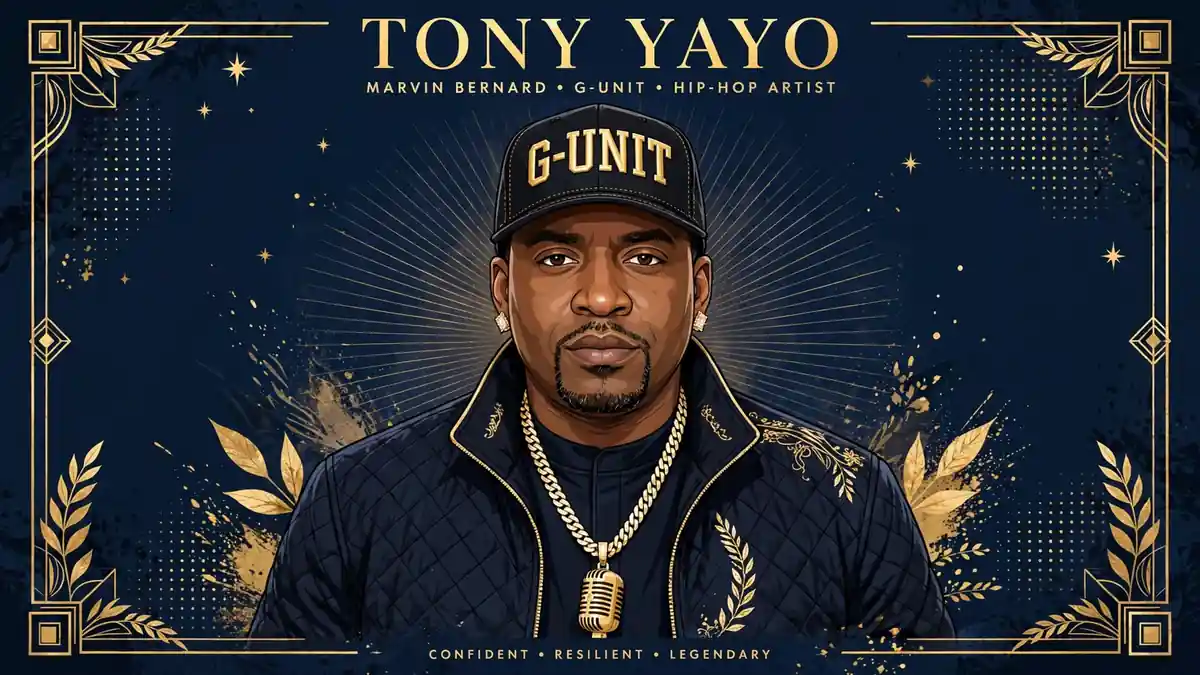
Tony Yayo‘s net worth is estimated at $2 million–$4 million as of November 2026. The G-Unit founding member built that fortune the hard way: a double-platinum group debut recorded while he sat in federal prison, a solo debut that opened at No. 2 on the Billboard 200 with more than 200,000 first-week sales, an 18-year wait for a second album, and a six-figure payday touring the world on 50 Cent’s Final Lap Tour in 2023.
Tony Yayo: Quick Facts
| Estimated net worth | $2 million–$4 million (range: $2 million–$4 million; wider published spread $2 million–$8.5 million) |
|---|---|
| Profession | Rapper, songwriter |
| Nationality | American |
| Born | March 31, 1978 (age 48) |
| Height | 6 ft (183 cm) |
| Primary income sources | Music royalties, touring, streaming, guest features, mixtapes, podcast and media appearances |
| Active years | 1999–present |
| Last reviewed | November 2026 |
- Early Life and Background
- Education
- Career Journey
- Rise to Fame
- Main Sources of Income
- Salary and Earnings
- Businesses and Investments
- Brand Deals and Sponsorships
- Houses, Cars and Other Assets
- Awards and Achievements
- Net Worth Growth Over the Years
- Social Media Presence
- Personal Life
- Sources & Reporting
- Frequently Asked Questions
Early Life and Background
Tony Yayo was born Marvin Bernard on March 31, 1978, in South Jamaica, Queens, New York City. He grew up on the same blocks as Curtis Jackson — the rapper the world knows as 50 Cent — and Christopher Lloyd, known as Lloyd Banks. The three were childhood friends before any of them had a record deal, and that friendship became the foundation of one of the most commercially successful rap groups of the 2000s.
South Jamaica in the 1980s and 1990s was a hard place to grow up, and Yayo has never hidden that his early years were shaped by street life. In interviews he has described selling drugs as a teenager and running with the same circle that later formed G-Unit. That background later became the raw material of his music — his stage name itself comes from the street slang of the era — and it also explains the legal trouble that nearly ended his career before it started.
Little is publicly documented about Yayo’s parents, who are named in some biographies only as Mr. and Mrs. Bernard. He has kept his family background private, and no reliable source names his siblings. What is documented is the neighbourhood: the same South Jamaica streets that produced 50 Cent also produced the loyalty-first code that Yayo still talks about in interviews, the idea that the group came before the solo career and that he would wait — even for years — rather than break ranks.
By the late 1990s, Yayo, 50 Cent and Lloyd Banks were recording together as G-Unit, an underground collective built on mixtapes. The name was short for Guerilla Unit, and the method was relentless: flood the streets with tapes, record in makeshift home setups, and let the buzz do the work that a label would normally pay for. Yayo later recalled on Drink Champs that the group recorded in basements and pressed its own mixtapes, selling them hand to hand on Jamaica Avenue. That grind is the first money story of his career — no advance, no label, just tapes sold directly to listeners.
Education
There is no public record of Tony Yayo attending college or completing any formal education beyond high school in Queens, and no credible biography lists a school he attended. Unlike some of his peers, he has never presented an academic credential as part of his public story, and we do not invent one here.
What he did receive was an education in the mixtape economy. By the time he was in his early twenties, Yayo understood the mechanics that later made G-Unit rich: record cheaply, release constantly, control the streets first, and let the labels come to you. The group pressed its own tapes, priced them to move, and built a following block by block in Queens before a single major-label dollar arrived. That street-level business schooling mattered more to his later earnings than any classroom — it taught him the value of owning his masters-era mixtape catalogue and of touring off buzz rather than waiting for radio.
His later career also shows a different kind of learning: patience with the business side. In a 2015 interview with The Boombox, Yayo spoke openly about label politics at Interscope holding up his second album for years, and about having already taken an advance for a record he could not release. Understanding advances, recoupment and the power a label holds over an artist’s release schedule — and surviving them — became a second education, one paid for with an 18-year gap between solo albums.
Career Journey
Yayo’s professional career begins in 1999, when G-Unit formalised as a group. The trio — Yayo, 50 Cent and Lloyd Banks — spent the next three years building a reputation on New York’s mixtape circuit with tapes such as 50 Cent Is the Future, No Mercy, No Fear and God’s Plan in 2002. The tapes were raw and aggressive, and they worked: by 2002, 50 Cent had the loudest underground buzz in hip-hop, and Yayo and Banks were riding with him.
The turning point came in 2002, when 50 Cent signed with Eminem’s Shady Records and Dr. Dre’s Aftermath Entertainment. The deal brought G-Unit into the mainstream, and Yayo was set to ride the wave. Instead, in December 2002, police found a loaded firearm in his car and Yayo was arrested on weapons charges. He was sentenced to federal prison and spent nearly two years behind bars — the exact stretch when G-Unit became a global brand.
That timing is the central irony of his career. While Yayo was in prison, G-Unit released its debut album Beg for Mercy on November 14, 2003. It debuted at No. 2 on the Billboard 200 and went on to be certified double platinum by the RIAA, with more than 2.7 million copies sold in the United States. Yayo’s voice and presence were on the record — his contributions had been recorded before his arrest — but he could not tour it, promote it, or collect the performance income that normally follows a hit album. The group also appeared on 50 Cent’s diamond-selling debut Get Rich or Die Tryin’ in 2003, the album that made his friend a superstar while Yayo watched from a cell.
Yayo was released in early 2004 and rejoined G-Unit at its peak. He stepped straight into the spotlight the group had built without him: arena tours, award shows, and a record-buying public that already knew his name and his ad-libs. His solo debut followed on August 30, 2005 — Thoughts of a Predicate Felon, released through G-Unit Records and Interscope Records. It debuted at No. 2 on the Billboard 200 and sold more than 200,000 copies in its first week in the United States, powered by the single “So Seductive” featuring 50 Cent.
The second G-Unit album, T.O.S. (Terminate on Sight), arrived on July 1, 2008. It debuted at No. 4 on the Billboard 200 and sold 102,000 copies in its first week — solid numbers, but a step down from the group’s debut, and a sign that the G-Unit moment was cooling. From there, Yayo’s career shifted into the long middle act that defines his finances today: mixtapes, guest features, and touring, with no second solo album for nearly two decades.
The mixtape years were prolific even if they were not lucrative in the way an album cycle is. Yayo released the El Chapo mixtape series, including El Chapo 2 in February 2012, a 12-track tape featuring Danny Brown, French Montana and others, and later El Chapo 3. He stayed visible through features and street releases, but the sophomore album he had been promised — and paid an advance for — never came. In his 2015 Boombox interview, he was blunt about why: “a whole bunch of politics going on with, like, Interscope and with us.” The album existed in pieces; the label machinery did not.
The drought finally ended on February 10, 2023, when Yayo released The Loyal, his second solo album and his first since leaving the G-Unit fold, initially exclusive to Apple Music and then on all streaming services four days later on Valentine’s Day. The title was a statement about the loyalty that had defined his career — and the cost of it. Later in July 2023 he released the 134 Tape mixtape, and his later releases have included The 4:20 Tape in 2026, according to TheCityCeleb’s biography. G-Unit itself formally disbanded in 2022, closing the group chapter that had defined him since 1999.
Rise to Fame
Yayo’s rise to fame is unusual because it happened twice: once on the mixtapes, and once again after prison. The first rise was collective. The G-Unit tapes of 2002 made 50 Cent the most talked-about unsigned rapper in America, and Yayo’s gravelly voice and street-certified verses were part of the package. When 50 Cent signed to Shady/Aftermath, the whole crew came with him — the deal was understood to include his friends as well as him.
The second rise was the solo debut. Thoughts of a Predicate Felon did what few debut albums by a group member manage: it sold on its own name. Opening at No. 2 on the Billboard 200 with more than 200,000 copies in week one, it proved Yayo was far more than a hype man. “So Seductive” became his signature record — it peaked at No. 48 on the Billboard Hot 100, No. 7 on the R&B chart, and No. 12 on the rap chart, and it was later certified platinum as a single. Follow-up singles “Curious” featuring Joe and “Pimpin'” kept him on radio through 2005 and 2006.
Television and film work never became a major income line for Yayo the way it did for 50 Cent, whose move into TV production made him tens of millions. Yayo’s fame stayed rooted in music and in the culture around it: guest verses, mixtape drops, and a reputation as the most loyal man in the group. That reputation paid off in a different currency in 2023, when his Drink Champs appearance — episode 371 with N.O.R.E. and DJ EFN — became one of the most-viewed slots of the year, according to HotNewHipHop, and Fat Joe publicly congratulated him on the podcast’s success. For an artist whose last chart hit was in 2005, that kind of cultural relevance is itself an asset: it keeps the touring offers coming.
The 2023 Final Lap Tour was the clearest proof. 50 Cent’s farewell-style world tour ran to 70 cities across more than 20 countries, and Yayo was on the road for it, performing the G-Unit catalogue to sold-out arenas. In a DJ Vlad interview afterwards, Yayo said he made six figures from the tour — and that 50 Cent had financed the entire production himself, paying for road management, catering, dancers, jet crew and pilots out of his own pocket. For Yayo, it was the biggest single payday of his later career, and it arrived twenty years after his first taste of fame.
Main Sources of Income
Tony Yayo’s money comes from five streams, and their balance has shifted sharply over time. In 2003–2006, album sales and the G-Unit machine dominated. In 2026, the money is mostly touring, streaming royalties, and guest features, with podcast and media appearances adding a newer line.
Music royalties remain the base. Yayo earns as a recording artist and songwriter on his solo catalogue and on his share of G-Unit’s two studio albums. Beg for Mercy is the crown jewel: double platinum in the US, with more than 2.7 million copies sold domestically, it generates mechanical and streaming royalties every year, and the G-Unit catalogue has held up well on streaming because the 2000s nostalgia cycle keeps those records in rotation. His solo debut, certified gold in the US, adds its own smaller but steady stream, and “So Seductive” — a platinum single — earns every time it is streamed or licensed.
Touring and live performance is now the biggest single earner. The Final Lap Tour in 2023 was the headline: Yayo told DJ Vlad he made six figures across the run, performing G-Unit classics in arenas from Salt Lake City to Europe. Before that, he toured off mixtape buzz as early as the 2000s — he recalled on Drink Champs that G-Unit toured off mixtapes before they even had an album out, a rare feat that showed how strong the street demand was. In 2026 he continues to take club and festival bookings built on the G-Unit catalogue, and those fees, rather than new music, are what keep the income flowing.
Streaming pays less per play than the CD era paid per sale, but it never stops. Yayo’s catalogue — the solo debut, the two G-Unit albums, The Loyal, and a long mixtape tail — earns across Spotify, Apple Music and YouTube. The 2023 release of The Loyal gave him a fresh streaming asset after an 18-year gap, and the 2026 release The 4:20 Tape added another. These are modest earners compared with a hit album cycle, but they compound: every playlist add of “So Seductive” or “Stunt 101” is money he did not have to tour for.
Guest features and collaborations form a fourth stream. Yayo has spent two decades as a go-to feature for artists who want a G-Unit verse, and features typically pay a flat fee plus a royalty share. His appearances on 50 Cent records, his work with Lloyd Banks, and features for newer artists all sit in this bucket. The exact fees are not public, and we do not guess at them — but the volume is documented across his discography, and it is a real income line.
Media and podcast appearances are the newest stream. His 2023 Drink Champs episode drew some of the show’s biggest numbers of the year, and Yayo has since become a regular voice on hip-hop podcasts and interview shows, including VladTV. These appearances pay appearance fees in some cases and, more importantly, keep his name in the conversation that produces touring offers. It is a small stream today, but it is the one growing fastest.

Salary and Earnings
Tony Yayo has never had a published salary in the way an athlete or actor does, so his earnings have to be reconstructed from the record — album sales, tour paydays, and his own words. Here is what the evidence supports.
The first big money arrived with Beg for Mercy. The album sold more than 2.7 million copies in the United States and was certified double platinum, and as a group member and songwriter Yayo shared in the recording royalties. How much he personally banked from it is not public, and group royalty splits are private — but the scale of the record means it was the largest single album payday of his life. Some outlets have claimed the album sold more than 4 million copies in the US; the lower, better-documented figure is the 2.7 million reported in the discography record, and we use that.
His solo debut is the one release where the numbers are precise. Thoughts of a Predicate Felon sold more than 200,000 copies in its first week and more than 214,000 by some counts, on its way to gold certification in the US. Yayo himself later said the album went “gold and platinum worldwide,” a claim that needs care: the RIAA’s US certification is gold, and the platinum claim refers to worldwide sales, not a US platinum plaque. That distinction is one of the most repeated errors in Tony Yayo net worth articles — several aggregators call the album platinum outright, which overstates the US record. The gold certification is the verified fact.
The second G-Unit album, T.O.S. (Terminate on Sight), sold 102,000 copies in its first week in 2008 — a respectable opening that still marked a cooling from the group’s peak. By then, album sales across the industry were falling, and Yayo’s earnings were already shifting toward touring and features.
The most concrete earnings figure Yayo has given himself came after the Final Lap Tour. Speaking to DJ Vlad, he said he made six figures from the 2023 run — the tour that covered 70 cities in more than 20 countries. That is the clearest hard number attached to his later career, and it explains why touring, not new music, now anchors his income. It also puts the $2 million net worth figure in context: a six-figure tour payday is real money, but it is not the kind of money that builds an eight-figure fortune, especially after taxes, management, and two decades of living costs.
On the social side, the analytics firm Hafi estimated his Instagram account (@tonyyayo, roughly 877,000 followers as of October 2026) at $342,760–$469,560 in annual earnings across all revenue streams. That is an algorithmic estimate, not a reported income, and it should be read with caution — it models what an account of that size could earn, not what Yayo actually banks. We include it as a third-party estimate, not as a fact.
One claim that circulates in low-quality net worth posts deserves a direct answer: that Yayo earned $5 million from a record deal with Aftermath Entertainment. No credible source supports that figure — it appears in a single content-farm article and contradicts the documented record, which shows Yayo signed to G-Unit Records and Interscope, not to Aftermath directly. We do not repeat it as fact.
Businesses and Investments
Here is where honest reporting has to draw a line: there is no documented record of Tony Yayo running a business empire. The $8 million and $8.5 million net worth figures that some aggregators publish are usually justified with vague phrases about “business ventures” and “entrepreneurial endeavours” — but none of those outlets names a company, a brand, a property, or a deal. When a net worth claim rests on unnamed businesses, the claim is not evidence.
What is documented is narrower. Yayo’s business life has been his music business: his recording contracts with G-Unit Records and Interscope, his publishing as a songwriter, his share of the G-Unit catalogue, and his touring income. He took an advance for a second solo album that Interscope never released — an advance is real money, but it is also recoupable against future earnings, which is one reason the 18-year delay cost him financially: the money was spent, the album was not released, and the recoupment clock did not move.
Unlike 50 Cent, who built a drinks company (Sire Spirits, with Branson Cognac and Le Chemin du Roi Champagne) and a television production business that made him one of the richest men in hip-hop, Yayo has no comparable second act on the public record. He has not announced a spirits brand, a clothing line, a cannabis company, or a real estate portfolio. That absence is itself informative: it is the main reason his fortune sits in the low single-digit millions while his friend’s sits at roughly $40 million, according to Celebrity Net Worth.
His most valuable business asset is the G-Unit catalogue itself. As a founding member, his stake in the group’s recordings continues to earn, and the 2000s nostalgia cycle — reunion talk, anniversary coverage, and the streaming afterlife of Beg for Mercy — keeps that asset productive. It is not a company he runs; it is a royalty stream he owns a share of. For a rapper whose peak came twenty years ago, that is the difference between fading away and still earning in 2026.
There are also no public records of property investments, stock holdings, or venture deals in Yayo’s name. That does not mean he owns nothing — private investments are private — but no outlet has documented them, and a careful estimate cannot count money it cannot see. Our $2 million–$4 million band reflects the visible record: music income, touring income, and a catalogue that still pays.
Brand Deals and Sponsorships
Tony Yayo has no major brand endorsement deal on the public record. No sneaker deal, no drinks sponsorship, no fashion collaboration, and no paid partnership of the kind that fills out the income of bigger rappers has ever been announced in his name. The endorsement income that some aggregators imply when they write about his “business ventures” is not traceable to any named brand.
That is not unusual for an artist of his profile. Endorsement money in hip-hop flows to artists with either chart heat or a large, engaged social following, and Yayo’s commercial peak was in 2005, before the influencer economy existed. His roughly 877,000 Instagram followers give him a platform, but it is a modest one by celebrity standards, and no brand partnership has been reported from it.
What he does have is the G-Unit brand itself. The group’s logo, its mixtape legacy, and its association with 50 Cent remain commercially recognisable, and Yayo benefits from that halo whenever he tours or sells merchandise under the G-Unit name. The Final Lap Tour was, in effect, a brand exercise: the G-Unit name sold the tickets, and Yayo was paid as part of it. But a tour fee is not an endorsement deal, and we do not present it as one.
Media appearances are the closest thing to a modern sponsorship line for him. His Drink Champs episode and his VladTV interviews generate attention that converts into bookings, and podcasting has become a genuine income lane for legacy rappers. Fat Joe’s public congratulations on Yayo’s podcast numbers in 2023 suggest the industry noticed. If Yayo formalises that into a regular show or a paid media role, it would be the first new income stream of his later career — but as of November 2026, no such deal has been announced.

Houses, Cars and Other Assets
There is no public record of Tony Yayo owning a mansion, a property portfolio, or a luxury car collection, and no property record or vehicle purchase has been reported in his name. That is worth stating plainly, because many net worth articles fill this section with invented detail. Yayo lives in Queens, New York — the neighbourhood he grew up in — and the reporting that exists describes a comfortable life rather than a lavish one. A 2026 video essay on his finances put it bluntly: he lives in Queens, not a mansion, and he is not broke — the two facts sit together.
The absence of property reporting cuts both ways for an estimate. On one hand, it means there is no hidden real estate fortune to add to the total. On the other, it means his wealth is mostly liquid and catalogue-based: royalties, touring fees, and whatever he has saved from two decades of music income. That is a thinner asset base than a rapper who bought property in the 2000s, and it is one reason the low end of the estimate — $2 million — is the most defensible figure.
His most concrete assets are intangible: his share of the G-Unit recordings, his solo catalogue, and his publishing as a songwriter. Those earn every year without him lifting a finger, and they are the assets that will still be paying in ten years. A gold-certified album and a double-platinum group debut do not depreciate the way a car does. In that sense, the catalogue is his real estate.
He has also spoken in interviews about the cost of his early choices: legal fees from the 2002 weapons case, the lost income of nearly two years in prison at the exact moment his group broke through, and the long wait for a second album. Those are not assets, but they are the reason the asset column is thinner than the career suggests. A rapper who missed his own group’s breakthrough pays for it for the rest of his career.
Awards and Achievements
Tony Yayo has never won a Grammy, and his awards shelf is thin compared with the biggest names in hip-hop. That is a fact, not a criticism — his achievements are commercial and cultural rather than ceremonial, and they are still substantial.
The headline achievement is Beg for Mercy: a double-platinum album that debuted at No. 2 on the Billboard 200 and sold more than 2.7 million copies in the United States. As a founding member of the group that made it, Yayo shares in one of the defining rap albums of the 2000s. His solo debut, Thoughts of a Predicate Felon, matched the No. 2 Billboard 200 debut and earned gold certification in the US, with its lead single “So Seductive” going platinum.
His chart record is solid for a group member turned solo artist: a No. 2 album, a platinum single, a No. 7 R&B hit, and a second group album that opened at No. 4. “So Seductive” also earned a Vibe Award nomination, according to contemporary reporting. The 18-year gap to his second album, The Loyal (2023), is itself a kind of achievement — few rappers from the 2005 era were still releasing new solo material in 2023 — and the Drink Champs episode that followed became one of the show’s most-viewed of the year.
The achievement that matters most to his net worth, though, is longevity. G-Unit disbanded in 2022, but Yayo was still touring arenas in 2023 and still releasing music in 2026. In an industry where most 2000s rappers have vanished from the touring circuit entirely, still being booked — and still being paid six figures for a tour — is the achievement that keeps the estimate above $2 million.
Net Worth Growth Over the Years
No year-by-year balance sheet exists for Tony Yayo, and any table that claims exact figures for 2010 or 2015 is inventing them. What follows is a reconstruction from the documented record — the events that moved his money, and the direction each one pushed it.
| Period | What happened | Effect on wealth |
|---|---|---|
| 1999–2002 | Mixtape years; G-Unit builds buzz on hand-sold tapes | Small cash income, no label money yet |
| 2002–2004 | Weapons arrest and nearly two years in federal prison; Beg for Mercy goes double platinum without him | Missed touring and promotion income at the group’s peak; royalties still accrued |
| 2005–2006 | Solo debut opens at No. 2, sells 200,000+ in week one, goes gold; “So Seductive” goes platinum | Peak earning years; the largest paydays of his solo career |
| 2008 | T.O.S. (Terminate on Sight) opens at No. 4 with 102,000 first-week sales | Solid but smaller group payday as sales cooled |
| 2009–2022 | Mixtape era: El Chapo series, features, club and festival dates; second album blocked by label politics | Steady but modest income; no album-cycle paydays |
| 2023 | The Loyal released after 18 years; Final Lap Tour — 70 cities, 20+ countries, six-figure payday for Yayo | Biggest single payday in nearly two decades |
| 2024–2026 | Continued touring, features, podcast appearances; The 4:20 Tape released in 2026 | Steady catalogue and touring income |
The shape of that table is the story: a sharp peak in 2005, a long flat stretch, and a 2023 bump from touring. It is the opposite of the compounding curve you see with artists who invested early or built businesses. Yayo’s wealth grew when he had a record to sell or a tour to play, and it stood still when he had neither. That is why the estimate is a band, not a single number — and why the low end of the band is the honest anchor.
How does he stack up against his peers? The comparison is stark, and it explains the public fascination with his finances. 50 Cent, the friend he grew up with, is worth roughly $40 million according to Celebrity Net Worth — built on music, then on the Sire Spirits drinks business and a television production empire. Lloyd Banks, the third founding member, is generally reported at around $9 million by net worth aggregators, though that figure is less well sourced than the $2 million attached to Yayo. Young Buck, the fourth member of the classic G-Unit line-up, has faced well-documented financial trouble, including bankruptcy proceedings. Yayo sits between Banks and Buck: better off than the group’s most troubled member, far behind its breakout star.
The wider peer group tells the same story. Eminem, whose Shady Records signed 50 Cent and brought G-Unit into the mainstream, built a fortune in the hundreds of millions. Drake and Kendrick Lamar, the generation that followed, earn in a different league entirely. Yayo’s $2 million–$4 million is real money — it puts him far ahead of most working rappers — but it is a reminder that in hip-hop, the fortune goes to the artist who owns the business, beyond the verses alone.
One more comparison matters: the estimate spread itself. Celebrity Net Worth says $2 million. TheCityCeleb, Internewscast and Oreate say $4 million. NetWorthList and Wealtholino say $6 million. CelebsMoney says $8 million. TheMost10 says $8.5 million for 2026. That is a fourfold spread, and it is not a rounding error — it is a measure of how little hard data exists. The high figures come from outlets that do not show their working and that recycle each other’s numbers, while the low figures come from the outlet that updates its estimate against the public record. Our band — $2 million to $4 million — sits where the sourcing is strongest, and the full spread is disclosed so readers can see the disagreement rather than being handed a false precision.
Social Media Presence
Tony Yayo’s social media presence is modest by celebrity standards and reflects a career built before the influencer era. His main platform is Instagram, where he posts as @tonyyayo to roughly 877,000 followers as of October 2026, according to the analytics firm Hafi. His feed mixes tour footage, throwback G-Unit material, new music announcements, and commentary on hip-hop news — the content of a working rapper, not a lifestyle influencer.
That following is large enough to matter commercially — it is the audience he announces tours and releases to — but it is not large enough to command the brand deals that bigger accounts attract. For comparison, 50 Cent’s social following runs into the tens of millions, and the gap shows in the endorsement column. Yayo’s social value is as a direct line to his core fans, the people who buy tickets to see the G-Unit catalogue performed live.
He is also active on the interview circuit, which functions as his second social channel. His VladTV appearances and his Drink Champs episode generate clips that travel far beyond his own following — the Drink Champs appearance was one of the show’s most-viewed of 2023, and clips from it circulated for months. In 2026, that kind of earned attention is worth more to him than follower counts: it is what keeps promoters calling.
Personal Life
Tony Yayo is the father of two children, a daughter named Maniyah and a son named London. He has spoken about them in interviews and on social media, but he keeps their lives largely private, and no reliable source publishes details about them beyond their names. He has never been publicly documented as married, and no credible outlet names a wife — several biographies state this directly, and we do not speculate beyond it.
His legal history is part of the public record and part of the money story. In December 2002 he was arrested on weapons charges after police found a loaded firearm in his car, and he served nearly two years in federal prison, returning in early 2004. Reporting also references a forged passport matter from 2004, and in 2007 he faced an assault allegation which he denied. None of these matters resulted in the kind of long sentence that ends a career, but the 2002–2004 imprisonment cost him the most valuable two years of G-Unit’s rise — a financial loss that no settlement could recover.
He still lives in Queens, New York, the neighbourhood where he grew up and where the G-Unit story began. That choice is part of his public identity: the loyal Queens rapper who never left, even after the money arrived. It is also, in practical terms, a cheaper life than the Los Angeles or Miami base that many of his peers chose — and one reason a $2 million–$4 million fortune stretches further for him than it would for an artist with a mansion and a staff to maintain.
His closest relationships remain the G-Unit circle. His friendship with 50 Cent dates to childhood, and it survived prison, label politics, the group’s 2022 disbandment, and two decades of an industry that rewards disloyalty. Yayo’s loyalty to that friendship is the theme of his 2023 album The Loyal, and it is the quality his peers mention first when they talk about him. It cost him money — the years waiting for a label that would not release his album — and it also made him money, in the form of the Final Lap Tour slot that only a trusted friend gets. Both halves belong in the account.
Sources & Reporting
Celebrity Net Worth — the $2 million estimate, updated December 2025 with a November 2026 snapshot; the most current and most conservative figure, and the anchor of our band. It also supplied the Beg for Mercy double-platinum certification, the solo debut’s No. 2 chart position, and the 200,000+ first-week sales figure.
Wikipedia — the biographical spine: born Marvin Bernard, March 31, 1978, South Jamaica, Queens; G-Unit formed 1999; the December 2002 weapons arrest and early-2004 release; the August 30, 2005 solo debut; The Loyal released February 10, 2023 after an 18-year gap; the 134 Tape in July 2023; and the group’s disbandment in 2022. Its discography page supplied chart positions and certifications for both solo and group albums.
HotNewHipHop — the Final Lap Tour launch coverage (July 2023, 70-city world tour) and the Clown You When You’re Down single that preceded The Loyal; also the reporting that Yayo’s Drink Champs appearance was among the show’s most-viewed of the year.
REVOLT — the Drink Champs episode 371 recap (July 2023), including the Beg for Mercy sales record and the solo debut’s chart performance.
iHeart — the Drink Champs episode 371 listing, confirming the interview’s date and framing.
The Boombox (via 107 Jamz) — Yayo’s 2015 interview on the El Chapo 3 mixtape and the blocked second album: the gold-and-platinum-worldwide claim, the advance he had taken, and the Interscope label politics that held the record up.
The Industry Cosign — Yayo’s DJ Vlad interview on the Final Lap Tour: 50 Cent financing the entire tour himself, the 70-city, 20+ country scale, and Yayo’s own statement that he made six figures on the road.
TheCityCeleb — the $4 million estimate, the 6 ft height, the two children (Maniyah and London), the unmarried status, and the 2026 release The 4:20 Tape.
CelebsMoney, TheMost10, NetWorthList and Wealtholino — the higher estimates ($8 million, $8.5 million and $6 million respectively), cited here to show the full published spread; their figures are not independently sourced, which is why our anchored band stops at $4 million. TheMost10 also supplied the roughly 160-pound weight figure, which we do not rely on.
Hafi — the Instagram analytics estimate for @tonyyayo (roughly 877,000 followers, $342,760–$469,560 modelled annual earnings as of October 2026), labelled as an algorithmic estimate, not reported income.
Reporting window: sources published or updated between 2015 and November 2026; figures checked against live pages in November 2026. Where sources disagreed, this article publishes the range and names who says what.
Frequently Asked Questions
What is Tony Yayo’s net worth in 2026?
Tony Yayo’s net worth is estimated at $2 million–$4 million as of November 2026. Celebrity Net Worth puts him at $2 million, while TheCityCeleb and Oreate put him at $4 million. Some aggregators claim $6 million to $8.5 million, but those figures are not backed by named sources or documented deals, so our anchored estimate stays in the $2 million–$4 million band.
What is Tony Yayo’s real name and how old is he?
His real name is Marvin Bernard. He was born on March 31, 1978, in South Jamaica, Queens, New York City, which makes him 48 years old in November 2026.
Did Tony Yayo go to jail?
Yes. In December 2002, just as G-Unit was breaking through, Yayo was arrested on weapons charges after police found a loaded firearm in his car. He was sentenced to federal prison and served nearly two years, returning in early 2004. He missed the release and touring of G-Unit’s double-platinum debut Beg for Mercy while he was inside, though his recorded contributions were on the album.
Is Tony Yayo still in G-Unit?
G-Unit formally disbanded in 2022, so there is no active group. Yayo was a founding member alongside 50 Cent and Lloyd Banks from 1999, and he remained loyal to the group throughout — including touring with 50 Cent on the Final Lap Tour in 2023 after the split. He released his second solo album, The Loyal, in February 2023.
Is Tony Yayo married? Who is his wife?
Tony Yayo has never been publicly documented as married, and no credible outlet names a wife. He is the father of two children, a daughter named Maniyah and a son named London, and he keeps his family life largely private.
How tall is Tony Yayo?
Tony Yayo is 6 feet tall (183 cm), according to TheCityCeleb’s biography and other profile outlets.
What is Tony Yayo’s most famous song?
“So Seductive” featuring 50 Cent, from his 2005 solo debut Thoughts of a Predicate Felon. It peaked at No. 48 on the Billboard Hot 100 and No. 7 on the R&B chart, and it was later certified platinum as a single. His debut album opened at No. 2 on the Billboard 200 with more than 200,000 first-week sales.
What is Tony Yayo doing now in 2026?
He is still recording and touring. After releasing The Loyal in February 2023 — his first solo album in 18 years — and touring the world on 50 Cent’s Final Lap Tour, he released The 4:20 Tape in 2026, continues to take live bookings built on the G-Unit catalogue, and appears regularly on hip-hop podcasts and interview shows.
Final Thoughts
Tony Yayo’s story is a reminder that a music career turns on more than talent — it is about timing, and his timing was cruel. He helped build G-Unit from mixtape tapes sold on Jamaica Avenue, then spent the group’s breakthrough years in federal prison, watching a double-platinum debut sell without him. He came home, delivered a No. 2 solo album with a platinum single, and then waited 18 years for a record label to let him make another one.
The money reflects that arc honestly: an estimated $2 million–$4 million in November 2026, built on royalties from records that still sell, a catalogue that still streams, and a touring career that produced its biggest payday in 2023, twenty years after his first taste of fame. It is not the $40 million fortune his childhood friend built, and it is not the $8.5 million some aggregators claim without evidence. It is the fortune of a loyal rapper who stayed in the game, kept touring, and finally released the album he had waited half his career to make.
For readers weighing the numbers, the useful figure is the low one. At $2 million, Tony Yayo is not broke — a claim that circulates every year and that his touring income disproves — but he is not rich in the way the G-Unit name suggests. He is a working musician with a valuable catalogue and a loyal audience, and in 2026 that is still paying him. That, more than any single estimate, is the honest account of Tony Yayo’s net worth.
Published on November 11, 2026. Last reviewed November 2026. Found an error? See our corrections policy.