
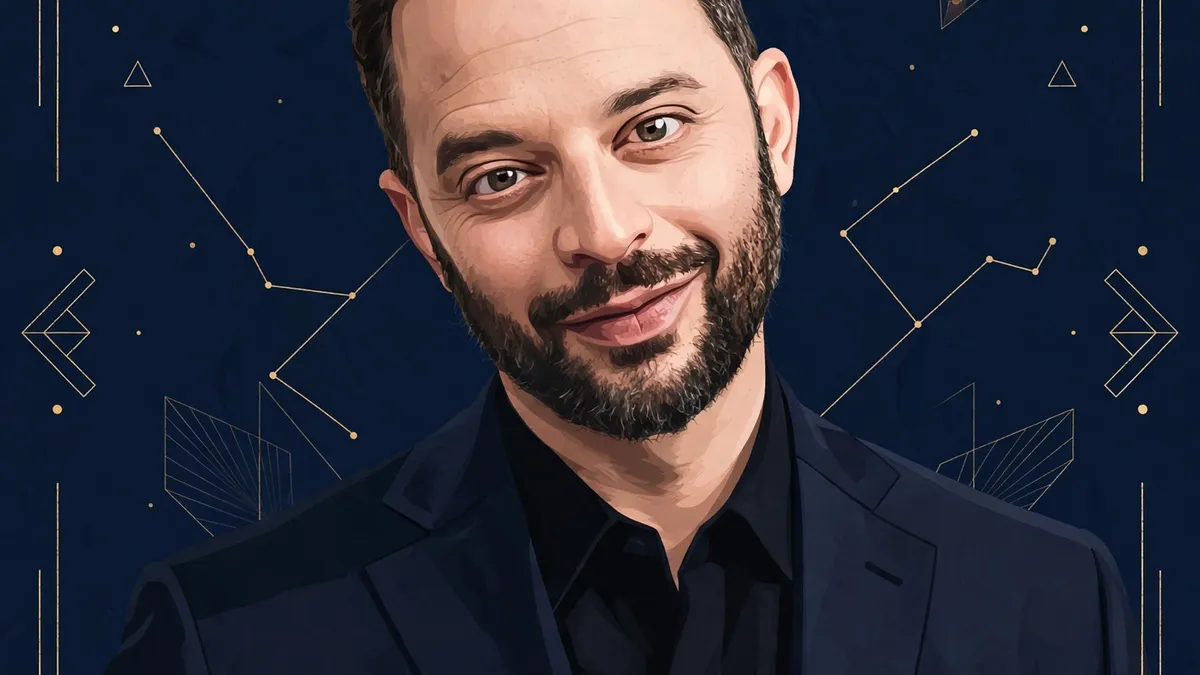
Nick Kroll‘s net worth is estimated at $18 million as of November 2026. The comedian, actor, writer and producer built it the slow way — eight seasons of Big Mouth on Netflix, seven seasons of The League on FX, his own Comedy Central sketch series, a six-month Broadway run with John Mulaney, and a voice-acting résumé that runs from Sing to Sausage Party to Smurfs. Older estimates still floating around the web put him at $10 million; the newer figure reflects nine more years of output since that number was first published, including the final season of Big Mouth in May 2025 and a brand-new Netflix series, Mating Season, which premiered in May 2026.
Nick Kroll: Quick Facts
| Estimated net worth | $18 million (range: $10 million–$18 million) |
|---|---|
| Profession | Actor, comedian, writer, producer |
| Nationality | American |
| Born | June 5, 1978, Rye, New York (age 48) |
| Height | 5 feet 9 inches (175 cm) |
| Primary income sources | Television creation and voice acting, film roles, live comedy and touring, producing, book royalties |
| Active years | 2004–present |
| Last reviewed | November 2026 |
- Early Life and Background
- Education
- Career Journey
- Rise to Fame
- Main Sources of Income
- Salary and Earnings
- Businesses and Investments
- Brand Deals and Sponsorships
- Houses, Cars and Other Assets
- Awards and Achievements
- Net Worth Growth Over the Years
- Social Media Presence
- Personal Life
- Sources & Reporting
- Frequently Asked Questions
- Final Thoughts
Early Life and Background
Nicholas Kroll was born on June 5, 1978, in Rye, New York, the youngest child of Lynn Kroll and Jules Kroll. His father is a billionaire businessman who founded Kroll Inc., the corporate investigations and risk-consulting firm, and his mother worked as a social worker. He grew up with an older brother, Jeremy, and two older sisters, Vanessa and Dana, in a Conservative Jewish household in Westchester County — the same suburban New York world he would later mine for Big Mouth, a show built directly from his own adolescence and that of his childhood best friend Andrew Goldberg.
The family money is the first thing most profiles mention, and it deserves a straight answer. Jules Kroll built Kroll Inc. from a one-man investigations practice into a global firm, and the business was sold to Marsh & McLennan in 2004 in a deal widely reported at roughly $1.9 billion. That made the Kroll family wealthy long before Nick’s first television credit. It also made Nick Kroll the rare comedian whose “struggling artist” years were a choice rather than a necessity — a fact he has joked about on stage and in interviews rather than hiding. The distinction matters for this estimate: none of his father’s fortune is counted here. The $18 million figure covers what Nick Kroll earned himself, from writing rooms, voice booths, stages and production credits across two decades.
His schooling followed the Westchester private-school track. He attended the Solomon Schechter School of Westchester, then Rye Country Day School, with a semester at The Mountain School in Vershire, Vermont, where he picked up a fondness for hiking that still surfaces in interviews. The through-line of his childhood is performance: he was the funny kid in a house where, by his own telling, humor was the family currency, and he carried that instinct into every room that would have him.
Two family connections still shape his public life. His sister Vanessa is married to journalist Roger Bennett, the Men in Blazers co-host — Bennett also co-wrote Kroll’s 2005 book Bar Mitzvah Disco with him. Through his wife, Kroll is related by marriage to fashion designer Joseph Altuzarra. The Kroll family story is, in short, a network of media, fashion and business figures, and Nick Kroll sits at the comedy end of it.
Education
Kroll graduated from Georgetown University in 2001, where he majored in history and minored in art and Spanish. By his own account, he drifted toward media studies as his degree went on, and the history training shows up in his work in an unexpected place: History of the World, Part II, the 2023 Hulu sketch series he co-created, is a history nerd’s comedy, built on the same instinct that made him a history major in the first place.
Georgetown did not hand him a comedy career. After graduation he did what a generation of New York comedians did — he went to the Upright Citizens Brigade Theatre, studied and performed improv and sketch there in both New York and Los Angeles, and built a bench of characters in small rooms. The UCB years matter because they explain the shape of his fortune: Kroll is not a stand-up who got one big special, or an actor who got one big role. He is a character comedian who learned to write, perform and produce at the same time, and that triple skill is what lets him collect three paychecks — writer, performer, producer — from a single show.
He also co-hosted the stand-up showcase Welcome to Our Week with Jessi Klein during this period, a small-room habit that kept him close to the writers and performers who would staff his later shows. The early New York years were lean by design, and they lasted longer than most people assume: his first significant television break did not arrive until 2007, six years after Georgetown.
Career Journey
Kroll’s first writing credits were strong ones. He contributed to Comedy Central’s Chappelle’s Show and MTV’s Human Giant, two of the most respected sketch rooms of the 2000s, and in late 2008 he toured the United States with Aziz Ansari on the Glow in the Dark comedy tour. Writing for Dave Chappelle‘s show put him inside a room that defined sketch comedy for a decade, and it taught him the discipline that later made Kroll Show possible: a sketch writer who can also perform his own material is worth more than a writer who cannot.
His first significant on-screen break was an odd one. In 2007 he co-starred in ABC’s Cavemen, a sitcom built from the Geico insurance caveman commercials. The show was cancelled after seven episodes, and Kroll has called the role “the most important experience of my professional career” — a flop that taught him how network television worked, and how little of it he wanted. He followed it with VH1’s Best Week Ever and a run of guest spots that reads like a tour of 2010s comedy television: Parks and Recreation, where he played the memorably loathsome character known as The Douche across five episodes; Community; New Girl; Brooklyn Nine-Nine; Unbreakable Kimmy Schmidt; Portlandia; and a recurring role on Adult Swim’s Childrens Hospital.
Voice work ran alongside the live-action roles from the start. He voiced Stu on HBO’s The Life & Times of Tim for 30 episodes, Andrew LeGustambos on Fox’s Sit Down, Shut Up, and Reuben Grinder on PBS Kids’ WordGirl. He also built a following online with Funny or Die characters — Bobby Bottleservice, the hard-partying club promoter; Ref Jeff; Fabrice Fabrice; and Gil Faizon, the elderly Upper West Side grouch he created with writing partner John Mulaney. Comedy Central aired his stand-up special Thank You Very Cool in 2011, and in 2013 the Just For Laughs festival named him Breakout Star of the Year.
One note on bad data, because it affects the money story. A wave of AI-written net-worth pages now credits Kroll with co-creating Apple TV+’s Severance and with a stint as a Saturday Night Live cast member, complete with invented per-episode salaries for both. Neither is true. Severance was created by Dan Erickson, and Kroll has never written for or appeared on Saturday Night Live. Any net-worth estimate built on those credits is fiction, and any site repeating them has not checked its sources. This article counts only the work Kroll actually did.
Film work filled the gaps between television jobs. Early supporting roles included I Love You, Man (2009), Date Night and Get Him to the Greek (both 2010), Dinner for Schmucks (2010) and A Good Old Fashioned Orgy (2011). He took his first villain voice role as Douche — a literal douche — in the adult animated film Sausage Party (2016), then played Professor Poopypants in Captain Underpants: The First Epic Movie (2017). The dramatic side of his résumé arrived the same decade: Bernie Cohen in the historical drama Loving (2016) and Israeli agent Rafi Eitan in Operation Finale (2018), proof that casting directors saw more in him than sketch characters.
Rise to Fame
Three projects made Nick Kroll famous, and they arrived in a tight six-year window. The first was The League, the FX fantasy-football comedy that ran from October 2009 to December 2015. Kroll played Rodney Ruxin, the scheming, trash-talking lawyer at the center of the friend group, and he also wrote for the show. Seven seasons of a cable hit gave him his first steady, serious television income and a character that still defines him for a large slice of his audience. The League was never a ratings monster; it was a cult hit with a loyal audience, which is exactly the kind of show that pays a cast member for years through streaming and syndication after it ends.
The second was Kroll Show, his own Comedy Central sketch series, which aired from January 2013 to March 2015 for 23 episodes. Kroll created it, executive-produced it, wrote it and played most of the characters — a one-man repertory company that included Bobby Bottleservice, Gil Faizon and the Canadian prankster Bryan La Croix. A sketch show you own and star in pays differently from a show you merely appear in: creator and executive-producer fees stack on top of the performance fee, and the show becomes a calling card for everything after it. Kroll Show is the project that turned Kroll from a reliable supporting player into a name networks would build a series around.
The third, and the one that changed his financial picture most, was the stage. Kroll and John Mulaney had been performing their two-man geriatric-character show Oh, Hello — Kroll as Gil Faizon, Mulaney as George St. Geegland — in small rooms for years. In September 2016 it opened on Broadway, ran for six months to strong reviews, and was filmed for a Netflix special in 2017. A Broadway run pays a performer in a way a club tour does not, and the Netflix film extended its earning life indefinitely. The partnership with Mulaney remains one of the most durable in comedy: the two have known each other since college, and Mulaney’s own path — his net worth now sits near $12 million per GuideNetWorth’s reporting — shows how far the same generation of comedians has travelled since their shared UCB days.
The project that dwarfed all three was Big Mouth. Kroll co-created the Netflix animated series with his childhood best friend Andrew Goldberg, plus Mark Levin and Jennifer Flackett, and it premiered in September 2017. The show follows a group of seventh graders through puberty, and its two lead characters are based on — and named after — Kroll and Goldberg themselves. Kroll voiced more than 80 characters across the run, according to a 2025 Rotten Tomatoes interview, including Nick Birch, the Hormone Monster Maury, Coach Steve, Lola, Rick the Hormone Monster and Lady Liberty. Eight seasons and 81 episodes later, the final season arrived on May 23, 2025, making Big Mouth Netflix’s longest-running scripted animated series. The Television Academy’s own feature on the show notes three consecutive Emmy nominations for Outstanding Animated Program from 2019 to 2021, plus a music and lyrics nomination in 2018. A creator who also writes, executive-produces and voices a dozen characters on an eight-season Netflix hit is not collecting one salary. He is collecting four or five, for eight years, with residuals and licensing tailing behind.
The follow-up arrived almost immediately. Human Resources, the Big Mouth spin-off about the hormone monsters’ workplace, ran for two seasons from March 2022 to June 2023. History of the World, Part II, the Hulu sketch series Kroll co-created, premiered in 2023. And in May 2026 the same four creators returned with Mating Season, a Netflix adult animated comedy that moves the Big Mouth formula from puberty to young-adult dating — this time with animals. Polygon’s June 2026 review called it familiar but distinct, and it premiered globally on Netflix on May 22, 2026. At 48, Kroll is not living off one old hit. He is running a second animated franchise while the first is still streaming everywhere.
Main Sources of Income
Kroll’s income breaks into five streams, and the mix is what makes his fortune durable. First, and largest, is television creation: co-creator, writer and executive-producer fees from Big Mouth, Human Resources, History of the World, Part II and now Mating Season. Creator fees on a streaming series are typically structured as episodic payments plus backend participation, and eight seasons of Big Mouth means eight seasons of that stack. ComingSoon’s May 2025 breakdown of his earnings names this cluster first, and the size of the Big Mouth run is the main reason the $18 million figure replaced the older $10 million one.
Second is voice acting, where Kroll is one of the busiest names in animation. The Sing franchise alone — Gunter in Sing (2016), Sing 2 (2021) and the Sing: Thriller short (2024) — spans three films, each a global box-office hit. Add Sausage Party, The Secret Life of Pets 2 (2019), both Addams Family films as Uncle Fester, The Bob’s Burgers Movie (2022) and Smurfs (2025), where he voiced the villain Chernobog, and the voice ledger is a second career running in parallel with the first. Franchise voice work pays residuals every time a film is re-licensed, which is why a voice actor’s income keeps arriving long after the recording sessions end.
Third is live-action film and television acting. The recent run is busy: Don’t Worry Darling (2022), First Time Female Director (2023), the indie comedy I Don’t Understand You (2025) opposite Andrew Rannells, the holiday blockbuster Red One (2024) and the animated Goat (2026). Guest spots on The Late Show with Stephen Colbert and regular comedy-podcast appearances keep his name in circulation between projects, and each of those appearances is a paid booking in its own right.
Fourth is live comedy and touring. The Oh, Hello Broadway run was the peak, but Kroll has toured stand-up throughout his career, including his Middle-Aged Boy show and the 2008 Aziz Ansari tour that opened doors for him. Live comedy is the one stream he controls completely — no network, no studio, just a room and a ticket price — and veteran comedians of his standing command five-figure nightly guarantees on the club and theatre circuit. Kevin Hart turned the same circuit into a nine-figure empire; Kroll has kept his touring smaller and steadier, which fits a fortune built on ownership rather than scale.
Fifth is the smallest stream, and the most often overlooked: publishing. Bar Mitzvah Disco, the 2005 book he co-wrote with Jules Shell and Roger Bennett, still sells, and ComingSoon’s earnings breakdown lists book sales among his income sources. It will never rival a Netflix creator fee, but it is a reminder that Kroll has monetised his writing in every format available — television, film, stage and print.
Salary and Earnings
There is no verified public record of what Nick Kroll earns per episode of anything. Netflix does not publish creator pay, FX never disclosed The League salaries, and Kroll himself has never discussed a number in an interview. Any article that states his salary as fact without a source is guessing, so this section says plainly what is reported, who reported it, and how much weight it deserves.
The only per-episode figure attached to Kroll’s name comes from CelebClive, which reports that he earns $100,000–$150,000 per episode of Big Mouth in his combined roles as co-creator, writer and voice actor. Treat that as an industry estimate from a mid-tier celebrity-finance site, not a confirmed number: it is plausible for a multi-hyphenate on a flagship Netflix animated series, and it sits in the same band as published voice-actor rates for comparable streaming shows, but no trade outlet such as Variety or The Hollywood Reporter has confirmed it. Across 81 episodes, even the low end of that band would imply roughly $8 million in episodic fees before writing, producing and backend money — which is consistent with, though not proof of, the $18 million total.
What is certain is the stacking effect. On Big Mouth, Kroll was paid in at least four capacities: co-creator, writer, executive producer and voice actor, voicing more than 80 characters. A performer who voices one character gets one fee. A creator who voices a dozen characters, writes episodes and holds an executive-producer credit gets paid at every layer of the production, and the backend participation that comes with a creator credit keeps paying as the show streams. That structure, repeated across eight seasons, is the real salary story — not any single per-episode number.
The same logic applies to his other shows. The League paid him as an actor and a writer for seven seasons. Kroll Show paid him as creator, executive producer, writer and star. Human Resources, History of the World, Part II and Mating Season each repeat the pattern. His annual income is therefore lumpy — big in years when a show is in production, smaller in gap years — which is why net-worth estimates for working comedians move in steps rather than straight lines. The $10 million figure from the late 2010s captured the Big Mouth early seasons; the $18 million figure captures the full eight-season run plus the spin-offs and the 2026 series.
For scale, the wider comedy market puts his number in context. Dave Chappelle‘s fortune, built on the same sketch-comedy-to-superstardom path Kroll started on, is reported near $60 million — but Chappelle’s figure rests on three Netflix specials reportedly worth $60 million in total, a deal Kroll has never had. Kroll’s money is steadier and smaller: many shows, many roles, no single mega-deal. That is a choice, and it shows in the shape of his career.
Businesses and Investments
Kroll’s main business is Brutus Pink, the production company he formed with Andrew Goldberg, Mark Levin and Jennifer Flackett after Big Mouth took off. Brutus Pink produces their shows in partnership with the animation studio Titmouse, Inc., and it is the vehicle through which the four creators developed Human Resources and Mating Season. Owning the production company matters more than any single salary: it means the creators control the intellectual property, negotiate the Netflix deals as owners rather than employees, and keep a share of the licensing and merchandising that a hit animated franchise generates.
Beyond Brutus Pink, there is strikingly little on the public record. Kroll has no tequila brand, no sneaker line, no venture-capital portfolio trumpeted in the press, and no chain of restaurants or gyms. That absence is itself informative. Many comedians of his generation converted fame into consumer brands; Kroll converted his into ownership of the shows he makes. The production company is the investment, and it is a focused one.
His personal investments are private, and this article will not invent them. No filing, interview or reputable report documents a stock portfolio, a crypto position or a start-up stake in his name. What can be said is that his father’s world — corporate investigations, risk consulting, billion-dollar exits — gave him a front-row seat to how serious money works, and his own career shows the lesson applied: build an asset you control, in this case a production company and a catalogue of shows, rather than renting your talent to other people’s projects forever.
Brand Deals and Sponsorships
Unlike many comedians of his stature, Nick Kroll has no major public endorsement portfolio. There is no sneaker deal, no liquor brand, no car commercial, no fast-food campaign attached to his name in any reliable reporting. His earliest commercial work ran in the opposite direction: Funny or Die videos and character sketches that built an audience without a sponsor attached.
That is not a gap in his income so much as a different model. Kroll’s brand value lives inside his shows — Big Mouth merchandise, licensing and the Netflix ecosystem pay him as an owner, which is worth more over time than a one-off endorsement cheque. The closest thing to a brand partnership in his career is the platform relationship itself: Netflix has now been his primary home for three series across nine years, a run of loyalty that most creators never achieve.
He does earn from the ordinary machinery of a working comedian’s public life — paid podcast appearances, live-event hosting (he hosted the Independent Spirit Awards in 2017 and 2018), and guest spots that carry appearance fees. None of these is large on its own. Together they form the connective tissue of a career that has never depended on a single paymaster, which is exactly why his net worth has grown steadily rather than spiking and collapsing.

Houses, Cars and Other Assets
Here is where honest reporting has to part company with most net-worth sites. The standard celebrity-finance article invents a house, a car collection and a watch drawer for every subject. For Nick Kroll, the verifiable record is thin, and this section says so rather than filling the gap with fiction.
No major outlet — not Variety, not the Los Angeles Times, not Architectural Digest, not the Wall Street Journal — has published a property record for a home purchase by Nick Kroll. A $3.5 million Los Angeles home bought in 2022 circulates on low-authority blogs, but it traces to no deed, no listing and no reputable report, so it is not stated here as fact. What the reporting does support is that Kroll splits his time between New York and Los Angeles: his wife’s landscape-design studio is Brooklyn-based, his television work is Los Angeles-based, and the couple have lived on both coasts during their marriage. Any article that gives you a street, a square footage and a price for his house is guessing.
The same applies to cars. No interview, profile or paparazzi report documents a collection, a favourite marque or a single notable purchase. Kroll does not post cars on social media, does not discuss them in interviews, and has never been photographed with a vehicle in a way that generated a story. A comedian whose public persona is built on characters and writing, rather than lifestyle display, simply does not generate the asset trail that a rapper or an athlete does.
What he does own, and what is worth more than any house, is the catalogue: co-ownership of Big Mouth, Human Resources, History of the World, Part II and Mating Season through Brutus Pink, plus residuals from a filmography that includes some of the highest-grossing animated films of the last decade. Those are the assets that explain an $18 million net worth for a man with no documented mansion and no car collection. The money is in the work, not the display.
Awards and Achievements
Kroll’s trophy shelf is thinner than his résumé, which is normal for a sketch and animation comedian — the industry’s awards machinery has never quite known what to do with him. The headline honours belong to Big Mouth: three consecutive Emmy nominations for Outstanding Animated Program in 2019, 2020 and 2021, plus an Emmy nomination for Outstanding Original Music and Lyrics in 2018, all documented by the Television Academy. The show never won, but three straight nominations for a streaming animated comedy put it in the top tier of its category for three years running.
Earlier, the Just For Laughs festival named him Breakout Star of the Year in 2013, the year Kroll Show premiered — the kind of industry nod that tells networks a performer is ready to carry a series. He hosted the Independent Spirit Awards in 2017 and again in 2018, a booking that signals peer respect more than any trophy: the Spirit Awards pick hosts who can hold a room of filmmakers, and they picked him twice.
The achievements that matter more than awards are the structural ones. Eight seasons and 81 episodes of Big Mouth made it Netflix’s longest-running scripted animated series. A six-month Broadway run for a two-man comedy show is a feat most comedians never attempt, let alone complete. And a production company that has now delivered three Netflix series across nine years is a business achievement that outlasts any single nomination. Kroll’s career is a case study in compounding: none of these milestones is a lottery win, and together they are worth $18 million.
Net Worth Growth Over the Years
The growth of Kroll’s fortune maps cleanly onto his career, and the published estimates tell the story in steps. The table below shows what outlets actually reported, and when — not a smooth curve invented for this article, but the dated record. Note the long flat stretch at $10 million: that figure was published by Celebrity Net Worth and TheRichest and then repeated for years while Kroll kept working, which is why it is now out of date.
| Year | Reported estimate | Source | What changed |
|---|---|---|---|
| 2018 | $10 million | TheRichest | Big Mouth in its first two seasons; The League and Kroll Show complete |
| 2021 | $10 million | Celebrity Net Worth | Figure carried unchanged despite four more seasons of Big Mouth |
| 2022 | $18 million | StarsUnfolded | Human Resources launches; Big Mouth renewed through season 8 |
| 2025 | $18 million | ComingSoon | Final Big Mouth season airs; Mating Season in production |
| 2026 | $18 million | NetWorthCraft estimate | Mating Season premieres May 2026; Goat released |
The honest reading is that Kroll’s wealth grew in two jumps. The first came between 2013 and 2017, when Kroll Show, the Oh, Hello Broadway run and the Big Mouth launch turned a working comedian into a creator with ownership. The second came across the Big Mouth run itself, as eight seasons of creator, writer, producer and voice fees compounded with residuals. The $10 million–$18 million range in this article is the distance between the stale figure and the current one, and the $18 million anchor is the number the most recent reporting supports.
Peer comparison sharpens the picture. The table below uses published third-party estimates for comedians whose careers overlap Kroll’s, and it shows exactly where he sits: above the single-show stars, below the arena-touring giants.
| Comedian | Reported net worth | Source | Main wealth engine |
|---|---|---|---|
| John Mulaney | $12 million | GuideNetWorth | Stand-up specials, Oh, Hello, television |
| Nick Kroll | $18 million | NetWorthCraft estimate | Big Mouth creation, voice acting, producing |
| Chris Rock | $60 million | Celebrity Net Worth | Stand-up specials, film, television |
| Dave Chappelle | $60 million | Celebrity Net Worth | Netflix specials, touring |
| Ben Stiller | $200 million | Celebrity Net Worth | Film franchises, directing, producing |
| Kevin Hart | $450 million | Celebrity Net Worth | Arena touring, film, Hartbeat media empire |
The gap between Kroll and Hart is the gap between ownership of a few shows and ownership of a media company at arena scale. The gap between Kroll and Mulaney is the gap between co-creating an eight-season animated franchise and building a career on stand-up specials. Both gaps are about business structure, not talent, and Kroll’s position — comfortably ahead of his closest collaborator, far behind the touring giants — is exactly what the record supports.
Social Media Presence
Kroll keeps a working comedian’s social media presence rather than an influencer’s. His Instagram account, @nickkroll, is used the way a touring performer uses it: tour dates, show announcements, clips from Big Mouth and Mating Season, and appearances on talk shows and podcasts. He is active on X as well, with a similar mix of promotion and comedy, and he appears regularly as a guest on comedy podcasts — including a May 2025 episode of Marc Maron’s WTF recorded as Big Mouth ended, in which he discussed the show’s eight-season run, his wife’s artwork and his new film I Don’t Understand You.
What he does not do on social media is nearly as telling. His children do not appear on his feeds, his home does not appear, and his spending does not appear. The family privacy is deliberate: his wife announced their son’s birth on her own Instagram in February 2021, and the couple have kept both children out of the press since. For a net-worth article, that restraint is a reporting constraint — there is no lifestyle content to mine for asset clues — and it is also a clue about the man. The fortune is real, and the display of it is absent.
Social media contributes to his income in the ordinary way it does for a working comedian: it sells tickets, it promotes shows, and it keeps a performer visible to casting directors between projects. It is not a business in itself. Kroll has never been a creator-economy figure, has no merch line driven by his feeds, and does not publish sponsored content. The audience is a few million followers across platforms, loyal rather than enormous, and it converts into ticket sales and streaming views rather than brand deals.
Personal Life
Kroll married landscape artist Lily Kwong in November 2020, in an intimate ceremony in Big Sur, California, attended by the couple and the officiant. They had met on the dating app Raya in 2018, when she was living in New York and he was in Los Angeles, and spent much of their courtship long-distance. Kwong, born May 29, 1988, in San Francisco, studied urban studies at Columbia University, made the Forbes 30 Under 30 list in 2018, and runs Studio Lily Kwong, a landscape-design practice whose clients have included Glossier, JW Marriott and St-Germain, alongside her Freedom Gardens initiative. She is, by any measure, a successful creative professional in her own right — not a footnote to her husband’s career.
Their son Leo was born on January 21, 2021, two months after the wedding; Kwong had announced the pregnancy in October 2020. A daughter followed in November 2023, bringing the family to four. The couple are private about their children by design, and this article respects that: no names beyond what the parents themselves have shared, no photographs, no detail about where the children go to school.
Before Kwong, Kroll dated comedian Amy Poehler from May 2013 to 2015, a relationship that overlapped with the Kroll Show years and was widely covered at the time. He has spoken in interviews about growing up as the youngest child in a wealthy family, about the expectations that came with the Kroll name, and about building a career that would stand apart from his father’s. The through-line of his personal life is the same as his professional one: a man who started with every advantage and chose the hardest version of the job anyway — writing his own material, building his own shows, and keeping his family out of the spotlight while he did it.
Sources & Reporting
ComingSoon — the May 2025 net-worth report putting Kroll at $18 million, plus its breakdown of his income streams (Big Mouth and Mating Season, film and voice work, live comedy, producing, book sales) and its note that he had wrapped the final season of Big Mouth.
Celebrity Net Worth — the older $10 million estimate, used here as the low end of the range and as evidence that the figure had gone stale; also the source for the peer-comparison figures for Chris Rock, Dave Chappelle, Ben Stiller and Kevin Hart.
TheRichest — the 2018-era $10 million estimate and its earnings table, used to date the low end of the range.
StarsUnfolded — the $18 million figure carried as of 2022, supporting the view that the higher estimate predates the final Big Mouth seasons.
Wikipedia — biography and full filmography (birth date and place, Georgetown graduation in 2001, family details, The League and Kroll Show dates, Big Mouth episode count, Brutus Pink, book credit, marriage and children), cross-checked against the Television Academy and trade reporting below. Accessed November 2026.
Television Academy — the April 2025 Emmy magazine feature on how Big Mouth became a hit, confirming the three consecutive Outstanding Animated Program nominations (2019–2021), the 2018 music and lyrics nomination, and the May 23, 2025 final-season date.
Rotten Tomatoes — the June 2025 Awards Tour podcast interview in which Kroll discusses voicing more than 80 characters across Big Mouth’s eight seasons.
Cartoon Brew — confirmation that Big Mouth ran eight seasons and 81 episodes and is Netflix’s longest-running scripted animated series.
Polygon — the June 2026 Mating Season review, confirming the new series premiered on Netflix on May 22, 2026, created by the same four-person Big Mouth team.
CelebClive — the reported $100,000–$150,000 per-episode Big Mouth figure, flagged in this article as an unverified trade-blog estimate because no major trade outlet has confirmed it.
YourTango and BuzzNigeria — family reporting: the November 2020 Big Sur wedding, the Raya meeting in 2018, son Leo’s birth on January 21, 2021, and Lily Kwong’s background (Columbia, Forbes 30 Under 30, Studio Lily Kwong).
Reporting window: May 2025–November 2026 for the 2025–2026 items; older estimates are dated in the text wherever they appear. No figure in this article rests on a single weak source without a flag saying so.
Frequently Asked Questions
What is Nick Kroll’s net worth in 2026?
Nick Kroll’s net worth is estimated at $18 million as of November 2026. Published estimates range from $10 million (Celebrity Net Worth and TheRichest, both older figures) to $18 million (ComingSoon in May 2025 and StarsUnfolded as of 2022). We anchor on $18 million because the newer reporting reflects the full eight-season run of Big Mouth, the Human Resources spin-off and the 2026 series Mating Season.
How did Nick Kroll make his money?
Mostly by creating and starring in television. He co-created Netflix’s Big Mouth, where he was also a writer, executive producer and the voice of more than 80 characters across 81 episodes; he starred in and wrote for FX’s The League for seven seasons; he created and starred in Comedy Central’s Kroll Show; and he co-owns the production company Brutus Pink. Film voice roles (Sing, Sausage Party, The Addams Family, Smurfs), live-action films, Broadway’s Oh, Hello, stand-up touring and book royalties make up the rest.
How much does Nick Kroll make per episode of Big Mouth?
The only published figure is $100,000–$150,000 per episode, reported by CelebClive — and it is an unverified estimate, not a confirmed salary, because Netflix does not disclose creator pay. What is certain is that Kroll was paid in four capacities on the show (co-creator, writer, executive producer and voice actor), so his per-episode income was the sum of several fees plus backend participation, not a single acting salary.
Is Nick Kroll related to Jules Kroll?
Yes — Jules Kroll is his father. Jules founded Kroll Inc., the corporate investigations and risk-consulting firm, which was sold to Marsh & McLennan in 2004 in a deal widely reported at roughly $1.9 billion. Nick Kroll’s $18 million fortune is separate: it covers only what he earned himself from entertainment, and none of his father’s wealth is counted in it.
Who is Nick Kroll’s wife?
Nick Kroll is married to Lily Kwong, a landscape artist and designer who studied urban studies at Columbia University, made the Forbes 30 Under 30 list in 2018 and runs Studio Lily Kwong. They met on the dating app Raya in 2018 and married in Big Sur, California, in November 2020. They have two children: a son, Leo, born January 21, 2021, and a daughter born in November 2023.
How old is Nick Kroll?
Nick Kroll was born on June 5, 1978, in Rye, New York, which makes him 48 years old as of November 2026. He graduated from Georgetown University in 2001 and has been active in comedy and television since 2004.
Did Nick Kroll create Severance?
No. Severance was created by Dan Erickson for Apple TV+, and Nick Kroll has no connection to it. Some AI-written net-worth pages credit him with the show and invent a salary for it; those pages are wrong, and so is any net-worth figure built on them. Kroll has also never been a Saturday Night Live cast member, despite the same pages claiming otherwise.
What is Nick Kroll doing in 2026?
His new Netflix animated series Mating Season, created with the same team behind Big Mouth, premiered on May 22, 2026, with Kroll voicing Ray the raccoon. He also voiced a role in the 2026 animated film Goat and appeared in the film Roommates. Big Mouth ended in May 2025 after eight seasons, so Mating Season is now his main ongoing television project.
Final Thoughts
Nick Kroll’s $18 million is the fortune of a builder, not a lottery winner. He spent his twenties in writing rooms and improv theatres, his thirties turning a sketch show and a Broadway two-hander into a calling card, and his forties running an eight-season Netflix franchise he co-owned from the start. The money came from stacking roles — creator, writer, producer, voice actor — on the same shows, and from a production company that keeps the ownership where the work is.
The two numbers that follow him around, $10 million and $18 million, are both honest in their own way: one is a snapshot from before Big Mouth finished, the other is the current picture. The next chapter is already in production — Mating Season is streaming, Goat is out, and Brutus Pink has a pipeline. If the last decade is any guide, the estimate will keep moving in the same direction, one season at a time.
Published on November 15, 2026. Last reviewed November 2026. Found an error? See our corrections policy.