
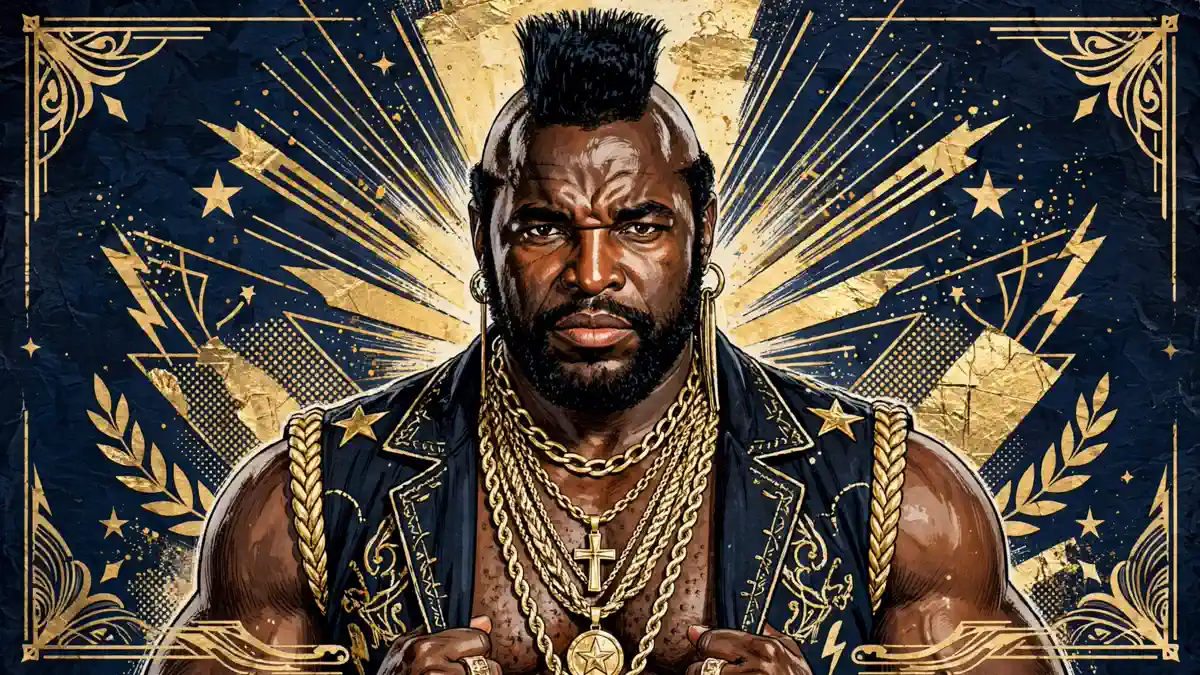
Mr. T‘s net worth is estimated at $1 million to $3 million as of November 2026. The figure sits at the center of one of Hollywood’s sharpest rags-to-riches-to-rags stories: a Chicago bouncer who became the most recognizable face of the 1980s, earned more than $25 million between 1983 and 1994, told Entertainment Tonight in 1998 that he had about $200 in the bank, and then spent the next three decades rebuilding a quieter fortune from endorsements, conventions, and the most durable personal brand in television history.
Mr. T: Quick Facts
| Estimated net worth | $2 million (range: $1 million to $3 million) |
|---|---|
| Profession | Actor, retired professional wrestler, television personality, pitchman |
| Nationality | American |
| Born | May 21, 1952 (age 74) |
| Height | 5 ft 10 in (178 cm) |
| Primary income sources | Television and film residuals, professional wrestling, endorsements, licensing, personal appearances, convention autographs |
| Active years | 1980–present |
| Last reviewed | November 2026 |
- Early Life and Background
- Education
- Career Journey
- Rise to Fame
- Main Sources of Income
- Salary and Earnings
- Businesses and Investments
- Brand Deals and Sponsorships
- Houses, Cars and Other Assets
- Awards and Achievements
- Net Worth Growth Over the Years
- Social Media Presence
- Personal Life
- Sources & Reporting
- Frequently Asked Questions
Early Life and Background
Mr. T was born Laurence Tureaud on May 21, 1952, on the South Side of Chicago. He was the youngest of twelve children in a family that had almost nothing. His father, Nathaniel Tureaud Sr., was a minister who left the family when Laurence was five years old, and his mother, Willie, raised the children largely on her own, cleaning the homes of wealthy families to keep food on the table. The family lived in the Robert Taylor Homes, one of Chicago’s largest public housing projects, and money was so tight that the lesson Mr. T carried out of childhood was not about wealth but about discipline, education, religion, and self-respect — values he credits his mother with drilling into all twelve of her children.
As a boy, he made his mother a promise that would shape every decision he made for the next forty years: if he ever became successful, he would buy her a beautiful house and pretty dresses. Decades later, after fame, fortune, a lawsuit, cancer, and near-bankruptcy, he still describes keeping that promise as more important than staying a Hollywood star. In a September 2026 interview with The Guardian, he put it plainly: all he ever wanted was done — buy his mother a house and pretty dresses. “I am complete,” he said.
The name itself was an act of self-invention with a sharp edge. At eighteen, Tureaud began calling himself Mr. T, a deliberate demand for respect after growing up watching white people address his father, his uncle, and even his brother — a Marine who had returned from Vietnam — as “boy.” If he was old enough to be drafted and possibly die for his country, he reasoned, he was old enough to be addressed as “Mister.” In 1970, he legally changed his last name to T, and the name that had started as a demand became a brand worth millions.
Chicago never left him. Even at the height of his fame he kept his roots in the city visible, and in 2026 he was described as living in Chicago’s South Loop while also keeping a residence in Los Angeles. He still works with homeless shelters and other charitable organizations in the city where he grew up, and his Christian faith — central to his life since childhood — now shapes his public work more than any acting role does.
Education
Mr. T attended Dunbar Vocational High School in Chicago, where he stood out in football and wrestling. His athletic ability earned him a football scholarship to Prairie View A&M University in Texas, a historically Black university. The scholarship did not last: he was expelled after taking part in a student protest, a detail that fits the pattern of a young man who had already decided he would not accept being talked down to.
After Prairie View, he attended colleges around Chicago while continuing to pursue athletics, but no degree followed. The classroom never became his path. Instead, in 1975, he joined the United States Army’s Military Police Corps, where he has said he was named top trainee among thousands of recruits. He received an honorable discharge in 1978 and tried out for the Green Bay Packers, but a knee injury helped end his ambitions of playing professional football. The Army years matter to his story in two ways that surfaced again in 2026: when Netflix released its documentary about his life that September, Mr. T publicly objected that the film buried his military service and his faith while leaning hard on a tough-guy image he felt was only part of the man.
What his schooling did give him was physical discipline and a stage. Dunbar’s wrestling mats and football field built the body that would later fill a television screen, and the Army’s military police training gave him the bearing and the confidence to walk into rooms full of strangers and take charge of them — first as a bouncer, then as a bodyguard, then as a star.
Career Journey
After football ended, Mr. T found the work that created his public image: nightclub security. He took a job as a bouncer at Dingbats, a Chicago nightclub, and it was there that the look the world would come to know began to take shape. Patrons lost or abandoned gold chains and other jewelry during nights at the club, and Mr. T began collecting the pieces and wearing them around his neck — partly so their owners could spot them and reclaim them. The jewelry piled up, and so did the persona. His mohawk, inspired by Mandinka warriors of West Africa, completed a silhouette that nobody who saw it once could forget.
Mr. T later gave the chains a meaning that went beyond decoration. His African ancestors had been brought to America in chains of iron, he explained; he would wear chains of gold. That framing turned a bouncer’s lost-property collection into a statement, and it is one reason the image survived long after the nightclub years ended.
His reputation for toughness brought work as a personal bodyguard, and the client list reads like a roll call of twentieth-century fame: Muhammad Ali, Michael Jackson, Diana Ross, Steve McQueen, Leon Spinks, and Joe Frazier. By the end of his bodyguard career, Mr. T has said he could charge anywhere from $3,000 to $10,000 per day — serious money in the late 1970s, and, according to The Cinemaholic, at least $50,000 a year when he first started securing celebrity contracts, before his rate climbed sharply. Guarding Ali and Jackson taught him something no acting class could: how famous people carry themselves, how crowds behave around them, and how a single unmistakable image can do the work of a hundred introductions.
The break came in 1980, when he entered and won an NBC competition called “America’s Toughest Bouncer.” Casting director Rhonda Young noticed him, and through her he came to the attention of Sylvester Stallone. Stallone was casting the villain for Rocky III and needed someone who looked like he could genuinely hurt Rocky Balboa. He found a man with no acting experience at all — and cast him anyway.
That single decision set up everything that followed: Rocky III in 1982, The A-Team in 1983, WrestleMania in 1985, a cartoon, a cereal, dolls, lunchboxes, and a level of fame that made him, for a few years, one of the highest-paid celebrities on the planet. It also set up the lawsuit, the judgment, and the collapse that would follow, because the money arrived faster than any structure existed to hold it.
Rise to Fame
Stallone cast the completely inexperienced actor as James “Clubber” Lang, Rocky Balboa’s ferocious challenger in Rocky III, released on May 28, 1982. Mr. T proved so memorable that his lack of conventional acting experience barely registered with audiences. The film also gave birth to his most famous phrase. When Clubber is asked whether he hates Rocky, Mr. T later explained that he did not want to say he hated anybody — so instead he answered, “I pity the fool.” The line became inseparable from his public identity, and it still follows him forty-four years later: it is the title of the Netflix documentary about his life.
Rocky III was the second-highest-grossing movie of 1982 in the United States, behind only E.T. the Extra-Terrestrial, and its worldwide box office reached about $270 million on a $17 million budget, with roughly $125 million of that coming from North American theaters. It was the highest-grossing film in the Rocky franchise at that point, and it turned a Chicago bouncer into a national celebrity overnight. His Rocky co-star Carl Weathers, who played Apollo Creed, shared that same box-office surge, and the two men’s careers stayed linked in the public mind through the franchise.
The following year, NBC cast him as Sergeant Bosco “B.A.” Baracus on The A-Team, and the show ran from 1983 to 1987. George Peppard entered the series as the established Hollywood star, but Mr. T became its breakout attraction: B.A. was a mechanical genius, a bruising fighter, and a reluctant flier whose mohawk, gold chains, and attitude made him instantly recognizable around the world. The ensemble also included Dirk Benedict and Dwight Schultz, and the show was syndicated in dozens of countries, which matters for Mr. T’s money story because syndication residuals kept paying long after the cameras stopped.
His popularity expanded beyond the series almost immediately. NBC launched the animated show Mister T, he appeared in the movie DC Cab, and the merchandising machine went into overdrive: Mr. T dolls, Halloween costumes, lunchboxes, trading cards, books, and even Quaker’s Mr. T cereal. He also worked deliberately at being a positive influence on children. His 1984 motivational special Be Somebody… or Be Somebody’s Fool! mixed life advice with songs and sketches, and the albums Mr. T’s Commandments and Be Somebody… or Be Somebody’s Fool promoted staying in school, respecting parents, avoiding drugs, and believing in yourself. The children’s audience made him a marketer’s dream and gave his image a second life that outlasted his acting career by decades.
At the same time, he was becoming a fixture of professional wrestling. On March 31, 1985, he teamed with Hulk Hogan in the main event of the first WrestleMania at Madison Square Garden, against Roddy Piper and Paul Orndorff. Muhammad Ali served as an outside referee and Liberace was the guest timekeeper, and Mr. T’s participation gave the fledgling event enormous mainstream publicity. He returned for WrestleMania 2 and kept making wrestling appearances for years. WWE inducted him into its Hall of Fame’s celebrity wing in 2014. The wrestling world also shaped the next generation of crossover stars — a path later walked by Dwayne Johnson and John Cena, who turned ring fame into film careers the way Mr. T had done in reverse.
After The A-Team ended, he starred in the Canadian television series T. and T. from 1988 to 1990. Later acting credits included Freaked, Spy Hard, Inspector Gadget, Not Another Teen Movie, and voice work in Cloudy with a Chance of Meatballs. His television appearances included Blossom, Martin, The Simpsons, and Saturday Night Live. From 2011 to 2013 he hosted the BBC series World’s Craziest Fools, and in 2017 he competed on Dancing with the Stars, saying he would donate his entire salary from the show to St. Jude Children’s Research Hospital and Shriners Hospitals for Children.
Main Sources of Income
Mr. T’s money has come from six streams across four decades, and the mix has changed completely since his peak. In the 1980s, acting and television paid the most. In the 1990s, the acting work dried up and the streams narrowed to appearances and commercials. Since the 2000s, endorsements, licensing, and personal appearances have carried almost all of it. Understanding that shift is the key to understanding why a man who earned more than $25 million in eleven years is now worth an estimated $2 million.
First, television and film. The A-Team salary was the anchor of his peak income, and Rocky III, DC Cab, T. and T., and his later film roles added to it. Syndication residuals from The A-Team, which aired in dozens of countries, kept paying after the show ended in 1987, and Rocky III residuals have continued as the film stayed in circulation. These are modest sums now, but they never fully stopped.
Second, professional wrestling. WrestleMania appearances paid appearance fees — The Cinemaholic reports he charged $100,000 for his WrestleMania 1 appearance in 1985 — and WWE royalties and Hall of Fame association have kept the wrestling connection alive as a source of convention and appearance income.
Third, endorsements and advertising, which became the most important component of his financial comeback. The exaggerated persona that made him famous in the early 1980s turned out to have extraordinary staying power, and companies kept paying to associate themselves with the mohawk, the booming voice, the gold chains, and the catchphrase long after The A-Team ended.
Fourth, licensing and merchandising. Dolls, lunchboxes, trading cards, books, Halloween costumes, and Quaker’s Mr. T cereal all licensed his image in the 1980s, and licensing of his name and likeness has continued in smaller forms since — including the legal work of protecting it, such as his 2019 lawsuit against the cannabis website Leafly, which had used “Mrt” for a marijuana strain called “Mr. Tusk.”
Fifth, personal appearances and conventions. By the end of the 1990s he was earning $15,000 for personal appearances, according to Wikipedia, and the convention circuit remains a live income stream in 2026: at Fan Expo Chicago that year, a standard autograph cost roughly $160 and a photo op around $180, with premium autographs — a signature on a boxing glove — priced above $850. Mr. T does not pocket every dollar charged to fans, but a popular celebrity making hundreds of paid autograph and photo transactions over a convention weekend can generate meaningful income.
Sixth, newer digital-era income: Cameo videos, where he is a highly rated performer, motivational speaking, and reality television. None of these streams is large on its own. Together they explain how a man who once said he had $200 in the bank rebuilt a fortune in the low single-digit millions without ever returning to full-time acting.
Salary and Earnings
The clearest numbers in Mr. T’s financial life come not from his own disclosures but from a courtroom. When former associates Calvin Hollins and John Bitoy sued him, the proceedings opened his books in a way no interview ever has. According to reporting from the 1996 case, Mr. T earned more than $25 million between 1983 and 1994, and his tax returns showed income of at least $5 million per year during his peak period. Celebrity Net Worth notes that the $25 million figure is worth roughly $60 million in today’s dollars — a scale of earnings that puts his 1980s peak alongside the biggest television stars of the era.
His A-Team salary has been reported as reaching as much as $80,000 per week, a figure carried by both Wikipedia and Celebrity Net Worth. Some secondary sources describe the same number as per-episode, but the weekly figure is the one the strongest sources support, and either way the scale is the same: over a five-season run, the show alone made him a multi-millionaire several times over. A detail Mr. T himself offered in a 2026 interview adds a strange footnote to that salary. According to him, A-Team star George Peppard had a contractual provision stating that no other actor on the series could be paid more than he was. Mr. T claims that because his total compensation actually exceeded Peppard’s, some of the money was routed through his animated NBC series, Mister T — a workaround that, if true, means his real A-Team-era earnings were even higher than the headline weekly figure.
The money came from far more than the show. He was making movies, wrestling, licensing his image, starring in a cartoon, and appearing on merchandise ranging from dolls and lunchboxes to breakfast cereal. Contemporary UPI reporting from the time of the 1984 lawsuit said his attorney estimated he had already generated around $20 million in salary, wages, and royalties by the time the suit was filed — when he was barely two years into his fame. Forbes magazine reported that he was raking in $5 million per year at the prime of his career, a figure that lines up with the tax-return evidence from the court case.
Then the earnings collapsed. By the end of the 1990s, with his acting career slowed and his health in question, he was appearing only in the occasional commercial and earning $15,000 for personal appearances. The fall from $5 million a year to $15,000 an appearance is the steepest part of his money story, and it was driven by three blows landing at once: the lawsuit judgment, the cancer diagnosis, and the simple fact that Hollywood had moved on to younger stars.
The comparison that frames his peak best is his own. In the September 2026 Guardian interview, asked whether he would accept a role in a future Rocky film, he answered: “No, no, no. I’m doing what my calling is. The money I made allowed me to have this free time.” The money, in other words, bought him the one thing his peak years never gave him — the freedom to stop chasing it.
Businesses and Investments
Mr. T was never a businessman in the way some of his peers were. There is no restaurant chain, no production company, no property portfolio on the public record. His business life was his image, and the investments that mattered were the ones other people made in it: NBC’s cartoon, Quaker’s cereal, the doll and lunchbox manufacturers, and later the advertisers who rented his persona by the campaign.
The one formal business relationship that surfaced in public reporting came in 2010, when he became the spokesman for Gold Promise, a gold-buying company backed by Cash America. Gold Promise’s president described Mr. T not merely as a spokesman but as a “business partner,” although the financial terms of the arrangement were never disclosed. Forbes described him that same year as one of entertainment’s most enduring pitchmen — a verdict that has aged well, given that he was still fronting a Super Bowl commercial fourteen years later.
His motivational work was a business as well as a calling. The 1984 special Be Somebody… or Be Somebody’s Fool! and the albums Mr. T’s Commandments and Be Somebody… or Be Somebody’s Fool carried his message into schools and living rooms, and motivational speaking became a steady earner through the 1990s and 2000s, when acting roles were scarce. It also fit the faith that has always driven his public life: he has said repeatedly that charity and service, not acting, are his principal calling now.
What he did not do, by all available evidence, was invest his peak earnings in a way that protected them. No public record shows a diversified portfolio, a property empire, or a production company. The $25 million he earned between 1983 and 1994 went to a mansion, to jewelry, to lifestyle, to legal fees, and to medical treatment — and when the income stopped, there was no business underneath to keep generating it. That absence is itself the lesson of his finances: the brand was the business, and when the brand’s peak passed, the income passed with it until endorsements rebuilt it on a smaller scale.
One legal action shows him thinking like a brand owner rather than a performer. In 2019, he sued the cannabis website Leafly after it used “Mrt” in connection with a marijuana strain called “Mr. Tusk,” alleging trademark infringement and violation of his right of publicity. Notably, he did not seek monetary damages — he wanted the company to stop using the name. The case was settled in 2020 on undisclosed terms. It was a small episode, but it shows a man who understands that his name is the asset and who polices it even when there is no check attached.
Brand Deals and Sponsorships
Advertising is where Mr. T’s second act was built, and the client list spans four decades. In the 1980s and 1990s he appeared in campaigns for MCI, Hitachi, and Fuze Iced Tea. His Snickers commercials introduced him to yet another generation of viewers, and his World of Warcraft campaign played directly off the absurdity and durability of the Mr. T character — the joke being that a man famous for pitying fools was now selling a fantasy game to millions of players who had grown up watching him.
The Snickers work deserves a closer look because it shows how his image kept renewing itself. The “You’re not you when you’re hungry” campaign put him in front of viewers who had never seen The A-Team, and it worked because the persona needed no introduction: mohawk, chains, booming voice, and the threat of pity. The same logic carried the World of Warcraft ads and, later, the World of Tanks campaigns that ran from 2015 into 2026. Advertisers were not buying an actor. They were buying instant recognition, and Mr. T’s recognition rate has barely faded in forty years.
The Gold Promise deal in 2010 put a neat bow on the pitchman story: a gold-buying company hiring the man famous for wearing more gold than anyone on television. Forbes called him one of entertainment’s most enduring pitchmen that year, and the description has only grown more accurate since. In 2023, Skechers hired him for an advertising campaign, and the brand brought him back for a 2024 Super Bowl commercial promoting its Hands Free Slip-ins — a prime-time national slot, forty-one years after his first A-Team episode, for a man who had once told a reporter he had $200 in the bank.
What makes the endorsement story unusual is its durability without a comeback role behind it. Most pitchmen need a current hit to stay bookable. Mr. T’s bookings rest on nostalgia alone: the image is the hit, and the image does not age because it was never really about youth. It was about size, certainty, and a catchphrase, and all three still work on a thirty-second spot.

Houses, Cars and Other Assets
The most famous asset Mr. T ever owned was a house that became a small piece of American folklore. In 1986, at the height of his fame, he bought Two Gables, a 10,000-square-foot English Tudor mansion set on 7.4 acres in Lake Forest, Illinois, for $1.7 million — roughly $5 million in today’s dollars. The estate had been built in 1910 and owned for decades by meatpacking magnate Laurance Armour, and it came with more than 100 mature oak, maple, and elm trees on the grounds. The deed of sale referred to him as “T., Mr.” — by then his legal name.
The house brought him into conflict with his neighbors almost immediately. Soon after buying it, he put up a large white fence around the property against local zoning codes, was admonished by the city council, and was forced to sandblast the fence. His plan to put a giant “T” sign at the entrance was also blocked. A year later, after a bout of terrible allergies, as he later claimed, he cut down more than 100 mature trees on the property. The community was outraged, and locals took to calling the incident the “Lake Forest Chain Saw Massacre.” The town had been recognized as “Tree City U.S.A.” for seven straight years by the National Arbor Day Foundation, and its citizens were outnumbered by trees roughly four-to-one. Cutting the trees was not technically illegal — the rules at the time protected trees on newly developed land, not on existing estates — but the incident pushed the town to pass a tree-preservation ordinance protecting trees throughout the area. Mr. T had, by accident, changed local law.
The house did not stay his for long. In 1993, he deeded the property to Phyllis Clark, the mother of his three children. Creditors later sought to undo the transfer after the 1996 judgment against him, and Phyllis Clark sold the estate in 1999 for $2.4 million. It was listed for sale for $12 million in 2006, did not sell, was eventually lost to foreclosure during the financial crisis, and sold in 2021 for $5 million. The arc of Two Gables — bought for $1.7 million at the peak, sold for $2.4 million in the crash years, listed at $12 million at the top of the bubble, and finally sold for $5 million — mirrors the arc of Mr. T’s own fortune more neatly than any table could.
His current real estate holdings are much less clear. In 2026, he was described as living in Chicago’s South Loop while also maintaining a residence in Los Angeles, and publicly available information does not establish whether he owns or rents either residence. No car collection is on the public record, and no other property is documented. The gold chains — once his most famous asset, with the collection valued in the press at various times in the hundreds of thousands of dollars — were mostly given away or sold by 1998, when he told Entertainment Tonight he had handed his jewelry to his family to sell. After Hurricane Katrina in 2005, he stopped wearing gold altogether, and he has never gone back to the mountains of gold that defined his 1980s image.
Awards and Achievements
Mr. T’s trophy shelf is thinner than his fame would suggest, because his career was built on presence rather than prestige. He was never an awards-circuit actor, and his most meaningful honors came from the two industries that made him: television and wrestling.
The clearest formal honor is his 2014 induction into the WWE Hall of Fame’s celebrity wing, recognizing his role in the first WrestleMania and his part in carrying professional wrestling into mainstream entertainment. The WrestleMania main event itself was the achievement that mattered most: teaming with Hulk Hogan at Madison Square Garden on March 31, 1985, in front of a mainstream audience that wrestling had never reached before, with Muhammad Ali as outside referee and Liberace as guest timekeeper.
On screen, his achievements are measured in numbers rather than statues. Rocky III was the second-highest-grossing film of 1982 in the United States and the highest-grossing Rocky film to that point, with about $270 million worldwide. The A-Team ran for five seasons and was syndicated around the world, making B.A. Baracus one of the most recognizable television characters of the decade. His 1984 motivational special and albums reached a children’s audience that most actors never touch.
Other markers of his standing: he won NBC’s “America’s Toughest Bouncer” competition in 1980, the contest that launched his acting career; he was named top trainee in his Army military police class; and in 2010 Forbes singled him out as one of entertainment’s most enduring pitchmen. In 2017, he competed on Dancing with the Stars and pledged his entire salary from the show to St. Jude Children’s Research Hospital and Shriners Hospitals for Children — a gesture that fits the charitable work he now calls his principal calling.
Net Worth Growth Over the Years
Mr. T’s net worth curve is not a steady climb. It is a spike, a cliff, and a slow rebuild — and the numbers from the court case make it one of the best-documented celebrity money stories of the 1980s.
| Year | Estimated net worth / key money event |
|---|---|
| 1980 | Working as a bouncer and bodyguard; earning at least $50,000 a year from celebrity protection contracts, per The Cinemaholic |
| 1982 | Rocky III releases; about $270 million worldwide box office; Mr. T becomes a national celebrity |
| 1983–1987 | The A-Team years; reported pay up to $80,000 a week; income of at least $5 million a year at peak |
| 1984 | Hollins and Bitoy sue, claiming 20% of his earnings for life; UPI reports he had already generated around $20 million |
| 1986 | Buys the Two Gables mansion in Lake Forest for $1.7 million; peak-wealth years |
| 1994 | Cumulative earnings pass $25 million for 1983–1994, per court records |
| 1995 | Diagnosed with T-cell lymphoma; chemotherapy and radiation begin |
| 1996 | $4.9 million judgment entered against him in the Hollins and Bitoy case |
| 1998 | Tells Entertainment Tonight he is “probably broke” with about $200 in the bank |
| 1999 | Two Gables sold by Phyllis Clark for $2.4 million |
| 2005 | Stops wearing his gold chains after Hurricane Katrina relief work |
| 2010 | Becomes Gold Promise spokesman and business partner; Forbes calls him one of entertainment’s most enduring pitchmen |
| 2014 | Inducted into the WWE Hall of Fame celebrity wing |
| 2024 | Stars in a Skechers Super Bowl commercial for Hands Free Slip-ins |
| 2026 | Estimated $1 million to $3 million; Netflix documentary premieres; Fan Expo convention circuit |
The peer comparison puts the $2 million figure in context. Celebrity Net Worth’s own comparison of the A-Team cast puts Mr. T at $2 million, George Peppard at $2.5 million at his death in 1994, Dirk Benedict at $1.5 million, and Dwight Schultz at $3 million. The four men who shared a television screen in the 1980s now sit within a million and a half dollars of each other — a reminder that the show paid them all well, and that none of them kept a fortune on the scale of the movie stars of their era.
The honest way to read the range is this: the $2 million figure from Celebrity Net Worth and The Cinemaholic is the best-supported anchor, TheRichest stretches it to $3 million, and the low end of $1 million reflects the outlets that round down for a man with no visible property, no active salary, and a history of telling reporters he is broke. Net Worth Spot’s $8.7 million figure stands apart from every other tracker and contradicts its own article text, which puts him at $1 million to $2 million; we treat it as an outlier. The least reliable numbers online — $18 million to $20 million from content-farm pages that credit him with a snack line and business ventures that do not exist in any credible reporting — should be ignored entirely.
Social Media Presence
Mr. T stays active on social media in 2026 at age 74, and his accounts are one of the few places where his current life is visible at all. He posts faith-based messages, motivational thoughts, and throwbacks to his 1980s peak, and his following is built on nostalgia rather than new projects. The Jerusalem Post noted his social media activity in 2025, and he was still posting through 2026, including around the release of the Netflix documentary.
His online presence is modest in scale compared with modern celebrities — he is a man whose fame predates the internet by two decades — but it serves his current income directly. Cameo, the personalized-video platform, is one of his live revenue streams, and he is a highly rated performer there, selling short videos to fans who grew up on the catchphrase. Convention promoters also use his social accounts to advertise appearances, and the Fan Expo circuit in 2026 — Philadelphia, Chicago, and Toronto — was promoted through the same channels.
The documentary year gave his accounts their biggest spike in years. When Untold Mr. T: I Pity the Fool premiered on Netflix on September 8, 2026, directed by Scott Weintrob, Mr. T used interviews and social posts to push back on the film, telling The Guardian it left out important parts of his life and focused too heavily on his tough-guy image. The director, for his part, told TV Insider that Mr. T had loved the film at a Netflix screening — a disagreement that played out in public and kept his name in the news for weeks. For a man with no new acting roles, that kind of attention is itself an asset: it is what keeps the convention bookings and the endorsement calls coming.
Personal Life
Mr. T has three children with his former partner Phyllis Clark, the woman to whom he deeded the Two Gables mansion in 1993. Their daughter Erica Clark became a comedian after previously working as a teacher. He has kept his family life largely private, and the children’s lives have stayed out of the tabloid cycle that followed his peak years.
His faith has been the through-line of his adult life. He is a born-again Christian, and he has spoken extensively about regarding charity and service as his principal calling. That faith shaped the most visible change in his appearance: after Hurricane Katrina in 2005, he helped with relief work and then stopped routinely wearing the enormous quantities of gold jewelry that had defined his image. He later explained that, as a Christian, seeing people lose their lives, their land, and their property made it feel like a sin before God to keep wearing his gold, and insensitive and disrespectful to people who had lost everything. He has occasionally worn individual pieces since then but has never returned to the mountains of gold that defined his 1980s persona.
His health battle is the other defining chapter. He was diagnosed with T-cell lymphoma in 1995, underwent chemotherapy and radiation, and later said the experience tested the religious faith that had been central to his life since childhood. The timing could hardly have been worse financially: his acting career had slowed, he was fighting the multimillion-dollar lawsuit, and cancer treatment consumed much of his attention. He survived and eventually became cancer-free, and he has frequently visited children undergoing cancer treatment, describing the experience as strengthening his desire to encourage other patients.
In 2026, Mr. T revealed that there was a woman in his life and that they planned to marry, though he declined to publicly identify his fiancée. The revelation, reported by Celebrity Net Worth from his 2026 interviews, was the rare piece of personal news from a man who has spent decades keeping his private life private. He remains closely associated with Chicago, continues working with homeless shelters and other charitable organizations, and has said repeatedly that his original ambition was never to accumulate endless wealth. The house and the dresses for his mother were the goal. Everything else was extra.
Sources & Reporting
Celebrity Net Worth — the $2 million estimate (updated September 4, 2026); the court-record earnings of more than $25 million from 1983 to 1994 and at least $5 million a year at peak; the $4.9 million judgment; the Two Gables purchase price, sale history, and “Lake Forest Chain Saw Massacre” account; the 2026 Guardian interview quotes; the Fan Expo 2026 autograph and photo prices; and the 2026 fiancée revelation. Reporting window: profile published 2020, updated September 2026.
Wikipedia — birth name Laurence Tureaud, May 21, 1952, Chicago; youngest of twelve children; Dunbar Vocational High School; Prairie View A&M scholarship and expulsion; Army Military Police service 1975–1978; Green Bay Packers tryout; the $80,000-a-week A-Team salary figure; T. and T. 1988–1990; and the $15,000 personal-appearance rate of the late 1990s. Also the Rocky III box office: about $270 million worldwide, $125 million domestic, $17 million budget.
The Cinemaholic — independent $2 million net worth estimate (September 2026); the $50,000-a-year early bodyguard income estimate; the $100,000 reported fee for the WrestleMania 1 appearance; and the account of his cancer treatment costs driving the loss of his fortune.
The Guardian — the September 2026 interview in which Mr. T discussed the Netflix documentary, declined a future Rocky role, and answered the question about his remaining money with “No. Let’s say I’m broke, because that sells better.”
Netflix — Untold Mr. T: I Pity the Fool, premiering September 8, 2026, directed by Scott Weintrob, part of the Untold anthology; corroborated by TV Insider, Martin Cid Magazine, and MediaPost reporting on the film and Mr. T’s public criticism of it.
Forbes — the 2010 description of Mr. T as one of entertainment’s most enduring pitchmen, and the reported $5 million-a-year income at the prime of his career, both as cited in Celebrity Net Worth’s profile.
TheRichest — the $1.5 million to $3 million net worth range that sets the top of our published range.
Outlets whose figures we weighed and set aside: Net Worth Spot, whose $8.7 million headline contradicts its own $1 million to $2 million article text, and content-farm pages crediting Mr. T with $18 million to $20 million and a snack-line business that appears in no credible reporting. Both are noted here so readers can see why they were not used.
Frequently Asked Questions
What is Mr. T’s net worth in 2026?
Mr. T’s net worth is estimated at $1 million to $3 million as of November 2026. Celebrity Net Worth and The Cinemaholic both put him at $2 million, and TheRichest places him between $1.5 million and $3 million. He earned more than $25 million between 1983 and 1994, but a $4.9 million court judgment, cancer treatment costs, and the end of his acting career cut the fortune down sharply.
How old is Mr. T?
Mr. T is 74 years old. He was born Laurence Tureaud on May 21, 1952, in Chicago, Illinois, and he turned 74 on May 21, 2026.
Is Mr. T still alive?
Yes. Mr. T is alive and active in 2026. He appeared in the Netflix documentary Untold Mr. T: I Pity the Fool, which premiered on September 8, 2026, appeared on the Fan Expo convention circuit in Philadelphia, Chicago, and Toronto, and gave a widely reported interview to The Guardian in September 2026.
What is Mr. T’s real name?
His birth name is Laurence Tureaud. He began calling himself Mr. T at eighteen, as a demand for respect, and in 1970 he legally changed his last name to T. The name on his birth certificate was Laurence Tureaud; his legal name is now Mr. T.
How much did Mr. T earn on The A-Team?
Mr. T was reported to be earning up to $80,000 a week for his role as B.A. Baracus on The A-Team, which ran from 1983 to 1987. Court records from a later lawsuit showed he earned more than $25 million in total between 1983 and 1994, with tax returns showing income of at least $5 million a year during his peak years.
How did Mr. T lose his money?
Three blows landed at once in the 1990s. A Chicago judge entered a $4.9 million judgment against him in 1996 in a lawsuit brought by two former associates who claimed 20% of his earnings for life. He was diagnosed with T-cell lymphoma in 1995 and paid for chemotherapy and radiation. And his acting income fell away as Hollywood moved on. By 1998 he told Entertainment Tonight he was “probably broke” with about $200 in the bank.
Why did Mr. T stop wearing his gold chains?
He stopped wearing his gold after Hurricane Katrina in 2005. After helping with relief work, he said that as a Christian it felt like a sin before God to keep wearing gold while people around him had lost their homes and everything they owned. He felt it would be insensitive and disrespectful, so he stopped. He has worn individual pieces occasionally since then but never returned to the heavy gold of his 1980s image.
What is Mr. T doing now in 2026?
In 2026, Mr. T is the subject of the Netflix documentary Untold Mr. T: I Pity the Fool, which he publicly criticized for focusing too heavily on his tough-guy image. He appears on the Fan Expo convention circuit, sells personalized videos on Cameo, continues endorsement work, and does charity work with homeless shelters and children undergoing cancer treatment. He also revealed in 2026 that he plans to marry a woman whose identity he has not made public.
Final Thoughts
Mr. T’s money story is the rare celebrity fortune tale with a complete arc and a documented paper trail. A boy from the Robert Taylor Homes turned a bouncer’s lost jewelry into a brand, turned the brand into more than $25 million in eleven years, lost nearly all of it to a lawsuit, an illness, and an industry that moved on, and then spent thirty years rebuilding a smaller, steadier fortune from the one asset nobody could take from him: an image the whole world recognizes in half a second. The $1 million to $3 million he holds now is a fraction of his peak, but it was earned the hard way — one commercial, one convention table, one Cameo video at a time — and by his own account it bought him the only thing he ever actually wanted: the freedom to stop chasing money and spend his time on his faith, his family, and the people he set out to help. That is a fortune measured in more than dollars, and it is why, forty-four years after Rocky III, audiences still stop and listen when Mr. T speaks.
Published on November 15, 2026. Last reviewed November 2026. Found an error? See our corrections policy.