
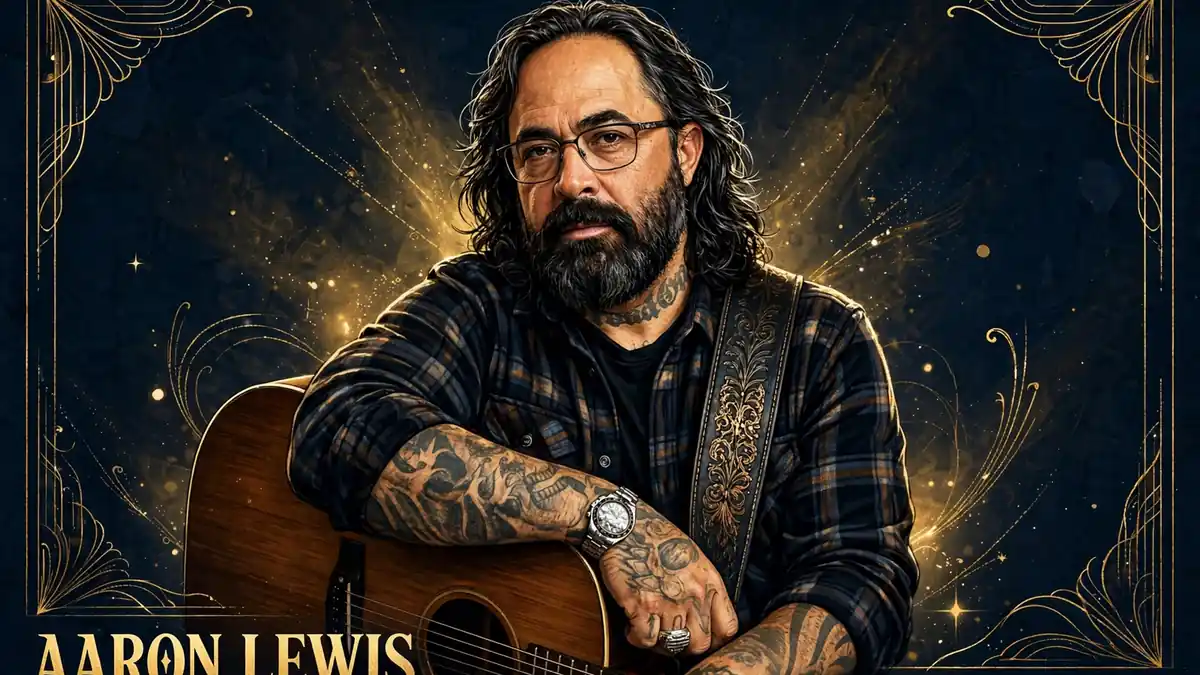
Aaron Lewis‘s net worth is estimated at $6 million to $9 million as of November 2026. The Staind frontman built the first half of that fortune on one of the biggest rock records of the 2000s — an album that was certified seven-times platinum in September 2026 — then built the second half by doing something almost no rock singer of his generation managed: starting over in country music and scoring a number-one country album, a number-one country single, and a sixth solo record released in July 2026.
Aaron Lewis: Quick Facts
| Estimated net worth | $6 million – $9 million (range: $6 million to $9 million) |
|---|---|
| Profession | Singer, songwriter, rhythm guitarist — lead vocalist of Staind; solo country artist |
| Nationality | American |
| Born | April 13, 1972 (age 54) |
| Height | 5 ft 10 in (1.78 m) as listed by IMDb; some fan sites list 6 ft |
| Primary income sources | Staind album sales and royalties, solo country records, touring, streaming, merchandise |
| Active years | 1995–present |
| Last reviewed | November 2026 |
- Early Life and Background
- Education
- Career Journey
- Rise to Fame
- Main Sources of Income
- Salary and Earnings
- Businesses and Investments
- Brand Deals and Sponsorships
- Houses, Cars and Other Assets
- Awards and Achievements
- Net Worth Growth Over the Years
- Social Media Presence
- Personal Life
- Sources & Reporting
- Frequently Asked Questions
Early Life and Background
Aaron Francis Lewis was born on April 13, 1972, in Rutland City, Vermont. His childhood was split across three New England states, and that unsettled geography shows up all through his songwriting — small towns, long drives, and the feeling of being an outsider looking in. His parents divorced when he was 13, after which he divided his time between his mother in New Hampshire and his father in Massachusetts, living with his siblings Jesse, Rachel, and Evyette.
The family moved around enough that Lewis has described his youth as restless rather than rooted. He spent part of his school years in the Forest Park section of Springfield, Massachusetts, the city that would later become Staind’s home base. Music was the constant. He picked up the guitar young and gravitated toward the confessional, acoustic-driven songwriting that would eventually define both halves of his career — the quiet verses of Staind ballads and, years later, his country records.
What matters for the money story is the timing. Lewis came of age just as the post-grunge wave was forming, and he spent his late teens and early twenties playing local stages in western Massachusetts instead of chasing a Nashville or Los Angeles break. That regional grounding kept his costs low and his audience loyal, and when the band finally broke, the fan base was already there, built show by show. He has never lived like a Los Angeles rock star, and the fortune he built reflects that: steady catalog income and relentless touring rather than a single windfall.
One detail from this period still shapes his public image. Lewis grew up hunting and fishing in rural New England, and the outdoorsman identity he carries on stage — the flannel, the acoustic guitar, the songs about small-town life — is not a costume he adopted for country radio. It is the same life he was living before Staind existed, which is a large part of why his country pivot later felt credible to audiences who usually punish rock singers for switching genres.
Education
Lewis completed his high school education in Springfield, Massachusetts. No college degree or formal music-school training appears in any credible biography of him, and he has never claimed one. His education, in the sense that matters to his career, was the club circuit: years of playing bars and small venues in Massachusetts, learning to hold a room with an acoustic guitar and a voice that could go from a whisper to a roar inside a single song.
That background is worth stating plainly because it explains the economics of his career. Lewis did not arrive with industry connections or a Berklee pedigree. He arrived with a band, a local following, and songs. The first Staind record, Tormented, was self-released in 1996, the classic do-it-yourself move of a band with no label money and no other way in. The education that paid off was learning to write songs people remembered and learning to tour without going broke — two skills that still pay his bills in 2026.
Career Journey
Lewis met lead guitarist Mike Mushok at a Christmas party in Springfield in 1993. Two years later, in 1995, the two formed Staind with bassist Johnny April and drummer Jon Wysocki. The band’s name, the story goes, came from a word Lewis liked — and the lineup that recorded the first seven Staind albums stayed intact for a decade and a half, an unusually stable run for a rock band of that era.
Staind’s early years were a grind. Tormented (1996) was self-released and sold in small numbers, mostly at shows. The break came when the band caught the attention of Limp Bizkit frontman Fred Durst, who helped them land a deal with Flip Records and Elektra. Their major-label debut, Dysfunction, arrived in April 1999, peaked at number 74 on the Billboard 200, and was eventually certified double platinum in the United States. It was a solid start, not a sensation — and it set up the record that changed everything.
That record was Break the Cycle, released on May 8, 2001. It debuted at number one on the Billboard 200, selling about 716,000 copies in its first week — the second-highest first week of any album that year, behind only Creed’s Weathered. The album spent three weeks at number one and sold four million copies in 2001 alone. It remains Staind’s best-selling album, with roughly seven million copies sold worldwide. The RIAA certification history tells the story of its staying power: the album was certified five-times platinum for years, and on September 3, 2026, the RIAA upgraded it to seven-times platinum — a fresh, official data point that most net-worth pages written before late 2026 do not reflect.
The band kept the run going. 14 Shades of Grey (2003) and Chapter V (2005) both topped the Billboard 200, giving Staind three consecutive number-one albums. The Illusion of Progress (2008) and the self-titled Staind (2011) both reached the top five. Across those years the band sold around 15 million albums in total, according to the band’s own publicity, and became a fixture of rock radio and arena touring.
Then came the pause. Staind went on hiatus after 2011, and Lewis turned to the solo country career he had been sketching since 2010. His debut solo EP, Town Line (2011), debuted at number one on Billboard’s Top Country Albums chart and number seven on the all-genre Billboard 200 — an almost unheard-of result for a rock singer’s first country release. The full-length debut The Road followed in November 2012, and Sinner (2016) gave him his second number-one country album, debuting at number four on the Billboard 200.
The reunion arrived in 2019, when Staind returned to the stage after eight years away, and the band’s eighth studio album, Confessions of the Fallen, was released in September 2023 — its first new record in 12 years. The single “Lowest in Me” hit number one on the rock charts. Since then Lewis has run both careers at once: Staind dates and solo acoustic tours, sometimes in the same season. In 2026 he added a sixth solo country album, Give My Country Back, released on July 17, 2026, and Staind remained active on the festival circuit, including a scheduled appearance at Welcome to Rockville in Daytona Beach, Florida.
Rise to Fame
Lewis’s rise has a precise date and a precise song. “It’s Been Awhile,” the lead single from Break the Cycle, was released in March 2001 and climbed to number five on the Billboard Hot 100 that October — Staind’s biggest pop-chart hit by a wide margin. The single spent 16 weeks at number one on Billboard’s Modern Rock chart and 14 weeks atop the Mainstream Rock chart, and it has since been certified eight-times platinum by the RIAA. It is one of the most-played rock songs in modern radio history, and it is the single asset that has done the most, over the longest period, to fund Lewis’s life.
The song worked because it was different from everything else on rock radio in 2001. Where his peers were shouting, Lewis was confessing — an acoustic-driven ballad about addiction and regret, written years earlier, around 1996, and carried in his pocket until the band was ready for it. The follow-up singles “Fade,” “Outside,” “For You,” and “Epiphany” kept the album on the charts for more than a year, and the band spent the next two years touring arenas on the strength of it.
The second rise — the country one — was slower and, in commercial terms, stranger. Rock singers who switch to country usually fail; country radio is a closed shop, and rock audiences tend to treat the move as a betrayal. Lewis beat those odds by doing it gradually and by having the biography to back it up. He had been playing acoustic country-leaning sets for years, and his first country single, “Country Boy,” featured George Jones and Charlie Daniels — two legends whose presence on the record amounted to a public endorsement. The song went platinum. When Town Line debuted at number one on the country chart, the move was no longer an experiment. It was a second career.
The third act of the rise came in 2021, a decade into the country career, when “Am I the Only One” debuted at number one on Billboard’s Hot Country Songs chart — Lewis’s first number-one country single — and reached number 14 on the all-genre Hot 100. The song was certified gold in 2023. For a singer who had already had a number-five pop hit twenty years earlier, it was a rare thing: a second number-one single in a second genre, twenty years apart.
Main Sources of Income
Lewis’s money comes from five streams, and the balance between them has shifted twice in his career — first when Staind’s album sales peaked, then when the solo country career and the reunion tours took over. No single stream dominates the way a single album once did, which is why the estimate is a range rather than a point figure.
Staind recordings and royalties. This is the foundation. Eight studio albums, around 15 million albums sold, and a catalog anchored by one of the most durable rock singles ever recorded. Break the Cycle alone accounts for roughly seven million of those sales, and the RIAA’s September 2026 upgrade to seven-times platinum confirms the album is still moving units a quarter-century after release — through streaming equivalents as much as physical sales now. “It’s Been Awhile,” at eight-times platinum as a single, generates publishing and recording royalties every time it is streamed or played on rock radio, and it remains a staple of rock playlists. As the band’s lead vocalist, rhythm guitarist, and primary songwriter — he wrote all of the band’s lyrics — Lewis holds a songwriter’s share of that catalog income, which is the most valuable kind: it pays whether or not he is on tour.
Solo country records. The second foundation. Six solo studio albums and one EP, released across four labels (Blaster, Dot, Big Machine, and Valory), with two number-one debuts on Billboard’s Top Country Albums chart (Town Line in 2011 and Sinner in 2016). The reported United States sales tell the scale honestly: The Road moved about 220,000 copies, Sinner about 146,800, and State I’m In about 41,600. Those are modest numbers next to Staind’s, and they are part of why Lewis’s net worth sits in the single-digit millions rather than the tens of millions — but the country records also carry something the rock catalog does not: they are largely his own project, recorded under his name, with a larger share of the proceeds flowing to him directly.
Touring. The largest current cash stream. Lewis tours constantly, in two formats: full-band Staind dates, including festival slots like Welcome to Rockville in 2026, and his American Patriot Acoustic Tour, a solo acoustic run that plays theaters, casinos, and state fairs. The 2026 solo itinerary ran through dozens of cities — Scottsdale, Santa Fe, Reno, Las Vegas, Atlantic City, Houston, Tulsa, Denver, and many more — a schedule that only makes financial sense if the rooms are selling. Acoustic solo shows are also cheap to stage: one man, one guitar, a small crew. The margin on that format is far better than a four-piece rock band’s arena overhead, which is one reason Lewis has kept the acoustic tour running for years alongside the band.
Streaming. The quiet earner. Staind’s catalog and Lewis’s solo records stream steadily, and “It’s Been Awhile” is the kind of song that never leaves rock playlists. Streaming pays fractions of a cent per play, so no single month is large — but across a catalog of eight Staind albums and six solo records, the monthly total is a real, recurring line of income that did not exist in the band’s CD-era prime.
Merchandise. Tour merchandise and the online store on his official site sell shirts, hats, and music directly to fans. Direct-to-fan sales carry the best margins in the business, and for an artist with a loyal, older audience that buys at shows, merchandise is a meaningful supplement to ticket income.

Salary and Earnings
There is no public salary figure for Aaron Lewis, and any page that prints one as fact is guessing. Musicians are not salaried employees; they are paid in advances, royalties, and tour guarantees, none of which are disclosed unless a filing or a lawsuit surfaces. What can be stated honestly is the shape of his earnings across three eras.
The Staind peak (2001–2005). This was the big-money era. Break the Cycle sold four million copies in 2001 alone, and the band toured arenas for two years on it. Two more number-one albums followed. Record deals of that size carried seven-figure advances, and the band’s touring grosses in the early 2000s were in the tens of millions across the cycle. But that money was split four ways among the band, then split again with managers, agents, lawyers, and the label’s recoupment of recording and marketing costs. The per-member take-home from even a huge album cycle is far smaller than the grosses suggest — a fact that explains why Lewis’s net worth, even after three number-one albums, is measured in single-digit millions.
The hiatus and country rebuild (2012–2019). Earnings fell and changed shape. Solo country records sold in the tens and hundreds of thousands rather than millions, and the venues shrank from arenas to theaters. But the economics improved in one respect: Lewis was now the sole headliner, keeping a far larger share of each night’s gross, and his recording costs were lower. Sinner was famously recorded mostly in a single 18-hour session, with many tracks done in one take — a cheap, fast way to make a record that then debuted at number one on the country chart and number four on the Billboard 200.
The dual-career present (2019–2026). The reunion restored the Staind income stream — festival fees, reunion tour guarantees, and a new album in Confessions of the Fallen — while the solo career kept paying through the acoustic tour and the 2024 and 2026 albums. Two income streams running at once is the best position Lewis has been in since the mid-2000s, and it is the main reason the upper end of the $6–9 million range is defensible in 2026.
One honest caveat belongs here. Some low-quality net-worth pages print precise annual income figures for Lewis — a million a year from royalties, a million from merchandise — with no source attached. We do not repeat those numbers. They trace to content-farm pages that present estimates as facts, and no credible outlet has published a verified annual income figure for him. The range we publish, $6 million to $9 million, is the figure the reporting supports.
Businesses and Investments
Lewis is not a businessman in the way some of his peers are. There is no restaurant chain, no clothing line, no venture fund attached to his name, and that absence is itself informative: his wealth is music wealth, built from recordings and touring, not from side ventures. What business activity exists is small, personal, and tied to his life in Massachusetts.
The most visible is the It Takes a Community Foundation, which he co-founded with his wife Vanessa in 2010. It is a nonprofit, not a profit center — it exists to fund local education projects in Worthington, Massachusetts, and it famously helped reopen the town’s closed elementary school as the private R.H. Conwell Community Education Center. The foundation raises money through benefit concerts and events, and while it is not an income source for Lewis, it is the closest thing he has to a business structure outside his music, and it ties directly to his public identity as a community-minded small-town figure.
He is also credited as a co-founder of a music production company, Little House of Faith Productions, a small outfit connected to his solo recording work. Public detail on the company is thin — no filings or revenue figures have been reported — so we note its existence without assigning it a value. The honest summary is that Lewis’s investments, as far as the public record shows, are his catalog, his touring business, and his real estate, not a portfolio of companies.
That conservatism cuts both ways. He has avoided the expensive failures that have dented other musicians’ fortunes — no failed restaurant, no bad tech bet on the public record — but he has also never had the kind of business windfall that turns a $9 million musician into a $50 million one. His net worth is what three decades of steady music work produces when it is managed carefully and spent modestly.
Brand Deals and Sponsorships
Endorsement income is the smallest of Lewis’s revenue streams, and the public record on it is thin. He has never fronted a national advertising campaign, and no major brand partnership — the kind that pays a musician seven figures to put a logo on a tour — is documented for him. That is consistent with his positioning: his audience is loyal but niche, and his public stances are polarizing enough that mass-market brands have generally stayed away.
What does exist is the usual working musician’s set of relationships: instrument and gear associations that come with a three-decade touring career, and merchandise partnerships tied to his tours and his official store. None of these is large enough to have been reported as a discrete deal, and none is assigned a value in this estimate. The honest statement is that brand deals contribute a small share of his income, far behind recordings and touring.
One indirect form of sponsorship is worth noting. His solo acoustic tour is billed as the American Patriot Acoustic Tour, and its branding leans hard into the patriotic, working-class identity that defines his solo audience. That identity is itself a commercial asset — it fills theaters in markets where other rock singers cannot sell tickets — but it is monetized through ticket sales, not through a sponsor’s check.
Houses, Cars and Other Assets
The best-documented asset Lewis owns is the Massachusetts estate where he raised his family. In 2001, at the height of Staind’s fame, he bought a 14,240-square-foot home on 12.1 acres in Worthington, Massachusetts, from Kevin Eastman, the co-creator of the Teenage Mutant Ninja Turtles. The property is secluded — the house cannot be seen from the street — and it includes a barn with a private fireproof vault area. It was the physical expression of the Break the Cycle money: a rock star buying privacy and land in the town where his children went to school, not a mansion in Los Angeles.
The house later became a public marker of his finances. The family listed the Worthington home for sale in the summer of 2020 at $3.5 million, with plans reported at the time to move to Nashville, Tennessee. It did not sell at that price. In 2022 the estate was relisted at $2.9 million — a $600,000 cut that tells its own story about the carrying costs of a 14,000-square-foot house in a town of about 1,200 people, and about how thin the buyer pool is for a property like that. The listing history is one of the few hard, dated numbers in Lewis’s financial life, and it is a useful reality check on the larger net-worth figures some sites print: a man worth $14 million does not usually cut $600,000 off his asking price to move a house.
On cars, the public record is silent. No verified reporting documents a car collection for Lewis, and we will not invent one. His public image is built around trucks, hunting, and the outdoors rather than luxury vehicles, and his spending, as far as it can be observed, has gone to land, family, and the foundation — not to a garage full of exotics. The absence of a car story is itself a data point: Lewis’s wealth is quiet, rural, and tied up in property and catalog, not displayed.
Beyond the house, his main assets are intangible: his share of the Staind publishing catalog, his solo masters and royalties, and the touring business itself. Those do not photograph well, which is why net-worth pages prefer houses and cars — but for Lewis, the catalog is the asset that matters. A song like “It’s Been Awhile” pays every month, and it will keep paying long after the Worthington house is sold.
Awards and Achievements
Lewis’s trophy case is measured in chart positions and certifications rather than award-show statuettes, and the record is formidable on those terms. With Staind he has three Billboard 200 number-one albums — Break the Cycle (2001), 14 Shades of Grey (2003), and Chapter V (2005) — plus two more top-five albums. “It’s Been Awhile” reached number five on the Billboard Hot 100, spent 16 weeks at number one on the Modern Rock chart, and is certified eight-times platinum as a single. The album it came from was certified seven-times platinum by the RIAA in September 2026.
The solo career added a second set of firsts. Town Line (2011) and Sinner (2016) both debuted at number one on Billboard’s Top Country Albums chart. “Country Boy,” featuring George Jones and Charlie Daniels, was certified platinum. “Am I the Only One” (2021) debuted at number one on Billboard’s Hot Country Songs chart, reached number 14 on the Hot 100, and was certified gold in 2023. Frayed at Both Ends (2022) was the best-selling country album in America in its debut week, according to the band’s publicity.
Put together, the achievement that sets Lewis apart is the double: a number-five pop hit and a number-one country single, twenty years apart, in two different genres, under the same name. Very few singers have a chart-topping single in two genres two decades apart. That is the achievement the net worth rests on — not one lucky record, but two careers, each with its own number ones.
Net Worth Growth Over the Years
No audited year-by-year figures exist for Lewis, so the table below is an informed reconstruction from the reporting record — album sales, chart peaks, touring eras, and the published estimates that exist for each period. Treat the early years as approximate and the recent years as anchored to the named sources.
| Year | Estimated net worth | What drove it |
|---|---|---|
| 1999 | Under $1 million | Dysfunction goes double platinum; first major-label money, mostly recouped by the label |
| 2001 | $2 million – $3 million | Break the Cycle debuts at number one, 716,000 first-week sales; arena touring begins |
| 2005 | $4 million – $5 million | Three number-one albums; peak Staind touring years |
| 2011 | $5 million – $6 million | Town Line tops the country chart; solo career begins as Staind pauses |
| 2016 | $6 million | Sinner debuts at number one country, number four on the Billboard 200 |
| 2021 | $6 million – $7 million | “Am I the Only One” hits number one on Hot Country Songs; solo touring resumes |
| 2023 | $6 million – $8 million | Staind reunion album Confessions of the Fallen; “Lowest in Me” tops rock radio |
| 2026 | $6 million – $9 million | Dual touring (Staind + solo), Give My Country Back released July 2026; Break the Cycle certified 7× platinum |
The shape of that table is the point. Lewis’s wealth did not spike and crash; it climbed in steps and then held. The Staind years built the base, the solo years kept it from eroding during the hiatus, and the reunion years added a second income stream on top of the first. That is a steadier curve than most rock careers produce, and it is why the 2026 estimate is a range with a firm floor rather than a guess.
For scale, here is how Lewis’s reported fortune compares with country and rock peers whose careers overlap his. The figures are reported estimates from Celebrity Net Worth and Forbes, and they move — read them as orders of magnitude, not bank balances.
| Artist | Reported net worth | Why the gap |
|---|---|---|
| Aaron Lewis | $6 million – $9 million | Two mid-size careers; catalog-driven, touring-led income |
| Miranda Lambert | About $60 million | Full-time country star with a longer run of hit singles and bigger tours |
| Blake Shelton | About $100 million | Television money (The Voice) on top of a country career |
| Carrie Underwood | About $140 million | Arena-scale country career plus television and endorsements |
| Taylor Swift | About $1.6 billion | Forbes-listed billionaire; a different universe of scale |
The comparison is flattering to nobody and instructive for everybody. Lewis never had the television contract, the pop-crossover ubiquity, or the stadium era that made his peers rich at that scale. What he had instead was durability: a catalog that still earns, a second genre that still books theaters, and an audience that has followed him from arenas to acoustic rooms without leaving. That durability is worth $6–9 million. It is not worth $100 million, and this article does not pretend otherwise.
Social Media Presence
Lewis keeps a working musician’s social media presence rather than an influencer’s. His official accounts on Instagram, Facebook, and X exist mainly to do three jobs: announce tour dates, sell merchandise, and post the occasional statement. He does not run the kind of daily content operation that builds a follower fortune, and he has never tried to monetize his audience through sponsored posts or brand partnerships on social platforms.
That low-key approach fits the audience. His fans are largely listeners who found him through rock radio in the 2000s or country radio in the 2010s, and they buy tickets and records rather than following a feed. The commercial value of his social media is therefore indirect: it fills the theater for the next acoustic tour date and moves merchandise at the show. No verified follower counts are published here because the numbers shift constantly and no credible outlet has tied a dollar figure to them; the honest statement is that social media is a marketing channel for Lewis, not an income stream in its own right.
His most important digital asset is not a social account at all. It is the streaming catalog — Staind’s eight albums and his six solo records — which earns around the clock without a single post. In 2026, that catalog is the closest thing Lewis has to passive income, and it is the reason his net worth holds its value between tours.
Personal Life
Lewis has been married to Vanessa Lewis since 2002, and the marriage is one of the longest-running in rock music — more than two decades, conducted almost entirely out of the spotlight. Vanessa keeps a low profile and rarely appears publicly, though she is a visible partner in the couple’s charitable work. They have three daughters: Zoe Jane, born in 2002; Nyla Rae, born in 2005; and Indie Shay, born in 2007. The family has lived in Worthington, Massachusetts, the small town — population around 1,200 — where the couple built their life and their foundation.
The daughters are part of the music as well as the biography. Zoe Jane is the namesake of the Staind song “Zoe Jane” from 14 Shades of Grey, and she sang guest vocals on her father’s Sinner album, which was recorded mostly in a single 18-hour session. That detail — a father recording an album in one long day with his daughter singing on it — captures the family-first shape of the solo career better than any press release.
In 2010, Aaron and Vanessa co-founded the It Takes a Community Foundation after budget cuts closed three of the five elementary schools in their area, including the one their daughters attended. Through fundraising concerts and events, the foundation helped reopen the school as the private R.H. Conwell Community Education Center, funding desks, books, supplies, and teachers’ salaries. It remains the couple’s main public project outside music, and it is the reason Lewis is known in Worthington as a neighbor who saved a school rather than only as a rock star who bought a big house there.
Lewis is also known for his outspoken conservative politics, which became a defining feature of his solo career with “Am I the Only One” in 2021 and the 2026 album Give My Country Back. His views have cost him some listeners and won him others, and they are part of why his solo audience is as loyal — and as narrow — as it is. This article does not take a position on those views; it notes them because they shape the commercial reality of his second career, for better and for worse.
In 2020 the family put the Worthington home on the market and spoke of moving to Nashville, Tennessee, the center of the country music business. The house did not sell at its $3.5 million asking price and was relisted at $2.9 million in 2022. Whether the move happens or not, the episode shows a family weighing the same trade-off Lewis’s whole career has turned on: the quiet Massachusetts life against the Nashville career.
Sources & Reporting
How this estimate was built. Celebrity Net Worth lists Aaron Lewis at $6 million, with its page updated on October 8, 2025 — the most recent update from the most widely cited net-worth publisher, and the anchor of our range. NetWorthPost independently reports $6 million. Celebily reports $9 million, and DailyWikiBio reports a $6–9 million range for 2025. The overlap between those sources — $6 million at the bottom, $9 million at the top — is the published range in this article.
Outliers, and why they were discounted. WealthyPersons published a $14 million figure in September 2021; it is five years old, it predates the current touring and streaming picture, and no other source has repeated it since. A fan site, aaronlewis.org, suggests $10–15 million, but it is not a reporting outlet and it gives no method. Both figures are noted here so readers can see them addressed, not hidden — and neither is used in the estimate.
Career and chart data. Album release dates, chart peaks, and sales figures come from Wikipedia’s Aaron Lewis biography and the Staind band page, cross-checked against AllMusic, including the September 3, 2026 RIAA upgrade of Break the Cycle to seven-times platinum and the July 17, 2026 release of Give My Country Back. Solo album sales (The Road 220,000; Sinner 146,800; State I’m In 41,600) are the United States figures carried in those discographies. The “Am I the Only One” chart run and gold certification, and the Staind reunion album details, come from the band’s publicity via Absolute Publicity.
Family, home, and foundation. Marriage, children, the Worthington home purchase and listing history, and the It Takes a Community Foundation come from NetWorthPost and DailyWikiBio, with the home’s $3.5 million listing and $2.9 million relisting corroborated across multiple reporting pages. Height is listed as 5 ft 10 in (1.78 m) by IMDb; some fan sites list 6 ft, and that disagreement is noted in the Quick Facts table.
Reporting window. Sources were checked in November 2026. Chart and certification data runs through September 2026; the net-worth anchor was last updated by its publisher in October 2025. Where sources disagree, this article publishes a range and names who says what, rather than picking the biggest number.
Frequently Asked Questions
How much is Aaron Lewis worth in 2026?
Aaron Lewis’s net worth is estimated at $6 million to $9 million as of November 2026. Celebrity Net Worth lists him at $6 million, while Celebily and DailyWikiBio put the figure as high as $9 million. The range reflects his Staind catalog royalties, solo country records, and constant touring income.
How old is Aaron Lewis?
Aaron Lewis is 54 years old. He was born Aaron Francis Lewis on April 13, 1972, in Rutland City, Vermont, and turned 54 in April 2026.
Is Aaron Lewis still married?
Yes. Aaron Lewis has been married to Vanessa Lewis since 2002 — more than two decades. The couple have three daughters: Zoe Jane (born 2002), Nyla Rae (born 2005), and Indie Shay (born 2007). Together they co-founded the It Takes a Community Foundation in Massachusetts.
Is Staind still together?
Yes. Staind reunited in 2019 after an eight-year hiatus and released their eighth studio album, Confessions of the Fallen, in September 2023. The band toured through 2026, including a scheduled appearance at Welcome to Rockville, while Lewis continued his solo acoustic tours in parallel.
What is Aaron Lewis’s biggest song?
“It’s Been Awhile” (2001) is his biggest song. It reached number five on the Billboard Hot 100, spent 16 weeks at number one on the Modern Rock chart, and is certified eight-times platinum by the RIAA. His biggest solo country hit is “Am I the Only One,” which topped Billboard’s Hot Country Songs chart in 2021.
How tall is Aaron Lewis?
Aaron Lewis is listed at 5 ft 10 in (1.78 m) by IMDb. Some fan sites list him at 6 ft, so the commonly quoted figures disagree by two inches; the IMDb listing is the one used in this article.
What is Aaron Lewis’s most successful solo album?
Sinner (2016) is his most successful solo album by chart position: it debuted at number one on Billboard’s Top Country Albums chart and number four on the Billboard 200. His debut EP Town Line (2011) also debuted at number one on the country chart, and Frayed at Both Ends (2022) was the best-selling country album in America in its debut week.
Where does Aaron Lewis live?
Aaron Lewis lives in Worthington, Massachusetts, where he bought a 14,240-square-foot home on 12.1 acres in 2001. The family listed the house for $3.5 million in 2020 and relisted it at $2.9 million in 2022, with reported plans to move to Nashville, Tennessee.
Final Thoughts
Aaron Lewis’s $6–9 million fortune is the honest size of a career that did something rare twice. First he fronted a band that sold around 15 million albums and produced one of the defining rock singles of the 2000s — a song so durable that its album was certified seven-times platinum in September 2026, twenty-five years after release. Then, when most rock singers of his generation were playing nostalgia tours, he built a second career in country music, with two number-one country albums and a number-one country single of his own.
The range is the story. Lewis is not a $100 million star, and this article does not pretend he is. He is a working musician whose catalog pays every month, whose tours fill theaters in two genres, and whose biggest asset is a song he wrote in 1996 that still earns. That is a durable, unglamorous fortune — and in a business where most fortunes from 2001 are long gone, durability is the achievement.
Published on November 15, 2026. Last reviewed November 2026. Found an error? See our corrections policy.