
Jim Tressel‘s net worth is estimated at $15 million to $18 million as of November 2026. The former Ohio State head coach banked a documented $21.7 million across a decade in Columbus, then spent nine years running Youngstown State University on a flat $300,000 salary before becoming Ohio’s lieutenant governor in February 2025 — and in September 2026, Ohio State put his name in the Ohio Stadium Ring of Honor beside Woody Hayes and Paul Brown.
Jim Tressel: Quick Facts
| Estimated net worth | $15 million – $18 million (range: $15 million to $18 million) |
|---|---|
| Profession | Former college football coach; university president; 67th Lieutenant Governor of Ohio |
| Nationality | American |
| Born | December 5, 1952, in Painesville, Ohio (age 73) |
| Height | Not officially published |
| Primary income sources | College football coaching contracts, university president salary, book royalties, speaking engagements, state office salary |
| Active years | 1975–present (coaching 1975–2011; university administration 2012–2023; public office 2025–present) |
| Last reviewed | November 2026 |
- Early Life and Background
- Education
- Career Journey
- Rise to Fame
- Main Sources of Income
- Salary and Earnings
- Businesses and Investments
- Brand Deals and Sponsorships
- Houses, Cars and Other Assets
- Awards and Achievements
- Net Worth Growth Over the Years
- Social Media Presence
- Personal Life
- Sources & Reporting
- Frequently Asked Questions
Early Life and Background
James Patrick Tressel was born on December 5, 1952, in Painesville, Ohio, and grew up in nearby Mentor, a Cleveland suburb where football was the family business. His father, Lee Tressel, coached at Mentor High School — where his teams once won 34 games in a row — then spent two seasons at Massillon Washington High School before becoming head coach at Baldwin–Wallace College in Berea, Ohio. His mother, Eloise Tressel, worked as the athletic historian at Baldwin–Wallace while her husband coached there. Jim grew up attending his father’s games and practices, and the family’s next-door neighbor was former Cleveland Browns great Lou Groza, a friendship that put a pro football legend within shouting distance of the Tressel kitchen table.
That upbringing explains almost everything about the coach Tressel became. He did not arrive at Ohio State as a hired gun with a playbook and an agent; he arrived as the son of an Ohio high school and small-college coach who had spent his childhood on sidelines and in film rooms. The sweater vest, the flat Midwestern delivery, the insistence on punting as the most important play in football — all of it traced back to Mentor and Berea, not to a branding consultant. It also explains why his money story looks different from the typical coaching fortune: Tressel spent fifteen years at a Division I-AA school before he ever saw a seven-figure salary, and he later walked away from top coaching money entirely to run a university for $300,000 a year.
The family coaching tree runs deep. Lee Tressel won 155 games at Baldwin–Wallace. Jim’s older brother, Dick Tressel, won 124 games as a head coach at Hamline University and later coached running backs at Ohio State under his younger brother. Between the three of them — Lee, Jim, and Dick — the family has won 508 games as head coaches. Jim’s own career total of 229 wins made him the third Tressel to reach 100 victories. When Jim and his father both won national championships, they became the first father-son duo to do so in college football.
Growing up around his father’s program also gave Tressel his first lesson in the economics of the sport: small-college football in the 1960s and 1970s paid modestly and demanded everything. Lee Tressel’s world was one of teaching loads, booster dinners, and long bus rides — a long way from the private jets and Nike money that would eventually define his son’s Ohio State contract. That contrast matters when judging Tressel’s fortune, because the first half of his career was built on salaries that would look small beside a modern graduate assistant’s pay, and the second half was built on contracts that made him one of the best-paid public employees in Ohio.
Education
Tressel graduated from Berea High School in 1971 and followed his father to Baldwin–Wallace College, where he played quarterback under Lee from 1971 to 1974. He earned four varsity letters and won all-conference honors as a senior in 1974, and he joined the Alpha Tau Omega fraternity. In 1975 he graduated from Baldwin–Wallace with a bachelor’s degree in education — a credential that shaped his career as much as any playbook, since Tressel always presented himself as a teacher first and a football coach second. That self-image later became the bridge to his university presidency: he was not a coach who happened to work at a school, but an educator who happened to coach.
After graduating, Tressel became a graduate assistant at the University of Akron, where he coached quarterbacks, receivers, and running backs while earning a master’s degree in education, completed in 1977. The Akron years matter for two reasons. First, they gave him a second Ohio university on his résumé, and he would return to Akron decades later as an administrator. Second, they established the pattern of his early career: short stays, low pay, and a willingness to coach any offensive position group that needed a coach. He received honorary degrees from Youngstown State in 2001 and Baldwin–Wallace in 2003, recognition that arrived after his coaching success rather than before it.
Education also became a recurring theme in Tressel’s contract negotiations. His Ohio State deals carried academic bonuses — $155,000 in total across his tenure for his players hitting academic standards — and his 2003 contract included a possible $100,000 yearly academic bonus. Those clauses were unusual at a time when most coaching contracts paid only for wins, and they reflected the same educator identity that later led him to accept a university presidency at a fraction of his coaching pay.
Career Journey
Tressel’s coaching ladder ran entirely through Ohio and the Northeast, one rung at a time. After Akron (1975–1978), he coached quarterbacks and receivers at Miami University in Oxford, Ohio (1979–1980), then quarterbacks at Syracuse (1981–1982). In 1983, Ohio State hired him as quarterbacks and receivers coach under head coach Earle Bruce; in 1984 he added running backs to his responsibilities. That 1984 team won the Big Ten, played in the Rose Bowl, and saw tailback Keith Byars finish second in Heisman Trophy voting. The 1983 team had gone 9–3 and beaten Pittsburgh 28–23 in the Fiesta Bowl on a 39-yard pass from Mike Tomczak to Thad Jemison with 39 seconds left. Tressel was learning, at close range, what big-time college football looked like from inside one of its biggest programs.
At the end of the 1985 season he left Ohio State to become head coach at Youngstown State University, a Division I-AA program that had never been a national power. His first season finished 2–9. His second finished 8–4 with an Ohio Valley Conference championship. From there, Youngstown State became the dominant program in Division I-AA: national championship game appearances in 1991, 1992, 1993, 1994, 1997, and 1999, with titles in 1991 (over Marshall), 1993 (over Marshall), 1994 (over Boise State), and 1997 (a 10–9 win over McNeese State). His overall record at Youngstown State was 135–57–2, and his teams of the 1990s went 103–27–2 — the most wins of any Division I-AA team that decade, and the fourth-most across both divisions of Division I combined. He was named Division I-AA Coach of the Year in 1991, 1993, 1994, and 1997.
Youngstown State also produced the first serious blemish on Tressel’s record, and it is worth stating plainly because it foreshadowed what later ended his Ohio State tenure. In 1998 it emerged that Ray Isaac, the quarterback of Tressel’s first national championship team, had accepted substantial benefits from Mickey Monus, the founder of the Phar-Mor drugstore chain and a former chairman of Youngstown State’s board of trustees. The NCAA had been tipped off about the violations in 1994 but dropped its inquiry after a cursory internal investigation by the university. When Isaac later admitted to tampering with a juror in Monus’s corporate fraud trial, the details surfaced: Monus testified that when Isaac arrived at Youngstown State in 1988, Tressel had called him and asked him to find Isaac a job. Youngstown State admitted a lack of institutional control and docked itself scholarships; the NCAA faulted Tressel and the school for the cursory 1994 investigation but did not cite them for wrongdoing, and Youngstown State kept its 1991 title because the NCAA’s statute of limitations had expired.
When John Cooper was dismissed as Ohio State’s head coach after a loss to unranked South Carolina in the 2001 Outback Bowl, Tressel returned to Columbus as the program’s 22nd head coach, announced on January 18, 2001. At a halftime ceremony during a basketball game shortly after his hiring, he told Buckeye fans: “I can assure you that you will be proud of your young people in the classroom, in the community, and most especially in 310 days in Ann Arbor, Michigan, on the football field.” Ten months later, his 7–5 first-year team upset Michigan 26–20, keeping the promise on schedule. The 2002 team then went 14–0 and beat the heavily favored Miami Hurricanes in double overtime in the Fiesta Bowl to win the national championship — Ohio State’s first in 34 years and the first 14–0 season in major college football since the 1897 Penn Quakers.
His Ohio State record, on the field, was 106–22 with six Big Ten titles, three BCS National Championship Game appearances, and a 9–1 record against Michigan. Two 19-game winning streaks ran through his tenure, one spanning 2002–2003 and the other 2005–2006. His .810 winning percentage over ten seasons and 116 games is tied for the second-best in school history. The 2006 team went undefeated in the regular season and played the first ever meeting between the No. 1 and No. 2 teams in the polls against Michigan, winning 42–39, before losing the BCS title game to Florida 41–14. The 2007 team reached a third straight Big Ten title and a second straight title game, losing 38–24 to LSU. Twelve of the 106 wins were later vacated because of NCAA sanctions, which is why the official record reads differently from the on-field one — a distinction that matters to historians and to Tressel’s legacy, but not to the money, which was already paid.
The end came fast. In December 2010, news broke that players had traded memorabilia for cash and tattoos, breaking NCAA rules. Tressel had learned of the violations months earlier and failed to tell his superiors. He resigned on May 30, 2011, writing that “the recent situation has been a distraction for our great university.” The 2010 season’s victories were vacated, including the 2011 Sugar Bowl win, and the NCAA’s investigation ended the most successful decade of Ohio State football since Woody Hayes. Assistant Luke Fickell took over as interim coach at roughly $700,000 — about $3 million less than Tressel had made the year before, a gap that said as much about Tressel’s market value as any statistic.
What followed was a second career that most fired coaches never get. On September 2, 2011, the Indianapolis Colts hired Tressel as a game-day and replay consultant; the NFL suspended him until the seventh game of the season as part of the fallout from the NCAA matter, and he stayed with the Colts through 2012. In February 2012 he accepted a non-athletic role at the University of Akron, where he eventually served as executive vice president for student success, charged with restructuring a newly created division focused on the academic and career success of students. On May 9, 2014, Youngstown State named him its ninth president. He took office July 1, 2014, and served until February 1, 2023, when Bill Johnson succeeded him. Then, on February 10, 2025, Governor Mike DeWine nominated him as Ohio’s lieutenant governor to replace Jon Husted; the Ohio Senate confirmed him on February 12, and he was sworn in on February 14, 2025, as the 67th lieutenant governor of Ohio.
Rise to Fame
Tressel’s fame arrived in two waves, and the second was bigger than the first. The first wave was Youngstown State’s run through the 1990s, when a small industrial-city university with no football pedigree won four national titles in seven years and Tressel became the most respected coach in Division I-AA. National writers noticed, and the job offers from bigger programs started coming. But Division I-AA success has a ceiling on fame, and Tressel stayed in Youngstown for fifteen seasons — a loyalty that later became part of his legend and part of the reason Ohio State trusted him with its program.
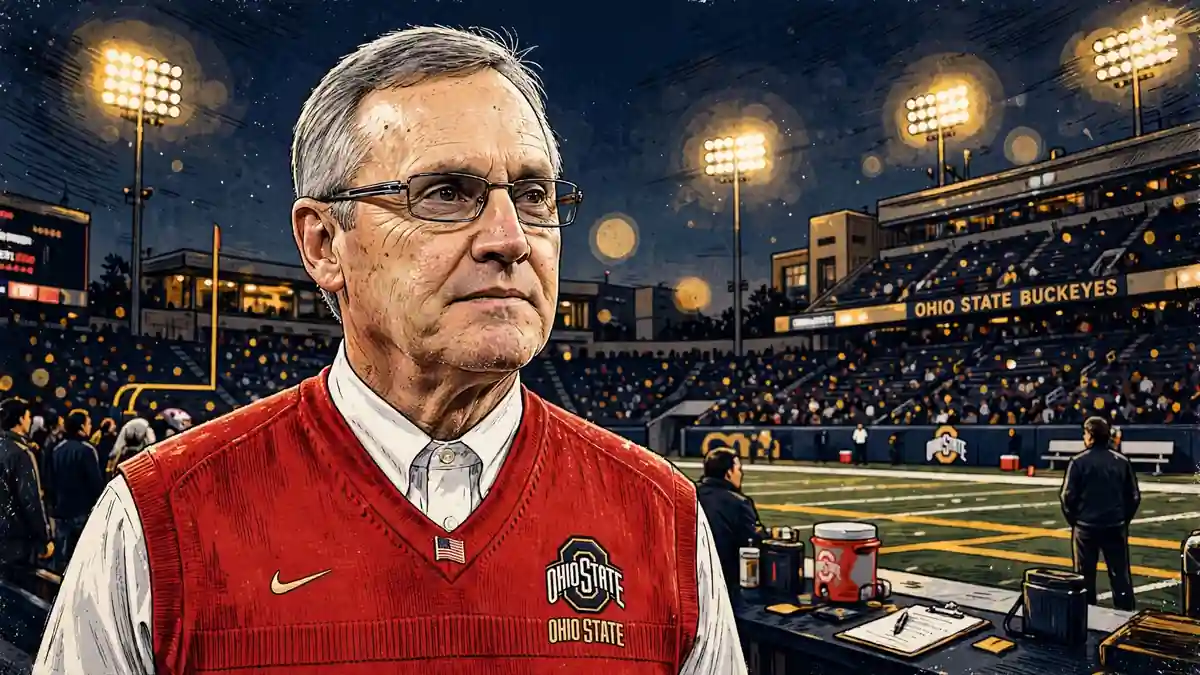
The second wave began the day he was introduced in Columbus. Ohio State had fired John Cooper after years of frustration, much of it centered on losing to Michigan, and Tressel’s “310 days in Ann Arbor” line gave a restless fan base a date to circle. He delivered on it, then delivered a national championship in his second season, and for the next decade he was the most famous coach in the Big Ten. ESPN’s Chris Fowler nicknamed him “The Senator” for his composure on the sideline and his diplomatic way of handling the media; fans called him “The Vest” for the sweater vest he wore on game days, a garment so identified with him that Ohio State covered his Ring of Honor plaque with a sweater vest before unveiling it in September 2026.
His style of football helped the legend and limited it at the same time. “Tresselball” meant conservative play-calling, strong defense, and winning on field position — Tressel often called the punt the most important play in football. His teams won close games: seven of the fourteen victories in the 2002 championship season came by seven points or fewer, including an overtime win over Illinois and the double-overtime Fiesta Bowl. That approach produced a 9–1 record against Michigan and six Big Ten titles, but it also produced two lopsided losses in BCS title games, 41–14 to Florida and 38–24 to LSU, which critics used to argue that his style could not keep up with the sport’s fastest teams.
Fame, for Tressel, never converted into the kind of celebrity wealth that follows coaches who chase television and endorsements. He wrote one book, gave speeches, and stayed inside Ohio institutions. The 2002 season made him the first coach in NCAA history to win the AFCA’s Coach of the Year award at different schools, and the first to win it in two different divisions. He collected the Paul “Bear” Bryant Award, the Bobby Dodd Coach of the Year Award, the Eddie Robinson Coach of the Year Award, the Woody Hayes Trophy, and the Sporting News Coach of the Year Award, all in 2002. The College Football Hall of Fame inducted him in 2015. And on September 5, 2026, during Ohio State’s season opener against Ball State — a 56–3 win before 101,120 fans at Ohio Stadium — he was enshrined in the Ohio Stadium Ring of Honor, becoming only the third coach so honored, alongside Paul Brown and Woody Hayes, and the first person added to the display since his former quarterback Troy Smith in 2014.
Main Sources of Income
Tressel’s money came from four distinct careers, stacked one on top of another across five decades, and that stacking is the whole story of his fortune. The first was small-college coaching, which paid modestly. The second was big-time coaching at Ohio State, which paid millions and produced nearly all of his wealth. The third was university administration, which paid well but far less than coaching. The fourth is public office, which pays a state salary that is a small fraction of what he once earned on a sideline.
College coaching contracts dominate the picture. At Youngstown State, his base salary as head coach was $88,000, plus $20,000 for serving as athletics director, a $6,000 annual car allowance, and a $5,000 bonus if his team reached the I-AA championship game or a I-A bowl — figures reported by the Youngstown Vindicator in 2002. Fifteen seasons at that level, even with raises, would have produced career earnings in the low seven figures. At Ohio State, the numbers jumped by an order of magnitude, and the Associated Press records obtained from the university in 2011 put his total Ohio State earnings at $21.7 million over ten seasons. That single figure is the foundation of his net worth: everything else he earned, before and after, is smaller by comparison.
University administration added a second, steadier stream. As Youngstown State’s president from 2014 to 2023, Tressel earned a flat $300,000 a year — a salary he accepted after the university offered him more, and one that stayed unchanged through multiple contract extensions. Nine years at that rate is roughly $2.7 million in gross pay, before taxes and before any benefits. His earlier administrative role at the University of Akron, as vice president of strategic engagement and then executive vice president for student success from 2012 to 2014, added two more years of senior university pay, though the exact figures were not publicly reported in the sources we reviewed.
Book royalties and speaking engagements form the third stream, and here the record carries an unusual twist: Tressel gave the money away. His 2008 book, The Winners Manual: For the Game of Life, was published by Tyndale House with co-author Chris Fabry and a foreword by John Maxwell, and it carried roughly 70,000 pre-orders — enough, The Lantern reported, to land around 50th on the best-seller list in its first week. All proceeds from the book were donated to the renovation campaign for Ohio State’s William Oxley Thompson Memorial Library, a project that cost about $109 million. Tressel and his wife Ellen served as co-chairs of that campaign, and the library’s fourth-floor outdoor terrace now bears their name. So the book built his reputation far more than his bank balance, and any honest accounting of his wealth has to treat the royalties as money he chose not to keep.
Consulting and public office round out the picture. His stint as a game-day and replay consultant for the Indianapolis Colts in 2011–2012 paid an NFL consulting fee that was never publicly disclosed, and it lasted barely a season. His current role as Ohio’s lieutenant governor pays a state salary set by statute — the Ohio Revised Code lists the base at $113,947 under the 2018 law, with scheduled annual increases running through 2028 — a low-six-figure income that is roughly one-thirtieth of what he earned in his final year at Ohio State. Speaking engagements, which the net-worth outlets routinely list among his income sources, are the least documented part of his earnings; no fee schedule or annual total has ever been published, so we treat them as a modest supplement rather than a pillar of the fortune.
What Tressel did not do is as telling as what he did. He never took an NFL head-coaching job, never became a television analyst, never launched a business empire, and never sold his name to a major endorsement campaign. Compared with coaching peers who turned sideline fame into media careers and product deals, Tressel’s income stayed inside institutions: two universities, one NFL team, one state government. That narrowness is why his net worth sits at $15 million to $18 million rather than at the $50 million-plus figures attached to coaches who monetized their fame more aggressively — and it is also why the number is more credible than most celebrity estimates, since the largest single input is a matter of public record.

Salary and Earnings
Few coaching fortunes can be traced year by year from public documents, but Tressel’s can, because Ohio State is a public university and its records are public. The Associated Press obtained those records in 2011, and the picture they paint is of a salary that roughly tripled across a decade — and of a compensation package stuffed with bonuses, perks, and deferred money that pushed his real earnings well past his base pay.
His first Ohio State contract, signed in January 2001, paid a base salary of $700,000 a year plus a $100,000 signing bonus, with $100,000 annual increments. The Lantern reported the same terms when he was introduced: five years, $700,000 to start, rising by $100,000 each year. Even that starting figure was roughly eight times what he had earned as Youngstown State’s head coach and athletics director combined.
The money grew quickly after the 2002 national championship. A new contract signed in June 2003 paid $1,309,750 in total compensation in its first year: a base salary of $285,750, a $200,000 signing bonus, and the rest from radio and television work, public relations, and Nike. It carried a possible $100,000 yearly academic bonus, $1.5 million in deferred compensation if he finished the contract through 2008, and a $200,000 bonus for another national title game appearance. His salary was scheduled to escalate to a $405,300 base by year six, with a possible total of $1,871,576. The Youngstown Vindicator’s reporting from January 2005 breaks down a single year in detail: a $344,000 base salary, $505,000 for radio and television shows, $5,000 for his summer football camp, and $376,000 from the university’s apparel agreement with Nike, for a total of $1.23 million — before bonuses, and before perks that included new cars for him and his wife, ten tickets and four parking passes to every home football game, and four tickets to every home men’s basketball game.
The deferred compensation account was a fortune in itself. Under the 2003 contract, Ohio State had to put $200,000 into the account in January 2005, $250,000 in January 2006, $300,000 in 2007, and $350,000 in each of the next two years — money that would have given him more than $2.2 million on top of his salary if he stayed through the contract. A further contract signed in 2006, retroactive to February 1 of that year and running through the 2012 season, paid $1,878,900 plus a $500,000 signing bonus in its first year — $2,378,900 in total — and rose year by year: $2,300,900 in 2007, $2,325,900 in 2008, $2,400,900 in 2009, $2,500,900 in 2010, $2,575,900 in 2011, and $2,675,900 in 2012. He resigned before collecting the final two years.
The Associated Press totals tell the story in one line: Tressel made $21.7 million as Ohio State’s football coach over his decade in Columbus. He earned more than $3.5 million in 2010 alone. Almost a quarter of his total pay — $4.6 million — came from the slice of Ohio State’s Nike apparel deal that the university directed to him. His contracts also delivered $835,000 in national-championship game bonuses across the 2002, 2006, and 2007 seasons, $155,000 in academic bonuses, a $200,000 signing bonus in 2003, and a $500,000 signing bonus in 2006. The perks were itemized with the same precision: football game tickets valued at $104,800 across his tenure, more than $10,000 in basketball tickets, over $21,000 in bowl tickets, nearly $10,000 reimbursed in 2008–09 for membership and expenses at an exclusive local country club, leased cars for him and his wife valued at $23,000 for 2010–11, and a private jet for recruiting visits.
| Period | Role | Documented pay |
|---|---|---|
| 1986–2000 | Youngstown State head coach | About $88,000 base + $20,000 as athletics director, plus $6,000 car allowance |
| 2001 | Ohio State head coach | $700,000 base + $100,000 signing bonus |
| 2003–04 | Ohio State head coach | $1,309,750 total compensation in year one of new contract |
| 2005 | Ohio State head coach | $1.23 million total (base $344,000; radio/TV $505,000; Nike $376,000; camp $5,000) |
| 2006 | Ohio State head coach | $2,378,900 total, including $500,000 signing bonus |
| 2010 | Ohio State head coach | More than $3.5 million |
| 2001–2011 | Ohio State head coach (career total) | $21.7 million, per Associated Press review of university records |
| 2014–2023 | Youngstown State president | $300,000 per year, unchanged through extensions |
| 2025–present | Lieutenant Governor of Ohio | Statutory base $113,947 (2018 law), with scheduled annual increases through 2028 |
Set beside his peers, Tressel’s pay looks both large and modest. He earned far less than the current generation of top college coaches — Kirby Smart’s net worth reflects contracts signed in an era when the best college coaches command $10 million-plus a year — and far less than Bill Belichick’s net worth, built across decades as the NFL’s best-paid coach. But in his own era, Tressel was near the top of the college game: his $3.5 million-plus in 2010 put him among the highest-paid coaches in the country, and the $21.7 million he collected in Columbus exceeded what most of his contemporaries earned in a full career. The gap between Tressel and today’s top coaches is a measure of how fast coaching pay inflated after he left the sideline, not of how little he was paid while he was on it.
Businesses and Investments
Tressel never built a business portfolio, and that is one of the more honest things that can be said about his money. There is no record of him founding a company, buying into a franchise, launching a clothing line, or investing in a startup. His name does not appear in the business press attached to a deal, a board seat at a public company, or a real-estate development. What he did with his money, as far as the public record shows, was give a large share of it away and keep the rest in the ordinary channels of a high-earning public employee: salary, deferred compensation, retirement contributions, and a home in Ohio.
The deferred compensation account in his Ohio State contracts was the closest thing he had to a structured investment vehicle. The university funded it year by year — $200,000, then $250,000, then $300,000, then $350,000 twice — and it was designed to pay out if he stayed through the contract. His 2006 contract also carried an annual $40,000 university contribution toward his retirement, on top of a $450,000 longevity bonus and a $25,000 annual raise. Those are the mechanics of a public-university pay package, not of an entrepreneur, and they rewarded staying put rather than taking risks.
His most visible financial decisions were charitable. In 2003, Jim and Ellen Tressel joined Frank and Norma Watson in donating a combined $250,000 to the campaign for Youngstown State’s Andrews Student Recreation and Wellness Center, which opened in 2005. In 2007, the two couples donated $1 million to Youngstown State for an indoor athletics facility, the Watson and Tressel Training Site, which opened in the fall of 2011. At Ohio State, the Tressels co-chaired the campaign to renovate the William Oxley Thompson Memorial Library, made a sizeable donation of their own toward the $109 million project, and directed all proceeds from The Winners Manual to the campaign. A coach who gives away his book royalties and donates seven figures to two universities is not a coach who is building a business empire on the side.
That absence of business activity is itself a data point for the net-worth estimate. Coaches who reach $50 million or more almost always have something beyond salary: a media contract, an endorsement portfolio, a business. Tressel had a salary, a pension-style deferred account, and a book whose proceeds he donated. The $15 million to $18 million range fits a man who earned $21.7 million in a decade, paid taxes on it, lived on a portion, gave away a meaningful share, and then spent nine years earning $300,000 a year. It does not fit a man with hidden business income, and no reporting we found suggests any exists.
Brand Deals and Sponsorships
The largest brand relationship in Tressel’s career was not a deal he signed but a slice of a deal his university signed. Ohio State’s exclusive apparel agreement with Nike directed a portion of the money to the head coach, and the Associated Press records show that $4.6 million of Tressel’s $21.7 million in Columbus came from that Nike arrangement — nearly a quarter of everything he earned at Ohio State. In 2005 alone, the Nike portion was $376,000. That is a sponsorship in substance, even though it arrived through the university’s contract rather than through a personal endorsement: Tressel wore Nike gear on the sideline, appeared in Nike-supplied apparel, and was paid for it.
Beyond Nike, the record is thin. His contracts included $505,000 a year for radio and television shows in 2005 — a media arrangement with the university’s broadcast partners rather than a personal endorsement. His summer football camp paid him a contractually guaranteed minimum of $5,000 a year, though camps of that kind typically pay head coaches many times the minimum. There is no record of a shoe deal in his own name, a car endorsement, a restaurant chain, or a product line. The sweater vest became his visual trademark, but he never commercialized it; the vest that covered his Ring of Honor plaque in September 2026 was a tribute, not a product launch.
That restraint is consistent with the rest of his career. Tressel’s public image was built on discipline, faith, and service — the “Big Ten fundamentals” of his book were attitude, discipline, faith, handling adversity and success, excellence, love, toughness, responsibility, team, and hope — and a coach selling himself as a pitchman would have undercut the message. The speaking engagements that net-worth sites list among his income sources are real but modest: a former national championship coach and university president commands a fee on the banquet circuit, but no figure has ever been published, and we do not treat speaking as a major pillar of his wealth.

Houses, Cars and Other Assets
No property record, car collection, or asset list for Jim Tressel has ever been published in the sources we reviewed, and we will not invent one. What the record does show is a man whose visible assets were modest relative to his earnings, and whose spending tilted toward institutions rather than possessions.
His Ohio State contracts supplied leased cars for him and his wife — valued at $23,000 for the 2010–11 year — and his Youngstown State presidential contract supplied housing, relocation costs, and an “American-made vehicle.” Those are perks of office, not personal purchases, and they suggest that Tressel’s employers handled his cars and, for a time, his housing. He has never been associated in reporting with a luxury car collection, a second home, a yacht, or a private jet of his own; the private jet in his story belonged to Ohio State and was for recruiting visits.
The one asset that can be named with confidence is his name on two buildings. The Tressel Terrace on the fourth floor of Ohio State’s Thompson Library honors the donation he and Ellen made to the $109 million renovation. The Watson and Tressel Training Site at Youngstown State, funded by the couples’ $1 million gift, is an indoor athletics facility that opened in 2011. Neither is a financial asset — both are the opposite, money given away and converted into other people’s facilities — but they are the most concrete things his wealth bought, and they say more about how he used his money than any property listing could.
Readers looking for a garage full of sports cars or a portfolio of rental properties will not find them in this story, and that absence is part of the estimate. A $15 million to $18 million net worth for a man who earned $21.7 million in one decade implies a life lived well below his peak income for many years, with a large share of the money taxed, saved, or donated. The public record supports exactly that picture.
Awards and Achievements
Tressel’s trophy case is one of the fullest in college football, and it was filled at two schools in two divisions — a combination no other coach has matched. At Youngstown State he won four NCAA Division I-AA national championships (1991, 1993, 1994, 1997), reached six title games, won the Ohio Valley Conference in 1987, and was named Division I-AA Coach of the Year four times. At Ohio State he won the 2002 national championship, six Big Ten titles (2002, 2005, 2006, 2007, 2008, 2009), and reached three BCS National Championship Games.
The 2002 season brought a clean sweep of the national coaching awards: the Paul “Bear” Bryant Award, the Bobby Dodd Coach of the Year Award, the Eddie Robinson Coach of the Year Award, the Woody Hayes Trophy as Coach of the Year, and the Sporting News Coach of the Year Award. He also won the Eddie Robinson Award in 1994 at Youngstown State. He was the first coach in NCAA history to win the AFCA’s Coach of the Year award at different schools, and the first to win it in two different divisions. His career head-coaching record of 229–79–2 includes a 23–6 mark in NCAA Division I-AA playoff games and a 5–4 bowl record.
The honors continued after he left the sideline. He was inducted into the College Football Hall of Fame in 2015, and into the athletic halls of fame at Baldwin–Wallace, Youngstown State, and Ohio State. His 2006 quarterback, Troy Smith, won the Heisman Trophy — the last Buckeye to do so before the program’s later winners — and Smith’s own Ring of Honor induction in 2014 was the most recent before Tressel’s in 2026. On September 5, 2026, Tressel joined Paul Brown and Woody Hayes as only the third coach in the Ohio Stadium Ring of Honor, with his name unveiled from beneath a sweater vest after the first quarter of a 56–3 win over Ball State. For a coach whose career ended in scandal fifteen years earlier, the ceremony was the institution’s final word on his place in its history.
Peer comparisons put the achievement in context. Nick Saban’s net worth reflects seven national championships, the most of any coach in the modern era — two more titles than Tressel’s five, at a level of pay Tressel never approached. Andy Reid’s net worth reflects three Super Bowl titles with the Kansas City Chiefs after a long career in the NFL, a different sport’s different economics. Tressel’s five national championships across two divisions, won with two programs that had never won one before he arrived, is a record that belongs in any conversation about the greatest college coaches — and it was built without ever leaving Ohio.
Net Worth Growth Over the Years
Tressel’s wealth grew in a single steep climb followed by a long plateau. The climb was the Ohio State decade: he arrived in Columbus earning $700,000 a year and left having collected $21.7 million, with his annual pay rising from under $1 million to more than $3.5 million. The plateau was everything after: nine years as a university president at $300,000 a year, two years in NFL consulting and Akron administration, and now a lieutenant governor’s salary. A fortune built that way does not compound quickly after the peak — it holds roughly steady, which is exactly what the published estimates show.
The published record of his net worth is a short one, and the numbers disagree with each other in a way that tells its own story. An early-2017 estimate put him at $16 million. By 2023, most net-worth outlets had settled on $18 million. In February 2025, Distractify reported $15 million, citing Celebrity Net Worth, while other outlets continued to report $18 million through 2025 and 2026. No outlet has ever published a figure above $18 million or below $15 million, which is a narrow band by the standards of celebrity estimates — and it is why we publish the range rather than picking one number and pretending the record is settled.
| Year | Published estimate | What was happening |
|---|---|---|
| 2001 | Not published; earnings under $1 million a year | First Ohio State contract: $700,000 base |
| 2006 | Not published; annual pay passes $2 million | New contract pays $2,378,900 in year one |
| 2010 | Not published; annual pay exceeds $3.5 million | Final full season at Ohio State; career total reaches $21.7 million |
| 2017 | $16 million | Third year as Youngstown State president |
| 2023 | $18 million | Final year as Youngstown State president |
| 2025 | $15 million (Celebrity Net Worth, via Distractify) / $18 million (other outlets) | Appointed lieutenant governor of Ohio |
| 2026 | $15 million – $18 million (our range) | Lieutenant governor; Ring of Honor, September 5, 2026 |
The gap between the $21.7 million he earned at Ohio State and a net worth of $15 million to $18 million deserves a direct explanation, because readers reasonably ask where the rest went. The answer is ordinary: federal and Ohio income taxes on a decade of seven-figure earnings, fifteen years of lower-paid coaching before that, nine years of $300,000-a-year university pay after it, living expenses across five decades, and donations that ran into seven figures — $1 million to Youngstown State’s training facility, $250,000 to its recreation center, a sizeable gift to Ohio State’s library, and all proceeds from a book that sold roughly 70,000 copies on pre-orders alone. A fortune of $15 million to $18 million is what remains when a man earns $21.7 million in his best decade, pays tax on it, and gives a meaningful share away.
One more honest note: no source we found documents Tressel’s investments, property, or retirement accounts, so the range carries real uncertainty. The low end assumes heavier spending and giving; the high end assumes disciplined saving and modest investment growth on the Ohio State earnings. What the range does not assume is any hidden business income, because no reporting supports one.
Social Media Presence
Jim Tressel has no meaningful personal social media presence, and that is consistent with everything else about him. He is not on X or Instagram as a public figure, he does not post training videos or hot takes, and he has never used social media to build a personal brand. The accounts that carry his name on social platforms are fan accounts, Ohio State accounts, or the official accounts of the offices he has held.
What exists instead is institutional presence. Ohio State’s football account marked his Ring of Honor induction on September 5, 2026, with a post celebrating the enshrinement. The Office of the Ohio Lieutenant Governor maintains official state accounts that cover his public appearances, including his Team Tressel Fitness Challenge, an initiative promoting health among Ohio’s young people. Youngstown State’s accounts covered his presidency for nine years. For a reader trying to follow Tressel in 2026, the official channels of the State of Ohio and Ohio State University are the reliable sources — not a personal feed, because there is not one to follow.
That absence is a useful check on the net-worth story. Modern coaches and media figures monetize social followings directly, through sponsored posts and brand partnerships. Tressel’s fortune contains none of that. His money was made before the influencer economy existed in its current form, in contracts negotiated with universities and an NFL team, and it has stayed there.
Personal Life
Tressel is married to Ellen Watson Tressel, and the couple has four children in a blended family. Ellen has been a constant presence in the public record of his career: the two served together as co-chairs of the campaign to renovate Ohio State’s Thompson Library, they donated together to Youngstown State, and the library terrace that bears their shared name is one of the few permanent public markers of their partnership. She was beside him at the Ring of Honor ceremony in September 2026, when Ohio State’s head coach Ryan Day posed for photographs with Tressel and his family before the Ball State game.
Faith has been a visible part of Tressel’s public identity for decades, and it shaped the book that remains his best-known work outside football. The Winners Manual is organized around ten fundamentals — attitude, discipline, faith, handling adversity and success, excellence, love, toughness, responsibility, team, and hope — that Tressel had been handing to his players in a manual that grew from 65 pages to 400 pages over twenty-two years as a head coach. The book’s foreword was written by John Maxwell, the leadership author, and its proceeds went to the Ohio State library campaign. Whatever a reader makes of the philosophy, it is the philosophy Tressel actually lived by in public: the same man who wrote about responsibility and handling adversity later resigned from Ohio State saying his situation had become a distraction for the university.
His life after coaching has stayed in Ohio, and mostly in public service. He and Ellen live in the state where he was born, coached, and governed, and his work as lieutenant governor has focused on education and workforce development — the same themes he emphasized as a university president. The Team Tressel Fitness Challenge, his signature initiative in office, asks young Ohioans to set health goals, a small program that fits the coach who once handed his players a manual on how to live.
Sources & Reporting
Associated Press — via the Finger Lakes Times and other republications, the AP’s 2011 review of Ohio State’s public records established the $21.7 million career total, the $3.5 million-plus 2010 earnings, the $4.6 million Nike share, the $835,000 in title-game bonuses, and the itemized perks. Reporting window: 2011 records release.
The Lantern — Ohio State’s student newspaper reported the 2001 contract terms ($700,000 base, $100,000 signing bonus) and the 2003 contract’s $1,309,750 first-year total, the $1.5 million deferred compensation clause, and the 2014 Youngstown State presidential salary of $300,000. Reporting window: 2001–2014.
Celebrity Net Worth — the $15 million net-worth figure, as reported by Distractify in February 2025. The $18 million figure reported by most other net-worth outlets is noted as a disagreement, not a settled fact.
Wikipedia — biographical spine: birth date and place, family, coaching timeline, records, awards, resignation, Colts and Akron roles, presidency dates, and the lieutenant governor appointment and confirmation dates. Cross-checked against the outlets below. Page last reviewed November 2026.
Distractify — the February 2025 report of the $15 million estimate and the lieutenant governor appointment; also the source for the claim that Tressel earned most of his wealth as Youngstown State president, which we do not repeat because the AP’s $21.7 million Ohio State total contradicts it.
Youngstown State University — official announcements of Tressel’s presidential contract extensions, confirming the $300,000 salary held flat through 2018 and 2019. Reporting window: 2014–2019.
Sports Illustrated — the 2014 report on Tressel’s presidential appointment, confirming the $300,000 base salary, the $150,000–$200,000 early-termination buyout, and the $11 million university budget deficit he inherited.
Ohio State Buckeyes — the official 2001 hiring announcement with the $700,000 base salary and $100,000 signing bonus, and the September 5, 2026 postgame notes confirming the Ring of Honor enshrinement, the 56–3 win over Ball State, and the 101,120 attendance.
ESPN — the September 6, 2026 report of the Ring of Honor enshrinement, confirming Tressel as the third coach honored alongside Woody Hayes and Paul Brown and the first addition since Troy Smith in 2014.
Ohio Revised Code — Section 141.01 sets the lieutenant governor’s statutory base salary at $113,947 under the 2018 law, with Section 141.011 providing scheduled annual increases through 2028.
Reporting window for this article: November 2026. Figures marked “reported” or “estimated” are attributed to the outlet named; the $15 million to $18 million range is our estimate, built from the disagreement between Celebrity Net Worth and the other net-worth outlets.
Frequently Asked Questions
What is Jim Tressel’s net worth in 2026?
Jim Tressel’s net worth is estimated at $15 million to $18 million as of November 2026. Celebrity Net Worth puts the figure at $15 million, while most other net-worth outlets report $18 million. We publish the range because the sources disagree and no audited figure exists.
How much did Jim Tressel make at Ohio State?
Jim Tressel made $21.7 million as Ohio State’s head football coach over ten seasons, according to Associated Press records obtained from the university in 2011. He earned more than $3.5 million in 2010 alone, and nearly a quarter of his total — $4.6 million — came from Ohio State’s Nike apparel deal.
Why did Jim Tressel resign from Ohio State?
Tressel resigned on May 30, 2011, after it emerged that players had traded memorabilia for cash and tattoos in violation of NCAA rules, and that Tressel had known about the violations for months without telling his superiors. The 2010 season’s victories were vacated, including the 2011 Sugar Bowl win.
What is Jim Tressel doing now?
Jim Tressel is the 67th lieutenant governor of Ohio. Governor Mike DeWine nominated him on February 10, 2025, the Ohio Senate confirmed him on February 12, and he was sworn in on February 14, 2025. His work in office focuses on education, workforce development, and the Team Tressel Fitness Challenge.
How old is Jim Tressel?
Jim Tressel was born on December 5, 1952, in Painesville, Ohio, which makes him 73 years old as of November 2026. He will turn 74 in December 2026.
How many national championships did Jim Tressel win?
Jim Tressel won five national championships as a head coach: four at Youngstown State in Division I-AA (1991, 1993, 1994, and 1997) and one at Ohio State (the 2002 season, won in the 2003 Fiesta Bowl). He also reached three BCS National Championship Games with Ohio State and six I-AA title games with Youngstown State.
What is Jim Tressel’s salary as lieutenant governor?
Ohio law sets the lieutenant governor’s base salary at $113,947 under a 2018 statute, with scheduled annual increases running through 2028. The role pays a low-six-figure state salary — roughly one-thirtieth of what Tressel earned in his final year coaching Ohio State.
Who is Jim Tressel’s wife?
Jim Tressel is married to Ellen Watson Tressel. The couple has four children in a blended family. They served together as co-chairs of the campaign to renovate Ohio State’s Thompson Library, and the library’s Tressel Terrace is named for them.
Final Thoughts
Jim Tressel’s fortune is the least flashy $15 million to $18 million in college football. It was earned in public, documented by a state university’s own records, taxed, partly given away, and then left mostly alone for fifteen years while its owner ran a university and then a state government. There is no business empire to explain, no endorsement portfolio to untangle, and no social media fortune to discount. There is a $21.7 million coaching decade, a $300,000-a-year presidency, a book whose proceeds went to a library, and a lieutenant governor’s salary.
The Ring of Honor ceremony on September 5, 2026 settled the question that mattered more than the money. Ohio State put Tressel’s name beside Woody Hayes and Paul Brown — the only coaches in the program’s history so honored — and covered the plaque with a sweater vest before unveiling it. Fifteen years after a resignation that ended his coaching career, the university decided that five national championships, a 9–1 record against Michigan, and a decade that restored the program to national prominence were the story it wanted to keep. The net worth is a footnote to that story, but it is a footnote with unusually solid numbers behind it, and the range we publish is honest about the one thing the record cannot settle: whether the true figure sits closer to fifteen million or eighteen.
Published on November 18, 2026. Last reviewed November 2026. Found an error? See our corrections policy.