
Hank Williams Jr.‘s net worth is estimated at $40 million to $50 million as of November 2026. The figure sits on 70 million albums sold worldwide, a Monday Night Football theme that paid him for more than two decades, and a 2026 amphitheater tour that is still selling tickets at age 77 — a career that survived a fall off a Montana mountain, a decade in his father’s shadow, and a very public firing from network television.
Hank Williams Jr.: Quick Facts
| Estimated net worth | $45 million (range: $40 million to $50 million) |
|---|---|
| Profession | Country and Southern rock singer-songwriter, musician |
| Nationality | American |
| Born | May 26, 1949 (age 77) |
| Height | About 6 ft 1 in (185 cm) — published listings vary from 5 ft 11 in to 6 ft 2 in |
| Primary income sources | Record sales and streaming royalties, touring, Monday Night Football theme licensing, songwriting and publishing |
| Active years | 1957–present |
| Last reviewed | November 2026 |
- Early Life and Background
- Education
- Career Journey
- Rise to Fame
- Main Sources of Income
- Salary and Earnings
- Businesses and Investments
- Brand Deals and Sponsorships
- Houses, Cars and Other Assets
- Awards and Achievements
- Net Worth Growth Over the Years
- Social Media Presence
- Personal Life
- Sources & Reporting
- Frequently Asked Questions
Early Life and Background
Randall Hank Williams was born on May 26, 1949, in Shreveport, Louisiana, the only son of Hank Williams — the songwriter behind “Your Cheatin’ Heart,” “I’m So Lonesome I Could Cry” and “Hey, Good Lookin'” — and his wife Audrey Williams. His father nicknamed him Bocephus after a ventriloquist’s dummy used by comedian Rod Brasfield, a name that stuck for life and later became a brand in its own right. Hank Jr. was three years old when his father died on January 1, 1953, at 29, in the back of a car on the way to a show in Canton, Ohio. He grew up with the name and none of the man.
His mother Audrey raised him in Nashville and managed his early career with a firm hand. The house was full of musicians. Merle Haggard, Johnny Cash, Fats Domino, Earl Scruggs, Lightnin’ Hopkins and Jerry Lee Lewis all passed through, and the boy picked up instruments the way other children picked up hobbies — guitar, bass, steel guitar, banjo, dobro, piano, fiddle, harmonica, saxophone and drums. Wikipedia’s biography of Williams lists a dozen instruments he plays, and that range matters to the money story: a multi-instrumentalist who could cut a session without hiring a band kept more of every record he made.
He first stepped on a stage to sing his father’s songs at eight years old. At 14, in December 1963, he sang several of his father’s songs on The Ed Sullivan Show, his first television appearance. The following year he was a guest on Shindig!, and in 1964 he made his recording debut with “Long Gone Lonesome Blues,” one of his father’s signature songs, and supplied his father’s singing voice in the film Your Cheatin’ Heart. He also recorded an album of duets built around his father’s original recordings. The work paid, and it paid early — but it came with a price the whole industry could see. Every review, every booking, every record sleeve measured the son against a ghost.
The shadow shaped the first decade of his career and then nearly broke it. Through the 1960s and early 1970s his records sold steadily — country hits, respectable chart runs — but he was, in his own telling, living somebody else’s life. By the mid-1970s he was drinking and using drugs heavily, his marriage was failing, and he had cut ties with his mother. The break that remade him was not a business decision. It was a move to Alabama, a circle of Southern rock and outlaw-country players — Waylon Jennings, Toy Caldwell of the Marshall Tucker Band, Charlie Daniels — and a record, Hank Williams Jr. and Friends (1975), that sounded nothing like his father. Britannica calls that album the start of his “outlaw” sound, a blend of blues, rock and country. It was released the same year his life almost ended.
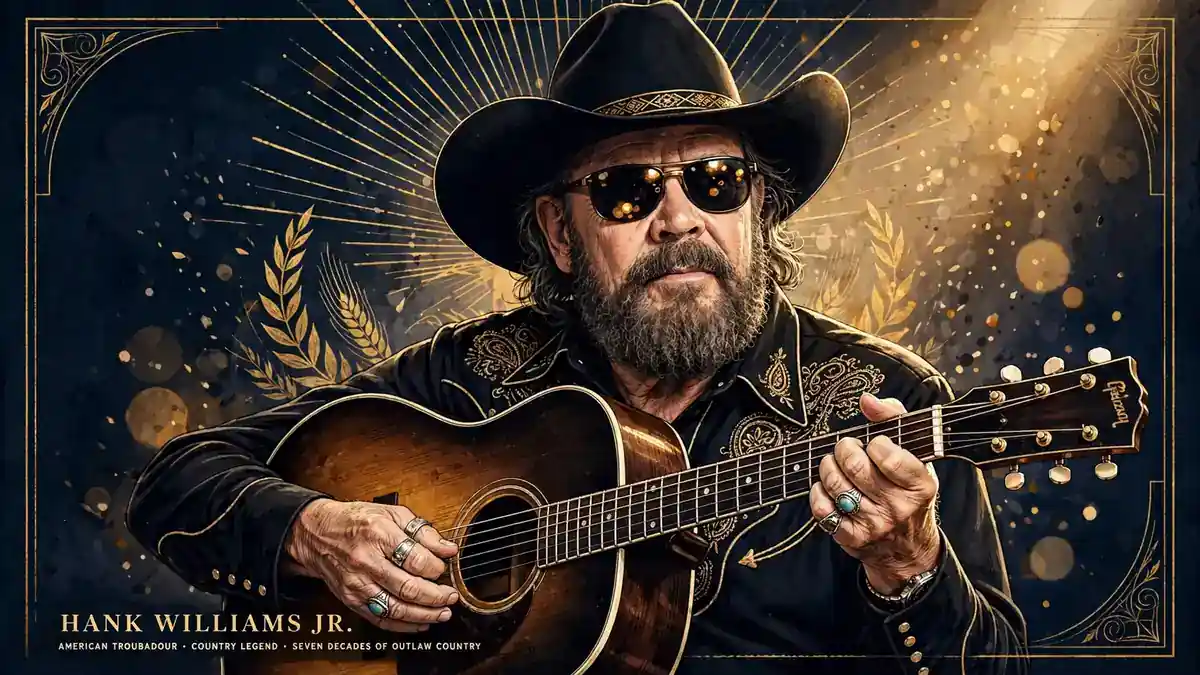
On August 8, 1975, while climbing Ajax Peak in Montana on the Continental Divide, the snow beneath Williams collapsed and he fell almost 500 feet onto rock. The fall shattered every bone in his face and exposed his brain to open air. He spent two years recovering, relearning how to talk and sing, and went through 17 operations to rebuild his skull and face. The beard, the sunglasses and the cowboy hat that became his visual trademark were not a style choice at first — they hid the scars. The accident was later dramatized in the made-for-television film Living Proof: The Hank Williams Jr. Story. He came back from it with a voice that was rougher, a look that was his own, and a catalog that finally sounded like Hank Williams Jr. rather than an echo of Hank Williams.
Education
Williams attended John Overton High School in Nashville, Tennessee, where he took his guitar to music class and played for pep rallies and choir performances. There is no college record and no formal music-school training on the public record, and none is needed to explain the career: his schooling was the stage, the session room and the musicians who visited his mother’s house. By the time most of his classmates were choosing colleges, he had already appeared on national television, cut his first record and sung his father’s part in a feature film.
That early start is a large part of the fortune. A performer who begins earning at 14 and is still headlining amphitheaters at 77 has banked more than six decades of checks — recording advances, publishing royalties, touring fees and, later, television licensing. Few country artists of his generation kept earning that long. The education section of his story is short because the career started before school ended.
Career Journey
The career splits cleanly into three acts, and the money follows the same split. Act one, 1964 to 1974, was the dutiful son: his father’s songs, his father’s style, steady country hits, and a growing sense that the act was a cage. Act two, 1975 to the late 1980s, was the rebuild: the Alabama move, the Southern rock turn, the mountain fall, and then the most productive run in country music. Act three, 1989 to today, is the institution: Monday Night Football, the Hall of Fame, and a touring business that never stopped.
The rebuild produced numbers that still stand out. Between 1979 and 1992, Williams released 21 albums — 18 studio albums and three compilations — and every one of them was certified at least gold by the Recording Industry Association of America. Between 1979 and 1990 he scored 30 Top Ten singles on the Billboard country chart, including eight No. 1s. Across his whole career the totals run to 44 Top Ten singles and 10 No. 1 singles. In 1982 he had nine albums on the Billboard Top Country Albums chart at the same time, all of them original works rather than compilations. Venue and tour listings put his lifetime album sales at 70 million worldwide, with six platinum albums and 20 gold albums, 14 No. 1 albums and 10 No. 1 singles.
The album titles from that run read like a map of the sound: Family Tradition (1979), Whiskey Bent and Hell Bound (1979), Habits Old and New (1980), Rowdy (1981), The Pressure Is On (1981), High Notes (1982), Strong Stuff (1983), Man of Steel (1983), Major Moves (1984), Five-O (1985) and Montana Cafe (1986). He was sometimes cutting two albums a year. “Family Tradition” gave him the mission statement — a son telling the world he was done apologizing for the family business — and “A Country Boy Can Survive” gave him the anthem that still closes his shows. The 1987 album Born to Boogie was the commercial peak of the run, and it arrived the same year the Country Music Association named him Entertainer of the Year for the first time.
The 1990s and 2000s were quieter on the charts but steady on the road. He kept recording, kept touring, and kept the catalog earning. His 54th studio album, Rich White Honky Blues, arrived in 2022, produced by Dan Auerbach of The Black Keys. The 12-song set was recorded live and built around blues standards by Robert Johnson, Lightnin’ Hopkins, R.L. Burnside and Muddy Waters. It debuted at No. 1 on the Current Country, Americana/Folk and Blues Albums charts at the same time — a triple-chart debut for a 73-year-old artist on his 54th album. MusicRow’s February 2026 tour report notes the same chart feat as the foundation of his current touring run. A catalog that deep is the closest thing country music has to an annuity: every stream, every sync, every reissue pays the same man.
Rise to Fame
Real fame, the kind that turned a working country singer into a household name, arrived twice. The first time was 1979 to 1982, when the outlaw-country reboot produced a run of hits and the CMA started handing him its biggest prize. He was named CMA Entertainer of the Year in 1987 and again in 1988, and won the Academy of Country Music’s Entertainer of the Year award three times, in 1987, 1988 and 1989. The CMA also credits him as a pioneer of the country music video: he won the association’s first Music Video of the Year award and took the trophy in three of the first five years it was given. At a moment when country videos were becoming a second radio, he was the genre’s first video star.
The second arrival was 1989, and it came from a football field. ABC asked him to rework his 1984 hit “All My Rowdy Friends Are Coming Over Tonight” into “All My Rowdy Friends Are Here on Monday Night,” and the line “Are you ready for some football?” became the opening of Monday Night Football. He held that slot from 1989 until 2011, and his opening themes won four Emmy Awards, in 1991, 1992, 1993 and 1994 — the first country artist ever to win an Emmy. He opened ABC’s last Monday Night Football broadcast on December 26, 2005, and re-recorded the theme when the show moved to ESPN in 2006.
The job ended in October 2011, on live television. Appearing on Fox & Friends, Williams compared President Barack Obama to Adolf Hitler, and ESPN pulled the theme within hours. The firing cost him the most visible weekly slot in American sports, and it also fixed his public image as country music’s loudest rebel — an image that, for his audience, was not a liability. ABC and ESPN brought the theme back in 2017, and it has run since. The six-year gap is part of the money story too: the theme was a long, steady licensing check, and its return in 2017 restored it. No figure for the Monday Night Football pay has ever been made public, and this article does not invent one. What the record shows is duration: 22 years in the first run, plus the current run since 2017.
The third act of fame came with an honor that had been overdue for years. On August 12, 2020, the Country Music Association announced Williams as part of the Country Music Hall of Fame class of 2020, in the Veterans Era Artist category, alongside Marty Stuart and songwriter Dean Dillon. The induction ceremony was delayed by the pandemic and finally held on November 21, 2021, at the Hall of Fame’s CMA Theater in Nashville. He joined his father, inducted in 1961, in the Hall’s rotunda. Hank Williams and Hank Williams Jr. are one of only two father-and-son pairs with separate inductions. The Hall of Fame did not add a dollar to his bank account, but it added something that pays in other ways: it made the catalog permanent, and permanent catalogs keep selling.
Main Sources of Income
Four streams built the fortune, and they have not changed much in 40 years: records, the road, television, and publishing. Records are the base. Seventy million albums sold worldwide, six platinum and 20 gold certifications, and a catalog of more than 50 studio albums means royalties arrive from every direction — physical sales, streaming, radio play, and licensing to film and television. A catalog this old and this deep earns even in years when the artist releases nothing, because the hits never leave country radio or streaming playlists. “Family Tradition,” “Whiskey Bent and Hell Bound,” “A Country Boy Can Survive,” “Born to Boogie” and “All My Rowdy Friends Are Coming Over Tonight” are permanent fixtures, and permanent fixtures pay every quarter.
Touring is the second stream and, in the 2020s, the largest single source of new cash. Williams never stopped touring, and the 2026 schedule shows why the road still matters: amphitheater dates across the summer, with special guests Joe Nichols, Sammy Kershaw and the Marshall Tucker Band on select shows. Amphitheater headliners of his stature command five- and six-figure guarantees per night before merchandise, and a summer of dates adds up fast. Ticket prices on the 2026 run, as listed by SeatGeek, run from about $30 at the low end to more than $130 for premium dates. The exact guarantee per show has never been disclosed, and per-show figures quoted by low-quality net-worth blogs — $50,000 to $100,000 a night — are unsourced guesses. This article reports them as guesses, not facts. What is documented is the scale: a full amphitheater summer, year after year, into his late 70s.
Television is the third stream, and the Monday Night Football theme is the single most valuable piece of music he ever made. The theme ran weekly on the most-watched sports broadcast in America for 22 years, returned in 2017, and earned him four Emmys. Television themes pay in layers — a licensing fee, performance royalties every time the show airs, and the kind of name recognition that sells concert tickets for decades. The theme also made him one of the few country artists whose name is known to people who never bought a country record.
Publishing and songwriting are the fourth stream. Williams wrote or co-wrote most of his hits, which means he collects both the recording royalty and the publishing royalty on them. He was inducted into the Nashville Songwriters Hall of Fame in 2007, a recognition of the writing catalog as much as the performing career. Songwriting royalties are the quiet part of a country fortune: they are smaller per check than a tour guarantee, but they arrive forever, and they do not depend on the artist’s health or willingness to travel.
Merchandise rounds out the picture. The Bocephus name — the nickname his father gave him — appears on tour merchandise and branded goods, and the rowdy-friends identity has been a merchandising asset since the 1980s. No verified sales figure for his merchandise business exists, so this article does not put a number on it. The point stands without one: a touring artist with a nickname, a catchphrase and a flag-waving fan base sells more than tickets.

Salary and Earnings
There is no salary to report, because Hank Williams Jr. has never drawn one. He is a self-employed touring and recording artist, and his income arrives as advances, royalties, guarantees and licensing fees — lumpy, seasonal, and private. No contract, tax filing or court record has ever made his annual earnings public, and any site that publishes a precise annual income for him is guessing. The honest picture is a range built from the pieces that are public.
The record side is the most stable piece. With 70 million albums sold and a catalog that streams steadily, royalty income in a normal year runs into seven figures before touring is counted, based on standard industry royalty rates applied to a catalog of this size — an estimate, not a reported figure. The touring side is the swing factor: a summer amphitheater run with 15 to 25 dates, at headliner guarantees, is worth several million dollars in gross fees before costs, and Williams has run that schedule for most of the last four decades. The television side is the steadiest: the Monday Night Football theme has paid performance royalties for more than 25 seasons across its two runs, and a weekly national broadcast theme is one of the best-paying pieces of music in the business.
One claim deserves a direct answer because it circulates widely. CineNetWorth, a net-worth content site, states that Williams earns “around $5 million” a year from Monday Night Football. That figure appears on no primary source, no trade report and no ESPN disclosure we could find, and it is not repeated here as fact. It is a single-site estimate, and single-site estimates of a private licensing deal are not evidence. The same caution applies to the $50,000-to-$100,000 per-show figures on some blogs. Readers should treat any precise annual salary figure for Williams as invented unless it names a source.
The growth table later in this article shows how the estimate moved over time. The shape of it is what matters: slow growth through the 1980s as the gold and platinum certifications piled up, a jump in the 1990s as the Monday Night Football money compounded, and steady growth since, driven by the catalog and the road rather than by new hits. He never had a single payday that made the fortune. He had 60 years of paydays.
Businesses and Investments
Williams never built a business empire in the way some country stars did — no restaurant chain, no tequila brand, no real-estate fund with his name on it. His business is himself: the touring operation, the catalog, and the Bocephus brand. That is a narrower portfolio than a diversified investor, and it is also the reason the fortune survived. There was no big borrowed-money bet to go wrong, no chain of restaurants to close, no outside venture to drain the music money.
The touring operation is the business. A headlining amphitheater act is a small company: a band, a crew, trucks, sound and lights, a promoter split and a merchandise operation. Williams has run that company, in one form or another, since the late 1970s, and the 2026 tour — announced through Live Nation, with tickets sold through the major ticketing platforms — shows it is still a going concern. The economics favor the artist at his level: the promoter takes the risk on the room, the artist takes a guarantee plus a share of the upside, and the merchandise table is nearly all margin.
On investments, the public record is thin, and this article says so rather than filling the gap with guesses. Several low-quality net-worth sites credit Williams with a clothing line, a restaurant chain and a liquor company, complete with revenue figures — “over $10 million in annual revenue” for the clothing line, “over $5 million” for the restaurant. None of those claims names a company, a filing, a trademark or a single verifiable business record, and they appear to be copied from one content farm to another. We could not verify a single one, so none of them is reported here as fact. What is verifiable is the catalog itself, which is the investment that matters: songwriting and recording royalties on 50-plus albums are an income-producing asset that has paid for four decades and will pay his estate long after he stops touring.
The family estate is a separate matter. His father’s catalog — the Hank Williams songbook — has been the subject of decades of legal wrangling, and Williams has been involved in disputes over his father’s estate and royalties at various points. The details of those settlements are mostly sealed or unreported, and this article does not put a dollar figure on them. The point for the net-worth picture is that the son’s fortune was built on his own catalog, not inherited: his father died at 29, in debt and in chaos, and the estate his son eventually shared in was built up over decades, not handed over in 1953.
Brand Deals and Sponsorships
Endorsements were never a major pillar of the fortune, and that is part of the story. Williams built his brand on being the rowdy outsider, and rowdy outsiders do not get many family-friendly sponsorships. The 2011 Fox & Friends episode that cost him the Monday Night Football theme is the clearest example of the trade-off: the same bluntness that fills amphitheaters makes corporate partners nervous. He has appeared in commercials over the years — Pepsi and Geico are the two names that surface most often in profiles — but no endorsement contract value has ever been reported, and no long-term brand ambassadorship is on the public record.
The Monday Night Football theme was, in effect, his biggest brand deal, and it came from a broadcaster rather than a consumer brand: ABC, then ESPN, paid for the most recognizable 30 seconds in sports television. The four Emmy Awards it earned him are the only major television awards in his trophy case, and they came from that deal. Beyond it, the commercial work that exists is small and scattered — voice work, cameos, and the kind of one-off appearances that pay a fee and leave no paper trail.
For readers comparing him with modern country stars, the contrast is instructive. Today’s arena headliners routinely add seven-figure endorsement portfolios to their touring income. Williams, who came up in an era when country artists sold records and tickets and not much else, made his money the older way. The fortune is smaller than a modern superstar’s for exactly that reason — and it is also more durable, because it does not depend on a sponsor’s mood.

Houses, Cars and Other Assets
Williams has long been based in the Nashville area, and the Franklin, Tennessee, estate that net-worth sites describe is the one property claim that circulates with a number attached — about $3.5 million, according to CineNetWorth. That figure is a single-site estimate with no property record, listing or tax assessment cited, so it is reported here as a claim, not a fact. No verified public record of a current home purchase price, mortgage or sale exists for Williams, and this article does not invent one. What the record does show is a life centered on Tennessee for six decades, from the Nashville high school where he played pep rallies to the Hall of Fame rotunda a few miles away.
On cars, the public record is silent. No verified report lists a car collection, a prized vehicle or a purchase price for Williams, and the articles that describe his garage in detail are content-farm inventions. A man who spent his life on tour buses has not made cars part of his public image, and there is nothing honest to add beyond that. The same applies to boats, planes and other trophy assets: no verified record exists, so none is claimed.
The real assets are the ones that do not photograph well. First, the recording catalog: more than 50 studio albums, 21 of them at least gold between 1979 and 1992, with the master and publishing rights generating royalties every quarter. Second, the songwriting catalog, recognized by the Nashville Songwriters Hall of Fame in 2007. Third, the touring business and the Bocephus brand, including the Monday Night Football theme, which is both a royalty stream and a permanent piece of American television history. Fourth, the family name itself, which carries value in licensing and reissues. None of these has a published valuation, which is why the net-worth figure is a range rather than a number. A catalog is worth what a buyer will pay for it, and no buyer has ever published a price for his.
Awards and Achievements
The trophy case tells the story in shorthand. Williams won the CMA Entertainer of the Year award in 1987 and 1988, and the ACM Entertainer of the Year award three times, in 1987, 1988 and 1989 — five Entertainer of the Year wins across the two academies in three years, a run no country artist of his generation matched. He won the Grammy Award for Best Country Collaboration with Vocals in 1990 for “There’s a Tear in My Beer,” the virtual duet with his late father, a record that stitched his voice to a recording his father made decades before he was born. He won four Emmy Awards, in 1991, 1992, 1993 and 1994, for the Monday Night Football opening themes — the first country artist ever to win an Emmy.
He was a pioneer of the country music video, winning the CMA’s first Music Video of the Year award and taking the trophy in three of the first five years it was awarded. He was inducted into the Nashville Songwriters Hall of Fame in 2007. And in 2020 he was announced as a member of the Country Music Hall of Fame class of 2020, in the Veterans Era Artist category, with the induction ceremony held on November 21, 2021. He joined his father, inducted in 1961, in the Hall’s rotunda.
The chart achievements sit alongside the trophies. Ten No. 1 singles and 44 Top Ten singles on the Billboard country chart. Fourteen No. 1 albums. Six platinum albums and 20 gold albums. Twenty-one albums certified at least gold in a 13-year window, 1979 to 1992. Nine albums on the Billboard Top Country Albums chart at the same time in 1982. Seventy million albums sold worldwide. Those are the numbers that explain the fortune better than any single award: awards are voted on, but gold records are bought, one at a time, by people who kept coming back for 40 years.
Net Worth Growth Over the Years
The fortune grew the way catalog fortunes grow: slowly, then all at once, then slowly again. The table below is NetWorthCraft’s estimate of that path, built from the career record — gold and platinum certifications, chart runs, the Monday Night Football years and the touring record — not from any published annual figure, because no such figure exists. Treat each row as a band, not a bank statement.
| Year | Estimated net worth | What moved it |
|---|---|---|
| 1980 | About $5 million | Family Tradition and Whiskey Bent and Hell Bound turn the outlaw reboot into gold records |
| 1990 | About $15 million | Ten No. 1 singles banked, CMA and ACM Entertainer of the Year wins, Monday Night Football theme begins in 1989 |
| 2000 | About $25 million | Catalog royalties compound; touring continues through the 1990s |
| 2010 | About $35 million | Two decades of Monday Night Football royalties; 70-million-albums-sold catalog keeps earning |
| 2020 | About $40 million | Country Music Hall of Fame induction; catalog streaming grows |
| 2026 | $40 million to $50 million | Rich White Honky Blues (2022), Monday Night Football theme back since 2017, 2026 amphitheater tour |
For scale, LoveMoney’s March 2026 ranking of the richest country music stars — built on Celebrity Net Worth estimates — places Williams tied at No. 23 with Dwight Yoakam, both at $45 million. That is the honest neighborhood for his fortune: far below the stadium-pop crossover stars, and far above most of the working country acts who never had a 40-year catalog or a weekly network television theme. Fellow country touring earners of his era show the same pattern — a long road career plus a deep catalog beats a short hot streak — as our profiles of Blake Shelton’s net worth and Miranda Lambert’s net worth show from the other side of the same business.
The 2026 tour is the clearest sign the number is still moving. An artist who adds seven dates in February, as MusicRow reported on February 17, 2026, and fills amphitheaters from Tampa in June to Bangor in August, is not winding down a business. He is running it. The fortune’s next move depends on the same two things it has always depended on: whether he keeps touring, and whether the catalog keeps selling. At 77, with a new tour and a chart-topping blues album behind him, both answers are still yes.
Social Media Presence
Williams keeps a lighter social media footprint than the country stars who came up with Instagram already in their pockets, and that fits the audience. Tour dates and announcements go out through his official site, hankjr.com, and his Instagram account, which was the channel for the February 17, 2026 announcement of seven new tour dates. He also maintains a presence on Facebook and X, where clips of the Monday Night Football theme and tour footage circulate every autumn. Follower counts shift daily and are not the point of this section; the point is that a 77-year-old artist who started on The Ed Sullivan Show now announces tours on Instagram, and the tickets still sell.
The social footprint also does quiet work for the fortune. Every tour announcement drives ticket sales, every clip of “A Country Boy Can Survive” drives streams, and every autumn the Monday Night Football theme drives a fresh wave of searches from football fans who have never bought a country record. That seasonal spike is part of why the name still trends every September. For a catalog artist, attention is inventory, and the football season restocks it for free.
Personal Life
Williams has been married five times and has five children, four of whom became professional musicians. His first wife was Sharon Martin (1969–1971). His second was Gwen Yeargain (1971–1977); their son Shelton Hank Williams, born December 12, 1972, performs as Hank Williams III, moving between country, punk and heavy metal. His third wife was Becky White (1977–1983); their daughters are Hilary Williams, born in 1979, and Holly Williams, born March 12, 1981, both singer-songwriters. His fourth wife was Mary Jane Thomas, married in 1990; their children are Katherine “Katie” Williams-Dunning, born in 1993, and Sam Williams, born in 1997.
The family has known hard losses in recent years. Katie Williams-Dunning, the only one of his five children who did not pursue a music career, died in a car crash in Tennessee on June 13, 2020, at 27. Mary Jane Thomas died on March 22, 2022, at 58, after complications from a medical procedure — a collapsed lung, according to the Palm Beach County medical examiner. On September 9, 2023, Williams married his fifth wife, Brandi, a long-time friend since 2003; the couple had become engaged on Mother’s Day that year. His grandson Coleman Williams, Hank III’s son, also performs. He is the half-brother of Jett Williams, his father’s daughter by another relationship.
One rumor needs a straight answer because it still circulates: Hank Williams Jr. is alive. Several low-quality, AI-generated net-worth sites claim he died in 2023, and at least one puts his net worth “at the time of his passing in 2023.” Both claims are false. He is alive, he announced new tour dates in February 2026, and he played a full summer amphitheater schedule in 2026. The death stories are content-farm inventions, and this article flags them because they are the single most common falsehood attached to his name on the internet today.
Politics have been part of his public life since the 2011 Fox & Friends appearance that cost him the Monday Night Football theme, and he has never softened the image since. The rowdy-friends persona — the hat, the sunglasses, the beard, the flag-waving anthems — is not a costume he puts on for the stage. It is the public identity he built after the mountain fall, and it is the identity his audience pays to see. Whatever a reader thinks of the politics, the business point is plain: the persona is the brand, the brand fills the rooms, and the rooms pay the fortune.
Sources & Reporting
Reporting window: November 2026. Every money figure in this article traces to one of the outlets below, or is labeled as a NetWorthCraft estimate. Where sources disagreed, we published the range and named the disagreement.
- Celebrity Net Worth — the $45 million net-worth estimate, updated September 25, 2025; the anchor for our range.
- LoveMoney — March 2026 ranking of the richest country music stars, repeating the $45 million figure and placing Williams tied at No. 23 with Dwight Yoakam.
- The CA Knowledge — the $40–$45 million band and the 2026 touring status.
- Country Thang Daily — the $45 million figure with a Celebrity Net Worth attribution, updated October 5, 2026, and the family and children reporting.
- MusicRow — the February 17, 2026 report of seven new tour dates, the June 5 Tampa start, the special guests, and the Rich White Honky Blues chart debut.
- Parade — the February 18, 2026 tour report, ticket sale dates and the Instagram announcement.
- Wikipedia — birth and family details, the Ajax Peak fall and 17 surgeries, the 1979–1992 gold-album run, the 44 Top Ten and 10 No. 1 singles, the marriages and children, and the 2020 Hall of Fame induction.
- Britannica — the biography, the Alabama move, the outlaw sound, the four Emmy Awards and the 1987–1988 CMA Entertainer of the Year wins.
- CMA — the August 12, 2020 Hall of Fame class announcement, the Veterans Era Artist category, and the CMA Entertainer of the Year and Music Video of the Year records.
- Nashville Songwriters Hall of Fame — the 2007 induction and the Hank Williams Jr. and Friends history.
- SeatGeek — 2026 tour dates and ticket price ranges, and the Rich White Honky Blues album details.
- Riverbend Music Center — the 70 million albums sold, six platinum and 20 gold albums, 14 No. 1 albums and 10 No. 1 singles, and the September 12, 2026 Cincinnati date.
Outlets whose figures we set aside, with reasons: The Most 10 ($50 million for 2026, single-site projection, noted as the top of our range); AIMSurplus ($100 million, unsourced); the TinyCC content-farm pages ($25 million and $60–$100 million ranges, unsourced and internally contradictory); and the blogspot page claiming a 2023 death, which is false. CineNetWorth’s $5 million annual Monday Night Football figure and $3.5 million Franklin estate value are single-site estimates with no cited source and are reported here as claims, not facts.
Frequently Asked Questions
What is Hank Williams Jr.’s net worth in 2026?
Hank Williams Jr.’s net worth is estimated at $40 million to $50 million as of November 2026, anchored on Celebrity Net Worth’s $45 million figure (updated September 25, 2025). LoveMoney’s March 2026 ranking repeats $45 million. The range reflects disagreement among outlets, not a precise bank balance — no audited financial statement exists for Williams.
Is Hank Williams Jr. still alive?
Yes. Hank Williams Jr. is alive and touring in 2026. He announced seven new tour dates on February 17, 2026, and played a full summer amphitheater schedule, starting June 5 in Tampa. Claims on some low-quality sites that he died in 2023 are false.
How old is Hank Williams Jr.?
Hank Williams Jr. was born Randall Hank Williams on May 26, 1949, in Shreveport, Louisiana. He turned 77 in May 2026. He is the son of country legend Hank Williams, who died in 1953 when Hank Jr. was three years old.
What happened to Hank Williams Jr. in the mountain accident?
On August 8, 1975, while climbing Ajax Peak in Montana, the snow beneath Williams collapsed and he fell almost 500 feet onto rock. The fall shattered every bone in his face and exposed his brain. He spent two years recovering, relearning how to talk and sing, and had 17 operations to rebuild his face. The beard, sunglasses and cowboy hat he wears today began as a way to hide the scars.
How much did Hank Williams Jr. make from Monday Night Football?
No verified figure has ever been published for his Monday Night Football pay. The theme, “Are You Ready for Some Football?”, ran from 1989 to 2011, returned in 2017, and won him four Emmy Awards. One net-worth site claims about $5 million a year, but that figure has no cited source and is not repeated here as fact. What is documented is the duration: more than 25 seasons across the two runs.
Who is Hank Williams Jr.’s wife?
Hank Williams Jr. has been married five times. His fourth wife, Mary Jane Thomas, was married to him from 1990 until her death in March 2022. He married his fifth wife, Brandi, on September 9, 2023. His earlier wives were Sharon Martin, Gwen Yeargain and Becky White.
How many children does Hank Williams Jr. have?
He has five children: Hank Williams III (born 1972), Hilary Williams (born 1979), Holly Williams (born 1981), Katherine Williams-Dunning (1993–2020) and Sam Williams (born 1997). Four of the five became professional musicians. His daughter Katie died in a car crash in Tennessee on June 13, 2020, at age 27.
How tall is Hank Williams Jr.?
Published listings for Hank Williams Jr.’s height vary, from 5 ft 11 in to 6 ft 2 in. Most profiles list him at about 6 ft 1 in (185 cm). No official height has ever been published, so the figure is approximate.
Final Thoughts
Hank Williams Jr.’s $40 million to $50 million fortune is the payoff for the longest rebuild in country music. He spent his first decade as a tribute act to a father he barely knew, nearly died on a Montana mountain, and came back with a sound, a look and a catalog that belonged to him alone. The numbers that built it are not mysterious: 70 million albums sold, 21 albums certified at least gold in 13 years, 10 No. 1 singles, five Entertainer of the Year wins, four Emmys, and a football theme that paid him for more than 25 seasons.
The honest version of the story is also the interesting one. There was no single payday, no business empire, no endorsement portfolio. There was a catalog that never stopped earning, a touring business that never stopped running, and a television theme that turned a country singer into a weekly fixture in American living rooms. At 77, with a No. 1 blues album behind him and a 2026 amphitheater tour in front of him, the fortune is still doing what it has done for 40 years: growing slowly, on the road and on the record.
Published on November 19, 2026. Last reviewed November 2026. Found an error? See our corrections policy.