
Grace Jones‘s net worth is estimated at $7 million to $10 million as of November 2026. The most-cited figure, $7 million, comes from Celebrity Net Worth, and a small set of newer trackers stretches the top of the range to $10 million. Her money was built across five decades and four careers at once: a Paris runway model who became a disco star, then a new-wave recording artist, then a film villain, and now a festival headliner still selling out rooms at 78.
Grace Jones: Quick Facts
| Estimated net worth | $7 million (range: $7 million to $10 million) |
|---|---|
| Profession | Singer, songwriter, model, actress |
| Nationality | Jamaican |
| Born | May 19, 1948 (age 78) |
| Height | 5 ft 8 in (1.73 m) |
| Primary income sources | Music royalties and live shows, film and television, modelling and fashion campaigns, memoir and licensing |
| Active years | 1973–present |
| Last reviewed | November 2026 |

- Early Life and Background
- Education
- Career Journey
- Rise to Fame
- Main Sources of Income
- Salary and Earnings
- Businesses and Investments
- Brand Deals and Sponsorships
- Houses, Cars and Other Assets
- Awards and Achievements
- Net Worth Growth Over the Years
- Social Media Presence
- Personal Life
- Sources & Reporting
- Frequently Asked Questions
- Final Thoughts
Early Life and Background
Grace Beverly Jones was born on May 19, 1948, in Spanish Town, Saint Catherine, Jamaica, to Marjorie Williams Jones and Robert W. Jones. Her father was an Apostolic clergyman and a local politician; her mother kept the household running under the strict rules of the Pentecostal church. That upbringing — church three times a week, no dancing, no popular music in the house — became the foil for everything Jones later became on stage. She has said the discipline of that childhood stayed with her even as she broke every one of its rules in public.
Her parents moved to the United States for work while Grace and her siblings stayed in Jamaica, raised largely by their maternal grandparents. She grew up between two worlds: a rural Jamaican childhood shaped by her grandparents and the church, and the knowledge that her parents were building a life in New York State. At 13 she joined them in Syracuse, New York, a move that put her in American classrooms for the first time and set up the culture shock she later turned into stagecraft. Syracuse in the early 1960s was a long way from Spanish Town, and Jones has described herself as an outsider there from the start — tall, watchful, and already aware that standing out was a skill she could use.
The family details matter to the money story because Jones did not arrive in show business with connections or capital. Her parents were working people, not entertainment figures, and her first paid work had nothing to do with fame. What she carried out of Jamaica was a voice, a look, and a willingness to be stared at — assets that cost nothing and, in the fashion world of the early 1970s, turned out to be worth a great deal. Her brother, Bishop Noel Jones, later became a well-known Pentecostal minister in Los Angeles, a reminder that the family’s religious roots ran deep even as Grace took the opposite road.
By her late teens Jones was moving between Syracuse and New York City, picking up work as a go-go dancer and drifting through the counterculture of the late 1960s. She has been open in her memoir about experimenting with drugs in that period and about living in hippie communes — a phase she treats as education of a different kind. The through-line is that she learned early how to hold a room, how to use her body as a visual statement, and how little she cared about other people’s comfort. Those three lessons became the foundation of a modelling career, then a music career, then a film career, each one paying better than the last.
Education
Jones attended Onondaga Community College in Syracuse before studying theatre at Syracuse University. The theatre training shows in everything she did afterwards: her stage shows were choreographed like plays, her album covers were composed like portraits, and her film roles were played with a physical precision that read as training rather than accident. She did not finish a degree. Modelling work pulled her to New York City, and the pay for a working model in the early 1970s beat anything a student job could offer.
That decision — to leave formal study for paid work in front of a camera — was the first of many times Jones chose a cheque over a credential. It also explains why her education shows up in her work as craft rather than as a line on a résumé. She learned stage discipline in a university theatre department, then learned the business of being looked at in New York and Paris studios. The combination made her unusual among models of the period: she could pose, she could move, and she could hold a character. Photographers noticed, and the photographers who noticed were the ones who set rates.
Career Journey
Jones signed with Wilhelmina Models in New York and worked steadily through the early 1970s, then moved to Paris, where her angular features and androgynous presence fitted a fashion moment that New York had not yet caught up with. In Paris she worked for Yves Saint Laurent and Kenzo, appeared on the covers of Elle and Vogue Hommes, and was photographed by Helmut Newton, Guy Bourdin and Hans Feurer — three of the most influential fashion photographers of the decade. For a Black model in the 1970s, that run of covers and campaigns was rare, and it paid accordingly: top Paris models of the period commanded day rates that dwarfed ordinary wages, and Jones was working for the houses that set them.
Music came next, and it came through the same rooms. By 1977 she had signed with Island Records, the label that had built its name on reggae and was expanding into disco. Her first three albums — Portfolio (1977), Fame (1978) and Muse (1979) — were disco records made for the Studio 54 crowd, and her version of Édith Piaf’s “La Vie en Rose” became her calling card. The disco years paid in club fees, record advances and a growing live draw, but they also boxed her in as a novelty act. Jones knew it, and the move she made next is the one that defines her career.
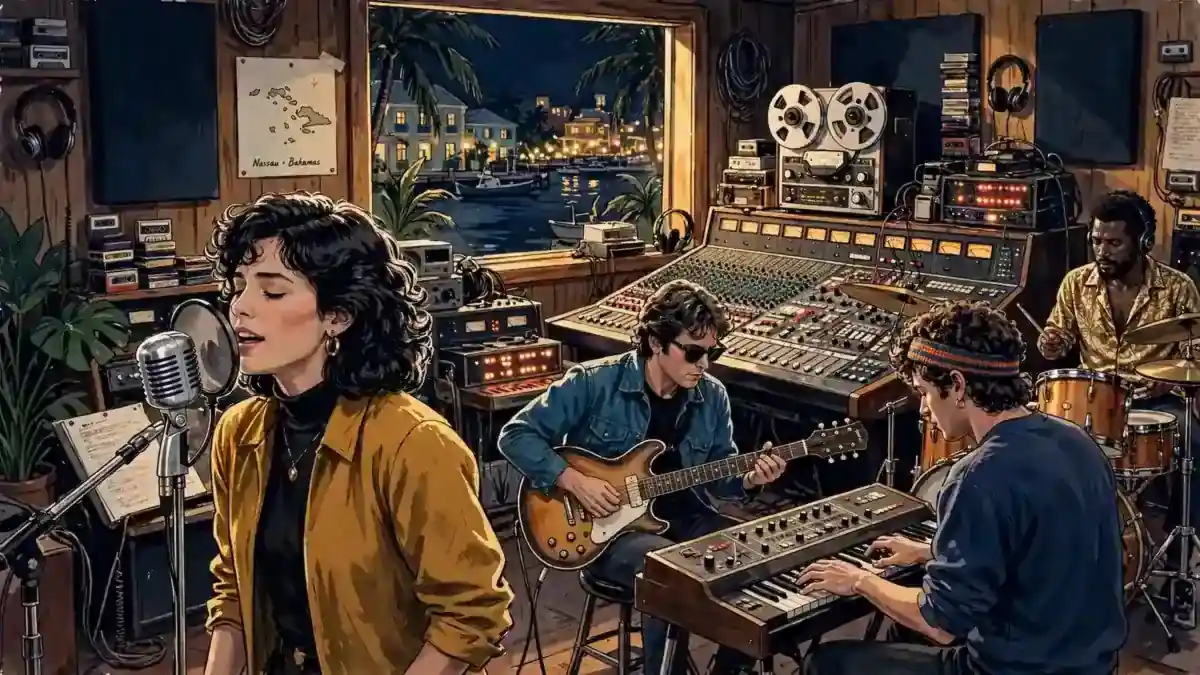
In 1980 she went to Compass Point Studios in Nassau, Bahamas, to work with the Jamaican rhythm section Sly & Robbie and producer Alex Sadkin. The three albums that followed — Warm Leatherette (1980), Nightclubbing (1981) and Living My Life (1982) — swapped disco gloss for a hard, spare sound built on reggae, funk and post-punk. Nightclubbing carried “Pull Up to the Bumper” and “I’ve Seen That Face Before (Libertango)”; Warm Leatherette gave her “Private Life” and the title track. These are the records that still earn: they are licensed, streamed, sampled and reissued, and they anchor every Jones setlist more than forty years on.
The visual side of the Compass Point years was inseparable from the sound. Her partner at the time, French graphic designer Jean-Paul Goude, built her image — the flat-top haircut, the severe cheekbones, the geometric poses — into one of the most recognisable brands in pop. The Island Life compilation cover of 1985, with Jones twisted into an arabesque, is routinely listed among the greatest album covers ever made. That image work was not decoration; it was the product. It got her fashion campaigns, film auditions and, eventually, the Bond role that paid her best film money.
Slave to the Rhythm arrived in 1985, produced by Trevor Horn, and it was both a single and an album built around one song in multiple versions — an unusual, expensive way to make a record that signalled Island still believed Jones could sell. Inside Story followed in 1986, Bulletproof Heart in 1989, and then a long recording silence that lasted until Hurricane in 2008. The gap looks like retirement from the outside; from the inside it was a shift toward live work, where the fees were immediate and the overhead was lower than funding albums that might not recoup.
Film ran alongside the music through the 1980s. Small independent roles in the 1970s — Gordon’s War in 1973, Let’s Make a Dirty Movie in 1976 — gave way to her first mainstream part as Zula the warrior in Conan the Destroyer (1984), opposite Arnold Schwarzenegger. A year later she was May Day in the James Bond film A View to a Kill (1985), opposite Roger Moore, and in 1986 she starred as the vampire Katrina in Vamp. All three films cast her the same way — physical, dangerous, impossible to ignore — and all three paid her as a featured supporting player rather than a lead, which is an important distinction when weighing her film earnings against her music income.
The 1990s and 2000s brought fewer films — Boomerang (1992) with Eddie Murphy, Wolf Girl (2001) with Tim Curry — and more selective live work. She published her memoir, I’ll Never Write My Memoirs, with Paul Morley in 2015, a book that sold on her name and her stories rather than on scandal. Then came the second act that rewrote her earning power for a new generation: curating the Meltdown Festival at London’s Southbank Centre in 2022, guesting on Beyoncé’s “Move” from Renaissance the same year, and appearing on Janelle Monáe’s “Ooh La La” from The Age of Pleasure in 2023. Each of those moves put her in front of audiences who had not been born when Nightclubbing came out — and each one carried a fee.
Rise to Fame
Jones did not have a single breakout moment; she had three, in three different industries, and that is why her fame has lasted longer than most of her contemporaries. The first was fashion: by the mid-1970s she was one of the most photographed Black models in Paris, and her face on a magazine cover was a statement in itself. The second was music: Nightclubbing in 1981 turned a disco singer into a new-wave artist with a sound nobody else had, and “Pull Up to the Bumper” reached No. 2 on the US dance chart. The third was film: May Day in A View to a Kill made her recognisable to audiences who had never bought a record, and the role is still the first thing most people name when asked about her.
The Bond role deserves a closer look because it explains how a supporting player becomes a household name. May Day is on screen for a fraction of the film’s running time, but Jones played her with such force — the costumes, the physicality, the fight scenes — that she walked away with the film’s most memorable performance after Christopher Walken’s villain. The part earned her a Saturn Award nomination for Best Supporting Actress and a Bravo Otto Silver award for Best Female Actress in 1985, and it put her on talk shows and magazine covers on both sides of the Atlantic. It also introduced her to Dolph Lundgren, who worked as her bodyguard on the production and later became her partner; Lundgren’s own acting career started from the visibility that connection gave him.
What held the fame together was the image. Goude’s photographs and videos — the A One Man Show video collection of 1982, which earned a Grammy nomination for Best Video Album — made Jones look like no one else in pop. In an era when female pop stars were styled to be approachable, Jones was styled to be untouchable, and audiences paid to see the difference. Her influence runs through the artists who followed her: Madonna’s net worth was built on a model of reinvention and visual control that owes an obvious debt to Jones, and the same is true of the generation of pop stars who treat the image as the art. That influence is now her most durable asset — it is what gets her booked at 78, when the records themselves are forty years old.
The 2020s gave her a fourth wave. Curating Meltdown in 2022 — announced for 2020 and delayed by the pandemic — put her in charge of one of Britain’s most respected festivals, and her closing set announced a new record she described as an “African hybrid” project. The Beyoncé feature the same year earned her another Grammy nomination, this time as a featured artist on Renaissance, and put her voice on a record that won Album of the Year nominations and sold in the millions. By 2025 she was playing the Montreux Jazz Festival and a headline show at Brooklyn’s Lena Horne Bandshell; in 2026 she opened the year with Australian dates and a headline slot at London’s Crystal Palace Bowl on July 31. A career that most obituaries would have closed in 1990 is still generating fees in 2026.
Main Sources of Income
Jones’s income has never come from one stream, and that spread is the reason a $7 million fortune survived five decades without a single blockbuster payday. The streams, in rough order of lifetime contribution, are music, live performance, film, modelling and fashion, and licensing and publishing. No one stream dominates, which is unusual for a pop star and useful for an estimate: it means the total does not depend on any single royalty statement or film contract.
Music is the base. Her Island Records catalogue — ten studio albums from Portfolio in 1977 to Hurricane in 2008 — earns from streaming, vinyl and CD reissues, sync placements in film and advertising, and sampling. Nightclubbing is the workhorse: “Pull Up to the Bumper” and “I’ve Seen That Face Before (Libertango)” appear in films, adverts and DJ sets every year, and each placement pays. Far Out Magazine puts her total record sales at more than 7 million — a modest number by superstar standards, and one reason her net worth sits at $7 million rather than $70 million. She was a cult artist with a loyal audience, not a chart-topper, and her catalogue earns like one: steady, modest, and long-lived.
Live performance is the stream that pays best now. Jones tours selectively — a handful of festival headlines and theatre dates a year rather than a months-long slog — and selective scarcity keeps her fee high. Her 2025 dates included the Montreux Jazz Festival in July and a headline show at the Lena Horne Bandshell in Brooklyn on June 9; her 2026 calendar opened with Australian dates in Sydney, Melbourne, Brisbane and Adelaide, followed by a July 31 headline at London’s Crystal Palace Bowl and a July 24 date at Amnesia in Ibiza. Ticket listings for her 2026 shows put standard seats in the region of $70 to $250, with premium seats above that. Promoters do not publish her fee, and this article does not guess at it, but a headline artist with her draw at a 5,000-capacity outdoor show is paid as a headline artist, not as a nostalgia act.
Film and television paid her best money in the 1980s and still pays in residuals. Conan the Destroyer, A View to a Kill and Vamp were studio films with wide releases, and supporting-player contracts on studio films of that era carried residuals on television, video and later streaming. The sums were not lead-actor money — Jones was a featured player, and the billing reflects that — but three studio films in three years, plus Boomerang in 1992, built a residuals tail that has run for forty years. Television appearances, documentaries and the 2017 documentary Grace Jones: Bloodlight and Bami added smaller fees along the way.
Modelling and fashion paid early and keeps paying late. The 1970s Paris campaigns for Yves Saint Laurent and Kenzo, the magazine covers, and the Helmut Newton and Guy Bourdin shoots were day-rate work at the top of the market. The later fashion work is different in kind: in 2023 she fronted Wolford’s spring-summer campaign, a luxury-brand booking that pays a mature star for her name and her look rather than for hours on set. Campaign fees for a figure of her standing are negotiated privately, and this article does not publish a number for them, but the Wolford booking shows the fashion income did not end with the 1970s.
Publishing and licensing round out the picture. Her 2015 memoir, I’ll Never Write My Memoirs, written with Paul Morley, earned an advance and ongoing royalties; it also refreshed her public profile at a moment when a new generation was discovering her through fashion and film references. Licensing of her image — the Goude photographs, the Island Life cover, the Slave to the Rhythm artwork — is a smaller but real stream, and her guest features on Renaissance in 2022 and The Age of Pleasure in 2023 carried both fees and a share of streaming royalties. For readers comparing her with peers of the same era, Janet Jackson’s net worth shows what the same decades look like with multi-platinum album sales behind them — Jones earned less from records and more, proportionally, from image and live work. More musician fortunes from the same era are collected in our musicians archive.
Salary and Earnings
Here is the honest position: no verified salary figure exists in the public record for any single Grace Jones job. No studio contract, record-company advance, or tour guarantee has ever been published, and the per-film and per-album figures that circulate on low-quality net-worth blogs — a few hundred thousand dollars for Conan the Destroyer, half a million for A View to a Kill, seven-figure album royalties — carry no source and no paperwork. This article does not repeat them as fact. Readers should treat any site that quotes an exact Jones film salary as guessing, because the documents that would prove it have never surfaced.
What can be said with confidence is structural. In the 1980s, a featured supporting player on a studio film earned a flat fee plus residuals, not a percentage of the gross; Jones’s three studio films in 1984–86 would have paid her as a name supporting actor, with the Bond film paying the most of the three because the franchise paid a premium for its villains. Her Island Records deals paid advances against royalties, and the Compass Point albums were made cheaply in Nassau with a small band — Sly & Robbie, Wally Badarou, Barry Reynolds — which kept recording costs down and left more of the advance in her pocket. The disco albums before them were more expensive to make and sold less, which is one reason the Compass Point years were the better business as well as the better art.
The touring economics are clearer. A headline festival set in 2025–26 pays an artist of Jones’s standing a five-figure fee per show at minimum, and often well into six figures for a major festival headline — but the exact figure depends on the promoter, the territory and the billing, and none of her recent contracts have been reported. What is verifiable is the volume: she plays a small number of high-profile dates a year, which is the pattern of an artist who can afford to choose. An artist who needed the money would play more rooms; Jones plays the rooms she wants.
The memoir advance is the same story. I’ll Never Write My Memoirs was published by Simon & Schuster in 2015, and advances for celebrity memoirs of that kind run from the low six figures upward — but the publisher has never disclosed the figure, and this article will not invent one. The book’s value to her finances was probably less in the advance than in the tour of interviews and appearances that came with it, each one carrying a fee, and in the way it reintroduced her to a generation that then bought tickets to her shows.
One comparison puts the scale in perspective. Prince’s net worth at his death was valued in the hundreds of millions on the strength of a vast catalogue, publishing rights and a recording career that sold tens of millions of albums. Jones sold a fraction of that — Far Out Magazine’s figure of more than 7 million records is the best available estimate — and she never owned a publishing catalogue of Prince’s size. Her $7 million is the fortune of a working artist with a long tail, not of a catalogue owner, and the comparison explains the gap without needing to invent a missing fortune.
Businesses and Investments
Jones never built a business empire, and that is a deliberate part of her financial story. There is no Jones-branded fashion label with stores, no restaurant chain, no beauty line, no venture fund. A handful of low-quality sites credit her with a clothing line and a fragrance; neither has a verifiable launch, a company filing, or a product record attached to it, and this article treats both claims as unproven. What she did build was a personal brand — her image, her name, her look — and she monetised it through fees and licences rather than through companies she owned.
The closest thing to a business in her career is the image itself, built with Jean-Paul Goude. The photographs, the album covers, the videos and the stage costumes were a joint creation, and their licensing value has lasted decades. The Island Life cover, the Slave to the Rhythm artwork and the A One Man Show videos are licensed for books, exhibitions, advertising and merchandise, and each licence pays. Jones has also been the subject of exhibitions and retrospectives that pay appearance and licensing fees, though the sums are private.
On investments, the public record is thin. Jones has never spoken in interviews about a stock portfolio, a property empire, or a business angel record, and no filing ties her to a company directorship. That silence is itself informative: artists who invest visibly tend to talk about it, and Jones talks about art, not asset allocation. The reasonable reading is that her wealth sits in the usual places for a working artist of her generation — earnings retained over a long career, royalties, and whatever property she holds — rather than in a portfolio of businesses. This article does not claim property she has not been shown to own, and readers should be wary of any net-worth page that lists Jones houses and cars with specific values: no property record or vehicle registration for her circulates in public reporting.
The one investment that is documented is time. Jones invested her prime years in an image and a catalogue that still earn, rather than in chasing the chart trends of the late 1980s and 1990s. The payoff is visible in 2026: she can headline a festival on the strength of records made in 1981 and a film made in 1985, while artists who sold more records in 1989 cannot get booked. That is not a financial strategy she ever described in those terms, but it is the strategy that produced the $7 million.
Brand Deals and Sponsorships
Jones’s endorsement history runs in two waves. The first wave was the 1980s, when her image was at its most commercially potent. The best-documented deal of that era is Citroën, which used her in advertising for the CX model in the mid-1980s — a campaign built around Goude’s visual language and Jones’s presence, and one of the earliest examples of a car brand hiring an avant-garde pop star rather than a conventional model. The fee was never published, and the campaign’s value to Jones was probably as much in the exposure as in the cheque: a national car campaign put her face in front of people who did not buy records.
The second wave is the luxury and fashion work of the last decade. In 2023 she fronted Wolford’s spring-summer campaign, appearing as the face of the Austrian luxury hosiery and bodysuit brand in a Milan installation built around her persona. Wolford’s own agency listing for Jones names the campaign as a milestone, and the booking fits the pattern of heritage luxury brands hiring icons whose image carries more weight than a current chart position. She has also appeared in campaigns and editorials for houses she modelled for in the 1970s, returning as a legend rather than as a working model — a distinction that commands a higher fee for fewer days of work.
What Jones has not done is the modern influencer economy. She does not run a sponsored-post operation, does not front a beauty line, and does not lend her name to products in volume. That restraint costs her money in the short term — a single Instagram endorsement deal for an artist with her following would pay more than a festival set — and it protects the value of the image in the long term. The brands that hire her hire the whole persona, not a post, and that scarcity is why the persona still commands a fee at 78.
Houses, Cars and Other Assets
The public record on Jones’s property is sparse, and this section says so plainly rather than filling the gap with invention. No verified property record, house tour, or real-estate listing ties her to a specific home with a specific value, and no reliable report lists a car collection. Net-worth pages that assign her a London townhouse or a fleet of cars with dollar values are guessing. Jones has lived in London for long stretches of her adult life and has been based there for much of her later career, but the address, the ownership status and the value of any home she holds are not public.
What can be counted as assets is the catalogue and the image. Her recorded catalogue — ten studio albums, plus compilations, live recordings and the A One Man Show video collection — is an asset that generates royalties every year, and its value rises whenever a song is licensed or a record is reissued. Her publishing share as a songwriter on tracks across the catalogue is a second asset, smaller than the recording royalties but steady. The third asset is the name and likeness itself, which earns through campaigns, appearances and licences. None of these carries a published valuation, and this article does not assign one.
The contrast with her peers is instructive. Pop stars who bought property aggressively in the 1980s and held it — the London and Los Angeles houses that tripled in value — added millions to their net worth without doing any extra work. There is no evidence Jones followed that path, and the absence of a property portfolio is one reason her net worth is $7 million rather than a larger figure. She earned her money from work, kept it in work, and did not convert it into real estate at scale. That is a choice, not a failure, and it is visible in the number.
Awards and Achievements
Jones’s trophy shelf is thinner than her influence would suggest, and the gap is part of her story: she was too strange for the mainstream awards of her peak years, and the institutions caught up with her later. The headline nominations are two Grammy nominations. The first came in 1984, for Best Video Album, for the A One Man Show video collection directed by Goude. The second came almost forty years later, in 2023, as a featured artist on Beyoncé’s Renaissance, which was nominated for Album of the Year. Two nominations, four decades apart, for two completely different kinds of work — that span is the achievement.
Film gave her two Saturn Award nominations for Best Supporting Actress, for Conan the Destroyer in 1985 and for A View to a Kill in 1986, and a Bravo Otto Silver award for Best Female Actress in 1985. She was ranked 82nd on VH1’s 100 Greatest Women of Rock and Roll in 1999, a list that put her ahead of many artists who sold far more records. In 2008 she received the Q Idol Award at the Q Awards, an honour that recognised influence rather than sales. None of these is an Oscar or a Grammy win, and Jones has never won a Grammy — but the nominations and the rankings trace a career that the industry kept noticing even when it did not know how to reward her.
The achievements that matter most to her fortune are not trophies. They are the catalogue that still earns, the image that still books campaigns, and the festival slots that still sell tickets. The Island Life cover’s place on lists of the greatest album covers ever made, the Meltdown curatorship in 2022, the Beyoncé feature the same year, and the King Charles playlist that included her “La Vie en Rose” in March 2025 — each of those is a marker of cultural value that converts, sooner or later, into a fee. Awards measure a year; those markers measure a lifetime.
Net Worth Growth Over the Years
Most net-worth pages print a neat year-by-year table for Jones with a rising figure for every year since 1980. Those tables are invented. No tracker published an annual estimate for her in the 1980s, 1990s or 2000s, and any page that claims she was worth a specific sum in, say, 1995 is making it up. The table below is the honest version: it uses only the anchor points the record actually supports, and it says where the record is silent.
| Period | Career moment | Reported estimate |
|---|---|---|
| 1973–1979 | Paris modelling, first Island albums | No reliable public estimate; working-model and club-artist income |
| 1980–1985 | Compass Point albums, Conan, Bond, Slave to the Rhythm | No reliable public estimate; peak earning years, studio fees plus record advances |
| 1986–2007 | Selective film and live work, long recording gap | No reliable public estimate; income from residuals, live dates and licensing |
| 2008–2014 | Hurricane comeback, festival return | No reliable public estimate; renewed touring and reissue income |
| 2015–2021 | Memoir, Bloodlight and Bami documentary | No reliable public estimate; memoir advance, royalties and appearances |
| 2022–2024 | Meltdown curatorship, Beyoncé Renaissance feature | $7 million (Celebrity Net Worth) |
| 2025–2026 | Montreux, Brooklyn, Australia, Crystal Palace headline | $7 million to $10 million (trackers converge on $7 million) |
The pattern the table shows is a fortune that was built in the 1980s and then held, not one that grew steadily. Jones earned her serious money when she was a working model, a recording artist on a major label, and a studio-film supporting player all at once. After that, the money came from the tail — royalties, residuals, licences and live fees — and the tail has been long enough to keep the total at $7 million for years. The 2022–26 activity added income, but it did not multiply the total, because festival fees and feature royalties, however welcome, are not catalogue-sale money. The $10 million top of the range reflects the most optimistic 2025 round-ups, not a documented jump, and readers should treat $7 million as the figure with evidence behind it.
One more comparison helps. Artists of Jones’s generation who sold tens of millions of albums and owned their publishing saw their net worth climb into the hundreds of millions as streaming and catalogue sales compounded. Jones sold a little over 7 million records, by Far Out Magazine’s estimate, and never owned a catalogue of that scale. Her wealth grew the way a working artist’s wealth grows: a strong decade, then a long tail, then a late-career revival that pays fees rather than building equity. The $7 million figure is consistent with that shape, and the shape is the story.
Social Media Presence
Jones runs a selective social media presence, and it looks like the rest of her career: controlled, visual, and infrequent. Her Instagram account carries tour posters, archive photographs, campaign images and short clips from live shows, posted around performances rather than as a daily feed. She does not run a sponsored-post business, does not post personal vlogs, and does not use the account to sell products. The account’s value to her is as a noticeboard for dates and as a gallery for the image — the same two jobs her album covers did in the 1980s.
She has no comparable presence as a daily poster on other platforms, and fan accounts fill much of the space around her name online. That absence is a commercial choice with a cost: an artist with her following could earn a substantial fee from a single brand post, and Jones leaves that money on the table. It also protects the brand: every post that does appear carries her full visual identity, and none of it dilutes the persona with low-value content. For a performer whose product is mystique, scarcity on social media is the same strategy as scarcity on tour — fewer appearances, higher value per appearance.
Personal Life
Jones has one child, her son Paulo Goude, born in 1979. His father is Jean-Paul Goude, the French graphic designer and photographer who shaped her image through the late 1970s and 1980s — the flat-top haircut, the geometric poses, the Island Life cover. Paulo has worked in music himself, and Jones has spoken about motherhood as the part of her life she kept most private, even while her stage persona was the most public thing in pop.
Her most public relationship of the 1980s was with Dolph Lundgren. They met during the production of A View to a Kill, where Lundgren worked as her bodyguard, and the relationship ran through the middle of the decade. Lundgren has credited Jones with helping him get his break in films — she introduced him to people, and his own debut as a screen presence followed from the visibility of being at her side. The relationship ended before the decade did, and both went on to long careers of their own.
In 1996 she married Atila Altaunbay, a Turkish bodyguard, in Rio de Janeiro. The marriage ended in divorce in 2004. Jones has kept her later private life largely out of the press, and this article does not speculate about relationships that have not been publicly confirmed. She has lived in London for much of her adult life, and her public appearances in recent years — the Meltdown curatorship, the festival headlines, the book promotion — have been professional rather than personal. Her memoir, I’ll Never Write My Memoirs, is the fullest account she has given of her private life, and it is candid about her childhood, her parents and her early years in a way her interviews rarely are.
Sources & Reporting
Celebrity Net Worth — the $7 million net worth figure; the most-cited estimate for Jones, repeated by most independent trackers. Reporting window: figure current through 2025–26 checks.
Britannica — biography, Island Records signing in 1977, Compass Point albums, film roles, Meltdown curatorship, Beyoncé feature, and memoir publication. Last updated October 20, 2026.
Wikipedia — full discography and filmography, birth and family details, education, Grammy and Saturn nominations, VH1 ranking, and 2017–present collaborations and festival dates.
NME — Montreux Jazz Festival 2025 booking, King Charles playlist inclusion of “La Vie en Rose”, and the Beyoncé and Janelle Monáe features.
Far Out Magazine — record-sales estimate of more than 7 million, height of 5 ft 8 in, and biographical details.
MN2S — Wolford spring-summer 2023 campaign and Meltdown curatorship listing.
Paper Plane — Crystal Palace Bowl headline announced February 17, 2026, for July 31, 2026, with Sophie Ellis-Bextor and Soul II Soul on the bill.
Figures in this article were checked against the sources above in November 2026. Where sources disagreed on the net worth total, the article publishes the range and names the figure with the strongest support. Film salaries, property values and endorsement fees that no source could verify are not stated as fact.
Frequently Asked Questions
What is Grace Jones’s net worth in 2026?
Grace Jones’s net worth is estimated at $7 million to $10 million as of November 2026. The most-cited figure is $7 million, from Celebrity Net Worth, and most independent trackers repeat it. A small set of 2025 round-ups stretches the top of the range to $10 million without showing their working, so $7 million is the figure with the strongest support.
How old is Grace Jones?
Grace Jones is 78 years old. She was born Grace Beverly Jones on May 19, 1948, in Spanish Town, Jamaica, and she is still headlining festivals in 2026, with Australian dates in February and March and a London headline at Crystal Palace Bowl on July 31.
What is Grace Jones famous for?
She is famous for three careers at once: as a Paris runway model photographed by Helmut Newton and Guy Bourdin, as the singer behind Nightclubbing, “Pull Up to the Bumper” and “Slave to the Rhythm”, and as the actress who played May Day in the James Bond film A View to a Kill (1985). Her image, built with Jean-Paul Goude, is as famous as any single song or role.
How did Grace Jones make her money?
Her money came from music royalties and live shows, film fees and residuals, modelling and fashion campaigns, and licensing and publishing. No single payday dominates: the Island Records catalogue earns steadily, festival headlines pay her best current fees, and her 1980s studio films still generate residuals. She never built a business empire or a property portfolio, so the fortune reflects a long working career rather than one big deal.
Was Grace Jones in a James Bond film?
Yes. She played May Day, the henchwoman of villain Max Zorin, in A View to a Kill (1985), opposite Roger Moore. The role earned her a Saturn Award nomination for Best Supporting Actress and remains her most famous screen part. She had played Zula in Conan the Destroyer the year before, also opposite Arnold Schwarzenegger.
Who is Grace Jones’s son?
Her son is Paulo Goude, born in 1979. His father is Jean-Paul Goude, the French graphic designer and photographer who created her most famous images, including the Island Life album cover. Paulo has worked in music himself.
Is Grace Jones still performing in 2026?
Yes. She opened 2026 with Australian dates in Sydney, Melbourne, Brisbane and Adelaide, and she is booked to headline London’s Crystal Palace Bowl on July 31, 2026, with a date at Amnesia in Ibiza on July 24. In 2025 she played the Montreux Jazz Festival and headlined Brooklyn’s Lena Horne Bandshell. She has not released a studio album since Hurricane in 2008, but her live calendar remains active.
What are Grace Jones’s biggest songs?
Her best-known songs are “Pull Up to the Bumper” (1981), which reached No. 2 on the US dance chart, “Slave to the Rhythm” (1985), “La Vie en Rose” (1977), “I’ve Seen That Face Before (Libertango)” (1981) and “Private Life” (1980). The albums Nightclubbing (1981), Warm Leatherette (1980) and Slave to the Rhythm (1985) are the core of her catalogue and of every live set she plays.
Final Thoughts
Grace Jones’s net worth — $7 million, with a fair range up to $10 million — is the fortune of an artist who was never the biggest seller in the room and never needed to be. She earned it in four careers at once, held it through a long tail of royalties and residuals, and is still adding to it at 78 with festival headlines that younger artists would envy. The number is smaller than the fortunes of the pop stars she influenced, and that gap is the honest measure of a cult artist: more than 7 million records sold, three studio films, one of the most recognisable images in pop, and a career that never depended on a single hit. The influence, unlike the money, was never counted — and it is the reason she can still fill a festival field in 2026 on the strength of records made in 1981.
Published on November 22, 2026. Last reviewed November 2026. Found an error? See our corrections policy.