
Christopher Guest‘s net worth is estimated at $60 million as of November 2026. That headline figure comes with a catch most outlets skip: it is a combined household figure shared with his wife of 41 years, actress Jamie Lee Curtis. Behind it sits a five-decade career built on an unusual pay model — the mockumentary films he writes, directs and stars in split fees and profits equally across the cast — plus the long tail of This Is Spinal Tap, a 2016 lawsuit in which Guest and his co-creators said they had received just $179 in royalties, and a Santa Monica property portfolio now valued at $10–12 million.
Christopher Guest: Quick Facts
| Estimated net worth | $60 million (combined with wife Jamie Lee Curtis) (range: $15 million to $60 million) |
|---|---|
| Profession | Actor, comedian, director, screenwriter, musician |
| Nationality | American-British |
| Born | February 5, 1948 (age 78) |
| Height | 5 feet 11 inches (1.80 m) |
| Primary income sources | Acting fees, directing and writing fees, film profit shares, music royalties, residuals |
| Active years | 1971–present |
| Last reviewed | November 2026 |
- Early Life and Background
- Education
- Career Journey
- Rise to Fame
- Main Sources of Income
- Salary and Earnings
- Businesses and Investments
- Brand Deals and Sponsorships
- Houses, Cars and Other Assets
- Awards and Achievements
- Net Worth Growth Over the Years
- Social Media Presence
- Personal Life
- Sources & Reporting
- Frequently Asked Questions
Early Life and Background
Christopher Haden-Guest was born on February 5, 1948, in New York City, into a household that mixed British diplomacy with American show business. His father, Peter Haden-Guest, was a British United Nations diplomat who later became the 4th Baron Haden-Guest. His mother, Jean Pauline Hindes, was an American who had risen to vice president of casting at CBS. That pairing — a father from the world of treaties and titles, a mother from the world of auditions and casting calls — shaped almost everything that followed: Guest grew up comfortable in both a London drawing room and a New York rehearsal studio, and the deadpan, class-aware comedy he later made draws on both.
Guest spent parts of his childhood in the United Kingdom and parts in New York. He was the middle child of three: an older half-brother, writer and journalist Anthony Haden-Guest, and a younger brother, Nicholas Guest, who also became an actor. A sister, Elissa Haden Guest, completed the family. Both of his parents were atheists, and Guest has said he had no religious upbringing — a detail that fits the cool, detached observer’s stance of his comedy, which watches human ritual from a slight remove and finds the absurdity in it.
Music came first, before acting. As a boy Guest studied the clarinet, and at the Stockbridge School in Massachusetts he picked up the mandolin and the guitar, playing in bluegrass bands and jamming with classmate Arlo Guthrie, who later became a Grammy-nominated folk musician. The guitar never left him: decades later he would play it on stage as Nigel Tufnel, record folk parody albums, and form a real band, The Beyman Bros. The musical ear he developed as a teenager became a professional asset — his films are full of songs that sound exactly like the genres they mock, because the man writing them can actually play them.
The title that follows his name in formal British usage — 5th Baron Haden-Guest — arrived much later, when his father died in 1996. Guest sat in the House of Lords from 1996 until the House of Lords Act of 1999 removed most hereditary peers from their seats. He has treated the peerage with the same dry amusement he brings to everything else, once remarking that the old system was unfair and that the Upper House should be an elected body. The barony carries no salary and no working income; it matters to his story because it explains the “Lord Haden-Guest” styling that sometimes appears in British coverage, and because it sits so oddly beside a career spent playing small-town theatre directors and heavy-metal guitarists.
Education
Guest attended the High School of Music & Art in New York City, a selective public school for artistically gifted students, where his formal music training continued. He then moved to the Stockbridge School in the village of Interlaken, Massachusetts, to study classical music — clarinet first, then mandolin and guitar. Stockbridge was where the two halves of his future met: the classical discipline and the folk and country music he played with Guthrie and in bluegrass bands.
After a year at Bard College, Guest enrolled in the Graduate Acting Program at New York University’s Tisch School of the Arts, earning a Master of Fine Arts in 1971. The NYU training gave him the stagecraft that carried his early career — he went from graduation straight into professional theatre — and the discipline of a trained actor shows in his directing style. His films hand actors a character background and a scene outline, then let them improvise the dialogue; that method only works with performers who have real technique, and Guest learned to recognise it at Tisch.
The education that paid off most directly was the musical one. Few film directors could write, perform and arrange the folk songs of A Mighty Wind or the metal riffs of This Is Spinal Tap from inside the joke. Guest could, because he had spent his teens and twenties learning the instruments and the idioms. It is one reason his parodies hold up as music in their own right: the title song of A Mighty Wind won a Grammy, and Spinal Tap’s albums have sold as records in their own right.
Career Journey
Guest began his professional career in theatre in the early 1970s. One of his first jobs was the role of Norman in Michael Weller’s Moonchildren, which premiered at the Arena Stage in Washington, D.C., in November 1971 and moved to Broadway in 1972. Stage work gave him a performer’s foundation, but the work that pointed toward his future was comedy: in 1973 he joined the National Lampoon Radio Hour, writing, arranging and performing musical parodies of Bob Dylan and James Taylor, and playing characters such as Flash Bazbo, a space explorer, and Ron Fields, a sleazy record-company representative. He appeared alongside John Belushi and Chevy Chase in the off-Broadway revue National Lampoon’s Lemmings, a production that launched several major comedy careers at once.
Film work arrived in small doses. His screen debut was an uncredited role as a hospital resident in The Hospital (1971), followed by a uniformed policeman in The Hot Rock (1972) and Patrolman Jackson Reilly in Death Wish (1974). Through the late 1970s he built a résumé as a reliable character actor: The Fortune (1975), Girlfriends (1978), The Long Riders (1980) as Charley Ford, and Heartbeeps (1981). Television spots filled the gaps — a 1977 episode of All in the Family, a turn as Mary’s brother Harry in the 1977 television film It Happened One Christmas, and a guest appearance on St. Elsewhere in 1982. None of these parts made him famous. All of them taught him how sets work, how directors think, and how a small part can steal a scene — lessons he later used from the director’s chair.
The turning point came from a sketch. Guest first played Nigel Tufnel, the lead guitarist of the fictional band Spinal Tap, on the 1978 sketch show The TV Show, years before the film existed. He, Michael McKean and Harry Shearer built the band as a running joke, and director Rob Reiner saw a feature in it. That slow build — a character tested live, refined over years, then committed to film — became Guest’s working method for the rest of his career: nothing rushed, everything rehearsed in front of an audience first.
Guest’s first feature as a director was the Hollywood satire The Big Picture (1989), starring Kevin Bacon as a film-school graduate trying to survive the studio system. He followed it with the CBS series Morton & Hayes (1991), a spoof of vintage black-and-white serials that he created, directed and starred in, and with television films including Attack of the 50 Ft. Woman (1993). He also directed the studio comedy Almost Heroes (1998). These were apprenticeship jobs in directing — competent, little-seen, and useful. The films that defined him came when he stopped directing other people’s scripts and started directing his own, with his own company of actors, in his own improvised style.
That second phase began in 1996 with Waiting for Guffman and ran through Best in Show (2000), A Mighty Wind (2003), For Your Consideration (2006) and Mascots (2016). Between those films he kept acting for other directors — Dr. Stone in A Few Good Men (1992), Lord Cromer in Mrs. Henderson Presents (2005), Ivan the Terrible in Night at the Museum: Battle of the Smithsonian (2009) — and co-created the HBO/BBC comedy series Family Tree (2013), directing all eight episodes. In 2015 Netflix announced Mascots, his film about a sports-mascot championship; after it, Guest was offered another Netflix film, and by his own account he had no idea for one and decided to retire instead. He stayed away from film acting for nine years, returning only in 2025 to play Nigel Tufnel once more in Spinal Tap II: The End Continues.
Across five decades, the through-line is consistency rather than volume. Guest has never chased franchise work, never taken a sitcom lead for a steady paycheque, and never made a film he did not write or co-write. Among the actors working in screen comedy, few have kept that kind of control over their own material for so long — and that control is the reason his income looks the way it does: modest upfront fees, shared profits, and a catalogue that keeps earning.
Rise to Fame
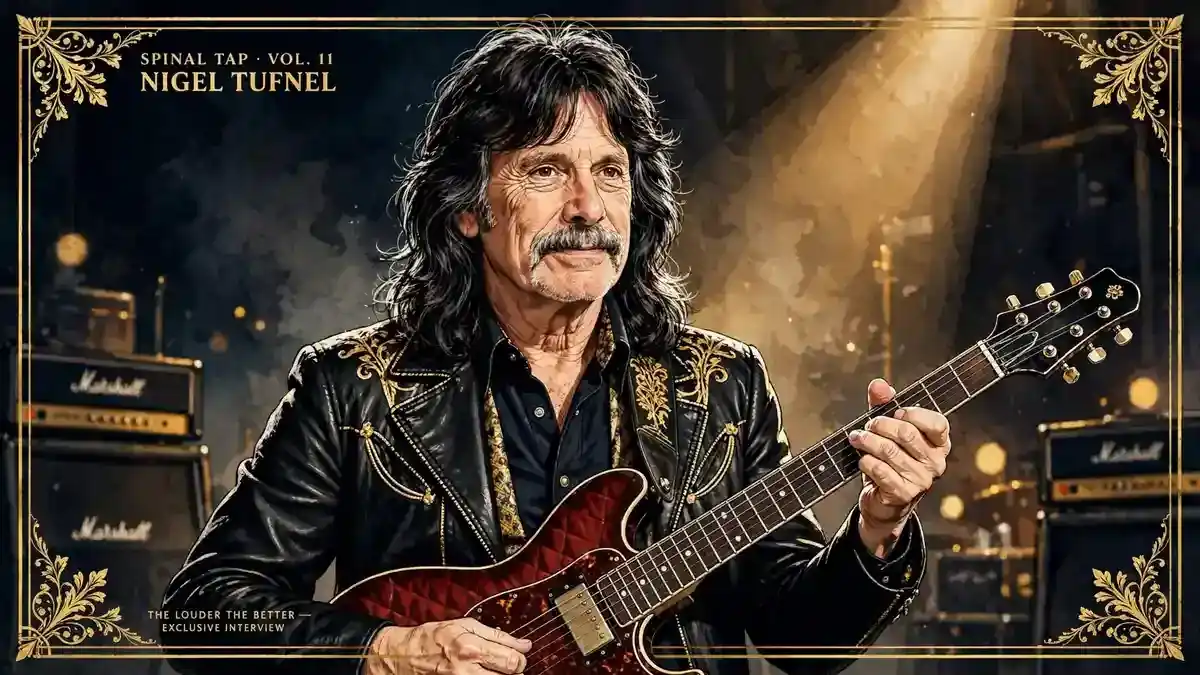
Fame arrived in two waves, six years apart, and both of them came from the same character. The first was This Is Spinal Tap (1984), directed by Rob Reiner and co-written by Reiner, Guest, McKean and Shearer. Guest played Nigel Tufnel, the lead guitarist whose solos, guitar collection and deadpan pronouncements — the amplifier that “goes to eleven” is his line — turned a low-budget satire into a cultural landmark. The film was not a box-office hit on release; it became one slowly, through home video, cable and word of mouth, until the joke band had real albums, real tours and a real place in rock history. Guest’s musical authenticity was the reason it worked: Tufnel plays like a real guitarist because Guest is one.
The same year, Guest joined Saturday Night Live as a writer and cast member for the 1984–85 season, hired alongside Martin Short, Billy Crystal and Harry Shearer in a one-year-only cast rebuild. His recurring characters included Frankie, one half of a pair of co-workers who recount physically painful mishaps in flat detail (“I hate when that happens”); Herb Minkman, a novelty toymaker; Rajeev Vindaloo; and Señor Cosa, a Spanish ventriloquist. He lasted one season, as the whole cast did, but the year put him in front of a national audience weekly and fixed his face in the public mind as a comic actor rather than a bit player.
The second wave was The Princess Bride (1987), in which Guest played Count Tyrone Rugen, the six-fingered villain. The film’s afterlife on home video made Rugen one of the most quoted villains of the decade, and it gave Guest a second signature role that had nothing to do with comedy. A viewer who had never seen Spinal Tap still knew his face from The Princess Bride, and a viewer who had never seen either knew him from A Few Good Men or from the dog-show mockumentary that came next.
The fame that stuck, though, came from directing. Waiting for Guffman (1996) opened in only a handful of theatres and earned $2.9 million domestically, according to Box Office Mojo — small numbers that hide its real effect. Critics and other comedians treated it as a new template: a film with no script, only character backgrounds and scene outlines, shot like a documentary, with actors improvising every line. Best in Show (2000) proved the template could pay, grossing $20.8 million worldwide on a $10 million budget, per Wikipedia’s reporting of the studio figures, with $18.7 million of that coming from North America. A Mighty Wind (2003) followed with $18.75 million worldwide. By then Guest was no longer just an actor with a cult film behind him; he was the director of a recognised body of work, with a repertory company — Eugene Levy, Catherine O’Hara, Michael McKean, Parker Posey, Jane Lynch, Jennifer Coolidge, Fred Willard, John Michael Higgins — that audiences followed from film to film the way they once followed a theatre troupe.
Main Sources of Income
Guest’s money comes from five streams, and the balance between them is unusual for a film star. Most actors of his generation earn the bulk of their wealth from a few large paydays — a franchise, a long-running series, a studio deal. Guest never had one. His wealth was assembled slowly, from fees on dozens of small and mid-size jobs, profit shares on films he part-owned creatively, music royalties, and a real-estate position built with his wife over 35 years. That is why the headline number is so hard to pin down: there is no single contract or franchise cheque to point at, only a long accumulation.
Acting fees. Guest has more than 60 screen credits as an actor, from uncredited parts in the 1970s to supporting roles in studio films in the 2000s. His best-paid acting work was almost certainly the studio supporting roles — A Few Good Men (1992), Mrs. Henderson Presents (2005), Night at the Museum: Battle of the Smithsonian (2009) — where a recognised character actor commands a solid six-figure fee for a few weeks’ work. His own films paid less upfront by design: the cast of his improvised films traditionally receives the same fee and the same share of profits, a point Wikipedia records from Guest’s own accounts of the method. He traded a large personal fee for creative control and a profit share.
Directing and writing fees. As writer-director of five features and a television series, Guest earned Writers Guild and Directors Guild scale fees plus backend participation on each project. Best in Show and A Mighty Wind were the commercial peaks of that run, and their profits — modest by studio standards, real by independent-film standards — flowed back to the filmmakers over years through home video, cable licensing and streaming deals. Family Tree (2013), which he co-wrote, produced and directed for HBO and the BBC, added a prestige-television fee on top of the film work.
Spinal Tap royalties and the catalogue. The Spinal Tap catalogue — the 1984 film, the albums This Is Spinal Tap (1984), Break Like the Wind (1992) and Back from the Dead (2009), the 1992 concert film The Return of Spinal Tap and the 2009 live film Unwigged & Unplugged — has earned money for four decades. For most of that time, according to the creators’ own lawsuit filings, almost none of it reached them: by 2013 they said they had received a total of $179 in royalties. The 2020 settlement with Vivendi and StudioCanal, and the creation of Authorized Spinal Tap LLC in 2021, changed that — the creators now control the trademarks, characters and future licensing directly. Spinal Tap II (2025) was the first project released under that new arrangement, and while its theatrical run was small — about $3.3 million worldwide on a $22.6 million budget, per Box Office Mojo — the streaming, home-video and licensing tail now belongs to the creators rather than to a studio accountant.
Music. Guest is a working musician, not a hobbyist. With childhood friend David Nichtern and Spinal Tap keyboardist C. J. Vanston he formed The Beyman Bros, whose debut album Memories of Summer as a Child was released in January 2009. The folk songs of A Mighty Wind — including the Grammy-winning title song — generate publishing and performance royalties, and Spinal Tap’s albums continue to sell and stream. Music is the smallest of his income streams, but it is the one that runs most steadily, because songs earn every time they are played.
Household wealth with Jamie Lee Curtis. The largest single fact in Guest’s financial picture is his marriage. Curtis has had her own long, well-paid career — the Halloween franchise, True Lies, Freaky Friday, an Academy Award for Everything Everywhere All at Once — plus a successful run of children’s books and brand endorsements. The couple’s shared assets, including the Santa Monica property, are the reason Celebrity Net Worth and Parade report the $60 million figure as a combined one. Any honest account of Guest’s wealth has to say so plainly: the number most people quote is a household number, not a solo one.
What Guest does not have is equally telling. There are no reported endorsement deals, no fashion or fragrance line, no restaurant chain, no production-company sale and no venture-capital portfolio in his name. He has never sold a company, never fronted a brand campaign, and never turned his fame into a consumer product. The fortune, such as it is, is a working actor-director’s fortune: fees, shares, royalties and property, accumulated over 55 years.

Salary and Earnings
No public record states what Christopher Guest was paid for any single role, and this article will not invent one. Unlike franchise stars, whose salaries leak through trade reporting on nine-figure deals, Guest’s contracts were mid-size, private, and spread across five decades of independent and studio work. What can be said with evidence is how his pay was structured, and where the big cheques — and the missing ones — actually were.
The defining feature of his pay is the equal-share model on his own films. Everyone who appears in a Guest mockumentary receives the same fee and the same portion of profits, according to the production accounts summarised by Wikipedia. That is a deliberate choice, and it caps his own upfront earnings on the films he directs: he does not pay himself a star salary while paying his cast scale. The upside is the backend. When Best in Show grossed $20.8 million worldwide against a $10 million budget, the profit participants — Guest among them — shared in a real return. When Waiting for Guffman earned $2.9 million domestically on a tiny release, the return was smaller, but the model was the same.
The studio acting roles paid differently. A supporting part in a 1990s studio film such as A Few Good Men typically paid an established character actor a fee in the low-to-mid six figures for a few weeks of shooting, and a 2000s studio sequel such as Night at the Museum: Battle of the Smithsonian would have paid more. These are industry norms rather than reported figures for Guest specifically, and they are labelled as such here: the trade press never published his per-film salary, so any site that prints one is guessing. What the record does show is volume — more than 60 credits — and longevity, which is how a character actor’s wealth is actually built: many solid fees, no single windfall.
One number that is public, and often misread, is the $2.5 million attached to his 2010 Super Bowl commercial for the United States Census Bureau. That was the reported cost of the advertising slot, not Guest’s directing fee — the Census Bureau paid $2.5 million to have the commercial shown during Super Bowl XLIV, with Guest directing it. It is still a useful data point: a director hired for a Super Bowl spot is being paid at the top of the commercial-directing market, even though the fee itself was never disclosed.
The largest sum ever attached to Guest’s name is not a salary at all. It is the $400 million in damages that he, Rob Reiner, Michael McKean and Harry Shearer sought in their lawsuit against Vivendi, StudioCanal and Universal Music Group, filed after Shearer’s initial 2016 suit. The creators alleged fraudulent accounting had hidden the profits of This Is Spinal Tap across home video, music and merchandising, leaving them with $179 in royalties by 2013. The case settled — with Universal Music Group in 2019 and with Vivendi and StudioCanal in 2020 — on undisclosed terms, and the creators formed Authorized Spinal Tap LLC in 2021 to control the property themselves. The settlement figure was never made public, so it cannot be counted in a net-worth estimate; what it did, financially, was convert a dead asset into a live one. Every future Spinal Tap licence, reissue and stream now pays the people who made it.
Spinal Tap II: The End Continues, released on September 12, 2025, is the first test of that new arrangement. The film cost a reported $22.6 million and grossed about $3.3 million worldwide, with $1.6 million of that on its opening weekend in 1,920 theatres, per Box Office Mojo and The Numbers. By December 2025, Forbes reported it among the most-streamed films on HBO Max — a reminder that a theatrical flop and a financial write-off are not the same thing for a film whose owners now control the streaming and licensing tail themselves. Guest co-wrote the film with Reiner, McKean and Shearer and returned as Nigel Tufnel, running a cheese and guitar shop in Berwick-upon-Tweed, nine years after he had said he was done with film acting.
Businesses and Investments
Guest has no public record of founding or selling a company, and no reported venture investments. That absence is itself a finding: where many celebrities of his generation built side businesses — tequila brands, production companies sold to studios, restaurant groups — Guest’s business life has stayed inside the work. His commercial entities are creative ones: the films themselves, the Spinal Tap catalogue, and the music.
The closest thing to a business asset is Authorized Spinal Tap LLC, formed in 2021 by Guest, Reiner, McKean and Shearer after their settlement with Vivendi and StudioCanal. The company holds the trademarks, characters and licensing rights to Spinal Tap, which means the four creators — rather than a French media conglomerate — now decide how the band is used, licensed and revived. It is a rights-holding vehicle, not an operating business, and it has no published valuation. Its value lies in control: the 2025 sequel, the reissues, the merchandise and any future use of the characters all flow through a company the creators own.
The Beyman Bros, his band with David Nichtern and C. J. Vanston, is a creative partnership rather than a commercial enterprise, but it is a real one: the group released Memories of Summer as a Child in 2009 and performs live. Music publishing — the songs from A Mighty Wind, the Spinal Tap albums — is the steadiest royalty stream in Guest’s portfolio, because a song earns every time it is streamed, broadcast or licensed, long after the film that introduced it has left theatres.
His most conventional investment is property, covered in detail below: a Santa Monica compound assembled across two purchases, in 1989 and 2016, now estimated at $10–12 million. Alongside it, the couple co-founded the Syzygy Foundation, a non-profit focused on environmental causes and children’s health — a philanthropic vehicle rather than an investment, but a real part of how the household deploys its money. Guest also sits on the board of trustees of Berklee College of Music, which awarded him an honorary doctorate.
The honest summary is that Guest’s wealth is not diversified in the modern celebrity sense. There is no portfolio of startups, no brand equity, no real-estate empire beyond the family home. The money sits in three places: the work itself, the rights to the work, and the house. For a man who has spent his career satirising people who chase status and money, that is a fitting shape for a fortune — and it is also why the estimate carries such a wide range.
Brand Deals and Sponsorships
There are no reported brand deals or sponsorships in Christopher Guest’s name. He has never fronted an advertising campaign as a celebrity endorser, never lent his face to a product line, and never appeared in the kind of paid social-media promotion that now funds many actors of his generation. The closest he has come to commercial work is behind the camera: directing the 2010 United States Census Bureau commercial that aired during Super Bowl XLIV. That was a directing job, not an endorsement — the Census Bureau hired a filmmaker, not a spokesman.
The absence is consistent with everything else about his public life. Guest gives few interviews, keeps no public social media presence, and has built his career on disappearing into characters rather than selling his own personality. A brand deal requires the opposite: a recognisable, promotable self. Guest’s most famous creation, Nigel Tufnel, is promotable — the character has sold guitars, T-shirts and albums — but the man behind him has never been for sale in that way.
The contrast with his wife’s career is instructive here, because it explains part of the household figure. Jamie Lee Curtis has had endorsement and commercial work across her career, including a long-running series of children’s books and brand partnerships that Parade cites as part of the couple’s wealth. Those are her earnings, folded into the combined $60 million figure. Guest’s own contribution to the household total comes from the films, the music and the property — not from sponsorships.
Houses, Cars and Other Assets
The one hard asset in Guest’s financial picture that can be priced with confidence is the Santa Monica property he shares with Jamie Lee Curtis. In 1989 the couple paid $1.683 million for a Spanish Colonial revival home in Santa Monica, California. In 2016 they bought the house next door for $2.2 million, joining the two lots into a single compound. Celebrity Net Worth estimates the combined property is now likely worth $10–12 million, and Parade reports the same $10–12 million range. That is a paper gain of roughly $7–8 million on a combined purchase price of about $3.9 million — the single largest capital gain in Guest’s financial life, and one that has nothing to do with show business.
The house entered the news again in January 2025, when the Palisades fire forced the couple to evacuate their home. As of Celebrity Net Worth’s last update, it was unclear whether the property had been damaged. The episode is a reminder that a large share of the couple’s reported wealth sits in a single physical asset in a fire-prone part of Los Angeles — a concentration of risk that no diversified portfolio would carry, and a fact that belongs in any honest estimate of the fortune.
Beyond the Santa Monica compound, there are no public records of other Guest properties. No second home, no ranch, no overseas flat appears in property reporting or in the coverage of the couple’s life. Cars are equally undocumented: Guest has never been photographed with a notable collection, never discussed vehicles in interviews, and no outlet has reported a car purchase. The famous guitar collection belongs to Nigel Tufnel, not to Christopher Guest — though Guest is a genuine guitarist and owns instruments, no inventory or valuation of them has ever been published, and this article will not invent one.
The other assets are intangible: the Spinal Tap rights held through Authorized Spinal Tap LLC, the music publishing from A Mighty Wind and the Spinal Tap albums, and the residuals from a 55-year screen career. None of these carries a published valuation, which is precisely why the net-worth range in this article is so wide. A fortune built on a house, a catalogue and a career is real, but it resists a single tidy number.
Awards and Achievements
Guest’s awards shelf is small for a career of his length, and that is part of the story: his films were never awards-season players, and his best work was often recognised years after release. The honours he does hold are specific and telling — a Grammy for a song, an Emmy for writing, and a set of nominations from the writers’ and critics’ bodies that judge craft rather than box office.
The Grammy came in 2004, when “A Mighty Wind” — the title song of his 2003 folk mockumentary, written with Eugene Levy — won Best Song Written for a Motion Picture, Television or Other Visual Media. He was nominated for a second Grammy in 2010, for Best Comedy Album, for Spinal Tap’s Back from the Dead. The Emmy came earlier: in 1976, Guest and his fellow writers on The Lily Tomlin Special won the Primetime Emmy for Outstanding Writing in a Comedy-Variety or Music Special. In 2001 he earned a Writers Guild of America nomination for Best Screenplay Written Directly for the Screen for Best in Show.
The Independent Spirit Awards nominated him three times — Best Male Lead for Waiting for Guffman, Best Director for Best in Show, and Best Screenplay for A Mighty Wind — without a win. A Mighty Wind also brought him a Comedy Film Honor for Best Director at the 2004 US Comedy Arts Festival, a Broadcast Film Critics Association Award for Best Song, and a Seattle Film Critics Award for Best Music. Waiting for Guffman earned him a Lone Star Film & Television Award for Best Director in 1998. His ensemble work was recognised with a National Board of Review Award for Best Acting by an Ensemble for Mrs. Henderson Presents (2005) and a DVD Exclusive Award for Best DVD Audio Commentary for This Is Spinal Tap (2001).
Two honours sit outside film and television. Berklee College of Music awarded Guest an honorary doctorate and a seat on its board of trustees — recognition of the musician inside the comedian. And the peerage itself, the 5th Barony of Haden-Guest, is a form of recognition that no other working Hollywood director holds: Guest is, as far as the record shows, the only hereditary peer to have directed a Hollywood studio film, written a Grammy-winning song, and played a heavy-metal guitarist on a world tour.
The achievement that matters most to his wealth, though, is not on the shelf. It is the survival of the catalogue: a 1984 film that flopped on release and became a classic, a set of mockumentaries that defined a genre, and a 2025 sequel that brought the band back 41 years later. The lawsuit that reclaimed the Spinal Tap rights may end up being the most valuable professional act of Guest’s career — worth more, in the long run, than any single award.
Net Worth Growth Over the Years
The table below is an estimate built from the published record, not a bank statement. Early figures are thin — Guest was a working character actor for two decades before anyone published a net-worth figure for him — and the jump in the 2020s reflects the combined household reporting and the Santa Monica property appreciation more than any single payday. Read it as a shape, not a ledger.
| Period | Estimated net worth | What drove it |
|---|---|---|
| 1970s | Under $1 million | Stage work, National Lampoon, small film parts; a working actor’s wages |
| 1984–1989 | $1–3 million | This Is Spinal Tap, Saturday Night Live, The Princess Bride; Santa Monica home bought for $1.683 million in 1989 |
| 1990s | $3–8 million | Studio supporting roles (A Few Good Men); first films as writer-director; marriage to Curtis in 1984 pooling household assets |
| 2000–2010 | $8–20 million | Best in Show ($20.8M worldwide) and A Mighty Wind ($18.75M worldwide); Grammy win; Beyman Bros album; Super Bowl commercial |
| 2010–2020 | $15–40 million | Second Santa Monica purchase ($2.2M, 2016); Family Tree; property appreciation; Spinal Tap settlement (2020, terms undisclosed) |
| 2021–2026 | $15–60 million | Authorized Spinal Tap LLC takes control of the catalogue; Spinal Tap II (2025); combined household figure of $60 million now the standard citation |
Two things stand out in that shape. First, the growth is slow and steady until the property market does the heavy lifting — the Santa Monica compound’s rise from $3.9 million of purchase prices to a $10–12 million valuation accounts for a large share of the increase. Second, the range widens rather than narrows over time, because the sources disagree more as the numbers get bigger. Older standalone listings put Guest at $15 million; the current combined citations put the household at $60 million. Both can be true at once if the first counts Guest alone and the second counts the couple — and that is the most likely explanation for the gap.
How does Guest compare with the comedy peers he actually worked beside? The comparison is instructive, but it needs a warning: peer net-worth figures come from the same estimation outlets, with the same flaws. Jamie Lee Curtis, his wife, is listed at the same $60 million combined figure — the same household, counted twice. Martin Short, his 1984–85 Saturday Night Live castmate, built his fortune on a longer television career and a Broadway run. Adam Sandler and Jim Carrey — the generation of film comedians who followed Guest — earned their fortunes from studio-leading-man paydays and, in Sandler’s case, a Netflix deal worth hundreds of millions: a scale of money Guest never pursued, because he never took the leading-man path. Guest’s career is the control case: what a comedy fortune looks like when the artist keeps creative control, shares the profits equally, and never sells out the catalogue. It is smaller, and it is his.
Social Media Presence
Christopher Guest keeps no public personal social media presence. He runs no verified personal account on Instagram, X or Facebook, and he does not promote his work through social channels. That is not an oversight; it is consistent with a public life built on privacy. Guest gives few interviews, rarely appears on talk shows, and has spent four decades letting characters do the talking while he stays out of frame.
The absence has a financial dimension. A working actor with Guest’s recognition could monetise a social following — sponsored posts, announcements, direct fan engagement — but he has chosen not to, and the choice costs him a revenue stream that many of his peers now treat as standard. It also shapes how news about him travels: the announcement of Spinal Tap II, the lawsuit settlement and the 2025 reunion were all reported by the trade press and the studios, not by Guest himself.
Fans looking for him online will find fan accounts, Spinal Tap pages and clips — none of them run by Guest. The official channels for his work are the studios and distributors: Bleecker Street for Spinal Tap II, Warner Bros. for Best in Show and A Mighty Wind, Netflix for Mascots. If an account claims to be Christopher Guest selling something, it is not him.
Personal Life
Guest married actress Jamie Lee Curtis on December 18, 1984, at the home of their mutual friend Rob Reiner — the director who had just made This Is Spinal Tap with him. The wedding was small and private, and the marriage has stayed that way for 41 years, a rarity in Hollywood by any measure. The couple adopted two daughters: Annie, born in December 1986, and Ruby, born in March 1996. Ruby is transgender; in July 2021 Curtis told AARP that she and Christopher had “watched in wonder and pride as our son became our daughter Ruby,” and that she would officiate Ruby’s wedding.
The family detail has a legal footnote that belongs in a biography of a hereditary peer: because Annie and Ruby are adopted, they are not eligible to inherit the barony, so Guest’s younger brother Nicholas is the heir presumptive. His half-brother Anthony is ineligible because his parents were not yet married when he was born. Guest inherited the title himself in 1996, on his father’s death, and sat in the House of Lords until the 1999 reforms removed hereditary peers.
Guest and Curtis co-founded the Syzygy Foundation, a non-profit focused on environmental causes and children’s health. He serves on the board of trustees of Berklee College of Music. The couple’s home life centres on the Santa Monica compound they have owned since 1989, and on a shared low profile: two of the most recognisable faces in American film, living for decades in the same house, largely out of the tabloids.
December 2025 brought a sad coda to one of Guest’s oldest friendships. Rob Reiner, who directed This Is Spinal Tap and Spinal Tap II and hosted Guest’s wedding, died on December 14, 2025, with his wife Michele. Spinal Tap II, released three months earlier, was Reiner’s final film. Guest has made no public statement about the loss in the reporting reviewed for this article — in keeping with a lifetime of keeping grief, like everything else personal, out of the press.
Sources & Reporting
Every figure in this article traces to a named source. Celebrity Net Worth supplies the headline $60 million figure, explicitly described as combined with Jamie Lee Curtis, plus the Santa Monica purchase prices ($1.683 million in 1989, $2.2 million in 2016), the $10–12 million current valuation, the $179 royalties claim, the $400 million damages sought, and the settlement timeline. Parade independently confirms the $60 million combined figure and the $10–12 million home valuation in its 2025 profile of the couple. Wikipedia provides the biographical spine — birth date, family, education, filmography, the equal-pay model on Guest’s films, the House of Lords dates, the 2010 Census Bureau commercial, and the Spinal Tap II production details — cross-checked against Britannica, whose Christopher Guest entry was last updated in September 2026. Box Office Mojo supplies the theatrical grosses: Waiting for Guffman ($2.9 million domestic), Best in Show ($18.7 million domestic), A Mighty Wind ($17.8 million domestic, $18.75 million worldwide) and Spinal Tap II (about $3.3 million worldwide on a $22.6 million budget). The Numbers corroborates the Spinal Tap II opening weekend ($1.6 million) and budget figures. IMDb lists Guest’s height at 5 feet 11 inches. SlashFilm covered the sequel’s theatrical performance in September 2025. Lower standalone estimates ($15 million from NetWorthList, about $20 million from smaller outlets) are cited as evidence of disagreement, not as facts. Reporting window: sources consulted November 2026; figures reflect the record as of the Spinal Tap II release and its aftermath.
Frequently Asked Questions
What is Christopher Guest’s net worth?
Christopher Guest’s net worth is estimated at $60 million as of November 2026, according to Celebrity Net Worth and Parade. That figure is a combined household figure shared with his wife, Jamie Lee Curtis. Standalone estimates for Guest alone run lower, from about $15 million to $20 million, so we report a range of $15 million to $60 million.
Is Christopher Guest’s net worth combined with Jamie Lee Curtis?
Yes. Celebrity Net Worth states plainly that its $60 million figure for Guest is a combined net worth with his wife of several decades, Jamie Lee Curtis. Parade reports the same. The couple’s shared assets include their Santa Monica home, valued at $10–12 million. Any site that quotes $60 million for Guest alone without mentioning Curtis is repeating the combined figure out of context.
How old is Christopher Guest?
Christopher Guest was born on February 5, 1948, in New York City, which makes him 78 years old as of November 2026. He has been working in film, television and theatre since 1971 — a career spanning 55 years.
Is Christopher Guest really a lord?
Yes. Guest is Christopher Haden-Guest, 5th Baron Haden-Guest, a hereditary British peerage he inherited when his father died in 1996. He sat in the House of Lords from 1996 until the House of Lords Act of 1999 removed most hereditary peers. The title carries no salary. Because his two daughters are adopted, they cannot inherit the barony; his younger brother Nicholas is the heir presumptive.
Who is Christopher Guest married to?
Guest has been married to actress Jamie Lee Curtis since December 18, 1984. They wed at the home of their mutual friend Rob Reiner, the director of This Is Spinal Tap. The couple adopted two daughters, Annie (born December 1986) and Ruby (born March 1996), and co-founded the Syzygy Foundation.
What is Christopher Guest most famous for?
Guest is best known as Nigel Tufnel, the lead guitarist in This Is Spinal Tap (1984), and as the writer-director of the improvised mockumentaries Waiting for Guffman (1996), Best in Show (2000) and A Mighty Wind (2003). He is also widely recognised as Count Rugen, the six-fingered villain in The Princess Bride (1987), and as a cast member of Saturday Night Live in the 1984–85 season.
How tall is Christopher Guest?
Christopher Guest is 5 feet 11 inches tall (1.80 m), according to IMDb. He is slightly above average height for an American man of his generation.
Why did Christopher Guest sue over Spinal Tap?
In 2016, Harry Shearer sued Vivendi and StudioCanal, alleging fraudulent accounting had hidden the profits of This Is Spinal Tap; Guest, Rob Reiner and Michael McKean joined the suit in 2017. The creators said they had received just $179 in total royalties by 2013 and sought up to $400 million in damages. The case settled in 2019–2020 on undisclosed terms, and in 2021 the four creators formed Authorized Spinal Tap LLC, giving them direct control of the film’s trademarks, characters and licensing.
Final Thoughts
Christopher Guest’s fortune is the least flashy $60 million in Hollywood, and the number itself needs the footnote every time it is printed: it is a household figure, shared with Jamie Lee Curtis, and the standalone estimates run from $15 million upward. What Guest actually built, on his own account, is something rarer than a large number — a 55-year career in which he kept creative control, paid his collaborators equally, owned his work, and finally, after a lawsuit, took back the rights to the film that made him famous. The Santa Monica house did as much for the balance sheet as any film did, and the Spinal Tap catalogue may yet do more, now that the creators own it outright. Spinal Tap II flopped in theatres in 2025, but it also proved the band — and the man who plays Nigel Tufnel — could come back after 41 years and still fill a room. For a comedian who made his name mocking people who take themselves too seriously, that is a fitting place to land: a fortune built slowly, a catalogue reclaimed late, and a reputation that never needed a brand deal to survive.
Published on November 22, 2026. Last reviewed November 2026. Found an error? See our corrections policy.