
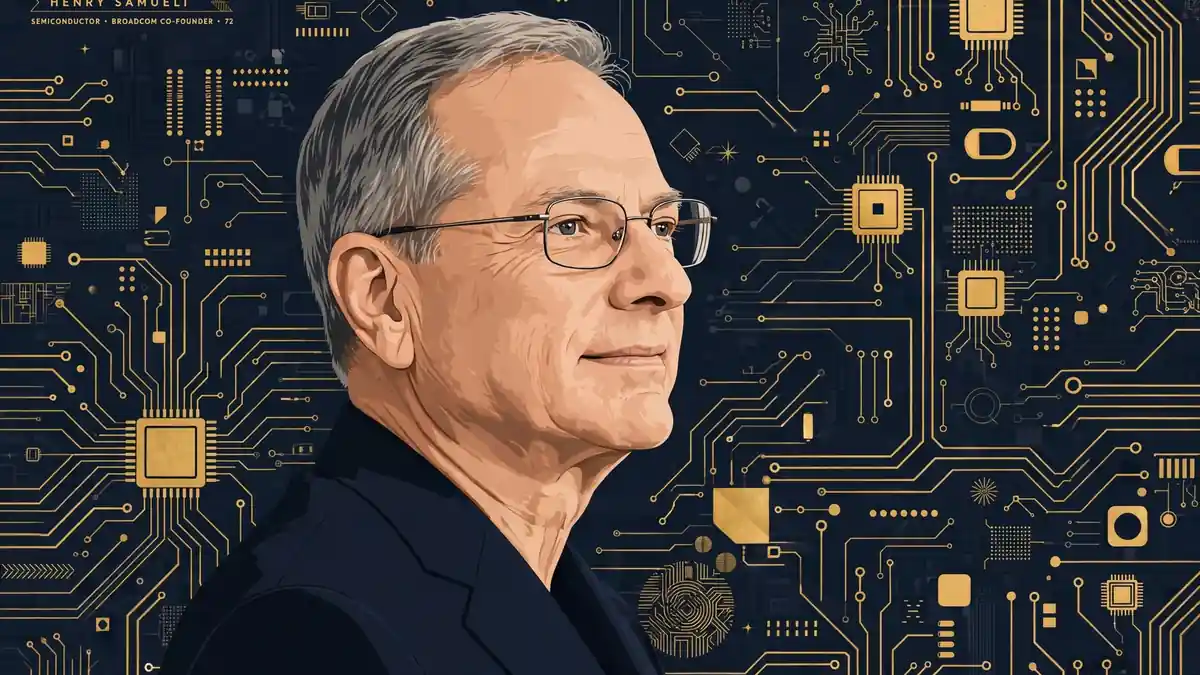
Henry Samueli‘s net worth is estimated at $29 billion to $34 billion as of November 2026. The Broadcom co-founder turned a $5,000 startup investment into one of the largest semiconductor fortunes in America, bought an NHL franchise for about $70 million that is now worth roughly twenty times that, and has already given away more than $1 billion through the Samueli Foundation.
Henry Samueli: Quick Facts
| Estimated net worth | $33.8 billion (Forbes 400, September 2026) (range: $29 billion to $34 billion) |
|---|---|
| Profession | Electrical engineer, Broadcom co-founder, NHL team owner, philanthropist |
| Nationality | American |
| Born | September 20, 1954 (age 72) |
| Height | Not publicly disclosed |
| Primary income sources | Broadcom equity, board compensation, Anaheim Ducks and Honda Center holdings, investments |
| Active years | 1980–present |
| Last reviewed | November 2026 |
- Early Life and Background
- Education
- Career Journey
- Rise to Fame
- Main Sources of Income
- Salary and Earnings
- Businesses and Investments
- Brand Deals and Sponsorships
- Houses, Cars and Other Assets
- Awards and Achievements
- Net Worth Growth Over the Years
- Social Media Presence
- Personal Life
- Sources & Reporting
- Frequently Asked Questions
Early Life and Background
Henry Samueli was born on September 20, 1954, in Buffalo, New York. His parents, Sala and Aron Samueli, were Polish-Jewish survivors of the Holocaust who arrived in the United States with almost nothing. The family moved to Los Angeles, where Henry grew up and worked stocking shelves in the family liquor store. That detail matters more than it first appears: Samueli has described his parents’ experience as the reason his first large gift went to education, and the reason he and his wife later signed the Giving Pledge.
The first sign of the engineer he would become arrived in a middle-school shop class at Bancroft Junior High School. Samueli built an AM/FM radio from a kit — a five-tube Graymark 506B — and the project hooked him on electronics. Decades later, after Broadcom made him a billionaire, he tracked down the same kit on eBay and built it again. He went on to Fairfax High School in Los Angeles, the same school system that produced a long line of the city’s engineers and entertainers, and he applied to UCLA because it had a strong electrical engineering program, affordable tuition, and was close to home.
Samueli’s childhood sits at the center of the Broadcom story in a way most founder biographies do not. He was not a business-school graduate who hired engineers; he was the engineer. His UCLA research into digital signal processing became the technical core of Broadcom, and the patents that came out of that work became the company’s first products. The $5,000 he put into Broadcom in 1991 was not venture money. It was a professor betting his own savings on his own lab work.
His parents’ history also shaped the Samueli Foundation’s priorities. In honor of Sala and Aron, Henry and his wife Susan founded the Sala and Aron Samueli Holocaust Memorial Library at Chapman University. The foundation’s giving concentrates on STEM education, integrative health, youth services, social justice, and Jewish culture — a direct reflection of the family’s own story.
Education
Samueli earned all three of his degrees at the University of California, Los Angeles: a bachelor’s degree in electrical engineering in 1975, a master’s degree in 1976, and a Ph.D. in 1980, all in electrical engineering. He completed the bachelor’s and master’s in back-to-back years, then spent four years on doctoral research in digital communications.
UCLA kept pulling him back. He joined the faculty in 1985 as a professor in the Department of Electrical and Computer Engineering, where he built a research program in broadband communications circuits and digital signal processing. He has been on leave of absence from UCLA since 1995, when Broadcom’s growth demanded his full attention, and he still appears on the department’s faculty roster. Since 2003 he has also served as a distinguished adjunct professor in the Electrical Engineering and Computer Science Department at UC Irvine.
The university repaid the loyalty in kind. In 1999, Samueli and his wife gave UCLA $30 million, and the engineering school was renamed the Henry Samueli School of Engineering and Applied Science. It was his first major gift, and he has said the choice was never in doubt: the school that trained him would be the first to benefit from his fortune. He now chairs the school’s Dean’s Executive Board, guiding capital projects and expansion.
His academic record also includes more than 75 U.S. patents as a named inventor and more than 100 published technical papers. Those numbers are unusual for a billionaire founder. Most chip-company founders hire the inventors; Samueli was one, and the patent record is the paper trail of how Broadcom’s early chips were designed.
Career Journey
Samueli’s first job after his Ph.D. was at TRW Inc. in Redondo Beach, California, where he worked from 1980 to 1985 in engineering and management roles in the Electronics and Technology Division, a military communications defense contractor now part of Northrop Grumman. The work was classified-adjacent defense communications — broadband systems for the military — and it gave him a practical education in building hardware that had to work the first time.
In 1988, before Broadcom, Samueli co-founded PairGain Technologies, a telecommunications equipment maker in the digital subscriber line (DSL) industry, where he served as chief scientist until 1994. PairGain built the equipment that let phone lines carry data, an early step toward the broadband world Broadcom would later dominate. The PairGain years are often skipped in short profiles of Samueli, yet they show the pattern of his career: spot a communications bottleneck, design the chip or the box that removes it, and commercialize it.
The turn came in August 1991. Samueli was still a UCLA professor when he and one of his Ph.D. students, Henry Nicholas III, incorporated Broadcom Corporation. Each man put in $5,000 — $10,000 combined — to rent an office and buy computers and supplies. They started in Nicholas’s Redondo Beach home. Samueli supplied the technical vision; Nicholas ran the business as chief executive. The division of labor held for the life of the original company.
Broadcom’s first work grew directly from Samueli’s university research. His team at UCLA had built proof-of-concept chips showing the key building blocks of high-performance digital modems, and Broadcom’s first major commercial client was Scientific Atlanta, the cable equipment maker. The company developed chips for cable modems, Ethernet networking, set-top boxes, wireless communications, and Bluetooth devices. Within a decade of its founding, Broadcom passed $1 billion in annual revenue, one of the fastest climbs in semiconductor history.
Samueli’s formal roles at Broadcom tell the story of a founder who stayed technical. He was chief technology officer from 1991 to 2008 and again from 2009 to 2016, vice president of research and development from 1991 to 2003, and chairman or co-chairman of the board from 1991 to May 2008 and from May 2011 to January 2016. When Avago Technologies acquired Broadcom Corporation for $37 billion in 2016, the combined company took the Broadcom name. Samueli joined its board in February 2016, served as chief technology officer from February 2016 to December 2018, then became chairman of the board in December 2018. He held the chairmanship until June 2026, when Harry You succeeded him, and he remains a member of the board of directors.
One chapter of that career is rarely told with the ending attached. In 2006, the SEC and the Department of Justice began investigating Broadcom for backdating stock options, and in May 2008 Samueli resigned as chairman and took a leave of absence as chief technology officer after being named in a civil complaint. On June 23, 2008, he pleaded guilty to lying to SEC investigators about his role in the options grants. The plea agreement called for five years’ probation, a $250,000 criminal fine, and a $12 million payment to the U.S. Treasury. The judge, U.S. District Judge Cormac Carney, rejected the plea deal that September because it carried no jail time. Then, in December 2009, after hearing Samueli testify under immunity at the trial of former CFO William Ruehle, Judge Carney dismissed the case against Samueli, ruling that his answer to the SEC had been ambiguous and evasive but was not a material false statement. Days later, Carney dismissed the cases against Nicholas and Ruehle as well, citing prosecutorial misconduct, and dismissed the SEC’s civil complaint against all four executives. Broadcom itself restated $2.2 billion in earnings and settled with the SEC for a $12 million penalty. Samueli later told IEEE Spectrum that the judge “threw everything out,” and the ruling itself stated that the evidence showed Samueli was “a brilliant engineer and a man of incredible integrity” with no evidence he had done anything wrong. The episode cost him two years away from the company he built; it did not cost him his reputation with the court.
Sports entered the picture in 2003, when the company managing the Ducks’ home arena went bankrupt and Anaheim officials asked the Samuelis to take over management of the venue. Henry and Susan formed Anaheim Arena Management and took over the Honda Center. Two years later, in 2005, they bought the Mighty Ducks of Anaheim from the Walt Disney Company for about $70 million — some reports put the price at $75 million — and in 2006 renamed the team the Anaheim Ducks and the arena the Honda Center. In 2007, the Ducks beat the Ottawa Senators to win the Stanley Cup, the first California team ever to win hockey’s championship. Samueli sits on the executive committee of the NHL Board of Governors.
Rise to Fame
Samueli’s rise has two distinct acts, and the second made him far richer than the first. Act one was the 1998 IPO. Broadcom went public in April 1998, and the stock more than doubled on its first day of trading. Samueli became a billionaire almost overnight, and the Samueli Foundation was created the same year. By the early 2000s Broadcom was one of the fastest-growing semiconductor companies in the world, and Samueli’s name was attached to a UCLA engineering school and a growing list of philanthropic gifts.
Act two arrived a quarter-century later, and it was driven by artificial intelligence. Broadcom’s chips — custom AI accelerators built with large cloud customers, plus its networking and infrastructure software — became central to the AI buildout. Forbes reported that Samueli’s fortune more than quadrupled in three years, from an estimated $6.7 billion in 2022 to $27.7 billion in September 2025, a 64% jump in a single year. Broadcom’s share price climbed from $163 in August 2024 to $279 by the end of August 2025, outpacing Nvidia, Qualcomm, and AMD over that stretch, according to Forbes. The company did a 10-for-1 forward stock split on July 12, 2024, and in fiscal 2024 it reported record revenue of $51.6 billion, cash from operations of $20.0 billion, and free cash flow of $19.4 billion.
The Forbes 400 list published in September 2026 put Samueli at No. 31 in the United States with $33.8 billion, and the Forbes list of America’s richest sports owners ranked him third, behind only Steve Ballmer at $156 billion and Rob Walton at $132 billion. Stacker’s November 2026 ranking of California’s richest people, built from Forbes data, listed him fifth in the state at $34.7 billion. Those rankings are snapshots, and the real-time number moves with Broadcom’s stock — trackers following Forbes’ live list showed about $29.4 billion in late November 2026 — which is why this article publishes a range rather than a single figure.
Recognition has followed the technical work, not just the wealth. Samueli was elected to the National Academy of Engineering in 2003. He won the Marconi Prize in 2012 and the IEEE Founders Medal in 2021. In 2025 he received the IEEE Medal of Honor, the organization’s highest distinction, for pioneering research and commercialization of broadband communication and networking technologies and for promoting STEM education. In 2026 he was inducted into the National Inventors Hall of Fame for the broadband work behind U.S. Patent No. 5,754,591, and he was elected to the American Philosophical Society the same year.
What competitors routinely miss is the scale of the second act relative to the first. Most net-worth profiles of Samueli still read as if his wealth peaked with the dot-com era. The numbers say the opposite: roughly four-fifths of his current fortune was created after 2022, by the AI hardware cycle, not by the 1998 IPO. The Ducks, bought for about $70 million, are now worth about $1.4 billion by Forbes’ 2025 valuation — a twenty-fold gain — yet the team is still a small fraction of his wealth. Broadcom stock is the fortune; everything else is a rounding error beside it.
Main Sources of Income
Broadcom equity is the source of nearly all of Samueli’s wealth. He has held a large stake in the company since its founding, through shares held directly and through family investment vehicles. An SEC filing from 2012, when the original Broadcom was still independent, showed him as the beneficial owner of 24,194,609 shares — about 4.5% of the class — held across H&S Investments, HS Management, HS Portfolio, and related partnerships. The share count has changed many times since through sales, gifts, and the 10-for-1 split of 2024, but the structure is the same: a founder’s stake, held for decades, compounding with the company’s market value.
Board compensation is a minor line beside the equity, and it is public because Broadcom files a proxy statement each year. For fiscal 2025, Samueli’s director compensation totaled $536,318 — $273,750 in cash fees and $262,568 in stock awards — for partial-year service as board chair before Harry You took the chair in June 2026. Compare that with Broadcom chief executive Hock Tan, whose total pay reached $205.3 million in fiscal 2025, and the shape of Samueli’s income is plain: he is paid like a director because his wealth is in the stock, not the salary.
The Anaheim Ducks and the Honda Center form the second income stream. Forbes’ 2025 NHL valuations put the Ducks at $1.4 billion, with revenue of $185 million and operating income of $26 million for the 2024–25 season. CNBC’s separate 2025 valuation put the team at $1.61 billion on revenue of $175 million. The team is one part of a larger sports and entertainment holding that includes the San Diego Gulls, the Ducks’ AHL affiliate, and the management of the Honda Center itself, which brings in concert and event revenue beyond hockey. Samueli’s arena company also owns the OCVIBE development around the arena, a $4 billion, 100-acre district whose first phase opened in 2026.
Dividends add a steady cash stream. Broadcom pays a regular dividend on its common stock, and a founder-scale holding generates millions a year in dividend income alone. Samueli has never disclosed his dividend receipts, and no honest profile can put a number on them, but the mechanics are straightforward: the stock pays, and he holds a lot of it.
Philanthropy runs in the opposite direction and is large enough to matter to the net-worth math. The Samuelis have gifted more than $1 billion through the Samueli Foundation, according to the Ducks’ own biography of the couple, and they signed the Giving Pledge in 2012, committing to give away most of their wealth during their lifetimes or through their estates. Any estimate of Samueli’s fortune is therefore net of a decade of major giving — the $200 million UC Irvine gift of 2017 alone was the largest in that university’s history.
There is also a quieter asset: intellectual property. Samueli holds more than 75 U.S. patents, and Broadcom’s early patent portfolio was built on his work. Patent royalties do not show up as a separate line in his wealth — the value sits inside Broadcom’s market capitalization — but the patents are the reason the company could charge for its chips in the first place.
Salary and Earnings
Samueli has never drawn a chief-executive-style salary from Broadcom. His roles were technical — chief technology officer, vice president of research and development — and later, chairman of the board. The proxy statement is the only public record of what Broadcom pays him, and it shows director-level pay: $536,318 in total for fiscal 2025, split between $273,750 in cash fees and $262,568 in stock awards.
That figure needs context. In the same proxy, Broadcom reported fiscal 2024 revenue of $51.6 billion and free cash flow of $19.4 billion, and chief executive Hock Tan’s fiscal 2025 pay totaled $205.3 million, mostly in stock awards. Samueli’s compensation is roughly a quarter of one percent of his chief executive’s. The gap is the point: founders who keep their stock do not need a salary. His earnings, in any year that matters, come from the appreciation of Broadcom shares and from dividends, not from a paycheck.
The 1998 IPO was the first earnings event that changed his life. The stock more than doubled on its first trading day, and the shares Samueli had held since 1991 were suddenly worth hundreds of millions. The 2016 Avago acquisition, valued at $37 billion in cash and stock, was the second: Samueli’s stake converted into shares of the combined company, which then grew through the VMware acquisition and the AI cycle into one of the world’s most valuable chip companies.
What the public record does not show is equally worth stating. Samueli has never disclosed personal stock sales, and Forbes’ estimates are built from public filings and the share price, not from his bank statements. Any article that claims a precise annual income for him is guessing. The honest statement is that his wealth rises and falls with Broadcom’s share price — in 2025, Forbes recorded a 64% one-year gain — and that his cash compensation is small beside it.
Businesses and Investments
Broadcom is the business, and everything else orbits it. Samueli co-founded the original Broadcom Corporation in 1991, served as its chief technology officer for most of its independent life, and stayed on the board of the combined Broadcom Inc. after Avago’s $37 billion acquisition in 2016. He chaired the board from December 2018 to June 2026 and remains a director. His influence inside the company is technical: engineers still describe him as the person who sets the technical direction, and his 2025 IEEE Medal of Honor citation credits the broadband research that made the company possible.
PairGain Technologies, the DSL equipment company he co-founded in 1988, was his first business. He served as its chief scientist until 1994, and the company was an early commercial step toward the broadband infrastructure that Broadcom later supplied with chips. PairGain is a footnote in most profiles; it belongs in this one because it shows Samueli had already built and run a communications company before Broadcom existed.
The sports business is the second pillar. Anaheim Arena Management, the company the Samuelis formed in 2003 to run the Honda Center, controls the arena and the land around it. The Ducks, bought in 2005, are the anchor tenant. The San Diego Gulls, the AHL affiliate, extend the hockey operation down the coast. The newest piece is OCVIBE, the $4 billion, 100-acre entertainment district around the Honda Center, with construction that began in 2023, parking garages opening in October 2025, and a first phase opening in 2026. In April 2025 the Samuelis announced Honda Center Encore, a separate $1 billion privately funded renovation of the arena itself, timed so the building can host indoor volleyball at the 2028 Los Angeles Olympics.
Samueli’s investment activity outside Broadcom and hockey is deliberately quiet. He invests through family vehicles — the H&S partnerships named in SEC filings — and through the Samueli Foundation’s endowment. He does not run a public venture fund, does not appear on startup cap tables in press releases, and does not promote investments. The one public window into his holdings, the 2012 Schedule 13G, shows the structure: direct holdings plus a cluster of limited partnerships controlled through H&S Ventures LLC. That opacity is normal for a founder of his generation, and it is one reason the net-worth range in this article is wide.
Two investments deserve a closer look because they show how he thinks. The first is the Honda Center itself. The Samuelis did not buy a team and rent a building; they took over the building first, in 2003, and bought the team two years later. Owning the venue and the tenant together is what makes the sports business work financially — the arena earns on concerts and events all year, not only on 41 home hockey games. The second is OCVIBE. A $4 billion district around a suburban arena is a real-estate bet as much as a sports bet, and it only makes sense if the Honda Center becomes a year-round destination. The 2028 Olympics give that bet a deadline and a showcase.
Brand Deals and Sponsorships
Samueli has no brand deals, endorsements, or sponsorships in the usual celebrity sense, and a profile that invents them would be wrong. He is not a paid endorser, does not appear in advertising, and has no product lines. His public-facing partnerships are institutional: he chairs the Broadcom Foundation, which sponsored the Broadcom MASTERS middle-school STEM competition for the Society for Science for 12 years, from 2011 through 2022, and he serves on the Dean’s Executive Board at the UCLA Samueli School of Engineering.
The closest thing to a commercial partnership is the Honda Center’s naming and sponsorship ecosystem, which belongs to the arena business rather than to Samueli personally. Honda holds the arena naming rights, and the venue’s corporate partnerships are negotiated by Anaheim Arena Management. The Ducks’ jersey and broadcast sponsors are team revenue, not personal income, and Samueli’s name does not appear on them.
That absence is itself a data point. Tech founders of Samueli’s wealth sometimes lend their names to funds, books, or speaking circuits. Samueli has done none of it. His public appearances are engineering lectures, university events, and the occasional IEEE ceremony. The 2025 IEEE Medal of Honor — the organization’s highest award — came with prize money that he directed toward an endowment for the IEEE Eta Kappa Nu honor society’s annual student-leadership conference, an event he had already been funding directly for three years.

Houses, Cars and Other Assets
Samueli lives with his wife Susan in Newport Beach, California, the Orange County coastal city where Forbes lists his residence. He has never publicized his home, and no credible property record with a purchase price circulates in the press, so this article does not invent one. What is public is the scale of his Orange County footprint through the businesses: the Honda Center, the OCVIBE district, Great Park Ice in Irvine, and the San Diego Gulls.
Great Park Ice deserves a mention because it is an asset that doubles as philanthropy. The Samuelis created the Irvine Ice Foundation in 2019, which built and opened the 280,000-square-foot Great Park Ice complex in Irvine — four ice sheets, including the 2,500-seat FivePoint Arena — as the Ducks’ official practice facility and a public skating and youth hockey center. It is a physical asset on the family’s balance sheet and a community facility at the same time.
Samueli’s car collection, if he has one, is not a matter of public record. Unlike sports-team owners who collect supercars in public, Samueli’s spending that the press can document is philanthropic: university gifts, the ice complex, and the arena district. The honest summary of his assets is short: Broadcom stock first, the Ducks and the Honda Center second, the OCVIBE development third, and a Newport Beach home whose details he keeps private.
One asset class is worth naming because readers ask about it: the Ducks are not just a trophy. Forbes’ 2025 valuation of $1.4 billion, on revenue of $185 million and operating income of $26 million, makes the team a genuine business asset, up roughly twenty-fold from the roughly $70 million purchase price. CNBC’s higher $1.61 billion valuation the same year shows the range in team valuations, but both agree on the direction: the franchise has been one of the best-performing sports investments of the century. The playbook — a tech founder buying a sports team — is one Mark Cuban followed with the Dallas Mavericks, and in both cases the team became a small but fast-growing slice of a much larger fortune.
Awards and Achievements
Samueli’s honors track his two careers — engineering and philanthropy — and the list is long enough to need its own table rather than a paragraph. The National Academy of Engineering elected him in 2003. The Marconi Prize, one of communications engineering’s highest honors, came in 2012. The IEEE Founders Medal followed in 2021, and the IEEE Medal of Honor — the Institute’s highest distinction — arrived in 2025, with a citation for pioneering research and commercialization of broadband communication and networking technologies and for promoting STEM education.
In 2026 he was inducted into the National Inventors Hall of Fame for the broadband work behind U.S. Patent No. 5,754,591, the quadrature amplitude modulation patent that helped make high-speed data over cable television lines practical. The same year he was elected to the American Philosophical Society. He is a Fellow of the IEEE and a Fellow of the American Academy of Arts and Sciences, and he holds honorary doctorates from the Technion-Israel Institute of Technology and National Chiao Tung University in Taiwan.
Broadcom itself won a 2024 Emmy for pioneering technologies enabling high-performance communications over cable TV systems — an award that belongs to the company but rests on Samueli’s early work. The Stanley Cup of 2007 is the sporting honor on the list: the Ducks’ championship made them the first California team to win it, in only the Samuelis’ second season as owners.
The philanthropic honors are quieter and, to Samueli, probably the point. The engineering schools at UCLA and UC Irvine both carry the Samueli name. The Susan & Henry Samueli College of Health Sciences at UC Irvine exists because of a $200 million pledge in 2017, the largest gift in the university’s history. None of those carry a trophy; all of them carry his name on buildings that will outlast him.
Net Worth Growth Over the Years
Samueli’s wealth history is a story of two plateaus and one steep climb. The first plateau ran from the 1998 IPO through the 2010s, when his fortune sat in the low single-digit billions. The second plateau, in the early 2020s, held around $6 billion to $7 billion. Then the AI cycle broke the pattern: Forbes recorded $6.7 billion in 2022, $27.7 billion in September 2025, and $33.8 billion in the Forbes 400 snapshot of September 4, 2026. Real-time trackers showed the figure pulling back to about $29.4 billion by late November 2026 as Broadcom’s share price eased — a reminder that a fortune built on one stock moves with that stock.
| Year | Estimated net worth | Source |
|---|---|---|
| 1998 | Billionaire after Broadcom IPO | Company history; IPO coverage |
| 2017 | About $3.7 billion | Forbes (Ducks valued at $415 million that year) |
| 2022 | $6.7 billion | Forbes |
| 2023 | About $20 billion | Forbes-linked trackers |
| December 2024 | $25.3 billion | Forbes / Bloomberg Billionaires Index |
| September 2025 | $27.7 billion | Forbes 400 / richest sports owners |
| September 2026 | $33.8 billion | Forbes 400 snapshot (September 4, 2026) |
| November 2026 | $29.4 billion | Forbes real-time tracker |
Two forces explain the climb. The first is Broadcom’s share price, which Forbes noted rose from $163 in August 2024 to $279 by the end of August 2025. The second is the company’s transformation: from a chip supplier into a central supplier of custom AI accelerators and networking gear for the largest cloud companies, plus a large infrastructure software business after the VMware acquisition. Samueli’s stake did not change much; the company around it did.
Against his peers, Samueli sits in the second tier of American tech wealth — far behind the sports-owner leaders, and far ahead of his own co-founder:
| Person | Source of wealth | Net worth (Forbes, 2026) |
|---|---|---|
| Steve Ballmer | Microsoft; LA Clippers | $156 billion |
| Rob Walton | Walmart; Denver Broncos | $132 billion |
| Henry Samueli | Broadcom; Anaheim Ducks | $33.8 billion |
| Henry Nicholas III | Broadcom co-founder | $20 billion |
Readers should treat the older numbers with care. Some low-quality net-worth sites still list Samueli at $5.5 billion or $6.5 billion to $7.5 billion — figures that were stale by 2023 and are now wrong by a factor of four or five. Others list $32.5 billion for 2026 without naming a source. The range in this article — $29 billion to $34 billion — comes from Forbes’ own two measurements in 2026: the dated Forbes 400 snapshot and the live real-time list. Where Forbes and Celebrity Net Worth disagree, the gap is small ($33.8 billion against $34 billion); where the real-time list sits lower, the reason is the share price, not a dispute about the assets.
Social Media Presence
Samueli has no public social media presence. He does not run a personal account on X, Instagram, LinkedIn, or any other platform, and he does not post about Broadcom, the Ducks, or his philanthropy. The organizations around him do: Broadcom Inc. posts company news on its corporate channels, the Anaheim Ducks run the team’s accounts, and the Samueli Foundation publishes its grantmaking through its own site. Search results that attach a social profile to Samueli’s name are either fan accounts or misattributed profiles of other people.
The absence fits the rest of his public life. Samueli gives interviews to engineering publications — IEEE Spectrum ran a long profile in 2025 — and speaks at university events, but he does not cultivate a personal brand. For a man worth more than $30 billion, he is one of the least visible billionaires in America, and that is a deliberate choice rather than an oversight.
Personal Life
Samueli is married to Susan Samueli, whom he met in Los Angeles. Susan earned her bachelor’s degree in mathematics from UC Berkeley in 1972. The couple has three children and three grandchildren, and they live in Newport Beach, California. Susan is a full partner in the philanthropy and the sports business: the Ducks and the Honda Center are owned jointly, the Samueli Foundation carries both names, and the UC Irvine health sciences college is the Susan & Henry Samueli College of Health Sciences.
The couple joined the Giving Pledge in 2012, the campaign started by Warren Buffett and Bill and Melinda Gates, committing to give away most of their wealth during their lifetimes or through their estates. They are among the pledge’s quieter signers: the giving is real — more than $1 billion through the foundation — but it arrives without press conferences. Fellow entrepreneur and Giving Pledge signer Oprah Winfrey took the same pledge in 2010, and the two belong to the same small group of founders who decided the fortune was a tool, not a trophy.
Samueli’s private interests are the ones the public record actually shows: engineering, hockey, and education. He still follows Broadcom’s engineering closely, still attends Ducks games, and still chairs the UCLA engineering school’s board. He has described himself as theoretically retired and as busy as ever, a fair summary of a 72-year-old who stepped down as chairman in June 2026 and stayed on the board.
Sources & Reporting
Forbes — Forbes 400 2026 snapshot ($33.8 billion, September 4, 2026), America’s Richest Sports Owners 2025 ($27.7 billion, Ducks valued at $1.3 billion, OCVIBE and Honda Center Encore figures), and the real-time billionaires list (about $29.4 billion, November 2026). Reporting window: September 2025 – November 2026.
Celebrity Net Worth — net worth estimate of $34 billion, Ducks purchase price of about $70 million, PairGain founding, and the $200 million UC Irvine pledge. Reporting window: profile updated 2026.
IEEE Spectrum — 2025 Medal of Honor profile (“Champion of Digital Broadband”): the Graymark radio kit, the $5,000 founding stakes, the options-backdating case and Judge Carney’s dismissal, the $30 million UCLA gift, and the Giving Pledge. Reporting window: May 2025.
Wikipedia — biographical spine: birth date and place, parents’ history, UCLA degrees, TRW and PairGain dates, Broadcom roles and dates, the options investigation timeline, and the Ducks purchase. Cross-checked against UCLA, NHL, and SEC sources below. Reporting window: profile updated October 2026.
UCLA Samueli School of Engineering — board biography: chairman tenure to June 2026, CTO dates, PairGain role, patents and papers, the 1999 naming gift, and the Dean’s Executive Board chair. Reporting window: 2026.
NHL / Anaheim Ducks — official owners’ biography: Honda Center takeover in 2003, Ducks purchase in 2005, 2007 Stanley Cup, San Diego Gulls, OCVIBE ($4 billion, 100 acres), Honda Center Encore ($1 billion), Great Park Ice, and foundation giving of more than $1 billion. Reporting window: 2026.
National Inventors Hall of Fame — 2026 induction fact sheet: patent number, Broadcom founding, the $37 billion Avago acquisition, the Samueli Foundation, and the Giving Pledge. Reporting window: January 2026.
U.S. Securities and Exchange Commission — 2012 Schedule 13G/A showing Samueli’s 24,194,609-share beneficial ownership and the H&S partnership structure; Broadcom’s 2025 proxy statement (DEF 14A) for fiscal 2024 revenue of $51.6 billion and director compensation of $536,318. Reporting window: filings 2012 and 2025.
ABA Journal and EDN — December 2009 reporting on Judge Carney’s dismissal of Samueli’s guilty plea and the prosecutorial-misconduct findings that ended the Broadcom options cases. Reporting window: December 2009.
Frequently Asked Questions
What is Henry Samueli’s net worth in 2026?
Henry Samueli’s net worth is estimated at $29 billion to $34 billion as of November 2026. Forbes put him at $33.8 billion in its Forbes 400 snapshot of September 4, 2026, while Forbes’ real-time list showed about $29.4 billion later in November and Celebrity Net Worth listed $34 billion. The figure moves with Broadcom’s share price, so the range is the honest number.
How did Henry Samueli make his money?
Samueli made his money as co-founder of Broadcom Corporation, the semiconductor company he started in 1991 with Henry Nicholas on $10,000 of combined savings. He supplied the technical vision — cable-modem and broadband chips based on his UCLA research — while Nicholas ran the business. The 1998 IPO made him a billionaire, the $37 billion Avago acquisition in 2016 converted his stake into shares of the combined Broadcom Inc., and the AI hardware boom after 2022 multiplied the fortune roughly five-fold.
How much of Broadcom does Henry Samueli own?
Samueli has never disclosed his current share count. A 2012 SEC filing showed him as beneficial owner of 24,194,609 shares, about 4.5% of the class, held through family partnerships. The count has changed since through sales, gifts, and Broadcom’s 10-for-1 stock split in July 2024. Forbes’ estimates are built from public filings and the share price, not from a disclosed stake.
Does Henry Samueli own the Anaheim Ducks?
Yes. Henry and Susan Samueli bought the Mighty Ducks of Anaheim from the Walt Disney Company in 2005 for about $70 million, renamed the team the Anaheim Ducks in 2006, and won the Stanley Cup in 2007. Forbes valued the franchise at $1.4 billion in 2025, with revenue of $185 million and operating income of $26 million. The Samuelis also manage the Honda Center and own the San Diego Gulls, the Ducks’ AHL affiliate.
What is Henry Samueli’s salary at Broadcom?
Samueli does not draw an executive salary. As a board director, his total compensation for fiscal 2025 was $536,318 — $273,750 in cash fees and $262,568 in stock awards — according to Broadcom’s proxy statement. His wealth comes from his Broadcom shares and dividends, not from pay. Chief executive Hock Tan’s total pay in the same year was $205.3 million.
Is Henry Samueli a billionaire because of the Ducks?
No. The Ducks are worth about $1.4 billion by Forbes’ 2025 valuation, against a fortune of $29 billion to $34 billion. The team is a strong investment — up roughly twenty-fold from its purchase price — but it accounts for only a small share of his wealth. Broadcom stock is the fortune; the Ducks are the most visible part of it.
How much has Henry Samueli donated to charity?
The Samuelis have gifted more than $1 billion through the Samueli Foundation, according to the Ducks’ official biography of the couple. Major gifts include $30 million to UCLA in 1999, which led to the engineering school being named for him, and a $200 million pledge to UC Irvine in 2017 to create the Susan & Henry Samueli College of Health Sciences. They signed the Giving Pledge in 2012, committing to give away most of their wealth.
What happened in the Broadcom stock options case?
In 2006 the SEC and the Justice Department investigated Broadcom for backdating stock options. Samueli resigned as chairman in May 2008 and pleaded guilty that June to lying to SEC investigators. In December 2009, U.S. District Judge Cormac Carney dismissed the case, ruling that Samueli’s answer to the SEC was not a material false statement, and days later dismissed the cases against his co-defendants, citing prosecutorial misconduct. Broadcom restated $2.2 billion in earnings and settled with the SEC for $12 million.
Final Thoughts
Henry Samueli’s fortune is the purest version of the founder’s story in this series: an engineer who solved a hard technical problem, kept his shares for 35 years, and let compounding do the rest. The $5,000 he put into Broadcom in 1991 is now worth, by Forbes’ count, more than $30 billion — and most of that gain arrived after 2022, when the AI boom turned his old broadband chips into the plumbing of the new computing era. The Ducks, the arena, and the $4 billion district around it show the same patience applied to sports and real estate. The philanthropy, more than $1 billion given and most of the rest pledged, shows what he intends to do with it. If there is a single number to remember, it is the range: $29 billion to $34 billion, moving with Broadcom’s share price, anchored on Forbes’ $33.8 billion snapshot of September 2026.
Published on November 22, 2026. Last reviewed November 2026. Found an error? See our corrections policy.